Resourcify’s 10-slide Series A deck is a lean, highly visual argument for the digitization of the waste management industry. By focusing on the friction between companies and a fragmented network of over 20,000 recyclers, the deck positions Resourcify as the essential connective tissue for a €1.8 trillion circular economy. The presentation excels at quantifying the 'mess'—citing 842 waste streams and a 97% offline market—before presenting a clean, all-in-one software solution. While the deck is light on traditional financial tables and team bios, it leans heavily into social proof with a dens…
Key takeaways
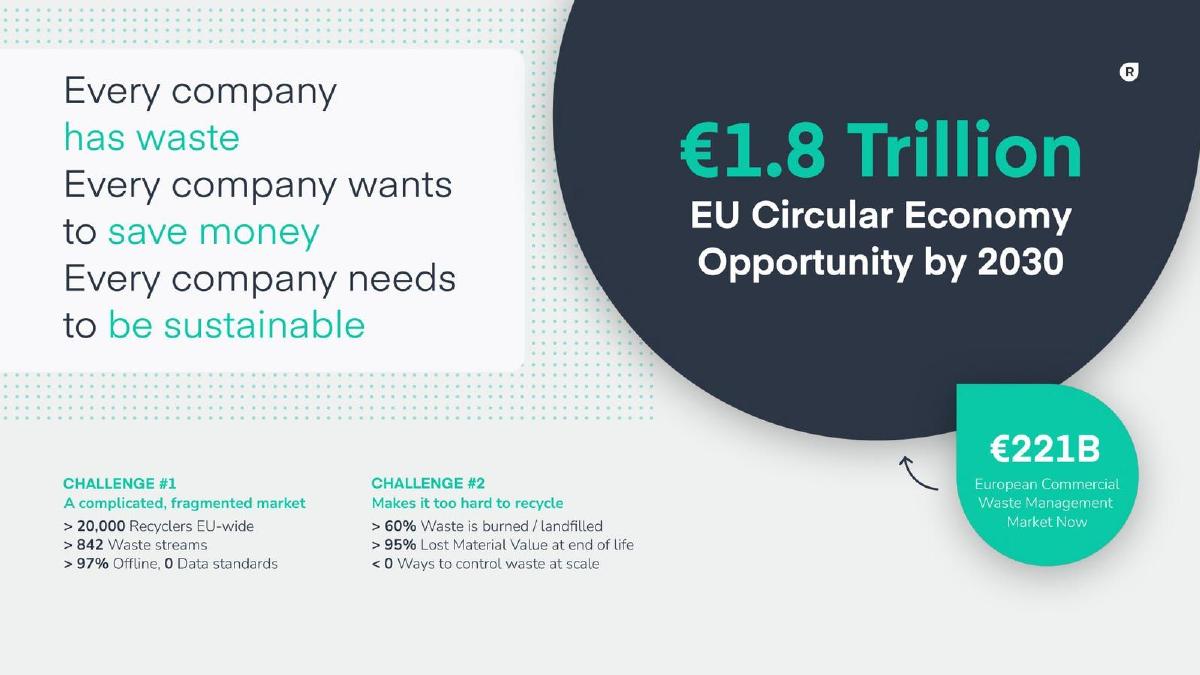
- The deck identifies a massive €1.8 trillion EU circular economy opportunity by 2030, contrasted against a current €221B commercial waste market (Slide 3).
- Resourcify highlights extreme market fragmentation, noting that 97% of the market is currently offline with zero data standards (Slide 3).
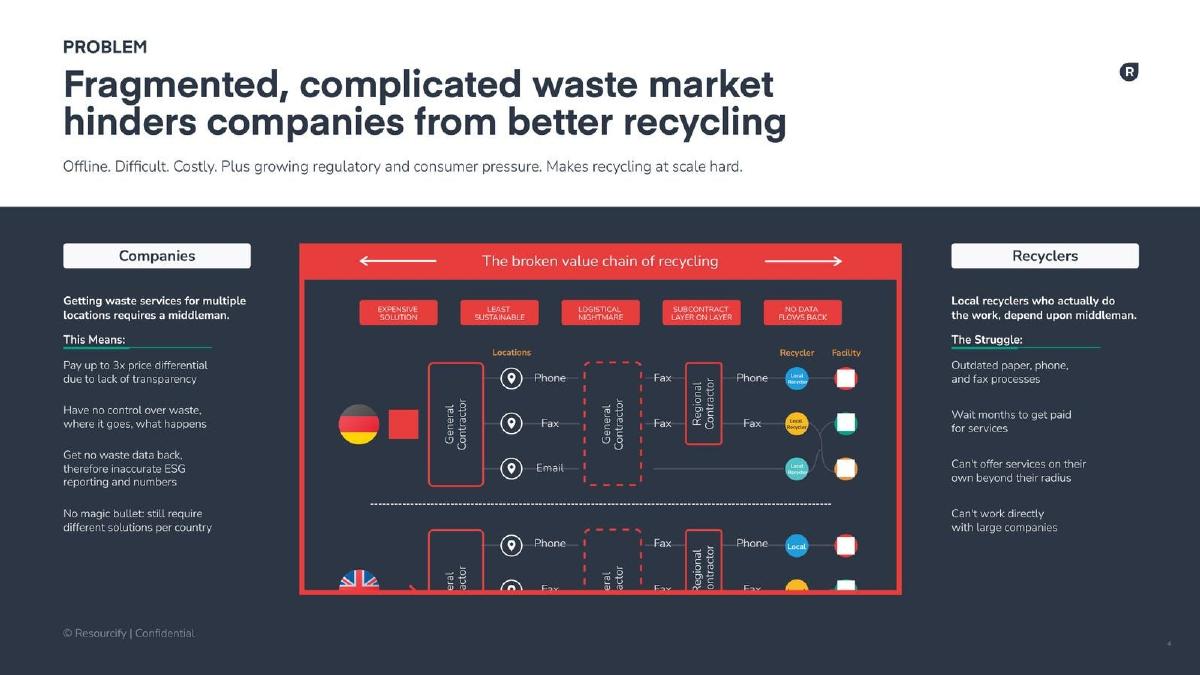
- The 'Broken Value Chain' visualization effectively illustrates the 'logistical nightmare' of using phone, fax, and email across multiple regional contractors (Slide 4).
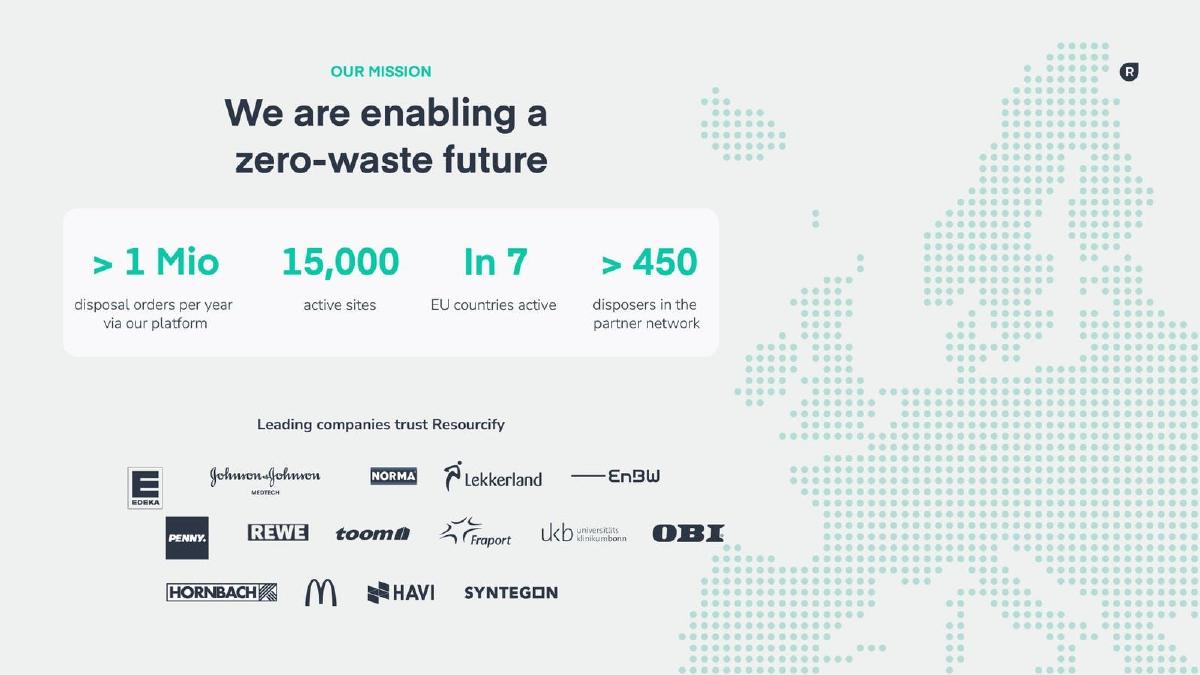
- Enterprise traction is proven through a logo wall featuring major brands like McDonald's, Johnson & Johnson, and Edeka (Slide 2).
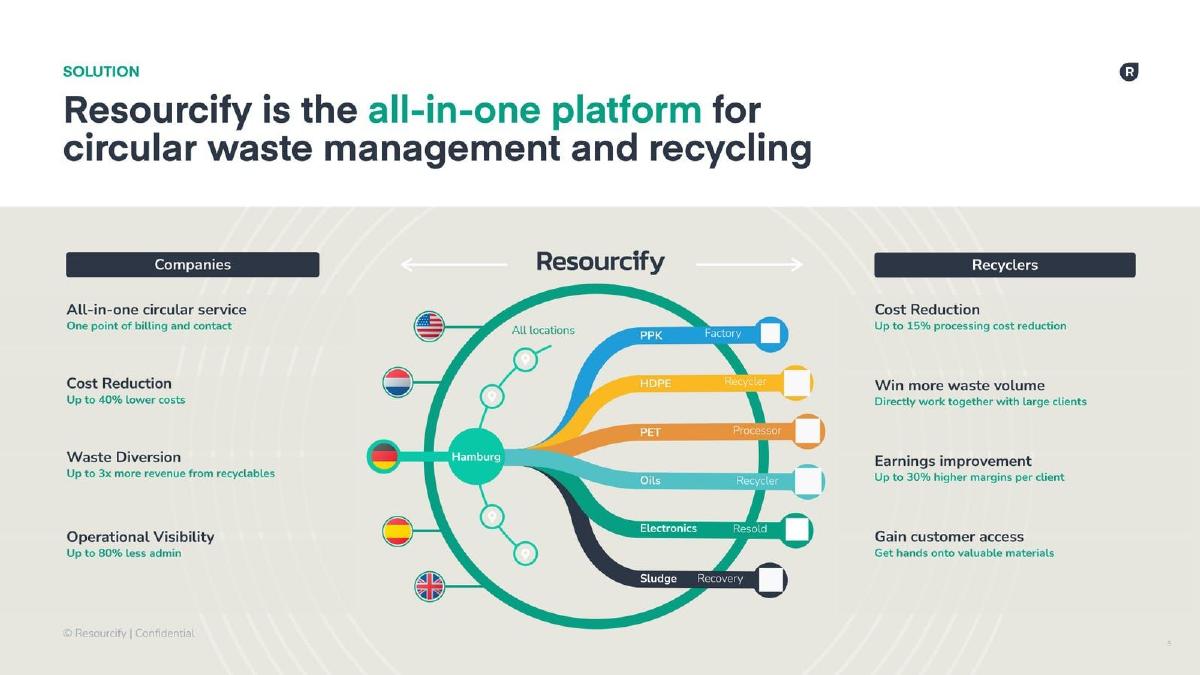
- The platform claims significant operational ROI, including up to 40% lower costs for companies and 30% higher margins for recyclers (Slide 5).
- The Serviceable Addressable Market (SAM) is specifically defined as 30,000 companies spending €50 billion on waste (Slide 7).
- Resourcify positions itself as the only 'all-in-one' solution compared to niche competitors like Rubicon Global or specialized marketplaces (Slide 8).
- The deck omits a dedicated team slide, choosing instead to feature only the CEO/Co-Founder on the final contact page (Slide 10).
Resourcify Series A: The Digital Connective Tissue for Waste
Resourcify’s Series A pitch deck is a masterclass in identifying a 'boring' but massive industry and illustrating exactly why it is ripe for digital disruption. The Hamburg-based startup raised $14.9M in 2024, a year where investors were highly selective, favoring companies with clear enterprise utility and ESG alignment. The deck consists of 10 slides that move rapidly from market chaos to platform order.
Slide 1: Title and Vision
The cover slide is minimalist, establishing the brand identity and the core mission: 'Building the digital champion for circular waste management and recycling.' The imagery—a mix of industrial waste bins, logistics workers, and waste trucks—grounds the software product in the physical reality of the industry. It signals immediately that this is an operational tool, not just a reporting dashboard.
Slide 2: The Traction and Social Proof
Resourcify leads with its strongest foot: scale and credibility. Slide 2 presents four key metrics: over 1 million disposal orders per year, 15,000 active sites, presence in 7 EU countries, and a network of over 450 disposers. The bottom half of the slide is a 'who's who' of European and global enterprise, featuring logos like McDonald's, Johnson & Johnson, Edeka, REWE, and Fraport. For a Series A, this level of enterprise adoption serves as a powerful proxy for product-market fit.
Slide 3: The Macro Opportunity
Slide 3 frames the market through two lenses: the immediate commercial waste market (€221B) and the future circular economy opportunity (€1.8 Trillion by 2030). The slide identifies two specific 'challenges' that prevent the market from reaching its potential. Challenge #1 is fragmentation, citing over 20,000 recyclers and 842 waste streams. Challenge #2 is the inefficiency of current methods, noting that 60% of waste is still burned or landfilled, representing a 95% loss in material value. This slide successfully transforms 'waste' into 'lost capital.'
Slide 4: The Problem Visualization
This is arguably the most important slide in the deck. It visualizes the 'broken value chain.' On the left are companies struggling with high costs (up to 3x price differentials) and a lack of data. On the right are local recyclers who are stuck with 'outdated paper, phone, and fax processes.' In the middle is a red box representing the 'logistical nightmare' of general contractors, regional contractors, and manual communication. By showing the mess of phone icons and fax lines, Resourcify makes the need for a digital platform feel urgent and obvious.
Slide 5: The Solution Architecture
Slide 5 mirrors the problem slide but replaces the red 'chaos' box with a clean, green 'Resourcify' hub. The platform is positioned as the 'all-in-one platform' that connects various waste types (PPK, HDPE, PET, Oils, etc.) to the appropriate processors. The slide lists specific ROI metrics: up to 40% lower costs for companies, 80% less admin work, and 30% higher margins for recyclers. This 'win-win' framing is essential for marketplace-style platforms.
Slide 6: Product Interface and Capabilities
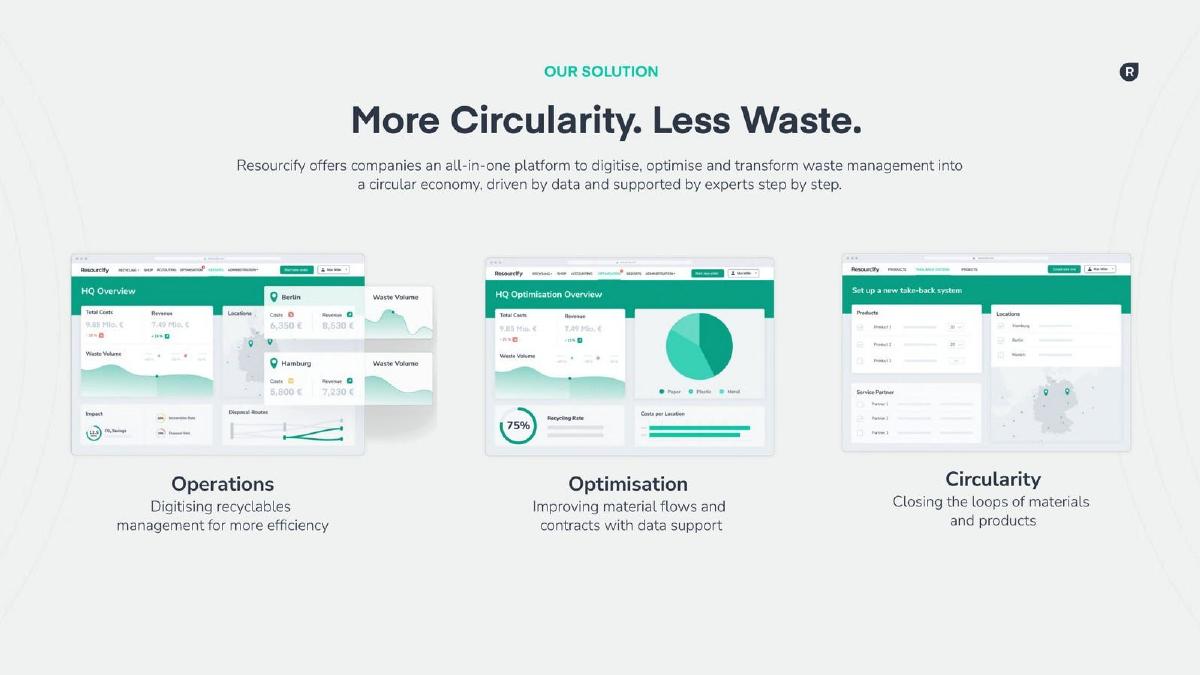
Resourcify provides a glimpse into the software itself, categorized into three functions: Operations (digitizing management), Optimisation (data-driven contract improvement), and Circularity (closing material loops). The screenshots show a clean, map-based interface with clear financial reporting (e.g., 'Total Costs 9.85 Mio €'). It demonstrates that the product is a robust ERP-style system for waste, not just a simple booking tool.
Slide 7: Go-To-Market Strategy
The strategy slide narrows the focus. While the TAM is €220B, the GTM focuses on a €50B segment: 30,000 companies with over €100m in revenue. The slide uses a pyramid to show the recycler landscape, from 28 national giants like Veolia and Remondis down to 17,000 local recyclers. This indicates a sophisticated understanding of how to build a network effect by targeting the top of the pyramid first.
Slide 8: Competitive Advantage
The competitive landscape uses a horizontal feature-comparison bar. Resourcify claims the top spot by being the 'only solution focusing on the whole value chain.' It lists competitors like Rubicon Global and Roadrunner (US-based) and local European players like Seenons or Cyrkl, but notes they only cover specific niches like 'Recycling Software' or 'Circularity Marketplace.' Resourcify’s USP is summarized as: 'Fully Digital, Asset-Free, Standardised, Circular, Neutral.'
Slide 9: The Flywheel and Outlook
Slide 9 presents the long-term vision: becoming the '#1 Global Recycling Platform by 2030.' It introduces a flywheel graphic: more customers bring more waste volume, which attracts more recyclers, leading to better prices and more circular options, which in turn attracts more customers. It also includes a bold projection of being the 'World 8th biggest by 2030' in terms of GMV, placing itself alongside giants like SUEZ and Waste Management.
Slide 10: The Ask and Contact
The final slide is a simple 'Thank You' featuring CEO and Co-Founder Gary Lewis. Notably, this deck does not include a traditional 'The Ask' slide detailing the specific use of funds or the valuation, nor does it have a slide dedicated to the full founding team or their backgrounds. This suggests the deck was likely used as a supporting document for a process where those details were handled in a separate data room or memo.
What Resourcify Does Exceptionally Well
The deck’s greatest strength is its visual storytelling of inefficiency . Slide 4, which depicts the 'broken value chain,' is a textbook example of how to make a complex supply chain problem understandable in seconds. By using recognizable icons for phone, fax, and email, they highlight the 'stone age' nature of the current market without needing paragraphs of text.
Furthermore, the dual-sided value proposition on Slide 5 is highly effective. Many startups fail to explain why the supply side (the recyclers) would want to join the platform. Resourcify explicitly lists '30% higher margins' and 'customer access' as the carrot for recyclers, which addresses the chicken-and-egg problem inherent in marketplace businesses.
The social proof on Slide 2 is also heavy-hitting. For a Series A company, having McDonald's and Johnson & Johnson as active clients is a massive de-risking signal. It tells investors that the product can handle the complexity and security requirements of global giants.
What is Missing from the Deck
The most glaring omission is a Team Slide . While Gary Lewis is featured on the final slide, there is no mention of the CTO, the engineering team, or any industry veterans who might be advising the company. In a Series A, investors usually want to see the 'who' behind the 'what,' especially in a specialized field like waste management.
There is also a complete lack of Unit Economics and Financials . While Slide 2 mentions '1 million disposal orders,' we don't know the take rate, the average contract value (ACV), or the burn rate. Most Series A decks would include at least one slide showing revenue growth (MRR/ARR) over the last 12-18 months. The absence of these figures suggests this deck was designed to sell the vision and strategic position , rather than the raw numbers.
Finally, there is no 'The Ask' slide. We know from publisher reports that they raised $14.9M, but the deck itself doesn't state how much they were seeking or how they planned to allocate that capital (e.g., 40% engineering, 40% sales, 20% international expansion). This is a common omission in decks that are leaked or shared post-round, as founders often remove the specific 'ask' slide for confidentiality.
Lessons for Founders
1. Visualize the 'Before' and 'After': If your startup is digitizing a manual process, don't just describe the new way. Show the 'broken' old way in all its messy glory. Resourcify’s use of red for the problem and green for the solution is simple but psychologically effective.
2. Define your SAM precisely: Don't just say 'the market is billions.' Resourcify (Slide 7) breaks their market down by company revenue (€100m+) and specific industries (Healthcare, Supermarkets, Manufacturing). This shows investors you have a targeted, executable plan.
3. Use 'Proxy Metrics' for Scale: If you aren't ready to share exact revenue, use volume metrics that imply value. '1 million disposal orders' sounds massive and suggests a high level of platform activity, even without a dollar sign attached to it.
4. Focus on the Flywheel: Investors love businesses that get stronger as they grow. Resourcify’s Slide 9 clearly explains how their marketplace becomes a moat through a virtuous cycle of volume and pricing. Every marketplace or platform deck should have a version of this slide.
Frequently asked questions
- What is the primary problem Resourcify is solving?
- Resourcify addresses the fragmentation of the waste management market. Slide 4 details a 'broken value chain' where companies must navigate multiple middlemen, regional contractors, and manual processes (phone/fax) to manage waste across different locations. This lack of transparency leads to companies paying up to 3x price differentials and receiving no actionable data for ESG reporting.
- How does Resourcify quantify its market opportunity?
- The deck uses a two-tiered approach on Slide 3. It identifies the current European Commercial Waste Management Market at €221B, but points to a much larger 'EU Circular Economy Opportunity' of €1.8 Trillion by 2030. On Slide 7, they narrow their immediate strategic focus to a €50B segment consisting of 30,000 companies with €100m+ revenue.
- What are the specific benefits for recyclers on the platform?
- Unlike many SaaS platforms that only focus on the buyer, Resourcify outlines clear incentives for the supply side. According to Slide 5, recyclers see up to 15% processing cost reduction, 30% higher margins per client, and direct access to large enterprise waste volumes that they previously couldn't reach due to geographic radius limitations.
- How does the company differentiate itself from competitors?
- Slide 8 features a competitive landscape matrix. Resourcify claims to be the only solution covering the entire value chain, including recycling software, waste management services, alternative pathways, circularity marketplaces, and multi-country service. They contrast this against 'asset-heavy' traditional recyclers and niche software players like Quentic or Cyrkl.
- What metrics does Resourcify use to show current traction?
- On Slide 2, the company reports over 1 million disposal orders per year processed via their platform. They have 15,000 active sites across 7 EU countries and a partner network of over 450 disposers. This is supported by a list of high-profile enterprise clients across healthcare, retail, and manufacturing.