Restaurant P.I. is a mobile platform designed to bridge the gap between poor customer service and restaurant management through 'Anonymous Customer Oversight.' By utilizing blockchain technology and smart contracts, the company proposes a system where customers provide direct feedback in exchange for deals and incentives. The pitch deck, dated 2018, outlines a significant market opportunity with a stated market size of $1534.4B. However, the deck suffers from a massive disconnect between its projected expenses—staying at a flat $3K annually for four years—and its ambitious revenue goals of $1…
Key takeaways
- The company identifies a $41 billion annual loss in the corporate sector due to poor customer service (Slide 3).
- The solution relies on blockchain technology and smart contracts to manage incentives and anonymous oversight (Slide 4).
- The mobile app flow requires users to choose food interests and confirm visits before receiving deals for future use (Slides 5-6).
- The target market is defined as 98.9M prospects, primarily composed of Millennials (Slide 7).
- The funding ask is split into a $1M Soft Cap and a $40M Hard Cap, intended for upgrades and personnel (Slide 9).
- Financial projections show revenue growing from $840K in FY'19 to $18.4M in FY'23 (Slide 12).
- Projected expenses are listed at a static $3K per year from FY'20 through FY'23, which is mathematically inconsistent with the $40M funding ask (Slide 12).
- The team consists of nine members and three advisors, including a dedicated Trademark Attorney (Slide 13).
Restaurant P.I. Pitch Deck Analysis
Restaurant P.I. presents itself as a tech-forward solution to the age-old problem of inconsistent customer service in the food and beverage industry. By combining the 'secret shopper' model with blockchain technology, the company attempts to create a transparent, incentivized feedback loop. This teardown examines the 13-slide deck published around 2018.
Slide 1: Title Slide
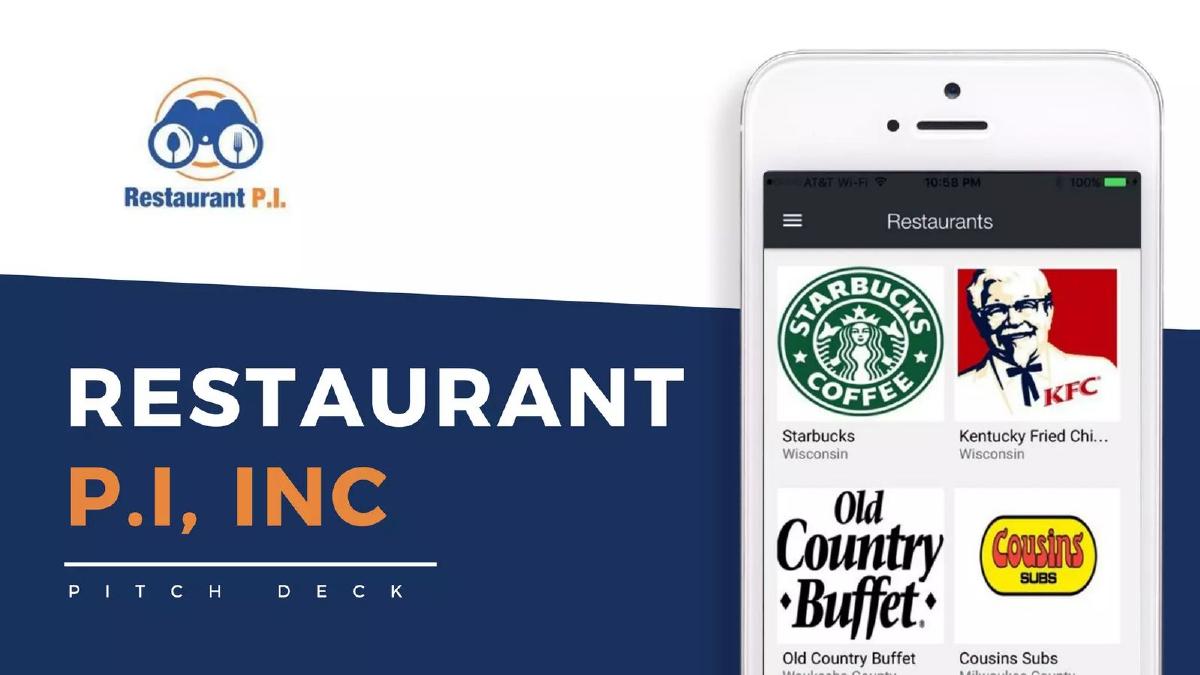
The cover slide introduces the brand name, Restaurant P.I., Inc., accompanied by a logo featuring binoculars with fork-and-spoon lenses. A mobile device mockup shows the app interface, featuring logos for Starbucks, KFC, Old Country Buffet, and Cousins Subs. This immediately establishes the company as a mobile-first platform targeting major restaurant chains.
Slide 2: The Vision
This slide uses a high-quality image of a waiter to set the tone. The text states: "All food and beverage serving businesses have the opportunity to improve the customer experience every time, everyday and everywhere." It is a broad mission statement that focuses on the universal need for service quality.
Slide 3: Problem Worth Solving
The deck quantifies the problem using data from a 2015 Global State of Multichannel Customer Service Report. It claims companies lose "41 billion per year due to poor customer service" and that 62% of customers have stopped doing business with a brand because of a poor experience. This slide successfully establishes the high stakes of the problem, though the $41 billion figure is a general corporate stat rather than one specific to the restaurant industry.
Slide 4: Our Solutions
The solution is broken down into four pillars: Anonymous Customer Oversight, Continuous Improvement, Incentives, and Blockchain technology/Smart Contracts. This is the first mention of blockchain. The deck suggests that these technologies will be used to facilitate the 'Incentives' and 'Oversight' aspects of the business, though it lacks technical detail on the implementation.
Slides 5-6: How It Works
These two slides provide a step-by-step walkthrough of the user journey. The process involves:
Downloading the app and signing up. · Choosing food interests (e.g., Italian, American, Thai). · Choosing a deal from a list of participating restaurants. · Confirming a visit and waiting for confirmation. · Sending feedback on five criteria: Food Quality, Service Quality, Cleanliness, and Ambience. · Receiving a deal (e.g., "2 For 1 Appetizer") to be used at the next visit.
The UI shown in the mockups appears functional, though the requirement to 'Wait for Confirmation' before visiting could be a friction point for users.
Slide 7: Target Market
The deck identifies a market size of "$1534.4B" and a prospect pool of "98.9M Prospects." A donut chart breaks these prospects down into three categories: Millennials (the largest segment), Restaurants/Pubs/Cafes, and Moms. The inclusion of both B2B (restaurants) and B2C (moms/millennials) in a single 'prospect' count is slightly confusing, as these groups require different acquisition strategies.
Slide 8: Competitors
The company compares itself to three giants: Yelp, Groupon, and OpenTable. The differentiators are "Direct and personal feedback" (vs. Yelp), "Unlimited deals and discounts" (vs. Groupon), and "Lower Cost" (vs. OpenTable). While these are valid points of comparison, the deck does not explain how Restaurant P.I. will achieve the scale necessary to compete with these established networks.
Slide 9: Funding Needed
This slide introduces the financial ask. It lists a "Soft Cap of 1M" and a "Hard Cap of 40M." The use of 'cap' terminology strongly suggests an ICO (Initial Coin Offering) structure. The funds are intended for upgrades, personnel, promotions, and marketing. A $40M hard cap is an exceptionally high ask for a startup that, based on the following slides, has very low projected operating costs.
Slide 10: Sales Channels
The strategy for reaching users and restaurants includes Social Media (LinkedIn, Twitter, Facebook), Marketing Kits, a Website, and the Apple/Google app stores. This is a standard list of distribution channels but lacks a specific 'go-to-market' hook beyond general presence.
Slide 11: Marketing Activities
The marketing strategy is to "use businesses as marketing tools for their own secret shopper service." This implies a B2B2C model where the restaurants themselves promote the app to their customers to gather feedback. The slide mentions that users become part of an "ecosystem based on their location."
Slide 12: Financial Projections
This slide presents a bar chart for Revenue, Expenses, and Profit from FY'19 to FY'23. The figures are:
Revenue: Grows from $840K (FY'19) to $18.4M (FY'23). · Expenses & Costs: $11K in FY'19, then dropping to a flat $3K per year for the next four years. · Profit: Scales almost identically to revenue, reaching $18.4M by FY'23.
The expense projection is the most problematic part of the deck. It is impossible to generate $18M in revenue with only $3,000 in annual expenses, especially when the next slide shows a team of nine people who presumably require salaries.
Slide 13: Team and Advisors
The final slide lists the personnel. The leadership includes Jeffery Varnado (Founder/CEO) and Adrian Triplett (Co-Founder/COO). The team is quite large for a seed-stage startup, featuring a Trademark Attorney, two Designers, and four Project/Product Managers. There are also three advisors listed. The presence of nine team members further highlights the inaccuracy of the $3,000 annual expense projection on the previous slide.
What Works / What is Missing
What Works: The deck identifies a clear and relatable problem: the gap between customer experience and management awareness. The UI mockups are clean and provide a clear understanding of the user flow. The competitive analysis, while brief, correctly identifies the pain points of existing platforms like Yelp (public negativity) and Groupon (high cost/limited deals).
What is Missing: The most glaring omission is a realistic financial model. The expense projections are not just optimistic; they are mathematically impossible for a staffed organization. Additionally, the deck lacks a technical explanation of the blockchain component. In 2018, many decks added 'blockchain' as a buzzword to attract capital, and without a clear utility for the token or ledger, this feels like a similar case. There is also no mention of current traction, pilot programs, or signed restaurant partners, despite using major brand logos on the cover.
Founder Takeaways
1. Align your ask with your projections: If you are asking for a $40M 'Hard Cap,' your expense slide should reflect how that money will be spent. Listing $3,000 in annual expenses while asking for $40,000,000 creates an immediate trust deficit with professional investors.
2. Be specific with 'Blockchain': If you claim to use blockchain or smart contracts, you must explain why . If the same result can be achieved with a standard SQL database, the blockchain element is just overhead. Investors need to see the 'unfair advantage' the technology provides.
3. Use relevant market data: While a $41B loss in general customer service is a big number, investors in this space want to know the specific TAM (Total Addressable Market) for restaurant mystery shopping and feedback tools. General corporate stats often feel like 'fluff' in a focused pitch.
4. Traction speaks louder than logos: Placing the Starbucks and KFC logos on the cover implies a relationship. If those are just examples of 'prospects,' it can be viewed as misleading. Founders should clearly distinguish between 'Target Customers' and 'Current Partners.'
Frequently asked questions
- What is the core product of Restaurant P.I.?
- The product is a mobile application that facilitates a 'secret shopper' ecosystem. Users download the app, select restaurants they are interested in, and perform 'Anonymous Customer Oversight.' After visiting a location and sending feedback on quality, service, cleanliness, and ambience, the user receives a deal or discount to be used on a subsequent visit. The backend is purportedly powered by blockchain and smart contracts to handle these incentives.
- How much money is Restaurant P.I. looking to raise?
- Slide 9 specifies two funding targets: a 'Soft Cap' of $1M and a 'Hard Cap' of $40M. The terminology 'Soft Cap' and 'Hard Cap' suggests the deck may have been intended for an Initial Coin Offering (ICO), which was a common fundraising method in 2018. The funds are earmarked for upgrades, personnel, promotions, and marketing.
- Who does the company consider its primary competitors?
- The deck lists Yelp, Groupon, and OpenTable as competitors on Slide 8. Restaurant P.I. claims to be better than Yelp by offering 'direct and personal feedback,' better than Groupon by offering 'unlimited deals and discounts,' and better than OpenTable by having a 'lower cost' for the restaurant.
- Are the financial projections in the deck realistic?
- The projections on Slide 12 contain a significant red flag. While revenue is projected to scale to $18.4M, the 'Expenses & Costs' are listed as just $3K per year for four consecutive years (FY'20-FY'23). It is functionally impossible to run a company generating $18M in revenue with only $3,000 in annual operating expenses, especially when the team slide shows nine staff members.
- What role does blockchain play in this startup?
- According to Slide 4, blockchain and smart contracts are used to manage 'Incentives.' The implication is that the feedback loop and the distribution of rewards are automated and secured via a ledger. However, the deck does not explain why a centralized database wouldn't suffice or how the blockchain integration provides a specific competitive advantage beyond being a 2018-era buzzword.