Biotech Competition Slide Examples: How Drug Startups Show
How biotech and drug development pitch decks compare their therapy with standard treatments, rival modalities and best-selling drugs.
Biotech Competition Slide Examples: How Drug Startups Show Rivals
Five competition slides from real biotech pitch decks, shown in full, compare how each deck picks what it competes with: the current standard therapy, other treatment approaches, named companies or the best-selling drugs in its field.
TL;DR
A biotech company usually competes with a treatment approach, not an app. The clearest slides compare on the clinical points that decide use: safety, efficacy, delivery and cost. SWITCH compares its switchable CAR-T with conventional CAR-T on five rows, such as "Efficacy on solid tumors: No / Yes". Antikor sets antibody-drug conjugates beside immuno-oncology, antibodies and small molecules, with one line on each one's weakness. SolyPlus names four wound-care rivals, including MediWound and KCI/Acelity/3M, before listing its own advantages. Nemus describes the weaknesses of oral cannabinoids and quotes their labels. Transcode lists the top five cancer drugs by 2021 revenue, which shows market size more than competition.
Biotech competition slides from real pitch decks
Each example shows the exact stored slide above its analysis and links to the full teardown. Stage and year are given only where the deck states them. Clinical and competitor claims are quoted as the slide states them; we have not checked them.
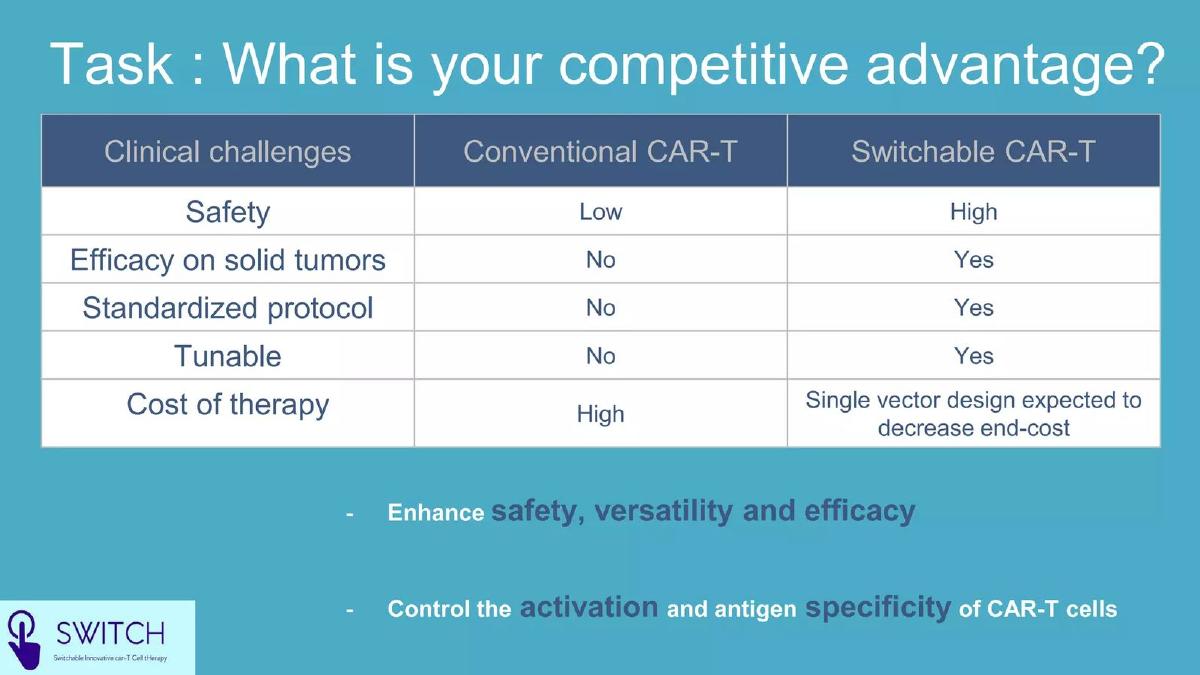
SWITCH competition slide — slide 6
Switchable CAR-T cell therapy for cancer. The teardown is filed under a generic name; the logo on the slide reads "SWITCH, Switchable Innovative car-T Cell therapy". Stage and year not stated.
SWITCH deck, slide 6. Exact stored slide matched to this analysis.
Our analysis: It compares against the current standard therapy on the clinical points that decide use, and the cost row honestly says "expected" rather than claiming a result.
Evidence and limitation: "Yes" on solid tumours is stated with no data or study stage, and no rival companies developing similar approaches are named.
What a founder can adapt: Compare with the standard of care on four or five clinical rows, and mark expected benefits as expected.
Supporting analysis
What the deck claims: "Task : What is your competitive advantage?" A table of "Clinical challenges" comparing "Conventional CAR-T" with "Switchable CAR-T": Safety "Low" vs "High"; Efficacy on solid tumors "No" vs "Yes"; Standardized protocol "No" vs "Yes"; Tunable "No" vs "Yes"; Cost of therapy "High" vs "Single vector design expected to decrease end-cost". Below: "Enhance safety, versatility and efficacy" and "Control the activation and antigen specificity of CAR-T cells".
Presentation choice: It compares against the current standard therapy on the clinical points that decide use, and the cost row honestly says "expected" rather than claiming a result.
When it does not fit: "Yes" on solid tumours is stated with no data or study stage, and no rival companies developing similar approaches are named.
Antibody-drug conjugates (ADCs) for cancer; the deck is marked non-confidential. The investment highlights guide uses slide 3 of this deck.
Antikor deck, slide 4. Exact stored slide matched to this analysis.
Our analysis: It explains how each rival approach works and gives each a specific weakness, so a non-specialist investor can see why ADCs matter.
Evidence and limitation: It compares approaches, not companies, so it never shows other ADC developers, which are Antikor's direct rivals. The market figures are years out of date for a current deck.
What a founder can adapt: Show each rival approach with one line on how it works and one on its limit.
Supporting analysis
What the deck claims: "Cancer therapy landscape": "Global cancer market set to be worth >$150bn by 2019" and "ADC market set to be worth >$18bn by 2022" (IMS Health 2016; Research & Markets 2017). Four drawings compare approaches: immuno-oncology ("Only works for limited cancers with inflammation side-effects"), ADCs/FDCs ("Tumour-specific delivery of ultra-potent payload that kills directly"), antibodies ("subject to resistance mutations") and small molecule drugs ("major side-effects due to lack of targeting").
Presentation choice: It explains how each rival approach works and gives each a specific weakness, so a non-specialist investor can see why ADCs matter.
When it does not fit: It compares approaches, not companies, so it never shows other ADC developers, which are Antikor's direct rivals. The market figures are years out of date for a current deck.
Hyaluronic acid granules for chronic wounds, Germany. The slide is dated November 2024.
SolyPlus deck, slide 5. Exact stored slide matched to this analysis.
Our analysis: It names real companies and says which technology each uses, so the reader sees the full range of treatments a clinician could choose.
Evidence and limitation: "Extreme fast healing success" has no number or study behind it, and the advantages aren't compared row by row with each rival.
What a founder can adapt: Pair each rival with its technology in a few words, then state your advantages against them.
Supporting analysis
What the deck claims: "Competitive developments": MediWound ("Bio-enzymes as e.g. Bromelain"), Organogenesis/Tissue Regenix/Aplagraf ("Tissue regeneration e.g. with living human cells"), KCI/Acelity/3M ("Negative Pressure Wound Therapy") and CINOGY System ("PlasmaDerm: Cold plasma wound healing"). Then "SolyPlus GmbH (Germany): Hyaluronic acid granules have 4 major advantages": body-own compound "without toxicity and immunicity", simple and cost effective production, application "without the need of professional support", and "Extreme fast healing success".
Presentation choice: It names real companies and says which technology each uses, so the reader sees the full range of treatments a clinician could choose.
When it does not fit: "Extreme fast healing success" has no number or study behind it, and the advantages aren't compared row by row with each rival.
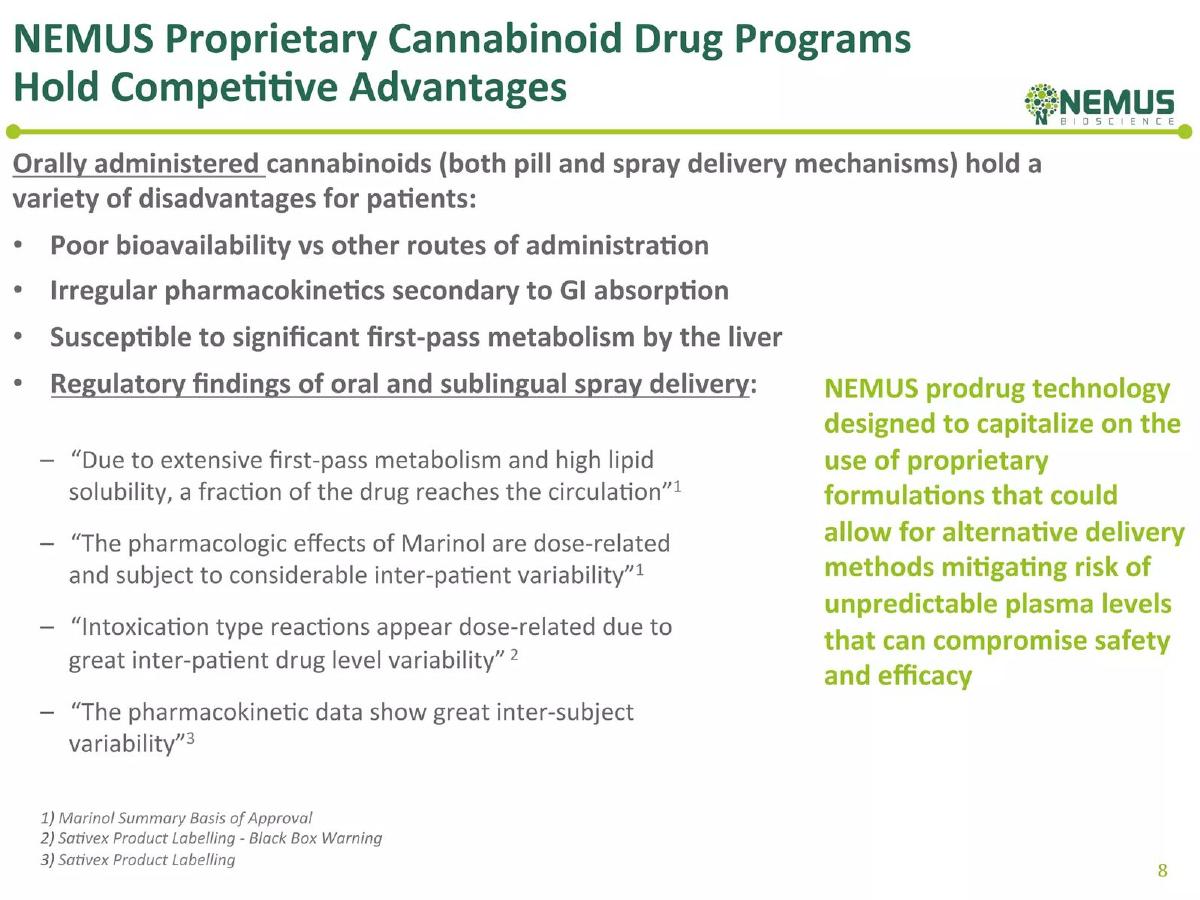
Cannabinoid-based drug programmes. The cannabis market guide uses slide 5 of this deck.
Nemus Bioscience deck, slide 8. Exact stored slide matched to this analysis.
Our analysis: Every weakness of the existing drugs is backed by a cited regulatory document, which is stronger than the company's own opinion.
Evidence and limitation: Nemus's own advantage is only "designed to" and "could allow", with no data, so the slide proves the problem better than the solution.
What a founder can adapt: Quote approved labels or regulatory reviews for rivals' weaknesses, and footnote each one.
Supporting analysis
What the deck claims: "NEMUS Proprietary Cannabinoid Drug Programs Hold Competitive Advantages". Orally administered cannabinoids have "Poor bioavailability", "Irregular pharmacokinetics" and are "Susceptible to significant first-pass metabolism by the liver". It quotes regulatory findings, for example "The pharmacologic effects of Marinol are dose-related and subject to considerable inter-patient variability", with footnotes to the Marinol Summary Basis of Approval and Sativex labelling. "NEMUS prodrug technology designed to capitalize on the use of proprietary formulations that could allow for alternative delivery methods".
Presentation choice: Every weakness of the existing drugs is backed by a cited regulatory document, which is stronger than the company's own opinion.
When it does not fit: Nemus's own advantage is only "designed to" and "could allow", with no data, so the slide proves the problem better than the solution.
RNA therapeutics for cancer. Year of the deck not stated; the data shown are 2021 revenues.
TransCode Therapeutics deck, slide 5. Exact stored slide matched to this analysis.
Our analysis: It names specific drugs and companies with sourced revenue, which shows how large successful cancer drugs can become.
Evidence and limitation: The slide is labelled "Market" and never says how TransCode's therapy relates to any of the five, so it is not really a competition slide.
What a founder can adapt: If you list top-selling drugs, say which of them your therapy would replace or combine with.
Supporting analysis
What the deck claims: "Market | Competitive Landscape – Top 5 Cancer Drugs (2021 Revenue)": Keytruda (Merck) $17.18 billion, Revlimid (Bristol Myers) $12.8 billion, Opdivo (Bristol Myers) $7.5 billion, Ibrance (Pfizer) $5.4 billion, Imbruvica (Abbvie) $5.4 billion, with a BioSpace source link. Text: "cancer remains the leading cause of death worldwide".
Presentation choice: It names specific drugs and companies with sourced revenue, which shows how large successful cancer drugs can become.
When it does not fit: The slide is labelled "Market" and never says how TransCode's therapy relates to any of the five, so it is not really a competition slide.
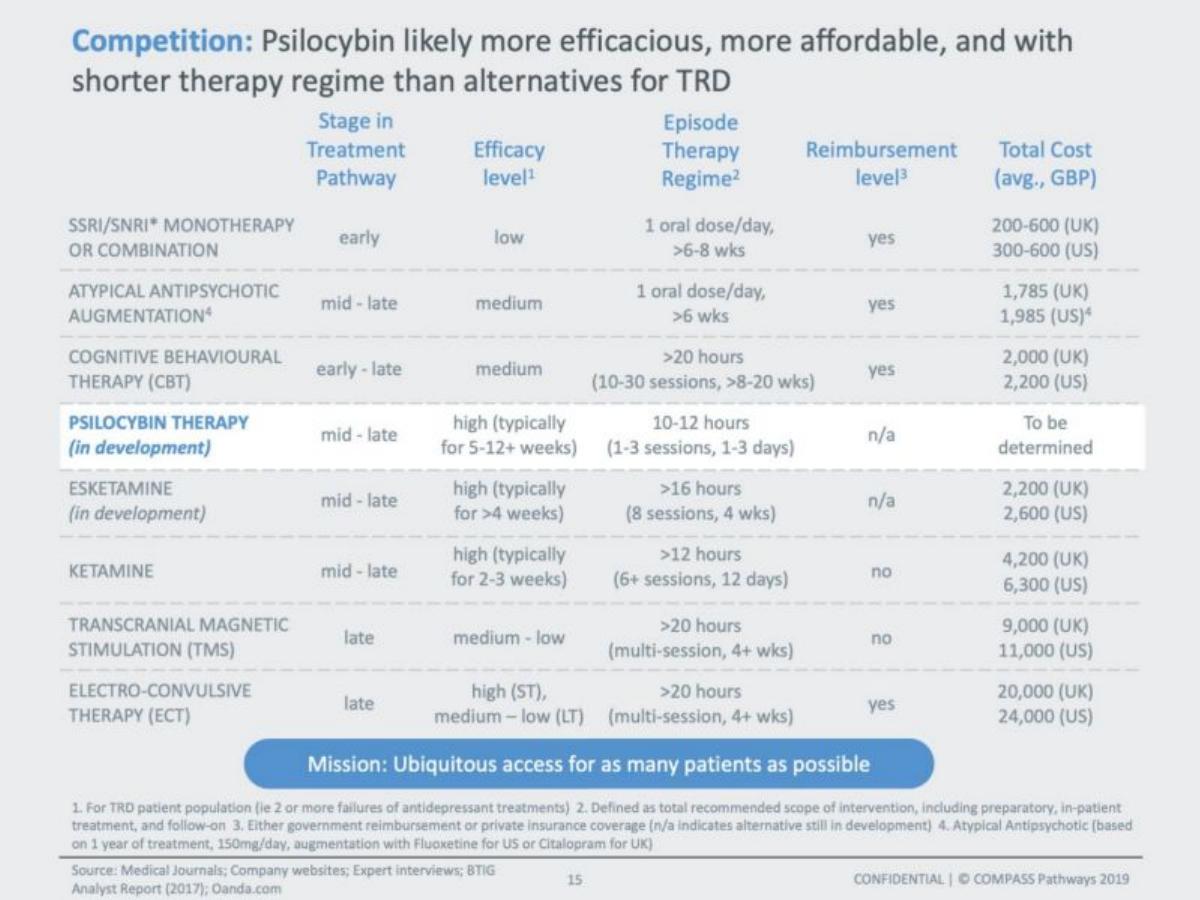
Psilocybin therapy for treatment-resistant depression (TRD). The deck cover is dated January 2018 and the slide footer reads 2019; the company listed on Nasdaq in September 2020, after this deck.
Compass Pathways deck, slide 16. Exact stored slide matched to this analysis.
Our analysis: It is the most complete comparison in this guide: every treatment a doctor might choose, scored on the same five clinical and commercial columns, with footnotes defining each column and a source line. The word "likely" in the headline and "To be determined" for its own cost mark what is still unproven.
Evidence and limitation: Its headline says "more affordable" while its own cost cell reads "To be determined"; claim affordability only with a price estimate.
What a founder can adapt: Use one row per treatment a doctor would actually choose between, the same columns for all, and say plainly which of your cells are still unknown.
Supporting analysis
What the deck claims: Headline: "Competition: Psilocybin likely more efficacious, more affordable, and with shorter therapy regime than alternatives for TRD." A table compares eight options (SSRI/SNRI, atypical antipsychotic augmentation, CBT, psilocybin therapy in development, esketamine in development, ketamine, TMS, ECT) on stage in treatment pathway, efficacy level, episode therapy regime, reimbursement and average total cost in the UK and US. Psilocybin: "high (typically for 5-12+ weeks)", "10-12 hours (1-3 sessions, 1-3 days)", cost "To be determined". ECT is the most expensive at £20,000 (UK) / $24,000 (US). Sources: medical journals, company websites, expert interviews, BTIG analyst report (2017).
Presentation choice: It is the most complete comparison in this guide: every treatment a doctor might choose, scored on the same five clinical and commercial columns, with footnotes defining each column and a source line. The word "likely" in the headline and "To be determined" for its own cost mark what is still unproven.
When it does not fit: Its headline says "more affordable" while its own cost cell reads "To be determined"; claim affordability only with a price estimate.
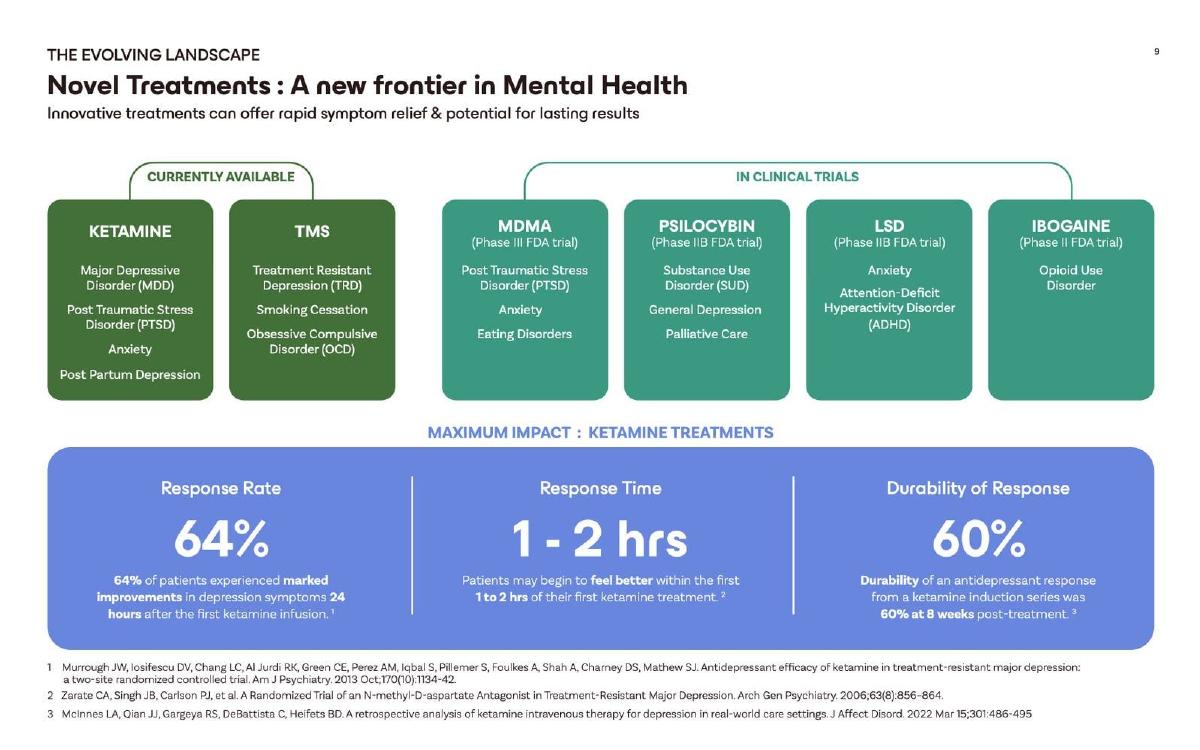
Mental health clinics offering ketamine and other novel treatments. Private when the deck was made; year not stated (the newest citation is from March 2022).
Being Health deck, slide 9. Exact stored slide matched to this analysis.
Our analysis: Grouping treatments by what is available now versus still in trials, with the trial phase for each, tells investors how soon each alternative can reach patients. The ketamine figures cite named journal studies.
Evidence and limitation: The slide lists treatments, not companies, so it never says who Being Health competes with for patients, such as other ketamine clinics.
What a founder can adapt: Show each alternative's regulatory stage, and footnote every efficacy figure to a study.
Supporting analysis
What the deck claims: "The Evolving Landscape. Novel Treatments: A new frontier in Mental Health." Two groups: "Currently available" (Ketamine; TMS) and "In clinical trials" (MDMA, Phase III FDA trial; Psilocybin, Phase IIB; LSD, Phase IIB; Ibogaine, Phase II), each with the conditions it targets. Below: "Maximum impact: Ketamine treatments" with 64% response rate at 24 hours, response in 1-2 hours and 60% durability at 8 weeks, each footnoted to a published study.
Presentation choice: Grouping treatments by what is available now versus still in trials, with the trial phase for each, tells investors how soon each alternative can reach patients. The ketamine figures cite named journal studies.
When it does not fit: The slide lists treatments, not companies, so it never says who Being Health competes with for patients, such as other ketamine clinics.
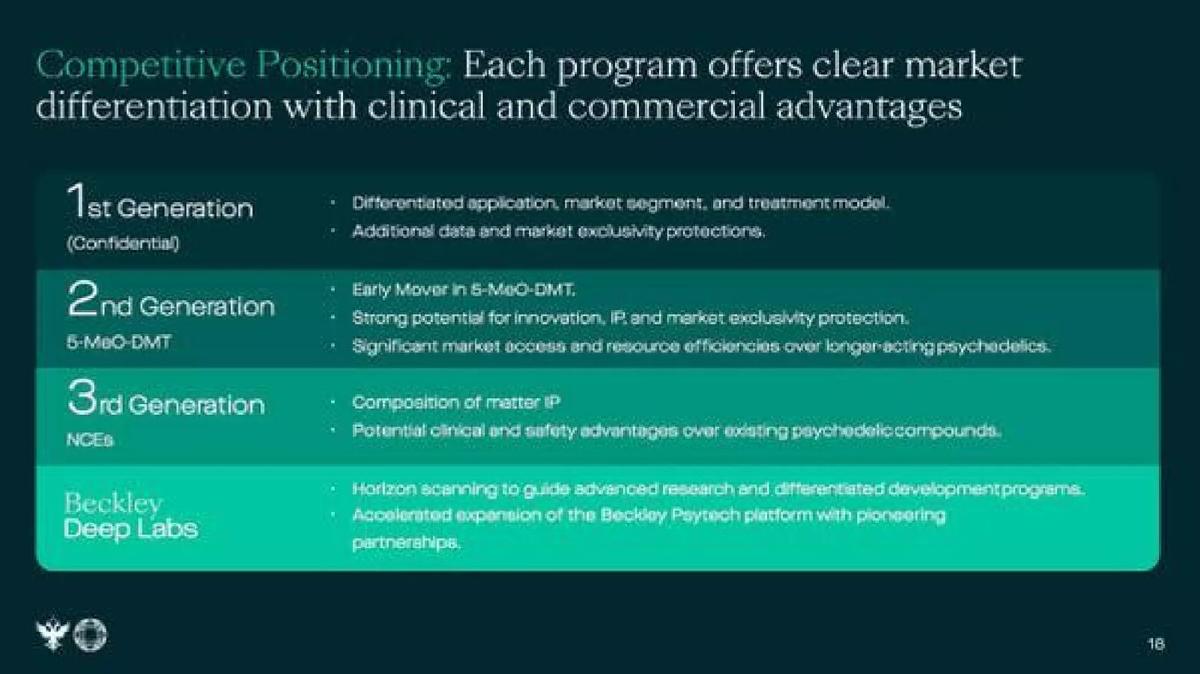
Psychedelic drug developer. Private when the deck was made; year not stated. Included as a weaker example.
Beckley Psytech deck, slide 18. Exact stored slide matched to this analysis.
Our analysis: Weaker example. It sorts its own programmes by generation and claims advantages for each, but it names no competing drug, company or trial and gives no data, so investors cannot check any advantage.
Evidence and limitation: Calling a slide "competitive positioning" without naming a single competitor.
What a founder can adapt: Name the closest rival for each programme and one measurable point of difference, such as session length.
Supporting analysis
What the deck claims: "Competitive Positioning: Each program offers clear market differentiation with clinical and commercial advantages." Four rows: 1st Generation (confidential) "Differentiated application, market segment, and treatment model"; 2nd Generation 5-MeO-DMT "Early Mover in 5-MeO-DMT", "Significant market access and resource efficiencies over longer-acting psychedelics"; 3rd Generation NCEs "Composition of matter IP", "Potential clinical and safety advantages over existing psychedelic compounds"; Beckley Deep Labs "Horizon scanning".
Presentation choice: Weaker example. It sorts its own programmes by generation and claims advantages for each, but it names no competing drug, company or trial and gives no data, so investors cannot check any advantage.
When it does not fit: Calling a slide "competitive positioning" without naming a single competitor.
What each biotech competition slide gives the reader
Clinical comparison points and named rivals make the slide useful.
Example
Compared with
Compared on
Evidence for rivals' weaknesses
Own advantage shown
SWITCH
Conventional CAR-T
Five clinical rows
None shown
Yes, cost marked expected
Antikor
Three other modalities
How each works and its limit
None shown
Yes, descriptive
SolyPlus
Four named companies
Technology
None shown
Four claims, no data
Nemus
Oral cannabinoids
Delivery and dosing
Cited labels and approvals
Only "could allow"
TransCode
Top five cancer drugs
2021 revenue
Not applicable
No
Compass Pathways
Seven treatments
Efficacy, regime, reimbursement, cost
Sourced (analyst report, journals)
Yes, marked likely
Being Health
Six treatments by stage
Availability and FDA phase
Cited studies (ketamine)
Indirect
Beckley Psytech
No one named
Own programmes
None
Claims only
Key Takeaways
Name what doctors use today: the standard therapy, rival approaches and the companies behind them.
Compare on clinical points (safety, efficacy, delivery, cost), not on generic business features.
Where you cite a rival's weakness, source it, as Nemus does with product labels.
Say which of your advantages are proven and which are expected; early data is not a result.
A list of best-selling drugs shows the prize, but not who you would take patients from.
Build your biotech competition slide
Answer these before designing the slide.
Standard. What do doctors use for this condition today?
Rivals. Which companies are developing competing approaches, and at what stage?
Criteria. Which three to five clinical points decide what doctors choose?
Evidence. Which label, study or review supports each weakness you cite?
Status. Which of your advantages are shown in data, and which are expected?
Copyable framework: [Standard therapy] [limit, source]. [Rival approach] [limit]. Our [therapy] [advantage], shown in [study/stage] or expected because [reason].
Illustrative example 1 — written by us
Before: Extreme fast healing success
After: Healing in [time] vs [time] with [standard care] in [study, n = X].
What improved: Our illustrative rewrite, not SolyPlus's text. Bracketed parts are placeholders, not company facts. It turns a claim into a measurable comparison.
How this guide relates to the other competition and biotech guides
The main competition guide covers comparison tables, positioning maps and feature matrices for any company. The healthcare competition guide covers digital health, telehealth, insurers and devices (Brain Backups, Troy Medicare and others), so none of its slides are repeated here. The biotech problem, solution and market guides and the biotech pipeline guide use other slides. Antikor's investment highlights slide appears in the investment highlights guide; this guide uses its separate landscape slide. Nemus's cannabis market slide appears in the cannabis market guide; this guide uses its drug programme slide.
Common mistakes
Modalities, no companies. Name the developers closest to you, not only the approaches.
Unsourced weaknesses. Cite labels or studies for every rival limitation.
Expected shown as proven. Mark which advantages have data and at what stage.
Market list as competition. Top-selling drugs show size; say who you replace or combine with.
Old figures. Update market numbers and rival status before each raise.
Diagnostic checklist
Standard of care and competing approaches are both shown.
Named companies developing similar therapies are included.
Comparison rows are clinical: safety, efficacy, delivery, cost.
Rivals' weaknesses are sourced.
Your advantages say whether they are proven or expected.
Frequently asked questions
How we chose these examples
Corpus: published pitch deck teardowns on StartupFundraising.com. Founder-uploaded private decks are excluded.
Selection (2026-09-28): we searched extracted slide text for slides whose opening words include "competition", "competitive", "landscape", "alternatives" or "vs" and whose text mentions drugs, therapies, antibodies, clinical trials, the FDA, compounds or pharma, then kept drug and therapy developers. Excluded: Brain Backups, Troy Medicare, Headsted and Mental Health (used by the healthcare competition guide), and cannabis retail and software decks.
Images: Nemus's slide image was rendered from the published deck PDF and stored on 2026-09-28; the other four were already stored.
Overlap check: no competition-slide facet for biotech existed. Antikor and Nemus appear in other guides with different slides.
Review: all five stored slide images were inspected on 2026-09-28 and matched to company, deck and slide number (editorial model review). Clinical and competitor claims are quoted from the slides and were not checked. No person has yet completed an editorial review of this page.
Update (2026-10-01): under the rule that a deck counts only if made before its company was publicly listed, we re-searched and added Compass Pathways p16 (2018 deck, 2020 IPO), Being Health p9 and Beckley Psytech p18, each checked against the original deck page image (AI editorial model review, not human). Rejected: Agomab p10 (a problem slide), Haystack Oncology p24 (no alternatives named; diagnostics). Excluded as already listed when the deck was made: Can-Fite, BioVie, Cardium, Cancer Genetics, Citius, Lantern.
We make no claim that any slide caused a fundraising outcome.