Friend Trusted's 2012 seed deck is a masterclass in leading with traction. By placing their $2.9M project run rate and 23% monthly growth on slides 2 and 3, the founders immediately validate the demand for their mobile-first home improvement marketplace. The deck identifies a clear friction point—the 2-to-4-week delay in getting contractor estimates—and proposes a solution that delivers three estimates within 24 hours via a single photo. While the deck lacks a formal 'Ask' slide and detailed unit economics, it compensates with strong social proof, including 630 five-star reviews and a team wi…
Key takeaways
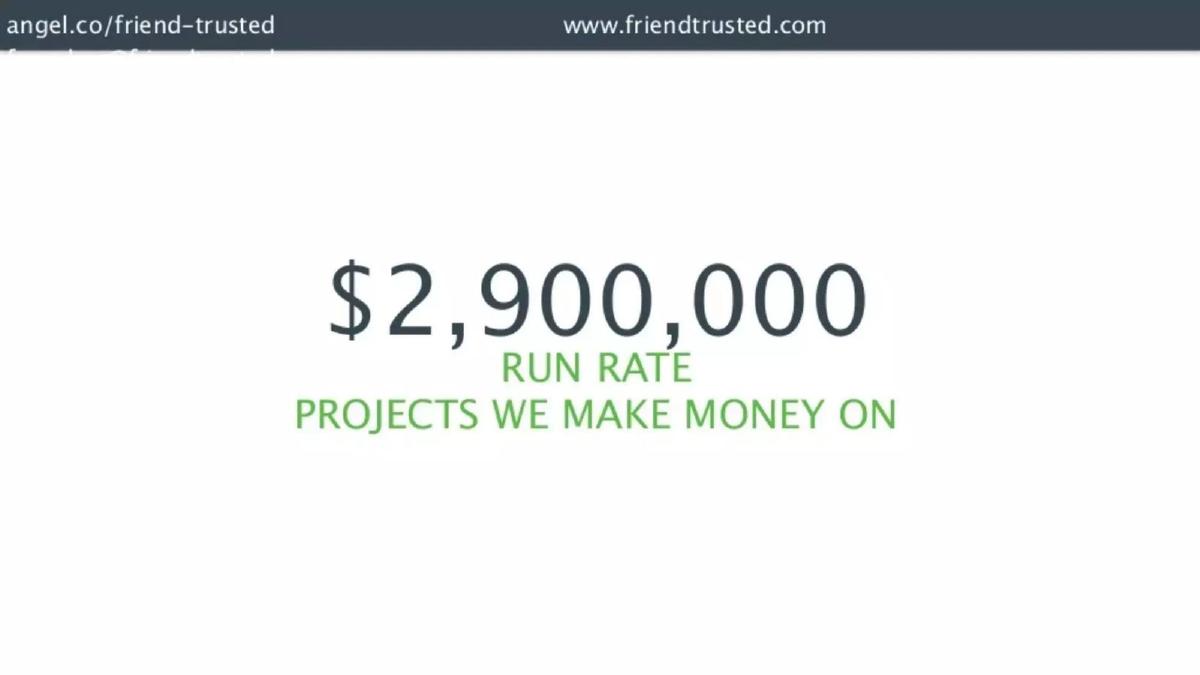
- The deck leads with a $2,900,000 run rate for projects the company makes money on (Slide 2).
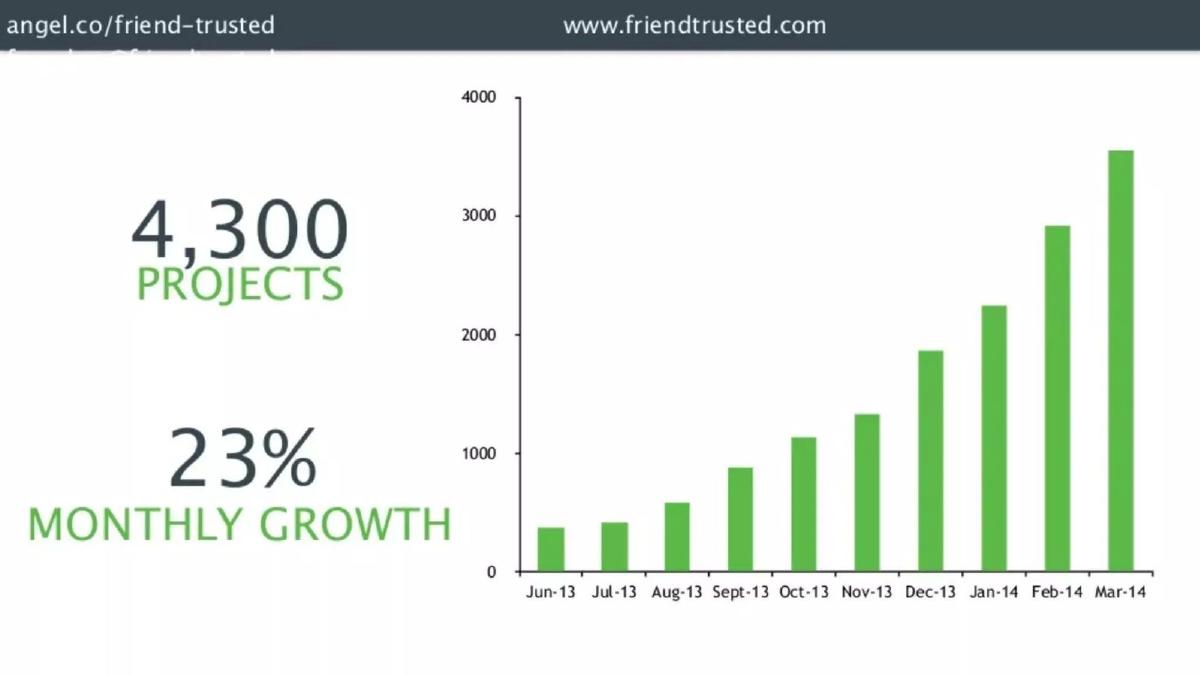
- Traction is further emphasized by a bar chart showing growth from June 2013 to March 2014, reaching 4,300 projects with 23% monthly growth (Slide 3).
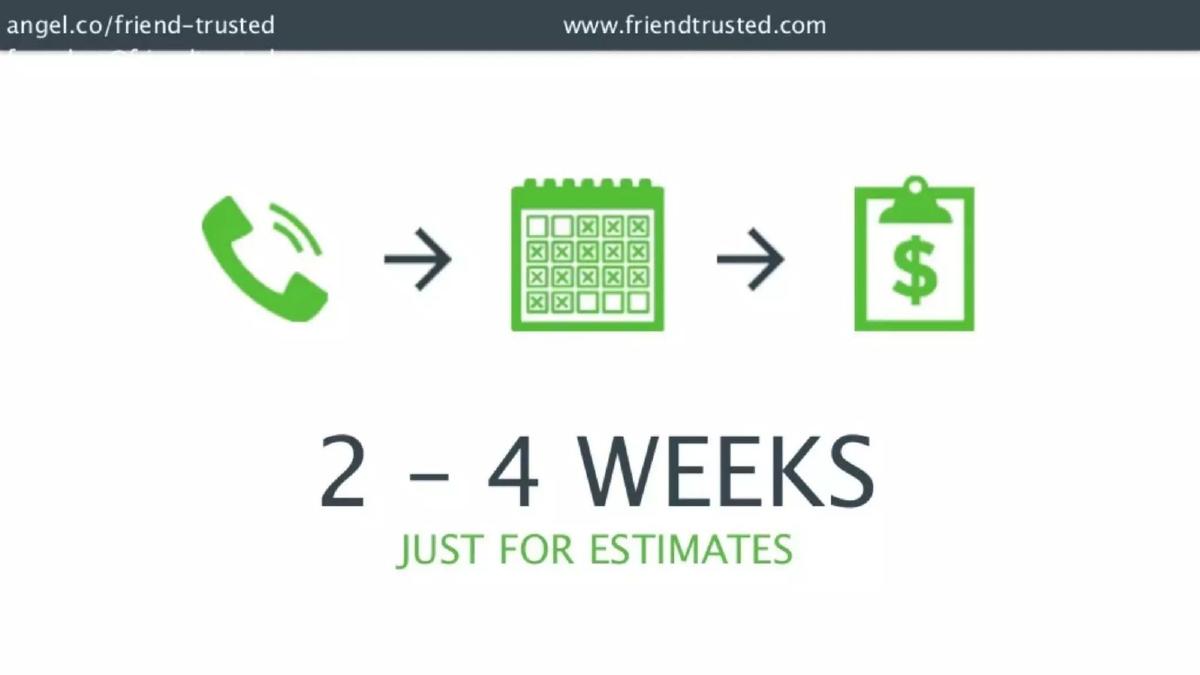
- The core problem identified is the 2-4 week delay typically required just to receive home improvement estimates (Slide 4).
- The product solution promises three estimates within 24 hours based on a single photo taken by the user (Slides 8-9).
- The total addressable market is cited at $130B spent on home improvement annually (Slide 11).
- Social proof is established through 630 five-star reviews and availability across iOS, Android, and Windows Phone (Slide 12).
- The team slide highlights founders from Carnegie Mellon with backgrounds at Philips, HP, and Mindjet, supported by advisors from LinkedIn, Uber, and Salesforce (Slide 13).
- The deck completely omits a financial 'Ask' slide, leaving the specific funding goal and use of proceeds unstated.
The Traction-First Strategy
Friend Trusted’s pitch deck, dating from 2012-2014, is a classic example of a 'momentum deck.' Rather than starting with a philosophical 'why' or a complex market analysis, the founders chose to lead with hard numbers. In an era where many mobile marketplaces were struggling to prove utility, Friend Trusted used its first three slides to scream that people were actually using the product and that the company was generating volume.
Slides 1-3: The Hook and The Numbers
Slide 1 is a standard title slide featuring the logo and the tagline: "Revolutionizing Home Improvement." The imagery of a couple looking at a house is generic but sets the thematic stage immediately.
Slide 2 is the 'Big Number' slide. It states a $2,900,000 run rate for "projects we make money on." This is a clever phrasing. It doesn't claim $2.9M in revenue, but rather the total value of the projects flowing through their system that are monetized. This gives investors a sense of the platform's scale and the potential for a 'take rate' or commission-based model.
Slide 3 reinforces this with a growth chart. It shows a steady climb from June 2013 to March 2014. The slide highlights 4,300 projects and a 23% monthly growth rate. By placing this at the front, the founders effectively say, "The rest of this deck is just explaining how we achieved this growth."
Slides 4-5: The Friction Point
Slide 4 defines the problem. It uses icons (phone, calendar, clipboard) to illustrate the current arduous process. The text is blunt: "2 - 4 WEEKS JUST FOR ESTIMATES." This identifies a specific, painful bottleneck in the home improvement industry that everyone—homeowners and contractors alike—understands.
Slide 5 is a moment of levity, featuring a dog in a hard hat with the caption "My specialty is roofing." While humorous, it subtly points to the lack of trust and transparency in finding contractors—the 'dog' in the industry who might not be who they say they are. This sets up the 'Trusted' part of the brand name.
Slides 6-10: The Product Solution
Slide 6 acts as a transition, showing the logo over a blurred house, preparing the viewer for the solution walkthrough.
Slide 7 shows a 'before' state: a dated, wood-paneled kitchen. This is the starting point for a typical user.
Slide 8 introduces the mobile app. The instruction is simple: "Simply take a picture." The iPhone mockup shows the user taking a photo of that same kitchen. This emphasizes the low barrier to entry for the user.
Slide 9 delivers the 'Aha!' moment. It shows a list of estimates on the phone screen with the promise: "Get 3 estimates within 24 hours." This directly counters the 2-4 week problem stated on Slide 4. The UI shows contractor names, star ratings, and price points (e.g., $80, $97, $90), though these appear to be placeholder figures for the sake of the mockup.
Slide 10 adds a layer of service. "Home experts that guide you" suggests that the platform isn't just an automated bot, but includes a human or expert support element (represented by a chat interface with 'Mary DoMoe'). This addresses the 'Trust' gap in high-stakes home renovations.
Slides 11-12: Market Size and Social Proof
Slide 11 provides the macro context. "$130B SPENT ON HOME IMPROVEMENT EACH YEAR." This justifies the venture scale of the business. If they can own the estimate phase of a $130B market, the revenue potential is massive.
Slide 12 focuses on validation. It boasts 630 five-star reviews and shows badges for the App Store, Google Play, and the Windows Phone Store. Being on three platforms in 2012-2014 was a significant engineering feat and signaled a commitment to broad user acquisition.
Slides 13-14: The Team and Closing
Slide 13 is the team slide. It is well-structured, highlighting the founders' Carnegie Mellon pedigree and 10+ years of experience at companies like Philips, HP, and Mindjet . The 'Design' and 'Operations' roles are also highlighted, showing a balanced early team. The bottom half of the slide features advisors with logos from LinkedIn, Uber, Salesforce, and SolarCity , which provides immense institutional credibility.
Slide 14 is a simple contact slide with the CEO's email and the website URL. Notably, there is no mention of how much they are raising or what the valuation is.
What Works
Traction First: By starting with growth metrics, the deck bypasses the skepticism often directed at early-stage marketplaces. · Clear Contrast: The comparison between the "2-4 weeks" status quo and the "24 hours" solution is a powerful value proposition. · Strong Social Proof: The combination of 630 reviews and high-profile advisors (Uber, LinkedIn) makes the startup look like a safe bet. · Visual Simplicity: The deck uses very little text, relying on large numbers and clear screenshots to tell the story.
What is Missing
The Ask: The most significant omission is the funding request. Investors need to know how much capital is required and what milestones that capital will achieve. · Business Model: While Slide 2 mentions "projects we make money on," the deck never explains how they make money. Is it a lead-gen fee from contractors, a percentage of the project cost, or a subscription? · Competition: The home improvement space was crowded even in 2012 (Angie's List, HomeAdvisor). The deck fails to mention how Friend Trusted wins against these incumbents. · Unit Economics: There is no mention of Customer Acquisition Cost (CAC) or Lifetime Value (LTV), which are critical for marketplace businesses.
What a Founder Should Copy
The Traction Slide: If you have a 23% month-over-month growth rate, put it on Slide 3. Don't bury it at the end. · The Problem/Solution Binary: Use a single, quantifiable metric to define the problem (e.g., "2-4 weeks") and a matching metric for the solution ("24 hours"). · Advisor Logos: If you have credible advisors, use their former company logos to borrow authority. It is one of the fastest ways to build trust in a seed-stage deck. · Minimalist Design: Notice how few words are on each slide. This forces the presenter to speak and the audience to listen, rather than reading a wall of text.
Frequently asked questions
- What is the primary value proposition of Friend Trusted?
- Friend Trusted focuses on speed and convenience in the home improvement sector. According to slides 4 and 9, the traditional process takes 2-4 weeks to get estimates, whereas Friend Trusted provides three estimates within 24 hours. The user simply takes a photo of their project (Slide 8) and receives professional guidance from home experts (Slide 10).
- How does the company demonstrate market traction?
- The deck uses two high-impact slides at the very beginning to show traction. Slide 2 claims a $2,900,000 run rate on revenue-generating projects. Slide 3 provides a month-over-month growth chart from June 2013 to March 2014, showing a total of 4,300 projects and a consistent 23% monthly growth rate.
- Who are the key people behind Friend Trusted?
- The team (Slide 13) is led by CEO Brenton Marrelli and CTO Darwin Widjaja, both Carnegie Mellon alumni with 10+ years of experience in SaaS and web development. The team also includes Jesse Bones (Design) and Mary DoMoe (Operations). Their advisor network is particularly strong, featuring individuals associated with LinkedIn, Uber, Salesforce, and SolarCity.
- What is missing from this pitch deck?
- The deck is missing several standard components: a specific 'Ask' (how much money they are raising), a detailed business model or unit economics slide (explaining the take rate or fee structure), and a competitive landscape analysis. It also lacks a roadmap for future product development or geographic expansion.
- What is the market size Friend Trusted is targeting?
- Slide 11 identifies a $130 billion annual spend on home improvement. By positioning their tool as the entry point for these projects (getting the estimate), they aim to capture a significant portion of the lead generation or transaction volume within this massive market.