QOTEQ positions itself as a solution to the 'software mishmash' and costly IT dependencies plaguing modern enterprises. By leveraging the 'hyper-automation' trend, the company proposes a universal business operating system that allows non-technical users to build systems using simple English. The deck is notable for its heavy reliance on external market data, citing Microsoft's projection of 450 million no-code apps and Gartner's prediction that 75% of large enterprises will use no-code tools by 2024. While the deck provides specific financial targets—including a projected Year 3 EBITDA of $6…
Key takeaways
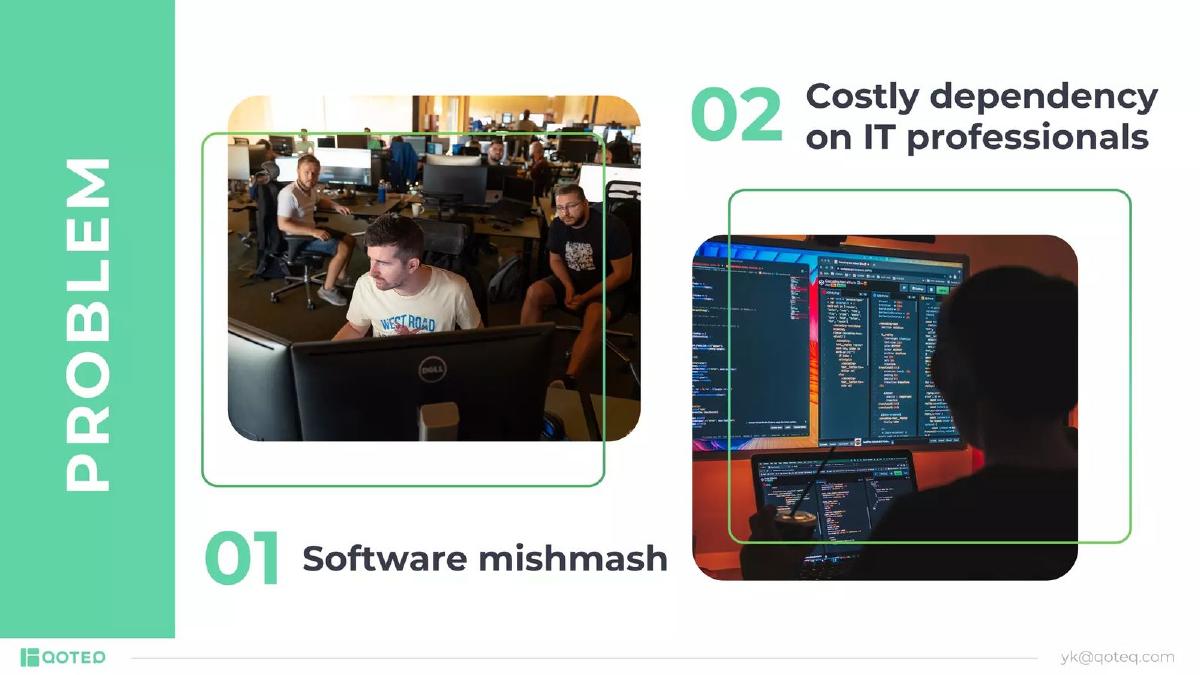
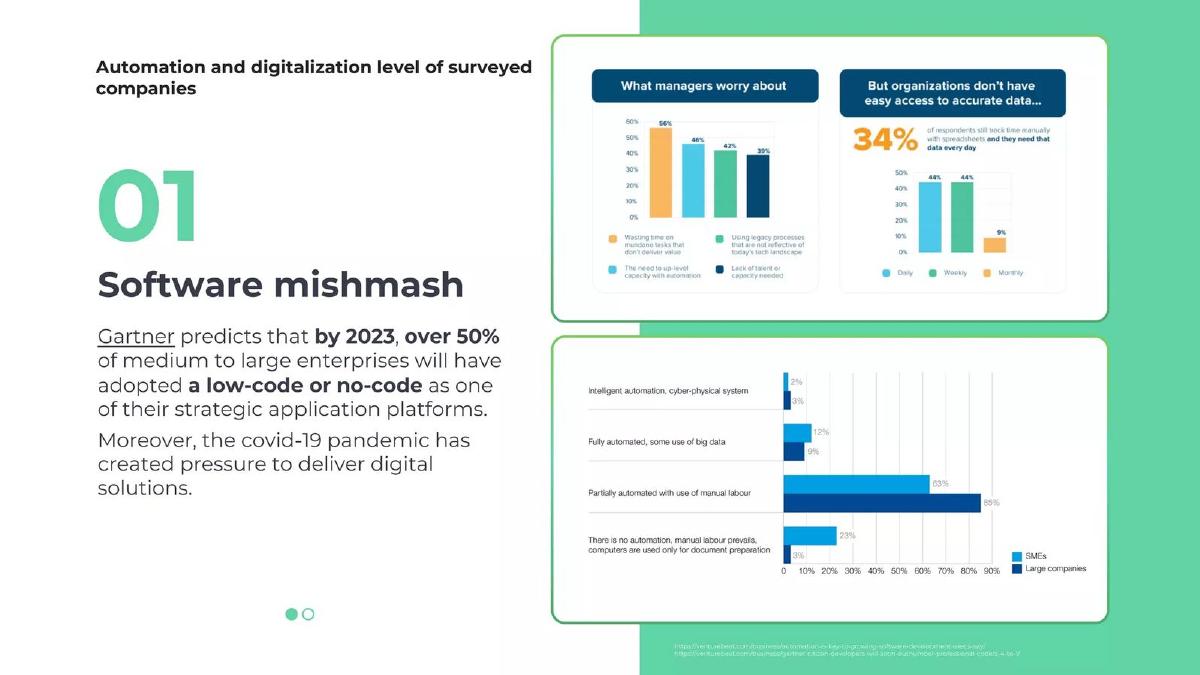
- The company identifies two primary pain points: 'Software mishmash' and 'Costly dependency on IT professionals' (Slide 2).
- QOTEQ cites Microsoft research suggesting that 450 million of the next 500 million apps created will be no/low-code (Slide 3).
- The product interface, branded as the 'Sales Specialist Cockpit,' includes integrated chat, task management, and calendar features (Slide 4).
- A mobile 'Dashboard for CEO roles' demonstrates the platform's ability to visualize market share and EBITDA metrics (Slide 5).
- The two-year acquisition plan targets four revenue streams: Enterprises ($1M), S&ME ($6.36M), Customization ($2M), and a Marketplace ($0.4M) (Slide 8).
- QOTEQ is seeking a 'Necessary investment' of $1,200,000 (Slide 9).
- The deck projects a high Year 3 EBITDA margin of 67.2% (Slide 9).
- Industry figures Vitor Cruz and Christoph Daszkiewicz provide commentary on the platform's role as a 'second expert analyst' (Slide 10).
Slide-by-Slide Analysis
Slide 1: Title and Vision
The opening slide introduces QOTEQ as an 'Extreme No-Code Universal Business Operating System.' The visual features a stylized world map highlighting Lisbon, Portugal, and Kyiv, Ukraine, with the tagline 'Developed in Ukraine • Empowering the world.' This establishes the company's geographic roots and its ambition to serve a global market. The term 'Universal Business Operating System' suggests a horizontal platform rather than a niche vertical tool.
Slide 2: The Problem Statement
QOTEQ identifies two distinct problems. Problem 01 is 'Software mishmash,' illustrated by a photo of a crowded office, implying the chaos of unintegrated tools. Problem 02 is 'Costly dependency on IT professionals,' shown via a developer looking at complex code. This slide sets the stage for a solution that simplifies the tech stack and democratizes development, moving it away from expensive technical silos.
Slide 3: Market Context and Hyper-Automation
This slide shifts to external validation. It cites Microsoft's anticipation that 450 million out of 500 million new apps will be no/low-code. It also introduces the Gartner definition of 'Hyper-Automation': a business-driven approach to automate as many processes as possible. The slide claims no-code can reduce development time by 90% and that the average company avoids hiring two developers, reaping '$4.4 M increase in business value.' This is a data-heavy slide designed to prove that the problem identified on Slide 2 is a massive, recognized market opportunity.
Slide 4: Product Showcase - Case II
Slide 4 provides a high-fidelity mockup of the 'User portal :: Sales Specialist Cockpit.' The interface includes a calendar, task lists ('My Backlog'), a central work area for a 'Make presentation template' task, and a chat sidebar. At the bottom, a command-line style bar shows '[Sales specialist] :: conclusion about phone call with Yaroslav,' suggesting an AI-driven or natural language interface for logging work. The design is clean and emphasizes a unified workspace.
Slide 5: Product Showcase - Mobile Dashboard
This slide shows a mobile version of the platform, specifically a 'Dashboard for CEO roles.' It displays a pie chart for 'Market share' (showing 'We 25.56%' vs 'Competitor 74.54%') and buttons for EBITDA, ROCE, and EVA. A prompt at the bottom reads '[CEO] :: propose me more optimal business process of issuance of loans,' indicating that the system is intended to be interactive and advisory, rather than just a static reporting tool.
Slide 6: Competitive Landscape Transition
This is a transition slide titled 'THE COMPETITORS & THE DIFFERENCES.' While it signals a discussion on competition, the specific competitive matrix or comparison is not included in the provided set of slides. In a full deck, this would typically be followed by a feature-by-feature comparison against players like Airtable, Monday.com, or Microsoft Power Apps.
Slide 7: Market Size Transition
Another transition slide titled 'THE MARKET SIZE & HOW WE INTENT TO REACH THE FULL POTENTIAL.' This sets the expectation for the go-to-market strategy and the Total Addressable Market (TAM) calculations.
Slide 8: Go-To-Market and Revenue Plan
This slide outlines the 'Plan of Clients acquiring on the next two years.' It breaks down revenue into four categories: Enterprises (1-5 clients, $1M revenue), S&ME (63,600 licenses, $6.36M revenue), Customization (20 clients via Partner Sales Network, $2M revenue), and Marketplace (4,000 items bought, $0.4M revenue). The specificity of these numbers—particularly the 63,600 licenses—suggests a very detailed bottom-up financial model exists behind the deck.
Slide 9: Investment Ask and Financials
QOTEQ presents its 'Basic Financials' alongside further Gartner validation. The 'Necessary investment' is stated as $1,200,000. The projected outcomes for Year 3 are an EBITDA Margin of 67.2% and an EBITDA of $6,898,136.91. The Gartner stats on the left reinforce the urgency: 75% of large enterprises will use 4+ no-code tools by 2024, and 70% of new apps will use no-code by 2025.
Slide 10: Industry Validation
The final slide in this set features Vitor Cruz and Christoph Daszkiewicz. Rather than a standard 'Team' slide listing founders and their education, this slide functions as a 'Testimonial' or 'Advisory' slide. Cruz highlights the platform's role as a 'second expert analyst,' while Daszkiewicz emphasizes the ability to build systems using 'simple English' and 'puzzle pieces.' This provides social proof from individuals with backgrounds in banking and venture capital.
What QOTEQ Does Well
Strong Market Tailwinds: The deck does an excellent job of tying the company's mission to massive industry trends. By citing Microsoft and Gartner, QOTEQ makes the shift to no-code feel inevitable rather than speculative. This reduces the 'market risk' in the eyes of an investor.
Clear Revenue Segmentation: Slide 8 is highly effective. Instead of just saying 'we will sell to everyone,' the founders have broken down their revenue into four logical buckets with specific targets. This shows a sophisticated understanding of how different customer segments (Enterprise vs. SME) require different sales motions.
Product Vision: The mockups on Slides 4 and 5 are not just generic dashboards. They demonstrate a specific 'Operating System' philosophy where communication, task management, and data visualization live in one place. The inclusion of natural language prompts suggests an early focus on what is now commonly referred to as AI agents.
What is Missing from the Deck
Founder Profiles: While Slide 10 provides excellent industry validation, the actual founders and their operational history are not explicitly detailed in these slides. Investors typically want to know who is running the company day-to-day and what their specific technical or business pedigree is.
Use of Funds: The deck asks for $1.2M but does not explain how that money will be spent. A standard pitch deck should include a breakdown (e.g., 50% Engineering, 30% Sales/Marketing, 20% Ops) to show that the founders have a plan for the capital.
Unit Economics: While Slide 8 mentions revenue and licenses, it does not mention Customer Acquisition Cost (CAC) or Lifetime Value (LTV). For a platform targeting 63,600 SME licenses, the efficiency of the acquisition engine is a critical metric that is missing here.
Traction to Date: The deck is forward-looking. It lacks a 'Traction' slide showing what has already been accomplished—current revenue, pilot programs, or user growth. Without this, the $6.8M EBITDA projection feels like a 'spreadsheet exercise' rather than a forecast based on historical data.
Founder Takeaways
Leverage Third-Party Data: If you are in a hot sector like AI or No-Code, use reports from Gartner, Forrester, or McKinsey to validate the market size. It saves you from having to prove the market exists and lets you focus on why your solution is the best one for that market.
Specific Financial Targets: Don't be afraid of specific numbers. QOTEQ’s projection of '$6,898,136.91' is almost too specific, but it signals that there is a detailed model behind the scenes. It invites the investor to ask, 'How did you get to that number?' which is a great conversation starter.
Focus on the 'Operating System' Angle: If your product replaces multiple tools, frame it as an 'Operating System' as QOTEQ does. This increases the perceived value of the software and suggests higher switching costs, which is attractive to investors looking for 'sticky' SaaS businesses.
Use Social Proof Early: If you have high-level advisors or industry veterans who believe in the product, give them significant real estate in the deck. QOTEQ uses Slide 10 to let experts explain the product's value proposition, which can be more convincing than the founders saying it themselves.
Frequently asked questions
- What is the core problem QOTEQ aims to solve?
- According to Slide 2, QOTEQ addresses the 'Software mishmash'—the fragmented nature of modern business tools—and the 'Costly dependency on IT professionals.' The platform intends to empower 'Citizen Developers' to build and automate processes without needing traditional coding skills, thereby reducing development time by a projected 90%.
- How does QOTEQ plan to generate revenue?
- Slide 8 outlines a multi-pronged revenue strategy for the next two years. The largest projected share comes from Small & Medium Enterprises (S&ME) via subscription tiers, targeting 63,600 licenses for $6.36M. Other streams include Enterprise open-core adoption ($1M), partner-led customization ($2M), and a developer marketplace ($0.4M).
- What market validation does the deck provide?
- The deck relies heavily on Gartner and Microsoft data. Slide 9 quotes Gartner's prediction that by 2024, 75% of large enterprises will use four or more no-code tools. Slide 3 notes that no-code platforms can reduce development time by 90% and that the average company avoids hiring two developers by using these tools, resulting in $4.4M in business value.
- Who are the key people mentioned in the deck?
- Slide 10 features Vitor Cruz, a Senior Banking Executive with 30 years of experience, and Christoph Daszkiewicz, formerly of Schneider Electric VC and Siemens. Rather than listing them as founders, the slide uses their profiles to validate the product's ability to act as a 'second expert analyst' and its use of 'simple English' for system assembly.
- What are the financial projections for the company?
- Slide 9 presents 'Basic Financials' including a Year 3 EBITDA of $6,898,136.91 and an EBITDA margin of 67.2%. These figures are tied to the request for a $1,200,000 investment. The deck notes that more detailed financials are available on request, suggesting these are high-level targets for the initial pitch.