The Ixia Q2 2016 investor deck serves as a late-stage or public company update rather than a traditional startup seed deck. It highlights the company's evolution into 'Cloudlens,' a solution for visibility across physical, data center, and cloud environments. With 2015 revenue reported at $517M and a healthy 78% non-GAAP gross margin, the deck focuses on operational efficiency and market tailwinds like the 38% growth in global security incidents. The presentation is heavy on financial rigor, including a three-page GAAP to non-GAAP reconciliation, signaling a focus on institutional investors.…
Key takeaways
- The company reported significant revenue growth from $464M in 2014 to $517M in 2015 (Slide 16).
- Ixia identifies four primary market drivers: Cloud, Network Security, Big Data, and IoT, citing that 90% of mobile data traffic would move to cloud apps by 2019 (Slide 7).
- The 'Cloudlens' product is positioned as a unified visibility solution for physical networks, data centers, and cloud environments (Slide 10).
- Non-GAAP gross margins remained consistently high, increasing from 76% in 2014 to 79% YTD in Q2 2016 (Slide 16).
- The company utilizes a 'Target Model' to communicate long-term financial goals, including a target operating margin of 18-25% (Slide 16).
- A detailed reconciliation shows that while GAAP net income was -0.5% YTD Q2 2016, non-GAAP net income was 9.6% after adjustments (Slide 19).
- Security is a major focus, with the deck citing a 38% growth in global security incidents between 2014 and 2015 (Slide 7).
Executive Summary and Brand Positioning
Slide 1: Title Slide
The presentation opens with the company logo 'ixia' and the tagline 'WE MAKE APPLICATIONS STRONGER.' It is explicitly labeled as an 'Investor Presentation – Q2 2016.' The background features a high-altitude cityscape at sunset, suggesting a global, enterprise-scale reach. The branding is clean and professional, typical of mid-to-large-cap technology firms.
Slide 2: Company Overview
This slide serves as a transition or introduction, identifying Bethany Mayer as the President and CEO. The design uses a geometric, hexagonal motif that carries through the rest of the deck. No specific company history or mission statement is provided on this slide, as it functions primarily as a title card for the CEO's portion of the presentation.
Market Context and Growth Drivers
Slide 7: Market Dynamics Driving Growth
Ixia identifies four pillars of market growth: Cloud, Network Security, Big Data, and the Internet of Things (IoT). The slide provides specific, time-bound metrics to validate these drivers. For Cloud, it claims 90% of mobile data traffic will move to cloud apps by 2019. For Security, it notes a 38% growth in global security incidents from 2014 to 2015. Big Data is quantified as 150 gigabytes of new data per person per day by 2020, and IoT is represented by 6 billion connected things requesting support by 2018. This slide is effective because it connects Ixia's product utility to massive, undeniable macroeconomic shifts in the tech sector.
Product and Solution Architecture
Slide 10: Introducing Cloudlens
This slide introduces 'Cloudlens' as a unified solution for visibility across physical networks, data centers, and the cloud. The visual diagram shows a complex network architecture involving Hyper-V, KVM, and ESXI environments, as well as Amazon Web Services (AWS) and Azure. The bottom of the slide identifies four key functional areas that benefit from this visibility: Network Operations, Application Operations, Security Admin, and Forensics. This slide successfully communicates that Ixia is no longer just a hardware testing company but a software-defined visibility provider capable of operating in hybrid cloud environments.
Strategic Positioning and Financial Performance
Slide 13: Well Positioned for Growth
Ixia summarizes its value proposition into four categories: Powerful Growth Drivers, Deep Applications and Security IP, Expanding Customer Base, and a Strong Financial Model. This slide acts as a summary of the 'why now' for investors. While it lacks specific data points, it sets the stage for the detailed financial disclosures that follow.
Slide 16: Non-GAAP Financials and Model
This is a critical slide for any investor teardown. It shows a clear upward trajectory in revenue from $464M in 2014 to $517M in 2015, with $233M reported YTD for Q2 2016. The gross margin is exceptionally strong, moving from 76% to 79% in the same period. The slide also introduces a 'Target Model' on the right side, showing where the company expects its margins to land long-term: 76-78% for Gross Margin, 18-25% for Operating Margin, and 12-16% for Net Margin. This transparency regarding long-term financial goals is a hallmark of mature, well-managed companies.
Slide 19: Reconciliation of GAAP to Non-GAAP
Ixia provides a deep dive into its accounting on this slide. It reconciles GAAP figures to non-GAAP metrics for 2014, 2015, and YTD Q2 2016. The most significant adjustments are the amortization of intangible assets and stock-based compensation. For example, in YTD Q2 2016, the GAAP operating margin was a slim 1.8%, but the non-GAAP operating margin was 14.6% after adding back 12.8% in reconciling items. Similarly, the GAAP net income was a loss of 0.5%, while the non-GAAP net income was a profit of 9.6%. This level of detail is intended to show investors the 'true' underlying profitability of the business operations by stripping out non-cash or one-time expenses.
What Works and What is Missing
What Works
High-Quality Financial Reporting: The inclusion of a target financial model (Slide 16) and a detailed GAAP reconciliation (Slide 19) provides a level of professional rigor that builds significant trust with institutional investors. · Clear Market Tailwinds: Slide 7 does an excellent job of using third-party data points to justify the company's existence. By citing specific percentages and dates, Ixia makes its growth seem inevitable rather than speculative. · Product Versatility: Slide 10 clearly illustrates how Cloudlens bridges the gap between legacy physical infrastructure and modern cloud environments, addressing a major pain point for enterprise IT departments.
What is Missing
Competitive Landscape: The provided slides do not mention competitors. In a crowded network visibility and security market, understanding how Ixia differentiates from players like Gigamon or NetScout is a notable omission. · Team Depth: While the CEO is mentioned on Slide 2, there are no slides detailing the broader executive team or the engineering talent behind the 'Deep IP' mentioned on Slide 13. · Customer Case Studies: Although the deck mentions an 'Expanding Customer Base' on Slide 13, it does not name any specific marquee customers or provide case studies showing the ROI of the Cloudlens solution. · The Ask: As this is a quarterly update deck, there is no specific fundraising 'ask' or valuation. For a startup founder looking to copy this, they would need to add a slide detailing how much capital they are raising and how it will be deployed.
Founder Takeaways
Use a Target Model: Founders should follow Ixia's lead on Slide 16 by presenting not just where their financials are today, but what the 'steady state' of the business looks like. Investors want to know what the margins will be when the company is at scale.
Quantify the Market Need: Don't just say 'the market is growing.' Use Slide 7 as a template to provide specific metrics (e.g., '150 GB of data per person') that make the problem feel urgent and massive.
Bridge the Gap: If your company operates in a transitionary space (like moving from physical to cloud), use a diagram like Slide 10 to show how you support the customer during that transition. It reduces the perceived risk of adoption.
Financial Integrity: Even if you are an early-stage startup, showing that you understand the difference between your cash flow and your GAAP accounting (Slide 19) demonstrates a level of financial sophistication that sets you apart from less experienced founders.
Frequently asked questions
- What is the primary product focus in this deck?
- The primary product highlighted is Cloudlens. According to slide 10, it is designed to provide visibility across physical networks, data centers, and cloud environments. It serves four main user groups: Network Operations, Application Operations, Security Admin, and Forensics. This suggests Ixia was moving away from pure hardware testing toward integrated software visibility.
- How does Ixia justify its non-GAAP financial reporting?
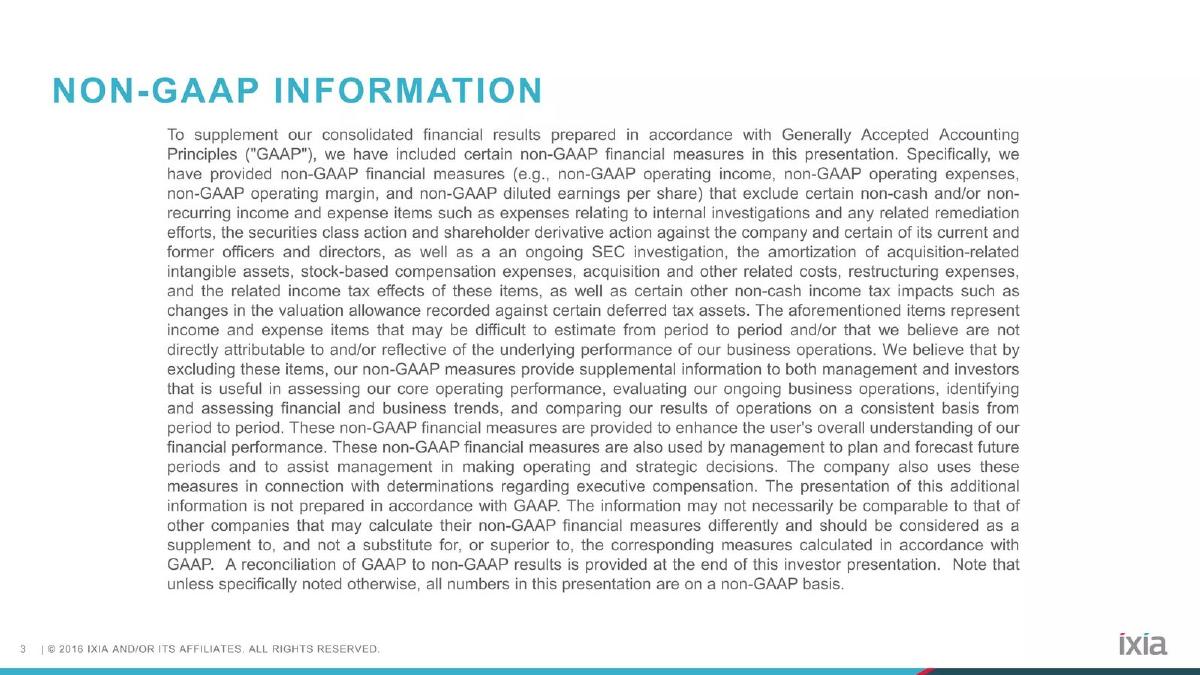
- Ixia provides a rigorous reconciliation on slide 19 to bridge the gap between GAAP and non-GAAP figures. Major adjustments include the amortization of intangible assets (8.6% of revenue in YTD Q2 2016) and stock-based compensation (3.6%). These adjustments allow the company to show a non-GAAP net income of 9.6% despite a GAAP net loss of 0.5%.
- What are the key market trends Ixia is capitalizing on?
- Slide 7 outlines four trends: 90% of mobile traffic moving to the cloud by 2019, a 38% increase in security incidents, the generation of 150GB of data per person daily by 2020, and 6 billion connected IoT devices by 2018. These metrics are used to justify the need for better network visibility and security.
- What does the target financial model indicate about the company's maturity?
- The target model on slide 16 indicates a highly mature company focused on optimization. By targeting a 12-16% net margin and 76-78% gross margin, Ixia is signaling to investors that it has a predictable, scalable business engine. This is typical for a public company or a late-stage firm preparing for an exit.
- Is there information about the leadership team or the specific investment ask?
- The provided slides mention Bethany Mayer as President and CEO on slide 2, but there is no dedicated team slide or specific 'ask' (valuation or capital amount) in the 7 slides shown. As this is an 'Investor Presentation' for a specific quarter (Q2 2016), it functions more as a performance update than a capital-raising pitch.