PVcase’s Series B deck is a masterclass in market timing and efficiency-driven value propositions. By framing the problem through the lens of a massive, accelerating market—projected to reach 857 GW by 2029—the company establishes immediate relevance for late-stage investors. The core of their pitch rests on a staggering efficiency metric: reducing solar design time by 30x compared to manual processes. While the provided slides lack specific financial disclosures or a formal team breakdown, the focus on product integration (PVcase Yield and Ground Mount) and social proof via customer testimon…
Key takeaways
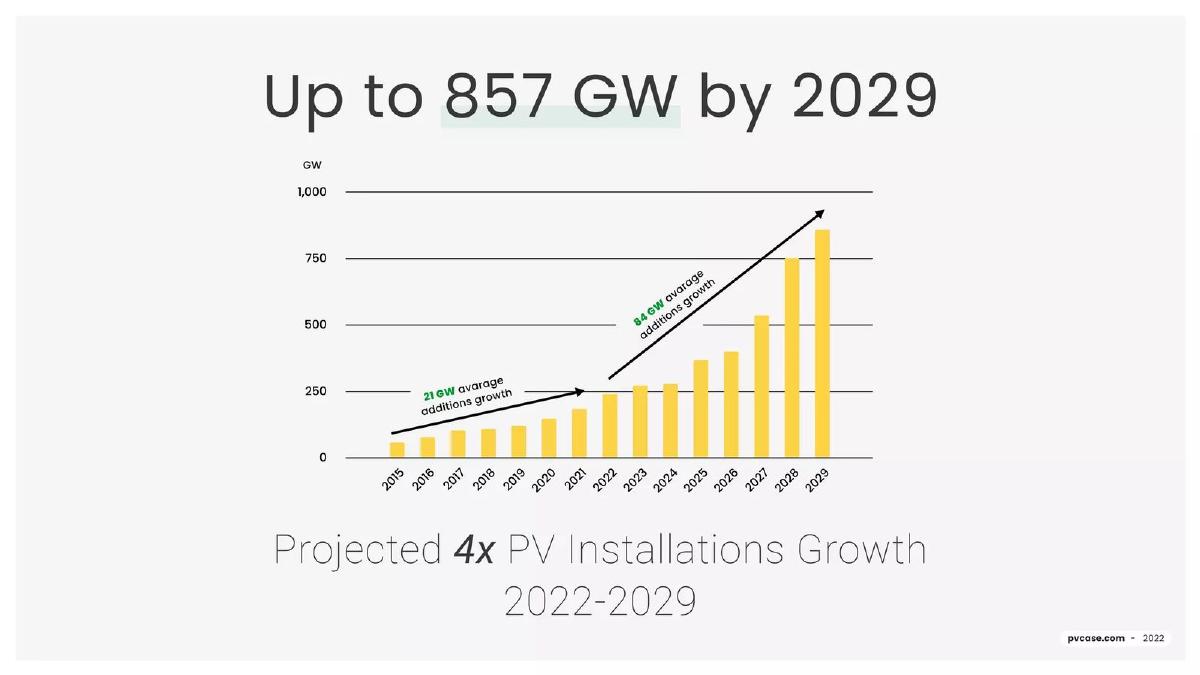
- The market opportunity is defined by a projected 4x growth in PV installations between 2022 and 2029 (Slide 2).
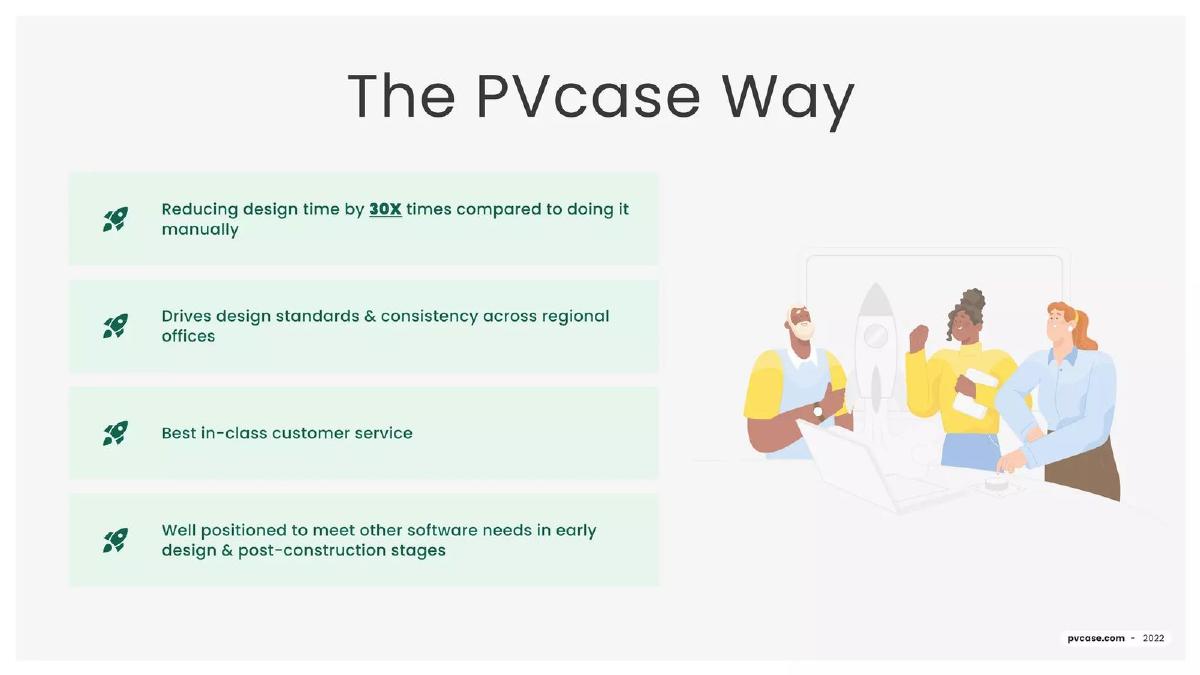
- PVcase claims to reduce solar design time by 30x compared to manual methods (Slide 3).
- The company highlights a shift from 21 GW average annual additions to 84 GW average additions growth (Slide 2).
- Product positioning emphasizes a 'physics-based simulation support' for advanced bifacial and HSAT systems (Slide 5).
- Customer validation is provided by Lasse Nieswitz of SENS, noting a two-week training period for new users (Slide 4).
- The deck positions PVcase as a solution for both early design and post-construction stages (Slide 3).
- The company leverages over 10 years of R&D experience to differentiate its technical moat (Slide 5).
- The visual identity focuses on 'Fighting Climate Change Through Software,' aligning with ESG investment mandates (Slide 6).
Executive Summary: The Infrastructure of the Energy Transition
PVcase’s Series B deck, dated 2022, is a lean, product-focused presentation that relies on the sheer scale of the solar market to do the heavy lifting. In a $100M round, investors are looking for evidence of a 'category king'—a company that has moved beyond product-market fit and is now an essential utility for its industry. PVcase attempts to prove this by showing how their software is the only way to keep pace with the projected 857 GW of solar capacity needed by 2029. The deck moves quickly from market macro-trends to specific engineering efficiencies, using a 30x time-savings metric as its central anchor.
Slide 1: Title and Mission
The deck opens with a minimalist title slide. It features the PVcase logo and the tagline: "Fighting Climate Change Through Software." This positioning is strategic for a Series B. It moves the company away from being viewed as a niche CAD plugin and toward being an ESG-aligned infrastructure play. The imagery of a utility-scale solar farm integrated with nature reinforces the scale of the projects their software supports.
Slide 2: The Macro Opportunity
Slide 2 is the most data-heavy slide in the set, focusing on "Projected 4x PV Installations Growth 2022-2029." The chart illustrates a massive inflection point in the industry. It contrasts the historical growth (2015-2021) of "21 GW average additions growth" with the projected future growth (2022-2029) of "84 GW average additions growth." By highlighting the target of "Up to 857 GW by 2029," PVcase establishes that the bottleneck in the industry isn't demand for solar, but the capacity to design and deploy it—a bottleneck their software is designed to solve.
Slide 3: The PVcase Way (Value Proposition)
This slide transitions from the 'Why Now' to the 'How.' It lists four key pillars of their value proposition:
Reducing design time by 30X times compared to doing it manually. · Drives design standards & consistency across regional offices. · Best in-class customer service. · Well positioned to meet other software needs in early design & post-construction stages.
The 30x metric is the standout figure here. In a Series B deck, such a high efficiency multiplier is intended to signal that the product is not just an incremental improvement, but a fundamental shift in how the work is performed.
Slide 4: Social Proof and Usability
Slide 4 features a customer reference from Lasse Nieswitz, Team Lead Design Engineering at SENS (STEAG Solar Energy Solutions). The quote addresses a major pain point in the engineering sector: talent shortages. Nieswitz states, "I can train a student just starting in the industry to use PVcase perfectly within two weeks on the job." This validates the claim of a "simple interface" and suggests that PVcase allows firms to scale their output without needing to find and hire rare, highly experienced senior designers for every task.
Slide 5: Product Deep Dive - PVcase Yield
This slide focuses on a specific product module, PVcase Yield. It emphasizes technical superiority and R&D depth, citing "Over 10 years of R&D experience." The feature list includes:
Convenient, cloud-based user interface. · Faster modelling with no size limitations. · Integration with PVcase Ground Mount. · Improved ability to represent physical reality. · Physics-based simulation support for bifacial and HSAT systems.
The mention of "bifacial and HSAT systems" is critical. These are the current industry standards for high-efficiency, utility-scale solar. By explicitly supporting these, PVcase signals that its software is built for the most complex, high-value projects in the market.
Slide 6: Closing and Social Presence
The final slide in the provided set repeats the mission statement: "Fighting Climate Change Through Software." It includes links to their website and social media handles (LinkedIn, Instagram, Twitter, YouTube). While standard, the repetition of the mission statement serves to bookend the technical details with the broader impact of the company's work.
What Works in the PVcase Deck
The deck excels at quantifying the pain point. By showing the 4x growth in installations, they make it clear that manual design processes are no longer viable. If the industry is to grow by 84 GW per year, the engineering work must be automated. The 30x efficiency claim is a powerful hook that justifies a high valuation, as it implies PVcase is a massive labor-saving device for its customers.
Furthermore, the customer testimonial is perfectly chosen. It doesn't just say the software is good; it says the software solves a specific business problem (training new staff). This is a 'bottom-up' validation that resonates with the engineers who actually use the tool, which is often a prerequisite for 'top-down' enterprise sales.
What is Missing from the PVcase Deck
As a teardown of a $100M Series B deck, the omissions are significant. There is no financial data provided in these slides. At this stage, investors would expect to see ARR (Annual Recurring Revenue) growth, Net Revenue Retention (NRR), and LTV/CAC ratios. Without these, it is impossible to see how the 30x efficiency translates into company revenue.
There is also no team slide. For a company claiming 10 years of R&D, the pedigree of the founders and the engineering team is a vital part of the 'moat' story. Additionally, the deck lacks a competitive analysis. While they mention manual design, they do not address other solar design software competitors, which is a standard requirement for late-stage due diligence.
Founder Takeaways: What to Copy
Use a 'Bottleneck' Narrative: If you are in a fast-growing industry, don't just show the market growth. Show why the current way of doing things cannot handle that growth. PVcase does this by contrasting the 84 GW growth projection with the need for 30x faster design.
Focus on Training Speed: In technical B2B SaaS, the 'time to value' for a new employee is a massive selling point. If your software reduces the training period from months to weeks, make that a headline. It speaks directly to the customer's ability to scale their own business.
Align with ESG: Even if you are a pure-play software company, if your product enables a greener industry, lead with that mission. It broadens your appeal to a wider range of institutional investors who have specific mandates to invest in climate-positive technologies.
Frequently asked questions
- What is the primary value proposition of PVcase?
- The primary value proposition is extreme efficiency in solar engineering. According to slide 3, the software reduces design time by 30x compared to manual processes. This is supported by customer testimonials stating that even students can be trained to use the interface perfectly within two weeks, significantly lowering the barrier to entry for engineering talent in the solar sector.
- How does PVcase define its market opportunity?
- PVcase defines its opportunity through the rapid acceleration of solar capacity. Slide 2 shows that while average additions growth was 21 GW previously, it is projected to jump to 84 GW. The company expects total installations to reach 857 GW by 2029, representing a 4x growth rate from 2022 levels.
- What specific technical features are highlighted in the deck?
- Slide 5 highlights 'PVcase Yield,' which features a cloud-based user interface, faster modeling with no size limitations, and integration with 'PVcase Ground Mount.' It specifically mentions physics-based simulation support for bifacial modules and Horizontal Single-Axis Tracker (HSAT) systems, which are standard in utility-scale solar.
- Who are the target customers for PVcase?
- Based on slide 4, the target customers are engineering firms and energy solution providers. The deck features a reference from SENS (STEAG Solar Energy Solutions), specifically quoting a Team Lead of Design Engineering. This indicates the software is built for professional engineers managing large-scale solar projects.
- What is missing from this version of the PVcase deck?
- This 11-slide deck (with 6 provided) omits several standard Series B requirements. There is no slide detailing the management team's background, no specific financial metrics (ARR, churn, or margins), and no explicit 'Ask' slide detailing how the $100M will be allocated. It also lacks a competitive landscape analysis.