The uSTADIUM pitch deck from 2014 presents a mobile-first social network designed specifically for sports fans. The company identified a problem where mainstream platforms like Facebook and Twitter isolated fans rather than connecting them. With 2,500+ iOS downloads within the first few weeks of launch and a list of over 15 athlete connections, the deck leans heavily on social proof and networking. However, the presentation lacks critical financial data, including a specific funding ask, valuation, or detailed unit economics. The revenue model remains high-level, citing e-commerce and adverti…
Key takeaways
- The platform launched its iOS app on 5/8/14 and achieved 2,500+ downloads shortly thereafter (Slide 3).
- uSTADIUM claims to have generated 180MM+ impressions across 5 events since 2013 (Slide 3).
- The startup leverages a list of 15+ professional athlete connections, including names like Cruz, Holmes, and Mack, to drive engagement (Slide 3).
- The revenue model is diversified across e-commerce, advertising, and sponsored experiences within the app (Slide 4).
- The team includes a CFO who generated $1MM per quarter in mobile revenues at LivingSocial (Slide 5).
- The deck identifies six direct competitors, including Sportlobster and Chat Sports, but dismisses them for having 'too much functionality' (Slide 6).
- There is no mention of a specific fundraising goal, use of proceeds, or current burn rate in the provided slides.
- The deck relies on subjective competitive advantages, explicitly stating the company wins because they are 'cool' (Slide 6).
Executive Summary: The Social Sports Niche
The uSTADIUM pitch deck, dated 2014, represents an era of mobile-first social networking where 'unbundling' larger platforms was a popular thesis. The company positions itself as the antidote to the 'loneliness' of sports fans on Facebook and Twitter. By focusing on a specific vertical—sports—uSTADIUM sought to build a high-engagement community supported by professional athlete endorsements and live event activations. While the deck succeeds in showing early community interest and a capable team, it leaves significant questions regarding the business's long-term financial viability and specific capital requirements.
Slide 1: Title and Branding
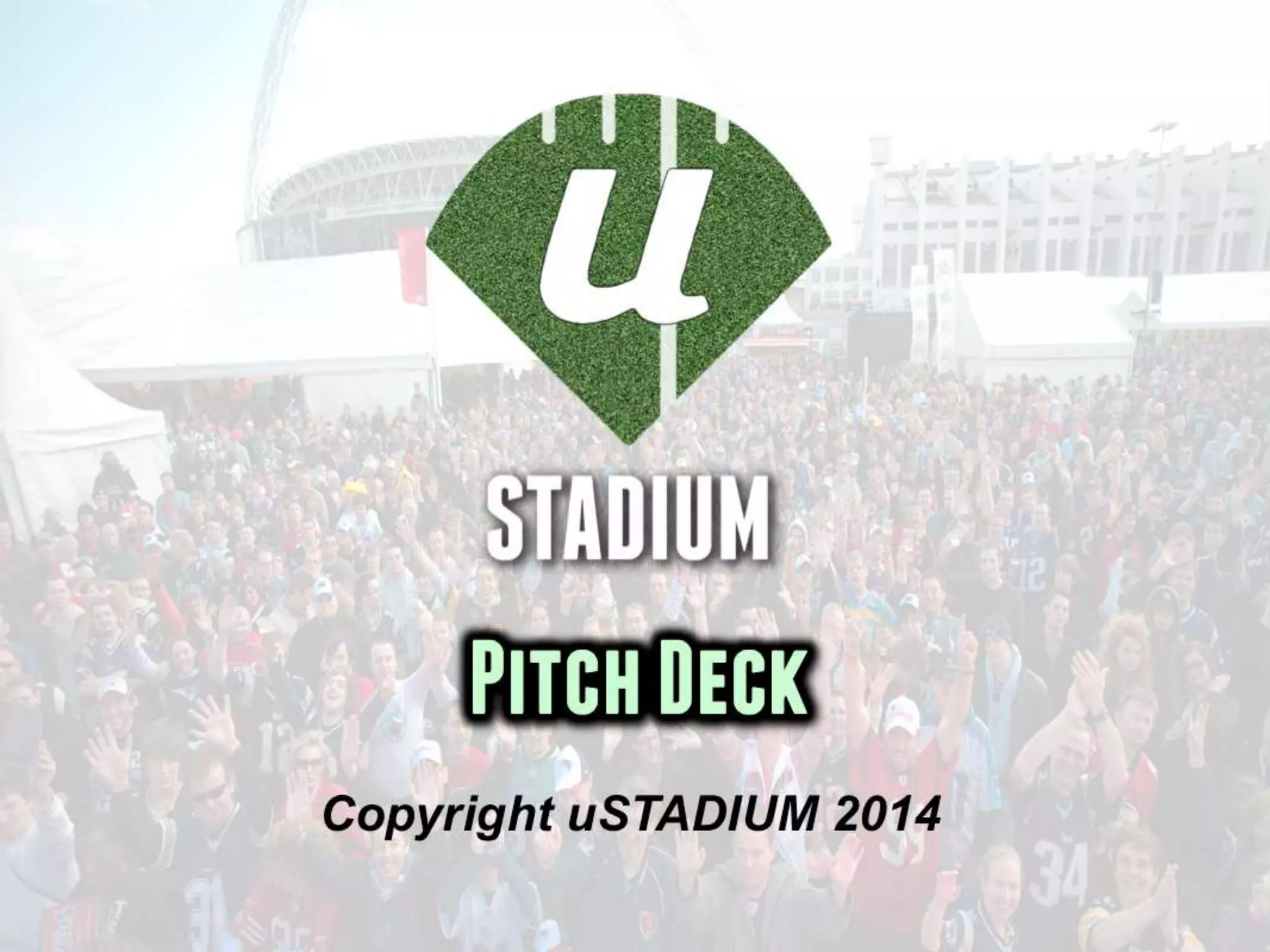
The cover slide introduces the uSTADIUM logo—a stylized 'u' inside a green football field diamond. The background features a crowded outdoor event, likely a tailgate or fan zone, which aligns with the company's focus on live sports culture. The slide includes a copyright notice for 2014, establishing the timeframe of this specific iteration of the business. The branding is clear, though the aesthetic is very much of its time, utilizing heavy drop shadows and high-contrast text overlays.
Slide 2: The Problem Statement
Slide 2 defines the 'Problem' as the isolation caused by general-purpose social networks. It states that "Facebook, Twitter and other social networks isolate fans." The deck argues that these platforms provide no incentive for fans to form identities or interact with one another in a meaningful way. The slide claims that "Fans no longer have to be lonely b/c they don't know where others are chatting about or watching the game." The proposed solution is that "uSTADIUM creates instant camaraderie." This is a classic 'community-first' pitch, focusing on the emotional and social gaps in the existing market rather than a technical deficiency.
Slide 3: Traction and Social Proof
This is the most data-dense slide in the deck. It breaks down the company's progress into four quadrants:
Since 2013: The company reports "5 events, 1.8K+ fans, 180MM+ impressions." This suggests a high level of viral reach relative to the small physical fan base. · Coverage: The deck lists several reputable media outlets, including "ESPN NY, SNY, NY Post, SportTechie..." · iOS Release: The app launched on "5/8/14" and achieved "2,500+ downloads" in the immediate aftermath. · Athlete Connects: A significant portion of the slide is dedicated to a list of over 15 professional athletes, including "Cruz, Holmes, A Rolle, Wilkerson, J Clowney, Ivory, S Richardson, Woody, Manningham, K Mack, K Fuller, Coples, D Davis, Amukamara, Powell..."
This slide effectively demonstrates that the team has the networking capability to get the product in front of high-profile influencers, which is critical for a social network's growth.
Slide 4: The Revenue Model
Slide 4 outlines how uSTADIUM intends to monetize its user base. The primary revenue streams are listed as "E/M-Commerce, Advertising & Sponsored Experiences via uSTADIUM App & Events." The slide includes a mockup of the app's 'Contests' section, showing how brands can "Sponsor directly on our app." Examples of contests include 'Best Tailgate' and 'Coolest Jersey.' While the model is clear, the slide lacks any mention of current revenue figures, conversion rates, or average revenue per user (ARPU), making it a theoretical model rather than a proven one.
Slide 5: The Team Pedigree
The team slide highlights a mix of editorial, operational, and technical talent. Key highlights include:
CEO Frank: Economics degree from Colgate and lead on a "60MM+ hits sports blog/ #1 web show." · CFO Charles: uPenn graduate who launched 5 of 13 markets for LivingSocial and "generated $1MM/quarter in mobile revenues." · CTO Javi: Master's in Computer Science and an "iOS dev expert." · CMO Nick: Described as "Mr. Viral" with an internship at WFAN that secured the athlete connections.
The inclusion of a CFO with specific mobile revenue experience (LivingSocial) is a strong signal to investors that the company understands how to scale a digital marketplace or ad-supported platform.
Slide 6: Competition and Differentiation
Slide 6 lists several competitors: "Sportlobster, Fancake, OnUp Games, Chat Sports, PlayUp & Sports Yapper." The founders critique these competitors for having "too much functionality, nothing sticky, & lack any offline/athlete presence." The slide concludes with a highly subjective and bold claim: "uSTADIUM wins b/c we're cool." While this speaks to the brand's confidence, it lacks a rigorous analysis of why their 'simple' package of features is technically superior or more defensible than the competitors' offerings.
What Works in This Deck
The uSTADIUM deck is highly effective at demonstrating social proof . By listing a large number of professional athletes and reputable media outlets, the founders prove they have the 'right to play' in the sports industry. The traction slide (Slide 3) provides concrete numbers regarding their launch and event history, which helps ground the pitch in reality. Furthermore, the team slide (Slide 5) shows a balanced group with both technical skills and business experience, particularly the mention of the CFO's previous revenue-generating success.
What Is Missing
The most glaring omission is the Financial Ask . There is no slide indicating how much money the company is looking to raise, what the valuation is, or how the funds will be allocated. Additionally, the deck lacks a Market Size slide. While the sports fan market is intuitively large, investors need to see a quantified Total Addressable Market (TAM) to understand the potential scale of the investment. Finally, the Product itself is only shown in small mockups; a more detailed walkthrough of the user experience and 'stickiness' would have helped counter the criticism of competitors having 'too much functionality.'
Founder Takeaways
Founders can learn two distinct lessons from this deck. First, leverage your network early . uSTADIUM's list of athlete connections is their strongest asset, and they put it front and center. Second, avoid subjective competitive advantages . Claiming a product will win because it is 'cool' (Slide 6) is rarely enough to convince a professional investor. Instead, focus on data-driven metrics like retention rates, time spent in-app, or unique features that competitors cannot easily replicate. If you are building a community platform, show the 'gravity' of that community through engagement data rather than just download counts.
Frequently asked questions
- What is the primary problem uSTADIUM aims to solve?
- According to Slide 2, uSTADIUM addresses the isolation fans feel on mainstream social networks like Facebook and Twitter. The founders argue these platforms provide no 'home' or incentive for fans to form identities or meet others. uSTADIUM intends to create 'instant camaraderie' by providing a centralized digital space where fans know exactly where others are chatting about or watching a game.
- How does uSTADIUM plan to make money?
- Slide 4 outlines a three-pronged revenue model: e/m-commerce, advertising, and sponsored experiences. These streams are delivered through both the mobile app and live events. The slide specifically highlights the ability for brands to 'Sponsor directly on our app' through contests, such as 'Best Tailgate' or 'Coolest Jersey,' which are shown as mockups in the deck.
- What early traction did the company demonstrate?
- Slide 3 details traction since 2013, including five events and 1.8K+ fans resulting in over 180 million impressions. Following the iOS release on May 8, 2014, the app secured over 2,500 downloads. The company also cites media coverage from ESPN NY, SNY, the NY Post, and SportTechie to validate its market presence.
- Who are the key members of the uSTADIUM leadership team?
- The team, detailed on Slide 5, consists of CEO Frank (formerly of a high-traffic sports blog), CFO Charles (ex-LivingSocial), and CTO Javi (enterprise systems expert). The technical team is rounded out by Angelo (Android developer) and Matt (Python expert/FactSet). CMO Nick is credited with securing the company's extensive list of athlete and celebrity connections.
- What is missing from this pitch deck?
- The deck is missing several standard fundraising components. There is no 'Ask' slide detailing how much capital is being raised or the intended use of funds. It lacks a financial roadmap, detailed unit economics (like Customer Acquisition Cost or Lifetime Value), and a clear exit strategy. Additionally, the market size (TAM/SAM/SOM) is not quantified numerically.