Remote Team on a Pitch Deck: How to Say Where Your Team
If your team is remote or spread across countries, investors want to know where people are, how the company works together and what it means for hiring.
Remote or Distributed Team on a Pitch Deck: Say Where People Are, How You Work and What It Changes
Many startups now have no single office. Founders often mention this in one phrase, such as 'fully remote' or '100% remote team', and move on. Investors read that phrase with questions in mind: where are the people, which countries will the company hire and pay in, how do decisions get made without an office, and is 'remote' a cost saving, a hiring advantage, or both? This guide looks at four pages that describe a remote or distributed team and shows how to turn the phrase into useful information.
TL;DR
Say where the team is, how many people are in each main location, and what working remotely changes for the business: hiring, cost, time zones or how decisions are made. Hone does this most compactly: 'Full team: 70' and 'Location: Remote-first, in SoCal, SF Bay Area, NYC, + more (US only)'. ID5 gives the most data, a monthly headcount chart from 14 to 48 people and '13 different countries, including 12 people in the US', but credits its growth to being remote without showing why. Arist explains how a remote team works ('clear goal-setting, writing-driven communications... regular in-person meet-ups'). KEA Reboost gives only '100% remote team to reduce overhead costs'. One line on location and one on how you work usually answer what investors will ask.
Four pages that describe a remote or distributed team
Each page is read at full size. Quotes are exact.
Hone team slide — slide 3
Live online manager training. Team slide with founders, department heads and a location line.
Hone deck, slide 3. Exact stored slide matched to this analysis.
Our analysis: The most efficient way to answer where the team is.
Evidence and limitation: Head count, main locations and a single hiring country stated.
What a founder can adapt: Add how often the team meets and numbers per location.
Supporting analysis
What the deck claims: "Full team: 70 (50% female & nonbinary; 38% non-white)". "Location: Remote-first, in SoCal, SF Bay Area, NYC, + more (US only)".
Presentation choice: Shows a one-line location statement with real information.
When it does not fit: Badges without saying what they measured.
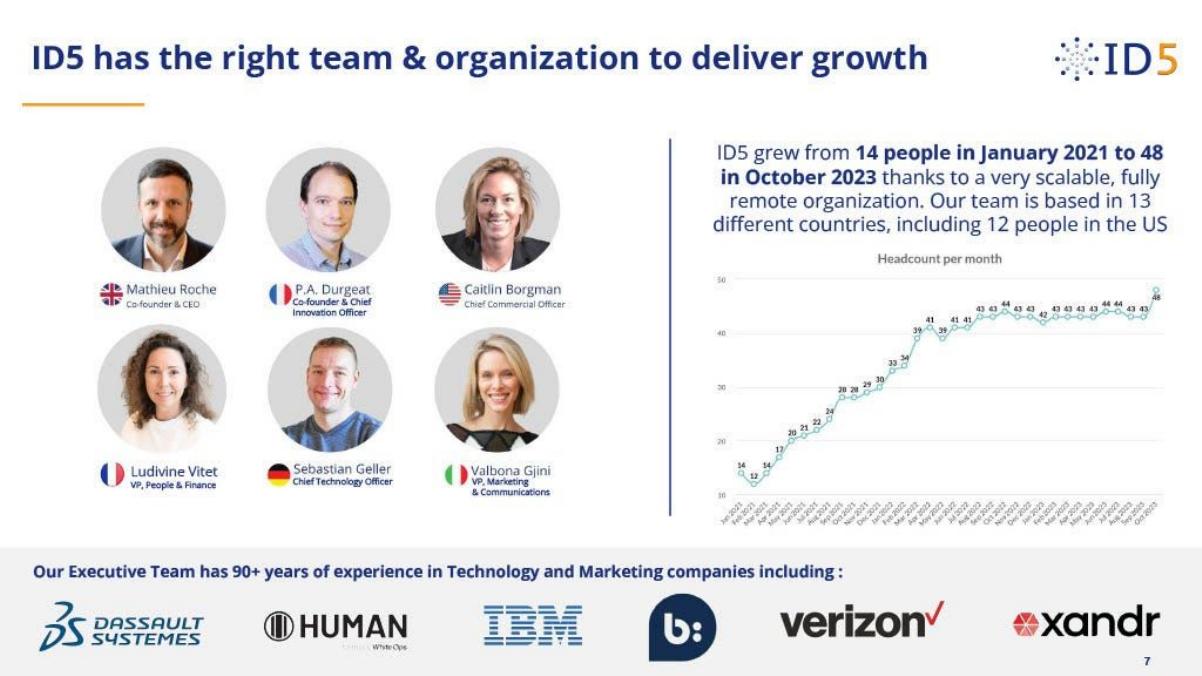
Advertising identity technology. Executive photos with a monthly headcount chart.
ID5 deck, slide 7. Exact stored slide matched to this analysis.
Our analysis: Rich data, but the headline credits growth to remote working without support.
Evidence and limitation: Monthly headcount 14 to 48; flat at 41 to 44 from April 2022 to September 2023; 13 countries; 12 in the US.
What a founder can adapt: State what remote hiring enabled, not that it caused growth.
Supporting analysis
What the deck claims: "ID5 grew from 14 people in January 2021 to 48 in October 2023 thanks to a very scalable, fully remote organization. Our team is based in 13 different countries, including 12 people in the US".
Presentation choice: Shows how to give countries and headcount, and the risk of a causal headline.
When it does not fit: Headlines the chart beneath doesn't support.
Text-message training. Memo-format page with team photo.
Arist deck, slide 20. Exact stored slide matched to this analysis.
Our analysis: The only example that explains how the team works without an office.
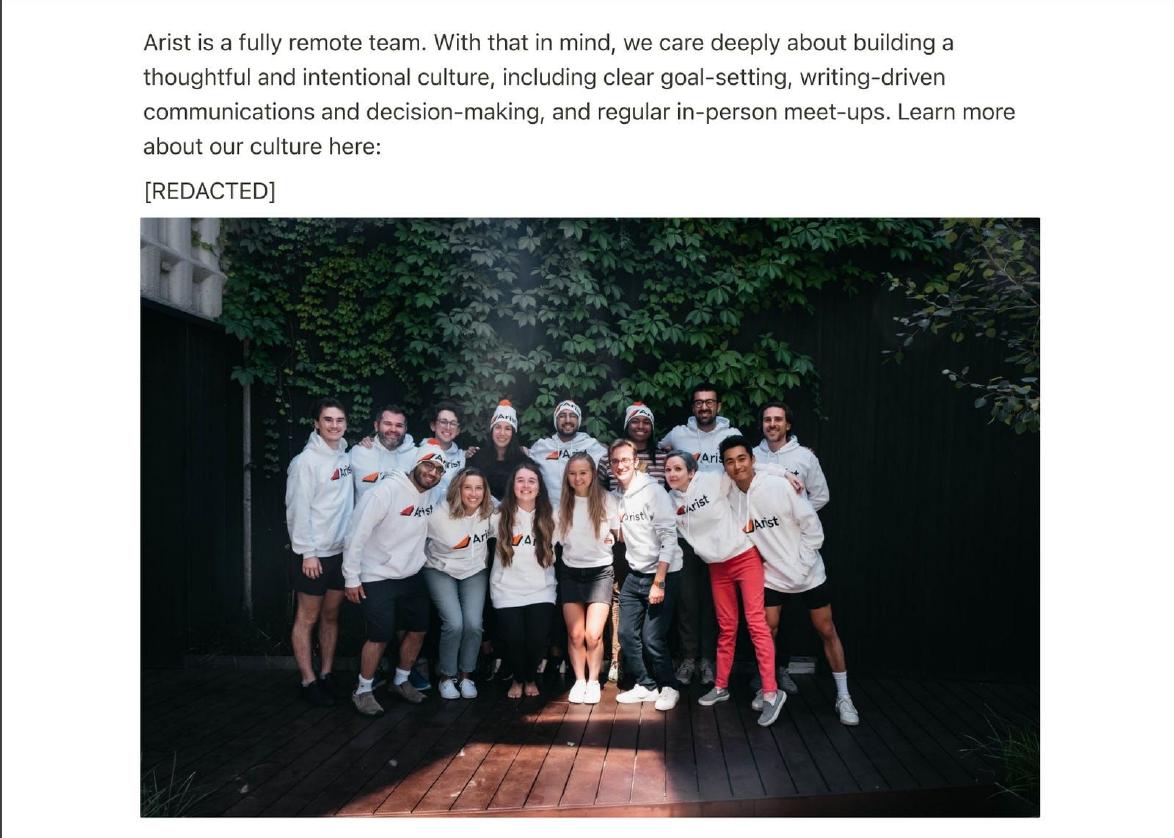
Evidence and limitation: Three working practices named; team photo; no locations or head count.
What a founder can adapt: Add locations, head count and meet-up frequency.
Supporting analysis
What the deck claims: "Arist is a fully remote team... clear goal-setting, writing-driven communications and decision-making, and regular in-person meet-ups."
Presentation choice: Shows the working practices investors look for.
When it does not fit: Using a photo as a substitute for a head count.
What each page tells an investor about a remote team
Locations, head count, working practices, reason and evidence for the reason.
Example
Locations given
Head count
How the team works
Reason given
Reason supported
Hone
Yes (cities, US only)
70
No
Not stated
Not applicable
ID5
13 countries; 12 in US
48 (monthly chart)
No
Growth
No
Arist
No
No (photo only)
Yes (three practices)
Culture
Partly (photo)
KEA Reboost
No
No
No
Cost
No
Key Takeaways
Say where people are, not just that they are remote.
Give the total head count and the main locations or countries.
Say whether you hire in one country or many; it affects cost, payroll and legal setup.
Explain in one line how a remote team makes decisions and meets.
If remote saves money, show how much; if it helps hiring, say how.
Don't credit growth to being remote unless you can show the link.
Describe your remote team
Answer these before you finalise the team slide.
Where. How many people are in each country or city? Do you hire in one country or several?
How. How are decisions recorded and goals set? How often does the team meet in person?
Why. Is remote about cost, hiring, being near customers, or several of these? What is one fact for each?
Next. Where will the hires funded by this round be located?
Copyable framework: "Remote-first team of [N] in [countries]; largest groups in [X] and [Y]. Written decisions, [frequency] goals, in-person weeks [frequency]. Remote lets us [hire / save / serve] [specific fact]."
Illustrative example 1 — written by us
Before: "100% remote team to reduce overhead costs"
After: "Fully remote team of [N] in [countries]; no office lease, saving about $[X] a year."
What improved: Our illustrative rewrite of KEA Reboost's bullet. Bracketed details are not stated on the slide.
The question this guide answers
This guide answers one founder question: if my team is remote or spread across countries, what should the deck say about it so investors see a working organisation rather than an unanswered question?
Our team slide guide covers who to feature and how to describe experience. Our culture draft covers values and how a team works in general, our org chart draft covers reporting lines, and our international expansion guide covers entering new markets. None makes location and remote working its subject. The advice here is specific: which facts about a remote team investors look for, how they affect cost and hiring, and where to put them.
The question matters most for early teams spread across time zones, companies hiring engineers in lower-cost countries, and founders who list 'remote' as a cost advantage.
How we chose and read the examples
We searched extracted slide text for 'fully remote', 'remote-first', 'distributed team' and 'remote team'. Most of the 62 matching pages were companies that sell products for remote workers, where 'remote' describes the customer's problem rather than the startup's own team; we excluded those, and listed companies. We kept four pages where founders describe their own team: two team slides, one business model slide and one page from an investment memo written in document form.
Each page was rendered from the source deck and read at full size. ID5's headcount chart labels are small, so we enlarged it at 300 dpi before reading the monthly values. We did not check any claim against outside sources. The analysis is about how the pages present a remote team, not whether remote working suited these companies.
Four examples are enough because each shows a different approach: a location line, headcount data with countries, a description of working practices, and a cost claim.
What investors want to know about a remote team
Where people are. 'Remote' can mean one city with no office, one country, or a dozen countries. Each has different consequences for time zones, payroll, employment law and tax. Investors want the actual locations.
How the work gets done. Without an office, a company depends on deliberate habits: written decisions, clear goals, regular meetings in person. Investors want to know the founders have thought about this, especially if the team will double after the round.
What it means for cost. Remote can save rent and allow hiring where salaries are lower. It can also add travel, payroll providers and legal entities. If the deck says remote reduces costs, investors will want to see roughly how much and whether it holds as the company grows.
What it means for hiring. A remote company can recruit from a wider pool. That is a real advantage if the company needs scarce skills. The deck should say whether this is the reason, and whether there are limits, such as hiring only in one country.
Where the customers are. For a company that sells to one market, investors may ask whether sales and support staff are in that market's time zone. ID5's note that 12 people are in the US speaks to this.
A location line with numbers: Hone
Hone, which provides live online training for managers, has a team slide headed 'A world-class, mission-driven team ready to win'. It shows two co-founders and nine department heads with photos, titles and previous employers. Below the founders, two lines read 'Full team: 70 (50% female & nonbinary; 38% non-white)' and 'Location: Remote-first, in SoCal, SF Bay Area, NYC, + more (US only)'. An 'Inc. Best Workplaces 2022' badge and a 'Great Place to Work Certified' badge sit beneath.
This is the most efficient example. In one line a reader learns that the company is remote-first, where its main clusters are, and that it hires only in the US. That last detail matters: it tells an investor the company isn't taking on employment law and payroll in several countries, and that the team works within US time zones. The full team count of 70 puts the eleven faces on the slide in context.
What's missing is how many people sit in each location and what 'remote-first' means in practice: whether there are offices people can use, or how often the team meets. The badges are outside recognitions; the slide doesn't say what they were based on, and we didn't check them. For a company of 70, one more phrase such as 'quarterly in-person weeks; hubs in LA and SF' would answer the question of how the team works.
Headcount and countries, with an unsupported reason: ID5
ID5, which provides identity technology for digital advertising, has a slide headed 'ID5 has the right team & organization to deliver growth'. Six executives are shown with photos and national flags (UK, France, US, France, Germany, Italy). On the right: 'ID5 grew from 14 people in January 2021 to 48 in October 2023 thanks to a very scalable, fully remote organization. Our team is based in 13 different countries, including 12 people in the US'. Below that is a monthly 'Headcount per month' chart.
This is the richest data of the four. The chart, read at 300 dpi, shows headcount rising from 14 in January 2021 to 41 in April 2022, then staying between 41 and 44 for about eighteen months before reaching 48 in October 2023. The country count and the US figure tell investors the company hires internationally and has a meaningful group in its largest advertising market.
The weak point is the word 'thanks'. The slide credits the growth in headcount to being remote, but the chart can't show that; it shows how many people were hired, not why hiring was possible. It also shows that headcount was nearly flat for most of the last eighteen months, which the headline doesn't mention. A reader can see both from the chart, so the headline claim reads as stronger than the evidence. A safer version would say 'fully remote since [year]; hiring in 13 countries let us recruit [specific roles]' and let the chart speak for itself.
Thirteen countries for 48 people also raises a practical question the slide doesn't answer: how the company employs people in each country (its own entities, or an employer-of-record service). That belongs in due diligence, but a founder should be ready for it.
How a remote team works: Arist
Arist, which delivers training through text messages, has a page in its investment memo that reads 'Arist is a fully remote team. With that in mind, we care deeply about building a thoughtful and intentional culture, including clear goal-setting, writing-driven communications and decision-making, and regular in-person meet-ups. Learn more about our culture here:', followed by '[REDACTED]' where a link was, and a photo of about seventeen people in matching company sweatshirts.
This is the only example that explains how the company works without an office. Clear goals, written decisions and regular in-person meetings are the practices investors look for in a remote company, and naming them shows the founders have thought about it. The photo shows the team has met in person, which supports the meet-up claim.
What's missing is where anyone is, how many people there are (the photo suggests roughly seventeen, but a photo is not a head count), and how often the meet-ups happen. Because this is a memo page rather than a slide, it has room for these details. A slide version could keep the three practices and add one line on locations and head count.
Remote as a cost line: KEA Reboost
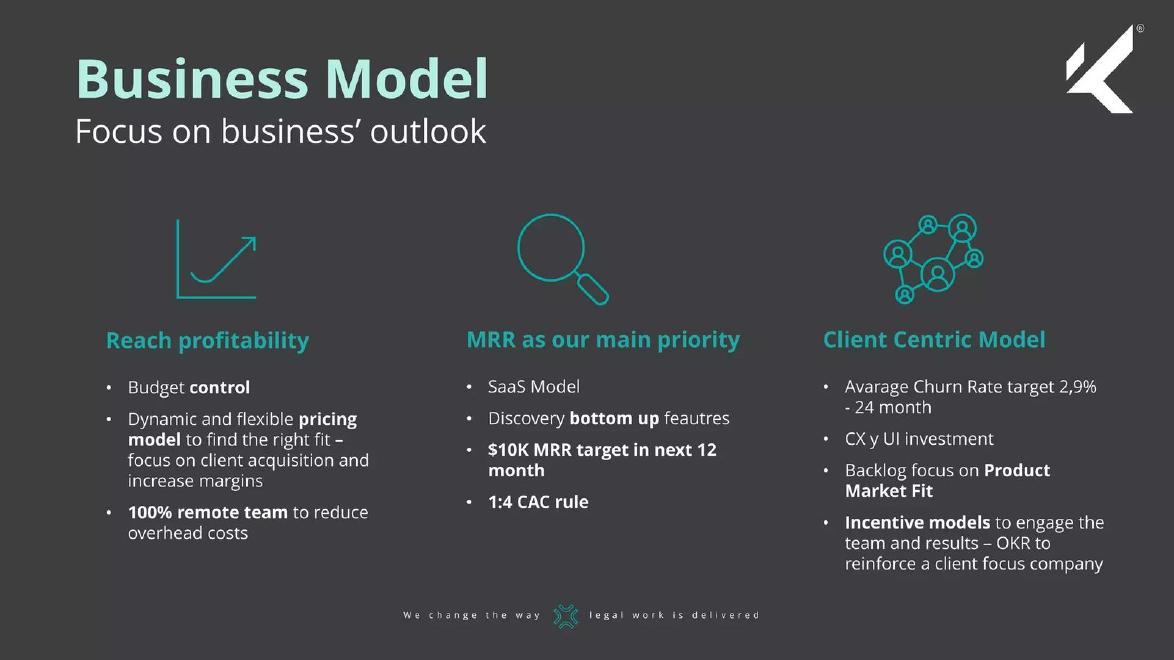
KEA Reboost, which sells legal technology in Latin America, has a slide headed 'Business Model' with the subtitle 'Focus on business' outlook'. Under 'Reach profitability', the third bullet reads '100% remote team to reduce overhead costs'. Other bullets include '$10K MRR target in next 12 month' and 'Avarage Churn Rate target 2,9% - 24 month' (spelling as on the slide).
Here remote working is presented purely as a way to save money, as part of the path to profitability. That is a legitimate reason, and placing it on the business model slide makes the link to cost clear.
But the slide gives no figure for the saving, no head count and no locations. For a company in Latin America, investors may also want to know whether the team is in one country or several, since that affects payroll and legal setup. 'Fully remote team of [N] in [countries]; no office lease, saving about $[X] a year' would turn the bullet into a number an investor can use in a model.
Where on the deck to say it
Team slide: total head count and a location line, as Hone does. If you hire in several countries, say how many and where your largest groups are.
Team or culture slide: one line on how you work, as Arist does: how decisions are recorded, how goals are set, how often the team meets in person.
Business model or financials: if remote is part of your cost case, put the saving in the numbers, not only in a bullet.
Hiring plan: if the round funds hires, say where they will be. Hiring in a new country is a different task from hiring in one you already employ in.
Due diligence: how people are employed in each country, contractor arrangements and any office commitments. These don't belong on slides but should be ready.
What to write
Location: 'Remote-first; [N] people in [countries/cities]; largest groups in [X] and [Y].'
Practice: 'Written decisions, [weekly/quarterly] goals, in-person team weeks [frequency].'
Reason: say whether remote is about cost, hiring, being near customers, or all three, and give one fact for each you claim.
Avoid crediting results to remote working unless you can show the link. 'Remote let us hire senior engineers in [country] at [cost]' is a claim with a mechanism; 'grew thanks to a scalable remote organisation' is not.
What these examples can and cannot show
These four pages show how founders have described a remote or distributed team. They can't show whether remote working helped these companies, what it cost or saved, or how investors reacted. We have not checked any claim against outside sources.
Treat them as patterns of presentation. Hone's location line and Arist's working practices are easy to copy together; ID5's chart is useful data with a headline that claims more than it shows; KEA Reboost's cost bullet needs a number.
Common mistakes
Remote without places. 'Fully remote' with no locations.
No head count. Photos or faces in place of a number.
Unsupported credit. Growth attributed to remote working without evidence.
Cost claim without a number. Savings mentioned but not sized.
No working practices. Nothing on how decisions and meetings happen.
Diagnostic checklist
Head count given.
Locations or countries named.
Single- or multi-country hiring stated.
One line on how the team works.
Reason for remote stated with a fact.
Location of planned hires given.
Frequently asked questions
Do investors mind fully remote teams?
Not usually in itself. They want to know where people are, how the team works and what it means for cost and hiring as the company grows.
Should I list every country?
Not if there are many. Give the count and the largest locations, and say whether you hire through your own entities or a service.
How we chose these examples
Corpus: published pitch deck teardowns on StartupFundraising.com. Founder-uploaded private decks are excluded.
Selection (2026-10-01): we searched extracted slide text for phrases describing remote or distributed teams, excluded companies selling remote-work products, and listed companies, and kept four pages where founders describe their own team, each showing a different approach.
Review: the four pages were rendered from the source decks at full size on 2026-10-01 and read in full against company, deck and page number (editorial model review, with AI assistance in drafting; not human-reviewed). ID5's chart was enlarged at 300 dpi to read monthly values. No claim was checked against outside sources.