Certifications in a Pitch Deck: How to Show B Corp, Carbon
How should a startup show a B Corp score, carbon verification or product certification in a pitch deck?
Certification Slide: Name Who Checked It, When, and What Exactly Was Certified
Many startups, especially consumer brands, food and farming companies and climate businesses, put a certification on a slide: a B Corp score, a carbon verification, an organic or safety label, or a third-party product seal. A certification can be strong evidence, because someone outside the company checked something against a published standard. But on most slides it shows up as a row of logos, and the reader can't tell who checked what, when, or whether the certificate is held today or only planned. This guide uses five real slides to show how to state a certification so it carries weight, and the common ways the claim gets weaker than it should be.
TL;DR
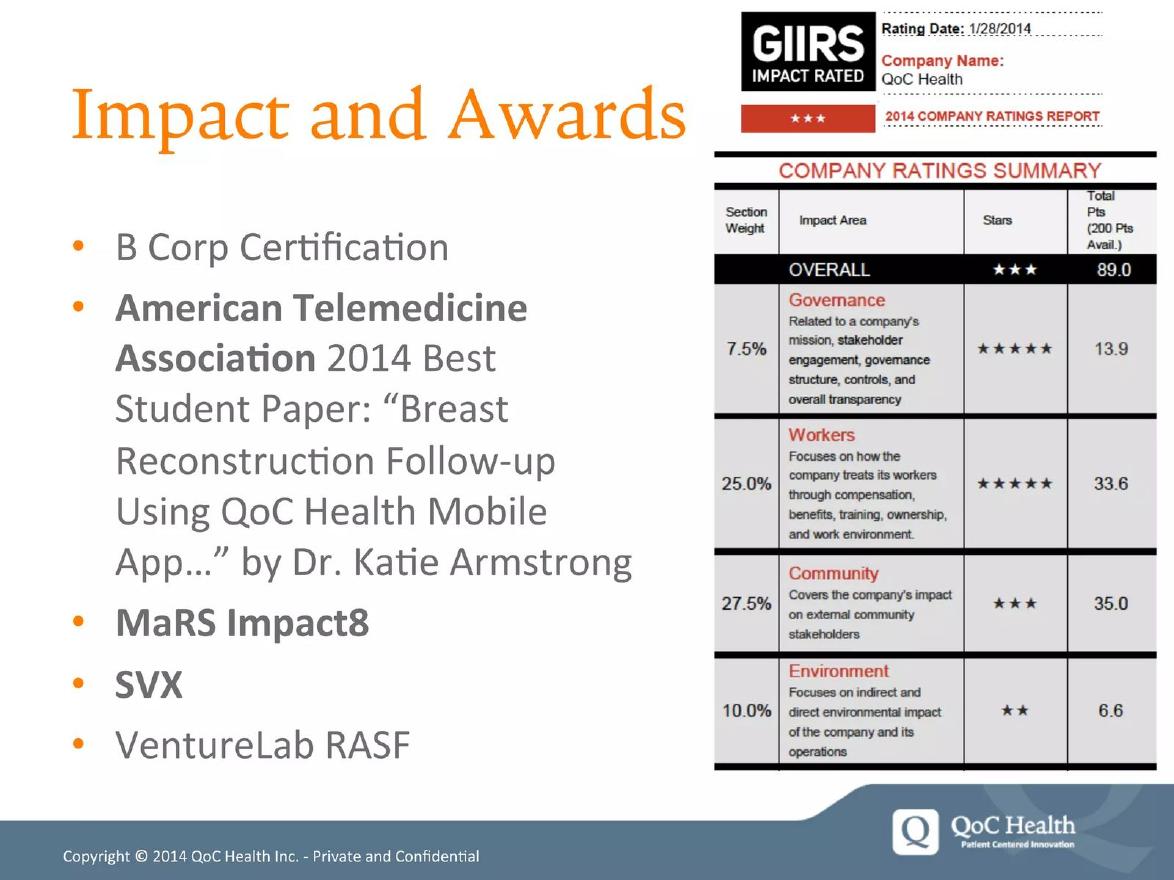
Name the certifier and the standard, say what exactly was checked (the company, one product, or one claim), give the date and the result, and mark plainly whether you hold it today or are working towards it. QoC Health does this best: its slide shows its 2014 impact rating report, dated 28 January 2014, with an overall score of 89.0 out of 200 and the score in each area. A logo alone, as on Bravo Sierra's slide, tells the reader far less.
Five certification slides, read in full
Each slide was rendered from the original deck at full size and read in full. Quotes are the slide's own words; we did not confirm any certificate with the certifier.
QoC Health traction slide — slide 18
Patient follow-up app. "Impact and Awards" slide, 2014.
QoC Health deck, slide 18. Exact stored slide matched to this analysis.
Our analysis: The most checkable certification claim in the set.
Evidence and limitation: Certifier, date, company name and scores shown in the report image.
What a founder can adapt: Add the passing mark and the B Corp certification date.
Supporting analysis
What the deck claims: "B Corp Certification"; "GIIRS Impact Rated"; "Rating Date: 1/28/2014"; overall "89.0" of "200 Pts Avail."; Governance 13.9, Workers 33.6, Community 35.0, Environment 6.6.
Presentation choice: The breakdown shows weak areas as well as strong ones, which builds trust.
When it does not fit: Leaving the reader to guess what 89 out of 200 means.
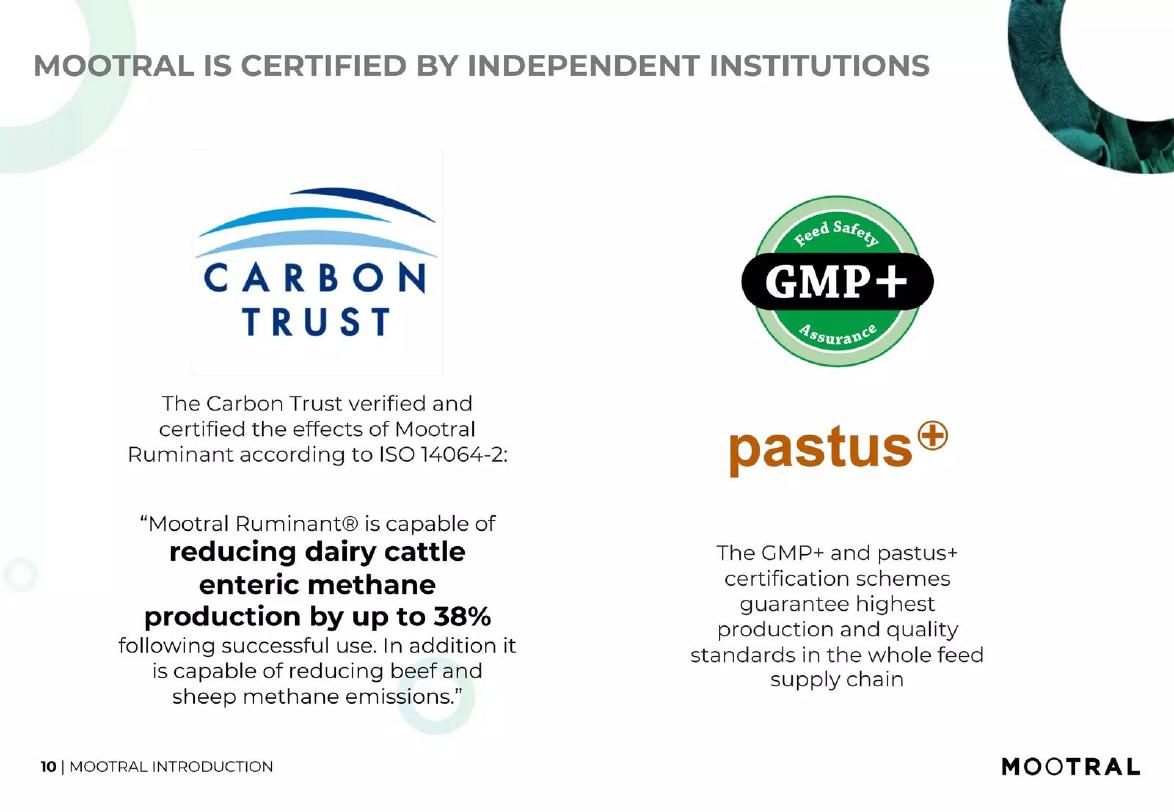
Feed supplement to cut cattle methane. Certification slide.
Mootral deck, slide 10. Exact stored slide matched to this analysis.
Our analysis: Strong where it quotes the verified claim, vague where it shows logos.
Evidence and limitation: Certifier, standard and exact claim named; no dates; second half describes schemes, not holdings.
What a founder can adapt: Add the verification date and state which sites or products hold GMP+ and pastus+.
Supporting analysis
What the deck claims: "The Carbon Trust verified and certified the effects of Mootral Ruminant according to ISO 14064-2"; "capable of reducing dairy cattle enteric methane production by up to 38%"; GMP+ and pastus+ schemes "guarantee highest production and quality standards".
Presentation choice: Naming the standard tells a reader exactly what was checked.
When it does not fit: Describing a scheme in marketing language instead of stating what you hold.
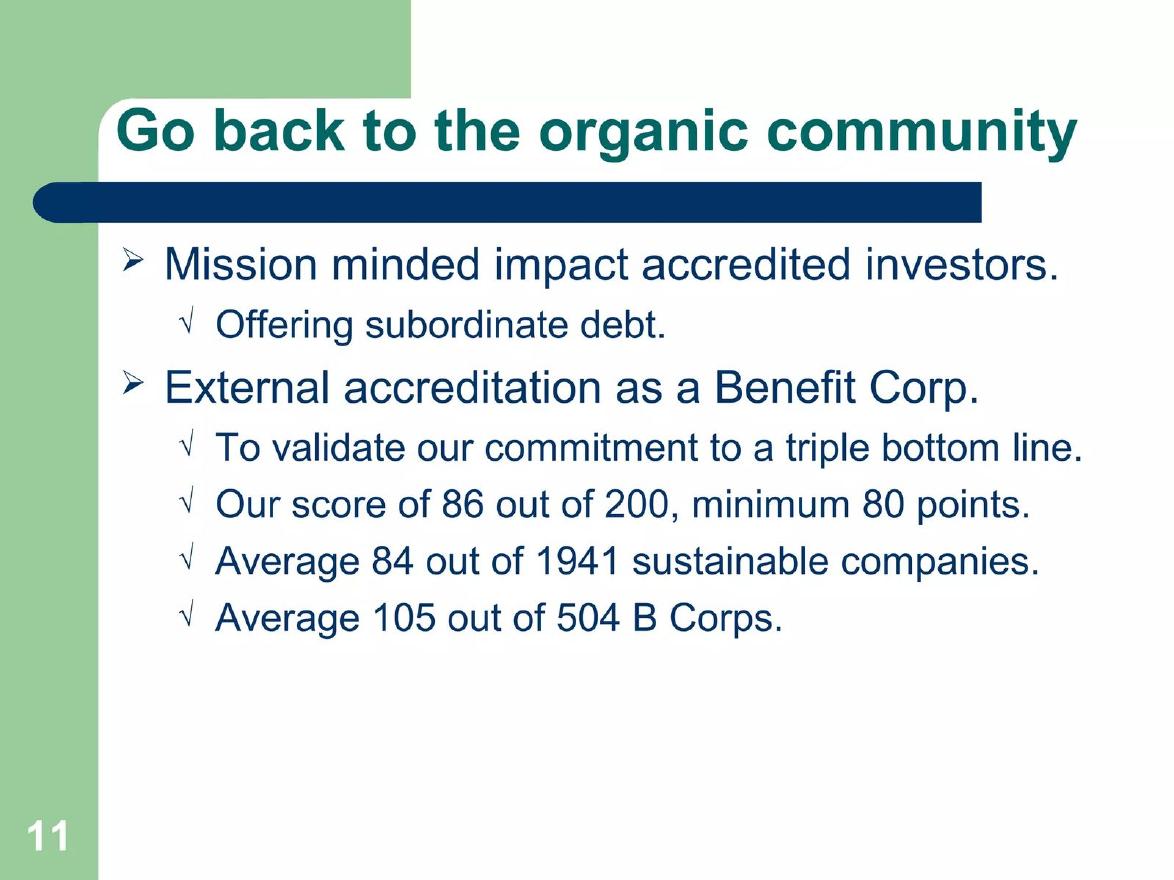
Organic food business raising subordinate debt from impact investors.
Tom Manley deck, slide 11. Exact stored slide matched to this analysis.
Our analysis: Open about where the score sits, but mixes up a legal form and a certification.
Evidence and limitation: Score given with the minimum and two benchmarks; no date.
What a founder can adapt: Write "Certified B Corp" with the certification date, and name the legal form separately.
Supporting analysis
What the deck claims: "External accreditation as a Benefit Corp."; "Our score of 86 out of 200, minimum 80 points."; "Average 84 out of 1941 sustainable companies."; "Average 105 out of 504 B Corps."
Presentation choice: Benchmarks let a reader judge a score in seconds.
When it does not fit: Calling a B Corp score a Benefit Corp accreditation.
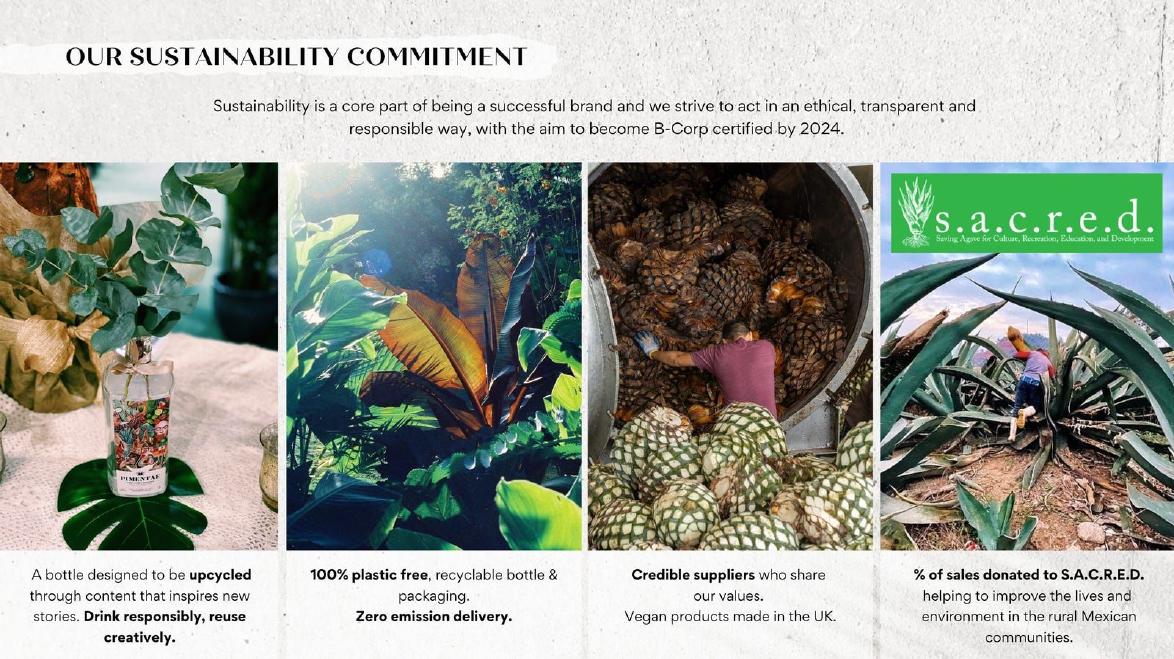
Pimentae deck, slide 16. Exact stored slide matched to this analysis.
Our analysis: Honest status, but no evidence of progress.
Evidence and limitation: Certification stated as a goal with a year; no current step; donation share not given.
What a founder can adapt: Add the step reached, such as an assessment start date or current self-score.
Supporting analysis
What the deck claims: "with the aim to become B-Corp certified by 2024"; "100% plastic free, recyclable bottle & packaging. Zero emission delivery."; "% of sales donated to S.A.C.R.E.D."
Presentation choice: Marking a certification as planned avoids overclaiming.
When it does not fit: A target year with nothing showing the work has begun.
Whether each slide names the certifier and standard, says what was certified, gives a date and states its status.
Example
Certifier and standard
What was certified
Date
Status clear
QoC Health
Yes (GIIRS report)
Company
Yes
Held
Mootral
Carbon Trust, ISO 14064-2; others logos only
One product claim
No
Held (claimed)
Organic food company
Score given; label confused
Company
No
Unclear wording
Bravo Sierra
Logos only
"All products"
No
Held (claimed)
Pimentae
B Corp named
Company
Target 2024
Planned
Key Takeaways
Name the certifier and the standard.
Say what was certified: company, product or claim.
Give the date and the score or result.
Mark held, in progress or planned.
Don't confuse a legal form with a certification.
Write your certification line
Answer each prompt before putting a certification on a slide.
Who. Which body certified you, and under which standard or scheme?
What. Is the certificate for the company, a site, a product or one claim?
When. When was it granted, and when does it need renewing?
Result. Is there a score or level, and what is the passing mark?
Why it matters. Which buyer or investor requires it, and what did it unlock?
Copyable framework: [Certification] from [certifier], [standard], for [company/product/claim], [result], granted [month year]. [What it unlocked or who requires it.]
Illustrative example 1 — written by us
Before: Two small logos and "All products certified by 3rd party".
After: "EWG Verified: 9 of 11 products, since May 2022. Required for our listing at [retailer]."
What improved: Our illustrative rewrite; the figures and retailer are placeholders. It names the scheme, says how many products hold it and since when, and ties it to the traction it unlocked.
The question this guide answers
Founders ask whether a certification is worth a slide, and how to show it. The short answer: it is worth space when the certification matters to the people who buy from you or invest in you, and when the slide lets a reader check it. A food buyer may require a safety scheme. A retailer may stock only products with a certain clean-ingredient label. An impact investor may screen for B Corp status. In those cases the certification is part of the traction story, not decoration.
Other guides touch nearby ground. The data privacy and security guide covers SOC 2, HIPAA and GDPR. The impact slide guide covers how to measure the good a company does. The hardware competition draft covers safety ratings as a difference between machines. None of them answers the general question of how to present an outside certification: which details to include, how to show status, and what a certification can and can't prove. That is this guide.
How we chose and read the examples
We searched the saved slide text from the teardown library for B Corp, Benefit Corp, certification, "certified by" and named schemes, and left out presentations by listed companies and mining or resource firms. One strong candidate, Flow Water's "Company Achievements FY2021" slide with a B Corp score of 126.5, was dropped because the company was listed on a stock exchange when that deck was made. Five slides from five startup decks remained.
Each slide was rendered from the original deck at full size and read in full. Quotes in this guide are the slide's own words. We did not check any certificate with the certifier; what follows is what each slide claims and how clearly it claims it. Certification standards change, so the scores and thresholds described are those each slide reports, at the time of the deck.
The strongest pattern: show the report itself
QoC Health, a patient follow-up app, titles its slide "Impact and Awards". On the left it lists "B Corp Certification", a 2014 American Telemedicine Association best student paper, and three impact programmes. On the right is an image of its "GIIRS Impact Rated" report: "Rating Date: 1/28/2014", "Company Name: QoC Health", "2014 Company Ratings Report", and a table with an overall score of "89.0" out of "200 Pts Avail.", broken into Governance 13.9, Workers 33.6, Community 35.0 and Environment 6.6, each with its weight.
This is the clearest example because a reader can see the certifier, the date, the company name and the score in one place. The breakdown also does something a logo can't: it shows where the company is strong (workers, governance) and where it is weak (environment, two stars). That honesty makes the strong areas more believable.
What it leaves out: the slide doesn't say what 89 means against the passing mark or against other companies, and the B Corp line and the rating report sit side by side without saying how they relate. One sentence would fix it: the minimum score and the date of certification.
Name the standard and quote the finding
Mootral, which makes a feed supplement meant to cut methane from cattle, titles its slide "MOOTRAL IS CERTIFIED BY INDEPENDENT INSTITUTIONS". Under the Carbon Trust logo it says: "The Carbon Trust verified and certified the effects of Mootral Ruminant according to ISO 14064-2", then quotes the finding: "Mootral Ruminant® is capable of reducing dairy cattle enteric methane production by up to 38% following successful use."
This half of the slide is strong. It names the certifier, the standard and the exact claim that was checked, and it uses the certifier's own wording rather than a paraphrase. A reader knows what was verified: one product's effect on methane, not the whole company.
Two things weaken it. "Up to 38%" is a ceiling, not a typical result, and the slide gives no date for the verification. The right half shows GMP+ and pastus+ logos and says these schemes "guarantee highest production and quality standards in the whole feed supply chain". That is a description of the schemes in marketing language, not a statement of what Mootral holds, for which site or product, or since when.
A score with its benchmark, and a mix-up
An organic food company raising subordinate debt from impact investors titles its slide "Go back to the organic community". One point reads "External accreditation as a Benefit Corp.", followed by "Our score of 86 out of 200, minimum 80 points.", "Average 84 out of 1941 sustainable companies." and "Average 105 out of 504 B Corps."
The useful part is the benchmark. Giving the minimum (80) and two averages lets a reader place 86 quickly: just above the passing mark, near the average for the wider group, and well below the average certified B Corp. Few slides are this open about where a score sits.
The problem is the label. A benefit corporation is a legal form a company chooses under state law; it is not an accreditation and has no score. The 200-point assessment with an 80-point minimum is B Lab's assessment for B Corp certification. Calling one by the other's name makes a reader wonder which the company actually has. Say "Certified B Corp, score 86 (minimum 80), certified [month year]", and add "benefit corporation" separately only if that is also true.
Logos with no detail
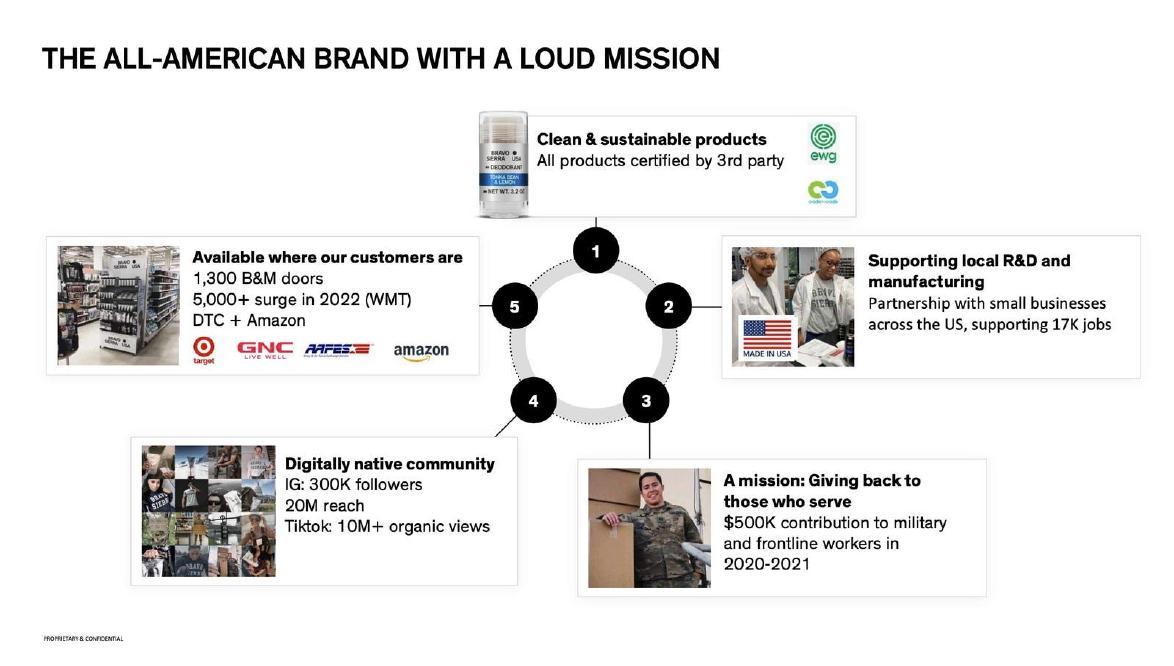
Bravo Sierra, a personal care brand, uses one segment of its "THE ALL-AMERICAN BRAND WITH A LOUD MISSION" slide for "Clean & sustainable products" and "All products certified by 3rd party", next to an EWG logo and a cradle-to-cradle style logo. The rest of the slide covers "1,300 B&M doors", "IG: 300K followers" and "$500K contribution to military and frontline workers in 2020-2021".
The claim is broad, "all products", but the slide doesn't say which certification each logo stands for, which products carry which, or when they were certified. Two small logos can't carry "all products certified". For a brand selling into retailers that check ingredient labels, this is worth a precise line: the scheme name, how many products hold it, and since when.
Planned, and said so
Pimentae, a spirits brand, titles its slide "OUR SUSTAINABILITY COMMITMENT" and says it aims to act "in an ethical, transparent and responsible way, with the aim to become B-Corp certified by 2024." Four photos below cover an upcycled bottle, "100% plastic free, recyclable bottle & packaging. Zero emission delivery.", "Credible suppliers" and "% of sales donated to S.A.C.R.E.D."
The status is honest: it is a goal with a year, not a claim. That is the right way to show a certification you don't hold yet. What it lacks is a step that shows progress, such as "assessment started March 2022, current self-score 72", and the donation line gives no percentage. A goal with no current step is easy to write and hard to check.
What a certification can and can't prove
A certification proves that a named body checked something against its standard at a point in time. It does not prove that customers care, that it will be renewed, or that it applies beyond what was checked. Mootral's verification is about one product's effect; QoC Health's rating is about the company's practices in 2014; neither says anything about sales.
So place the certification where it does work. If buyers require it, put it next to the traction it unlocked, such as a retailer listing or a contract. If investors screen for it, put it on the impact or ask slide. If it is a product-safety requirement, a single line on the product or go-to-market slide is enough.
Writing the line
A good certification line has five parts: the certifier, the standard or scheme, what was certified, the date, and the result or status. For example: "Certified B Corp (B Lab), score 92, certified June 2023" or "Carbon Trust verified, ISO 14064-2, methane reduction claim for Product X, March 2021". If the certification is in progress, say which step you have reached and when you expect it.
Then test the line. Could an investor search the certifier's public directory and find you? Many schemes, including B Corp, publish a directory of certified companies. If they couldn't, add what's missing. If the certificate has lapsed, take it off the slide.
Common mistakes
Logo with no words. Name the scheme and what it covers.
No date. Certificates lapse; give the month and year.
Legal form called a certification. A benefit corporation is a legal form; B Corp is a certification.
Describing the scheme instead of your status. Say what you hold, not what the scheme promises.
Planned shown as held. Mark goals clearly and show the step reached.
Diagnostic checklist
Certifier and standard named.
Scope stated: company, site, product or claim.
Date granted given.
Score shown with the passing mark, if there is one.
Held, in progress or planned marked plainly.
Frequently asked questions
Is a certification traction?
Only when someone who pays you requires it or it unlocked a sale. Otherwise it is supporting evidence and belongs in one line on the relevant slide.
Should I show a certification I am still working towards?
Yes, if it matters to buyers or investors, but label it as planned and show the step you have reached and the expected date.
Should I show my B Corp score?
If you show it, show the passing mark too, so the reader can judge it. A score alone invites guessing.
How we chose these examples
Corpus: published pitch deck teardowns on StartupFundraising.com. Founder-uploaded private decks are excluded.
Selection (2026-10-01): we searched extracted slide text for B Corp, Benefit Corp, certification and named-scheme phrases, excluded listed-company, mining and resource presentations (Flow Water's FY2021 slide was dropped because the company was listed when that deck was made), and kept five slides from five startup decks.
Review: all five slides were rendered from the source decks at full size on 2026-10-01 and read in full against company, deck and page number (editorial model review, with AI assistance in drafting). No person has yet completed a human review. Certificates were not confirmed with the certifiers.