Cerca is a consumer dating application that differentiates itself by connecting users within their existing social circles, specifically targeting the 'fear of strangers' prevalent in modern dating. The deck highlights a strong early traction profile with 13,000+ downloads and a notable 7.8 average referrals per user, suggesting a viral loop built into the product's core utility. By focusing on accountability through mutual connections, Cerca addresses safety concerns that have reportedly driven 40% of women off traditional dating platforms. The team, largely composed of Georgetown University…
Key takeaways
- Cerca identifies 'Fear of Strangers' and 'Hookup Culture' as the primary pain points driving users away from legacy dating apps on Slide 3.
- The startup cites that 45% of 18-40 year-olds meet their significant others through mutual friends, providing a statistical foundation for their product focus on Slide 4.
- Safety is a core value proposition, with Slide 4 noting that 40% of women have left dating apps due to safety concerns.
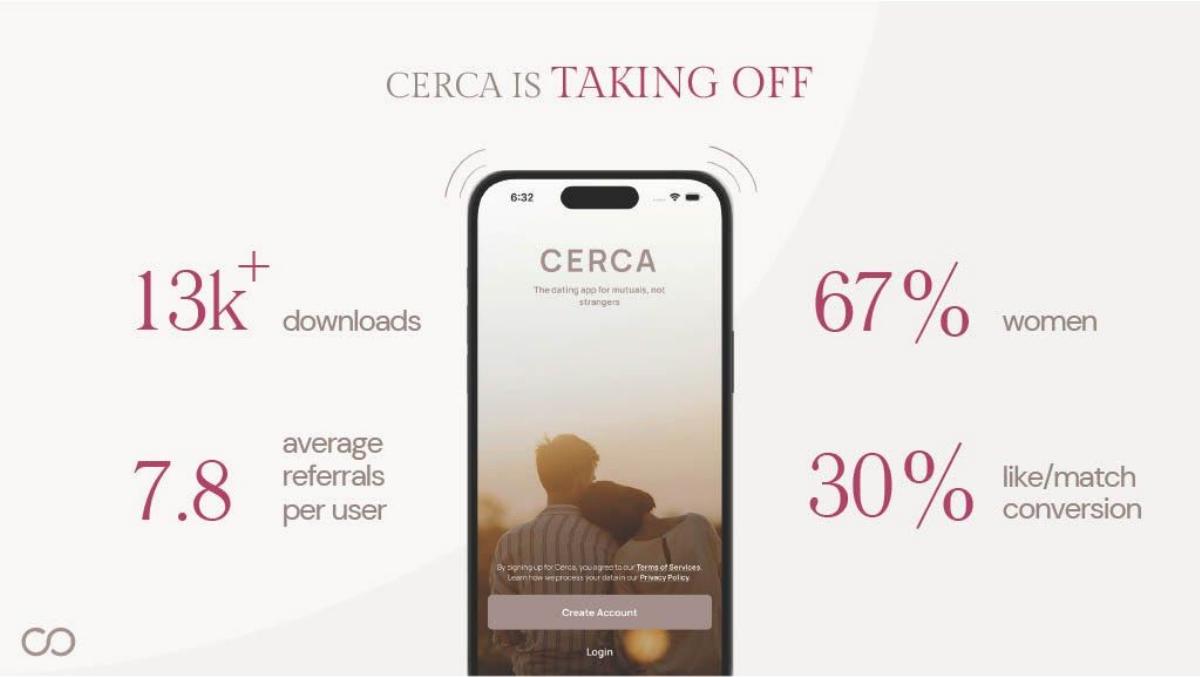
- Traction is quantified on Slide 6 with 13k+ downloads and a high engagement metric of 30% like/match conversion.
- The product utilizes a viral growth mechanism, reporting 7.8 average referrals per user on Slide 6.
- The go-to-market strategy includes a physical event layer, listing upcoming activations at major universities like Duke, Michigan, and Harvard on Slide 7.
- The founding team consists of four current seniors at Georgetown and USC, emphasizing a peer-to-peer connection with their target Gen Z demographic on Slide 8.
- The deck concludes with a specific $1.5 million SAFE request on Slide 10, though Business Insider reports they ultimately closed $1.6M.
Executive Summary: The Social Graph as a Safety Feature
Cerca’s pitch deck is a lean, 10-slide presentation that leans heavily into the cultural zeitgeist of 'dating app fatigue.' Rather than competing on better algorithms or gamification, Cerca bets on the oldest form of matchmaking: the mutual friend. By quantifying the safety risks and rejection fears of current platforms, the deck positions Cerca not just as a dating tool, but as a social accountability layer. With reported publisher facts indicating a $1.6M Seed raise in 2024, this deck serves as a prime example of how early-stage consumer startups can trade on high referral metrics and a clear demographic focus to overcome the lack of traditional revenue data.
Slide 1: The Hook
The cover slide establishes a minimalist aesthetic with a clear, high-contrast tagline: 'The dating app for mutuals, not strangers.' This immediately identifies the company's USP (Unique Selling Proposition). The imagery—a couple looking out at the ocean—is standard for the industry but reinforces the 'meaningful relationship' angle mentioned later in the deck.
Slide 2: The Mission Statement
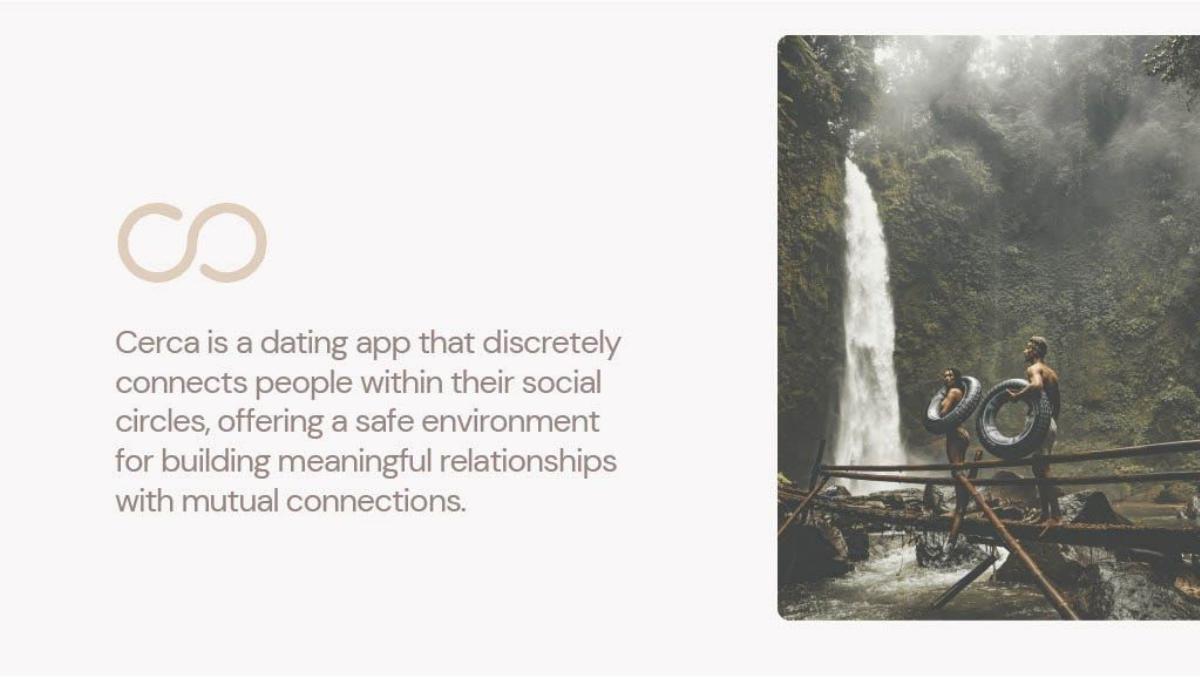
Slide 2 provides a concise definition of the product. It uses the word 'discretely,' which is a subtle nod to the privacy concerns inherent in dating within one's social circle. The focus is on 'mutual connections' and 'safe environments,' setting the stage for the problem/solution slides that follow.
Slide 3: The Triple Threat Problem
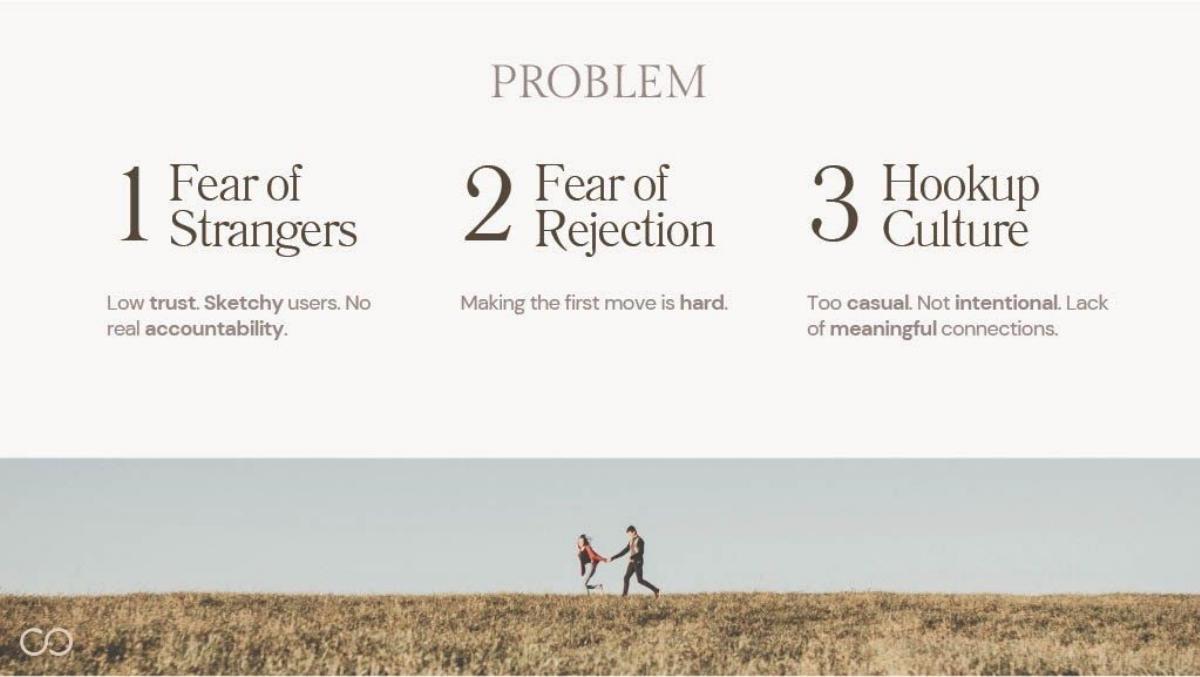
Cerca breaks the problem down into three pillars: Fear of Strangers, Fear of Rejection, and Hookup Culture. Slide 3 is effective because it targets emotional pain points rather than technical ones. By labeling users on other apps as 'sketchy' and lacking 'accountability,' Cerca builds a case for a walled-garden approach to dating.
Slide 4: Statistical Validation
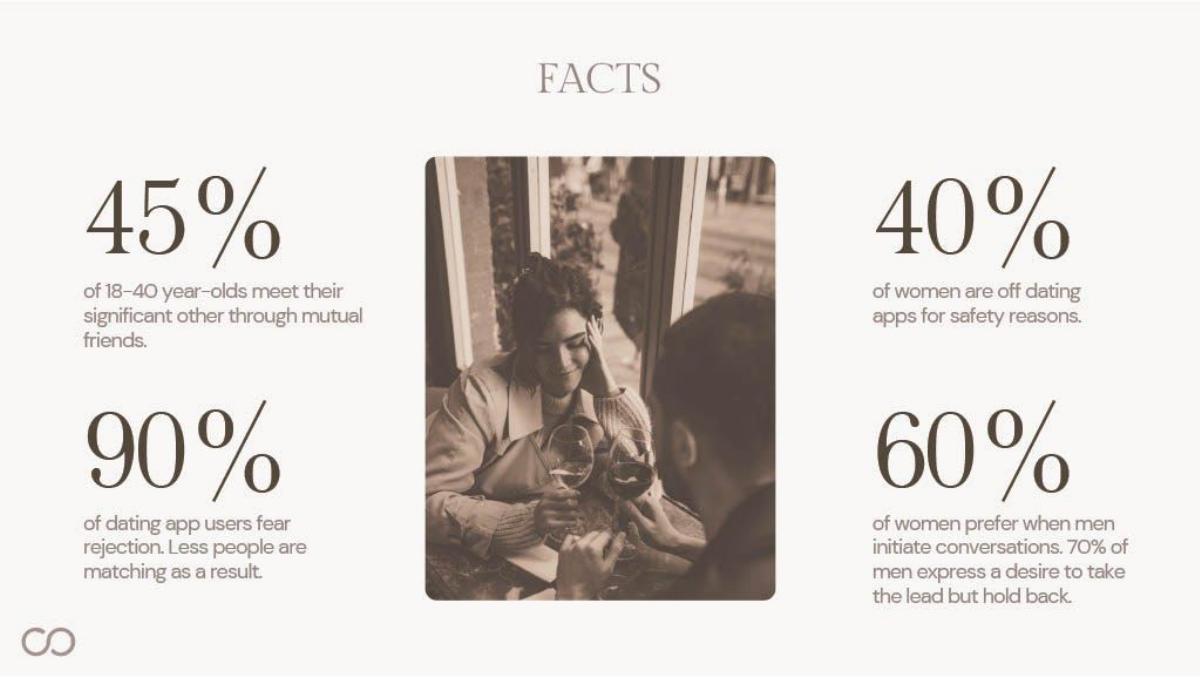
This is the 'Facts' slide, and it is the strongest piece of evidence in the first half of the deck. It cites four key data points:
45% of 18-40 year-olds meet through mutual friends. · 90% of dating app users fear rejection. · 40% of women are off dating apps for safety reasons. · 60% of women prefer when men initiate, but 70% of men hold back.
These figures (Slide 4) provide a logical bridge from the emotional problems on Slide 3 to the product features on Slide 5. The 40% figure regarding women's safety is particularly compelling for investors, as it represents a massive, underserved market segment.
Slide 5: The Three-Part Solution
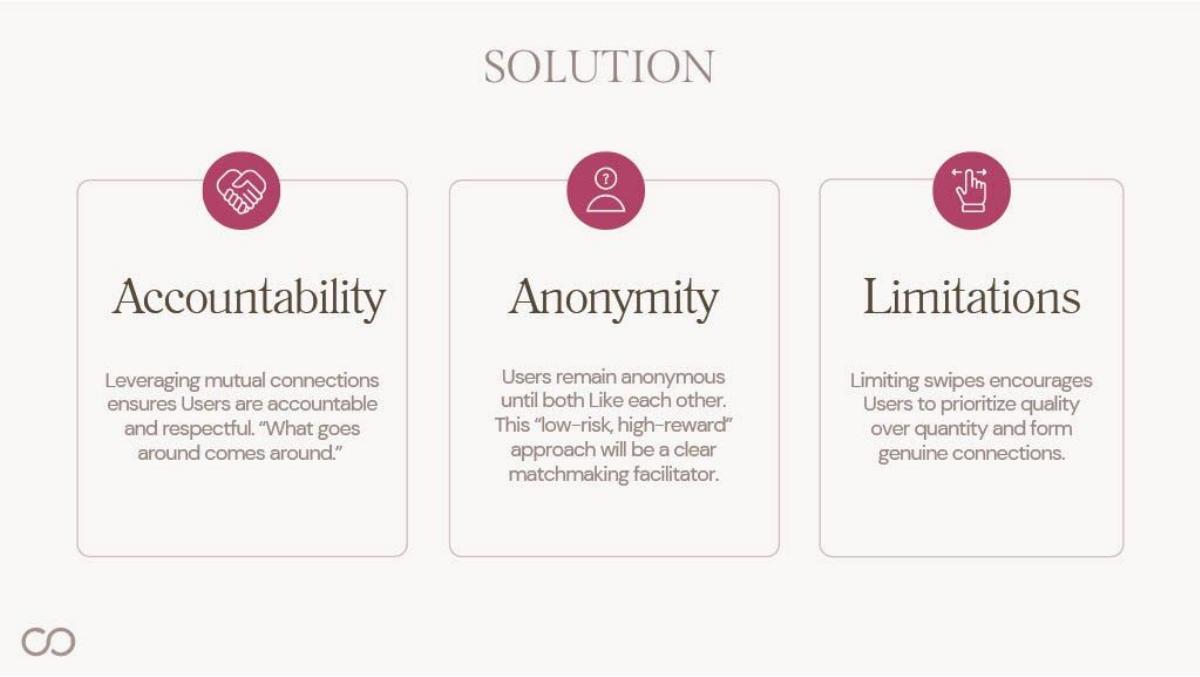
Cerca’s solution rests on Accountability, Anonymity, and Limitations. Slide 5 explains that mutual connections create a 'what goes around comes around' social pressure, which theoretically reduces harassment. The 'Limitations' aspect—limiting swipes—is a direct response to the 'too casual' nature of hookup culture mentioned on Slide 3. This slide effectively communicates that the app is designed to slow down the dating process to increase quality.
Slide 6: Traction and Virality
This is the 'money slide' for a seed-stage consumer app. Cerca reports:
13k+ downloads. · 7.8 average referrals per user. · 67% women. · 30% like/match conversion.
The 7.8 referrals per user (Slide 6) is the standout metric. In consumer tech, a K-factor (virality coefficient) above 1.0 is considered good; 7.8 suggests an extremely high level of organic growth and user trust. Furthermore, the 67% female user base is a significant 'moat' in the dating industry, which is traditionally male-heavy and struggles to retain female users due to the safety issues Cerca highlights.
Slide 7: The O2O (Online-to-Offline) Strategy
Slide 7 introduces 'Cerca Events.' By listing specific cities (NYC, LA, DC, MIA) and upcoming galas at elite universities like Harvard, Michigan, and Duke, the team demonstrates a clear Go-To-Market (GTM) strategy. This 'boots-on-the-ground' approach is reminiscent of early Tinder or Bumble, which used campus ambassadors to seed their initial networks. It also suggests a potential secondary revenue stream, though that isn't explicitly stated.
Slide 8: The Team
The team slide reveals a very young founding group. Myles Slayton (CEO), William Conzelman (CMO), and Reed Uhlik (CTO) are all seniors at Georgetown University. Carter Munk (COO) is a senior at USC. While their professional experience is limited to internships (Evercore, DC Advisory, D.E. Shaw), the deck highlights their entrepreneurial 'hustle.' For example, Slayton sold a sneaker business for $100k in 9th grade, and Conzelman generated $500k in revenue from events. This slide aims to prove that while they are young, they understand their target demographic better than older incumbents.
Slide 9: Product Sneak Peek
Slide 9 shows the actual UI. It confirms the 'mutuals' count feature and the 'Secret Admirer' function. The interface looks clean and follows modern iOS design patterns. The 'Search' feature (Slide 9) appears to allow users to search their own contacts to see who is already on the platform, which explains the high referral rate mentioned earlier.
Slide 10: The Ask
The deck ends with a clear request: a $1.5 million SAFE. The slide notes that the 'main cost drivers are development and college / event marketing.' This aligns perfectly with the strategy laid out in the previous slides. While the publisher reported a final raise of $1.6M, the $1.5M ask on Slide 10 shows the founders had a realistic grasp of their capital needs for this stage.
What Works in the Cerca Deck
1. The 'Safety First' Narrative: By leading with the fact that 40% of women have left dating apps for safety reasons, Cerca makes a compelling case for why a new app is necessary in a crowded market. They aren't just 'another dating app'; they are a safety-focused alternative.
2. Viral Growth Metrics: The 7.8 referrals per user is a 'wow' metric. For an investor, this suggests that the Customer Acquisition Cost (CAC) could be significantly lower than competitors who rely on heavy social media ad spend.
3. Demographic Alignment: The founders are the target audience. Their plan to launch at Georgetown, Duke, and Harvard (Slide 7) shows they are leveraging their current social standing to build the initial network effects required for a social-graph app to work.
What is Missing from the Cerca Deck
1. Competitive Landscape: The deck completely ignores competitors. While they mention 'dating apps' generally, they don't address how they will defend against Hinge (which also uses mutual friends) or niche players like Luma or Raya. Investors need to know why a user wouldn't just use a 'mutual friends' filter on an existing app.
2. Monetization Plan: There is zero mention of how Cerca will make money. While 'growth first, revenue later' is common in consumer tech, a seed deck should at least hint at the business model (e.g., premium subscriptions for more 'searches' or ticket sales for events).
3. Long-term Retention Data: While the match conversion rate is 30% (Slide 6), there is no data on Day-30 or Day-90 retention. In dating, high match rates are good, but if users leave the app once they find a partner (or if they don't find one quickly), the LTV (Lifetime Value) is low.
Founder's Playbook: What to Copy
Quantify the 'Why Now': Cerca doesn't just say dating is hard; they use Slide 4 to provide specific percentages that explain the current market failure. Founders should always back up their 'Problem' slide with third-party or proprietary data that proves the market is shifting.
Focus on a 'Wedge': Cerca isn't trying to launch to everyone at once. Their event list on Slide 7 shows a clear 'wedge' strategy—targeting high-density, high-status college campuses. This is a classic and effective way to build the initial liquidity needed for a marketplace or social network.
Highlight 'Founder-Market Fit': Even though the founders are students, they lean into it. They don't hide their age; they use it to show they are in the trenches with their users. If you are building for a specific demographic you belong to, make that your primary credential.
Frequently asked questions
- How does Cerca actually work based on the slides?
- According to Slide 2 and Slide 9, Cerca discretely connects people within their social circles using mutual connections. The app features a 'Secret Admirer' mode where users can send anonymous likes that only reveal identities once a match is mutual. It also tracks the number of mutual friends between users, showing a 'You have X mutual connections' screen to build trust before a match occurs.
- What is the primary growth lever for the company?
- Cerca relies on a combination of high organic referrals and localized events. Slide 6 reports an average of 7.8 referrals per user, which is exceptionally high for a consumer app. Slide 7 details 'Cerca Events' in cities like NYC and LA, as well as campus-specific galas and speed dating at elite universities, suggesting a hyper-local, community-driven expansion strategy.
- Is there a clear monetization strategy in the deck?
- No. The deck focuses entirely on user acquisition, safety metrics, and the social-graph problem. There is no mention of subscription tiers, in-app purchases, or advertising revenue. The only mention of money is the $1.5 million SAFE ask on Slide 10 and a brief mention of a founder's previous $500k revenue generation from events on Slide 8.
- Who is the target audience for Cerca?
- The deck heavily implies a Gen Z and collegiate focus. The 'Facts' slide (Slide 4) focuses on the 18-40 demographic, but the team slide (Slide 8) highlights that three of the four founders are seniors at Georgetown University and one is at USC. Furthermore, the event roadmap on Slide 7 is dominated by major university names.
- What are the main risks identified in the deck's omissions?
- The most significant omissions are a competitive analysis and a long-term defensibility plan. While Cerca solves the 'stranger' problem, it does not address how it will compete with incumbents like Hinge or Tinder if they implement similar social-graph features. Additionally, the lack of financial projections or unit economics makes it difficult to assess the business's sustainability beyond the initial seed round.