The Celsius Network investor presentation from June 2019 is a study in ideological fundraising. Rather than leading with complex financial statements, the deck uses broad sociological trends—such as the 'War vs. Centralization' and the transition from 'VOIP to MOIP' (Money Over IP)—to justify its existence. The core value proposition is distilled into a single spread: depositors receive 7% interest while borrowers pay 9%. While the deck successfully visualizes the flow of funds between lenders, borrowers, and exchanges, it notably lacks specific historical financial performance, a detailed te…
Key takeaways
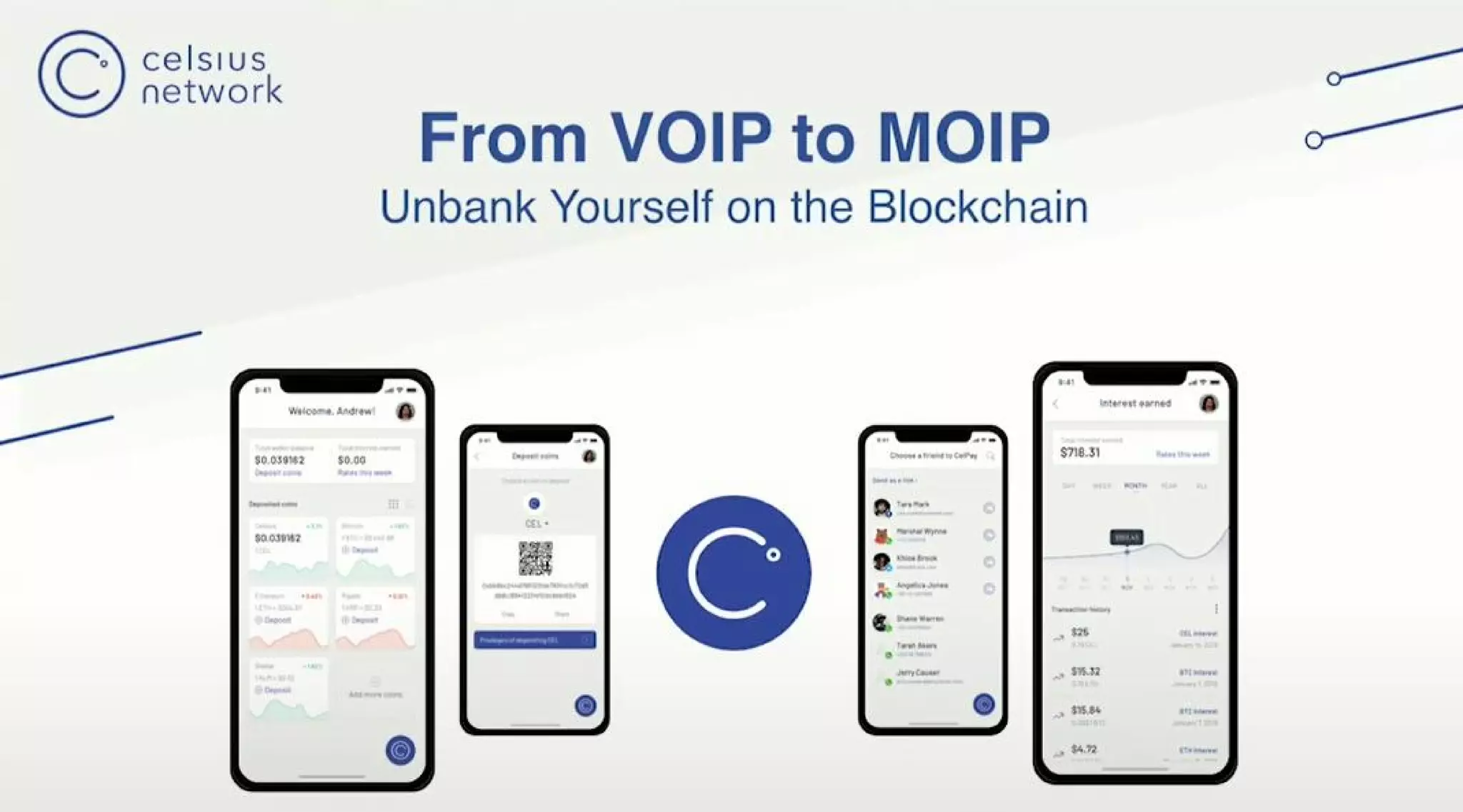
- The company positions itself as the 'MOIP' (Money Over IP) successor to VOIP on the title slide.
- Celsius frames the current financial state as a 'War' between centralization (monopolies like Google/Amazon) and decentralization (Slide 3).
- The platform targets the 70.1% of the world population categorized as 'Lower Class' to drive mass adoption (Slide 3).
- A Pac-Man graphic predicts that the $500B crypto market will eventually consume the $95T liquid money market (Slide 5).
- The business model is simplified to a 2% spread: 7% for depositors and 9% for borrowers (Slide 8).
- The deck identifies 'Institutions' as the current step in the adoption curve, aiming to reach 'Mass Adoption' next (Slide 6).
- Celsius acts as a central hub connecting Lenders, Borrowers, Custodians, and Coin Exchanges (Slide 10).
- The presentation utilizes a 'Crossing the Chasm' framework to show the evolution from Satoshi's thinking to Jamie Dimon's eventual acceptance (Slide 6).
The Ideological Pitch: Celsius Network’s Vision for Decentralized Finance
The Celsius Network Investor Conference Presentation from June 2019 is a fascinating artifact of the pre-DeFi summer era. It captures a moment when crypto lending was transitioning from a niche libertarian experiment to an institutional-grade financial product. The deck is less about spreadsheets and more about a sociological shift, using the 'Unbank Yourself' slogan to frame a commercial enterprise as a populist movement.
Slide 1: Title and Vision
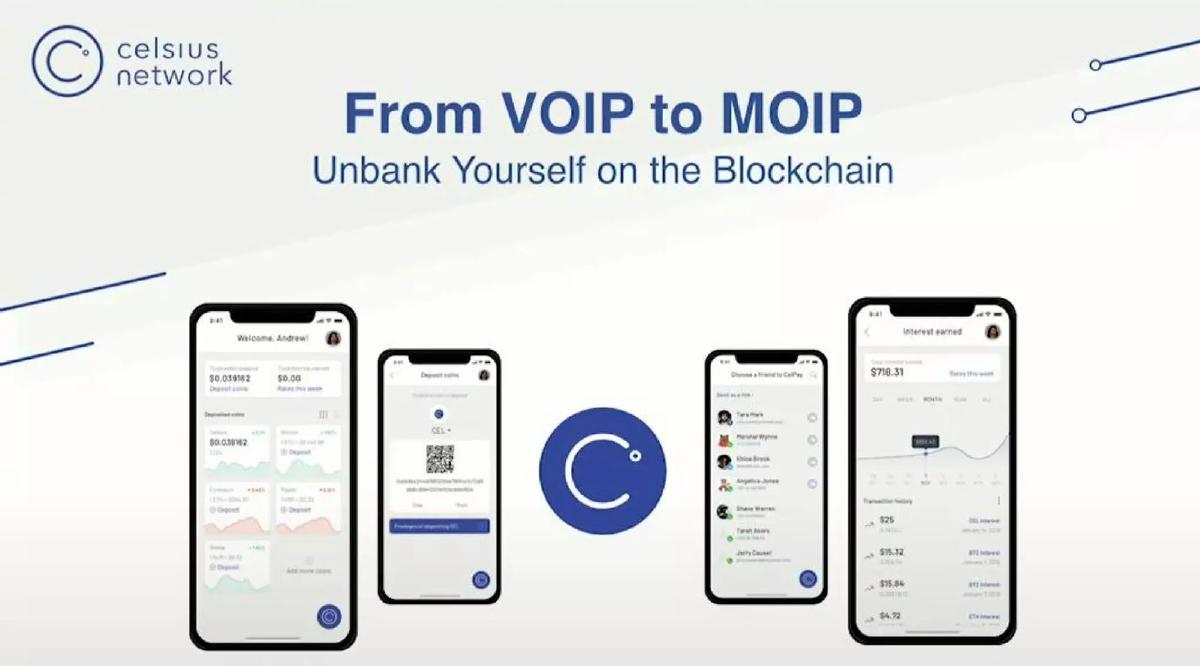
The deck opens with the bold headline 'From VOIP to MOIP: Unbank Yourself on the Blockchain.' By invoking VOIP (Voice Over IP), Celsius immediately anchors its technology in a successful historical precedent of digital disruption. The slide features four mobile app mockups showing a clean user interface for depositing coins, checking interest earned (a figure of $718.31 is shown), and sending payments via 'CelPay.' This establishes the product as a consumer-ready fintech application rather than a complex developer tool.
Slide 2: The Hand-Off
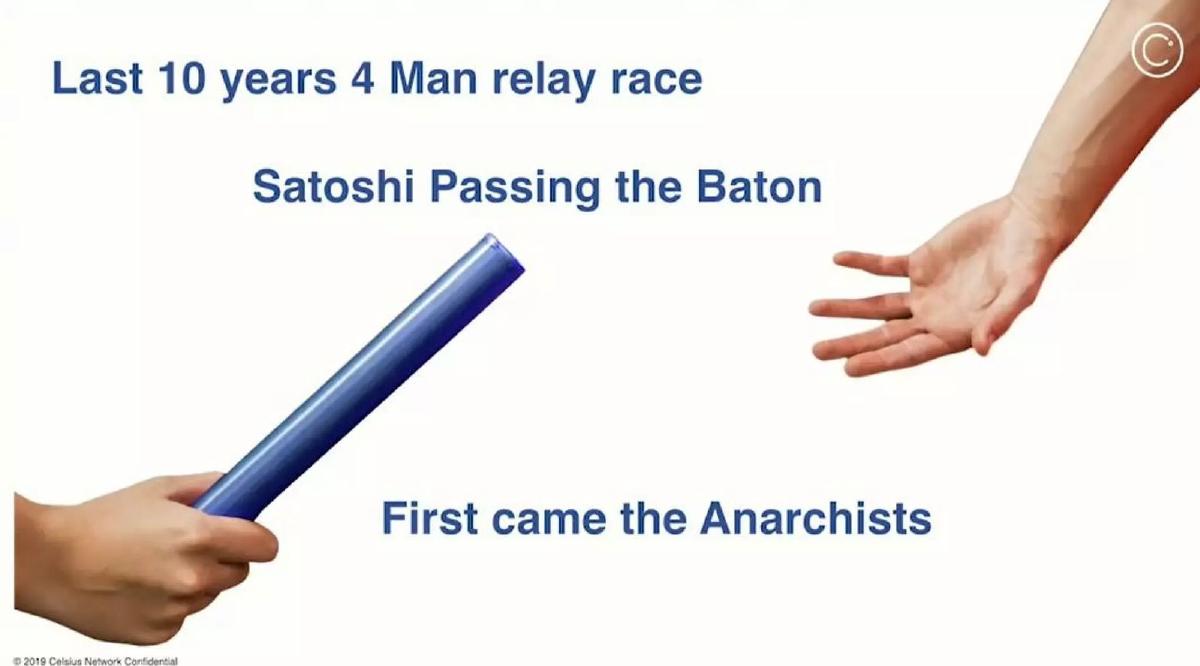
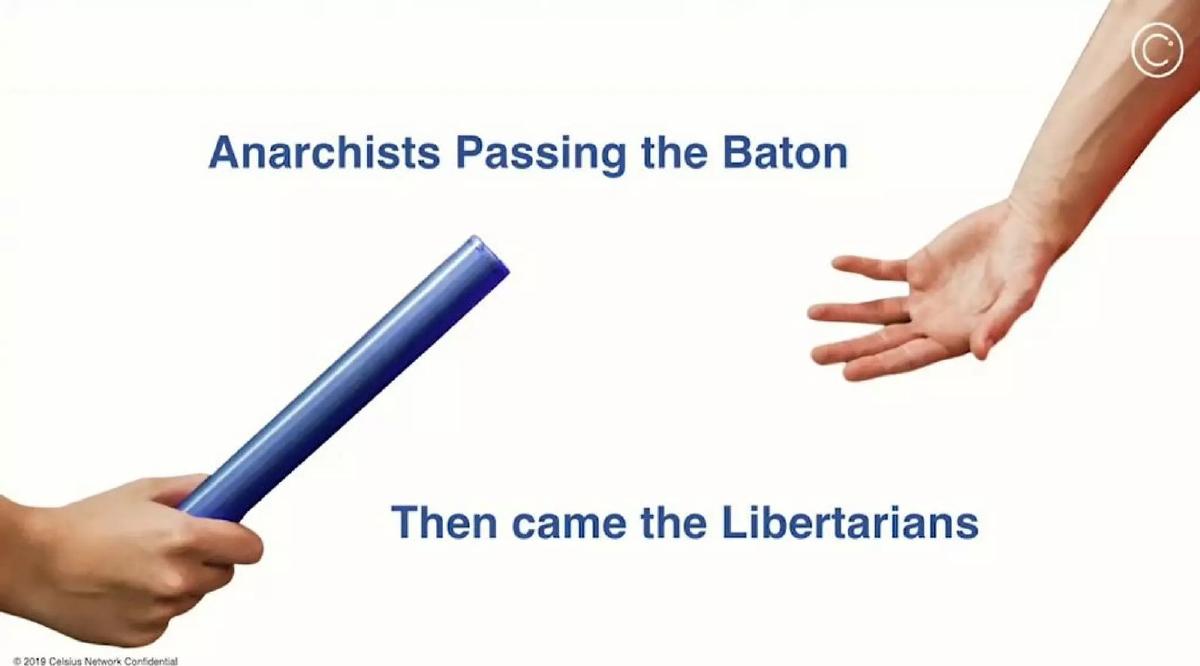
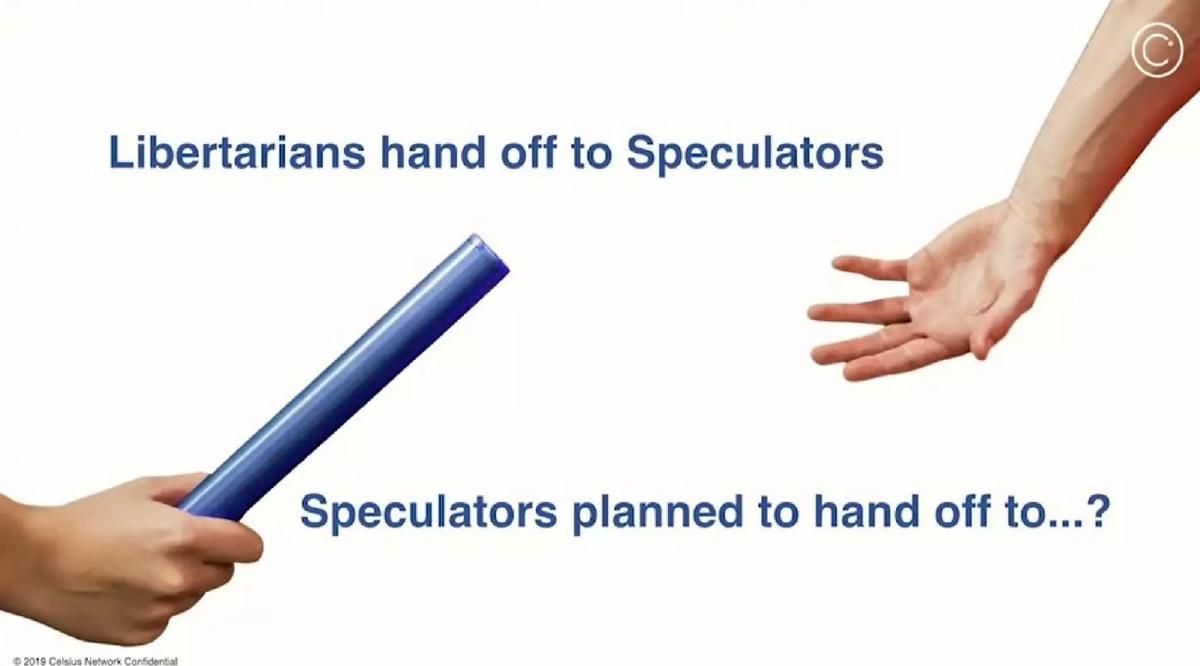
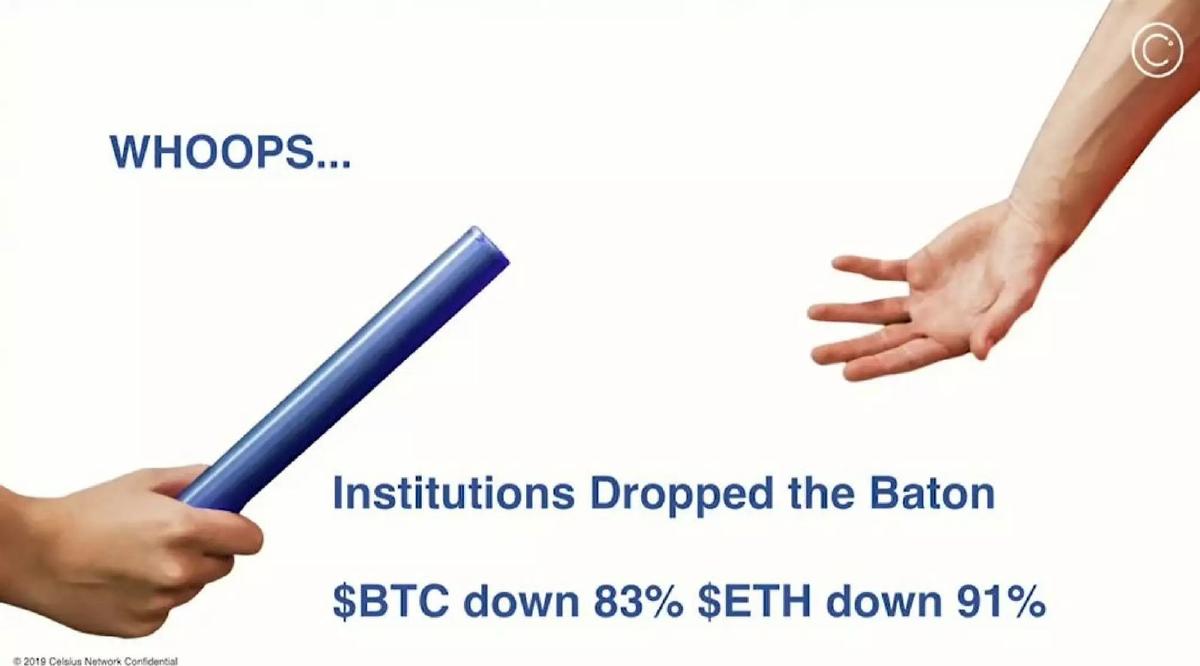
Slide 2 is purely conceptual, showing a relay baton being passed. The text reads: 'Libertarians hand off to Speculators. Speculators planned to hand off to...?' This slide serves as a rhetorical device to identify the current state of the market. It suggests that the early ideological phase is over, the speculative phase is maturing, and a new phase—which Celsius intends to lead—is beginning.
Slide 3: Centralization War vs. Decentralization
This slide presents a 'War' narrative. On the left, a pyramid represents the 7.5 billion people in the world, dominated by a 'Lower Class' of 5.2 billion (70.1%). Icons for Google, Facebook, and Amazon are placed at the apex, representing the 'Centralization' that Celsius claims to fight. On the right, a 'Block Chain' network diagram represents the decentralized alternative. The implication is that Celsius is the bridge for the 92% of the population not currently served by the 'High Net Worth' financial structures.
Slide 4: The Public Blockchain Value Proposition
Using a Venn diagram, Slide 4 identifies the 'Celsius' sweet spot at the intersection of three pillars: 'Decentralised DApps' (replacing monopolies), 'Token Economics' (crossing regulatory hurdles), and 'Secure & Immutable' (open ledgers). The slide claims this intersection represents the 'opportunities where the public blockchain will change the world.' It is a high-level strategic slide meant to justify the use of blockchain technology for lending.
Slide 5: Market Size and The Pac-Man Effect
Slide 5 is the 'Market Opportunity' slide, but it avoids traditional TAM/SAM/SOM charts. Instead, it uses a Pac-Man graphic labeled 'Crypto $500B' (citing data as of 2/20/2018) about to consume a series of larger circles: USD in Circulation ($1.61T), Gold Market Cap ($8.2T), Stock Markets ($80T), and All Liquid Money ($95T). The message is clear: crypto is an apex predator in the financial ecosystem, and its growth potential is measured in trillions, not billions.
Slide 6: Crossing The Chasm
Borrowing from Geoffrey Moore’s 'Crossing the Chasm,' Slide 6 maps the crypto adoption curve. It places 'Satoshi thinking' at the start, followed by Anarchists, Libertarians, and Speculators. The 'Chasm' is located between Speculators and Institutions. Celsius depicts two characters—one a bear-like figure in streetwear and another in a Celsius-branded jacket—helping each other over the chasm. The 'Late Majority' is humorously labeled with names like 'Jamie Dimon & Nouriel Roubini,' positioning these traditional finance figures as the final skeptics to be converted.
Slide 7 & 8: The Core Economics
Slides 7 and 8 are the most 'business-focused' in the set. Slide 7 simply shows the numbers '9' and '7.' Slide 8 explains them: 'Depositors get 7%' and 'Borrowers pay 9%.' This is the 'Unbank Yourself' value proposition in its simplest form. By showing a narrow 2% spread, Celsius implicitly critiques traditional banks that might pay 0.1% on savings while charging 15% on credit cards. It positions Celsius as a high-yield, low-cost alternative.
Slide 9: Defining the Blockchain
Slide 9 is a transition slide asking 'What is the Public Blockchain?' In a full 40-slide deck, this likely leads into a technical or educational section. In this 10-slide sample, it serves to signal that the presentation will now move from 'Why' to 'How.'
Slide 10: The Ecosystem Map
The final slide in this set provides a functional diagram of the Celsius Network. Celsius sits at the center, acting as the orchestrator. It shows 'Lenders (Coin Holders)' depositing coins and receiving ETH & BTC payments. It shows 'Borrowers (Traders)' placing trades and paying profits back to the center. At the top, it connects to 'Custodians (itBit...),' 'Coin Exchanges (GDax, Gemini, Kraken...),' and 'Banks & Financial Institutions (Fidelity, IB...).' This slide is crucial because it demonstrates that Celsius is not a closed loop; it is integrated with both the crypto and fiat financial infrastructures.
What Works in the Celsius Deck
1. Radical Simplicity: The '7% vs 9%' slide is a masterclass in distilling a complex business model into a single, memorable image. It answers the 'how do you make money' question instantly.
2. Strong Narrative Arc: The deck follows a clear 'Hero’s Journey.' The world is broken (centralization), a new technology has arrived (blockchain), and Celsius is the guide helping the masses 'cross the chasm' to financial freedom.
3. Visual Branding: The use of custom illustrations (Slide 6) and consistent color palettes makes the company feel like a modern consumer brand rather than a stuffy financial institution. This aligns with the 'Unbank Yourself' populist messaging.
What is Missing from the Celsius Deck
1. Risk Disclosure: In the 10 slides provided, there is no mention of the risks associated with providing 7% yields, nor is there a discussion of collateralization ratios or what happens during a market liquidation event. For a lending business, the 'downside' protection is as important as the 'upside' yield.
2. Team Credentials: There is no team slide in this selection. In fintech, the pedigree of the founders and their experience with risk management and compliance is a primary factor for investor due diligence.
3. The 'Ask': The deck does not state how much capital is being raised, the valuation, or the specific use of funds. While this may appear later in the full 40-slide version, its absence here leaves the 'Investor Conference' context feeling more like a marketing presentation than a formal pitch.
4. Historical Traction: While the app mockups show numbers, there are no charts showing actual user growth, total value locked (TVL), or revenue generated to date. The deck relies heavily on future projections and market size rather than proven execution.
Founder Takeaways
Lead with a Movement, Not a Product: Celsius didn't just pitch a lending app; they pitched the 'War vs. Centralization.' Founders in crowded markets should look for the larger sociological shift their product enables. · Use Analogies to Bridge Knowledge Gaps: Comparing 'MOIP' to 'VOIP' helps non-technical investors immediately understand the scale and nature of the disruption being proposed. · Simplify the Unit Economics: If your business model relies on a spread, fee, or commission, find a way to express it as simply as the '7 and 9' slide. If an investor can't explain your business model in one sentence after the pitch, the slide failed. · Address the 'Chasm': Every startup faces an adoption hurdle. Acknowledging who the early adopters are (Speculators) and who the target 'Mass Adoption' audience is shows a sophisticated understanding of go-to-market strategy.
Frequently asked questions
- What is the primary business model described in the Celsius deck?
- The business model is a traditional lending spread applied to digital assets. According to Slide 8, Celsius aims to pay depositors 7% interest on their holdings while charging borrowers 9% for loans. Slide 10 illustrates that Celsius facilitates this by taking coin deposits from lenders, interacting with custodians and exchanges, and providing liquidity to borrowers (traders) who pay interest back into the system.
- How does Celsius define its market opportunity?
- Celsius defines its opportunity through total global wealth displacement. Slide 5 uses a visualization showing a $500B crypto market (as of February 2018) positioned to 'eat' larger asset classes, including the $8.2T Gold market, the $80T Stock Market, and eventually the $95T 'All Liquid Money' market. They view the public blockchain as a replacement for existing financial monopolies.
- Who are the target users according to the presentation?
- The deck segments the world into four tiers: High Net Worth (0.7%), Mass Affluent (7.9%), Consuming Middle (21.3%), and Lower Class (70.1%). Slide 3 suggests that while centralization serves the top tiers, the 'Block Chain' and Celsius are designed to serve the broader population, specifically aiming to 'Unbank' those currently underserved by traditional finance.
- What is the 'MOIP' concept mentioned in the deck?
- MOIP stands for 'Money Over IP.' The title slide draws a parallel between the disruption of telecommunications (VOIP) and the disruption of finance. Celsius positions itself as the protocol or platform that will do for money what Skype or WhatsApp did for voice calls—moving it onto a decentralized, internet-based infrastructure to bypass traditional 'toll collectors.'
- Does the deck address regulatory or security concerns?
- The deck touches on these themes at a high level. Slide 4 mentions 'Token Economics' as a way to cross 'regulatory hurdles' and highlights 'Secure & Immutable' ledgers as a foundation for new business models. However, the 10 slides provided do not contain a detailed compliance roadmap, insurance disclosures, or specific security protocols beyond general blockchain attributes.