Cematrix is a publicly traded company (TSXV: CVX) specializing in cellular concrete solutions for infrastructure and industrial applications. This June 2021 deck focuses heavily on technical superiority and historical project execution rather than typical startup growth metrics. The company emphasizes its proprietary technology, including advanced foaming agents and processing equipment capable of producing 250 cubic metres per hour. While the deck lacks a specific 'ask' or detailed financial projections in the provided slides, it compensates with extensive case studies ranging from $0.35M to…
Key takeaways
- The company is publicly traded on the TSXV under the symbol CVX and the OTCQB under CTXXF, as noted on the title slide.
- Cematrix was recognized as a 'Venture 50' company in both 2020 and 2021, according to the badges on slide 1.
- Proprietary processing equipment allows for high-volume output of up to 250 cubic metres of cellular concrete per hour (slide 16).
- The company claims to be the only known provider of underwater cellular concrete placement technology in North America (slide 16).
- Case studies demonstrate significant project scale, including a $7.55M industrial project for the NWR Diesel Refinery (slide 32).
- The technology offers a time-saving advantage, completing a tunnel grouting project in less than a week compared to a scheduled 3 months for traditional grout (slide 42).
- The Board of Directors includes specialists in actuarial risk, corporate law, and senior business engineering (slide 27).
- Cematrix positions recessions as a catalyst for growth due to government prioritization of infrastructure spending (slide 6).
Executive Summary and Market Positioning
The Cematrix June 2021 Corporate Presentation is a technical and operational deep dive into a specialized industrial sector: cellular concrete. Unlike early-stage venture decks that focus on user acquisition or viral loops, Cematrix focuses on industrial reliability, proprietary chemistry, and massive infrastructure contracts. The deck is designed for institutional and retail investors on the TSXV and OTCQB, emphasizing the company's stability and its role as a critical infrastructure partner.
Slide 1: Title and Recognition
The title slide establishes immediate credibility by displaying the 'Venture 50' awards for both 2020 and 2021. This indicates that Cematrix is recognized as a top performer on the TSX Venture Exchange. The slide clearly lists the trading symbols— TSXV: CVX and OTCQB: CTXXF —signaling that this is a public company presentation rather than a private funding round. The subtitle 'Cellular Concrete Solutions' defines the niche immediately.
Slide 6: COVID-19 Impact and Resilience
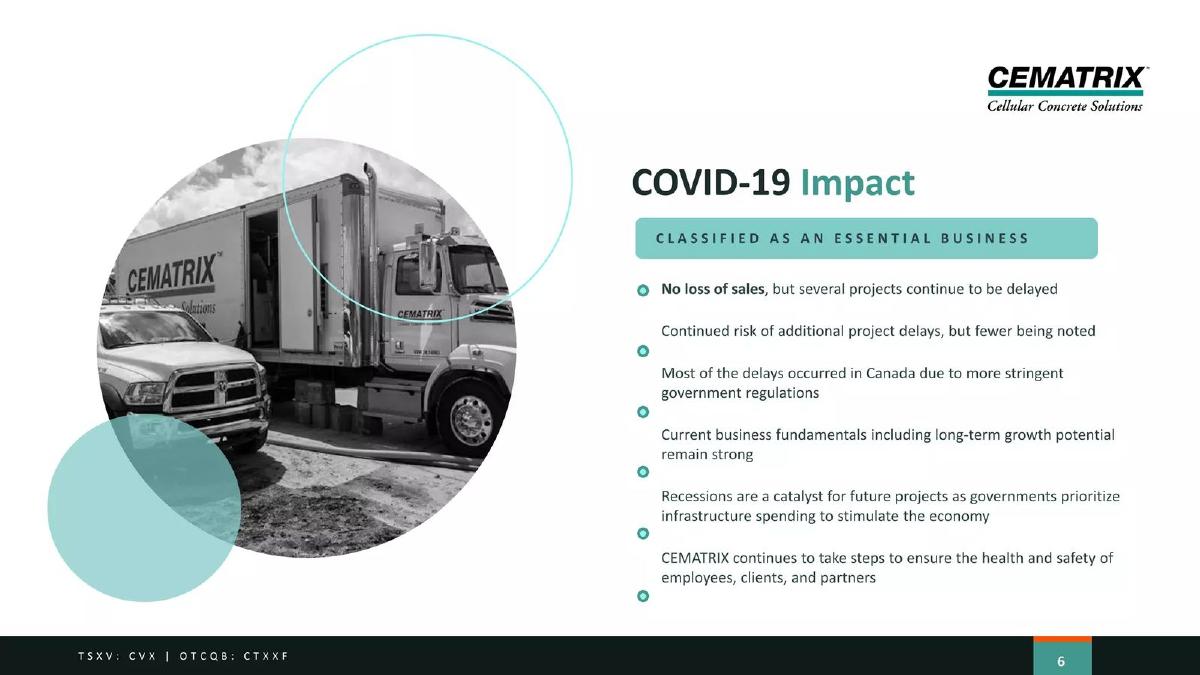
This slide addresses the macro environment of 2021. The most critical takeaway is the classification of Cematrix as an 'Essential Business.' The company reports 'No loss of sales,' though it admits to project delays, specifically in Canada. A strategic point made here is that recessions act as a 'catalyst for future projects' because governments tend to prioritize infrastructure spending to stimulate the economy. This positions the company as a counter-cyclical investment opportunity.
Slide 11: Competitive Advantages
Cematrix outlines its value proposition through three main pillars: material quality, mobility, and premium positioning. They claim their concrete is 'lighter and stronger' than competitor specifications. The mention of 'unit mobility' is significant in the construction industry, as it implies the company can move its production equipment to remote or varied geographical sites quickly, reducing the logistical hurdles typically associated with concrete supply.
Slide 16: Proprietary Technology and R&D
This is the 'moat' slide. Cematrix lists several 'only known' claims to differentiate itself from generic concrete providers. Key technical metrics include equipment capable of producing 250 cubic metres of CC per hour . They highlight their status as the only North American provider of underwater cellular concrete placement and the only supplier with three 'Dry mix units' for tunnel grouting. The slide also mentions R&D collaborations with the University of Waterloo and the NRC, suggesting a pipeline of continuous material improvement.
Slide 21: Financials Transition
Slide 21 serves as a section break for 'Financials.' While the specific financial data slides were not included in the provided set, the presence of this divider indicates a structured approach to reporting revenue, margins, and perhaps EBITDA to the investor audience. In a 42-slide deck, a dedicated section for financials is expected for a publicly traded entity.
Slide 27: Board of Directors
The board composition reflects a heavy emphasis on professional services and engineering. Minaz Lalani (Chairman) brings a background in actuarial and risk management from Towers Watson. The inclusion of a CA (Steve Bjornson), a corporate lawyer (Patrick N. Breen), and a senior business engineer (Robert L. Benson) suggests a board equipped for complex contract negotiation and technical oversight. Dan Koyich provides experience in investor relations, which is vital for a micro-cap public company.
Slide 32: Case Study - Industrial (Diesel Refinery)
This slide provides a concrete example of the company's scale. The project at the NWR Diesel Refinery in Fort Saskatchewan had a Sales Value of $7.55M . Cematrix was selected over rigid insulation because it provided a 'better overall solution' at a 'significantly reduced cost.' This slide proves the company can handle high-value, complex industrial subbase projects for major owners and general contractors like Fluor Constructors.
Slide 37: Case Study - Geotechnical (Wisconsin)
Focusing on the Marquette Interchange in Milwaukee, this slide highlights a US$4.7M sales value project for the Wisconsin Department of Transportation. The key takeaway here is the replacement of 'EPS Blocks' (expanded polystyrene) with cellular concrete. By winning a contract from a government DOT, Cematrix demonstrates that its technology meets rigorous public safety and engineering standards.
Slide 42: Case Study - Tunnel Grouting (Edmonton)
The final slide in the set showcases a tunnel grouting project for the City of Edmonton with a Sales Value of $0.35M . While the dollar amount is smaller than the refinery project, the efficiency metric is the highlight: Cematrix placed the grout in 'less than a week,' whereas traditional grout was scheduled to take 3 months. This 12x improvement in project timelines is a powerful selling point for municipal clients looking to minimize infrastructure downtime.
What Cematrix Does Well
The deck excels at validation through execution . By including multiple case studies with specific sales values, dates, and client names (e.g., City of Edmonton, Wisconsin DOT), Cematrix moves beyond theoretical benefits to proven market fit. The use of 'only known' statements on the technology slide (Slide 16) creates a strong sense of a proprietary moat that would be difficult for a general contractor to replicate without Cematrix's specific equipment and foaming agents.
The presentation also handles the macro-economic narrative effectively. By framing infrastructure as a government stimulus tool, they turn a potential weakness (a recessionary environment) into a strength. This is a sophisticated way to speak to institutional investors who are looking for 'safe harbor' industries during volatile market cycles.
What is Missing from the Deck
Based on the 9 slides provided from the 42-slide deck, there are several omissions that a private investor would typically look for, though some may be present in the other 33 slides. First, there is no clear 'Ask.' As a public company, they may not be raising a specific round, but a slide detailing their capital allocation strategy (e.g., buying more units, expanding into new regions) would be beneficial.
Second, while the board is shown, the Executive Management team is not featured in this selection. Investors usually want to see the CEO and COO's track record alongside the board. Third, there is a lack of unit economics . We see the total sales value of projects, but we don't see the gross margins or the cost of the proprietary foaming agents. For a company claiming a technological advantage, showing how that translates into superior margins compared to traditional concrete would be a 'knockout' slide.
Founder Takeaways
Use Case Studies to Prove Speed: The most compelling data point in this deck is the reduction of a 3-month project to one week (Slide 42). If your startup offers a B2B solution, find the one metric where you are 10x better than the legacy solution and center a case study around it.
Lean on 'Essential' Status: Cematrix successfully branded itself as an essential business. Founders in industrial or infrastructure tech should always highlight how their business survives (or thrives) during regulatory or economic shifts.
Quantify the Moat: Cematrix doesn't just say they have 'good equipment.' They specify it can do 250 cubic metres per hour. When describing your technology, use hard throughput or performance metrics that a competitor would find difficult to match. Generalities like 'faster' or 'better' are less effective than specific capacity figures.
Frequently asked questions
- What is the core technology Cematrix offers?
- Cematrix specializes in cellular concrete (CC) solutions. According to slide 16, their proprietary technology includes advanced material mix designs, specialized foaming agents, and additives that achieve higher strengths at lower densities than competitors. They also utilize advanced processing equipment capable of high-volume production (250 cubic metres per hour) and specialized units for tunnel grouting and underwater placement.
- How did COVID-19 affect Cematrix's business operations?
- Slide 6 states that Cematrix was classified as an 'essential business.' While they reported no loss of sales, they did experience project delays, particularly in Canada, due to stringent government regulations. The company views economic downturns as a potential catalyst, as governments often increase infrastructure spending to stimulate the economy, which aligns with their service offerings.
- What kind of projects does the company typically handle?
- The deck highlights three distinct project types: industrial, geotechnical, and tunnel grouting. Examples include an insulating subbase for a diesel refinery ($7.55M sales value, slide 32), a geotechnical project for the Wisconsin Department of Transportation ($4.7M sales value, slide 37), and tunnel grouting for the City of Edmonton ($0.35M sales value, slide 42).
- Who oversees the company's governance?
- Governance is managed by a five-member Board of Directors shown on slide 27. The board is led by Chairman Minaz Lalani, a risk management consultant. Other members include Steve Bjornson (Financial Consultant), Patrick N. Breen (Corporate Lawyer), Robert L. Benson (former senior business engineer), and Dan Koyich (former President of JeanDan Management Ltd.).
- What are the primary competitive advantages cited by Cematrix?
- As per slide 11, the company claims its cellular concrete is lighter and stronger than competitor specifications. They emphasize 'unit mobility,' which allows for rapid response and geographical movement. Additionally, slide 16 highlights their status as the only known full-service CC supplier in North America engaged in specific R&D collaborations with universities and government research councils.