White-Label Business Model Slide Examples in Pitch Decks
How to present a white-label business model on a pitch deck: what partners pay, how the price scales and how much revenue depends on it.
How to Present a White-Label Business Model on a Pitch Deck
Six slides from real pitch decks show how founders explain a white-label offer, where another company sells your product under its own brand: what the partner pays, what the price is tied to, and how much of the forecast rests on it.
TL;DR
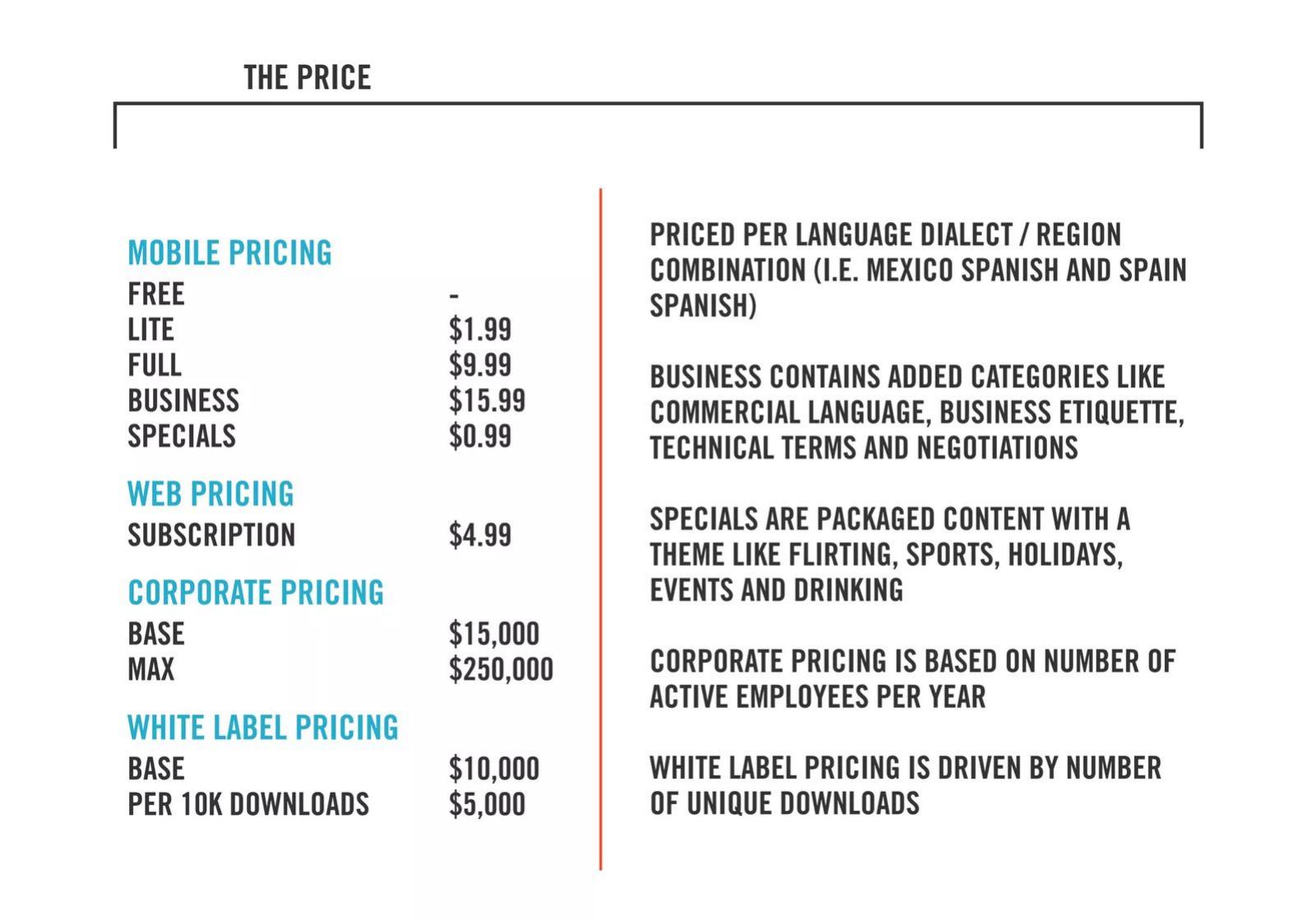
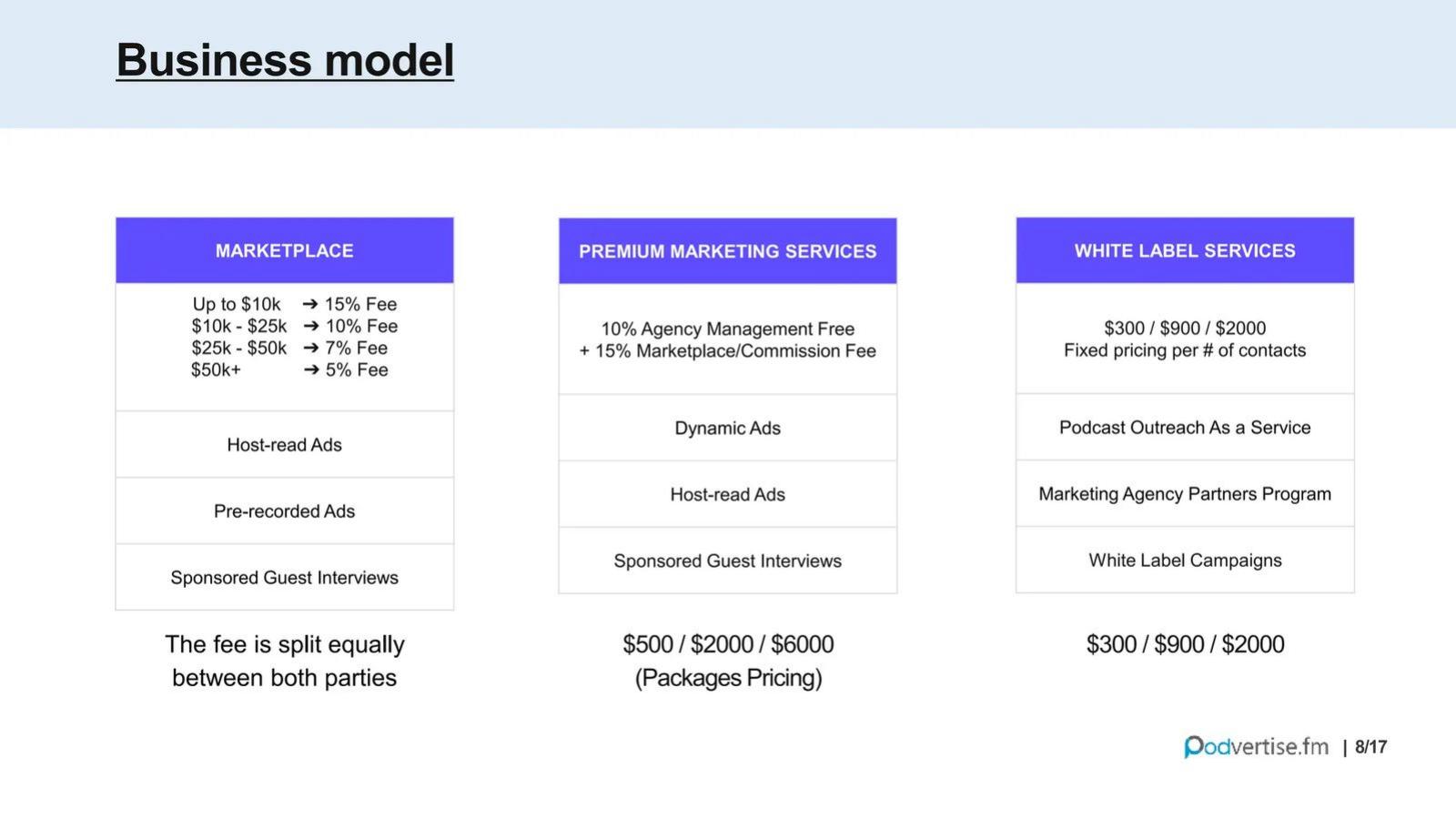
A white-label slide should say who the partner is, what they pay, and what the price grows with. TripLingo does this in two lines: a $10,000 base fee plus $5,000 for every 10,000 downloads of the partner's branded app. Podvertise lists fixed white-label packages at $300, $900 and $2,000, priced by number of contacts and kept separate from its marketplace commission. Key2cell charges mobile operators a monthly white-label fee plus a fee per message sent, but gives no amounts. Digitzs offers payments under the platform's own brand and shares its 2.9% fee with the platform, without saying how much it shares. VRJAM's forecast gets $1.8M a year from a single white-label client paying $150,000 a month, an assumption the slide never explains. Talent Insights names a white-label offer with no price at all.
White-label slides from real pitch decks
Each example shows the exact stored slide above its analysis and links to the full teardown. Stage and year are given only where the deck states them. Figures are the company's own claims; where we checked arithmetic, we say so.
TripLingo business model slide — slide 11
Travel language and culture app.
TripLingo deck, slide 11. Exact stored slide matched to this analysis.
Our analysis: The clearest white-label price in the set: a base fee plus a usage charge tied to the partner's own success.
Evidence and limitation: Say whether the base fee is one-off or yearly, and whether downloads are counted once or each year.
What a founder can adapt: Give a base fee and a per-unit charge so revenue grows with each partner.
Supporting analysis
What the deck claims: Pricing slide with mobile, web, corporate and white-label tiers. "White label pricing: Base $10,000; Per 10K downloads $5,000"; "White label pricing is driven by number of unique downloads." Corporate pricing runs from $15,000 to $250,000, based on active employees per year.
Presentation choice: The clearest white-label price in the set: a base fee plus a usage charge tied to the partner's own success.
When it does not fit: Say whether the base fee is one-off or yearly, and whether downloads are counted once or each year.
Podcast advertising marketplace for small businesses and agencies. 2024 deck.
Podvertise.fm deck, slide 8. Exact stored slide matched to this analysis.
Our analysis: White label gets its own column and its own prices, so it can be judged apart from the marketplace.
Evidence and limitation: Name who buys the white-label packages and how many have bought so far.
What a founder can adapt: Put white label in a separate column or line with its own price.
Supporting analysis
What the deck claims: Three columns: marketplace fee from 15% (up to $10k) down to 5% ($50k+), split between both parties; premium marketing services at $500, $2,000 or $6,000; and "White label services: $300 / $900 / $2000, fixed pricing per # of contacts", covering podcast outreach as a service, an agency partner programme and white-label campaigns.
Presentation choice: White label gets its own column and its own prices, so it can be judged apart from the marketplace.
When it does not fit: Name who buys the white-label packages and how many have bought so far.
Hong Kong mobile advertising platform for MMS campaigns. 2019 deck.
Key2cell deck, slide 14. Exact stored slide matched to this analysis.
Our analysis: Shows a recurring white-label fee plus a usage charge, set out per partner type.
Evidence and limitation: No amounts anywhere. Add the monthly fee, price per message and number of partners.
What a founder can adapt: List each partner type with how and how often it pays.
Supporting analysis
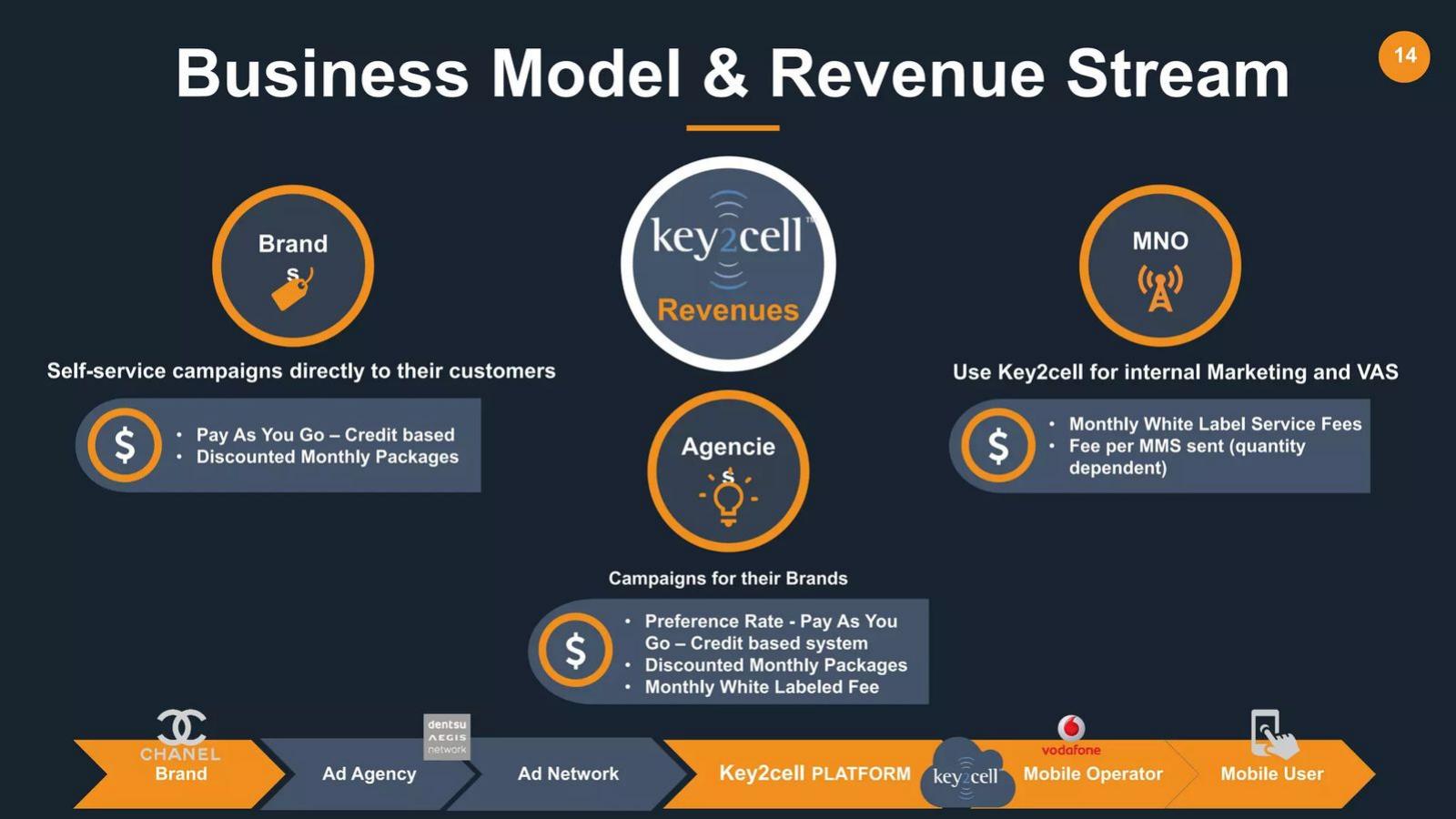
What the deck claims: Revenue by customer: brands pay as they go or buy monthly packages; agencies pay a preferential rate, packages and a "Monthly White Labeled Fee"; mobile operators pay "Monthly White Label Service Fees" and a "Fee per MMS sent (quantity dependent)".
Presentation choice: Shows a recurring white-label fee plus a usage charge, set out per partner type.
When it does not fit: No amounts anywhere. Add the monthly fee, price per message and number of partners.
Payments for apps, marketplaces and platforms. Deck dated November 2016.
Digitzs deck, slide 4. Exact stored slide matched to this analysis.
Our analysis: Explains clearly why a partner would join: its own brand, its own fees and a share of every transaction.
Evidence and limitation: The commission rate is missing, so an investor can't tell what Digitzs keeps from the 2.9%.
What a founder can adapt: If partners earn from your fee, show what they get and what you keep.
Supporting analysis
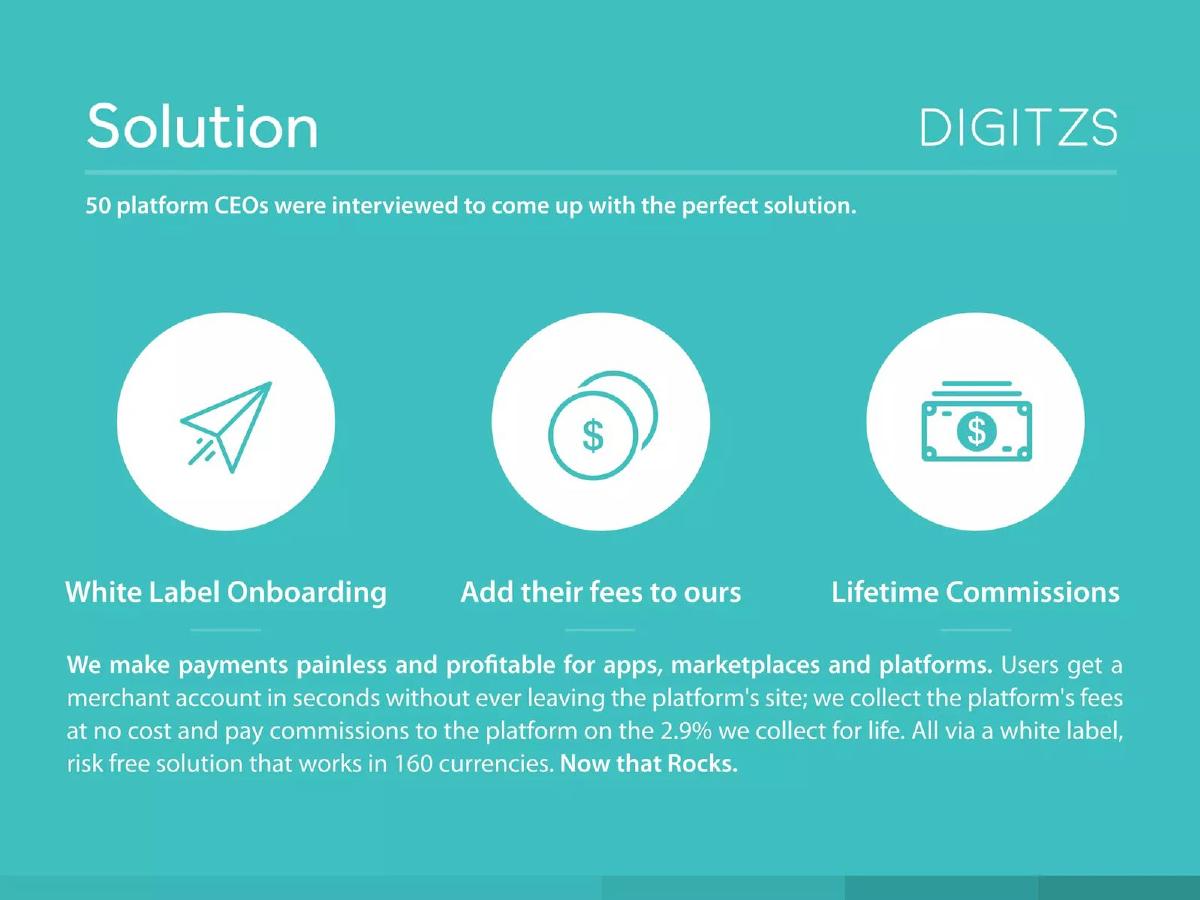
What the deck claims: "White Label Onboarding", "Add their fees to ours", "Lifetime Commissions". Users get a merchant account without leaving the platform's site; Digitzs collects the platform's fees at no cost and pays the platform commissions "on the 2.9% we collect for life". "50 platform CEOs were interviewed".
Presentation choice: Explains clearly why a partner would join: its own brand, its own fees and a share of every transaction.
When it does not fit: The commission rate is missing, so an investor can't tell what Digitzs keeps from the 2.9%.
Live virtual and augmented reality platform for music events. Crowdfunding-era deck (2019).
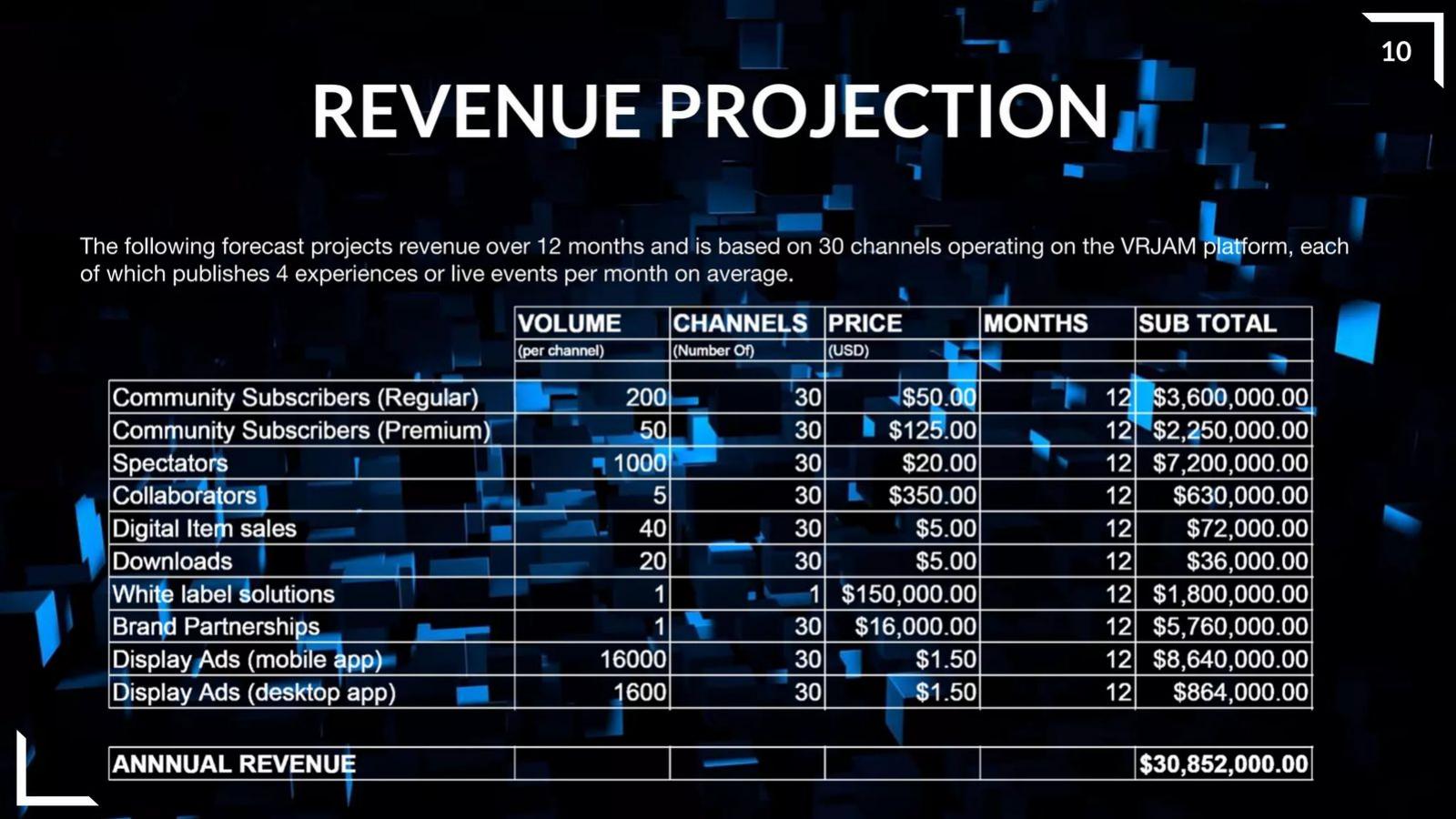
VRJAM deck, slide 10. Exact stored slide matched to this analysis.
Our analysis: An example to learn from: the arithmetic is correct (we checked every line and the total), but a $1.8M line rests on one unexplained client.
Evidence and limitation: Don't assume a large partner pays in full from month one without saying why.
What a founder can adapt: Back a white-label forecast line with a named client, letter of intent or comparable deal.
Supporting analysis
What the deck claims: 12-month revenue projection for 30 channels. "White label solutions": volume 1, channels 1, price $150,000, 12 months, $1,800,000. Annual revenue $30,852,000.
Presentation choice: An example to learn from: the arithmetic is correct (we checked every line and the total), but a $1.8M line rests on one unexplained client.
When it does not fit: Don't assume a large partner pays in full from month one without saying why.
Talent discovery from public social and developer profiles.
Talent Insights deck, slide 5. Exact stored slide matched to this analysis.
Our analysis: A weak example to learn from: white label named as a model with no price, unit or partner count.
Evidence and limitation: Listing two models with no order leaves investors unsure which one you will actually build.
What a founder can adapt: Add the price per API call or per seat and the first partners you will target.
Supporting analysis
What the deck claims: "Model 1: Provide IaaS via White Labelling (API) to companies (startups, SMEs, enterprises) & partners." "Model 2: Build an Ecosystem to provide 'Discovery' of talents".
Presentation choice: A weak example to learn from: white label named as a model with no price, unit or partner count.
When it does not fit: Listing two models with no order leaves investors unsure which one you will actually build.
The strongest slides give a price, the unit it grows with and white label as its own line.
Example
Price stated
Scales with
Separate from direct sales
Partner count
TripLingo
Yes ($10,000 + $5,000 per 10k)
Downloads
Yes
No
Podvertise.fm
Yes ($300 / $900 / $2,000)
Contacts
Yes
No
Key2cell
No
Messages sent
Yes (per partner type)
No
Digitzs
2.9% fee; split not stated
Transactions
Not applicable (white label only)
No
VRJAM
Yes ($150,000 a month)
Not stated
Yes
One, unexplained
Talent Insights
No
Not stated
Yes (Model 1)
No
Key Takeaways
Name the partner type: who puts their brand on your product.
Give the price and the unit it scales with: per user, per download, per message, per month.
Keep white-label revenue on its own line, separate from your direct customers.
Say how many white-label partners the forecast assumes, and on what evidence.
If partners share your fee, state the split.
Test your white-label slide before you send it
Answer these with numbers, even if they are targets.
Partner. Who puts their brand on your product, and why won't they build it themselves?
Price. What do they pay, and is it a one-off, monthly or yearly fee?
Scale. What does the price grow with: users, downloads, messages, transactions?
Split. If partners earn from your fee, what share do they get and what do you keep?
Evidence. How many partners does the plan assume, and which are signed or in talks?
Copyable framework: White label for [partner type]: [fee] per [period] + [price] per [unit]; [number] partners signed, [number] assumed in year one
Illustrative example 1 — written by us
Before: Provide IaaS via White Labelling (API) to companies & partners.
After: White-label API for [partner type]: [fee] a year + [price] per [unit]; [number] pilots signed, [number] partners planned by [year]
What improved: Our illustrative rewrite, not Talent Insights' text. Bracketed parts are placeholders, not company facts. It turns a label into a model an investor can test.
What this guide covers
A white-label offer lets another company sell your product under its own name. A bank gives its customers a payments tool built by someone else; a telecom operator sends marketing messages through a platform it didn't build; a travel company hands out a language app with its own logo on it. The partner owns the customer relationship and the brand. You supply the product and take a fee.
Founders often list white label as one revenue stream among several. That is where it usually goes wrong. A white-label deal is a different business from selling direct: fewer, larger customers, longer sales cycles, and revenue that depends on how well the partner sells. Investors want to know how you charge for it, how the charge grows, and how much of your plan rests on it.
Our business model guides cover marketplaces, subscriptions, advertising, hardware, licensing and franchising. Several guides mention white label in passing, but none explains how to present it. We found about thirty startup slides in our corpus that discuss white-label pricing or revenue. Seven were readable, from companies that were private when they made the deck, and different enough from each other to teach something.
State the price and what it grows with
The most useful thing a white-label slide can do is give a price and the unit it is tied to. A partner that grows should pay you more. If your price is a flat fee, say so, and explain why.
TripLingo, a travel language app, does this on its pricing slide. Alongside its consumer and corporate prices it lists "White label pricing: Base $10,000; Per 10K downloads $5,000", with the note "White label pricing is driven by number of unique downloads." That works out to 50 cents per download on top of the base fee. A partner whose branded app reaches 100,000 downloads would pay $10,000 plus 10 × $5,000, or $60,000, if the base fee is charged once. The slide doesn't say whether the base fee is one-off or yearly, or whether downloads are counted once or every year; those two details change the revenue a lot.
Podvertise, a podcast advertising marketplace, gives white-label services a column of their own on its business model slide: "$300 / $900 / $2000, fixed pricing per # of contacts", covering podcast outreach as a service, a partner programme for marketing agencies and white-label campaigns. Because the price steps up with the number of podcasts contacted, it grows with how much work each agency client wants done. Putting it in a separate column from the marketplace fee (15% on deals up to $10k, falling to 5% above $50k) lets an investor see the two businesses apart.
Say who pays and how often
White-label partners are usually businesses, and different partner types often pay in different ways. If you have more than one type, show each one.
Key2cell, a Hong Kong mobile advertising platform, splits its revenue by customer on one slide. Brands pay as they go or buy monthly packages. Agencies pay a preferential rate, buy packages and pay a "Monthly White Labeled Fee". Mobile operators, who use Key2cell for their own marketing, pay "Monthly White Label Service Fees" plus a "Fee per MMS sent (quantity dependent)". That is a clear structure: a recurring fee for the right to use the platform under the partner's name, plus usage charges that grow with volume.
What the slide leaves out is every number. There is no monthly fee, no price per message and no count of operators or agencies. An investor can understand the model but can't size it. A stronger version would add one line per partner type: the monthly fee, the typical monthly volume and what that customer is worth in a year.
When partners earn from your fee
Some white-label models pay the partner as well as charging them. Payment companies are the clearest case: the platform puts the payment tool under its own brand and receives part of each transaction fee. If you share revenue, the split decides your margin, so state it.
Digitzs, a payments company for apps and marketplaces, describes this on its solution slide. Users get a merchant account "without ever leaving the platform's site"; Digitzs collects the platform's own fees at no cost and "pay[s] commissions to the platform on the 2.9% we collect for life. All via a white label, risk free solution that works in 160 currencies." Its three headings, "White Label Onboarding", "Add their fees to ours" and "Lifetime Commissions", tell a platform owner exactly why to sign up.
For an investor, though, the missing number is the commission. If Digitzs passes on a large part of the 2.9%, what it keeps may not cover its own processing costs. The slide also cites "50 platform CEOs were interviewed", which supports the design but isn't evidence that platforms signed. A stronger version would give the commission rate, what Digitzs keeps per $100 processed, and how many platforms are live.
Show how much of the forecast depends on white label
White-label revenue tends to arrive in a few large deals. That makes it easy to put a big number in a forecast with very little behind it. Investors look for the count of partners and the price per partner, and then ask whether those are realistic.
VRJAM, a live virtual reality platform for music events, shows a 12-month revenue projection with ten lines. We checked the arithmetic: every line multiplies volume by channels by price by 12 months correctly, and the lines add up to the stated $30,852,000. The white-label line reads one unit, one channel, $150,000, 12 months: $1,800,000, or about 5.8% of the total.
The arithmetic is right, but the assumption is not explained. The slide implies one client paying $150,000 every month from the first month, and gives no name, no signed agreement and no reason for that price. The deck was made around VRJAM's 2019 equity crowdfunding round, when it was raising £250,000; a single white-label client worth $1.8M a year would be several times that raise. The lesson is not that the number is wrong, but that a large white-label line needs a source: a signed client, a letter of intent or a comparable deal.
Weak examples: white label with no price
The most common white-label slide in our corpus names the offer and stops. That tells an investor you have thought about it, but not whether it will earn anything.
Talent Insights, which analyses public profiles to find job candidates, lists two models on its business model slide. Model 1 is to "Provide IaaS via White Labelling (API) to companies (startups, SMEs, enterprises) & partners." Model 2 is a talent discovery ecosystem. There is no price, no unit and no indication of which model comes first.
Both slides could be fixed with one sentence: who the partner is, the price per unit, and how many partners or users the plan assumes in the first year.
How to put a white-label slide together
Start with who the partner is and why they would rather put their brand on your product than build their own. Then give the price, the unit it grows with and how often it is charged. If partners earn from your fee, give the split. Finally, show white-label revenue as its own line in your forecast, with the number of partners behind it and the evidence for that number.
Keep the slide honest about what white label means for your business. It usually brings fewer customers who pay more, longer sales cycles and less control over how the product is sold. Investors don't mark you down for that; they mark you down for hiding it. A white-label line built from one named pilot partner is more convincing than a large round number with nothing behind it.
Common mistakes
No price. Give an amount for every white-label fee.
No unit. Say what the price grows with.
Hidden revenue share. State the split if partners earn from your fee.
Unexplained big deal. Back a large white-label line with a named client or evidence.
Equal slices. Size each revenue stream by what it will actually earn.
Diagnostic checklist
Partner type named.
Price, billing period and scaling unit stated.
Revenue share stated, if any.
White-label revenue on its own forecast line.
Number of partners assumed, with evidence.
Frequently asked questions
How we chose these examples
Corpus: published pitch deck teardowns on StartupFundraising.com. Founder-uploaded private decks are excluded.
Selection (2026-10-01): we searched extracted slide text for white-label offers mentioned alongside fees, pricing, revenue or partners, then read each candidate from images made from the original deck files.
Removed in v2 (2026-10-05): Juubix, because a page of its deck carries a restriction notice. Eligibility: each company was private when its deck was made. TripLingo (venture and angel rounds 2011 to 2014, later acquired), Digitzs (private rounds 2014 to 2018 and equity crowdfunding in 2016), VRJAM (equity crowdfunding in 2019) and Key2cell (privately held Hong Kong company) were confirmed from public funding records and company profiles; Podvertise.fm's 2024 deck reports early-stage revenue; Talent Insights showed no sign of a listing in their decks.
Not used: Sonder (its deck was made for a merger with a listed shell company), a Techstars demo day deck (it combines several companies, so its pricing table can't be tied to one startup), and other slides that mention white label only as a product feature with no pricing or revenue.
Overlap check: no other guide covers white-label models. The licensing, partnerships, marketplace, subscription, advertising, hardware and franchise guides cover other models; several guides mention white label only in passing.
Review: all six slide images were inspected on 2026-10-01 and matched to company, deck and slide number, and the arithmetic on the VRJAM projection and the TripLingo pricing example was recomputed (AI editorial model review). No person has yet completed an editorial review of this page.
Figures are the companies' own claims; we checked arithmetic, not underlying data. We make no claim that any slide caused a fundraising outcome.