Lantern’s 13-slide deck is a masterclass in category creation, introducing the term 'Agentic Commerce' to describe the shift from traditional SEO to AI recommendation optimization. The narrative is built on the premise that as AI agents begin to handle product discovery and purchasing, brands risk losing visibility unless they optimize for Large Language Models (LLMs). The deck uses compelling data points, such as an 8% click-through rate when AI summaries are present versus 15% without, to establish urgency. By positioning their tool as a 'fix' rather than just a reporting dashboard, Lantern…
Key takeaways
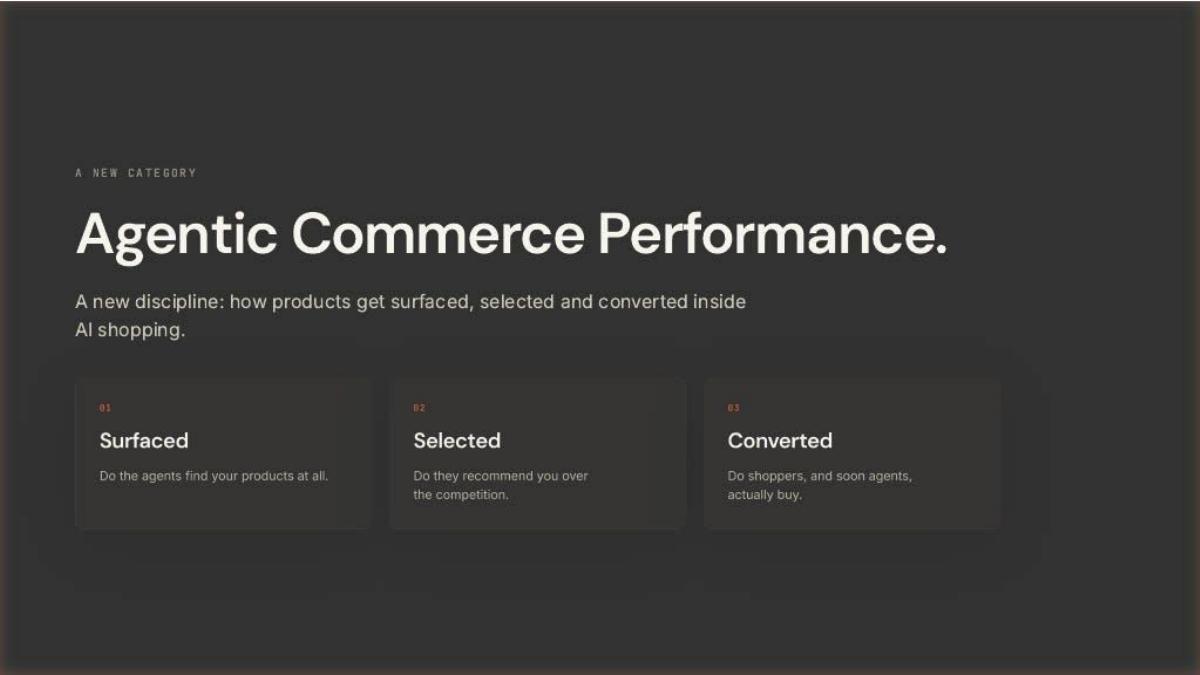
- The deck introduces 'Agentic Commerce' as a new discipline for e-commerce brands (Slide 6).
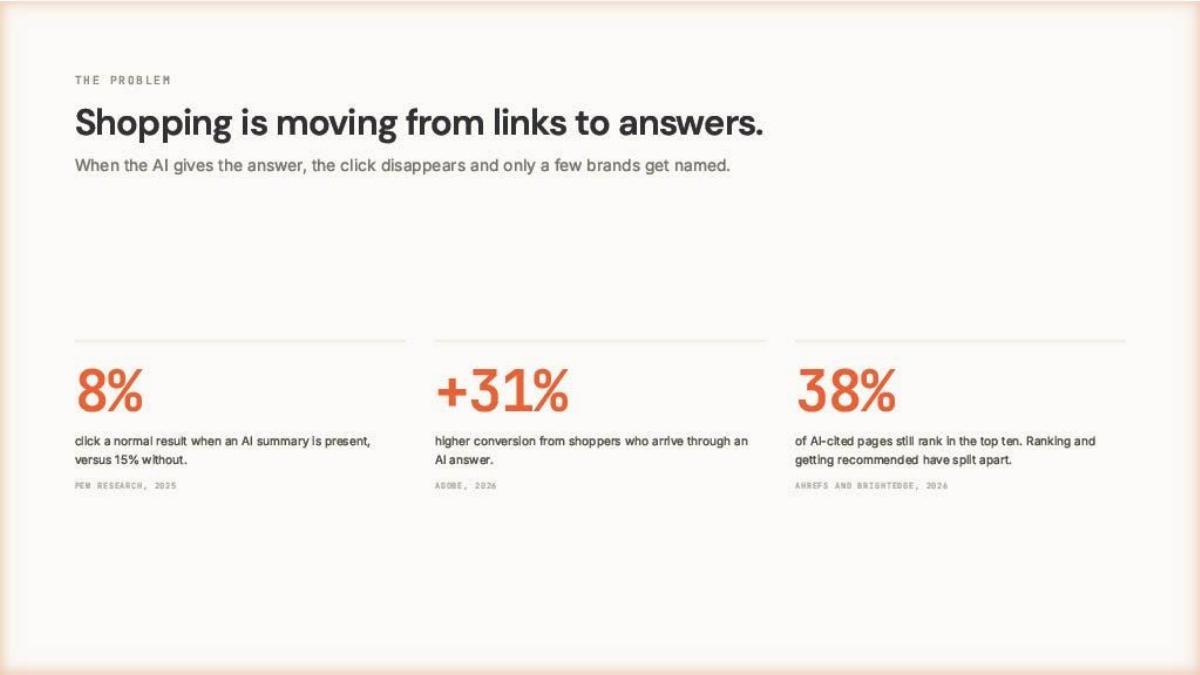
- Lantern highlights a significant drop in organic clicks, noting only 8% of users click a normal result when an AI summary is present (Slide 3).
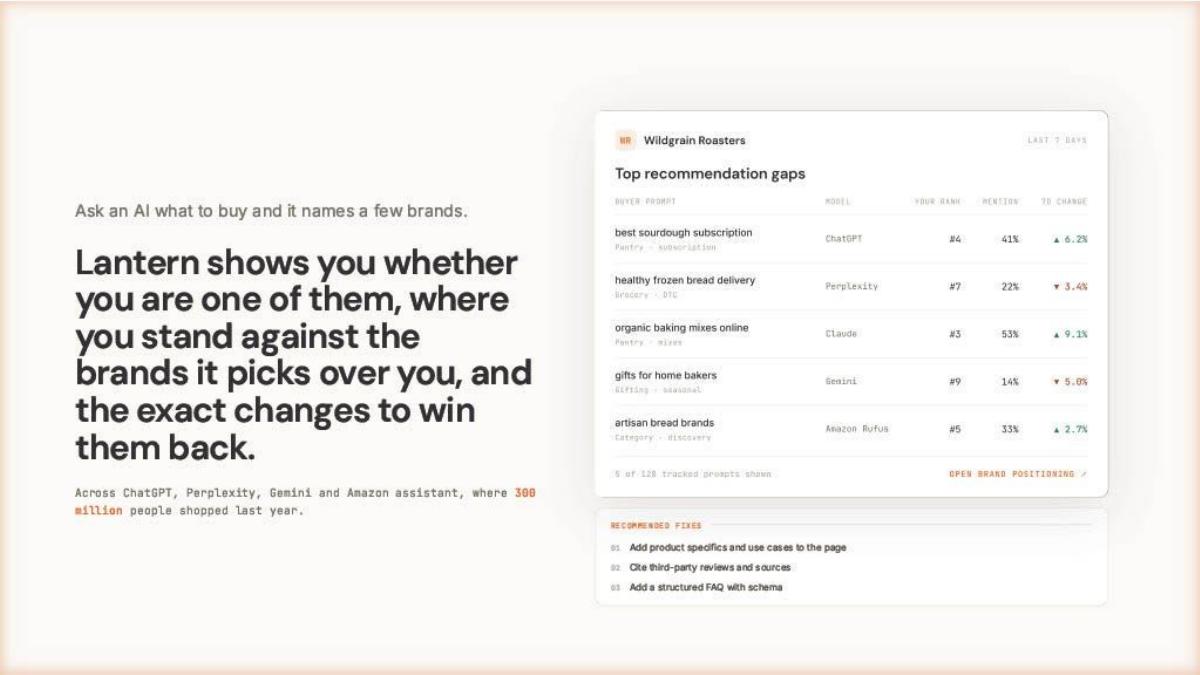
- The product is positioned as an actionable tool that delivers 'exact changes' to win back AI recommendations (Slide 4).
- The company raised $3.1M in a Seed round led by Salesforce Ventures (Slide 2, Slide 11).
- Lantern claims AI-driven retail traffic grew by nearly 700% year-over-year (Slide 10).
- The team emphasizes founder-market fit, featuring an operator who built Headphones.com and engineers from Amazon (Slide 12).
- The deck identifies a massive market opportunity with 300M+ people shopping through AI assistants last year (Slide 11).
- Lantern's platform includes an 'Agent Ready Score' and 'Automated Fixes' to differentiate from legacy SEO tools (Slide 7).
The Vision: From Search to Agents
Slide 1: The Hook
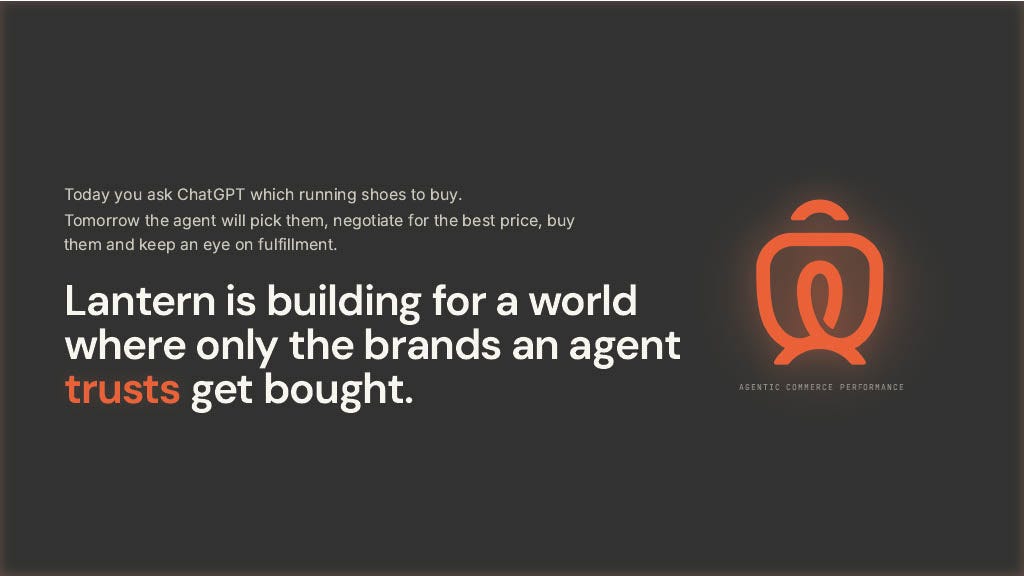
Lantern opens with a narrative shift. Instead of focusing on current search behavior, it paints a picture of a near-future where AI agents don't just recommend products but negotiate and buy them. The slide states, "Lantern is building for a world where only the brands an agent trusts get bought." This immediately sets the stakes: if you aren't visible to the agent, you don't exist in the transaction.
Slide 2: The Team and the Raise
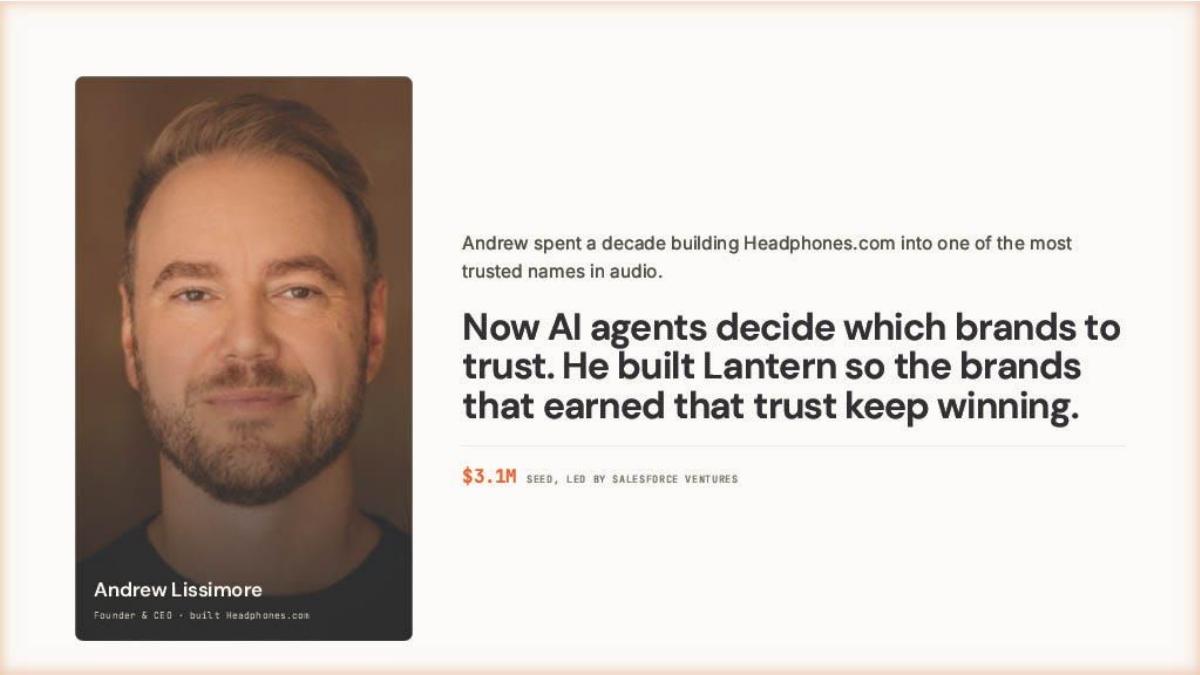
This slide serves as a dual-purpose credibility builder. It introduces Andrew, the founder who built Headphones.com, establishing deep domain expertise in e-commerce. It also confirms the $3.1M Seed round led by Salesforce Ventures . By placing the raise amount and lead investor early, the deck signals that the vision has already been validated by a top-tier institutional investor.
Slide 3: The Problem – The Disappearing Click
Lantern uses data to quantify the threat to brands. Citing Pew Research 2025, the slide notes that only 8% of users click a normal result when an AI summary is present , compared to 15% without. It also highlights that 38% of AI-cited pages still rank in the top ten , suggesting that traditional SEO ranking and AI recommendations have decoupled. The core problem is clear: shopping is moving from links to answers, and the click is disappearing.
Slide 4: The Solution – Winning the Recommendation
The solution slide explains how Lantern works across platforms like ChatGPT, Perplexity, Gemini, and Amazon. It promises to show brands where they stand against competitors and provides "the exact changes to win them back." This moves the value proposition from passive monitoring to active intervention.
Slide 5: A New Playbook
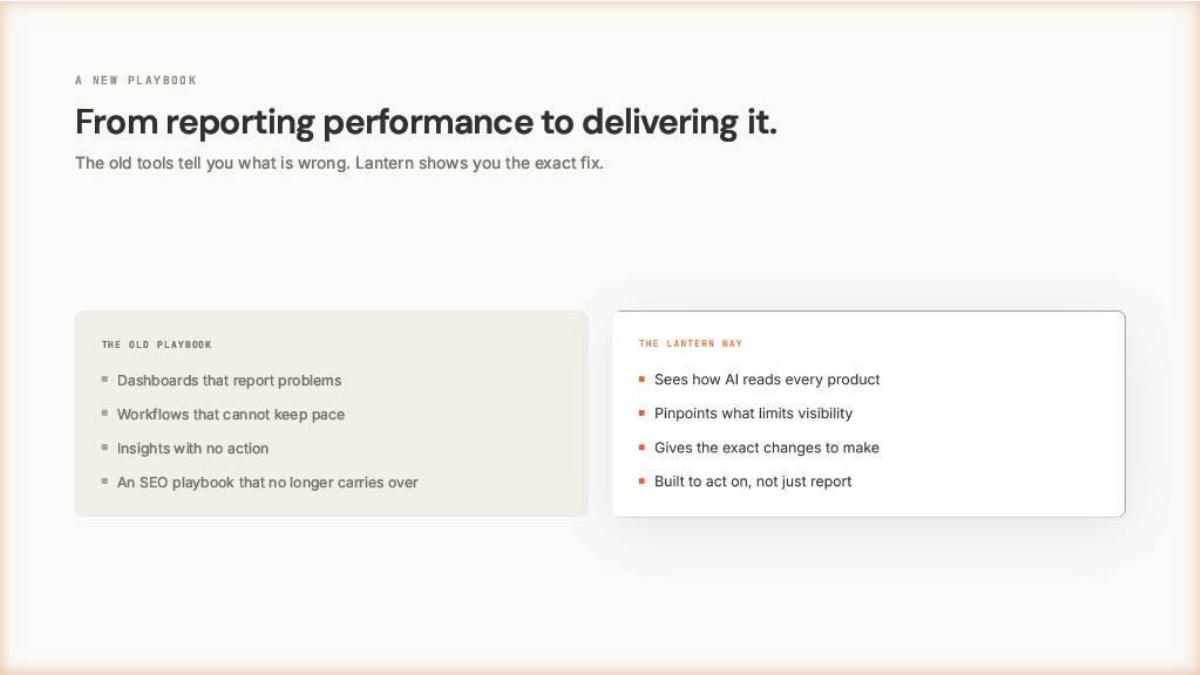
This slide uses a comparison table to distance Lantern from legacy software. The "Old Playbook" is characterized by dashboards that report problems and insights with no action. The "Lantern Way" focuses on pinpointing what limits visibility and delivering the "exact fix." This is a classic positioning tactic to justify a new category spend.
Slide 6: Defining Agentic Commerce
Lantern introduces a new discipline: Agentic Commerce Performance . It breaks this down into three stages: 01 Surfaced (do agents find you?), 02 Selected (do they recommend you?), and 03 Converted (do they buy?). By naming the category, Lantern positions itself as the leader of a new market rather than a participant in an old one.
Slide 7: Platform Capabilities
This slide lists six core features: Agent Ready Score, AI Visibility Tracking, Product-Level Analysis, Category Benchmarking, Automated Fixes, and Specialized Agents. It also lists compatibility with major platforms like Shopify, BigCommerce, WooCommerce, Adobe Commerce, Salesforce, Squarespace, and Wix. This demonstrates the breadth of the technical build and its readiness for enterprise-scale integration.
Slide 8: Built for a Moving Target
Recognizing the volatility of the AI space, Slide 8 addresses technical defensibility. It acknowledges that models and retrieval protocols are shifting and claims that "Lantern adapts so you do not have to." This positions the product as an abstraction layer that protects brands from the underlying chaos of the AI landscape.
Slide 9: The Future of Buying
Slide 9 reinforces the opening narrative: "The agents that recommend brands to you today are the ones that will buy them for you tomorrow." It acts as a bridge between the current product (recommendation optimization) and the future vision (transactional agents).
Slide 10: Market Momentum
To prove the trend is real, Lantern cites a 700% year-over-year increase in retail traffic from AI . This is a powerful momentum metric that suggests brands are already seeing the impact, even if they aren't yet optimized for it.
Slide 11: Why Now?
The "Why Now" slide combines market size with the business model. It repeats the $3.1M raise and the 300M+ people shopping through AI assistants . It also mentions a "Free to start" model, indicating a bottom-up adoption strategy to quickly capture market data.
Slide 12: The Founders
The team slide highlights the balance between operational experience and technical depth. Andrew is described as an operator who built Headphones.com, while Sanders is an "Ex-Amazon engineer building the core of Lantern." This combination of e-commerce P&L experience and big-tech engineering is a strong signal for Seed-stage investors.
Slide 13: The Closing Statement
The deck ends on a high-level vision: "Soon, agents will do the buying. Lantern makes sure they buy from you." It uses the metaphor of a "light" (referencing the company name) to show the way to the front of the recommendation engine.
What Lantern Does Well
Category Creation: The deck does an excellent job of coining and defining "Agentic Commerce." By creating a new bucket for their software, they avoid being compared to low-margin SEO tools or generic AI wrappers. They make the case that this is a fundamental shift in how commerce works, requiring a new stack.
Urgency through Data: The use of the 8% vs. 15% click-through rate is a brilliant way to scare brands into action. It frames the rise of AI not as a cool new feature, but as a direct threat to existing revenue streams. The 700% traffic growth figure further validates that the shift is happening in real-time.
Action-Oriented Value Prop: Lantern repeatedly emphasizes that they don't just report problems; they provide the "exact fix." In a market saturated with analytics dashboards, the promise of automated fixes and prioritized changes is a significant differentiator.
What is Missing from the Deck
Unit Economics and Pricing: While the deck mentions it is "Free to start," there is no information on how the company plans to monetize at scale. There are no details on contract sizes, take rates, or subscription tiers.
Case Studies/Traction: Despite the founder's background, the deck does not show any specific results from early pilots or beta customers. While it mentions 300M+ people using AI assistants, it doesn't state how many brands are currently using Lantern or what their "Agent Ready Scores" improved by after using the tool.
Competitive Landscape: The deck ignores other players in the emerging AI SEO (ASO) space. While they position themselves against the "Old Playbook," they don't address how they will compete against other startups or the AI platforms (like OpenAI or Perplexity) themselves if those platforms build their own brand portals.
What Founders Should Copy
The 'Old vs. New' Slide: Slide 5 is a perfect example of how to position a product against legacy competitors. It uses clear, bulleted lists to show why the current way of working is failing and why the new way is necessary. This is a highly effective way to simplify a complex value proposition.
Narrative Bookending: Lantern starts and ends with the same vision: AI agents doing the buying. This consistency helps the investor remember the core thesis. Every slide in between serves as evidence for how they will win that future.
Founder-Market Fit: The team slide doesn't just list titles; it explains why these specific people are the ones to build this company. Andrew’s experience building a trusted e-commerce brand gives him the "empathy" for the customer, while the Amazon engineers provide the "authority" to build the tech.
Frequently asked questions
- What is the primary problem Lantern is solving?
- Lantern addresses the 'disappearing click' in e-commerce. As consumers move from traditional search engines to AI agents like ChatGPT and Perplexity, fewer brands are being surfaced in results. Lantern provides the tools to ensure a brand is one of the few selected and recommended by these AI models.
- Who led Lantern's Seed round and how much was raised?
- As reported by Business Insider and stated on Slide 2 and Slide 11 of the deck, Lantern raised $3.1M in a Seed round led by Salesforce Ventures.
- How does Lantern differentiate itself from traditional SEO tools?
- Slide 5 explicitly contrasts the 'Old Playbook' (dashboards that report problems) with the 'Lantern Way' (delivering exact fixes). While SEO tools focus on search engine rankings, Lantern focuses on how AI agents read, surface, and select products.
- What specific metrics does the deck use to prove market demand?
- The deck cites that 300M+ people used AI assistants for shopping last year (Slide 11) and that retail traffic from AI grew by nearly 700% year-over-year (Slide 10).
- What are the core features of the Lantern platform?
- According to Slide 7, the platform includes an Agent Ready Score, AI Visibility Tracking, Product-Level Analysis, Category Benchmarking, Automated Fixes, and Specialized Agents.