LafaLafa’s 9-slide deck is a lean, metric-driven presentation that successfully secured $125,000 in seed funding in 2015. The deck avoids the common pitfall of over-explaining technology, instead focusing on the massive market opportunity in India—valued at $100B for e-commerce—and the company's specific traction. With a reported $300K in monthly GMV and a 37% month-over-month growth rate, the founders presented a compelling case for a scalable affiliate model. While the deck lacks a formal 'Ask' slide and detailed financial projections, it compensates with strong unit economics (3x LTV/CAC)…
Key takeaways
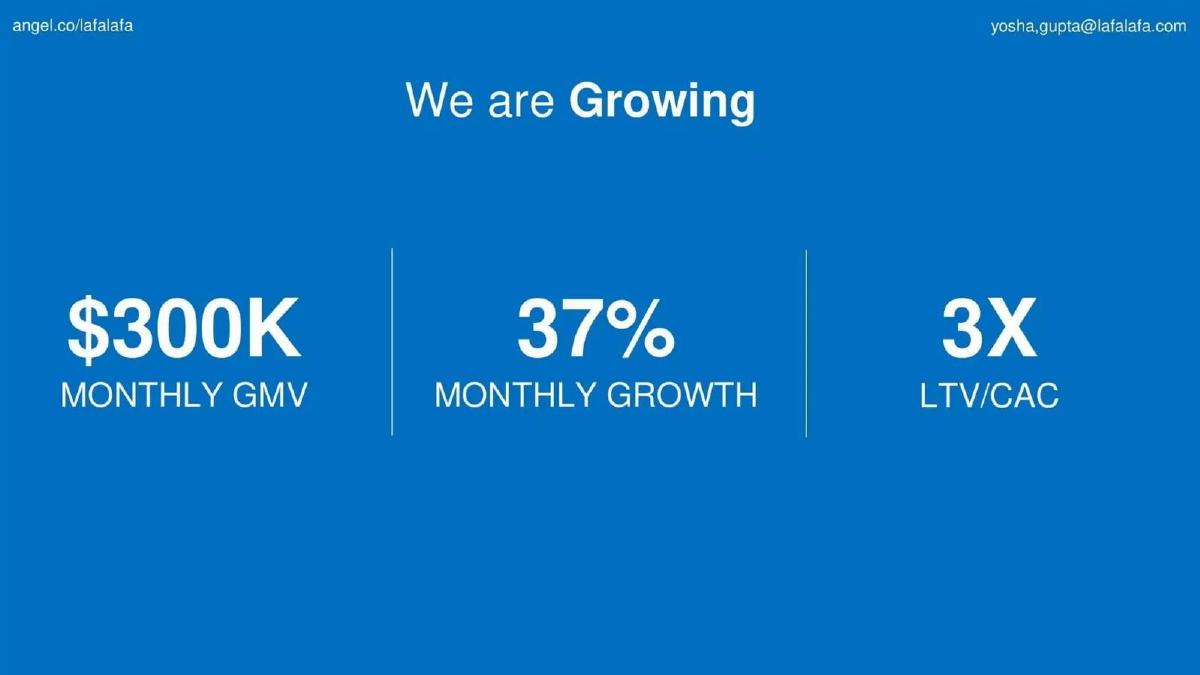
- The company reported a significant $300K Monthly GMV at the time of the pitch (Slide 2).
- LafaLafa demonstrated high capital efficiency with a 3x LTV/CAC ratio (Slide 2).
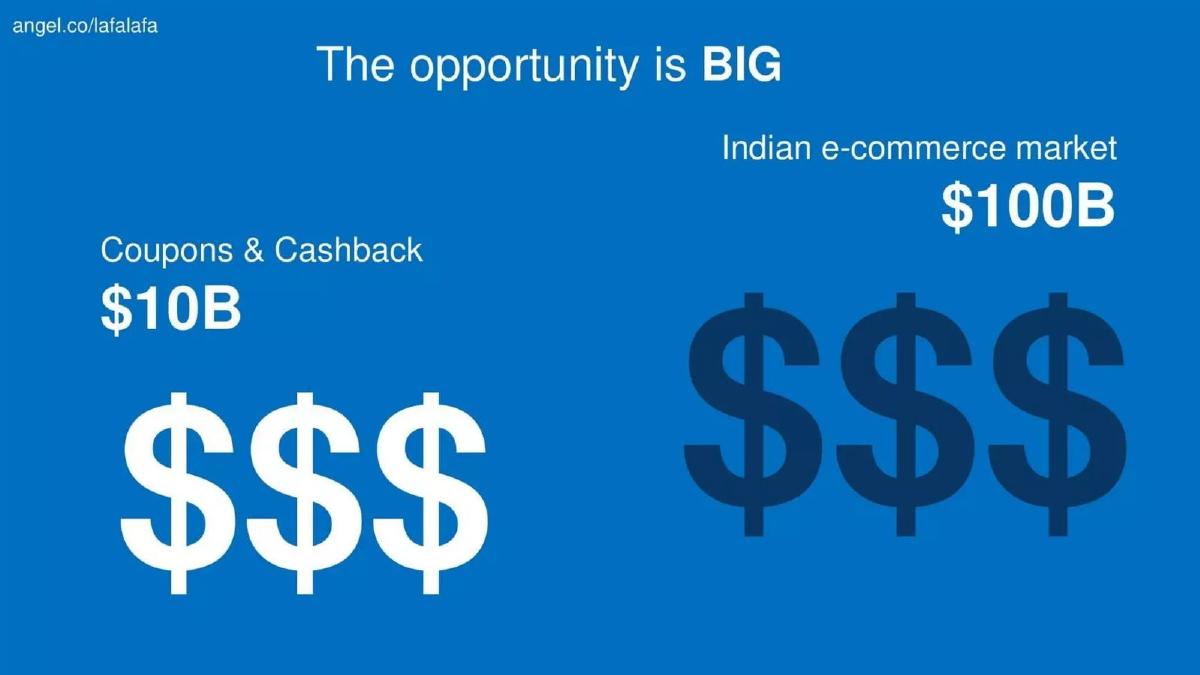
- The deck identifies a $10B market opportunity specifically for coupons and cashback within India (Slide 3).
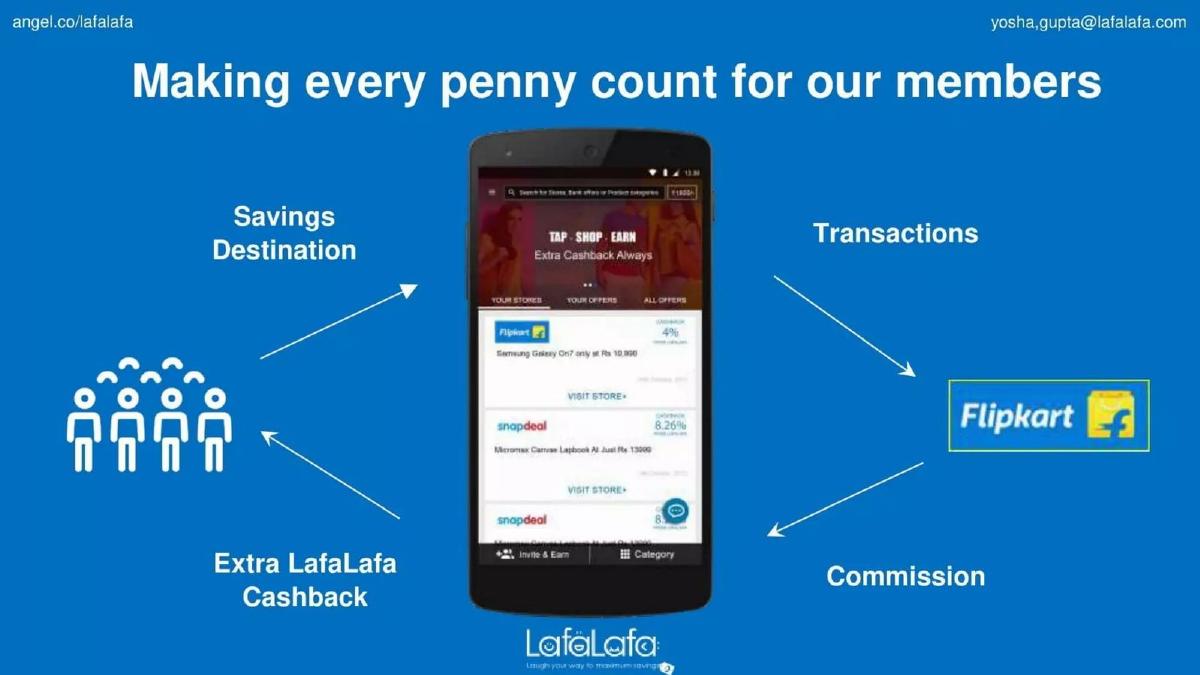
- The business model relies on a circular flow where retailers pay commissions that are partially shared with members as cashback (Slide 5).
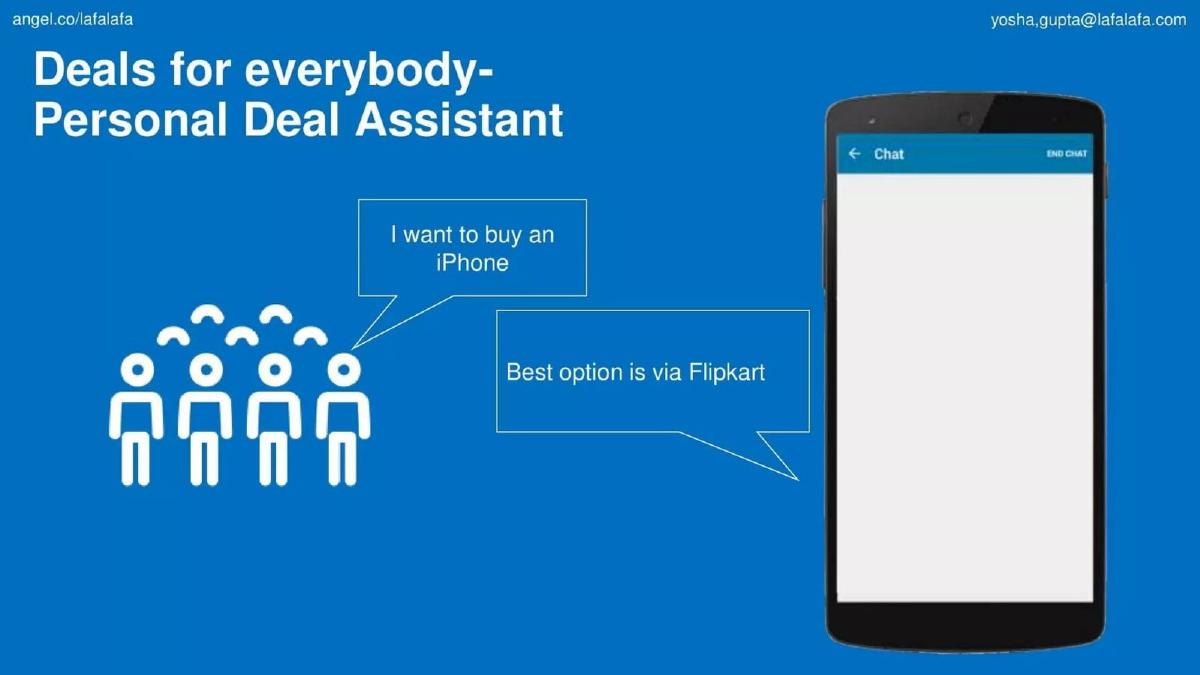
- The product roadmap included a 'Personal Deal Assistant' chat feature to drive mobile engagement (Slide 6).
- Geographic expansion was already underway or planned for Hong Kong and Indonesia beyond the core Indian market (Slide 7).
- Founder Yosha Gupta is highlighted for having 10 years of experience in mobile payments and fintech (Slide 8).
- The deck omits a specific funding 'Ask' or breakdown of how the $125,000 would be spent (Slide 9).
The 9-Slide Sprint: LafaLafa’s Seed Deck Analysis
LafaLafa’s pitch deck is a concise 9-slide document that focuses heavily on market timing and traction. In 2015, the Indian e-commerce market was experiencing a massive surge, and LafaLafa positioned itself as the essential intermediary between price-sensitive consumers and high-CAC (Customer Acquisition Cost) retailers. This teardown examines how they used a lean deck to raise $125,000.
The Hook and Immediate Traction (Slides 1-2)
Slide 1: Title The cover slide is functional and brand-forward. It features the LafaLafa logo with the tagline "Laugh your way to maximum savings" and a clear descriptor: "Coupons & Cashback App for online shopping." A mobile handset mockup displays the app interface, showing offers from Flipkart and Snapdeal. This immediately establishes the product as a mobile-first platform in the affiliate space.
Slide 2: Traction LafaLafa makes a bold move by placing their traction slide second. This is a "momentum-first" strategy. They list three key figures: $300K Monthly GMV , 37% Monthly Growth , and a 3X LTV/CAC ratio. By leading with these, they answer the investor's most pressing question—"Does this work?"—before even explaining the problem. The 3x LTV/CAC is particularly important for an affiliate business, as it proves the unit economics are sustainable despite the thin margins typical of the sector.
Market Opportunity and Problem Statement (Slides 3-4)
Slide 3: The Opportunity is BIG This slide uses simple, large-scale typography to define the Total Addressable Market (TAM). They cite the Indian e-commerce market at $100B and the specific Coupons & Cashback segment at $10B . While the slide lacks a specific source for these figures, the scale is large enough to justify venture-scale interest. The use of oversized dollar signs is a bit cliché, but it effectively communicates the scale of the prize.
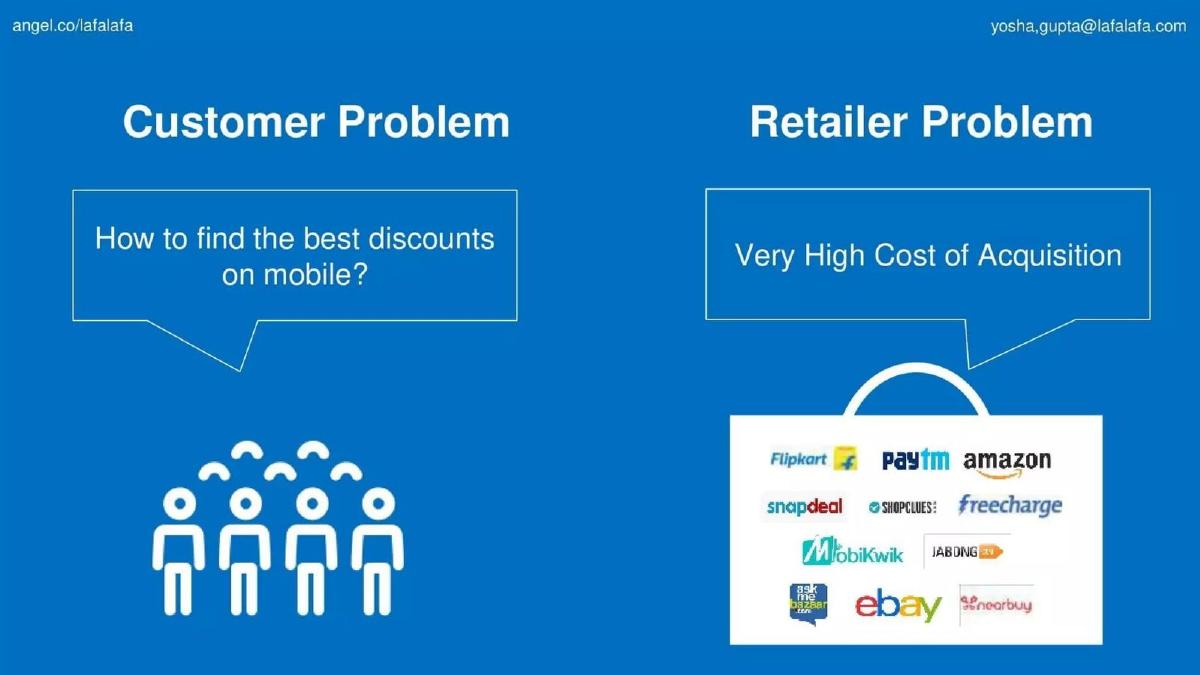
Slide 4: Problem Statement The deck splits the problem into two categories: the "Customer Problem" and the "Retailer Problem." For customers, the issue is "How to find the best discounts on mobile?" For retailers, it is the "Very High Cost of Acquisition." By framing themselves as a solution for both sides of the marketplace, LafaLafa positions itself as a value-added partner rather than just a discount site. The inclusion of logos like Amazon, Flipkart, and Paytm reinforces the caliber of retailers they are targeting.
The Solution and Product Vision (Slides 5-6)
Slide 5: Business Model Titled "Making every penny count for our members," this slide illustrates the circular flow of their business. Users go to LafaLafa (the "Savings Destination"), which directs them to a store like Flipkart. The transaction occurs, Flipkart pays a commission to LafaLafa, and LafaLafa returns "Extra LafaLafa Cashback" to the member. It is a clear, jargon-free explanation of affiliate marketing.
Slide 6: Personal Deal Assistant This slide introduces a feature-level differentiator: a chat-based "Personal Deal Assistant." The mockup shows a user asking for an iPhone and the assistant recommending Flipkart. In 2015, conversational commerce was a burgeoning trend. This slide suggests that LafaLafa isn't just a static list of links but an active, AI-driven (or human-assisted) shopping companion, which adds a layer of perceived "tech defensibility" to a business model that is otherwise easy to replicate.
Expansion and Leadership (Slides 7-8)
Slide 7: Geographic Expansion LafaLafa uses a map of Asia to show their ambitions beyond India. They highlight Hong Kong and Indonesia as expansion targets. This is a strategic inclusion for a seed round; it tells investors that the model is portable and that the founders are thinking about regional dominance, not just a single-country play.
Slide 8: The Team The team slide features a group photo of approximately 14 people, suggesting a significant operation already in place. However, the text focuses solely on the founder: Yosha Gupta, CEO & Founder . Her credentials—10 years in mobile payments and fintech—are highlighted to provide the necessary domain expertise. While the rest of the team is pictured, their specific roles or backgrounds are not detailed, which is a common omission in smaller seed decks.
The Close and Social Proof (Slide 9)
Slide 9: Conclusion and Media The final slide repeats the core traction metrics from Slide 2 ($300K GMV, 37% growth, 3x LTV/CAC). This repetition ensures that these figures are the last thing an investor sees. Below the contact information, they include a row of media logos: Forbes, CNBC, YourStory, Digit, DNA, DealStreetAsia, and Amar Ujala . This provides a final layer of social proof, suggesting that the company is already a recognized leader in the Indian startup ecosystem.
What Works in This Deck
Metric-Forward Design: By putting traction on Slide 2 and Slide 9, the founders ensure the conversation is rooted in their actual performance rather than just theoretical potential. · Clear Unit Economics: The 3x LTV/CAC ratio is the most important metric in the deck. It tells investors that for every dollar spent on marketing, the company generates three dollars in value, making it a "money printer" if given more capital. · Dual-Sided Problem Solving: Acknowledging the high CAC of retailers like Amazon and Flipkart shows a sophisticated understanding of the e-commerce ecosystem. · Brevity: At only 9 slides, the deck is easy to digest and doesn't get bogged down in technical details of how the cashback is tracked or paid out.
What is Missing
The Ask: There is no slide stating how much money they are raising, the valuation, or the specific milestones they intend to hit with the new capital. · Competitive Analysis: The deck does not mention other cashback players in India (like CashKaro or GoPaisa), which would be a primary concern for any investor in this space. · Financial Projections: While they show current GMV, there is no forward-looking chart showing when the company expects to reach profitability or what the revenue (not just GMV) looks like. · Product Depth: The "Personal Deal Assistant" is mentioned, but there is no detail on whether this is automated, manual, or how it scales.
What a Founder Should Copy
The Traction Sandwich: Start and end with your strongest metrics. If you have 37% month-over-month growth, don't hide it on Slide 11. · Visualizing the Flow: Slide 5’s diagram of how money moves from the retailer to the platform to the user is a perfect way to explain a marketplace or affiliate model. · Market Context: Linking a specific niche ($10B cashback) to a broader, well-understood trend ($100B e-commerce) helps investors size the opportunity quickly. · Founder-Market Fit: Highlighting "10 years in mobile payments" for a mobile savings app is a textbook example of establishing founder-market fit in a single sentence.
Frequently asked questions
- What was LafaLafa's primary value proposition?
- LafaLafa positioned itself as a 'Coupons & Cashback App for online shopping' (Slide 1). It solved a dual problem: helping customers find the best mobile discounts while reducing the 'Very High Cost of Acquisition' for major retailers like Amazon, Flipkart, and Snapdeal (Slide 4).
- How did LafaLafa generate revenue?
- The revenue model is a classic affiliate commission structure. As shown on Slide 5, LafaLafa drives transactions to partner stores (e.g., Flipkart). The store pays a commission to LafaLafa, which then returns a portion of that money to the user as 'Extra LafaLafa Cashback,' keeping the margin.
- What were the key growth metrics presented in the deck?
- The deck leads with three core metrics on Slide 2: $300,000 Monthly GMV (Gross Merchandise Volume), a 37% Monthly Growth rate, and a 3x LTV/CAC (Lifetime Value to Customer Acquisition Cost) ratio. These figures were repeated on the final slide to reinforce the company's traction.
- Who were the main competitors or partners mentioned?
- While the deck does not include a formal competitive landscape slide, it lists several major partners that could also be seen as ecosystem incumbents, including Flipkart, Paytm, Amazon, Snapdeal, Shopclues, and eBay (Slide 4).
- What is missing from the LafaLafa pitch deck?
- The deck is notably missing a 'Use of Funds' or 'The Ask' slide, which typically specifies how much capital is being raised and for what purpose. It also lacks a detailed slide on unit economics beyond the LTV/CAC ratio and provides no long-term financial projections or exit strategy.