Should a pitch deck include a culture or values slide? Five real culture slides compared, from measured employee scores to lists of values with no evidence.
Culture and Values Slide Examples in Pitch Decks
Five culture and values slides from real pitch decks, shown in full, compare slides that give an investor evidence about how the company works with slides that only list good intentions.
TL;DR
A culture or values slide helps only when it gives an investor evidence they can use: a measured score, a hiring or retention fact, or a link between how the team works and how the company will win. CMR Surgical pairs each value with a claim, such as going "from concept to patient in 5 years" and "75% of our people love the 'great culture' at CMR". Copado ties its values to how it sells. Canary Technologies, Aliat and Bijana Healthcare list values or mottos with no evidence, which an investor reading quickly will skip. In most early-stage decks, the slot is better used for the team itself.
Culture and values slides from real pitch decks
Each example shows the exact stored slide above its analysis and links to the full teardown. Stage and year are given only where the deck states them. Figures are the companies' own unless a source is shown on the slide.
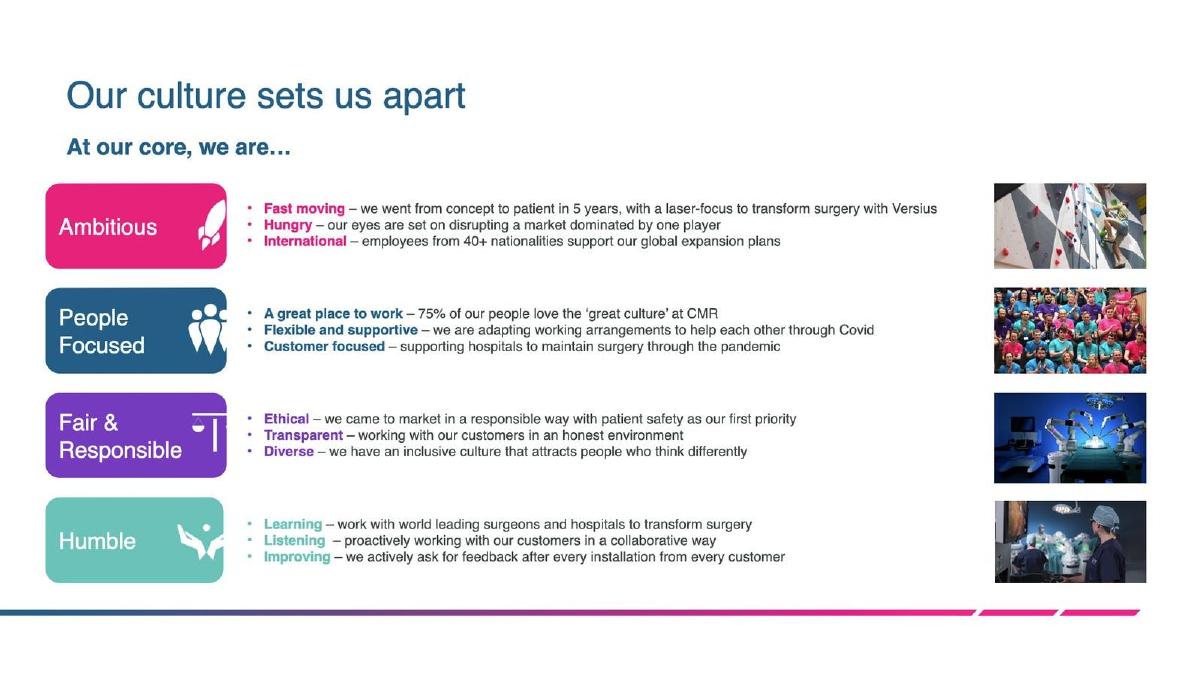
CMR Surgical team slide — slide 15
Surgical robotics (Versius system), founded in Cambridge, UK, in 2014. Earlier slides describe unicorn status in 2019 and more than 1,000 procedures.
CMR Surgical deck, slide 15. Exact stored slide matched to this analysis.
Our analysis: Each value is backed by a specific statement, so the slide reads as a description of the company rather than a wish list.
Evidence and limitation: The 75% figure has no stated source, survey or date (the company's claim). The text is very small for a slide; four values with one claim each would read better.
What a founder can adapt: Under each value, add one concrete fact, decision or number that shows it.
Supporting analysis
What the deck claims: "Our culture sets us apart". Four values, each with claims: Ambitious ("we went from concept to patient in 5 years"; "employees from 40+ nationalities"); People Focused ("75% of our people love the 'great culture' at CMR"); Fair & Responsible ("patient safety as our first priority"); Humble ("we actively ask for feedback after every installation from every customer").
Presentation choice: Each value is backed by a specific statement, so the slide reads as a description of the company rather than a wish list.
When it does not fit: The 75% figure has no stated source, survey or date (the company's claim). The text is very small for a slide; four values with one claim each would read better.
Software release and DevOps company; its mission slide reads "Make Release Days Obsolete".
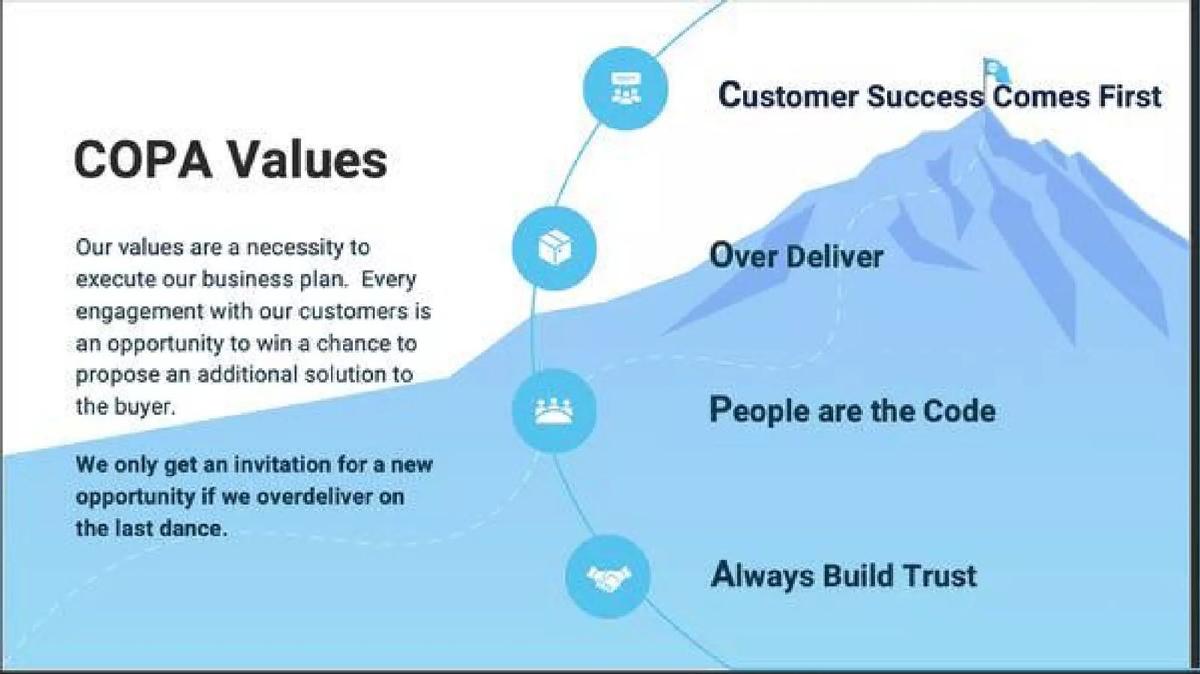
Copado deck, slide 12. Exact stored slide matched to this analysis.
Our analysis: It explains why the values matter commercially: growth depends on delivering well enough to be invited back for the next sale.
Evidence and limitation: No evidence that it works on this slide. Pair the claim with an expansion or retention figure, or point to the slide that has one.
What a founder can adapt: Say in one sentence how your culture supports the business plan.
Supporting analysis
What the deck claims: "COPA Values": Customer Success Comes First; Over Deliver; People are the Code; Always Build Trust. Side text: "Our values are a necessity to execute our business plan... We only get an invitation for a new opportunity if we overdeliver on the last dance."
Presentation choice: It explains why the values matter commercially: growth depends on delivering well enough to be invited back for the next sale.
When it does not fit: No evidence that it works on this slide. Pair the claim with an expansion or retention figure, or point to the slide that has one.
Hotel guest-management software. Slide 21 of 22, near the end of the deck.
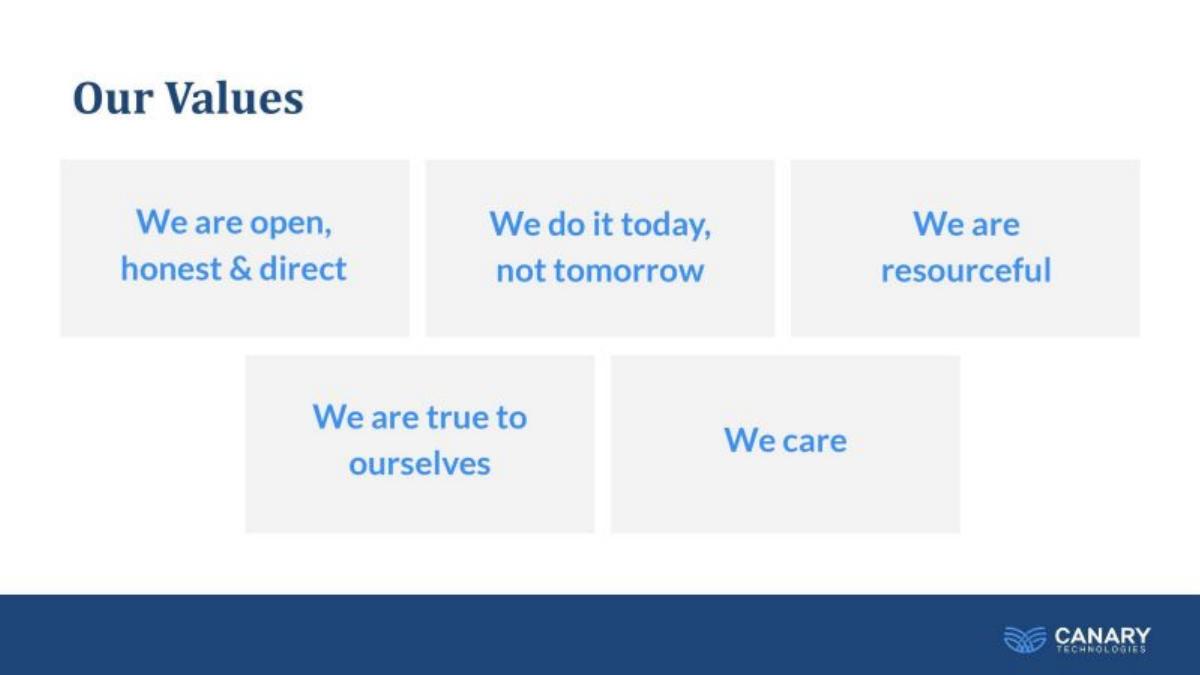
Canary Technologies deck, slide 21. Exact stored slide matched to this analysis.
Our analysis: Short and readable, and placed near the end, so it doesn't delay the argument.
Evidence and limitation: Nothing shows the values in practice. "We do it today, not tomorrow" could be backed by a shipping or response-time fact; without one, an investor will skip the slide.
What a founder can adapt: If you keep a values slide, keep it this short and put it late.
Supporting analysis
What the deck claims: "Our Values": We are open, honest & direct; We do it today, not tomorrow; We are resourceful; We are true to ourselves; We care.
Presentation choice: Short and readable, and placed near the end, so it doesn't delay the argument.
When it does not fit: Nothing shows the values in practice. "We do it today, not tomorrow" could be backed by a shipping or response-time fact; without one, an investor will skip the slide.
HR, payroll and benefits services for small and mid-sized businesses. A long deck (51 slides); values appear on slide 5.
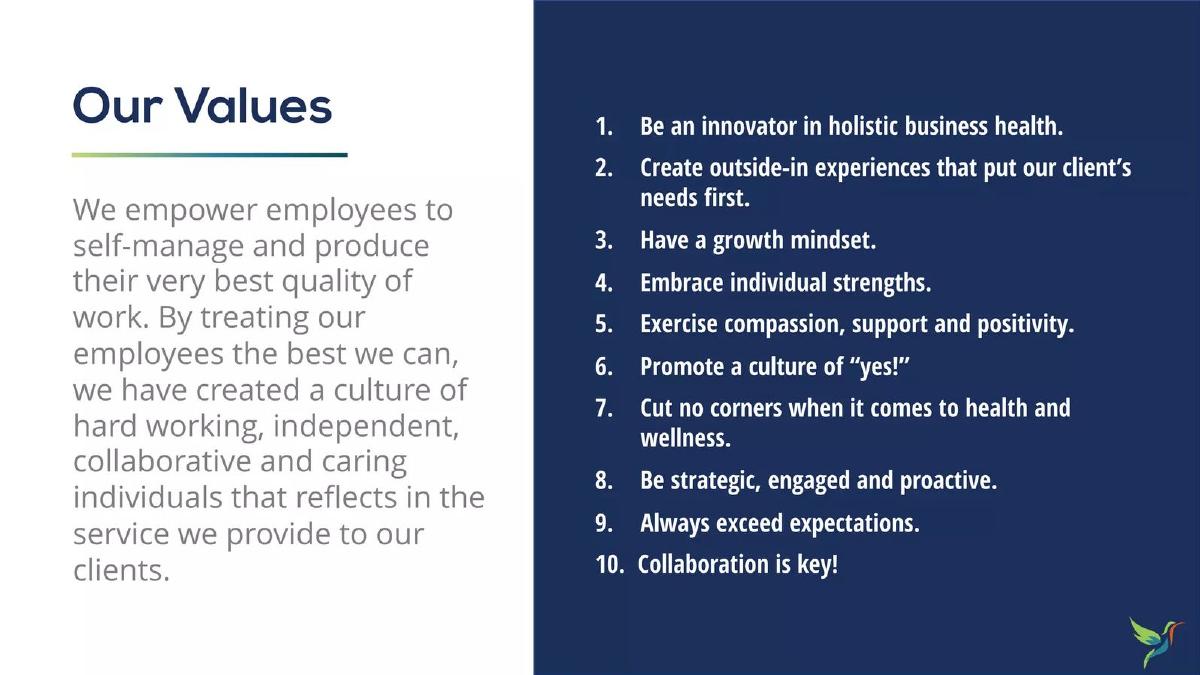
Aliat deck, slide 5. Exact stored slide matched to this analysis.
Our analysis: For an HR services company, how it treats its own staff is arguably relevant to what it sells.
Evidence and limitation: Ten values is too many to remember, and slide 5 is early: an investor reaches values before the problem slide. Cut to three and move it later.
What a founder can adapt: If culture relates to your product, say so directly and show one proof.
Supporting analysis
What the deck claims: "Our Values": a paragraph ("We empower employees to self-manage and produce their very best quality of work...") and ten numbered values, from "Be an innovator in holistic business health" to "Collaboration is key!"
Presentation choice: For an HR services company, how it treats its own staff is arguably relevant to what it sells.
When it does not fit: Ten values is too many to remember, and slide 5 is early: an investor reaches values before the problem slide. Cut to three and move it later.
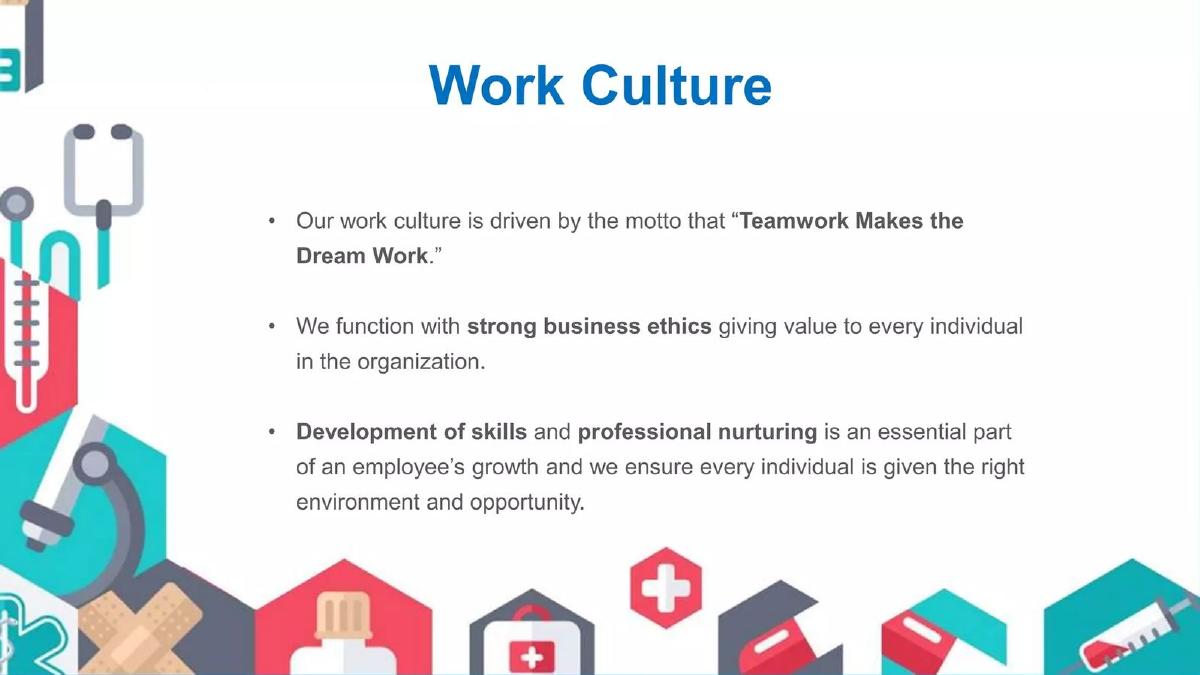
Bijana Healthcare (CareNSave) team slide — slide 8
Online pharmacy and healthcare services based in Hyderabad, India.
Bijana Healthcare deck, slide 8. Exact stored slide matched to this analysis.
Our analysis: A contrast example: it shows how little a generic culture statement tells an investor.
Evidence and limitation: Every line could appear in any company's deck. A slot in the middle of the deck is spent with no evidence.
What a founder can adapt: Replace mottos with one fact about your team, such as tenure, hiring or retention.
Supporting analysis
What the deck claims: "Work Culture": driven by the motto "Teamwork Makes the Dream Work"; "strong business ethics"; "Development of skills and professional nurturing is an essential part of an employee's growth".
Presentation choice: A contrast example: it shows how little a generic culture statement tells an investor.
When it does not fit: Every line could appear in any company's deck. A slot in the middle of the deck is spent with no evidence.
Evidence and a link to the business plan matter more than the wording of the values.
Example
Values listed
Evidence
Kind of evidence
Linked to the business
CMR Surgical
4
Concept to patient in 5 years; 75% love the culture; 40+ nationalities
Claimed
Partly
Copado
4
None on the slide
Unsupported
Yes (expansion sales)
Canary Technologies
5
None
Unsupported
No
Aliat
10
None
Unsupported
Partly (HR services)
Bijana Healthcare
Motto + 2 statements
None
Unsupported
No
Key Takeaways
Most seed decks don't need a culture slide. Investors judge culture through the founders, not a list of values.
If you include one, show evidence: a survey result, a review score, retention, an award or a hiring fact, with its source and date.
Connect culture to execution: speed, customer outcomes or the ability to hire in a hard market.
Short lists of adjectives (open, honest, caring) read the same in every deck.
Later-stage decks with a large team have more to show, and more reason to show it.
Decide whether your deck needs a culture slide
Answer these before adding one.
Evidence. What measured fact do you have: a survey score, review rating, retention, tenure or award, with source and date?
Link. How does the way your team works help you win customers or hire?
Stage. Is your team large enough that culture data means something?
Alternative. Would one line on the team slide say the same thing?
Questions. Can every number on the slide survive one follow-up question?
Copyable framework: [Value]: [one fact that shows it, with source and date]
Illustrative example 1 — written by us
Before: We do it today, not tomorrow
After: We do it today: [median time from customer request to shipped fix], measured [period]
What improved: Our illustrative rewrite, not Canary's text. Bracketed parts are placeholders, not company facts. It turns a value into a claim an investor can ask about.
How this guide relates to the team slide guides
The team slide guides cover founders, key hires and advisors: who is on the team and why they can win. This guide covers a different and less common slide: one about how the company works, usually titled "Our culture", "Our values" or "Work culture". Searching the extracted text of our pitch deck corpus, we found slides that open with these words in roughly 70 decks, far fewer than team slides. That is a signal in itself: most founders leave this slide out, and most investors don't expect it.
What an investor can learn from a culture slide
An investor reading a deck is trying to answer a few questions about the team: can these people build the product, sell it, and hire the people they need? Culture matters to all three, but a list of values doesn't answer any of them. Every company says it is open, ambitious and customer-focused. Canary Technologies' five values ("We are open, honest & direct", "We do it today, not tomorrow", "We are resourceful", "We are true to ourselves", "We care") are reasonable, but an investor can't tell from the slide whether they describe how the company actually works.
What an investor can use is evidence: a measured score with a named source, a retention figure, or an award with a year. None of the five slides in this set shows outside, measured evidence of that kind. The closest is CMR Surgical's own claim that "75% of our people love the 'great culture' at CMR", discussed below; the deck doesn't say how the figure was measured, but a stated figure still tells an investor more than a list of words. For a company that is about to grow its headcount with new money, signs that people stay and recommend the company bear directly on whether the plan is achievable.
Turning values into claims
CMR Surgical shows the most useful approach in this set. It lists four values (Ambitious, People Focused, Fair & Responsible, Humble), but under each one it gives specific claims. Under Ambitious: "we went from concept to patient in 5 years" and "employees from 40+ nationalities support our global expansion plans". Under People Focused: "75% of our people love the 'great culture' at CMR". Under Fair & Responsible: "we came to market in a responsible way with patient safety as our first priority". These are the company's own claims, and the slide doesn't say where the 75% figure comes from, but each value now points to something an investor can ask about.
If you have a values list, try the same exercise. For each value, write one sentence that shows it in action: a decision, a number or an outcome. If you can't find one, the value may be an aspiration rather than a description, and an investor will read it that way. Drop any value that doesn't survive the exercise, and keep the slide to the ones that do.
Linking culture to how the company wins
Copado takes a different approach. Its slide, titled "COPA Values", lists four values (Customer Success Comes First, Over Deliver, People are the Code, Always Build Trust) and adds a short explanation of why they matter commercially: "Our values are a necessity to execute our business plan. Every engagement with our customers is an opportunity to win a chance to propose an additional solution to the buyer. We only get an invitation for a new opportunity if we overdeliver on the last dance." That turns the values into part of the go-to-market argument: the company grows by expanding inside existing customers, and expansion depends on delivery.
It's a stronger framing than a list alone, but the slide still gives no evidence that the values work, such as net revenue retention, expansion revenue or the share of revenue from existing customers. The natural pairing is a culture slide that makes the claim and a traction slide that proves it. If your deck already has a retention or expansion figure, point to it from the culture slide.
Stage matters
The examples with the most useful evidence come from later-stage companies. CMR Surgical's deck describes a company that had passed unicorn status and run more than 1,000 procedures. A company with hundreds of employees can show engagement scores, review-site ratings, retention and awards. A five-person seed team can't, and a seed deck that tries to fill the gap with values often reads as padding.
At seed, culture shows up in other places: how long the founders have worked together, whether early hires followed them from a previous company, and how fast the team ships. Those facts belong on the team slide. If you want to say something about culture in a seed deck, one line there ("Our first four engineers all joined from our previous company") usually does more than a separate slide.
Measured, claimed and unsupported
It helps to sort the evidence on a culture slide into three kinds. Measured evidence comes from an outside source or a stated method: a Glassdoor rating, an engagement survey from a named provider, an award with a year. Claimed evidence is the company's own statement without a stated source, such as CMR Surgical's 75% figure. Unsupported statements are values and mottos with nothing behind them, such as Bijana Healthcare's "Teamwork Makes the Dream Work".
Investors weigh these very differently. A measured figure with a source and a date can be checked. A claimed figure invites the question "how did you measure that?", which is fine if you have an answer. An unsupported statement mostly tells the reader that the slide could be cut. When you build a culture slide, label each item honestly in your own head before deciding whether it earns space.
Questions investors usually ask
If a culture slide is in the deck, expect questions about it. Common ones: How was the engagement figure measured, how many people responded, and when? What is your employee turnover over the last twelve months? How many of your early hires are still with you? How will the culture change as you double the team with this round? Who owns hiring, and how long does it take to fill a senior role?
Have the answers ready before the meeting. If a number on the slide can't survive one follow-up question, remove it. A culture slide that falls apart under questioning does more harm than having no culture slide at all.
Before a culture figure goes on the slide, check it the way an investor will. Write down where it comes from (an outside review site, a survey tool, your own HR records), the date it was taken, how many people it covers and what share of the team responded. If the survey was run by the company itself, say so. If the figure is a few years old or covers a much smaller team than you have today, either update it or leave it out. A figure with its source and date in small type under it is more credible than a bigger number with nothing behind it, and it saves a round of follow-up questions in diligence. (General guidance, not drawn from the slides below.)
Common mistakes
Values with no evidence. Add one fact per value or cut the value.
Too many values. Three is enough.
Culture slide too early. Put it after the argument, not before the problem.
Unsourced percentages. Name the survey, sample and date.
A separate slide at seed. One line on the team slide usually does more.
Diagnostic checklist
The slide shows evidence, not only values.
Each figure has a source and a date.
It says how culture helps the company win or hire.
Three values at most.
It sits late in the deck, after traction and team.
Frequently asked questions
How we chose these examples
Corpus: published pitch deck teardowns on StartupFundraising.com. Founder-uploaded private decks are excluded.
Selection (2026-10-01): we searched extracted slide text for slides whose opening words include "culture", "our culture" or "our values" and that come from a company pitch or investor deck, then read each candidate slide from images made from the original deck files.
Not used: Almost Friday slide 3 (about the culture of its audience and content, not how the company works), Atento slide 24 (a publicly listed company), Assembly slides 5 to 19 (its product is culture software, so the slides describe the market, not the company), and decks where "culture" appears only in a company or product name (CulturePulse, cultureRush, DataCulture, Agreatculture).
Overlap check: no other guide covers culture or values slides. The team slide guides cover founders, hires and advisors.
Review: all five slide images were inspected on 2026-10-01 and matched to company, deck and slide number (AI editorial model review). No person has yet completed an editorial review of this page.
Figures are the companies' own statements as shown on the slides; we did not verify survey methods or review counts. We make no claim that any slide caused a fundraising outcome.