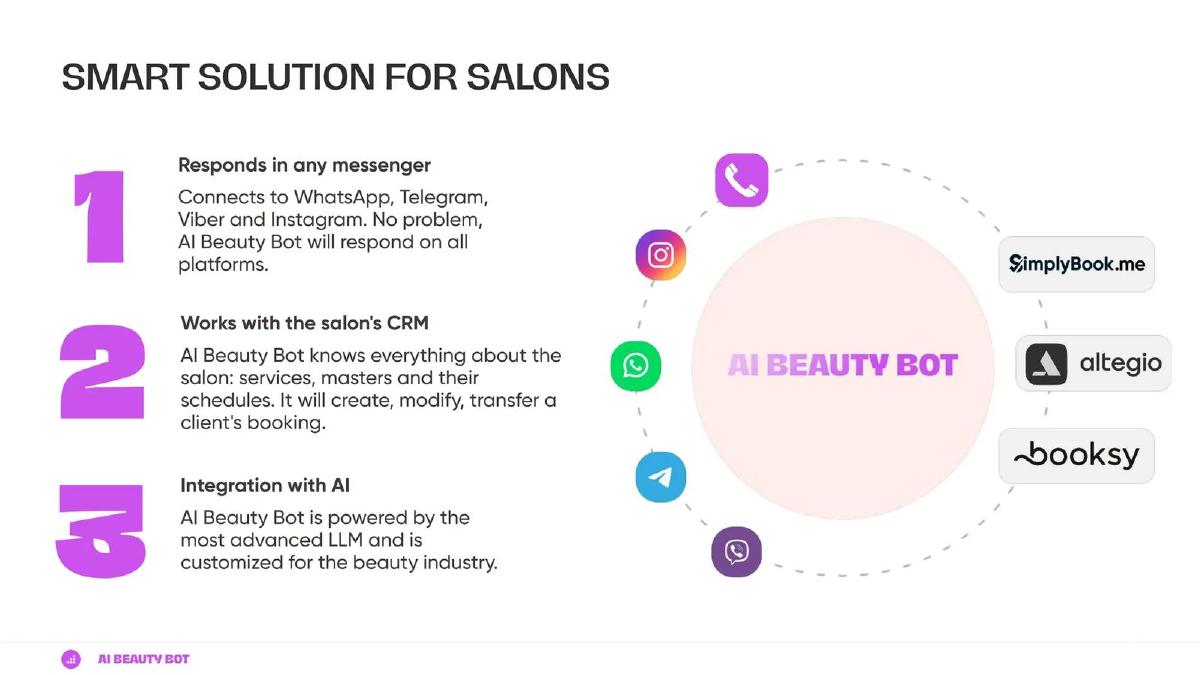
AI Beauty Bot is a vertical AI agent targeting the $122B global beauty market, where AI adoption remains below 1%. The company positions its product as a 24/7 digital administrator that integrates with existing CRMs like Symplybook and Altegio to handle bookings, rescheduling, and client support. The deck emphasizes a strong shift toward positive unit economics, reporting a 6x reduction in CoGS and a doubling of ARPPU between May and November 2025. With a core team boasting 13+ years of startup experience and $220,000 already raised from angel investors, the company outlines a clear roadmap t…
Key takeaways
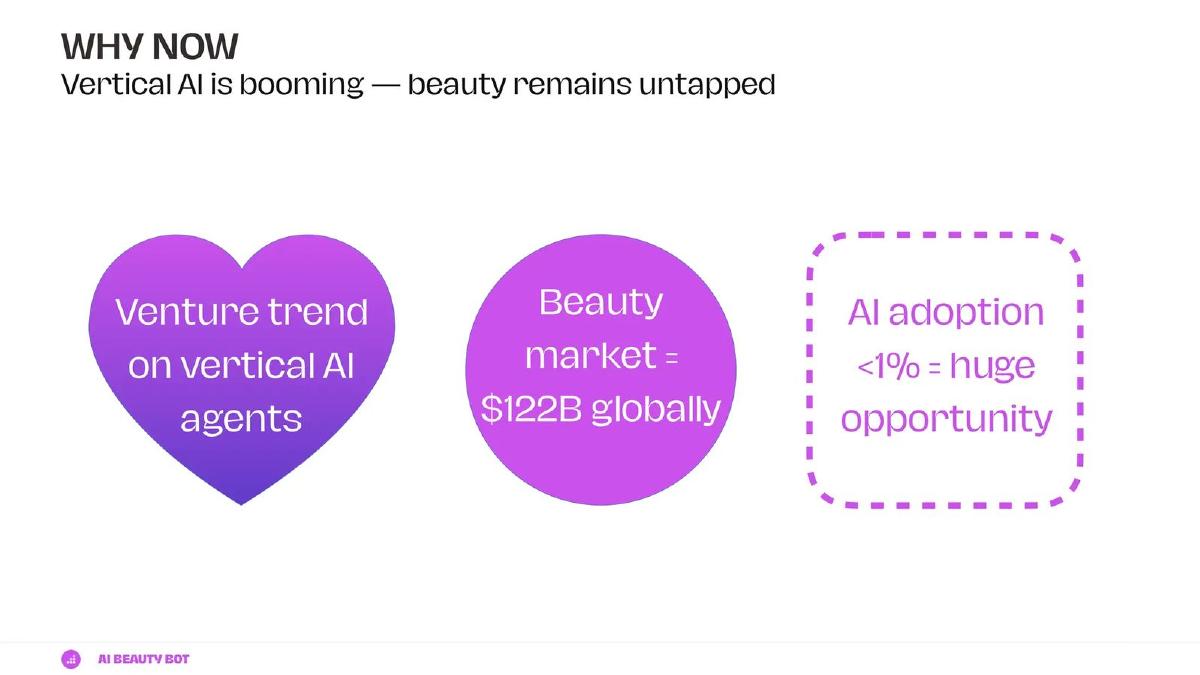
- The company targets a $122B global beauty market with less than 1% AI adoption (Slide 3).
- The core team includes founders with 13+ years of experience in B2B SaaS and startups, supported by three angel investors who have contributed a total of $220,000 (Slide 4).
- Traction data shows a significant improvement in unit economics, with ARPPU reaching $102.8 and profit per user hitting $47.9 by November 2025 (Slide 5).
- The product maintains an 80% retention rate and a 33% conversion rate from trial to payment (Slide 5).
- Pricing is tiered across Light ($79), Standard ($149), and Platinum ($219) monthly subscriptions per branch (Slide 6).
- The roadmap outlines a three-stage evolution: from basic Admin (booking/support) to mid-level (segmentation/offers) to a full Manager-level 'Beauty OS' by 2026 (Slide 7).
- The technology supports multi-language capabilities and audio message processing for client interactions (Slide 10).
- The deck omits a specific funding ask, valuation, or detailed breakdown of how new capital will be allocated.
Executive Summary: Automating the Beauty Front Desk
AI Beauty Bot is a vertical AI play targeting the administrative inefficiencies of the beauty salon industry. The deck, dated November 2025, presents a company that has moved past the initial development phase and is now demonstrating scalable unit economics. By positioning the product as a '24/7 Administrator,' the founders are tapping into the labor-intensive nature of salon management. The narrative is built on three pillars: a massive untapped market, a team with deep B2B SaaS roots, and a clear technological path from a simple chatbot to a comprehensive operating system.
Slide 1: Title Slide
The cover slide introduces 'AI Beauty Bot' with the subtitle 'AI Administrator & Manager for Beauty Salons.' It identifies Mike Avdeev as the Co-founder and provides the website URL (ai-beauty.bot). The date is listed as November 2025. The imagery features a professional-looking woman in a library/office setting, which, while clean, does not immediately scream 'beauty salon,' though it reinforces the 'administrator' persona.
Slide 2: The Value Proposition
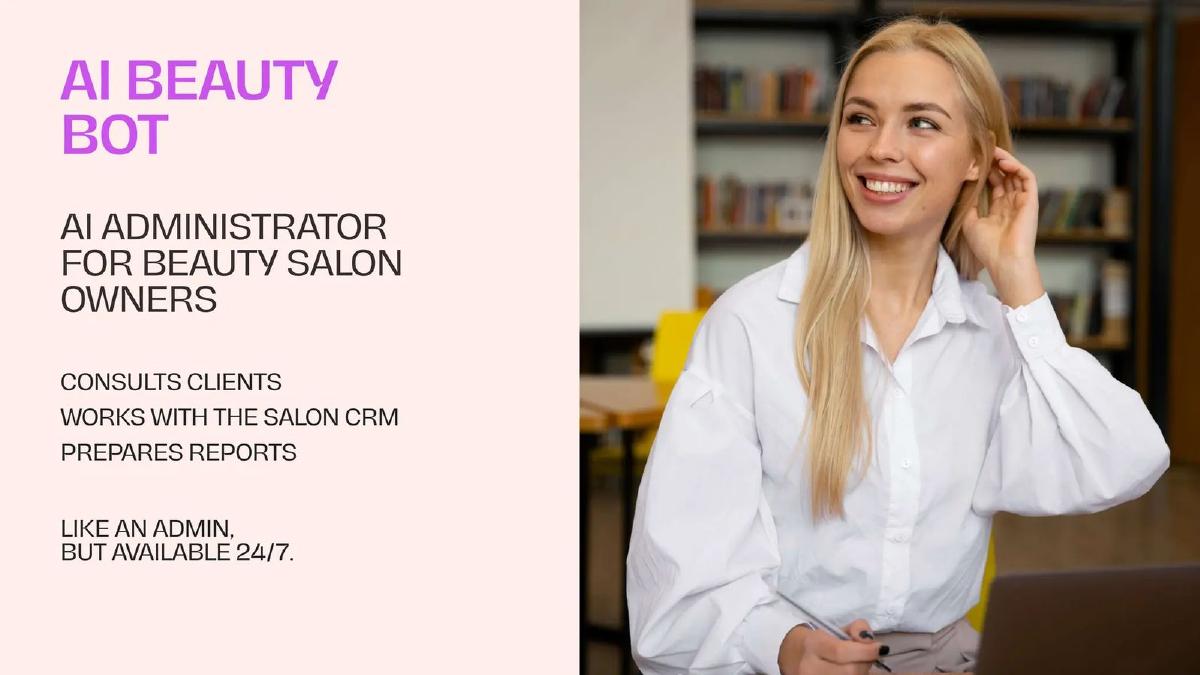
This slide defines the product's role for salon owners. It lists three primary functions: consulting clients, working with the salon CRM, and preparing reports. The tagline 'LIKE AN ADMIN, BUT AVAILABLE 24/7' clearly communicates the replacement/augmentation value proposition. This slide is effective because it avoids technical jargon and focuses on the utility for the end-user.
Slide 3: Why Now - The Market Opportunity
The 'Why Now' slide uses three graphics to build a case for urgency. First, it cites a 'Venture trend on vertical AI agents.' Second, it values the global beauty market at $122B. Third, it claims AI adoption is currently less than 1%. This creates a narrative of a 'huge opportunity' in an untapped vertical. However, the slide lacks a source for the $122B figure and the 1% adoption metric, which are bold claims that usually require third-party validation.
Slide 4: Core Team and Early Backers
This is a strong team slide. Mike Avdeev (Co-founder) claims 13 years in startups, including a CEO role at ETransport with 300K+ users. Andrey Tomachinskiy (Co-founder) brings 13 years in B2B SaaS and claims to have generated $4.5M+ in revenue. Maxim Karmatskikh (CTO) has 18 years in software development. Uniquely, the slide also lists three angel investors and the specific amounts they invested: Sergey Budyakov ($40,000), Aleksey Kulakov ($50,000), and Maksim ($130,000). This transparency regarding early capitalization is rare and signals a high degree of founder confidence.
Slide 5: Traction and Unit Economics
Slide 5 is the most data-dense slide in the deck. It shows a bar chart of ARPPU (Average Revenue Per Paying User) vs. CoGS (Cost of Goods Sold) from May 2025 to November 2025. The chart illustrates a successful turnaround: in May, the company lost $17.7 per user; by November, they achieved a profit of $47.9 per user. Key highlights on the right include an 80% retention rate, a 33% conversion rate from trial to payment, and a 6x reduction in CoGS. The slide also notes that they have achieved clients in 20+ countries, suggesting early international product-market fit.
Slide 6: Business Model and Pricing
The company employs a tiered subscription model based on the number of employees and 'dialogs' (interactions) per month.
Light ($79/mo): Up to 10 employees and 225 dialogs. · Standard ($149/mo): Up to 20 employees and 450 dialogs. · Platinum ($219/mo): Unlimited employees and 675 dialogs.
The slide also lists 'Add-ons' such as additional channels (+$8/mo) and extra dialog packages (+$30 per 100). This is a standard SaaS pricing structure that allows for expansion revenue as a salon grows.
Slide 7: Product Evolution (Roadmap)
The roadmap visualizes the transition from 'Admin level' to 'Manager level.' The current state (late 2025) includes booking, rescheduling, and client support. The 'mid-level' adds segmentation, offers, and re-engagement. The ultimate goal for 2026 is a 'Full AI Operating System for salons.' This slide is crucial because it shows investors that the company isn't just building a bot, but a platform that could eventually own the entire salon workflow.
Slide 8: Contact and Call to Action
The closing slide features Mike Avdeev again with a QR code labeled 'ask AI about us.' This is a clever use of their own technology to engage investors. It provides standard contact info: email (hello@ai-beauty.bot) and social handles (@mikeavdeev). The 'Let's work together' headline is a standard, if somewhat generic, closing.
Slide 9: The Holy Grail of Products
This is a conceptual slide featuring a three-way Venn diagram with a star in the center. However, the circles are not labeled in this version of the deck. While visually consistent with the brand's purple and pink palette, it provides no information and serves as a filler or a placeholder for a verbal explanation during a live pitch.
Slide 10: Product Functionality in Detail
This slide provides a deep dive into how the bot interacts with clients. It highlights three features: 24/7 availability with 1-minute response times, the ability to understand audio messages, and multi-language support. The right side of the slide shows mockups of a chat interface (in Russian), demonstrating the bot handling a booking request and processing a voice note. This provides a concrete look at the user experience, which helps ground the 'AI' claims in reality.
What Works Well in This Deck
The unit economics slide (Slide 5) is the standout. Many early-stage decks focus on top-line growth while ignoring the cost of serving those customers. By showing a clear path from negative to positive margins, AI Beauty Bot demonstrates operational maturity. The team slide is also exceptionally strong; listing the specific dollar amounts from angel investors builds immediate social proof and shows that the founders have already convinced professional peers to open their wallets. Finally, the roadmap (Slide 7) provides a compelling 'big picture' vision that justifies a venture-scale valuation, moving the company from a utility tool to a core infrastructure play.
What Is Missing or Could Be Improved
The most glaring omission is a specific funding ask. While we know what they have raised in the past, the deck does not state how much they are looking for now or what the specific milestones for the next round will be. Additionally, there is no competitive landscape slide. The beauty tech space is crowded with legacy CRM players (like Mindbody) and newer AI startups; failing to address how AI Beauty Bot wins against incumbents is a missed opportunity. The 'Why Now' slide (Slide 3) also lacks specific citations for its market data, which can lead to skepticism during due diligence. Lastly, Slide 9 is completely uninformative without labels, which detracts from the professional polish of the rest of the deck.
Founder's Playbook: Lessons to Copy
Founders should emulate the way this deck handles traction. Instead of just showing a 'up and to the right' revenue chart, they broke down the components of profitability (ARPPU vs. CoGS). This level of detail is exactly what sophisticated investors look for. Another takeaway is the 'Product Evolution' slide; it’s a masterclass in showing how a simple entry-point product (a booking bot) can expand into a much larger, stickier business (an Operating System). Finally, the use of a QR code to 'ask the AI' about the company is a brilliant way to demonstrate product efficacy without needing a formal demo environment.
Frequently asked questions
- What specific problem does AI Beauty Bot solve for salon owners?
- According to Slide 2 and Slide 10, the bot acts as a 24/7 administrator. It solves the problem of missed client inquiries during off-hours by responding within one minute. It handles routine tasks like booking, rescheduling, and answering client questions, and it can even process voice messages, reducing the manual workload on human staff.
- How does the company justify its 'Why Now' argument?
- Slide 3 points to a broader venture trend favoring vertical AI agents. It highlights that while the beauty market is massive at $122 billion globally, AI adoption in the sector is currently under 1%. This suggests a 'blue ocean' opportunity where the first movers in vertical-specific AI can capture significant market share.
- What are the key financial metrics reported in the traction slide?
- Slide 5 shows a transition from negative to positive unit economics over seven months. In May 2025, the company had an ARPPU of $66.0 against a CoGS of $83.7 (a loss). By November 2025, ARPPU increased to $102.8 while CoGS was reduced to $54.8, resulting in a profit of $47.9 per user.
- What integrations does the product support?
- The business model slide (Slide 6) lists integrations with major communication channels including WhatsApp, Telegram, Viber, VK, and Instagram. For backend operations, it integrates with salon-specific CRM systems such as Symplybook and Altegio, ensuring the bot can sync with existing schedules and client databases.
- Who is behind the company and how much have they raised?
- The core team (Slide 4) consists of Co-founder Mike Avdeev (13 years in startups), Co-founder Andrey Tomachinskiy (13 years in B2B SaaS), and CTO Maxim Karmatskikh (18 years in software dev). They have raised $220,000 from three angels: Sergey Budyakov ($40k), Aleksey Kulakov ($50k), and an investor named Maksim ($130k).