AGV Protocol presents an institutional pitch for a decentralized platform that tokenizes real-world assets (RWA), specifically focusing on clean energy and AI compute infrastructure. The deck positions the company at the center of an 'energy supercycle' driven by AI demand, which they claim will push data center power consumption past 1,000 TWh by 2030 (Slide 02). The protocol aims to function as a decentralized ETF, offering investors exposure to a mix of solar capacity, edge compute nodes, and agricultural yields. With a pre-seed ask of $1M at a $25M valuation (Slide 06), the company highli…
Key takeaways
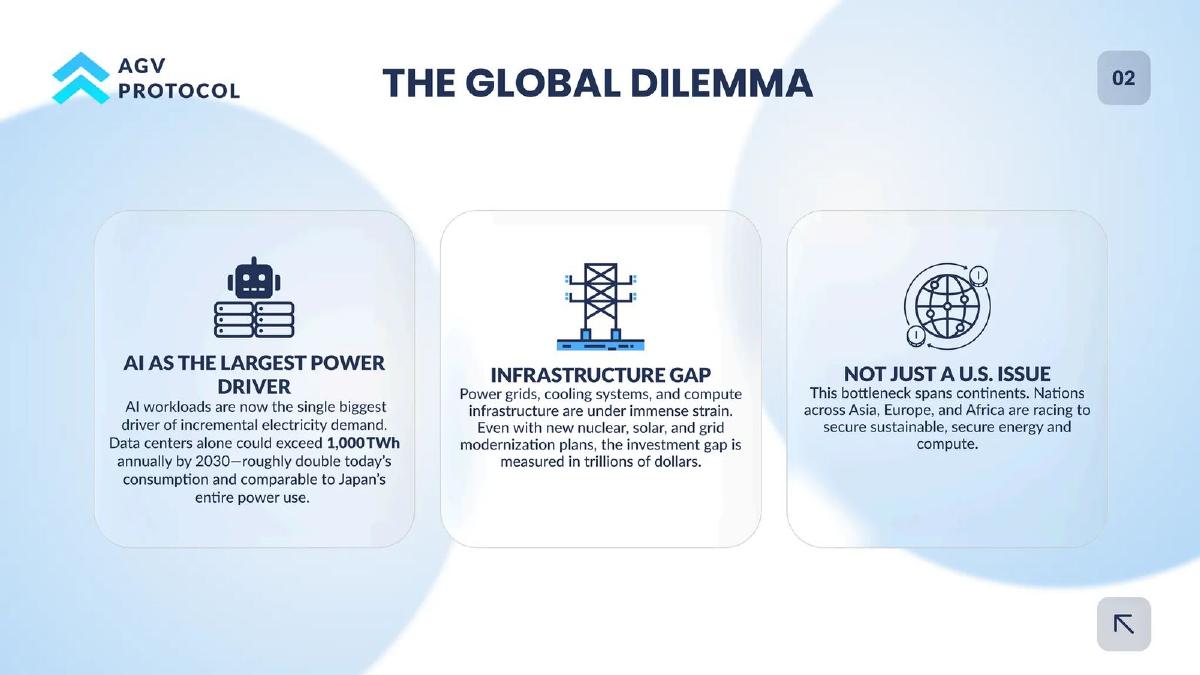
- The company identifies a massive infrastructure gap, noting that data centers could exceed 1,000 TWh of annual power use by 2030 (Slide 02).
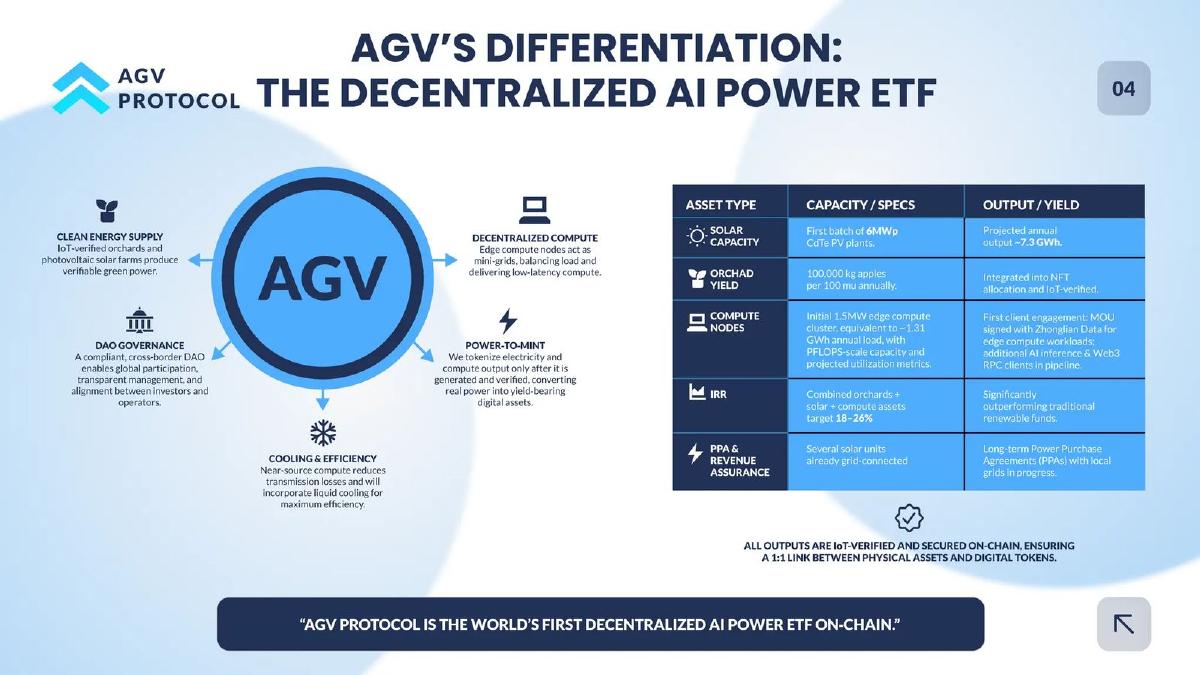
- AGV Protocol differentiates itself as a 'Decentralized AI Power ETF' combining solar capacity, compute nodes, and orchard yields (Slide 04).
- The protocol targets a high internal rate of return (IRR) of 18-26% through its combined asset portfolio (Slide 04).
- A pre-seed raise of $1M is sought in exchange for 4% of the GVT supply, implying a $25M valuation for the protocol (Slide 06).
- Phase 1 assets are reported to generate approximately $1.2M in annual revenue with $900k in net cash flow (Slide 06).
- The roadmap includes aggressive valuation targets, aiming for a $200M fully diluted valuation (FDV) within 12-24 months (Slide 07).
- Execution proof includes a commissioned 6MW solar plant and an installed 1.5MW compute cluster (Slide 09).
- The team consists of specialists in investment banking, quant fund management, and blockchain architecture, though specific surnames for most members are omitted (Slide 08).
Executive Summary: The Infrastructure of the AI Supercycle
AGV Protocol’s institutional pitch deck, dated September 2025, presents a high-conviction thesis on the convergence of clean energy, AI computation, and decentralized finance. The deck argues that the AI revolution is creating a 'new energy supercycle' (Slide 01) that traditional capital markets are too slow to finance. By tokenizing physical assets like solar farms and compute clusters, AGV Protocol aims to provide liquid, tradable access to the physical backbone of the digital economy.
Slides 01-02: The Macro Thesis and Global Dilemma
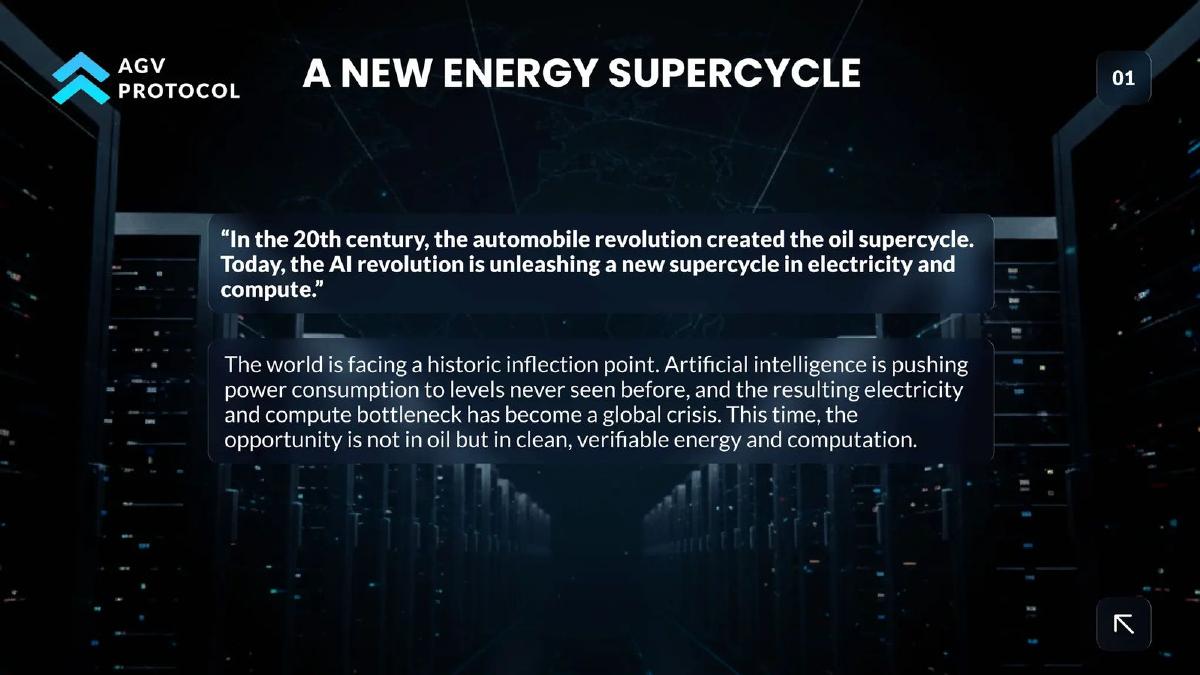
The deck opens with a bold comparison between the 20th-century automobile revolution and the current AI revolution. Slide 01 frames the opportunity not in oil, but in 'clean, verifiable energy and computation.' This sets the stage for the 'Global Dilemma' presented on Slide 02, which identifies AI as the primary driver of incremental electricity demand. The slide provides a specific metric: data centers could exceed 1,000 TWh annually by 2030, which is roughly double today's consumption and comparable to the total power use of Japan. The 'infrastructure gap' to meet this demand is measured in trillions of dollars, creating a massive opening for alternative financing models.
Slide 03: The Evolution of Capital Markets
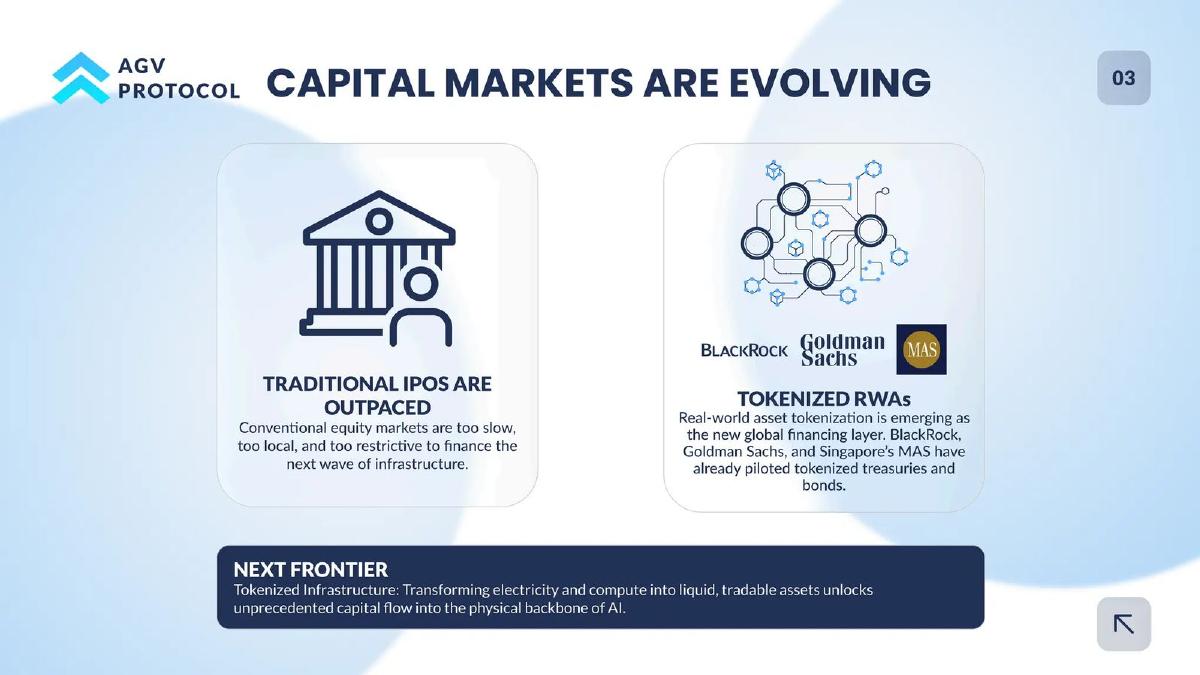
Slide 03 addresses why decentralized protocols are necessary. It argues that traditional IPOs are 'outpaced'—too slow, local, and restrictive. The solution is 'Tokenized RWAs' (Real-World Assets). The deck name-drops major institutions like BlackRock, Goldman Sachs, and Singapore’s MAS to validate the emerging trend of tokenizing treasuries and bonds. AGV positions itself as the 'Next Frontier,' moving beyond financial instruments into tokenized physical infrastructure.
Slide 04: The Product – A Decentralized AI Power ETF
This is the core functional slide of the deck. AGV Protocol describes itself as the 'World’s First Decentralized AI Power ETF On-Chain.' The slide details a multi-asset portfolio approach:
Solar Capacity: First batch of 6MWp CdTe PV plants with a projected annual output of ~7.3 GWh. · Orchard Yield: 100,000 kg of apples per 100 mu annually, integrated into NFT allocation. · Compute Nodes: Initial 1.5MW edge compute cluster (~1.31 GWh annual load) with PFLOPS-scale capacity. · IRR: A target of 18-26% for the combined assets. · Revenue Assurance: Long-term Power Purchase Agreements (PPAs) with local grids.
The slide emphasizes that all outputs are IoT-verified and secured on-chain, ensuring a 1:1 link between the physical asset and the digital token.
Slide 05: Market Opportunity and Growth Curves
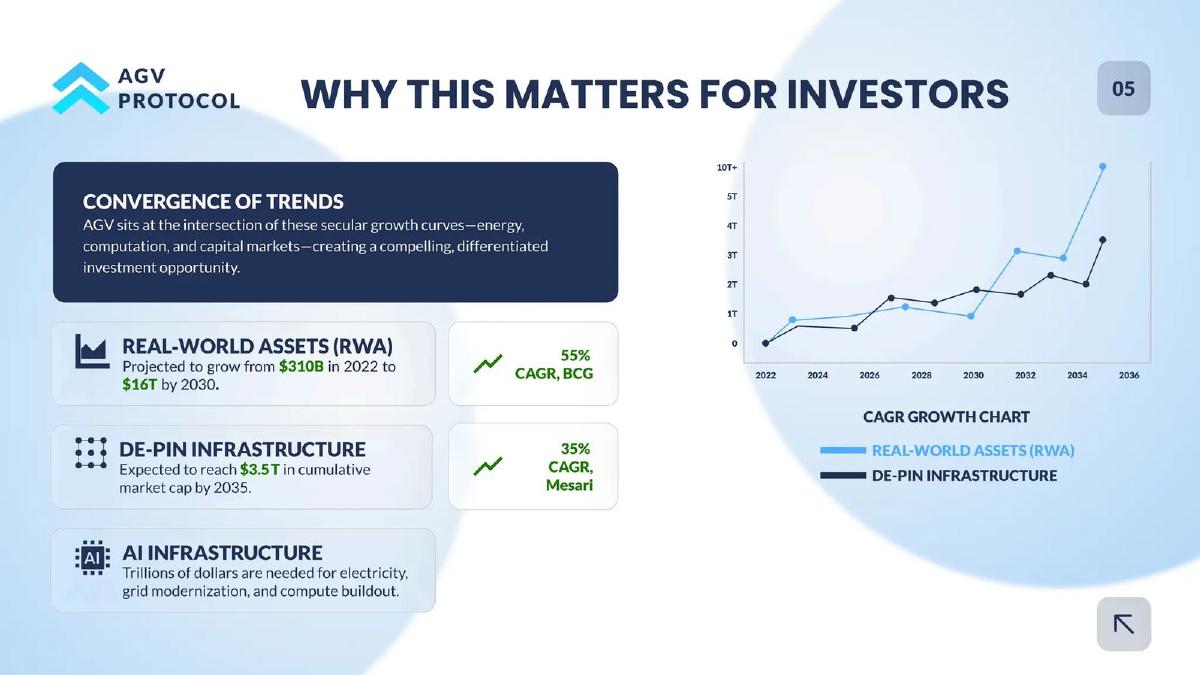
Slide 05 provides the 'Why Now' for investors, citing aggressive growth projections. It quotes a 55% CAGR from BCG for Real-World Assets, reaching $16T by 2030. It also cites a 35% CAGR from Messari for De-PIN infrastructure, reaching $3.5T by 2035. A CAGR growth chart visualizes these trends, though the chart itself is a stylized representation rather than a data-heavy plot.
Slide 06: The Investment Opportunity and Ask
AGV Protocol is seeking a Pre-Seed Raise of $1M . The terms are specific: the investment is in exchange for approximately 4% of the GVT supply, which values the protocol at $25M . The 'Use of Proceeds' includes expanding assets, third-party audits, and DAO structuring. Crucially, the slide notes that Phase 1 assets are already generating ~$1.2M annual revenue with ~$900k net cash flow , which covers operating expenses and supports the stated 18-26% IRR.
Slide 07: Compliance and Valuation Roadmap
The 'Compliance Roadmap' is a critical inclusion for an institutional deck. It shows a progression from an initial audit by Beosin in August 2025 to legal certifications in Australia and New Zealand. Future phases involve RWA compliance filings in Singapore and Hong Kong. The bottom half of the slide ties valuation to physical milestones:
Phase 1 (0-6M): 6MW solar + 1.5MW compute = $80-100M FDV target. · Phase 2 (6-12M): 10+ assets = $120-150M FDV target. · Phase 3 (12-24M): 50+ assets + institutional onboarding = $200M FDV target.
The slide explicitly states: 'Valuation growth is tied directly to real asset expansion, not just narrative.'
Slide 08: The Execution Team
The team slide lists seven members, though most are identified only by first names or first names and last initials. Susan Zheng (Strategy & Capital Markets) is noted as having an investment banking background. Yini Wang and Winnie Wu are both described as former Quant Fund Managers. Other roles include Tech & Compliance (Tyler), Smart Contracts (Yasir), Front-End (Robin Wu), and Security (Phantom). While the professional backgrounds are relevant, the lack of full names for the majority of the team might be a point of friction for institutional due diligence.
Slides 09-11: Execution Proof and Conclusion
Slide 09 reiterates the 'Execution Proof' with three bullet points: the 6MW solar plant, the 1.5MW compute cluster, and the completed Beosin audit. Slide 10 provides a visual summary, using high-quality imagery of solar farms, orchards, and server racks to reinforce the 'Real Energy, Real Yield' branding. The deck concludes on Slide 11 with the company logo and the core value proposition: 'Real Energy. Real Yield. Real Assets — On-chain.'
What Works in This Deck
Specific Asset Metrics: Unlike many crypto-adjacent decks that remain vague, AGV provides specific megawatts, gigawatt-hours, and even kilogram yields for their orchards (Slide 04). This grounds the 'Real-World Asset' claim in tangible numbers.
Clear Valuation Drivers: Slide 07 does an excellent job of linking valuation targets to physical infrastructure milestones. This gives investors a clear framework for how their capital will be used to drive specific increases in the protocol's paper value.
Macro-Micro Alignment: The deck successfully bridges a massive global trend (AI power demand) with a specific, local solution (edge compute and solar in AU/NZ). It makes the case that the 'Global Dilemma' is a direct revenue opportunity for the protocol.
What Is Missing or Weak
Team Transparency: The use of first names only (e.g., 'Tyler', 'Yasir', 'Phantom') on Slide 08 is unconventional for an 'Institutional' pitch deck. Institutional investors typically require full bios and verifiable track records for the core leadership team.
Competitive Landscape: The deck lacks a competitor slide. While it mentions BlackRock and Goldman Sachs as validators of the RWA trend, it does not address other De-PIN or RWA protocols that might be competing for the same assets or investor liquidity.
Unit Economics of Tokenization: While the deck mentions a 1:1 link between assets and tokens, it does not explain the mechanics of the GVT token or how the $900k in net cash flow (Slide 06) actually flows to token holders. The relationship between the DAO, the physical asset owners, and the token holders remains high-level.
Founder Takeaway: Copy the Milestone-Based Valuation
The most effective part of this deck is Slide 07 (Milestone-Based Valuation Drivers) . Founders in the RWA or infrastructure space often struggle to justify high valuations in the early stages. By explicitly tying FDV targets to the acquisition and commissioning of physical assets (e.g., 'Scale to 50+ assets... target $200M FDV'), AGV Protocol creates a logical roadmap that feels less like speculation and more like a capital deployment schedule. This approach helps de-risk the investment by showing that value creation is dependent on execution rather than just market sentiment.
Frequently asked questions
- What is the core product of AGV Protocol?
- AGV Protocol is a decentralized platform that tokenizes real-world infrastructure assets. It specifically focuses on clean energy (solar) and AI compute power, acting as a 'Decentralized AI Power ETF.' By using IoT verification, it links physical energy production and compute cycles to on-chain tokens, allowing investors to gain exposure to the infrastructure required to power the AI revolution.
- What are the specific financial terms of the current funding round?
- According to Slide 06, AGV Protocol is seeking a pre-seed investment of $1M. In exchange, investors receive approximately 4% of the GVT supply. This structure values the AGV Protocol at approximately $25M. The proceeds are intended for expanding orchard, solar, and compute assets, as well as structuring the DAO and listing tokens on exchanges.
- What physical assets does the company currently operate?
- The deck claims 'Execution Proof' on Slide 09, stating that a 6MW solar plant is already commissioned and grid-connected. Additionally, a 1.5MW compute cluster has been installed and is monitored via IoT. The protocol also includes 'Orchard Yields,' specifically citing a capacity of 100,000 kg of apples per 100 mu annually on Slide 04.
- How does the company handle legal and regulatory compliance?
- Slide 07 outlines a 'Compliance Roadmap.' It notes that core documents are notarized and certified in Australia and New Zealand. The company is currently pursuing law firm certification for its DAO structure and asset tokenization, with future phases targeting RWA compliance filings in Singapore and Hong Kong to facilitate institutional-grade DeFi integration.
- What is the projected growth for the markets AGV operates in?
- Slide 05 cites data from BCG and Messari to support its market thesis. It notes that Real-World Assets (RWA) are projected to grow from $310B in 2022 to $16T by 2030 (a 55% CAGR). Furthermore, De-PIN (Decentralized Physical Infrastructure Networks) is expected to reach a $3.5T cumulative market cap by 2035.