Agora’s pitch deck is a masterclass in identifying a proven international business model—Chinese social commerce—and localizing it for a specific high-margin vertical in Europe. The deck focuses heavily on the 'why now' by highlighting the massive gap between e-commerce penetration in China (40%) versus Europe (<10%). With a lean 12-slide structure, Agora emphasizes early community traction, reporting 50,000 users and a 3% conversion rate on initial social commerce tests. While the deck lacks a formal 'Ask' slide or detailed financial projections, it compensates with a strong team pedigree fe…
Key takeaways
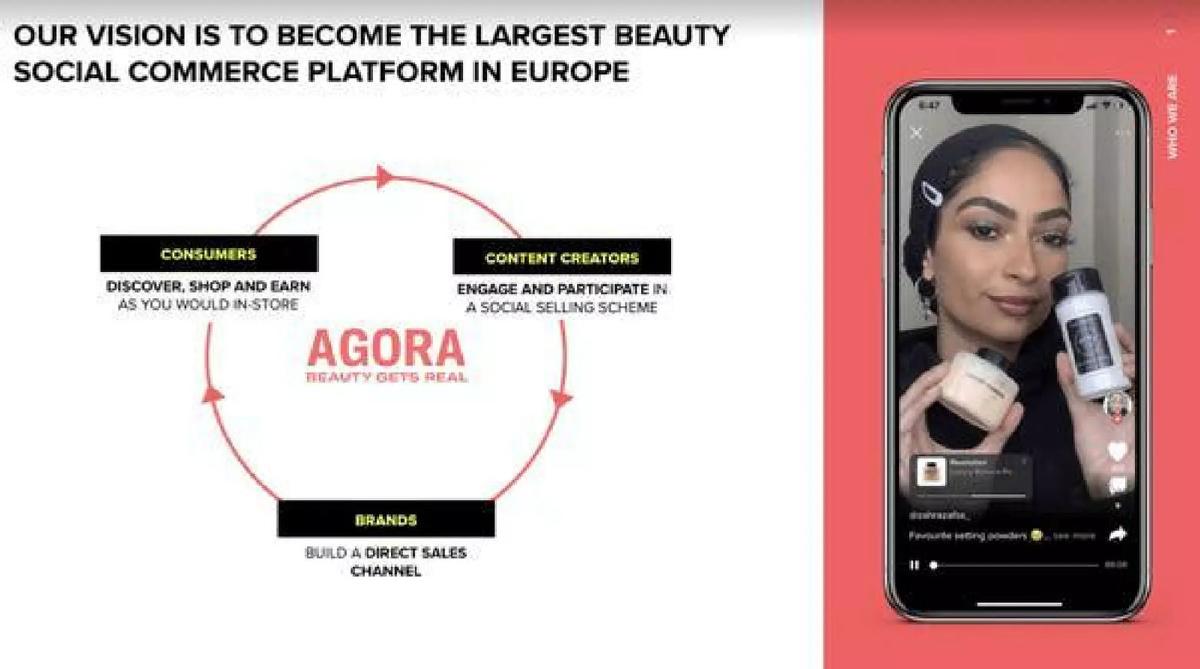
- The vision is explicitly stated as becoming the largest beauty social commerce platform in Europe (Slide 1).
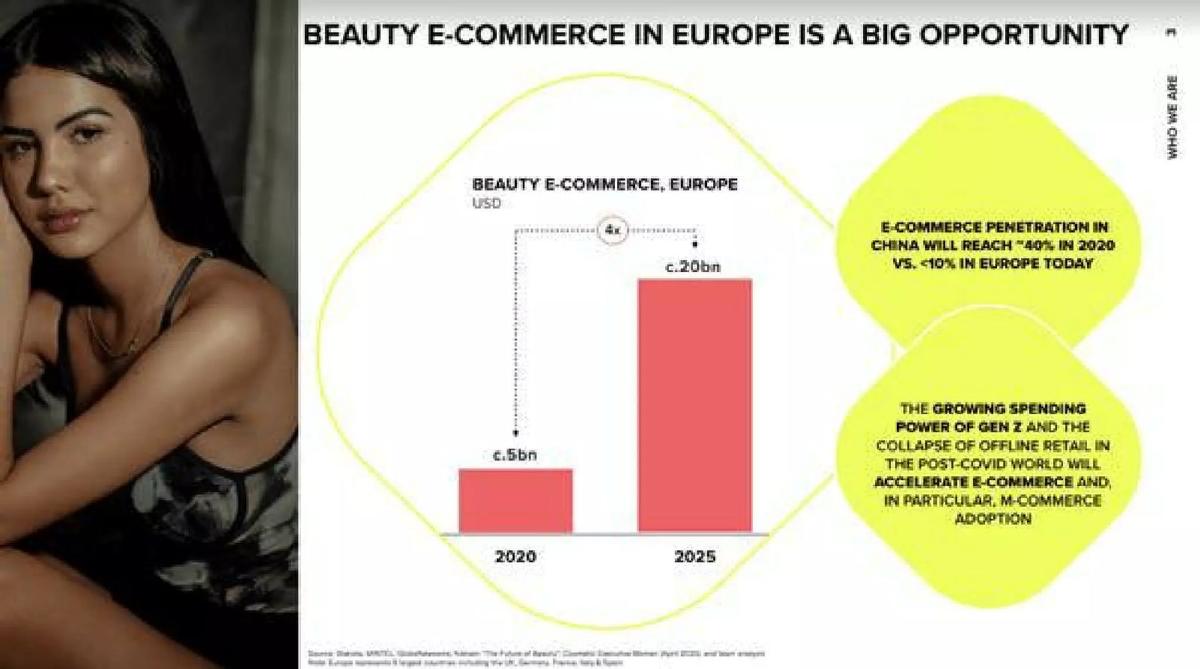
- A significant market gap is identified: China's e-commerce penetration is 40% compared to less than 10% in Europe (Slide 3).
- The platform reported early traction of 50,000 users, mostly organic, with over 1 million videos watched (Slide 5).
- Initial social commerce tests achieved a 3% conversion rate with top sellers selling out in a single day (Slide 5).
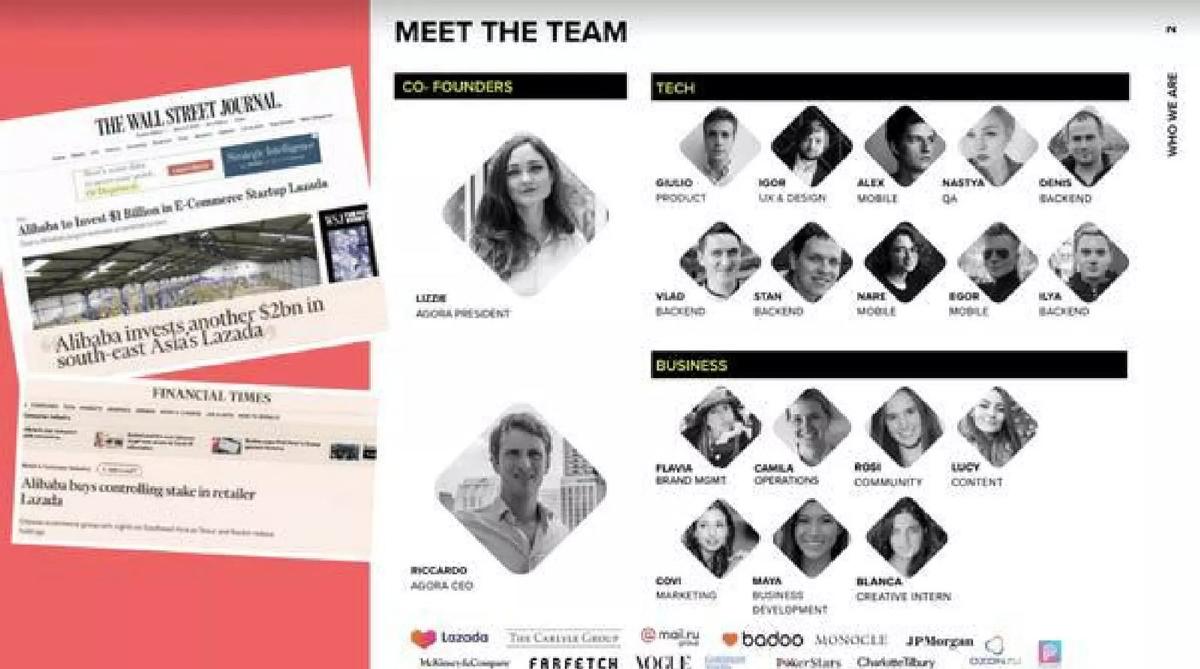
- The team leverages significant e-commerce experience, with founders and staff hailing from Lazada, Farfetch, and McKinsey (Slide 2).
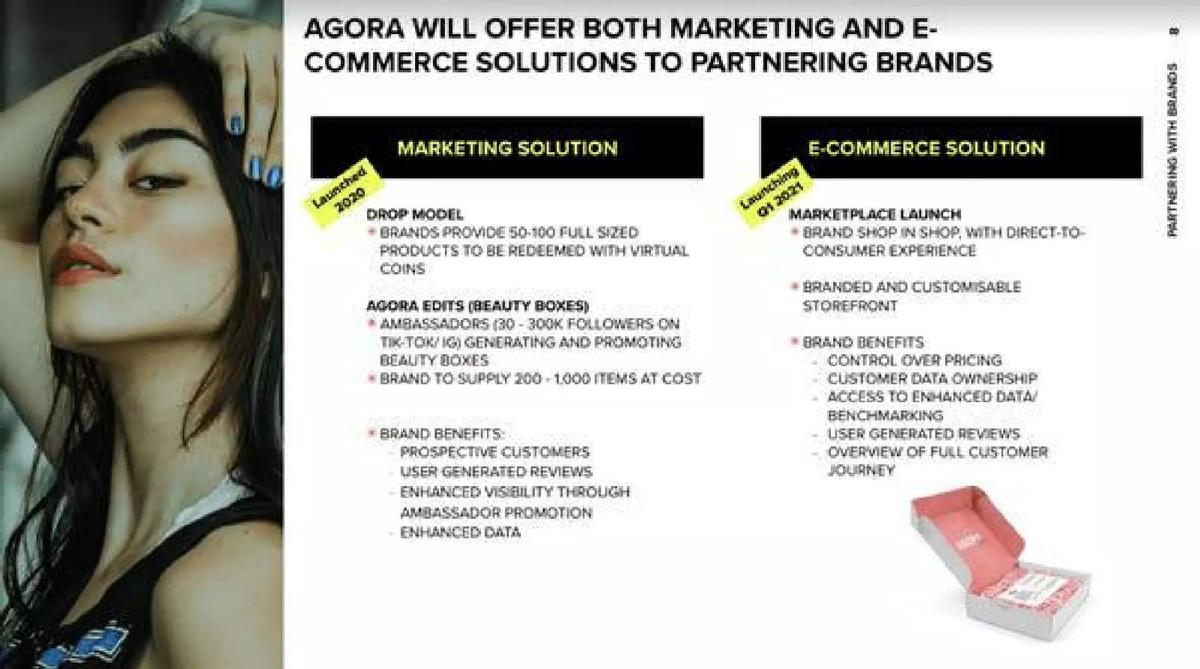
- The business model bifurcates into Marketing Solutions (drops and beauty boxes) and E-commerce Solutions (brand flagship stores) (Slide 8).
- The deck identifies a specific demographic target: 60% Gen Z and 90% UK females (Slide 5).
- Agora positions itself as a solution for brands to regain control over pricing and customer data ownership (Slide 7).
Executive Summary: The Social Commerce Arbitrage
Agora’s pitch deck is built on a clear premise: the future of European retail looks like the present of Chinese retail. By 2019, social commerce had already transformed the Asian market, yet Europe remained stuck in a traditional search-and-buy e-commerce loop. Agora positions itself as the bridge between these two worlds, specifically targeting the high-margin, high-engagement beauty sector. The deck is visually driven, utilizing high-quality lifestyle photography and app mockups to convey a brand-first aesthetic that appeals to both investors and the Gen Z demographic it serves.
Slide-by-Slide Teardown
The Vision and Ecosystem (Slides 1-2)
Slide 1: Title and Vision. The deck opens with a bold vision statement: "To become the largest beauty social commerce platform in Europe." It introduces a three-way flywheel involving Consumers (who discover and earn), Content Creators (who engage in social selling), and Brands (who build direct sales channels). This immediately establishes Agora as a marketplace, not just a social app.
Slide 2: Meet the Team. Unusually early in the deck, Agora presents its team. This is a strategic move to establish credibility. The slide features press clippings of Alibaba’s multi-billion dollar investment in Lazada, directly linking the founders' experience to one of the world's most successful social commerce stories. The logos at the bottom—Lazada, Farfetch, McKinsey, and JP Morgan—signal that this is an experienced, 'grown-up' team capable of handling $8.2 million in capital.
Market Opportunity and Roadmap (Slides 3-4)
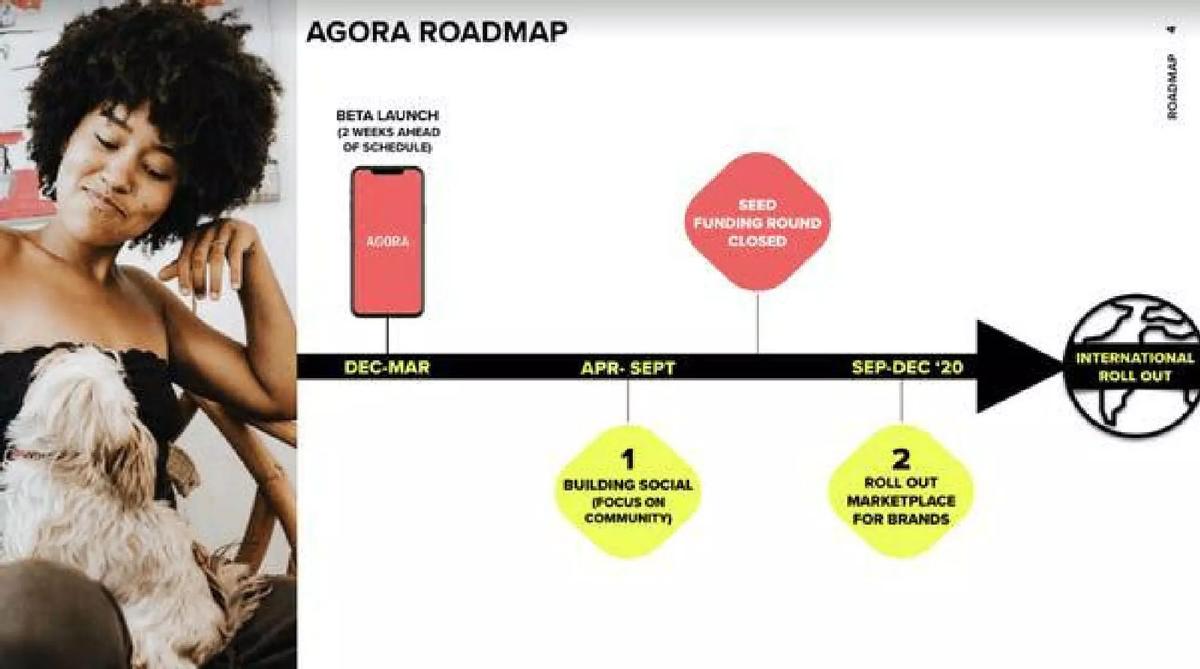
Slide 3: The Opportunity. This is the 'Why Now' slide. It uses a simple bar chart to show the Beauty E-commerce market in Europe growing from c.5bn in 2020 to c.20bn in 2025—a 4x increase. The most compelling data point is the comparison of e-commerce penetration: 40% in China vs. Slide 4: Agora Roadmap. The timeline shows a rapid progression from a Beta launch (2 weeks ahead of schedule) to a Seed funding round, followed by building the social community and rolling out the marketplace. It concludes with an 'International Roll Out' arrow, suggesting the UK is merely the testing ground for a pan-European play.
Product and Community Traction (Slides 5-6)
Slide 5: The App Experience. This slide breaks down the user journey into three pillars: Discover, Shop, and Earn. It provides critical demographic data: ~60% Gen Z, ~90% UK females, and ~80% based outside of London. The traction metrics are impressive for an early-stage venture: 50,000 users, 50,000 videos uploaded, and a 3% conversion rate. The 'Earn' component—daily free redemptions—explains the high engagement and organic growth.
Slide 6: Agora Edits. This slide focuses on a specific social commerce test. By engaging just 36 ambassadors, Agora reached 3.4 million people. The slide sets a target for January 2021 to scale this to 300 ambassadors and 5 million reach. It proves that the 'social' part of their 'social commerce' model actually works as a top-of-funnel acquisition strategy.
Brand Partnerships and Business Model (Slides 7-8)
Slide 7: E-commerce Enabling. Agora shifts the focus to the B2B value proposition. For brands, Agora isn't just a place to sell; it's a suite of tools including an in-app flagship store, CRM data access, and marketing suites. By promising brands "Full control over assortment, pricing & content," Agora addresses a major pain point brands have with traditional marketplaces like Amazon.
Slide 8: Marketing vs. E-commerce Solutions. This slide clarifies the revenue streams. The Marketing Solution (launched 2020) uses a 'Drop Model' and 'Beauty Boxes' where brands provide products at cost for visibility. The E-commerce Solution (launching Q1 2021) is the true marketplace. This tiered approach shows a logical progression from building brand awareness to facilitating high-volume transactions.
Social Proof and Appendix (Slides 9-12)
Slide 9: Stakeholder Support. A classic 'Wall of Love' slide. It includes quotes from the CEO of Bolt Beauty and, notably, a board member of L'Oreal. The inclusion of user testimonials ("I wanna cry! As a student... Agora has allowed me to do the things I love") adds emotional weight to the data-heavy slides that preceded it.
Slide 10: Download Now. A simple call to action with a large QR code. This serves as a functional slide for investors to immediately experience the product they are evaluating.
Slide 11: Appendix - Gen Z Shopping Habits. This slide provides deeper market research, noting that 60% of Gen Z still shop offline but value social connection and UGC. It reinforces the idea that Agora is capturing the 'social' aspect of shopping that traditional websites lack.
Slide 12: Closing. A repeat of the cover slide, maintaining brand consistency.
What Works in the Agora Deck
1. The 'China Comparison' Anchor: By using China's 40% penetration as a benchmark, Agora makes their growth projections feel conservative rather than speculative. It’s a powerful way to frame a market opportunity.
2. Founder-Market Fit: The team slide doesn't just list names; it lists relevant experience. The Lazada connection is the 'secret sauce' that gives investors confidence that this team knows how to execute a social commerce playbook.
3. Clear Segmentation: The deck does a great job of explaining what the app does for the consumer (Discover/Earn) versus what it does for the brand (Data/Direct Sales). This dual-sided value proposition is essential for marketplace businesses.
What is Missing
1. The Ask: There is no slide stating how much money is being raised or what the specific milestones for the next 18 months are. While we know from external sources they raised $8.2M, a pitch deck should ideally stand on its own with a clear request.
2. Unit Economics: While a 3% conversion rate is mentioned, there is no data on Customer Acquisition Cost (CAC) or Lifetime Value (LTV). For a social commerce app, these are the metrics that determine long-term viability.
3. Competitive Landscape: The deck ignores competitors. Whether it's traditional players like Sephora or social giants like TikTok/Instagram moving into commerce, a slide addressing how Agora wins against these incumbents is a notable omission.
What a Founder Should Copy
1. Visual Storytelling: Use high-quality imagery that reflects your target audience. Agora’s use of diverse, Gen Z-focused photography makes the deck feel like the product itself.
2. The Flywheel Diagram: Slide 1’s simple circular diagram of Consumers, Creators, and Brands is an excellent way to explain a complex ecosystem in seconds.
3. Specificity in Traction: Instead of saying "users love us," Agora says "36 ambassadors generated 175k engagements in 1 week." Specificity builds trust.
Final Thoughts
Agora’s deck is a lean, high-conviction document. It relies heavily on the macro-trend of social commerce and the micro-credibility of its founding team. While it skips over the 'nitty-gritty' of financial modeling, it succeeds in selling a compelling vision of a future where shopping is a social, video-first experience. For a $8.2M round, this deck serves as a high-level narrative that likely opened the door for deeper due diligence into the company's tech stack and unit economics.
Frequently asked questions
- What is the core problem Agora is solving?
- Agora addresses the stagnation of traditional e-commerce in Europe, which lags significantly behind China in terms of social integration and penetration. According to Slide 3, European e-commerce penetration was under 10% in 2020. Agora aims to capture the growing Gen Z spending power by replacing static shopping with a video-first, community-driven social commerce experience that mirrors successful Asian models like Lazada.
- How does Agora generate revenue according to the deck?
- The deck outlines a dual revenue strategy on Slide 8. The 'Marketing Solution' involves brand-sponsored 'drops' and curated 'Agora Edits' (beauty boxes) where brands supply items at cost. The 'E-commerce Solution' is a marketplace model where brands launch 'Shop in Shop' storefronts. This allows Agora to act as both a media channel for discovery and a transactional platform for direct-to-consumer sales.
- What early traction did Agora demonstrate to investors?
- Agora presented strong early engagement metrics on Slide 5, including 50,000 users (primarily organic), 50,000 video uploads, and over 1 million videos watched. Furthermore, Slide 6 highlights a social commerce test with 36 ambassadors that reached 3.4 million people across social platforms, generating 175,000 engagements in a single week and achieving a 3% conversion rate.
- Who are the key people behind the company?
- The team is led by co-founders Riccardo (CEO) and Lizzie (President). The deck emphasizes their pedigree on Slide 2, showcasing a history with Lazada (an Alibaba-backed giant) and The Carlyle Group. The broader team includes talent from Farfetch, Badoo, and JP Morgan, suggesting a strong mix of high-growth tech, luxury fashion, and financial expertise.
- What is missing from this pitch deck?
- The most notable omissions are a specific 'Ask' slide (detailing how much capital is being raised) and a 'Use of Funds' slide. While the catalogue facts state $8.2 million was raised, the deck itself does not specify the round size or valuation. Additionally, there are no detailed financial projections or unit economics (CAC/LTV) beyond the 3% conversion rate mention.