Healthcare Business Model Slides: 6 Real Pitch Deck
How healthtech startups show who pays them in a pitch deck: patients, employers, hospitals, advertisers, pharma partners and health plans.
Healthcare Business Model Slide: Name Who Pays and Show the Math
In healthcare, the person who uses the product is often not the one who pays for it. A patient might use an app that an employer buys, a clinic might pay to be listed, or a drug company might fund the work. Investors want to see who pays, how much, and how many payers you need. This guide compares six real business model slides from decks tagged healthcare in our library, from a funnel that works out annual revenue to a slide that names two customer types and no price. Our separate reimbursement guide covers insurance billing in depth.
TL;DR
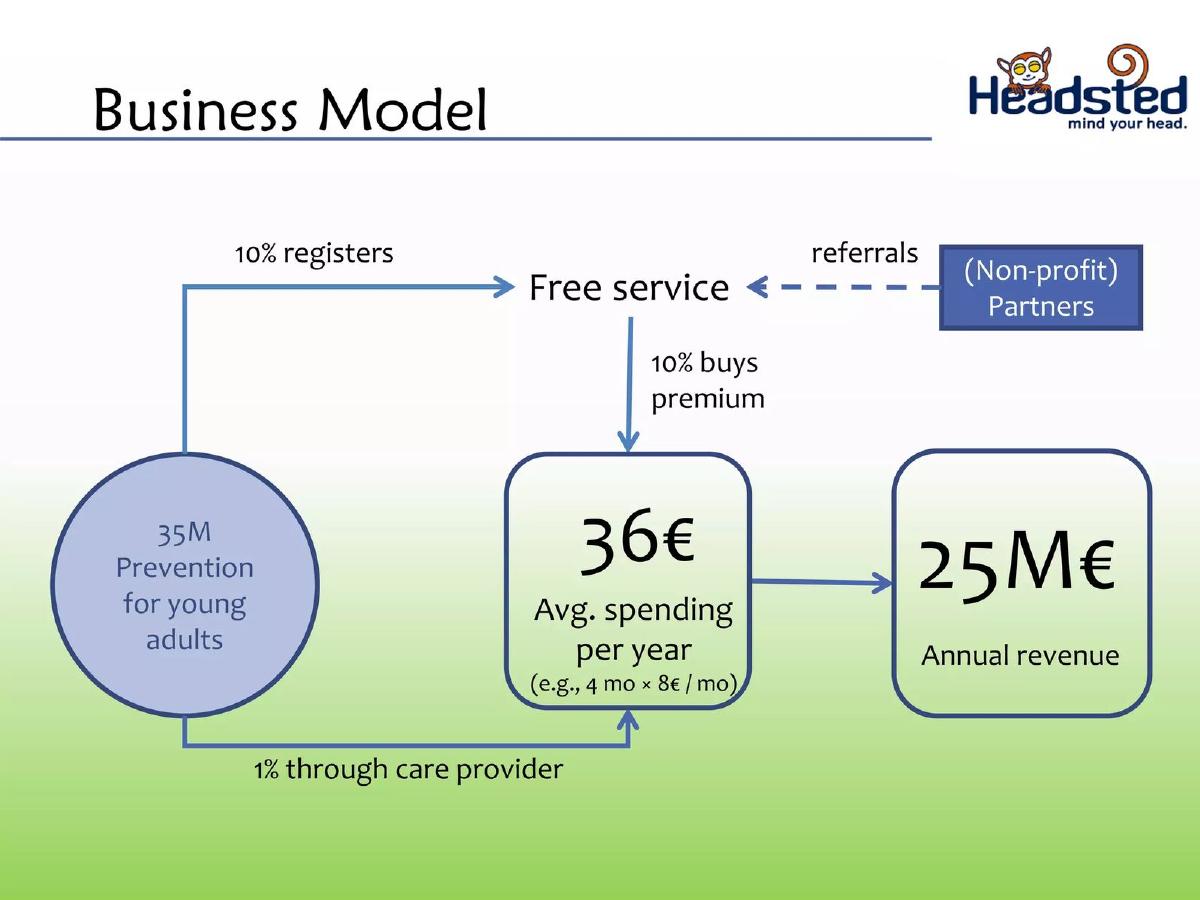
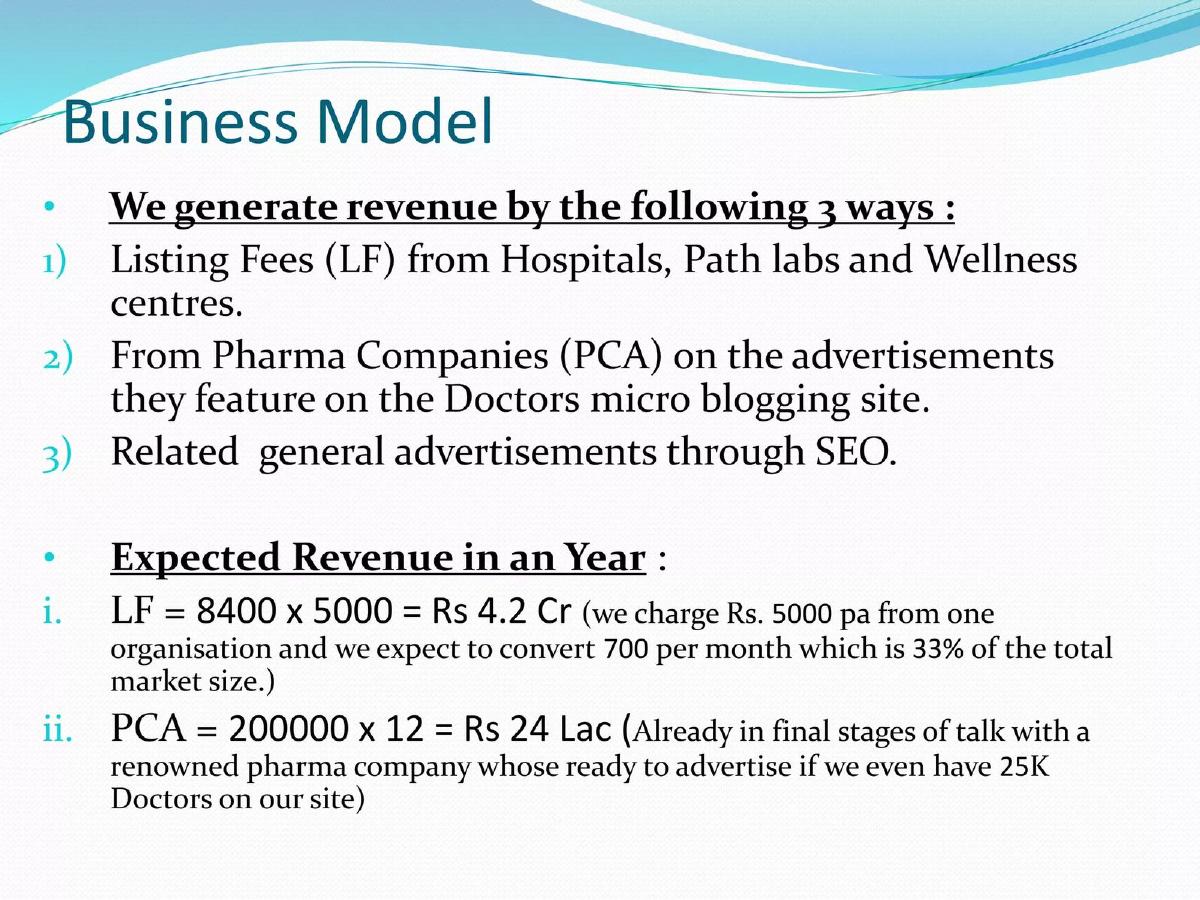
Name each payer, the price and the number you need, and show the sum. Headsted works from 35M young adults through 10% sign-ups and 10% premium buyers at €36 a year to €25M revenue. Call the Doc multiplies a ₹5,000 yearly listing fee by 8,400 organisations. ApolloMed lists its payers and its payment types. Cyclica describes pharma partnerships without terms. My US Doctor and Spora Health name who they serve but give no prices.
Healthcare business model slides from real pitch decks
Each example shows the exact stored slide above its analysis and links to the full teardown. The clearest models come first; weaker ones follow for contrast. Claims are as shown on the slides; comments are ours.
Headsted business model slide — slide 6
Online mental health courses for young adults. Slide titled "Business Model".
Headsted deck, slide 6. Exact stored slide matched to this analysis.
Our analysis: Every step from audience to revenue is on the slide, so an investor can test each assumption, and the price is broken into months and a monthly fee.
Evidence and limitation: The 10% rates are assumptions with no source or pilot result. 35M × 10% × 10% × €36 comes to about €12.6M; the slide does not show how the care-provider and partner routes add the rest of the €25M.
What a founder can adapt: Source each rate (a pilot, a comparable app) and show the care-provider route as its own line so the total adds up.
Supporting analysis
What the deck claims: A flow chart: "35M Prevention for young adults" → "10% registers" → "Free service" → "10% buys premium" → "36€ Avg. spending per year (e.g., 4 mo × 8€ / mo)" → "25M€ Annual revenue". Also "1% through care provider" and "referrals" from "(Non-profit) Partners".
Presentation choice: Freemium health apps are judged on conversion; showing the funnel invites the right questions.
When it does not fit: A headline total that the steps shown do not reach.
Healthcare directory and booking app for smaller Indian cities. Slide titled "Business Model".
Call the Doc deck, slide 6. Exact stored slide matched to this analysis.
Our analysis: It names three payers, gives the listing price, and shows the multiplication behind each revenue line.
Evidence and limitation: 700 new organisations a month is a forecast, and the pharma deal is described as in talks, not signed.
What a founder can adapt: Show how many organisations have paid so far and what the pharma deal depends on (the 25K doctor condition).
Supporting analysis
What the deck claims: "We generate revenue by the following 3 ways: 1) Listing Fees (LF) from Hospitals, Path labs and Wellness centres. 2) From Pharma Companies (PCA) on the advertisements they feature on the Doctors micro blogging site. 3) Related general advertisements through SEO." "Expected Revenue in an Year: LF = 8400 x 5000 = Rs 4.2 Cr (we charge Rs. 5000 pa from one organisation and we expect to convert 700 per month which is 33% of the total market size.)" "PCA = 200000 x 12 = Rs 24 Lac (Already in final stages of talk with a renowned pharma company whose ready to advertise if we even have 25K Doctors on our site)."
Presentation choice: When patients use the service free, investors need to see who does pay; this slide says so and prices it.
When it does not fit: Calling a 33% market share in one year an expectation without evidence.
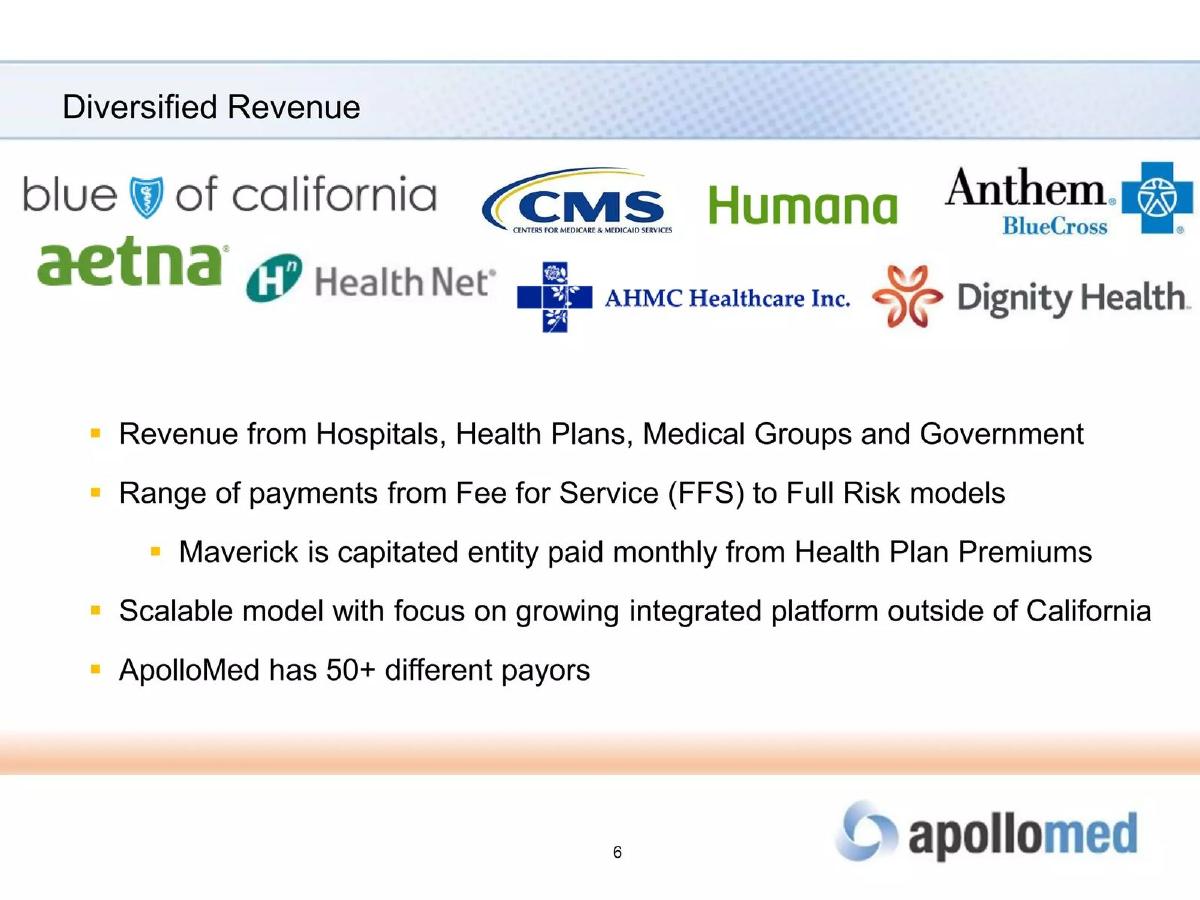
Integrated care provider for the US Medicare market, listed company. Slide titled "Diversified Revenue".
ApolloMed deck, slide 6. Exact stored slide matched to this analysis.
Our analysis: It names who pays and how (fee per service, fixed monthly amounts, full risk), which is what a healthcare investor asks first.
Evidence and limitation: No share of revenue by payer or payment type.
What a founder can adapt: Add the share of revenue from each payment type and the largest payer's share.
Supporting analysis
What the deck claims: Payer logos including Blue Shield of California, CMS, Humana, Anthem Blue Cross, Aetna and Health Net. "Revenue from Hospitals, Health Plans, Medical Groups and Government." "Range of payments from Fee for Service (FFS) to Full Risk models." "Maverick is capitated entity paid monthly from Health Plan Premiums." "ApolloMed has 50+ different payors."
Presentation choice: Payment type decides risk and margin in care delivery; stating it avoids a long diligence question.
When it does not fit: A logo wall without the split between payers.
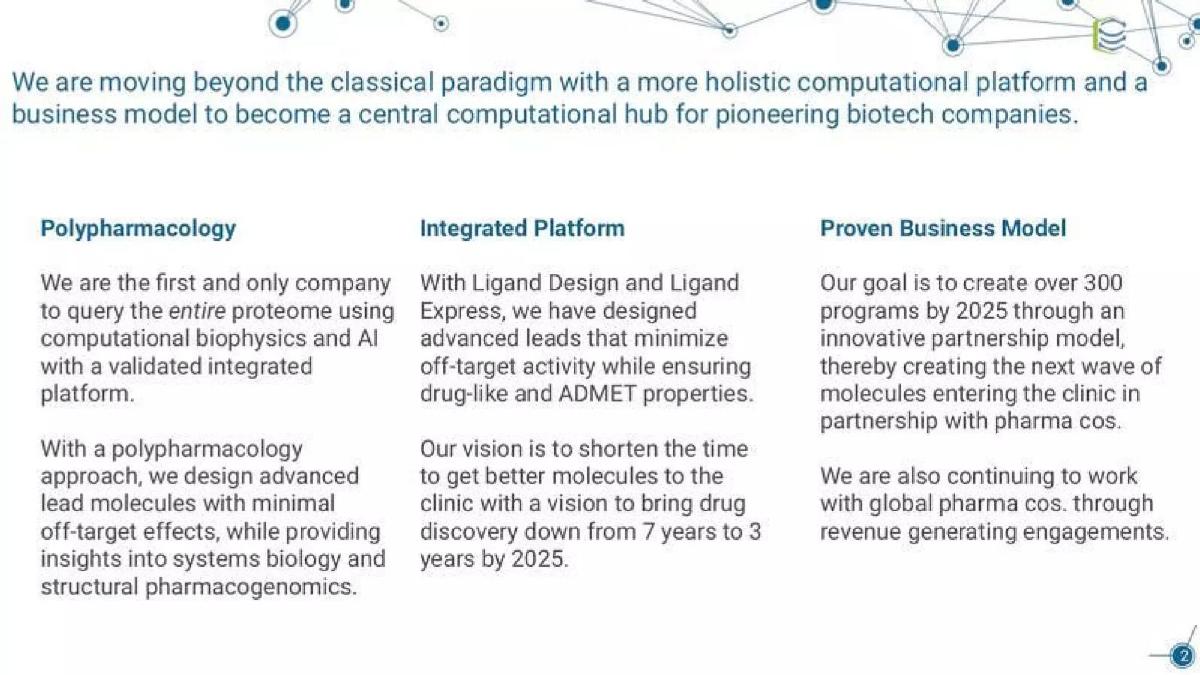
Computational drug discovery platform. Overview slide with three columns.
Cyclica deck, slide 2. Exact stored slide matched to this analysis.
Our analysis: It says the company earns through partnerships with drug companies and sets a programme target, but not how a partnership pays.
Evidence and limitation: No partnership terms (fees, milestones, royalties), partner names or count of current programmes.
What a founder can adapt: Show one typical deal: upfront fee, milestone payments and any royalty or equity share, plus how many are signed.
Supporting analysis
What the deck claims: "We are moving beyond the classical paradigm with a more holistic computational platform and a business model to become a central computational hub for pioneering biotech companies." Under "Proven Business Model": "Our goal is to create over 300 programs by 2025 through an innovative partnership model, thereby creating the next wave of molecules entering the clinic in partnership with pharma cos. We are also continuing to work with global pharma cos. through revenue generating engagements."
Presentation choice: Drug discovery platforms are valued on deal terms; "partnership model" alone does not say whether revenue is upfront, milestone or royalty.
When it does not fit: Calling a model "proven" without a deal count.
Medical travel service connecting Chinese patients with US doctors and hospitals. Slide titled "Business Model". (weaker)
My US Doctor deck, slide 4. Exact stored slide matched to this analysis.
Our analysis: It shows the three sides clearly, but the reader cannot tell who pays My US Doctor or how much.
Evidence and limitation: No prices, fees or commissions, and no sign of whether patients or hospitals pay.
What a founder can adapt: Add the consultation fee, any referral fee from hospitals, and the revenue per patient.
Supporting analysis
What the deck claims: A map linking "Chinese Patients" through "My US Doctor – Online consultation, Hospital reservation, Medical facilitation" to "USA Doctors" and "USA Hospitals". A starburst reads "Uber/Airbnb in cross-border healthcare".
Presentation choice: A marketplace comparison raises the question of take rate; the slide needs to answer it.
When it does not fit: An "Uber of" label in place of a price.
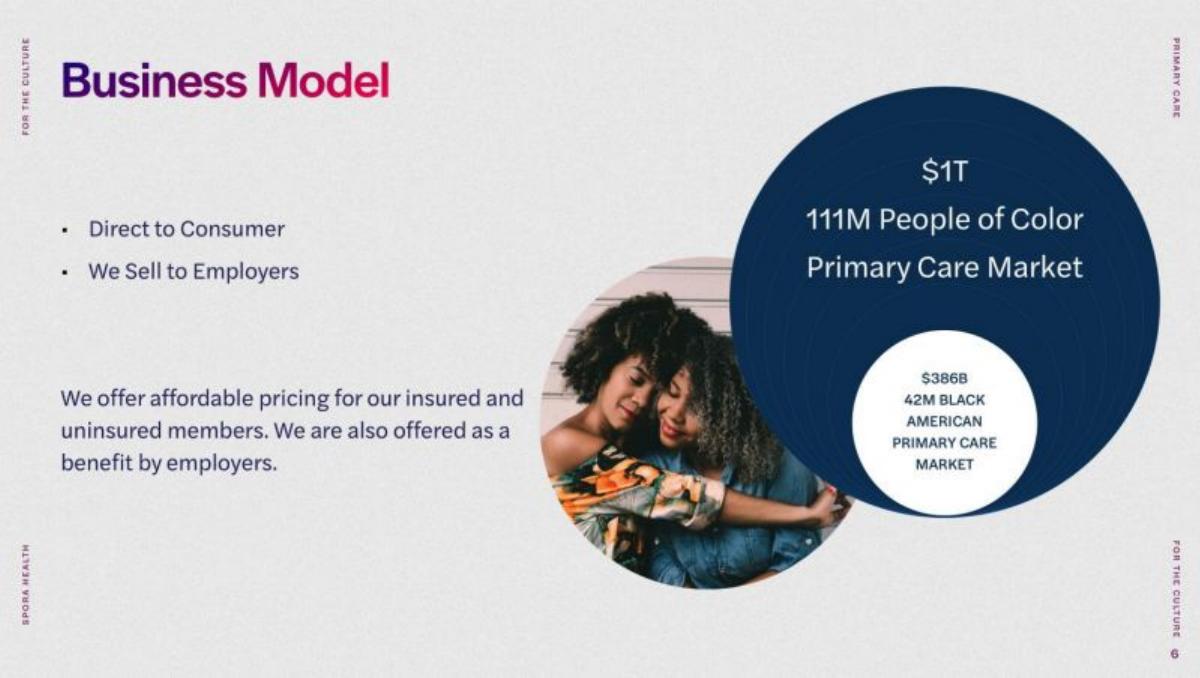
Primary care for people of colour. Slide titled "Business Model". (weakest)
Spora Health deck, slide 6. Exact stored slide matched to this analysis.
Our analysis: It names two payers, but most of the slide is market size, so the reader learns who pays but not how much.
Evidence and limitation: No member price, employer price or split between the two channels; the market figures are unsourced on the slide.
What a founder can adapt: Give the monthly member price, the employer price (per employee per month), and which channel leads.
Supporting analysis
What the deck claims: "Direct to Consumer" and "We Sell to Employers". "We offer affordable pricing for our insured and uninsured members. We are also offered as a benefit by employers." A circle reads "$1T 111M People of Color Primary Care Market" and "$386B 42M Black American Primary Care Market".
Presentation choice: Direct-to-consumer and employer sales have very different acquisition costs; investors want to see the price and mix of each.
When it does not fit: Filling a business model slide with market size.
Separate the user from the payer: patient, employer, clinic, advertiser, drug company, health plan.
Give a price per payer and the number of payers behind your revenue figure.
Show the calculation, so the investor can test each step.
Say how you are paid: per visit, per member per month, per listing, per programme.
If insurers pay, see the reimbursement guide; this slide still needs a named payer.
Build your healthcare business model slide
Start from who pays, not who uses.
Payer. Who pays you: patient, employer, clinic, hospital, advertiser, drug company, health plan?
Price and unit. What do they pay, and per what: visit, month, member, listing, programme?
How many. How many payers are behind your revenue figure, and how did you estimate it?
Payment type. Fee per service, subscription, fixed monthly amount, milestone or share of savings?
Proof. Do you have one real figure: a paying employer, a signed partner, a listing sold?
Copyable framework: [Payer] pays [price] per [unit] for [what]. [Number] payers × [price] = [revenue]. Live with [number] today; next: [payer] once [condition].
Illustrative example 1 — written by us
Before: Direct to Consumer. We Sell to Employers.
After: Members pay $40 a month; employers pay $12 per employee per month. Today 70% of revenue is employer contracts, from 5 signed employers.
What improved: Our illustrative rewrite; the prices, share and employer count are invented for the example. It gives each payer's price and which channel leads.
What this guide adds
The general business model guide covers any company, and the healthcare reimbursement guide covers how insurers and government programmes pay. This guide covers the wider question of who pays a healthtech company at all: patients paying directly, employers, providers, advertisers and drug companies, as well as health plans.
Our library's healthcare tag is broad; it includes clinics, mental health apps, medical travel, doctor directories and drug discovery. We note each company's business in the examples.
How we read each slide
We quote the text on the stored slide images. We have not checked any price, conversion rate, revenue figure or partnership claim.
Common mistakes
User and payer mixed up. Say who pays, not only who is helped.
No price. Give a price per payer and per unit.
Totals the steps don't reach. Check that the sum on the slide adds up.
Partnerships with no terms. Show how a typical deal pays you.
Market size in place of a model. Keep market figures on the market slide.
Diagnostic checklist
Names each payer.
Gives a price and unit for each.
Shows the calculation behind the revenue figure.
States the payment type.
Marks which payer or channel leads today.
Frequently asked questions
How should a healthtech startup show its business model?
Name who pays, the price and how many payers you need. Call the Doc multiplies a ₹5,000 yearly listing fee by 8,400 organisations to reach its revenue line.
How do you show a freemium health app's business model?
Show the funnel with each rate. Headsted goes from 35M young adults through 10% sign-ups and 10% premium buyers at €36 a year, though its steps alone reach about €12.6M, not the €25M shown.
Should a care provider list its payers on the business model slide?
Yes, with the payment types. ApolloMed names its health plans and government payers and says it is paid anywhere from fee for service to full risk.
How we chose these examples
Corpus: published pitch deck teardowns on StartupFundraising.com. Founder-uploaded private decks are excluded.
Selection (2026-09-27): we searched extracted slide text in decks tagged healthcare for business model, revenue model, revenue streams, monetization, pricing and how we make money. About 60 slides matched; many were tables of contents, highlights, market or traction slides.
Kept six with stored images. Excluded for no stored image (no uploads requested): Baby2Body p8, HomeFit p8, Heart Metrics p8, Everside Health p7 and Devoted Health p3. 100Plus, AcuMedical and Agility Health are in the reimbursement guide; 98point6 p5 and Medico Gate p6 are used elsewhere. MedReleaf p5 (cannabis unit economics) and Medlio p6 (unlabelled chart) were left out.
Review: stored slide text and images were checked on 2026-09-27 and matched to company, deck and slide number (editorial model review). No person has yet completed an editorial review of this page. We make no claim that any slide caused a fundraising outcome.