UpTop’s 2019 fundraising deck is a masterclass in identifying market fragmentation and presenting a unified solution. The 12-slide presentation focuses on the friction between renters and property managers, who currently juggle multiple disconnected tools for listings, screenings, and payments. By showcasing a 40% market penetration in their initial test market within just four months, UpTop provided the necessary social proof to justify a $4 million ask (ultimately raising $5.5 million). While the deck is visually lean and lacks detailed financial projections or a deep competitive moat analy…
Key takeaways
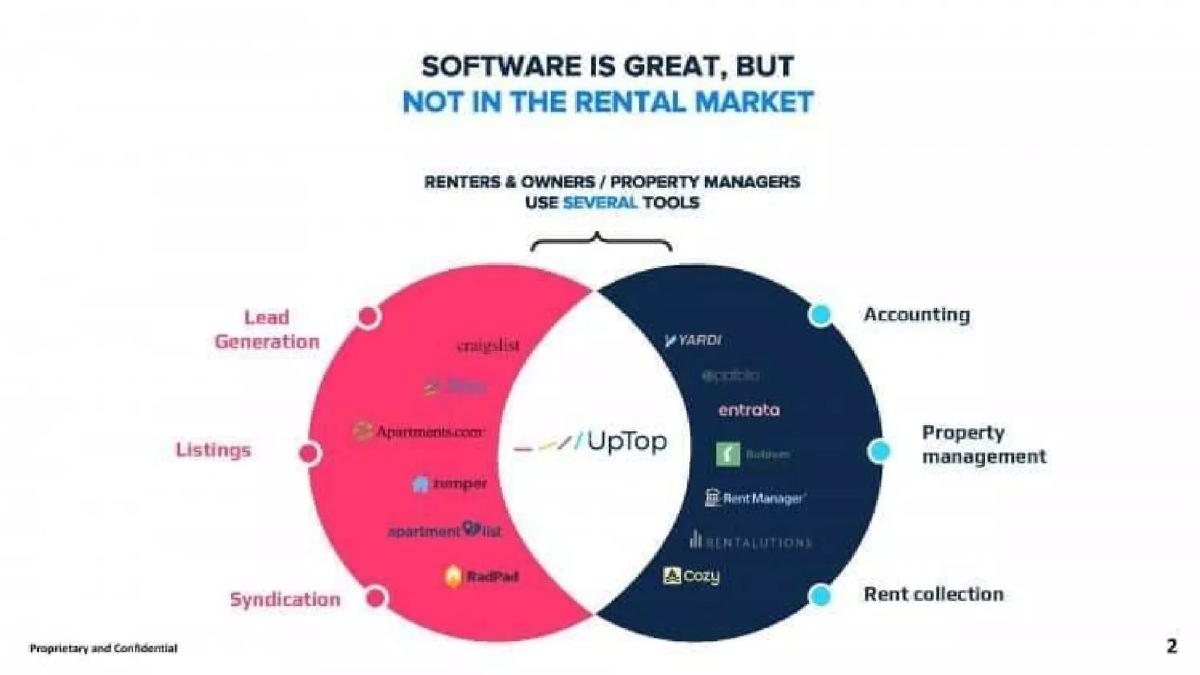
- The deck identifies a fragmented market where users must toggle between tools like Craigslist and Yardi, positioning UpTop as the central bridge (Slide 2).
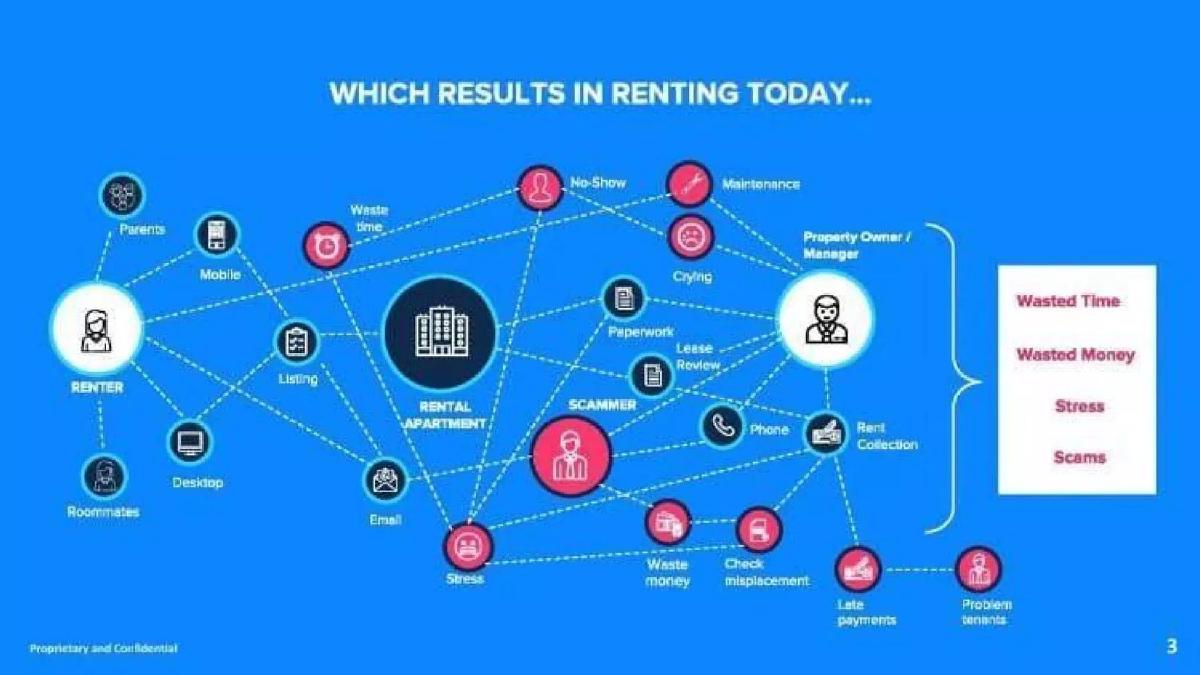
- A complex 'spaghetti' diagram illustrates the current chaotic state of renting, highlighting pain points like scams, wasted time, and stress (Slide 3).
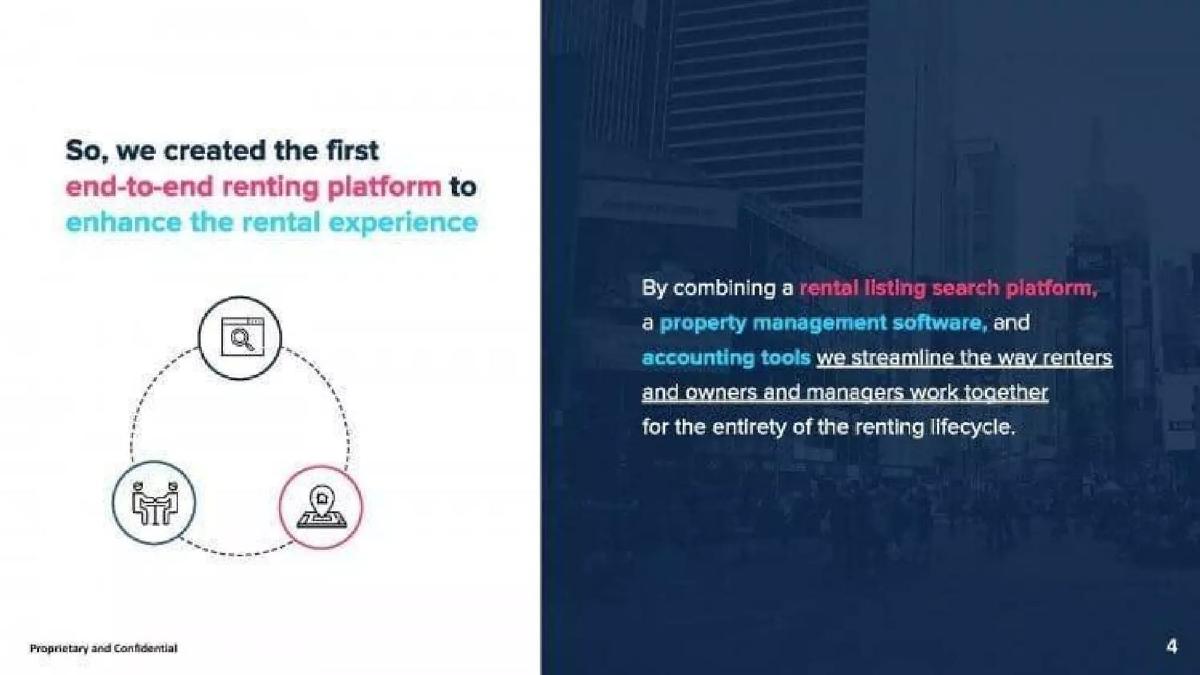
- UpTop claims to be the first end-to-end platform combining search, management, and accounting (Slide 4).
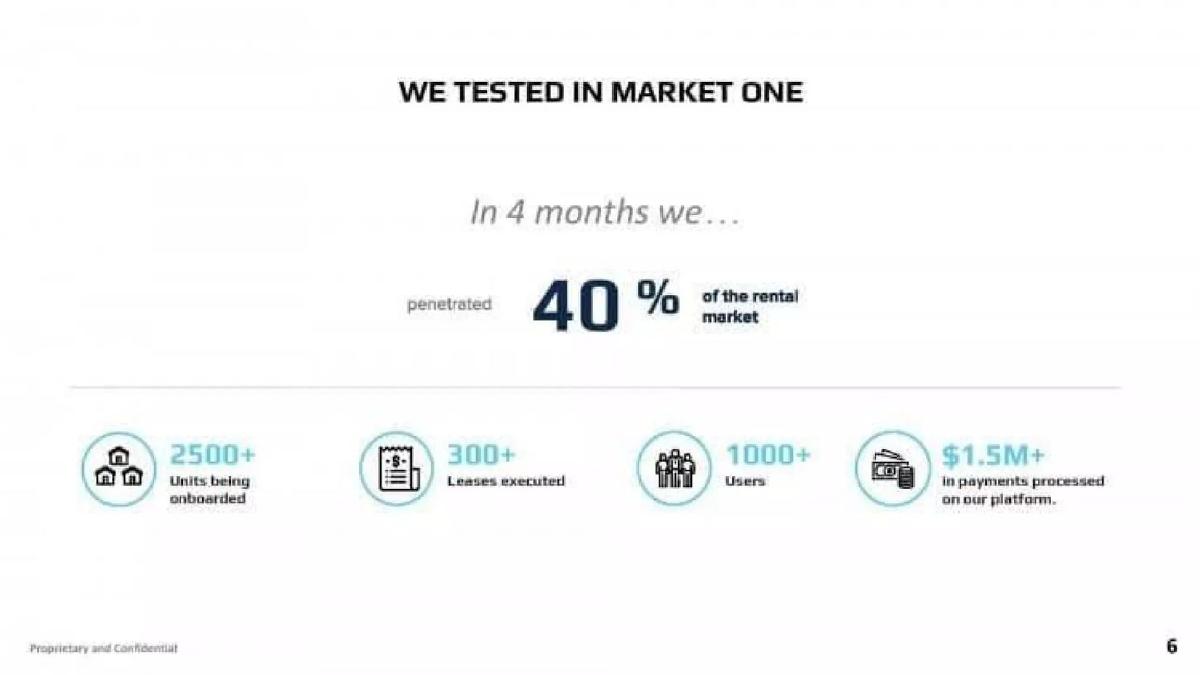
- The startup demonstrated significant early traction, reporting 40% penetration in their first market within four months (Slide 6).
- Early performance metrics include 2,500+ units being onboarded and $1.5M+ in payments processed (Slide 6).
- The team slide features 15 members, including a C-suite and engineering staff, but lacks professional biographies or past company logos (Slide 8).
- The product is showcased through high-fidelity mockups for both the owner/manager dashboard and the renter mobile app (Slides 9 and 10).
- The fundraising ask was specifically set at $4 million for product development, new hires, and growth (Slide 7).
Introduction: The Unified Rental Vision
UpTop’s 2019 pitch deck is a concise, 12-slide presentation that successfully secured $5.5 million in Seed funding, despite an initial ask of $4 million. The deck focuses on a 'platform play' in the real estate tech (PropTech) space, aiming to consolidate the disparate tools used by landlords and tenants into a single ecosystem. The narrative is built on the transition from chaos to order, using traction in a pilot market to prove that the industry is ready for consolidation.
Slides 1-3: The Problem of Fragmentation
Slide 1: Title Slide The deck opens with a clean, dark blue aesthetic. The company name 'UpTop' is accompanied by the tagline 'End-to-End Renting Platform.' It is dated 'Fundraising 2019.' The branding is modern, using a multi-colored slash logo that suggests movement and connection.
Slide 2: The Software Gap This slide identifies the core market inefficiency. It states, 'Software is great, but not in the rental market.' A Venn diagram shows two distinct silos. On the left (pink circle) are lead generation and listing tools like Craigslist, Zillow, and Apartments.com. On the right (dark blue circle) are accounting and property management tools like Yardi, AppFolio, and Entrata. UpTop is placed in the overlapping center, claiming to be the bridge between these two worlds.
Slide 3: The Chaos of Modern Renting To drive home the pain point, Slide 3 uses a complex node-and-line diagram to represent the current rental experience. It connects icons for 'Parents,' 'Roommates,' 'Scammers,' and 'Crying' with lines representing emails, phone calls, and paperwork. The summary box on the right lists the consequences: Wasted Time, Wasted Money, Stress, and Scams. This is a classic 'villain' slide designed to make the audience feel the frustration of the status quo.
Slides 4-5: The Integrated Solution
Slide 4: The Value Proposition UpTop introduces itself as 'the first end-to-end renting platform.' The slide explains that by combining search, management, and accounting, they 'streamline the way renters and owners and managers work together for the entirety of the renting lifecycle.' This slide is the 'hero' moment, offering a simple three-part solution to the complex mess shown on the previous slide.
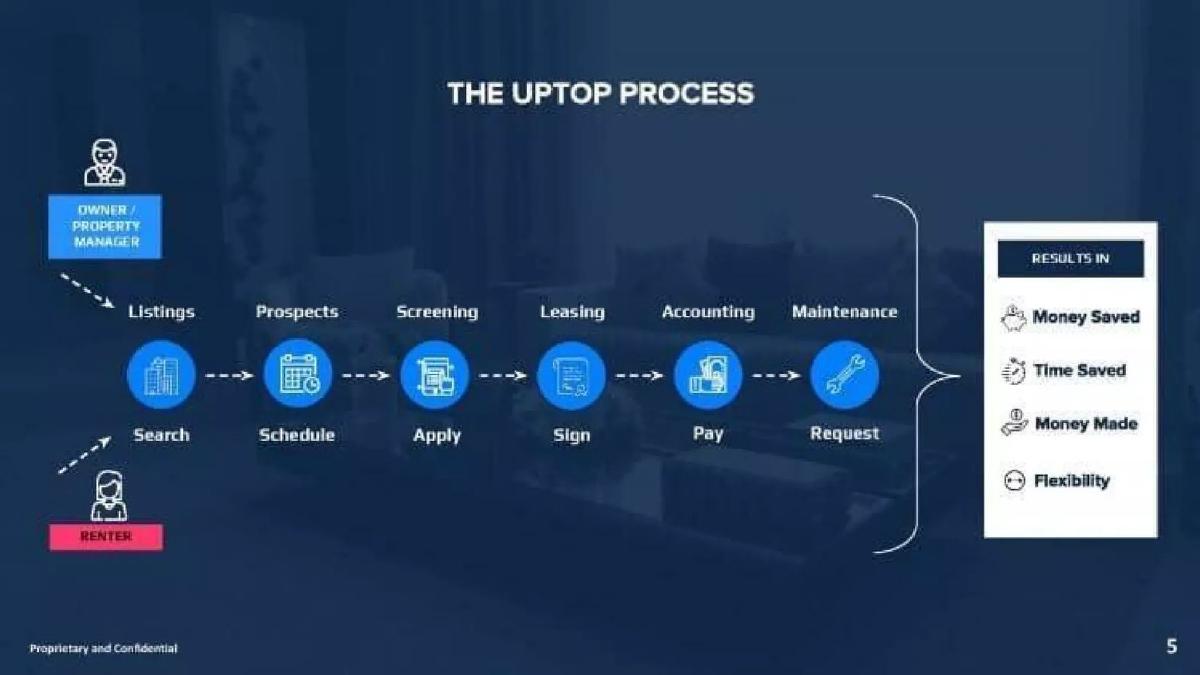
Slide 5: The UpTop Process This slide visualizes the user journey. It maps out a linear flow from 'Listings' to 'Maintenance.' For the Owner/Property Manager, the steps are Listings, Prospects, Screening, Leasing, Accounting, and Maintenance. For the Renter, the corresponding steps are Search, Schedule, Apply, Sign, Pay, and Request. The slide promises four outcomes: Money Saved, Time Saved, Money Made, and Flexibility. It effectively shows how the platform serves both sides of the marketplace simultaneously.
Slide 6: Traction and Market Validation
Slide 6: The 'Market One' Test This is arguably the most important slide in the deck. It provides proof of concept by detailing a four-month test in a single market. The headline figure is '40% penetration of the rental market.' Supporting metrics include:
2500+ Units being onboarded · 300+ Leases executed · 1000+ Users · $1.5M+ in payments processed on our platform
By focusing on a single market, UpTop demonstrates that their solution can dominate a local geography before attempting to scale nationally.
Slides 7-8: The Ask and The Team
Slide 7: Fundraise and Use of Proceeds The ask is clear: 'Raising $4 Million.' The right side of the slide breaks down the use of proceeds into three categories: Product Development, New Hires, and Growth. There are no specific dollar amounts or percentages attached to these categories, which is a common omission in seed decks but one that usually requires follow-up during due diligence.
Slide 8: The Team The team slide shows 15 individuals. The leadership includes Frank Barletta (CEO), Brad Marder (CTO), Jonathan Foux (CMO), and Travis Hardman (CPO). The team appears well-rounded, with dedicated roles for Design, Human Resources, and Finance. However, the slide is entirely visual; it lacks any text describing the team's background, education, or previous successes. Investors are forced to rely on the photos alone to judge the team's experience level.
Slides 9-11: Product and Media
Slide 9: Owner / Manager Product This slide shows a high-fidelity mockup of the desktop dashboard for property managers. It displays a specific address (102 South Street #302, NY 14850), rent amounts ($1500), and a real-time chat interface. The UI looks clean and professional, emphasizing the 'all-in-one' nature of the tool.
Slide 10: Renter Product The renter experience is shown through a series of mobile app screens. These include a map-based search, a chat interface, a screening application, an e-sign document, a payment screen for a security deposit, and a maintenance request form. This confirms the 'end-to-end' claim by showing the app can handle every stage of the tenant lifecycle.
Slide 11: Media Validation The deck includes a 'Media' slide featuring a headline from the Pittsburgh Business Times: 'UpTop real estate platform to expand to Pittsburgh.' It also shows a screenshot of a television appearance on 'Our Region's Business.' This provides external validation and suggests that the company is already generating buzz in its expansion markets.
Slide 12: Contact Information
Slide 12: Join Us The final slide provides contact details for CEO Frank Barletta, including his email and the company's New York office address at 1460 Broadway. It maintains the consistent branding seen throughout the deck.
What Works in This Deck
The 'Spaghetti' diagram on Slide 3 is a highly effective way to visualize a messy problem. By showing the sheer number of touchpoints and potential failure points in a traditional rental transaction, UpTop makes the need for a unified platform feel urgent. Additionally, the traction slide (Slide 6) is excellent. Achieving 40% market penetration in a test market is a powerful 'micro-monopoly' story that suggests the product has high utility and low friction for adoption. The clear distinction between the Owner and Renter workflows on Slide 5 also demonstrates a deep understanding of the two-sided marketplace dynamics.
What is Missing from This Deck
The most glaring omission is the business model. There is no mention of how UpTop makes money. Do they charge a SaaS fee to landlords, a transaction fee on rent payments, or a lead-gen fee for listings? Without this, the $1.5M in 'payments processed' is a vanity metric, as it doesn't indicate actual revenue for the startup. Furthermore, the team slide (Slide 8) is far too thin. In a seed round, investors are betting on the founders' ability to execute. Omitting their professional history (e.g., 'Ex-Google,' 'Sold previous company for $Xm') is a missed opportunity to build credibility. Finally, there is no mention of unit economics (CAC/LTV) or a detailed competitive landscape beyond the high-level Venn diagram.
What a Founder Should Copy
Founders should emulate the way UpTop framed their market position on Slide 2. Instead of saying 'we are better than Zillow,' they said 'we are the bridge between Zillow and Yardi.' This positioning reduces the perceived threat to established giants and makes the startup look like a necessary evolution of the industry rather than just another competitor. The use of a 'Market One' case study is also a brilliant strategy for early-stage companies. If you haven't scaled nationally yet, proving that you can 'own' a specific city or niche is the best way to convince investors that you can eventually own the whole market. Finally, the visual consistency of the deck—using a limited color palette and high-quality mockups—makes the company appear more mature and 'venture-ready' than a typical seed-stage outfit.
Frequently asked questions
- What was the primary problem UpTop aimed to solve?
- UpTop addressed the extreme fragmentation in the rental market. As shown on Slide 2, renters and owners currently use separate, disconnected tools for lead generation (Craigslist, Zillow) and property management (Yardi, AppFolio). This lack of integration leads to a chaotic process involving 'wasted time, wasted money, stress, and scams,' which the deck visualizes through a complex web of interactions on Slide 3.
- How did UpTop demonstrate product-market fit in this deck?
- The company used a 'Market One' test case to prove demand. According to Slide 6, they achieved 40% market penetration in just four months. They backed this up with hard numbers: over 2,500 units being onboarded, 300+ leases executed, 1,000+ users, and more than $1.5 million in payments processed. This concentrated success in a single market suggested a scalable model.
- What was the specific fundraising ask and intended use of funds?
- On Slide 7, UpTop explicitly stated they were raising $4 million. The use of proceeds was categorized into three buckets: Product Development, New Hires, and Growth. While the slide provides the 'what,' it lacks a detailed breakdown of how the $4 million would be allocated percentage-wise or what specific milestones that capital would help them reach.
- Who was on the founding team, and what was their expertise?
- Slide 8 displays a 15-person team, led by CEO Frank Barletta, CTO Brad Marder, CMO Jonathan Foux, and CPO Travis Hardman. While the slide shows a robust headcount for a seed-stage startup—including four junior software engineers and a head of finance—it notably omits any text regarding their professional backgrounds, previous exits, or relevant industry experience.
- How did the deck handle competition?
- UpTop took a unique approach to competition on Slide 2. Rather than a standard 'check-box' grid, they used a Venn diagram. They placed competitors like Zillow and Apartments.com in a 'Lead Gen/Listings' circle and Yardi and Entrata in an 'Accounting/Property Management' circle. UpTop positioned itself in the center, suggesting that its value proposition is the integration of these two previously separate worlds.