Fashion Competition Slides: 7 Real Pitch Deck Examples
How fashion, apparel and accessories startups show competition in a pitch deck: written comparisons, overlapping circles, positioning maps and logo walls.
Fashion Competition Slide: Show Where Your Brand Fits Among Rivals
Fashion founders never lack competitors. Shoppers can buy from global sportswear giants, department stores, online marketplaces, small independent designers or a styling app, and most of them already do. The hard part of a fashion competition slide is not finding rivals; it is showing where your brand sits among them and why a shopper or a retailer would pick you. This guide compares seven real competition slides from fashion, apparel, accessories and fashion-technology decks. They use six different formats: a written comparison, a plain list, overlapping circles, a two-axis map, a wall of logos, a one-rival contrast and a two-line list with barriers to entry.
TL;DR
Name the brands your buyer already chooses from, group them in a way that explains your position, and add one reason a buyer would switch. Abacus Sportswear writes out its rivals, admits they are bigger, and names the one it meets most often in rainwear. SheNative groups its rivals into Indigenous designers and Canadian leather brands, which shows where it stands without a single number. ING Bags draws overlapping circles of activewear and bag brands and leaves the overlap open for itself. Probe Fashion places ten rivals on a map from catalogue to social and from generic to personalised. Hourglass Project shows ten Indian fashion sites as logos with no comparison. Unzipped defines itself against one named rival, ShopStyle. FasterPants lists only two kinds of competition and moves straight to why rivals would struggle to copy it.
Fashion competition slides from real pitch decks
Each example shows the exact stored slide above its analysis and links to the full teardown. The slides that explain the company's position come first; weaker ones follow for contrast. Claims are as shown on the slides; comments are ours.
Abacus Sportswear US competition slide — slide 13
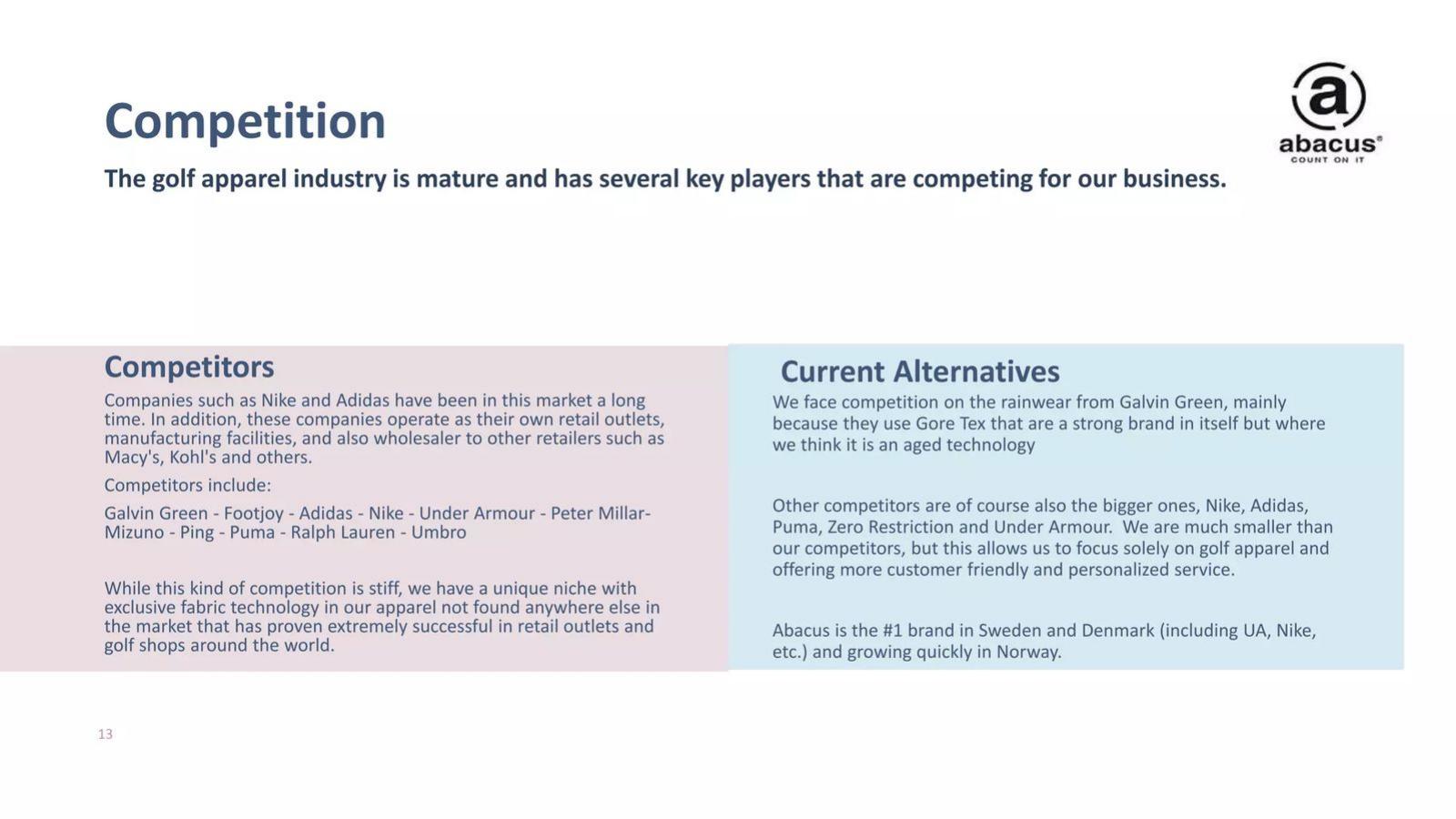
US arm of a Swedish golf apparel brand. Slide titled "Competition", with two text panels: "Competitors" and "Current Alternatives".
Abacus Sportswear US deck, slide 13. Exact stored slide matched to this analysis.
Our analysis: It names eleven rivals, explains how the biggest ones sell, admits Abacus is smaller, and singles out the rival it meets most often in one product line.
Evidence and limitation: Claimed. No source for the top-brand claim in Sweden and Denmark, and no figure for the fabric's success in shops. The brand's US site, checked on 2026-10-01, describes it as operating in 25 countries and approaching its 50th year in 2027.
What a founder can adapt: Keep the written structure, add one price for a comparable rain jacket from Abacus and Galvin Green, and give the source and year for the market-share claim.
Supporting analysis
What the deck claims: "The golf apparel industry is mature and has several key players that are competing for our business." Competitors: "Galvin Green - Footjoy - Adidas - Nike - Under Armour - Peter Millar - Mizuno - Ping - Puma - Ralph Lauren - Umbro." Nike and Adidas "operate as their own retail outlets, manufacturing facilities, and also wholesaler to other retailers such as Macy's, Kohl's and others." Current alternatives: "We face competition on the rainwear from Galvin Green, mainly because they use Gore Tex that are a strong brand in itself but where we think it is an aged technology." "We are much smaller than our competitors, but this allows us to focus solely on golf apparel." "Abacus is the #1 brand in Sweden and Denmark (including UA, Nike, etc.) and growing quickly in Norway."
Presentation choice: Admitting size and naming the rainwear rival by its fabric brand makes the slide read as honest, and it tells investors exactly where Abacus expects to win.
When it does not fit: Calling a rival's technology "aged" without a test or customer evidence; a buyer at a golf shop will ask for proof.
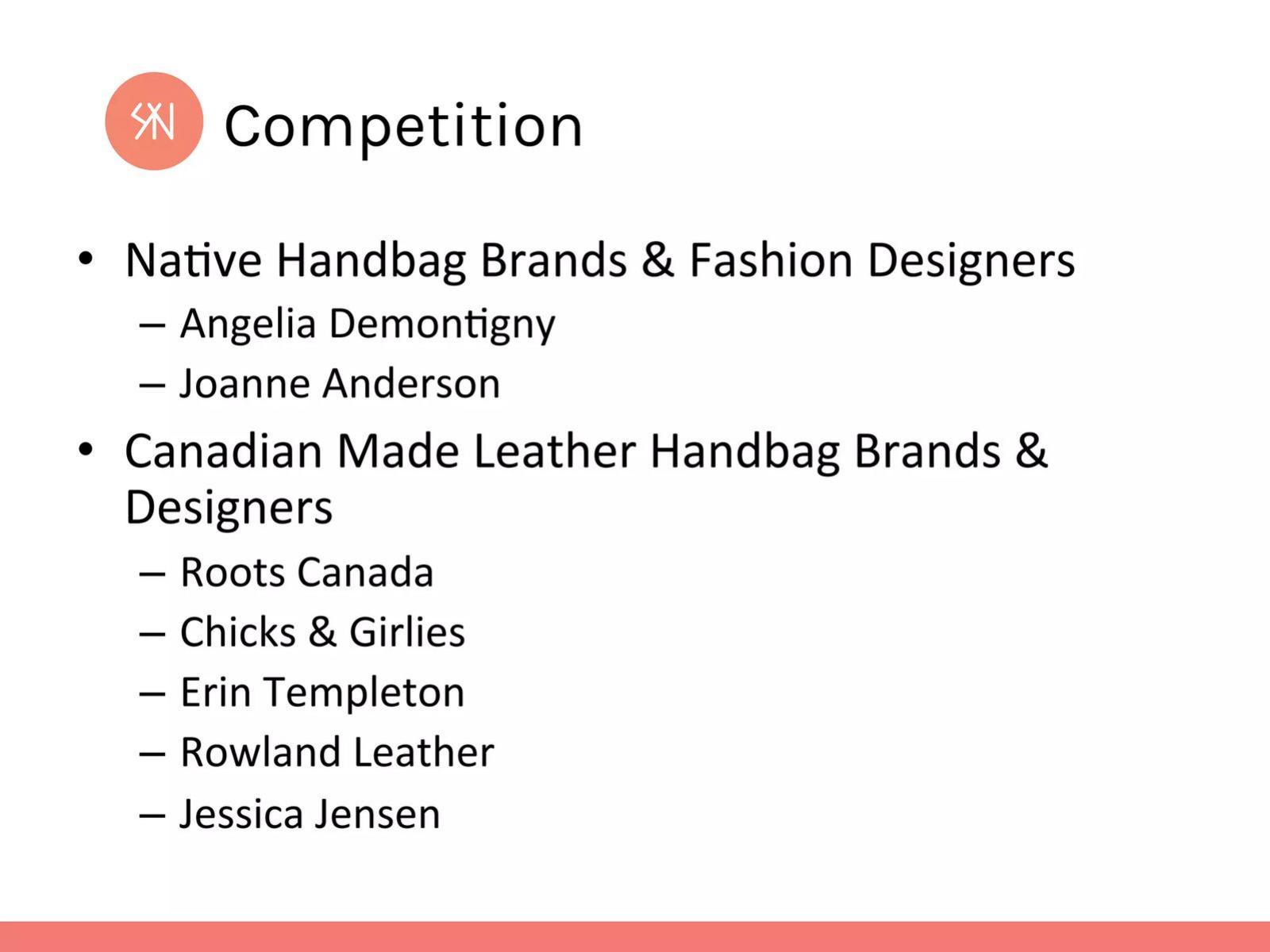
Indigenous- and woman-founded leather handbag and apparel brand from Saskatoon, Canada. Slide titled "Competition", a two-group list.
SheNative deck, slide 7. Exact stored slide matched to this analysis.
Our analysis: The two headings place SheNative at the meeting point of two groups: Indigenous designers and Canadian-made leather bags.
Evidence and limitation: Names only; no prices, sizes or comparison. A 2020 University of Toronto case study describes SheNative as a leather goods and apparel social enterprise launched in 2015.
What a founder can adapt: Add a third line saying what the shopper gets from SheNative that neither group offers alone, and one price per group.
Presentation choice: Grouping rivals this way shows the niche without saying it; few brands sit in both groups, which is the company's point.
When it does not fit: Leaving out the larger brands a shopper would also consider; a buyer choosing a leather bag will compare with department-store labels too.
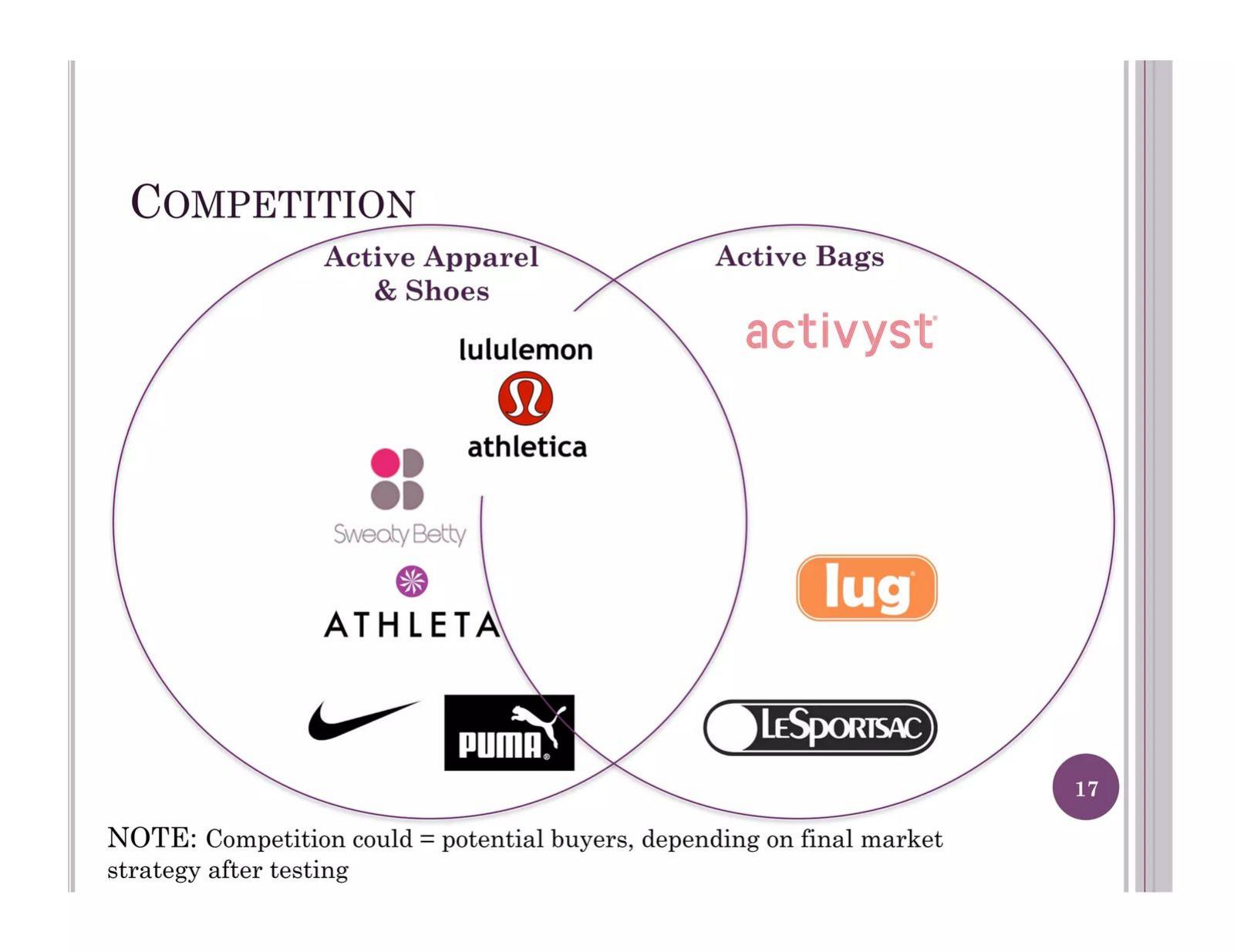
Wholesale bags and accessories handmade in Bolivia. Slide titled "Competition", drawn as two overlapping circles.
ING Bags deck, slide 17. Exact stored slide matched to this analysis.
Our analysis: It says the company's bags sit between activewear brands and bag brands, and that the large activewear brands might stock its products rather than fight them.
Evidence and limitation: Logos only; no prices or figures.
What a founder can adapt: Place ING Bags on the diagram, and say which of the brands are targets as stockists and which are true rivals.
Supporting analysis
What the deck claims: Left circle, "Active Apparel & Shoes": Sweaty Betty, Athleta, Nike, Puma. Right circle, "Active Bags": Activyst, Lug, LeSportsac. Lululemon Athletica sits in the overlap. "NOTE: Competition could = potential buyers, depending on final market strategy after testing."
Presentation choice: The note about rivals becoming buyers is unusually candid; it tells investors the sales plan is still being tested.
When it does not fit: Leaving your own brand off a diagram whose purpose is to show where you fit.
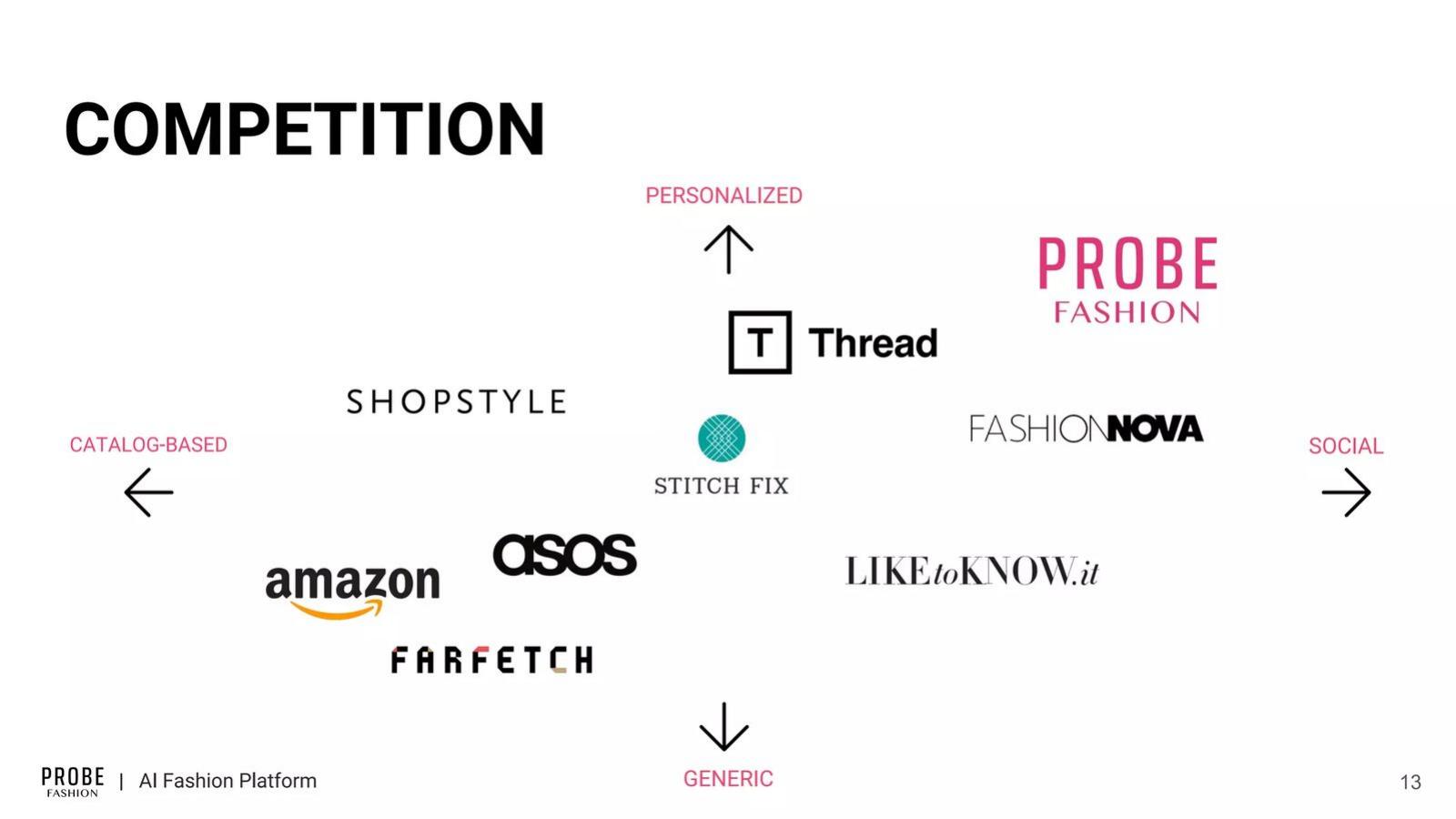
Shopping app that finds clothes from a photo, focused on the United Arab Emirates. Slide titled "Competition", a two-axis map.
Probe Fashion deck, slide 13. Exact stored slide matched to this analysis.
Our analysis: It argues that no rival combines social discovery with personal recommendations.
Evidence and limitation: Positions are the company's own judgement; no basis is given. The app's last listed update was in January 2019; outcome unknown.
What a founder can adapt: Explain each axis in one line, give one fact behind each position (such as whether a rival offers photo search), and say how partners differ from rivals.
Supporting analysis
What the deck claims: Axes: "Catalog-based" to "Social" and "Generic" to "Personalized". Probe Fashion sits alone at top right (personalised, social). Thread is near the top centre; ShopStyle and Stitch Fix in the middle; Fashion Nova and LIKEtoKNOW.it on the social side; Amazon, ASOS and Farfetch at bottom left (catalogue, generic).
Presentation choice: Shown as a mixed example: the axes are relevant to fashion shopping, but the company places itself in the empty corner with no reason given, and two of the rivals (Amazon and Farfetch) appear elsewhere in the deck as retail partners.
When it does not fit: Drawing a map where you alone own the best corner without a reason; investors read it as a picture of hope.
Concept for a fashion search engine, in a 7-slide deck from around 2011. Slide contrasts what the company "is not" and what it "is".
Unzipped deck, slide 5. Exact stored slide matched to this analysis.
Our analysis: Instead of listing many rivals, it defines itself against the best-known one and draws a clear line: search only, no selling.
Evidence and limitation: No figures. Much of the rest of the deck uses placeholders such as "$X" and "TBD"; this slide does not. ShopStyle, the rival it names, closed in July 2026 according to Wikipedia. Unzipped's outcome is unknown.
What a founder can adapt: Keep the contrast, then add a short row of other options shoppers use (search engines, marketplaces) and one fact showing why information-only search is better for them.
Supporting analysis
What the deck claims: "Unzipped is not a Retail Portal." "Unlike Shopstyle, a potential competitor that combines content and shopping, Unzipped is not an affiliate network or retailer." "Unzipped is... An information-only search tool serving the global shopper; A superior platform for retailers, e-commerce sites and fashion designers; A source of the best range of global fashion and style content provider."
Presentation choice: A single named contrast is easy to remember, and it tells investors what the business will not do.
When it does not fit: Words such as "superior" and "best range" with nothing behind them, and relying on one rival when shoppers have many.
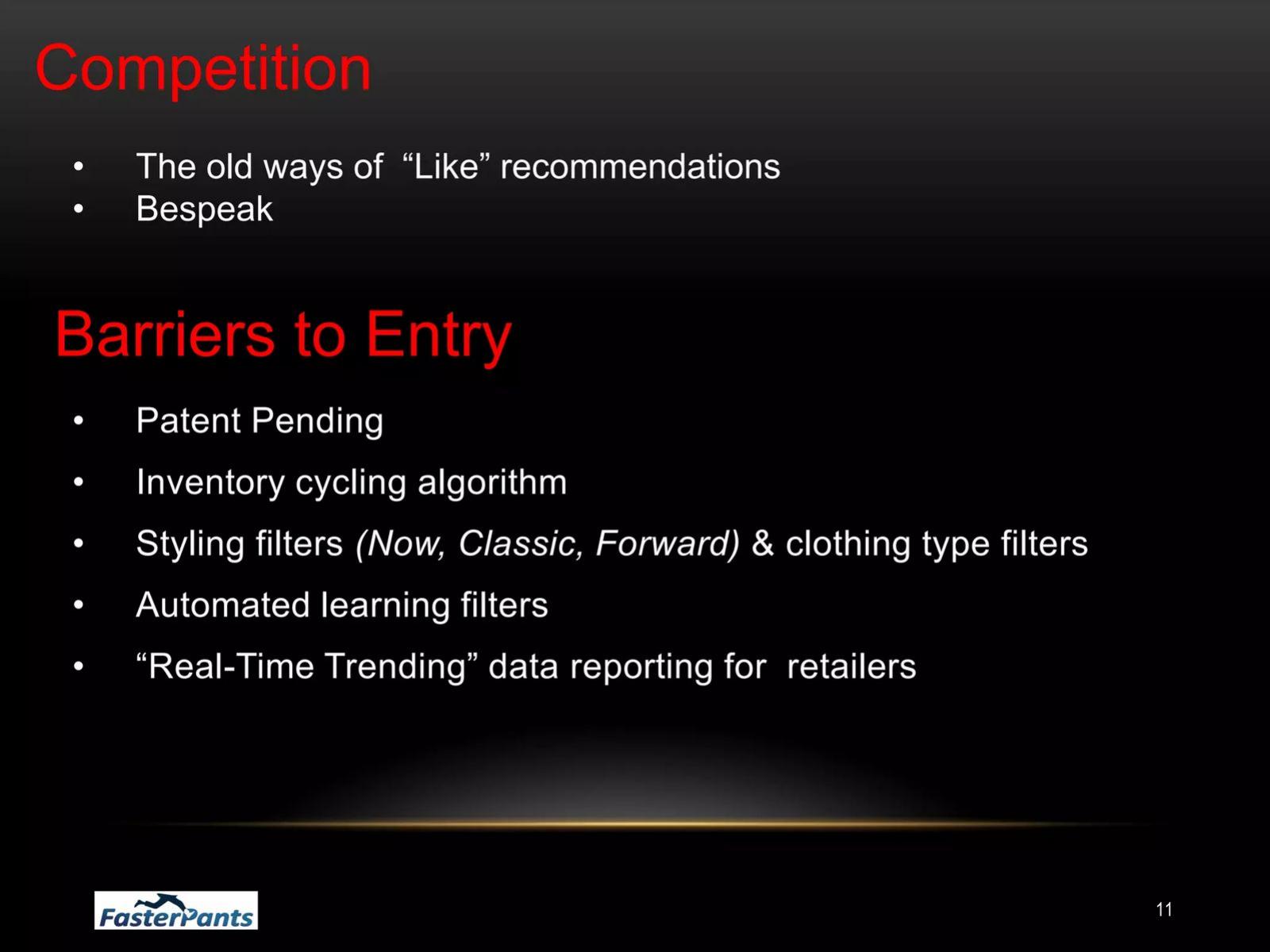
Outfit styling software for clothing retailers, from New York, deck from around 2012. Slide combines "Competition" and "Barriers to Entry".
FasterPants deck, slide 11. Exact stored slide matched to this analysis.
Our analysis: It treats the main rival as an approach, simple "people who liked this also liked" recommendations, plus one named company.
Evidence and limitation: No figures, no patent number. Company research site aVenture lists FasterPants as founded in 2010 in New York; current status unknown.
What a founder can adapt: Name the tools retailers use today, say what each does, and give the patent application number and filing date.
Supporting analysis
What the deck claims: Competition: "The old ways of 'Like' recommendations"; "Bespeak". Barriers to entry: "Patent Pending"; "Inventory cycling algorithm"; "Styling filters (Now, Classic, Forward) & clothing type filters"; "Automated learning filters"; "'Real-Time Trending' data reporting for retailers".
Presentation choice: Shown for contrast: naming an approach as a rival is a good idea for software sold to retailers, but two lines leave investors unsure who else sells styling tools.
When it does not fit: Letting the barriers list do the work of the competition list; features are not proof that rivals cannot follow.
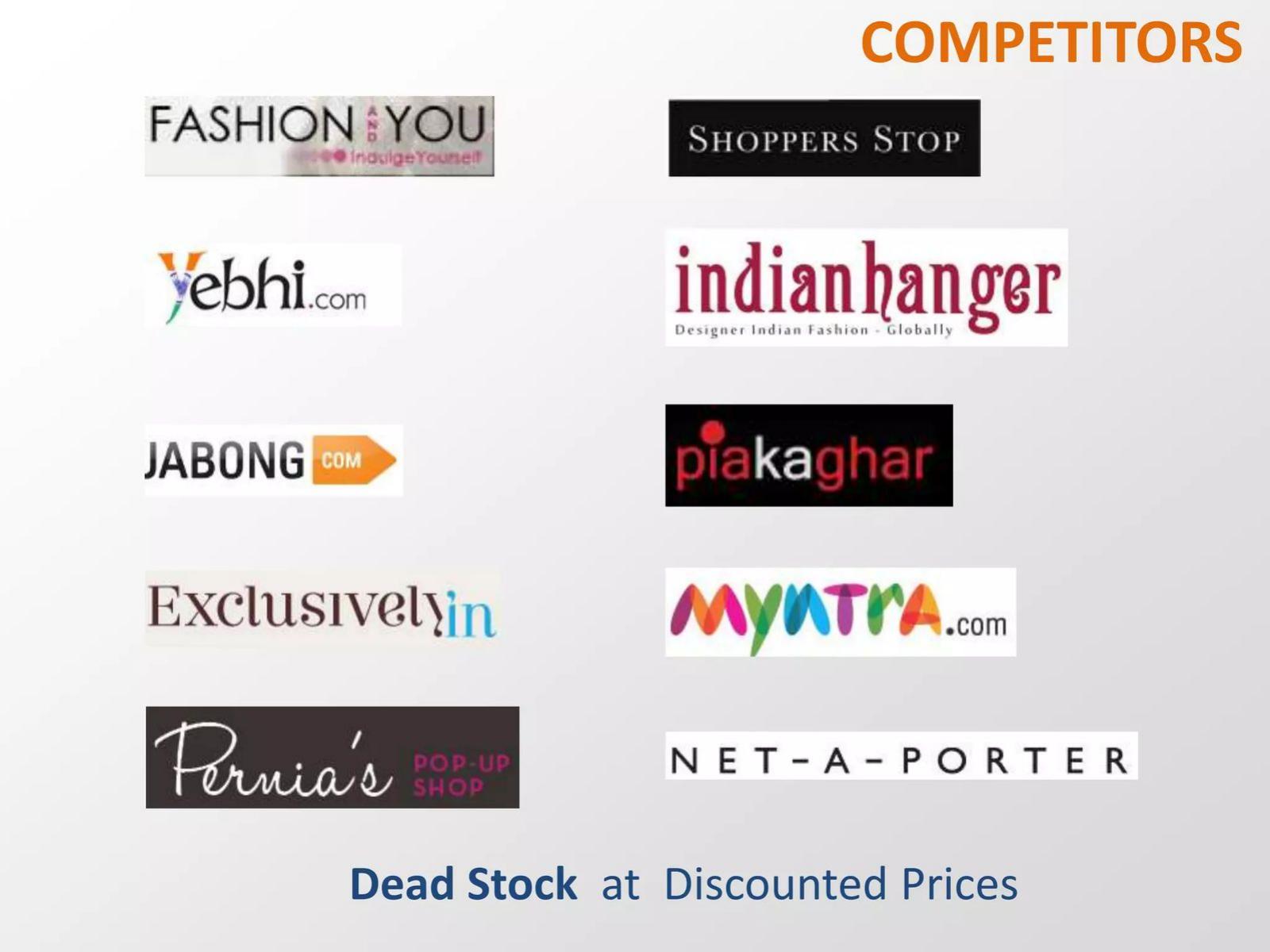
Fashion consulting and designer-wear startup from IIT Bombay, aimed at women in smaller Indian cities. Slide titled "Competitors", a wall of logos.
Hourglass Project deck, slide 37. Exact stored slide matched to this analysis.
Our analysis: The caption seems to say that rivals clear old stock at a discount, but the slide does not say how Hourglass differs.
Evidence and limitation: Logos only; no comparison or figures. Outcome unknown.
What a founder can adapt: Group the sites (discount, premium, department store), put Hourglass on the slide, and state the difference in one line, such as personal styling for smaller cities.
Supporting analysis
What the deck claims: Logos: Fashion and You, Shoppers Stop, Yebhi, Indianhanger, Jabong, Piakaghar, Exclusively.in, Myntra, Pernia's Pop-Up Shop, Net-a-Porter. Caption: "Dead Stock at Discounted Prices".
Presentation choice: Shown as the weakest: ten logos prove the team knows the market, but nothing tells the reader where Hourglass fits. Several of these sites have since closed or merged, which a reader today should keep in mind.
When it does not fit: A logo wall with an unexplained caption; the reader cannot tell whether the caption describes rivals or the company.
Whether each slide names rivals, shows the company's own position, and gives something a reader could check.
Example
Rivals named
Own position shown
Checkable basis
Abacus Sportswear US
Yes (eleven)
Yes (in words)
Partly (unsourced share claim)
SheNative
Yes (seven, in two groups)
Partly (implied by groups)
No
ING Bags
Yes (eight logos)
No (not on diagram)
No
Probe Fashion
Yes (ten)
Yes (map corner)
No
Unzipped
Yes (one)
Yes (is / is not)
No
FasterPants
Partly (one company, one approach)
Partly (barriers list)
No (no patent number)
Hourglass Project
Yes (ten logos)
No
No
Key Takeaways
Group rivals by what the shopper is choosing between, not by size.
Admit what bigger brands do well; it makes your niche believable.
A map or circles only help if your own position is explained.
A logo wall shows awareness, not a reason to switch.
Comparing against one named rival can be sharper than ten logos.
Build your fashion competition slide
Start from what your shopper or retail buyer chooses from today.
Buyer. Is your customer the wearer, a shop that stocks you, or both?
Options. Which brands, shops, marketplaces or apps would they use if you did not exist?
Groups. How would you group those options so your own position is obvious?
Their strength. What does each group do well: price, range, brand, convenience?
Proof. Can you show a price, a sell-through rate, a stockist list or a patent number?
Copyable framework: Shoppers today buy [comparable item] from [group A] at about [price] or [group B] at about [price]. We sell at [our price] and offer [difference], shown by [evidence and date].
Illustrative example 1 — written by us
Before: Competitors: ten fashion website logos. Dead stock at discounted prices.
After: Women in smaller cities buy designer wear from discount sites (old stock, about 40% off) or travel to stores in big cities. We offer new designer pieces with a free styling session online, at full price; 3 in 10 trial customers bought a second item.
What improved: Our illustrative rewrite; figures are invented for the example. It groups rivals, explains the difference and adds one result a reader could ask about.
What this guide adds
The general competition slide guide covers any kind of business. Fashion adds its own problems. Brands compete on taste, price and fit at the same time, so a simple table of features rarely captures why a shopper picks one label over another. The biggest rivals, such as Nike, Adidas or Amazon, are so well known that listing them proves little. And many fashion startups sell through retailers, so the slide has to speak to two buyers at once: the shop that stocks the product and the person who wears it.
The fashion problem and solution guides cover other slides from similar decks. Here we look only at how each deck handles rivals: who it names, how it groups them, where it places itself and what a reader could check.
How we read each slide
We quote the text on the stored slide images, read at full size. We have not checked any market-position claim, such as being the top brand in a country, or any rival's features or prices. "Claimed" means the company states something on the slide without a source. Where we checked what happened to a company after its deck, we say what we found and where; where we found nothing, we say the outcome is unknown.
These decks span roughly 2011 to 2019. Several rivals named on them have since closed, merged or changed, so we note dates where they matter. A slide that was accurate when written can read very differently today, and readers should judge each one against its own time.
Six formats, and what each one shows
Written comparisons (Abacus) take more space but can explain a trade-off: who the rivals are, what they do well, and where the company is different. Plain lists (SheNative, FasterPants) are quick to read and honest about what they are, but leave the reader to work out the difference. Overlapping circles (ING Bags) show that a product sits between two categories, which suits brands that combine two kinds of item. Two-axis maps (Probe Fashion) show a gap in one glance, but the founder picks the axes, so the gap can be an artefact of the choice. Logo walls (Hourglass Project) prove the founder knows the market but say nothing about position. A one-rival contrast (Unzipped) defines the company sharply, at the cost of ignoring everyone else.
Whichever format you pick, a reader needs three things: who the rivals are, where you sit among them, and what that position is based on. Most of the seven slides deliver the first. Fewer deliver the second, and almost none deliver the third.
Two buyers: the retailer and the wearer
Several of these companies sell through shops. Abacus mentions that its large rivals act as wholesalers to retailers such as Macy's and Kohl's. ING Bags adds a note that its competitors could also be its buyers. For a wholesale brand, the real competition is for space on a shop's shelf, and the shop cares about margin, minimum orders and how fast items sell, not only about style.
If your plan depends on retailers, say which rivals you replace on their shelves and why a buyer at a shop would switch. If you sell direct, say which brands your customer would otherwise buy and at what price. Mixing the two without saying so is a common source of confusion on fashion slides.
Questions investors ask about a fashion competition slide
Where does the company sit? A list or wall of logos without the company on it leaves the reader to guess the price point, style and customer.
Who chose the groupings and axes? If the company sits alone in the best corner of a map, investors will ask what was left out, such as price, fit or delivery.
Is the niche defensible? A unique fabric, a cultural story, a styling method or a patent can be a real difference, but the slide should say what stops a large brand from copying it.
Are the rivals still current? Fashion retail changes fast. A slide that names companies which have since closed or merged should be updated before it is sent.
Mistakes fashion slides make most often
The most common gap across these seven slides is the absence of price. Fashion shoppers compare on price constantly, yet only one slide even hints at it, and only indirectly. A single price for a comparable item from each rival would make almost every slide here stronger.
The second gap is evidence for the claimed difference. Abacus says its fabric is unique and has proven successful; FasterPants cites a pending patent; SheNative relies on its story. Each could add one checkable fact, such as a sell-through rate in golf shops, a patent application number or a list of stockists, without changing the design of the slide.
Common mistakes
Leaving yourself off. ING Bags and Hourglass Project show rivals without placing the company.
Logos with no comparison. A wall of logos proves awareness, not a reason to switch.
The empty best corner. Probe Fashion owns the top-right of its own map with no reason given.
No prices. Fashion shoppers compare on price; none of the seven slides shows one.
Unsupported claims. "Aged technology" or "superior platform" need a test or a figure.
Out-of-date rivals. Check that the brands you name still trade before sending the deck.
Diagnostic checklist
Names the brands, shops or apps your buyer uses today.
Groups them so your position is clear.
Puts your own brand on the slide.
Says what bigger rivals do well.
Gives one price or measured fact per group.
Explains what stops a large brand copying you.
Separates retail buyers from end shoppers if you sell through shops.
Frequently asked questions
Who should a fashion startup list as competitors?
The brands, shops and apps your buyer already uses, grouped by type. Abacus lists eleven golf apparel brands and says how the biggest ones sell; SheNative groups Indigenous designers and Canadian leather brands.
Is a logo wall a good fashion competition slide?
Only as a starting point. Hourglass Project shows ten Indian fashion sites as logos but never says how it differs; adding groups and one line on the difference would fix that.
Should a fashion brand use a positioning map?
It can, if the axes matter to shoppers and each position has a reason. Probe Fashion's catalogue-to-social and generic-to-personalised axes are relevant, but it gives no basis for placing itself alone in the best corner.
Can a fashion startup compare itself with just one rival?
Yes, if that rival is the obvious alternative. Unzipped defines itself against ShopStyle, which makes its position clear, though shoppers had other options too.
How we chose these examples
Corpus: published pitch deck teardowns on StartupFundraising.com. Founder-uploaded private decks are excluded.
Selection (2026-10-01): we searched extracted slide text across the full corpus for competition, competitor and landscape wording near fashion, apparel, clothing, streetwear and named fashion retailers. About 24 slides matched. Kept seven competition slides from fashion, apparel, accessories and fashion-technology decks that no other guide uses.
Not used: Blended p8 (a cosmetics retailer, not fashion), My Beautiful Africa p14 (a travel-focused "competitive edge" slide naming no rivals), QashOps p21 (software for fashion marketplaces, outside scope), Savvy p10 (a fashion gaming app compared with gaming apps), and slides that mention competition only in passing.
Status checks (2026-10-01): Abacus Sportswear US site; University of Toronto case study and Buy Native listing for SheNative; app listing for Probe Fashion; aVenture profile for FasterPants; Wikipedia for ShopStyle. A 2016 fundraising page for a company called Your Style Unzipped exists, but we found nothing linking it to this deck, so we do not treat them as the same company. No public outcome was found for Hourglass Project.
Review: stored slide text and images were checked on 2026-10-01 against company, deck and slide number (editorial model review). No person has yet completed an editorial review of this page. We make no claim that any slide caused a fundraising outcome.