How music startups present the problem in a pitch deck: name the artist, label, teacher or licensee, show where money or time is lost, and give one figure.
Music Startup Problem Slide: Real Pitch Deck Examples
Eight problem slides from music startups (licensing, artist tools, data, education and listening), shown in full, compare whether each slide names who struggles, what goes wrong, and gives evidence.
TL;DR
A music problem slide has to go past "there's a problem in the music industry" to one person who loses money or time, and how. Freshsound is the most specific: licensing a commercial song "requires approval from all copyright holders of that single song, such as label, the artist, all songwriters and music publishers", pricing "is not transparent" and "this process can take months". Fund Music Ed gives the kind of figure most slides lack: "School Music Programs have decreased by 50% in the last 5 years." Listin's three lines, headed "Problems solved", with no user or number, are the weaker pattern.
Music problem slides from real pitch decks
Each example shows the exact stored slide above its analysis and links to the full teardown. Claims are as shown on the slides; we have not verified them.
Freshsound problem slide — slide 3
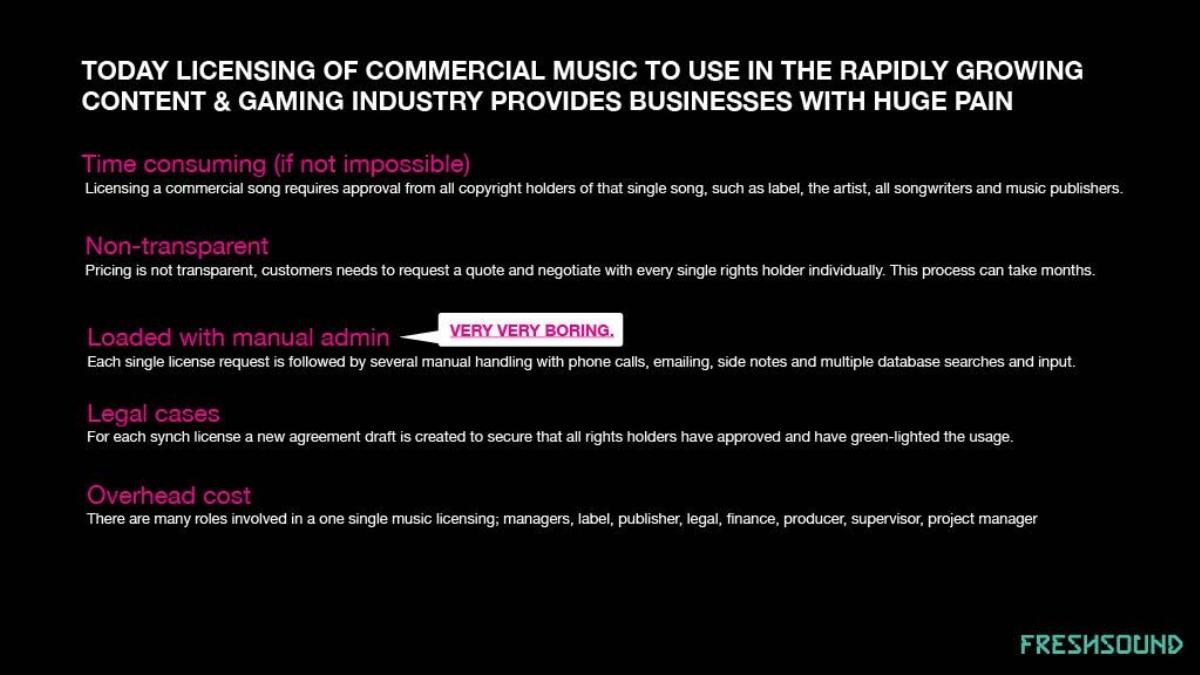
Commercial music licensing. Five headed pains on a black slide.
Freshsound deck, slide 3. Exact stored slide matched to this analysis.
Our analysis: The strongest example here: it names the buyer (content and gaming businesses) and walks through exactly why clearing one song takes months.
Evidence and limitation: No figures, but a detailed description of the process.
What a founder can adapt: Describe the steps your customer goes through today, and where each one stalls.
Supporting analysis
What the deck claims: "Today licensing of commercial music to use in the rapidly growing content & gaming industry provides businesses with huge pain." "Time consuming (if not impossible): Licensing a commercial song requires approval from all copyright holders of that single song, such as label, the artist, all songwriters and music publishers." "Non-transparent: Pricing is not transparent, customers needs to request a quote and negotiate with every single rights holder individually. This process can take months." "Loaded with manual admin" (tagged "Very very boring"). "Legal cases." "Overhead cost."
Presentation choice: An investor who has never licensed music understands the pain after reading it.
When it does not fit: Five pains in small type; lead with two and add a figure such as average weeks to clear.
Funding for school music programmes. One headline, one figure, a half-shaded US map.
Fund Music Ed deck, slide 3. Exact stored slide matched to this analysis.
Our analysis: One problem, one number, and a map that shows the number.
Evidence and limitation: One figure with a timeframe; no source shown.
What a founder can adapt: Give your one figure a timeframe and a visual.
Supporting analysis
What the deck claims: "Funding for the arts in schools is the #1 problem facing music education today." "School Music Programs have decreased by 50% in the last 5 years."
Presentation choice: "50% in 5 years" is easy to remember and repeat.
When it does not fit: Add the source; "#1 problem" also needs someone to have said so.
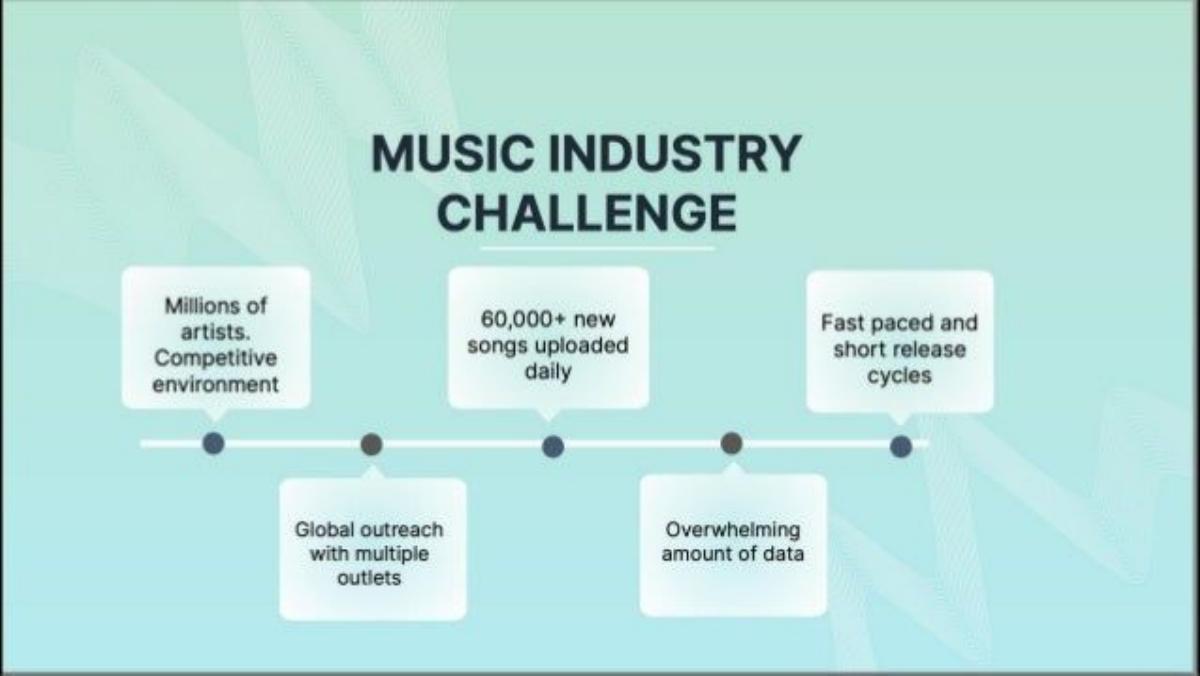
Music industry analytics. Five points on a timeline.
Chartmetric deck, slide 5. Exact stored slide matched to this analysis.
Our analysis: It shows why the data is overwhelming, but never says who is overwhelmed: a label, a manager, a playlist curator.
Evidence and limitation: One figure (60,000+ songs a day); no source.
What a founder can adapt: Name the person who has to make sense of the data and the decision they get wrong.
Supporting analysis
What the deck claims: "Music industry challenge." "Millions of artists. Competitive environment." "60,000+ new songs uploaded daily." "Fast paced and short release cycles." "Global outreach with multiple outlets." "Overwhelming amount of data."
Presentation choice: "60,000+ new songs uploaded daily" makes "overwhelming" concrete.
When it does not fit: Industry conditions without a customer.
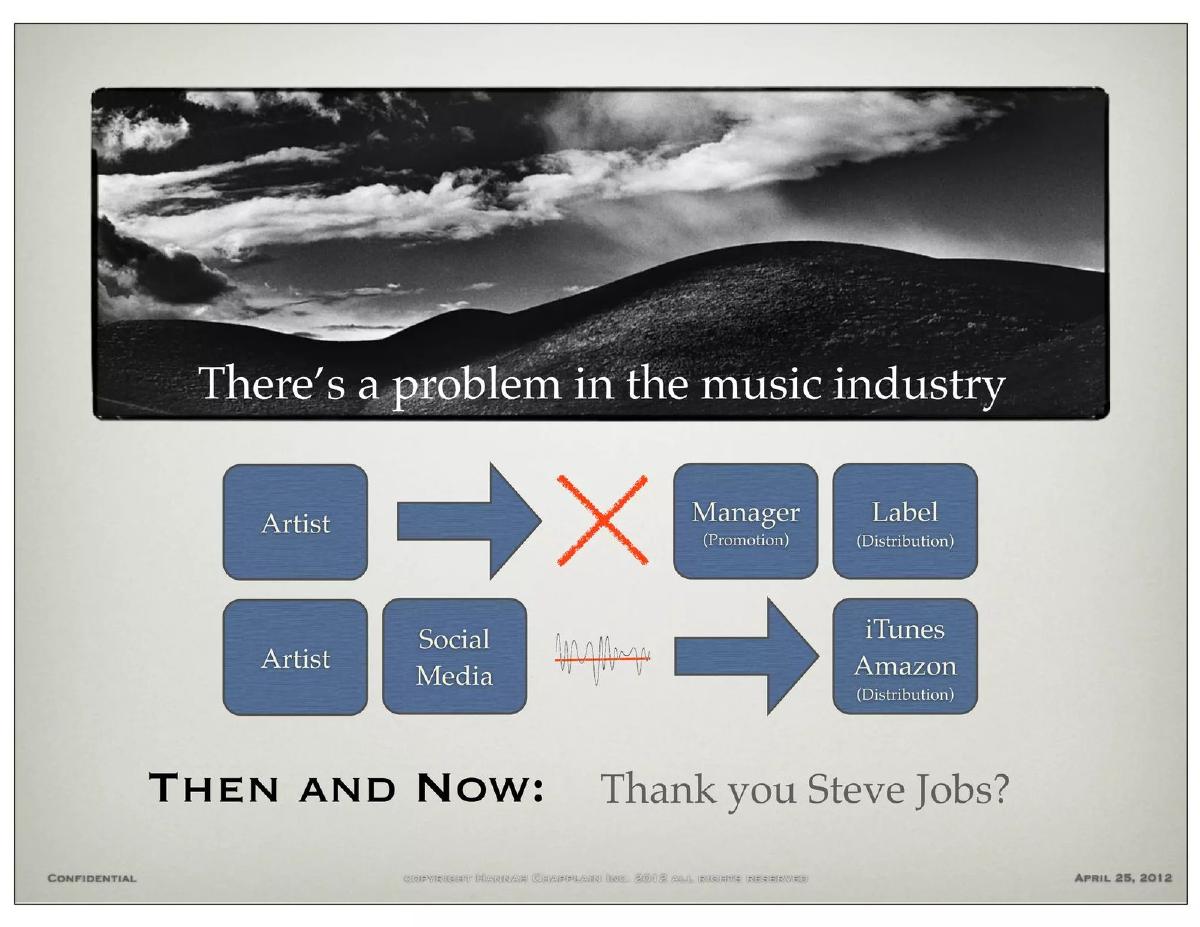
Artist career platform (2012). A then-and-now diagram.
Hannah Chapplain deck, slide 2. Exact stored slide matched to this analysis.
Our analysis: The diagram shows artists now distribute themselves, but the slide doesn't say what they're missing (promotion, presumably).
Evidence and limitation: A diagram; no figures.
What a founder can adapt: After the shift, say what the artist now has to do alone.
Supporting analysis
What the deck claims: "There's a problem in the music industry." Then: "Artist" → (crossed out) → "Manager (Promotion)", "Label (Distribution)". Now: "Artist", "Social Media" → "iTunes, Amazon (Distribution)". "Then and Now: Thank you Steve Jobs?"
Presentation choice: Then-and-now is a quick way to show a shift.
When it does not fit: Leaving the problem for the audience to infer.
Digital music learning. Headline, three bullets and a closing line.
Miso Media deck, slide 4. Exact stored slide matched to this analysis.
Our analysis: It names students and teachers but describes three different gaps, with "lackluster" doing most of the work.
Evidence and limitation: No figures.
What a founder can adapt: Lead with that closing line and cut to one gap.
Supporting analysis
What the deck claims: "The tools for digital music learning are insufficient." "Educators are not harnessing technology to make music education affordable and effective." "Musicians want digital sheet music but current alternatives are lackluster." "No consolidated platform for engaging within the music community." "Musicians Want a Cost Effective Way to Learn Quickly and Easily but Both Students and Teachers Need Better Tools."
Presentation choice: The closing line is the clearest statement of the problem.
When it does not fit: "Insufficient" and "lackluster" without saying how.
Social music listening. Three lines under "Problems solved".
Listin deck, slide 3. Exact stored slide matched to this analysis.
Our analysis: Weak on purpose: three feature gaps, no listener, no consequence, and a heading that mixes problem and solution.
Evidence and limitation: No figures.
What a founder can adapt: Say who wants to share playlists and what happens when they can't.
Supporting analysis
What the deck claims: "Problems solved." "Live collaboration on music playlists is unavailable." "No easy way for cross platform music sharing." "Difficulty keeping up to date with new music."
Presentation choice: Kept as a contrast; compare Freshsound, which describes who suffers and how.
When it does not fit: Writing problems as missing features.
Whether each slide names who struggles, what goes wrong, and gives evidence.
Example
Who
What goes wrong
Evidence
Freshsound
Yes (licensees)
Yes (step by step)
Partly (process)
Fund Music Ed
Partly (schools)
Yes
Yes (50% in 5 years)
8merch
Yes (independent artists)
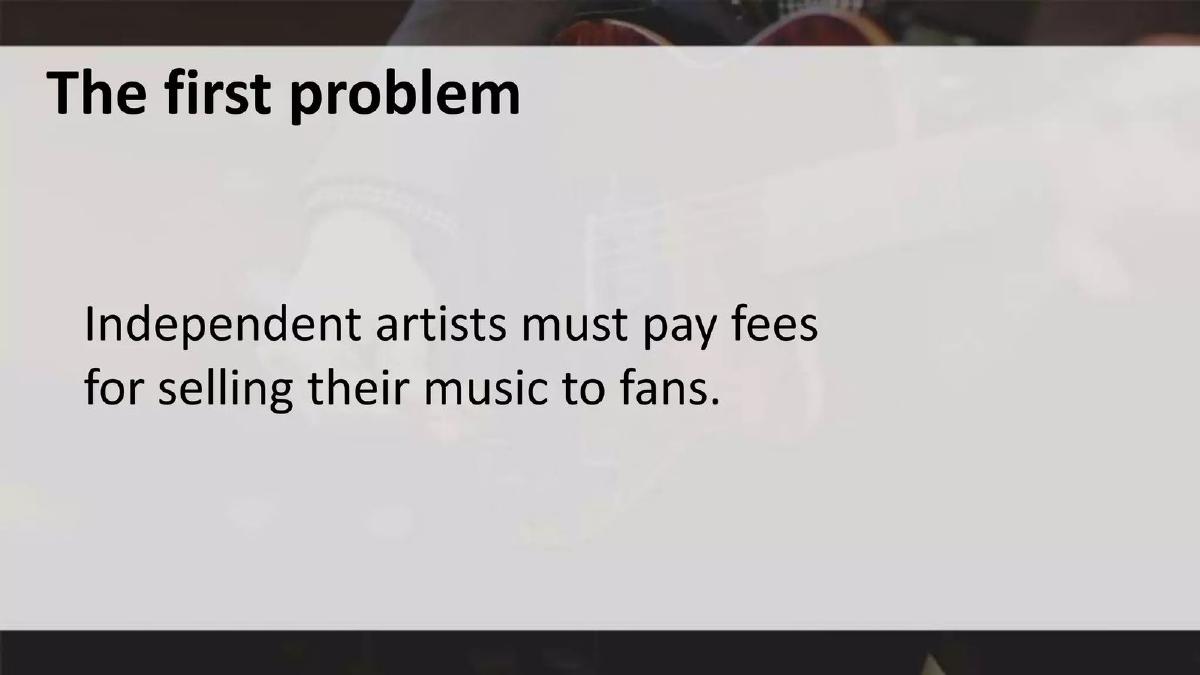
Yes (fees)
No
CultiNet
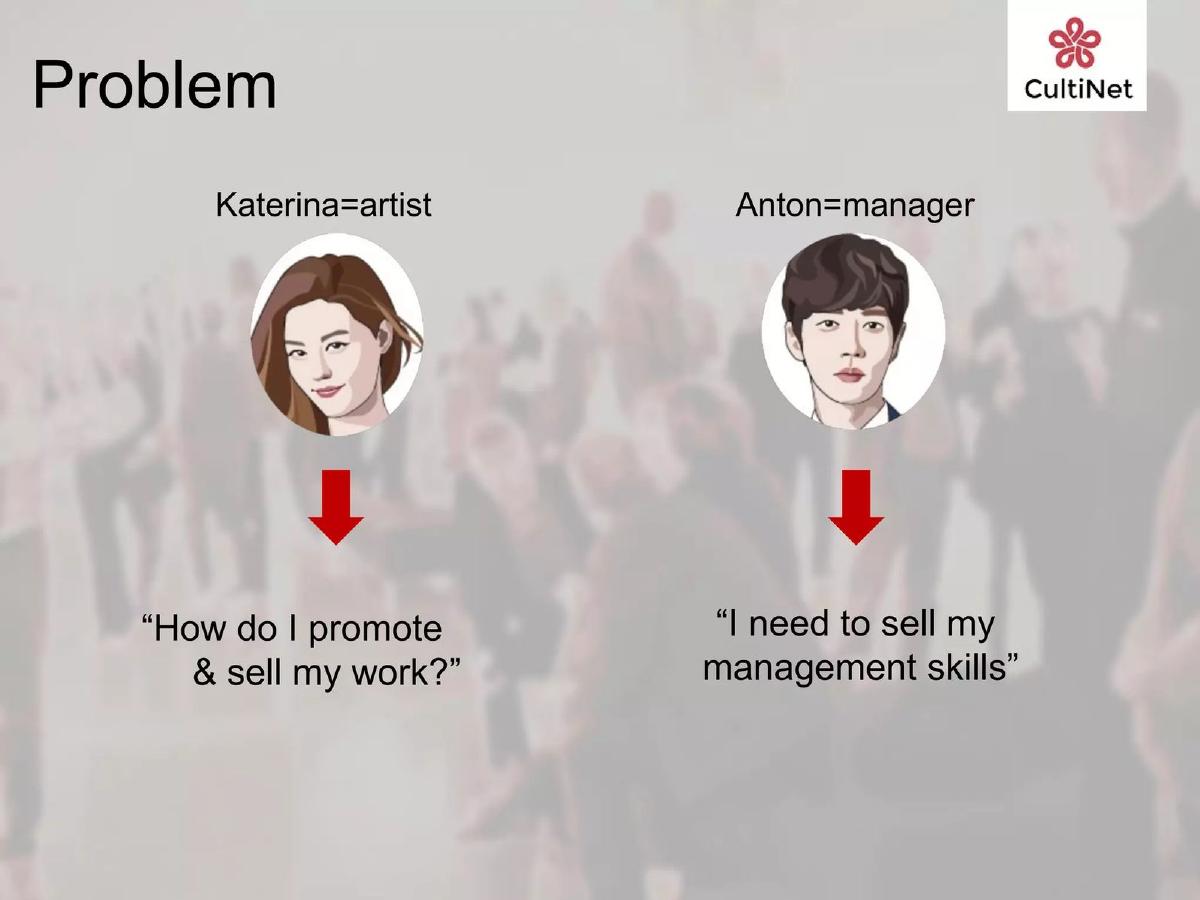
Yes (two personas)
Partly
No
Chartmetric
No
Partly
Partly (60,000+ a day)
Hannah Chapplain
Yes (artists)
Implied
No
Miso Media
Partly
Partly
No
Listin
No
No (feature gaps)
No
Key Takeaways
Name who loses out: the independent artist, the licensee, the teacher, the label analyst.
Show where the money or time goes: fees, months of clearance, lost programmes.
One figure with a timeframe beats a list of industry trends.
"The music industry has a problem" is a heading, not a problem.
Personas work when each has a different, specific need.
Build your music problem slide
One person, where they lose money or time, one figure.
Who. Artist, songwriter, label, licensee, teacher or listener?
Loss. What do they lose: a fee, weeks, a programme, fans?
Figure. One number with a timeframe and source.
Today. What do they do now, and why doesn't it work?
Copyable framework: [Person] loses [amount of money or time] because [cause]. [Figure] ([source]). Today they [workaround].
Illustrative example 1 — written by us
Before: There's a problem in the music industry: artists can't get paid fairly.
After: An independent artist with 50,000 monthly listeners earns about $150 a month from streams; selling direct means paying 15% platform fees plus payment costs. (Figures from our survey of 200 artists.)
What improved: Our illustrative rewrite; the figures are invented for the example. It names the artist, the amount and the cost.
What this guide adds
The media problem guide covers content and publishing broadly, including two music decks (Audoo and Music Coco). This guide focuses on music alone, with eight different slides: licensing (Freshsound), artist income (8merch), artist careers (CultiNet, Hannah Chapplain), data (Chartmetric), education (Fund Music Ed, Miso Media) and listening (Listin).
Music problems usually come down to who gets paid, how long it takes, and who can find whom.
What goes wrong: "Independent artists must pay fees for selling their music to fans" (8merch); "Each single license request is followed by several manual handling with phone calls, emailing, side notes and multiple database searches" (Freshsound).
Evidence: "decreased by 50% in the last 5 years" (Fund Music Ed); "60,000+ new songs uploaded daily" (Chartmetric).
Common mistakes
"The music industry is broken". Name who it's broken for and how.
Feature gaps as problems. "No playlist collaboration" is a missing feature, not a pain.
Industry stats without a customer. 60,000 songs a day matters only if someone has to sort them.
Fees without amounts. Say how much.
Leaving the problem implied. A diagram still needs one sentence saying what's wrong.
Diagnostic checklist
It names one person or business.
It says what they lose.
It gives one figure with a timeframe.
It says what they do today.
The problem is stated, not implied.
Frequently asked questions
How we chose these examples
Corpus: published pitch deck teardowns on StartupFundraising.com. Founder-uploaded private decks are excluded.
Selection (2026-09-25): we searched slides 2–5 for problem slides mentioning music, musicians, artists, songs or concerts. Twelve stored images were inspected. Audoo slide 3 and Music Coco slide 2 are already in the media problem guide and were left out; Music Coco slide 3 was left out as a repeat of its slide 2; Echome slide 4 was left out because its deck already appears in the media solution guide. 8merch is marked partial; Listin is kept as a weaker contrast.
Overlap check: none of these eight slides appears in another guide.
Review: all eight stored slide images were inspected on 2026-09-25 and matched to company, deck and slide number (editorial model review). No person has yet completed an editorial review of this page.
Claims are as shown on the slides; we have not verified them. We make no claim that any slide caused a fundraising outcome.