Committed Capital on a Pitch Deck: How to Show Money
'$500k already committed' or 'oversubscribed' can help a raise, or raise doubts.
Money Already Committed on the Ask Slide: Say How Much, From Whom, How Firm and What Is Left
Founders who have some of their round lined up usually want investors to know. A line such as '$500k already committed' tells a new investor that someone else has looked at the company and decided to put money in, and that the round may close. But the line raises its own questions: who committed, on what terms, how firm is the commitment, and how much is left for the reader? A vague version, or an 'oversubscribed' banner with no figures, can create more doubt than it removes. This guide looks at four ask slides that mention money already committed and shows what makes the line believable and useful.
TL;DR
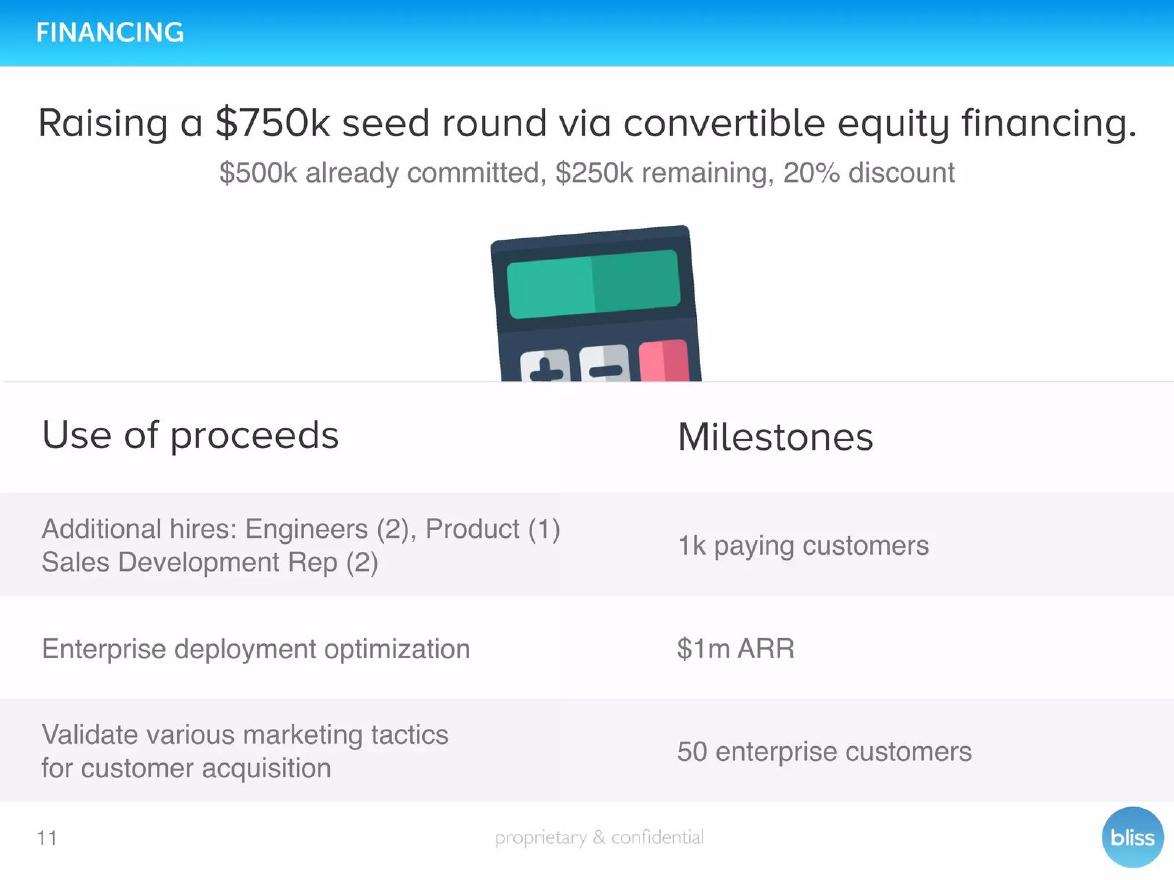
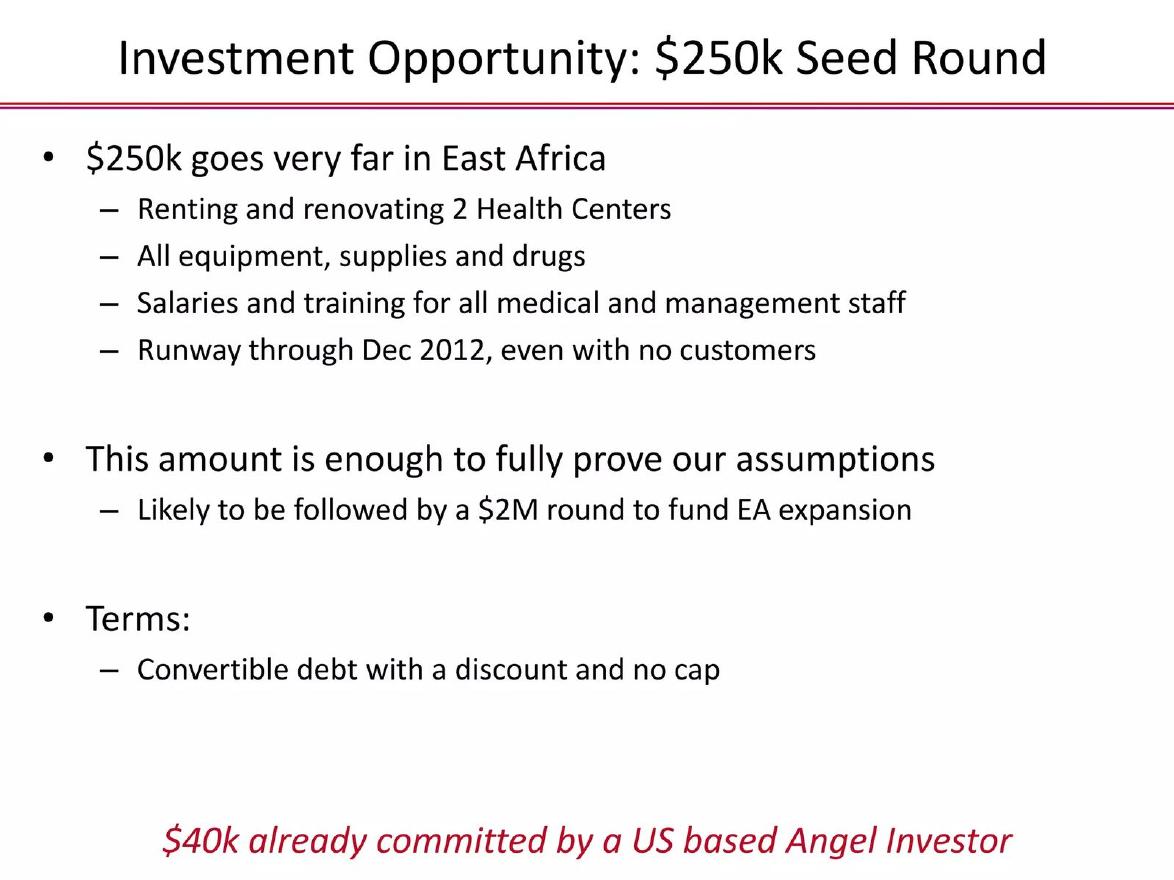
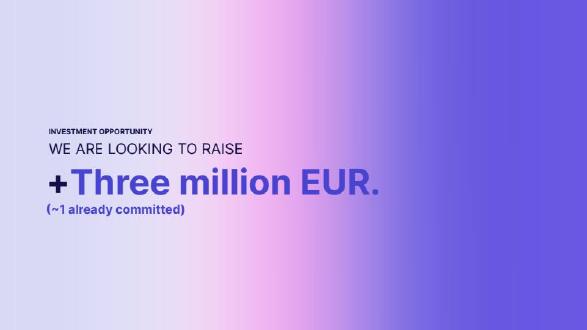
State the committed amount, the total round and what is left, in the same unit and currency; say who committed, at least by type, and whether the commitment is signed, verbal or already in the bank; and keep the terms the commitment was made on beside it. Bliss does the arithmetic best: 'Raising a $750k seed round via convertible equity financing. $500k already committed, $250k remaining, 20% discount'. Penda Health names the source: '$40k already committed by a US based Angel Investor' on a $250k round. CulturePulse writes '+Three million EUR. (~1 already committed)', leaving the unit of '~1' and the meaning of '+' to the reader. Suma Wealth's closing slide says 'Our seed round is now oversubscribed!' with no amounts, then invites more investors. Amount, source, firmness and remainder are what make the line useful.
Four ask slides that mention money already committed
Each slide is read at full size. Quotes are exact; calculated figures are our arithmetic from the slide.
Bliss ask slide — slide 11
Business software. Financing slide with use of proceeds and milestones.
Bliss deck, slide 11. Exact stored slide matched to this analysis.
Our analysis: The clearest arithmetic, without the source or firmness.
Evidence and limitation: Round, committed, remaining and discount in one line; two-thirds committed by our arithmetic.
What a founder can adapt: Add who committed and whether it is signed.
Supporting analysis
What the deck claims: "Raising a $750k seed round via convertible equity financing. $500k already committed, $250k remaining, 20% discount".
Presentation choice: Shows committed, remaining and terms together.
When it does not fit: A discount with no mention of whether there is a cap.
What each slide tells an investor about money already in the round
Amount, round size, remainder, source, firmness and terms.
Example
Committed
Round
Remaining stated
Source
Firmness
Terms beside it
Bliss
$500k
$750k
Yes ($250k)
No
No
Partly (discount)
Penda Health
$40k
$250k
No
US angel
No
Yes
CulturePulse
~1 (unit not given)
+€3 million
No
No
No
No
Suma Wealth
'Oversubscribed'
Not given
No
No
No
No
Key Takeaways
Give the committed amount, the round size and the remainder in one unit and currency.
Say who committed, by name if they agree, otherwise by type.
Say how firm it is: signed, verbal, or money received.
Keep the terms the commitment was made on next to it.
If you claim 'oversubscribed', give the figures and say what room is left.
Update the line every time you send the deck.
Write your committed-capital line
Answer these before you add a committed amount to the ask slide.
Amount. How much is committed, out of what total, and what is left?
Source. Who committed? Can you name them, or describe them by type?
Firmness. Is each commitment signed, verbal or already received? Any conditions?
Date. As of what date is the figure correct?
Copyable framework: "Raising $[round] on [instrument] at [cap / valuation]; $[committed] committed ([signed / verbal]) from [source] as of [date]; $[remaining] open."
Illustrative example 1 — written by us
Before: "+Three million EUR. (~1 already committed)"
After: "Raising €3M; about €1M committed by [investor type], [signed / verbal]; €2M open."
What improved: Our illustrative rewrite of CulturePulse's line. Bracketed details are not stated on the slide.
The question this guide answers
This guide answers one founder question: if part of my round is already committed, how should the ask slide say so, so that it helps rather than raises doubts?
Our ask slide guide covers the amount and use of funds, and our deal terms guide covers instruments and caps. Our bridge round draft mentions the committed amount as one of several items on a bridge slide. Our funding-to-date draft covers money already raised in past rounds. None makes commitments within the current round its subject. The advice here is specific: which facts about a commitment investors look for, how to word an 'oversubscribed' claim, and how to keep the line accurate as the round fills.
The question matters most for angel and seed rounds, where a lead or early backer is often the main thing a later investor wants to know about.
How we chose and read the examples
We searched extracted slide text for 'already committed', 'soft commitment', 'committed capital' and 'oversubscribed'. We excluded investment funds, listed companies, and slides where 'committed' referred to customers or partners rather than investors. Several matches used 'oversubscribed' about past rounds; those belong to a funding-history slide, so we kept only claims about the current round. We kept four slides that each handle the point differently: full arithmetic, a named source type, a vague figure, and an oversubscribed claim without figures.
Each slide was rendered from the source deck and read at full size. Bliss appears in several versions in our library with the same financing slide; we used one. Calculated figures, such as the share committed, are our arithmetic from the slide. We did not check any commitment against outside sources and don't know whether these rounds closed.
What investors want to know about a commitment
How much, out of how much. '$500k committed' means one thing on a $750k round and another on a $5 million round. The share already committed tells an investor how close the round is to closing.
From whom. A commitment from a known fund or an experienced angel in the sector says something about the company. A commitment from the founders' family says something different. Both are fine, but investors want to know which.
How firm. A signed agreement, a verbal promise and money already in the bank are very different. Investors who later learn a 'commitment' was a friendly conversation tend to discount the rest of the deck.
On what terms. If early investors committed at a given cap or discount, a new investor will expect the same terms. Putting the terms beside the committed amount avoids that conversation later.
What is left. A new investor wants to know whether there is room for them and how much. 'Oversubscribed' with no figures leaves that unclear.
Committed, remaining and terms in one line: Bliss
Bliss, which offered software for businesses, has a slide headed 'Financing'. The main line reads 'Raising a $750k seed round via convertible equity financing.' Beneath it: '$500k already committed, $250k remaining, 20% discount'. Below, a table pairs 'Use of proceeds' (two engineers, one product hire, two sales development reps; enterprise deployment; marketing tests) with 'Milestones' ('1k paying customers', '$1m ARR', '50 enterprise customers').
This is the clearest arithmetic of the four. A reader learns the round size, the amount committed, the amount left and the discount, in one line. By our arithmetic two-thirds of the round is committed, which tells a new investor the round is likely to close and that there is $250k of room. Putting the discount in the same line implies the remaining money comes in on the same terms.
What's missing is who committed and how firm it is. Two-thirds of a round from an experienced seed fund reads differently from two-thirds from friends and family. The slide also mentions a discount but no valuation cap; whether there is one matters to anyone calculating their stake, and our deal terms guide covers that point. 'Led by [investor], $500k signed' would complete the line.
A commitment with a source: Penda Health
Penda Health, which was opening primary health clinics in Kenya, has a slide headed 'Investment Opportunity: $250k Seed Round'. Bullets say the money covers renting and renovating two health centres, equipment, staff salaries and 'Runway through Dec 2012, even with no customers'; that 'This amount is enough to fully prove our assumptions', 'Likely to be followed by a $2M round'; and 'Terms: Convertible debt with a discount and no cap'. At the bottom, in red: '$40k already committed by a US based Angel Investor'.
The strength here is the source. Even without a name, 'a US based Angel Investor' tells the reader the commitment comes from an outside individual investor, not the founders, and suggests the company can attract foreign money. The terms are on the same slide, so a new investor knows what the angel agreed to.
The amount is small relative to the round: by our arithmetic $40k is 16%, leaving $210k to raise. Stating that remainder would be more useful than leaving the reader to subtract. 'Committed' is also not defined; 'signed' or 'wired' would remove the doubt. Naming the angel, if they agree, would add more: a known investor in health or emerging markets would carry more weight than a description.
A vague figure: CulturePulse
CulturePulse, which builds AI models of human behaviour, has a short slide headed 'Investment Opportunity'. It reads 'We are looking to raise' above '+Three million EUR.' and, in smaller type, '(~1 already committed)'. The slide has no other text.
The intent is clear: the founders want investors to know that a meaningful part of the round is spoken for. Mentioning it on the ask slide, rather than burying it, is the right instinct.
But the wording leaves three questions. '~1' has no unit; the reader has to assume it means about one million euros. The '+' before 'Three million' could mean 'more than three million' or could be decoration, which changes the remainder. And the tilde ('about one') suggests the figure isn't settled, which raises the question of how firm the commitment is. 'Raising €3M; about €1M committed by [investor type], signed; €2M open' would answer all three in a line of similar length.
'Oversubscribed' without figures: Suma Wealth
Suma Wealth, which offers financial education and tools for Latino communities, closes its deck with a slide that reads 'Thank you for taking the time to look into Suma', then, in large yellow type, 'Our seed round is now oversubscribed!' and 'Feel free to reach out if you are a mission aligned investor.' An illustrated wrestler in a mask and championship belt gives a thumbs-up.
'Oversubscribed' is a strong claim: it says investors have offered more money than the company is raising. Putting it at the end of the deck leaves a reader with a sense of demand, and the invitation to 'mission aligned' investors says who the founders still want to hear from.
The problem is that the slide gives no round size, no amount committed and no indication of how much more the company will accept. 'Oversubscribed' followed by 'reach out' leaves a reader unsure whether there is room for them at all, or whether the round is being enlarged and on what terms. A version such as 'Seed: $[X] target, $[Y] committed; extending to $[Z] for mission-aligned investors' keeps the signal and answers the question. Because the claim is the kind investors check with each other, it should match exactly what the founders would say in a meeting.
Keeping the line accurate
Update it every time you send the deck. A committed figure from six weeks ago can be wrong in both directions. Date it if the deck may be forwarded: 'as of [date]'.
Only count what you would describe the same way in due diligence. If a commitment is verbal, call it verbal. If it is conditional on a lead investor, say so.
Ask before naming investors. Many angels and funds are happy to be named once they have signed; some aren't. A description such as 'a sector-focused seed fund' works when a name can't be used.
Don't let the committed amount replace the terms. New investors need the instrument, cap or valuation and discount, whatever others have done.
Firmness: 'signed' / 'verbal' / 'received', and the date: 'as of [date]'.
Terms: '[instrument], [cap / valuation], [discount]' in the same line or directly beneath.
Oversubscribed: 'Target $[X], commitments of $[Y]; [closing at $X / extending to $Z].'
What these examples can and cannot show
These four slides show how founders have presented money already committed to a round. They can't show whether the commitments were real, firm or completed, or how investors responded. Calculated shares in this guide come from numbers printed on the slides; we have not checked any against outside sources.
Treat them as patterns of presentation. Bliss's one-line arithmetic and Penda Health's named source type are easy to combine. CulturePulse shows how a missing unit and a tilde weaken the line. Suma Wealth shows why 'oversubscribed' needs figures beside it.
Common mistakes
No remainder. A committed figure with no amount still open.
No source. Commitments with no indication of who made them.
Firmness unstated. Verbal interest presented as a commitment.
Missing units. Figures without currency or magnitude.
Oversubscribed without figures. A demand claim with no target or room stated.
Diagnostic checklist
Committed, round and remaining in one currency.
Source named or described.
Firmness stated.
Date given if the deck may be forwarded.
Terms beside the committed amount.
Oversubscription claims backed by figures.
Frequently asked questions
Should I mention verbal commitments?
Only if you call them verbal. Investors will ask, and a commitment described more firmly than it is damages trust in the rest of the deck.
Does 'oversubscribed' help?
It can, if you give the target and committed figures and say whether there is room left. Without them, readers can't tell whether to engage.
How we chose these examples
Corpus: published pitch deck teardowns on StartupFundraising.com. Founder-uploaded private decks are excluded.
Selection (2026-10-01): we searched extracted slide text for commitment and oversubscription phrases, excluded investment funds, listed companies, customer or partner commitments and claims about past rounds, and kept four slides each presenting current-round commitments differently.
Review: the four slides were rendered from the source decks on 2026-10-01 and read in full at full size against company, deck and page number (editorial model review, with AI assistance in drafting; not human-reviewed). Calculated figures are arithmetic from the printed numbers. No commitment was checked against outside sources.