Should You Show Competitors' Funding on Your Pitch Deck
Listing how much competitors have raised can prove a market or make you look outgunned.
Competitor Funding on a Competition Slide: Say What the Money Proves and Why You Still Win
Some founders put their competitors' funding on the competition slide: "$90M raised", "Raised $204M", "$500K seed". It is a tempting fact, because it is public and it sounds like proof that investors care about the space. It can also backfire. An investor reading that a rival has raised a hundred times more may simply conclude the rival will win. This guide uses four real competition slides to show when competitor funding helps, what it can and cannot prove, and what must sit next to it.
TL;DR
Show competitors' funding only when you say what it proves and why you can still win. Use it to show that investors already back the problem, that a rival spent heavily and still left a gap, or that you do more per dollar. Flowtab does the first well: "$90M raised on concept of SMB loyalty in 2011 and 2012..." then "Loyalty in nightlife is wide open!" Coursmos does the third, dividing funding by courses ($70 per course against Coursera's $170,000). Always give the source and date of each funding figure, and never let a big number stand alone, or it reads as "they will outspend us".
Four competition slides that use competitor funding, read in full
Each slide was rendered from the original deck at full size and read in full. We recalculated Coursmos's ratios; we did not check any competitor's funding against outside records.
Flowtab competition slide — slide 8
Bar ordering and payments app. Competition slide.
Flowtab deck, slide 8. Exact stored slide matched to this analysis.
Our analysis: Funding as proof the problem is backed, turned straight into an opening.
Evidence and limitation: Adjacent-category funding used to show investor interest, followed by the gap and a feature table; no source for the $90M.
What a founder can adapt: Add a source and the rounds included in the total.
Supporting analysis
What the deck claims: "$90M raised on concept of SMB loyalty in 2011 and 2012..."; "LevelUp, FiveStars, BellyCard, Mogl, Shopkick, etc."; "Loyalty in nightlife is wide open!"; feature table against GoPago, Coaster, TabbedOut and BarTab.
Presentation choice: Shows the strongest framing: number, then why you still win.
When it does not fit: Calling a market "wide open" above a table of direct competitors.
Subscription analytics for PayPal sellers. Competition slide.
Paymetrics deck, slide 7. Exact stored slide matched to this analysis.
Our analysis: Small, specific funding fact used as part of a clear argument.
Evidence and limitation: One rival's funding and public revenue as a footnote supporting a gateway argument; no date on the footnote.
What a founder can adapt: Date the footnote figures.
Supporting analysis
What the deck claims: Table of eight tools by payment service; "*Baremetrics.io has raised $500K seed and publicly discloses monthly revenue: $28K (Up 900% YoY)."; estimated websites using PayPal 1M, Stripe 12K, Braintree 1K, with SimilarTech links.
Presentation choice: Shows funding as supporting detail, not headline.
When it does not fit: Treating websites using a payment service as buyers of analytics.
Xpanceo deck, slide 12. Exact stored slide matched to this analysis.
Our analysis: Funding shows the category is real; the change of direction implies an opening.
Evidence and limitation: Best-funded rival shown to have changed direction; funding for only one of four rivals.
What a founder can adapt: Say what Xpanceo has done that the rival had not.
Supporting analysis
What the deck claims: "Mojo Vision Raised $204M, tested the complete prototype lens on a real person. Attracted investors such as PTC, NASA, Amazon Fund. Pivoted to microLED in 2022."; Innovega, InWith and SmartLens / Sensimed described without funding; "Why not AR glasses:" with six drawbacks.
Presentation choice: Shows how to use a well-funded rival's exit.
When it does not fit: Leaving the reason for a rival's exit for the reader to guess.
After: "Clinic-booking apps raised $165M in 2023-24 (Crunchbase, checked May 2025), all for large hospital groups. None serves single-dentist practices, which are 70% of US dental offices. We built for them first."
What improved: Our illustrative rewrite; the figures are invented for the example. It turns a funding gap into proof of demand plus a clear opening.
The question this guide answers
Founders often ask whether to list how much their competitors have raised. Our competition guides cover how to choose competitors, how to build a comparison table or a positioning map, and how to describe your advantage. None answers this specific decision: whether to put competitors' funding on the slide, what point it should make, and what has to go with it so it helps rather than hurts.
The decision matters because funding numbers are the loudest figures on most competition slides. They are large, in dollars, and usually larger than anything about the startup presenting. Whatever point the founder intends, the reader will draw one, and the most natural one is "the others have more money". The slide has to steer that reading.
How we chose and read the examples
We searched saved slide text in the teardown library for competition slides that mention competitors' funding amounts, then read the matching slides. We left out listed companies and investor presentations from listed firms, and decks where the funding figures were unreadable. We kept four slides that use competitor funding in four different ways: as proof the category is funded, as a ratio of money spent to output, as a footnote about one rival's public numbers, and as context for a rival that changed direction.
The examples are Flowtab (bar ordering and payments app), Coursmos (short online courses), Paymetrics (subscription analytics for PayPal sellers) and Xpanceo (smart contact lenses, a later-stage deck). Each slide was rendered from the original deck at full size and read in full. We recalculated Coursmos's ratios from its own table. We did not check any competitor's funding against outside records, so the guide treats each figure as what the deck claims.
Funding as proof the problem is backed: Flowtab
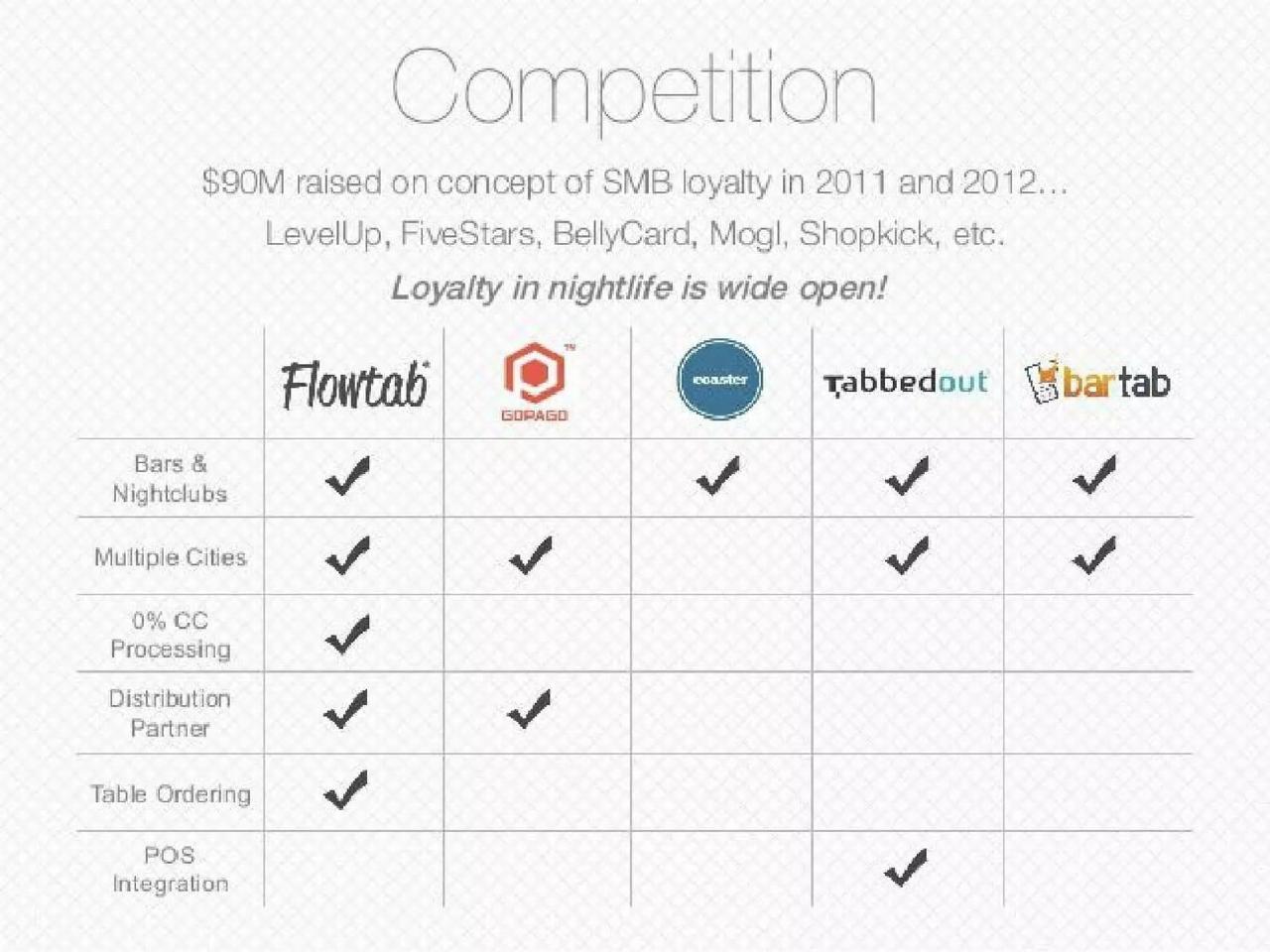
Flowtab's slide is titled "Competition". Under it: "$90M raised on concept of SMB loyalty in 2011 and 2012..." then "LevelUp, FiveStars, BellyCard, Mogl, Shopkick, etc." then, in bold italics, "Loyalty in nightlife is wide open!" Below is a table comparing Flowtab with GoPago, Coaster, TabbedOut and BarTab on six features: bars and nightclubs, multiple cities, "0% CC Processing", distribution partner, table ordering and POS integration. Flowtab has a tick in every row except POS integration; it is the only company with ticks for 0% card processing and table ordering.
This is the clearest use of competitor funding in our set. The $90M is not put against Flowtab: it belongs to companies in a nearby category (loyalty for small businesses in general), and the slide uses it to argue that investors already pay for this kind of product. The next line turns it into an opening: none of that money went to nightlife. Then the table shows the direct competitors in nightlife and where Flowtab differs.
What it cannot establish: the slide does not say where the $90M figure comes from or which companies' rounds it adds up. Money raised by loyalty companies shows that investors liked loyalty products in those two years, not that bars will adopt a payment app. And "wide open" sits awkwardly with a table listing four direct competitors. The point would be stronger with a source line and with "loyalty" linked to what Flowtab actually sells.
Funding divided by output: Coursmos
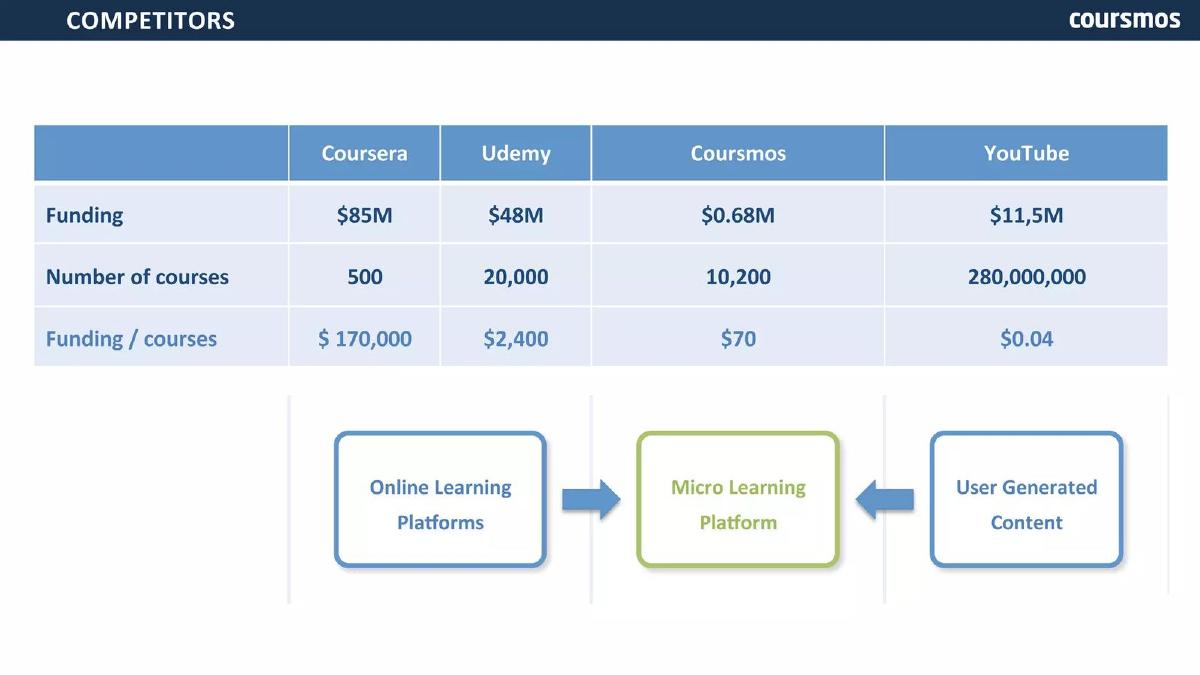
Coursmos's slide is headed "COMPETITORS" and shows a table with four columns: Coursera, Udemy, Coursmos and YouTube. Three rows read: "Funding" $85M, $48M, $0.68M and "$11,5M"; "Number of courses" 500, 20,000, 10,200 and 280,000,000; and "Funding / courses" $170,000, $2,400, $70 and $0.04. Below, arrows show "Online Learning Platforms" and "User Generated Content" pointing into "Micro Learning Platform".
We recalculated each ratio from the table: $85M divided by 500 is $170,000; $48M divided by 20,000 is $2,400; $0.68M divided by 10,200 is about $67, shown as $70; and $11.5M divided by 280 million is about $0.04. The arithmetic holds. Turning funding into a ratio is a smart move: it changes the reading from "they have more money" to "we do more with less", which is the point a small company wants an investor to take.
What it cannot establish: courses are not equal units. A Coursera university course, a Udemy course, a Coursmos short course and a YouTube video differ hugely in length and cost, so the ratio rewards whoever counts the smallest unit. YouTube's $11.5M is its funding before Google bought it, which is not comparable with an independent startup's raises. And the slide gives no date or source for any figure. A fairer version would compare like with like, for example cost per hour of content or per active learner, and date each number.
One rival's public numbers in a footnote: Paymetrics
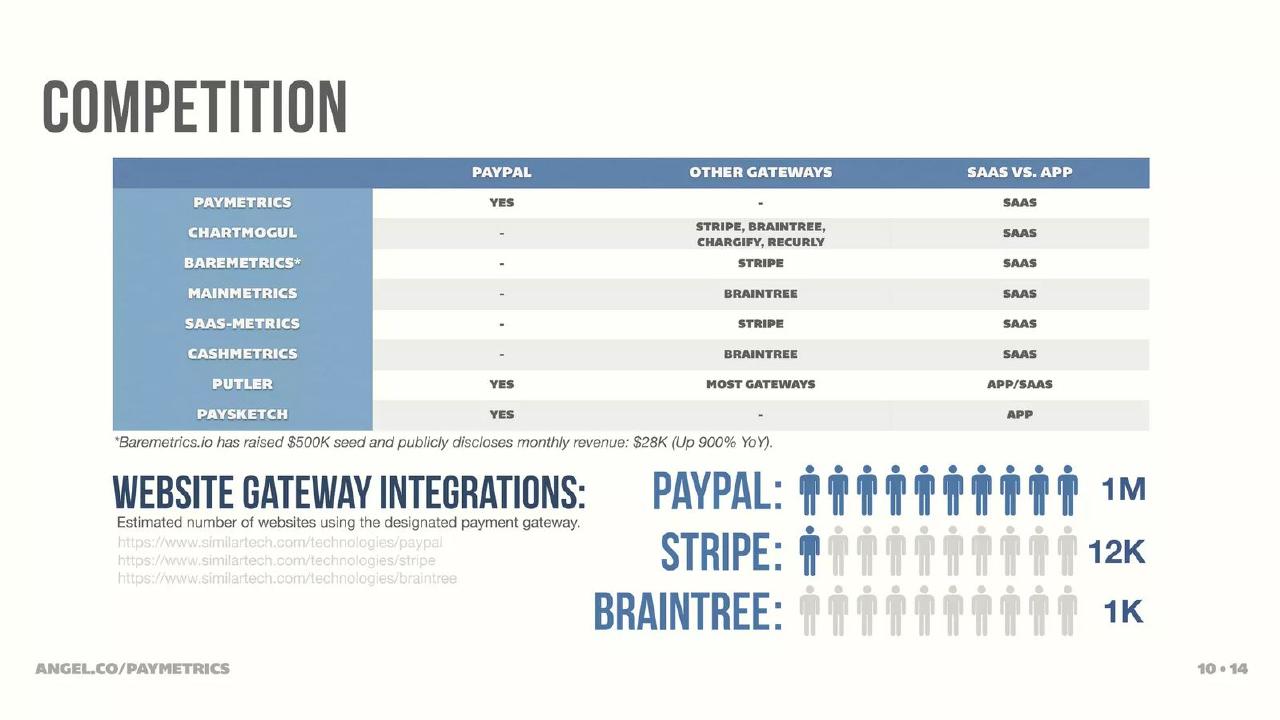
Paymetrics's "COMPETITION" slide compares eight subscription-analytics tools on which payment services they connect to and whether they are web software or an app. Paymetrics, Putler and Paysketch connect to PayPal; Chartmogul, Baremetrics, Mainmetrics, SaaS-Metrics and Cashmetrics do not. Baremetrics has an asterisk, explained underneath: "*Baremetrics.io has raised $500K seed and publicly discloses monthly revenue: $28K (Up 900% YoY)." Below, a section titled "WEBSITE GATEWAY INTEGRATIONS" estimates websites using PayPal (1M), Stripe (12K) and Braintree (1K), with links to SimilarTech as the source.
Here competitor funding is small and specific, and it works with the rest of the slide. A rival that connects only to Stripe raised a seed round and shares its revenue publicly, so the investor can see that a similar product makes real money. The gateway counts then argue that PayPal, which Paymetrics serves and most rivals don't, is the larger pool. Funding is one piece of a clear argument, not the headline.
What it cannot establish: one competitor's revenue says little about how fast Paymetrics can grow, and the slide gives no date for the funding or revenue figure. The website counts are estimates of sites using each payment service, not of sellers who would pay for analytics. The slide does name its source for the counts, which is more than most competition slides do, and the same care should go on the funding footnote.
A heavily funded rival that changed course: Xpanceo
Xpanceo's "Competition" slide describes four rivals in short paragraphs. The first: "Mojo Vision Raised $204M, tested the complete prototype lens on a real person. Attracted investors such as PTC, NASA, Amazon Fund. Pivoted to microLED in 2022." The others, Innovega, InWith and SmartLens / Sensimed, are described by what they make, with no funding given. Below, "Why not AR glasses:" lists six drawbacks of glasses, such as "Bulky and uncomfortable." and "Restrict the wearer's peripheral vision."
This is a more subtle use. The $204M and the list of investors show that serious money has gone into smart contact lenses, and the prototype test shows the idea is technically possible. The last sentence, that Mojo Vision changed to microLED in 2022, tells the reader that the best-funded rival has left the race. Without saying so, the slide argues: the category is real, and the leader has stepped away.
What it cannot establish: why Mojo Vision changed direction, which could be a warning about how hard the product is as much as an opening. Funding is given for only one of four rivals, so the reader cannot compare. And the slide does not say what Xpanceo does differently from the remaining three. A sentence on what Xpanceo has done that Mojo Vision had not, or a funding line for the others, would complete the argument.
The three points competitor funding can make
Across the four slides, competitor funding supports one of three points. It can show that investors already back the problem (Flowtab's $90M, Xpanceo's $204M). It can show that a well-funded rival left a gap, by market (Flowtab's nightlife) or by giving up (Mojo Vision's change of direction). Or it can show efficiency, if it is divided by a fair measure of output (Coursmos's per-course figure, with the caveats above). Paymetrics's footnote does a fourth, smaller job: it shows a comparable product makes money.
What competitor funding never proves is that you will win. Every use above needs a second sentence that says why you, and the best slides put that sentence right next to the number: "Loyalty in nightlife is wide open!" directly under "$90M raised".
When to leave competitor funding off
Leave it off when the rivals are direct competitors in your exact market, much better funded, and you have no clear reason to win that the slide can state in one line. In that case the funding figure only makes the gap more visible. Show your difference instead, and be ready to answer the funding question when an investor asks it, which they usually will.
Also leave it off when you cannot source it. Funding totals found on aggregator sites are often incomplete or out of date, and an investor who knows the space may know the real figure. A wrong number about a rival damages trust in your own numbers.
Getting the figures right
For every funding figure, record the source and the date you checked it, and put at least the year on the slide. Say whether the figure is total funding or the latest round, and keep that the same for every company on the slide. If you add rounds across several companies, as Flowtab did, list which ones are included in the appendix or speaker notes.
If you build a ratio, choose a unit that means the same thing for every company, and say what it is. Cost per active customer or per dollar of revenue is usually fairer than cost per item listed. Leave out companies whose funding is not comparable, such as divisions of large firms or businesses that were acquired, or label them clearly.
Common mistakes
A big number standing alone. Put your reason to win right beside it.
No source or date. Give both for every funding figure.
Mixed totals and rounds. Use the same measure for every company.
Unfair ratios. Divide by a unit that means the same for everyone.
Incomparable companies. Leave out or label acquired firms and divisions of large companies.
Diagnostic checklist
Funding makes one stated point.
Reason to win sits next to it.
Source and date given.
Same measure for every company.
Any ratio uses a fair unit.
Frequently asked questions
Does showing well-funded competitors scare investors?
It can, if the number stands alone. Paired with a clear gap or advantage, it shows the problem is worth solving.
Where should I get competitors' funding figures?
From public announcements or funding databases. Note the source and date, and check figures before each round.
Is funding per customer or per product a good comparison?
Only if the unit means the same for every company. Otherwise the ratio favours whoever counts the smallest unit.
Should I include my own funding in the comparison?
Only if the comparison is about efficiency. Otherwise keep your raise on the ask slide.
How we chose these examples
Corpus: published pitch deck teardowns on StartupFundraising.com. Founder-uploaded private decks are excluded.
Selection (2026-10-01): we searched extracted slide text for competition slides citing competitors' funding, excluded listed-company presentations and unreadable slides, and kept four slides using funding in four different ways.
Review: the four slides were rendered from the source decks at full size on 2026-10-01 and read in full against company, deck and page number; Coursmos's ratios were recalculated from its table (editorial model review, with AI assistance in drafting). No competitor funding figure was checked against outside records. No person has yet completed a human editorial review of this draft.