Nanno’s pitch deck is a masterclass in high-stakes positioning. By dedicating 25% of the deck to the safety failures of incumbents like Care.com and Sittercity, the founders frame their 'vetted' model not just as a convenience, but as a necessity. The deck shows consistent quarterly GMV growth from Q4 2017 through Q2 2019, peaking near $80,000 before a projected Q3 spike. Despite the aggressive competitive slides, the deck remains lean on financial projections and unit economics. It relies heavily on the 'Uber for X' narrative, specifically comparing the $34B childcare market to the pre-Uber…
Key takeaways
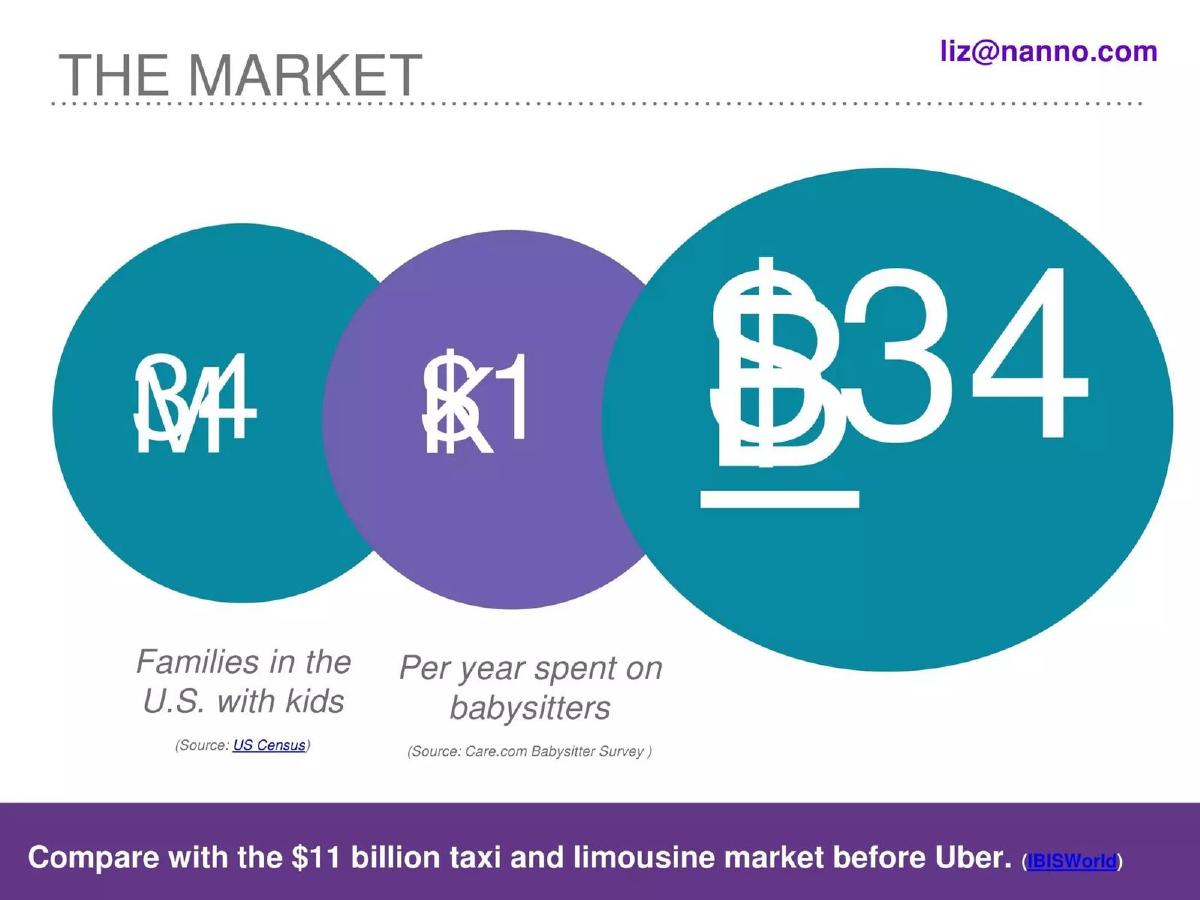
- The deck identifies a $34 billion annual spend on babysitters in the U.S. on slide 3.
- Nanno positions itself against the $11 billion pre-Uber taxi market to emphasize disruption potential on slide 3.
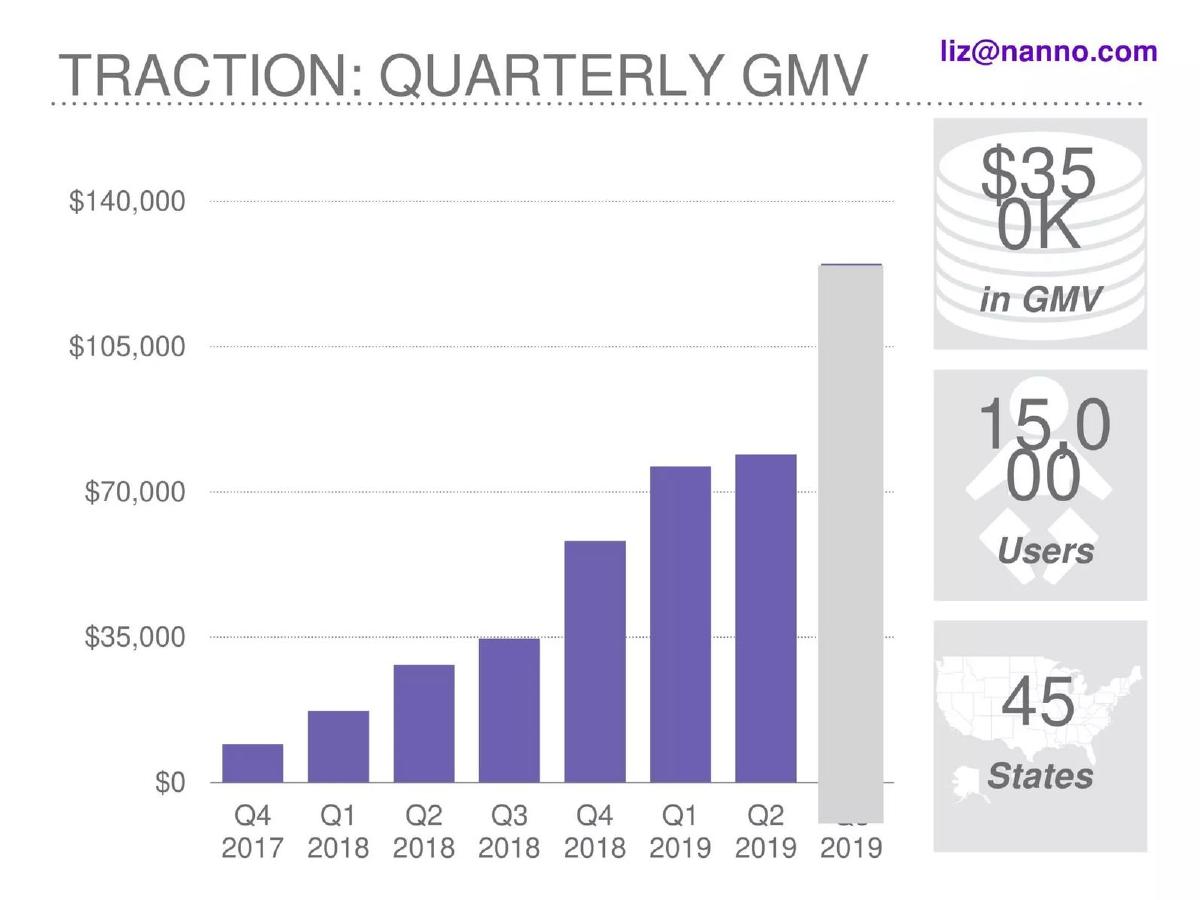
- Quarterly GMV grew steadily from approximately $10,000 in Q4 2017 to nearly $80,000 in Q2 2019 as shown on slide 4.
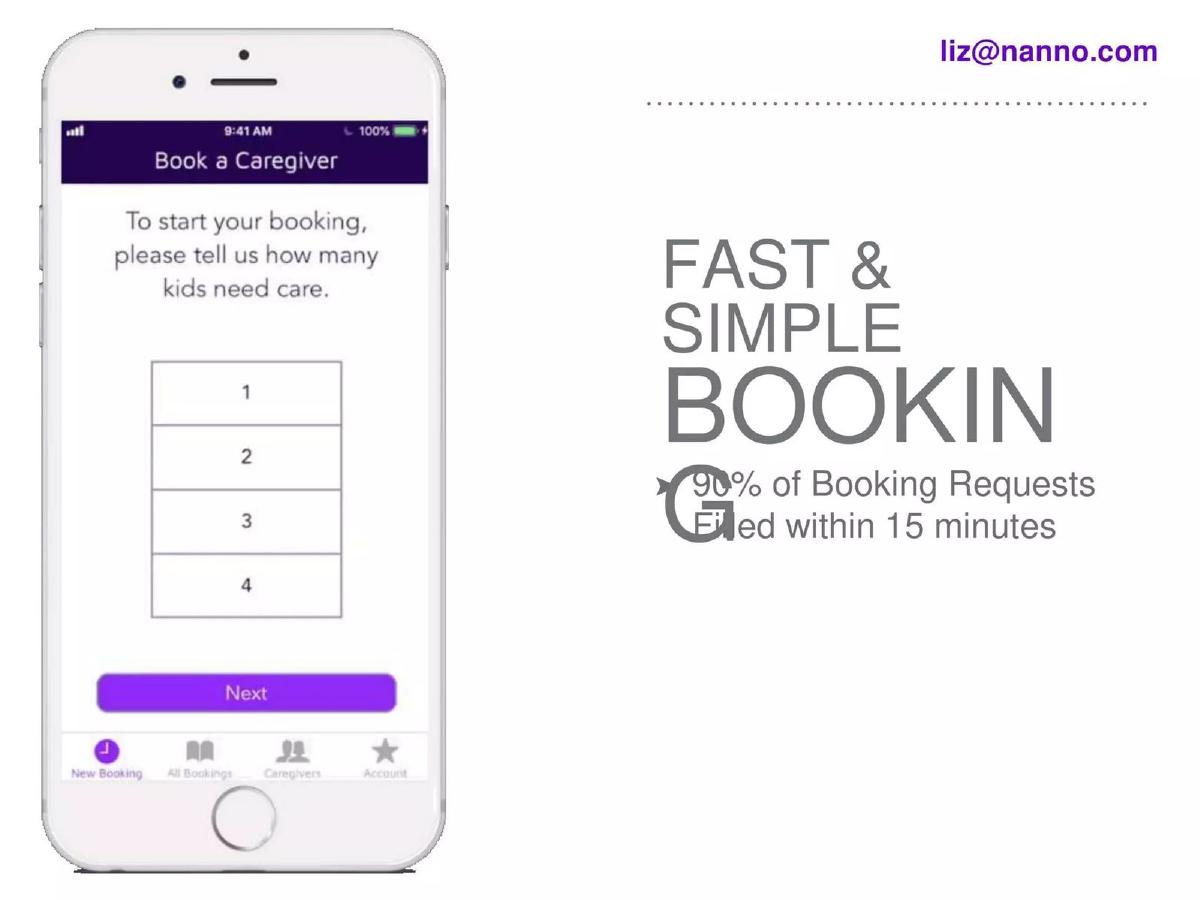
- The platform achieved a 90% fill rate for booking requests within 15 minutes according to slide 5.
- Safety protocols include criminal background checks, safety skills tests, and psychometric behavioral tests on slide 6.
- The company has filed two provisional patent applications related to their trust-building technology on slide 6.
- Three consecutive slides (7, 8, and 9) use negative news headlines to highlight safety failures at competitors UrbanSitter, Sittercity, and Care.com.
- The founding team consists of a startup lawyer and a software developer, both mothers of two, as detailed on slide 11.
The Nanno Pitch Deck Analysis
Nanno, founded in 2016 and based in Denver, raised $1.7 million using this 12-slide deck. The presentation is a focused narrative on trust, safety, and the 'Uber-ification' of the childcare industry. It moves quickly from the emotional pain of parents to the massive market opportunity, before spending a significant portion of its runtime attacking the safety records of established competitors.
Slide 1: Title Slide
The deck opens with a high-quality lifestyle image of a mother and child, immediately establishing the target demographic. The logo is clean, and the tagline—'connecting parents with great sitters on demand'—clearly defines the value proposition. It is a standard, effective opening that identifies the 'who' and the 'what' without clutter.
Slide 2: The Problem
Slide 2 is purely emotional. It features a photo of a stressed mother on the phone while a child screams in the background. There is no text other than the header 'THE PROBLEM' and a contact email. This slide relies on the presenter to narrate the friction of traditional childcare: the hours spent calling around, the last-minute cancellations, and the lack of reliable options. It targets the 'pain point' with visceral imagery.
Slide 3: The Market Opportunity
Nanno uses a three-circle visualization to define their market. They cite the US Census for 'Families in the U.S. with kids' (represented by a 'B' and '4', likely intended to be 40+ million, though the graphic is stylized) and a Care.com survey for the '$1 billion' spent per year on babysitters. However, the largest circle shows '$34B,' representing the total addressable market. The most important element here is the footer: 'Compare with the $11 billion taxi and limousine market before Uber.' This is a direct appeal to venture logic, suggesting that Nanno is the Uber of a market three times larger than the one Uber disrupted.
Slide 4: Traction and Growth
This slide provides the 'proof of life' for the business. The bar chart shows Quarterly GMV from Q4 2017 to Q2 2019. The growth is linear and consistent, starting near $10,000 and reaching approximately $80,000 by Q2 2019. A greyed-out bar for Q3 2019 suggests a projected jump to over $120,000. To the right, three key stats are highlighted: $350K in total GMV (cumulative), 15,000 users, and a presence in 45 states. This demonstrates that the model is not just a local Denver pilot but has national scalability.
Slide 5: The Product and Speed
Slide 5 showcases the mobile interface. The UI is simple, asking for the number of kids to start a booking. The key metric here is '90% of Booking Requests Filled within 15 minutes.' In a marketplace, speed of fulfillment is the primary indicator of liquidity. By highlighting this, Nanno proves they have enough sitters to meet on-demand needs, solving the 'last minute' problem shown on slide 2.
Slide 6: Building Trust at Scale
This slide addresses the 'how' of their vetting process. They list three pillars: Comprehensive Criminal Background Check, Safety Skills Test, and Psychometric Behavioral Test. Crucially, the footer notes '2 Provisional Patent Applications Filed.' This suggests that their vetting process isn't just a manual checklist but a proprietary technology stack, which adds 'moat' value to the company in the eyes of an investor.
Slides 7-9: Competitive Attack
These three slides are unusual in their aggression. Instead of a standard feature-comparison grid, Nanno uses news headlines to highlight safety failures at UrbanSitter (slide 7), Sittercity (slide 8), and Care.com (slide 9). The Care.com slide specifically quotes a Wall Street Journal article stating that the platform 'Puts Onus on Families to Check Caregivers’ Backgrounds—With Sometimes Tragic Outcomes.' This is a powerful way to frame the competition as 'dangerous' and Nanno as the 'safe' alternative. It moves the competition from a price war to a trust war.
Slide 10: Traction (Repeated)
The deck repeats the traction slide. This is likely a tactical choice for the live pitch, allowing the founder to return to the growth numbers after the 'fear-based' competitive section. It grounds the emotional weight of the previous slides back into the reality of business growth.
Slide 11: Founding Team
The team slide features Liz Oertle (CEO) and Desi McAdam (CTO/COO). Their credentials are a mix of professional and personal: Oertle is a JD from Michigan Law and a startup lawyer; McAdam is a Georgia Tech grad and software developer. Both are listed as 'Mother of two.' This 'Founder-Market Fit' is essential in childcare; it tells investors that the founders are building a solution for a problem they personally experience and understand from a liability (lawyer) and technical (developer) perspective.
Slide 12: Closing
The final slide returns to the lifestyle imagery and the core tagline. It includes the contact email but, notably, lacks a specific call to action or 'Ask' regarding the amount of money being raised or the valuation. This suggests the deck was used as a general teaser or as part of a presentation where the 'Ask' was handled verbally.
What Works in This Deck
The Uber Comparison: By benchmarking the $34B childcare market against the $11B pre-Uber taxi market, Nanno provides an immediate 'Aha!' moment for venture investors looking for massive disruption. · Liquidity Proof: The 90% fill rate within 15 minutes is a killer metric for an on-demand marketplace. It proves the technology and the supply side are working. · Founder-Market Fit: Having a lawyer and a developer who are both mothers is a perfect team composition for a high-liability, tech-heavy childcare platform. · Aggressive Positioning: While risky, the use of news headlines to discredit incumbents is memorable. It turns a boring 'background check' feature into a life-or-death competitive advantage.
What is Missing
The Ask: There is no slide detailing how much money is being raised, the terms of the round, or the milestones they intend to hit with the capital. · Unit Economics: Investors usually want to see the Customer Acquisition Cost (CAC) vs. the Lifetime Value (LTV). Nanno shows GMV, but not the margin they keep or how much it costs to acquire a parent. · The Sitter Side: The deck is very parent-centric. It doesn't explain why sitters choose Nanno over other platforms, what they earn, or how the supply side is recruited. · Financial Projections: There is no forward-looking roadmap or 3-5 year revenue projection, which is standard for a seed or Series A deck.
What a Founder Should Copy
Use 'Fear' Wisely: If you are in a high-stakes industry (health, child safety, finance), don't be afraid to show the consequences of your competitors' failures. It defines the 'stakes' of your startup. · Benchmark Against Success: Find a famous disrupted market (like taxis) and show how your market is bigger or more inefficient. It helps investors size the opportunity instantly. · Highlight Proprietary Vetting: If your 'process' is your product, mention patents. It turns a service business into a scalable tech business. · Clean Visuals: The deck uses high-quality imagery and very little text. This forces the audience to listen to the founder rather than reading the slides.
Frequently asked questions
- How does Nanno differentiate itself from Care.com?
- Nanno differentiates through its vetting process and liability model. While slide 9 highlights that Care.com 'puts the onus on families' to check backgrounds, Nanno claims to perform comprehensive criminal checks, safety skills tests, and psychometric behavioral tests internally. They position themselves as an on-demand service with a 90% fill rate, whereas incumbents are often viewed as job boards where parents do the heavy lifting.
- What is the significance of the $11 billion taxi market comparison?
- On slide 3, Nanno compares the $34B babysitting market to the $11B taxi market before Uber. This is a classic venture capital framing technique. It suggests that if a smaller, inefficient market (taxis) could produce a decacorn through on-demand technology, a market three times larger (childcare) is significantly undervalued and ripe for a similar platform-based explosion.
- What metrics does Nanno use to prove traction?
- Nanno focuses on three primary metrics on slide 4: Quarterly Gross Merchandise Volume (GMV), total users (15,000), and geographic reach (45 states). Their GMV chart shows consistent quarter-over-quarter growth over seven quarters, which is the most critical signal for a marketplace startup to prove liquidity and demand.
- Why are the competition slides so aggressive?
- Slides 7, 8, and 9 use 'shock' tactics by showing news headlines of crimes committed by sitters on rival platforms. This is a high-risk, high-reward strategy. It forces the investor to view the problem through the lens of safety and liability rather than just price or UI. It frames Nanno's vetting process as a defensive moat that incumbents cannot easily replicate without changing their business models.
- What is missing from the Nanno pitch deck?
- The deck is missing several standard components: a clear 'Use of Funds' or 'Ask' slide, detailed unit economics (LTV/CAC), and long-term financial projections. It also lacks a 'How it Works' slide for the sitter side of the marketplace, focusing almost entirely on the parent's experience and the vetting backend.