Pitch Deck Closing Slide Examples: What to Put on the Last
What the last slide of a pitch deck should do: restate the case in a few facts, repeat the ask, and make it easy to reply.
Pitch Deck Closing Slide: Leave the Case, the Ask and a Way to Reply
The last slide of a pitch deck is usually the one left on screen while questions start, and the one an investor sees last when reading a deck sent by email. Many founders use it for a large "Thank you" and little else. Founders ask what should go there instead: a summary, the ask, contact details, or all three? This guide uses four closing slides from four startup decks to answer that, from a slide that repeats three headline numbers to one that still carries the design template's credits.
TL;DR
A strong closing slide does three jobs: it restates the case in a few facts the reader should remember, it repeats what you are raising and what it buys, and it gives a named person to contact. Medifies does all three on one slide, titled "Snapshot & Thank You": market size, customer results, team record, named customers, then "SAFE investment for $1.1M ARR & profitability by year-end 2021" and the founder's name, email and phone. DataCulture shows a shorter version: three numbers (2016 ARR, growth, margins) and a one-line description. Cloudsmith gives two named contacts and "Questions?", which suits a live meeting but leaves a reader with nothing to remember. The AssetsHub slide still carries the presentation template's credits and no contact details at all.
Four closing slides, read in full
Each example quotes the slide, separates what it claims from what it shows, and notes what to copy and what to avoid.
Medifies executive summary slide — slide 13
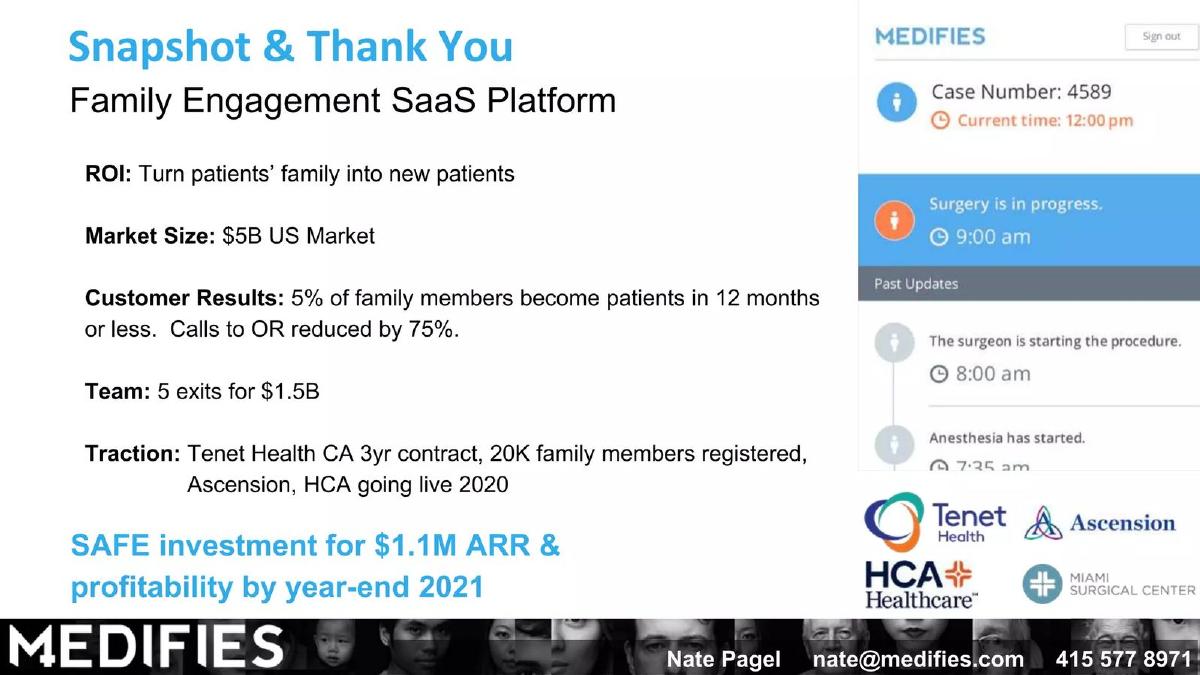
Software that keeps patients' families informed during surgery. Slide titled "Snapshot & Thank You".
Medifies deck, slide 13. Exact stored slide matched to this analysis.
Our analysis: Full recap, ask phrased as outcome, and a named contact.
Evidence and limitation: Company claims; signed and expected customers in one line.
What a founder can adapt: Add the amount raised and separate signed from expected customers.
Supporting analysis
What the deck claims: Market "$5B US Market"; "5% of family members become patients in 12 months or less. Calls to OR reduced by 75%."; "Team: 5 exits for $1.5B"; Tenet Health 3-year contract, 20K family members registered; "SAFE investment for $1.1M ARR & profitability by year-end 2021"; founder name, email, phone.
Presentation choice: Answers the end-of-meeting questions on one screen.
When it does not fit: Mixing live and upcoming customers in one traction line.
AssetsHub deck, slide 15. Exact stored slide matched to this analysis.
Our analysis: A template slide sent without editing.
Evidence and limitation: No company name, contact or summary.
What a founder can adapt: Replace credits with a name, email and phone.
Supporting analysis
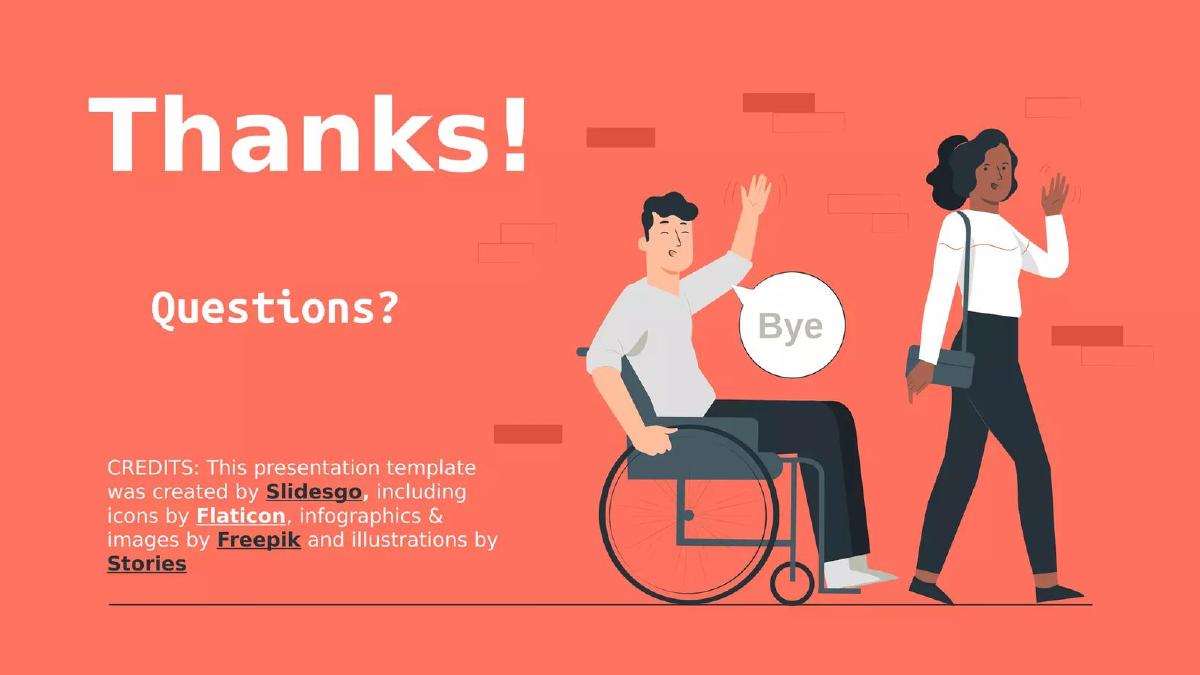
What the deck claims: "Thanks!"; "Questions?"; illustration with "Bye"; "CREDITS: This presentation template was created by Slidesgo, including icons by Flaticon, infographics & images by Freepik and illustrations by Stories".
Presentation choice: A warning: the slide signals the deck was not checked.
When it does not fit: Template text in place of contact details.
After: Scheduling software for dental clinics. 140 paying clinics; revenue up 9% a month for six months; 3% monthly churn. Raising $2M to reach $1.5M ARR by Q4 next year. Jane Doe, CEO, jane@example.com, +1 555 0100.
What improved: Our illustrative rewrite; all figures and names are invented for the example. It restates the case in defined numbers, repeats the ask with a milestone and gives one named contact.
The question this guide answers
Founders ask what the final slide of a pitch deck should contain. Other guides in this library cover nearby ground. The ask guide covers how to present the amount and use of funds; the executive summary guide covers a one-page summary at the start; the appendix guide covers what goes after the main deck. None of them answers what the closing slide itself should do, and what makes it useful for an investor who reads it last.
The closing slide has two audiences. In a meeting, it stays on screen during questions, so it should show the few facts you want discussed. When a deck is read alone, it is the last thing the reader sees before deciding whether to reply, so it should make the next step obvious and easy.
How we chose and read the examples
We searched the extracted text of the slide library for slides beginning with "Thank you" or "Thanks", removed public companies, mining and resource companies, listed-company presentations and slides where the phrase appeared in another context, and viewed the remaining candidates. We kept four slides from four startup decks, each showing a different approach. Every slide was rendered from the original deck at full size and read in full before we wrote about it.
We quote what is visible on each slide. We have not checked any company's figures against other sources, and we make no claim that any closing slide affected a fundraising result.
Recap the case, the ask and the contact on one slide
Medifies, a software platform that keeps patients' families informed during surgery, titles its closing slide "Snapshot & Thank You" with the subtitle "Family Engagement SaaS Platform". It then lists five labelled lines: "ROI: Turn patients' family into new patients"; "Market Size: $5B US Market"; "Customer Results: 5% of family members become patients in 12 months or less. Calls to OR reduced by 75%."; "Team: 5 exits for $1.5B"; and "Traction: Tenet Health CA 3yr contract, 20K family members registered, Ascension, HCA going live 2020". Below them, in larger type: "SAFE investment for $1.1M ARR & profitability by year-end 2021". A product screenshot and four customer logos sit on the right, and the footer gives the founder's name, email and phone number.
This is the most complete closing slide in the set. Each line answers a question an investor will have at the end: why customers buy, how big the market is, whether it works, who the team is, who is using it. The ask is phrased as what the money achieves, not just an amount. And the reader knows exactly whom to contact.
Two improvements would help. The ask names the instrument and the target but not the amount being raised. And "Ascension, HCA going live 2020" mixes signed and expected customers in one line; separating them would make the traction line easier to trust.
Leave three numbers on screen
DataCulture, which uses AI to reduce supply chain costs, puts three numbers on its closing slide under the words "Thank You": "2016 ARR $2M", "Growth 32%" and "Margins 89%". Below them is the line "A.I. to Optimize Supply Chain Costs", and the top bar gives a shared founders' email address and the company's AngelList page.
This is a good choice for a slide that stays on screen during questions. Three figures are easy to remember, and they cover size, momentum and quality of revenue. The one-line description reminds the reader what the company does.
The figures need definitions, though. "Growth 32%" does not say over what period: monthly, quarterly or yearly growth mean very different businesses. "Margins 89%" does not say whether it is gross or contribution margin. On a closing slide, where the numbers are meant to stick, each should carry its unit. The slide also has no ask and no named person, only a shared inbox.
A one-sentence summary is not enough on its own
A closing line that restates product, benefit and market in one sentence is a useful pattern, but on its own it leaves out the ask and the contact. Claims such as "customers engaged" or "an experienced team" without facts behind them are weaker still: if the deck has the numbers, such as how many customers are in trials, put one of them here instead. (General guidance, not drawn from the slides below.)
Before you finalise the close, read it on its own. A partner who opens the deck at the last page, or who reaches it after a forwarded email, should be able to tell from that page alone what the company does, the one or two facts that matter most, how much you are raising and who to contact. Put a person's name and email address, not only a generic inbox, and check that both still work when the deck is sent. If the round has a close date or a lead investor, say so here as well, because that is the information a reader needs to decide whether to reply now or later. Keep the page uncluttered so these few items stand out. (General guidance.)
Contacts suit a live meeting, not a deck read alone
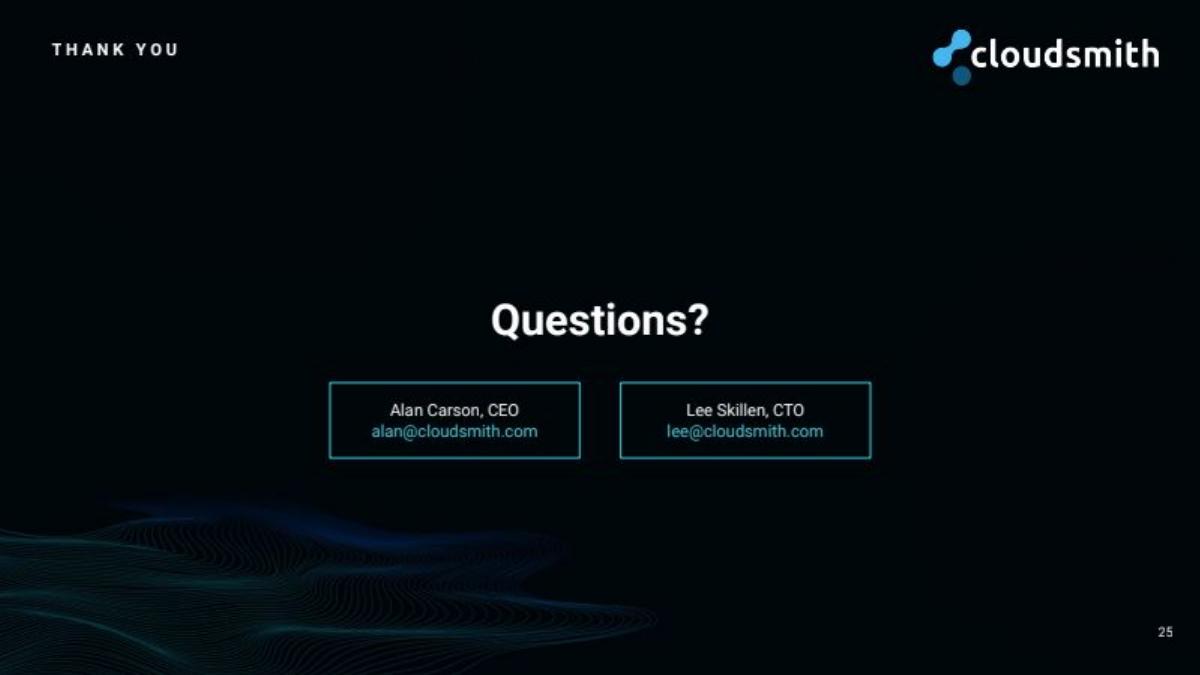
Cloudsmith, a software company, has a page headed "THANK YOU" with one word in the middle, "Questions?", and two boxes: "Alan Carson, CEO alan@cloudsmith.com" and "Lee Skillen, CTO lee@cloudsmith.com". It is page 25 of a 37-page file, so further pages follow it.
In a meeting, this slide does its job: it invites questions and tells the room whom to follow up with. Naming two people with their roles is helpful, since technical questions can go straight to the CTO. Read alone, it leaves nothing to remember: no summary, no ask. A founder who sends the deck ahead of a meeting can keep this layout and add a line above the contacts restating the raise and two or three headline facts.
Remove template text
The AssetsHub deck closes with a slide reading "Thanks!" and "Questions?" beside an illustration of two people waving, one saying "Bye". At the bottom is the template's credit line: "CREDITS: This presentation template was created by Slidesgo, including icons by Flaticon, infographics & images by Freepik and illustrations by Stories". There is no company name, contact detail or summary on the slide.
Leaving template text on the final slide is an easy mistake and an avoidable one. It tells the reader the deck was not checked before sending, and it takes the place of the one thing the slide must have: a way to contact the founder. Use the space for a name, email and phone, and remove the credits (most free templates allow credit on a separate page or in the file properties; check the template's licence).
Adjust the close to how the deck will be seen
The same closing slide rarely serves every setting equally well. For a deck presented live, keep the slide sparse enough to stay readable from across a room during questions: the one-line description, three facts in large type and the contact. For a deck sent ahead of a meeting or forwarded inside a firm, the reader has no one to ask, so the slide should carry slightly more: the amount being raised, the milestone it funds and the date by which you expect to reach it.
Many founders keep two versions of the final slide for this reason. Whichever version you use, check that every number on it matches the figure used earlier in the deck. A closing figure that differs from the traction or financials slide, even through rounding, invites a question you would rather not spend the meeting on.
What a complete closing slide shows
Together, the four slides show each part of a useful close. Medifies shows the full recap with the ask and contact. DataCulture shows how few numbers are needed if they are well chosen. Cloudsmith shows named contacts by role. AssetsHub shows what to remove.
A practical layout is three blocks: a one-line description of the company; three or four defined facts, such as revenue, growth, customers and team record; and the ask with what it buys, followed by one named person with email and phone. If the deck is read without you, that slide is your last chance to say why it matters and how to reply.
Common mistakes
Thank you and nothing else. The last screen should carry the case and a way to reply.
Undefined numbers. Give growth a period and margin a type.
No ask. Repeat the amount and what it achieves.
Shared inbox only. Name one person with email and phone.
Template text left in. Remove credits and placeholders before sending.
Diagnostic checklist
One-line description of the company.
Three or four defined headline facts.
Amount raised and the milestone it buys.
One named contact with email and phone.
No template credits or placeholders.
Frequently asked questions
Should the last slide just say thank you?
Thank you is fine as a heading, but the slide should also restate the case, repeat the ask and give a contact. It is often on screen the longest.
Should I repeat the ask on the closing slide?
Yes, briefly: the amount and what it achieves. Medifies phrases it as the outcome the money buys, which is easier to remember than an amount alone.
What if the deck has an appendix?
Put the closing slide at the end of the main deck, before the appendix, so the last thing the reader sees in the story is the recap and contact.
How we chose these examples
Corpus: published pitch deck teardowns on StartupFundraising.com. Founder-uploaded private decks are excluded.
Removed in v2 (2026-10-05): Synthara, because a page of its deck carries a restriction notice. Selection (2026-10-01): we searched extracted slide text for slides beginning with "Thank you" or "Thanks", excluded public companies, mining and resource companies, listed-company presentations and unrelated uses, and kept four slides from four startup decks that each show a distinct approach.
Review: all four slides were rendered from the source decks at full size on 2026-10-01 and read in full against company, deck and page number (editorial model review, with AI assistance in drafting). No person has yet completed an editorial review of this page. We did not verify any company's figures.