Outsourced Development on a Pitch Deck: How to Show Who
If contractors or an agency build your product, investors will ask who owns the code and who can change it.
Outsourced Development on a Pitch Deck: Show Who Builds the Product, Who Owns It and When That Changes
Many early startups don't have a full engineering team. The first version is built by a freelancer, an agency or an offshore studio, sometimes with one technical person in-house. That is a normal choice, and investors know it. What worries them is not the choice itself but the questions a deck leaves open: who owns the code, who can fix it next month, how much it costs, and when the company plans to bring the work in-house. This guide looks at four slides that mention outsourced or in-house engineering and shows how to turn a passing phrase into an answer.
TL;DR
Say plainly who builds the product, then answer the three questions investors will ask: who inside the company owns the technology, does the company own the code, and what is the plan and budget for development after the round. BoxedUp comes closest: its use-of-funds slide lists '$400k outsourced software dev' next to an in-house 'SDE' role inside '$900k 4-FTEs', so a reader sees both the outside spend and an internal hire. Davakhaana and Reel Cash mention outsourcing only as a cost advantage ('Small Team – Outsourced Technology'; 'variable overhead; outsourced development'). CellBreaker claims an 'In-House Engineering Team' but shows no engineer. One clear line on the team slide and one budget line on the use-of-funds slide usually answer the question before it is asked.
Four slides that mention who builds the product
Each slide is read at full size. Quotes are exact.
BoxedUp team slide — slide 22
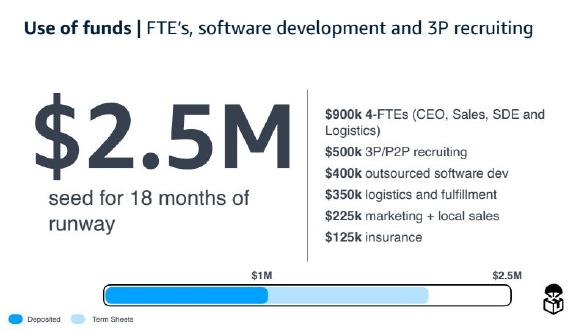
Rental marketplace. Use-of-funds slide for a $2.5M seed.
BoxedUp deck, slide 22. Exact stored slide matched to this analysis.
Our analysis: Outside development treated as a budgeted expense alongside an internal technical hire.
Evidence and limitation: Lines total $2.5M; outside development is $400k (16%). An in-house SDE role sits in the payroll line.
What a founder can adapt: Add who owns the code and what the outside budget buys.
Supporting analysis
What the deck claims: "$2.5M seed for 18 months of runway". "$900k 4-FTEs (CEO, Sales, SDE and Logistics)", "$500k 3P/P2P recruiting", "$400k outsourced software dev", "$350k logistics and fulfillment", "$225k marketing + local sales", "$125k insurance".
Presentation choice: Shows the simplest way to make outsourcing visible and planned.
When it does not fit: Leaving the link between the in-house role and the outside team unstated.
Outsourcing early development is common; hiding it or leaving it vague is what costs trust.
Name one person inside the company who owns the product and the technical decisions.
State that the company owns the code and IP, if it does.
Put outsourced development in the use-of-funds budget as its own line.
Say when and why you plan to bring development in-house, or why you won't.
If you claim an in-house engineering team, show who is on it.
Describe who builds your product
Answer these before you finalise the team and use-of-funds slides.
Who. Who inside the company owns product and technical decisions? Who writes the code today?
Ownership. Do signed agreements assign all code and IP to the company?
Cost. How much will outside development cost over the period the round covers?
Plan. Will you bring development in-house? When, and what triggers it?
Copyable framework: "[Name], [title], owns product and technology. [Product] is built by [outside team description] working with [in-house role]. All code and IP assigned to [company]. Use of funds: $[X] outside development to [date]; [N] engineering hires from [date]."
Illustrative example 1 — written by us
Before: "Small Team – Outsourced Technology"
After: "Small team: app built and run by [partner] for $[X]/month; [name] manages product; code and customer data owned by Davakhaana."
What improved: Our illustrative rewrite of Davakhaana's bullet. Bracketed details are not stated on the slide.
The question this guide answers
This guide answers one founder question: if people outside the company build my product, should the deck say so, and how do I present it so investors see a plan rather than a gap in the team?
Our team slide guide covers who to feature and how to describe experience. Our org chart draft covers showing reporting lines and planned hires, our hiring plan guide covers which roles a round pays for, and our use-of-funds guide covers splitting the raise into categories. None of them makes outside development its subject. The advice here is specific: what investors worry about when development is outsourced, which three facts remove most of that worry, and where on the deck each fact belongs.
The question matters most for non-technical founding teams, for marketplaces and consumer apps whose first version was built by an agency, and for founders who plan to use part of the round to replace contractors with employees.
How we chose and read the examples
We searched extracted slide text across the teardown library for 'outsourced development', 'outsourced software', 'outsourced technology', 'in-house development' and 'in-house engineering'. Most matches were about outsourced manufacturing, logistics or customer service, or were companies that sell outsourcing as their product; we excluded those, and listed companies. Fifteen pages matched the narrower phrases. We kept four startup slides where the founders describe who builds their own product, each in a different place in the deck: use of funds, business model, financials and team.
Each slide was rendered from the source deck and read at full size. BoxedUp's list of spending lines is small, so we enlarged it at 300 dpi before quoting. We did not check any of these claims against outside sources, and we don't know which development arrangements these companies actually had beyond what the slides say. The analysis is about how the slides present the arrangement, not about whether the arrangement was a good one.
Four examples are enough because each shows a distinct way founders handle the subject: as a budget line, as a cost advantage, as a scalability claim in the financials, and as an in-house claim on the team slide.
What investors worry about when development is outsourced
Control. If nobody inside the company understands the code, every change goes through a contractor's queue and price list. Investors want to know who inside the company decides what gets built and can judge whether it was built well. That person doesn't have to write code, but they need to be named.
Ownership. Code written by contractors is not automatically owned by the company that paid for it; that depends on the contract and the law where it was signed. During due diligence, investors and their lawyers usually ask for agreements that assign the work to the company. A deck can't prove ownership, but it can state it, and a founder who states it has usually thought about it.
Cost and continuity. An agency can be cheaper than hiring at the start, and more expensive later. Investors want to see the outside development cost in the budget and a view on what happens to it after the round: whether it continues, shrinks or is replaced by hires.
Speed of learning. Startups change their product often. Investors worry that an outside team, paid per project, slows down the cycle of testing and changing. A founder who explains how product decisions and releases are made answers this.
None of these worries means outsourcing is wrong. Many companies have built first versions this way. The point is that a deck that mentions outsourcing without addressing them leaves the investor to assume the worst.
A budget line with an in-house role: BoxedUp
BoxedUp, which was moving from renting its own inventory to a rental marketplace, has a slide headed 'Use of funds | FTE's, software development and 3P recruiting'. On the left: '$2.5M seed for 18 months of runway'. On the right, six lines: '$900k 4-FTEs (CEO, Sales, SDE and Logistics)', '$500k 3P/P2P recruiting', '$400k outsourced software dev', '$350k logistics and fulfillment', '$225k marketing + local sales' and '$125k insurance'. A progress bar beneath marks '$1M' and '$2.5M', with a legend for 'Deposited' and 'Term Sheets'.
The six lines add up to exactly $2.5M. Outsourced software development is $400k, which is 16% of the round, or about $22,000 a month over the stated 18 months if spent evenly. The slide doesn't say it will be spent evenly; that is our calculation.
This is the most useful of the four examples because it treats outside development as a planned expense with a number, not as a description of the company. And it pairs it with an in-house technical role: 'SDE' is usually short for software development engineer, though the slide doesn't spell it out. Together the two lines suggest a common and sensible model: one engineer on staff who owns the code and works with an outside team that adds capacity.
What the slide leaves out is the connection between the two. A reader can't tell whether the outside budget is for the first build, for ongoing work, or for a fixed project; whether the SDE is already hired; or whether the company owns what the contractors produce. Adding one line under the budget, such as 'Outside team builds the marketplace app to [date]; in-house SDE owns architecture and code review; all code assigned to BoxedUp', would answer the main questions without adding a slide.
Outsourcing as a cost advantage: Davakhaana
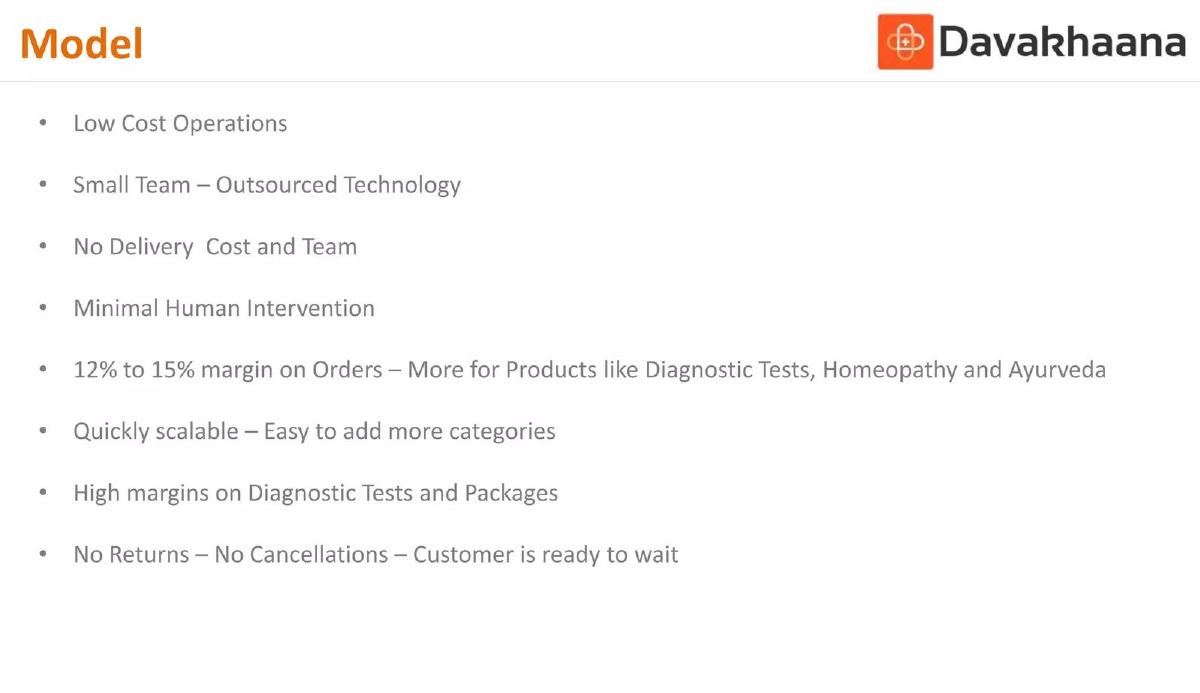
Davakhaana, an online pharmacy business in India, has a slide headed 'Model' with eight bullet points. The second reads 'Small Team – Outsourced Technology'. The others include 'Low Cost Operations', 'No Delivery Cost and Team', 'Minimal Human Intervention' and '12% to 15% margin on Orders – More for Products like Diagnostic Tests, Homeopathy and Ayurveda'.
Here outsourcing is presented as part of a low-cost model: a small team keeps costs down because technology is bought in rather than built in-house. That is a fair point for a business whose margins are thin, and the slide is honest that the company doesn't build its own technology.
But the bullet gives an investor nothing to assess. It doesn't say what is outsourced (the whole app, or only parts), who supplies it, what it costs, who inside the company manages it, or whether the company owns it. For an online pharmacy, where ordering, prescriptions and customer data all run through the software, those questions are central. A buyer of the business, or a later investor, would ask whether the software could be taken away or repriced.
If outsourcing is part of your cost story, put a number on it and say who controls it. 'Technology run by [partner] on a [monthly fee / revenue share]; [name] manages the product; code and customer data owned by Davakhaana' turns a vague cost claim into something an investor can check.
Outsourcing as a scalability claim in the financials: Reel Cash
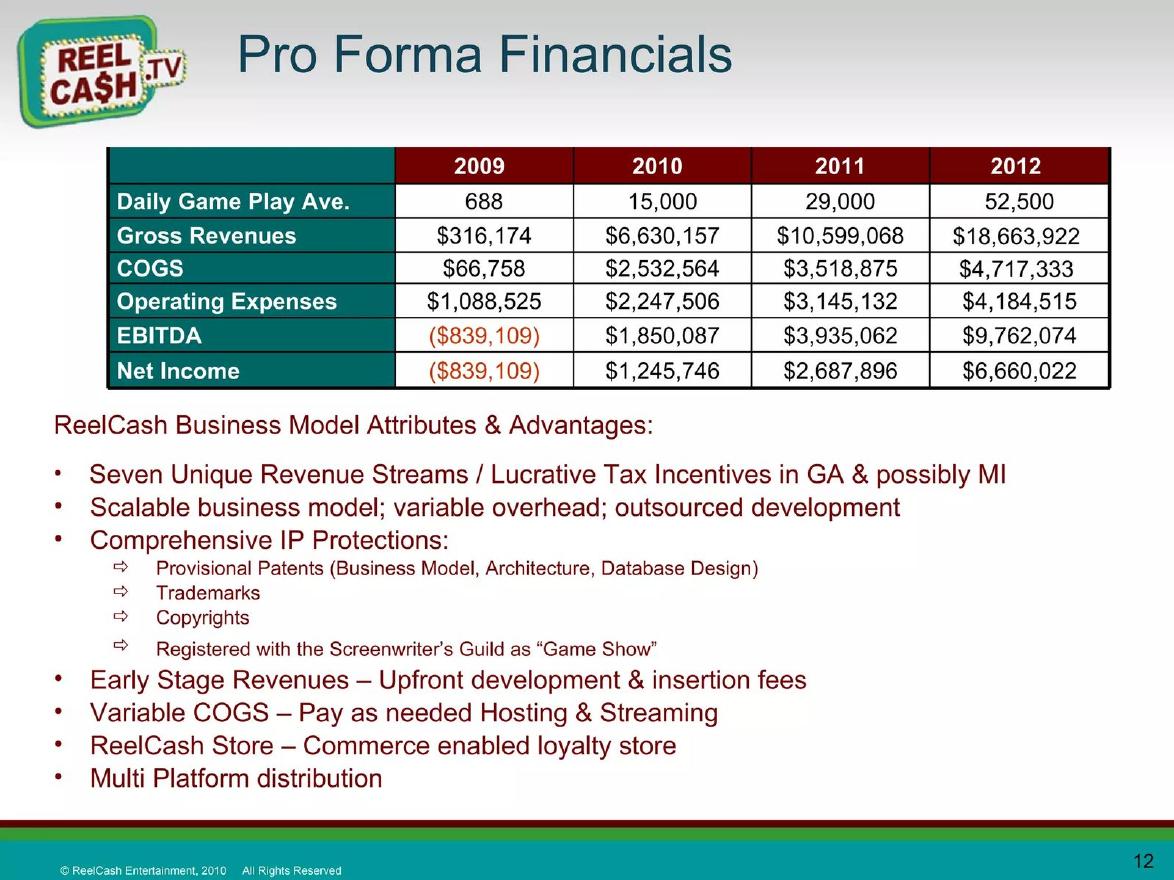
Reel Cash, which ran an online game show that rewarded viewers for watching ads, has a 2010 slide headed 'Pro Forma Financials'. A table shows daily game plays, gross revenues, cost of goods sold, operating expenses, EBITDA and net income for 2009 to 2012. Below it, under 'ReelCash Business Model Attributes & Advantages', one bullet reads 'Scalable business model; variable overhead; outsourced development'. A later bullet lists 'Comprehensive IP Protections' including 'Provisional Patents (Business Model, Architecture, Database Design)'.
The slide uses outsourcing to support a claim about cost structure: development is a variable cost rather than a fixed payroll, so overhead can rise and fall with the business. That can be true. But putting it next to the forecast doesn't show how outsourced development is reflected in the numbers. The table has a single operating-expense line ($1,088,525 in 2009, rising to $4,184,515 in 2012), so a reader can't see what share is development or how it changes as the business grows.
The same slide claims provisional patents on the architecture and database design. When the architecture is built by outsiders, an investor will want to know that the company, not the contractor, owns the work those patent filings describe. The slide doesn't say either way, and we don't know what the company's agreements said. The general lesson is that IP claims and outsourcing claims on the same slide invite the ownership question, so answer it there.
A clearer version would split development out of operating expenses in the forecast, or add a footnote with the assumed outside development cost per year, and state that development work is assigned to the company.
An in-house claim with no engineer shown: CellBreaker
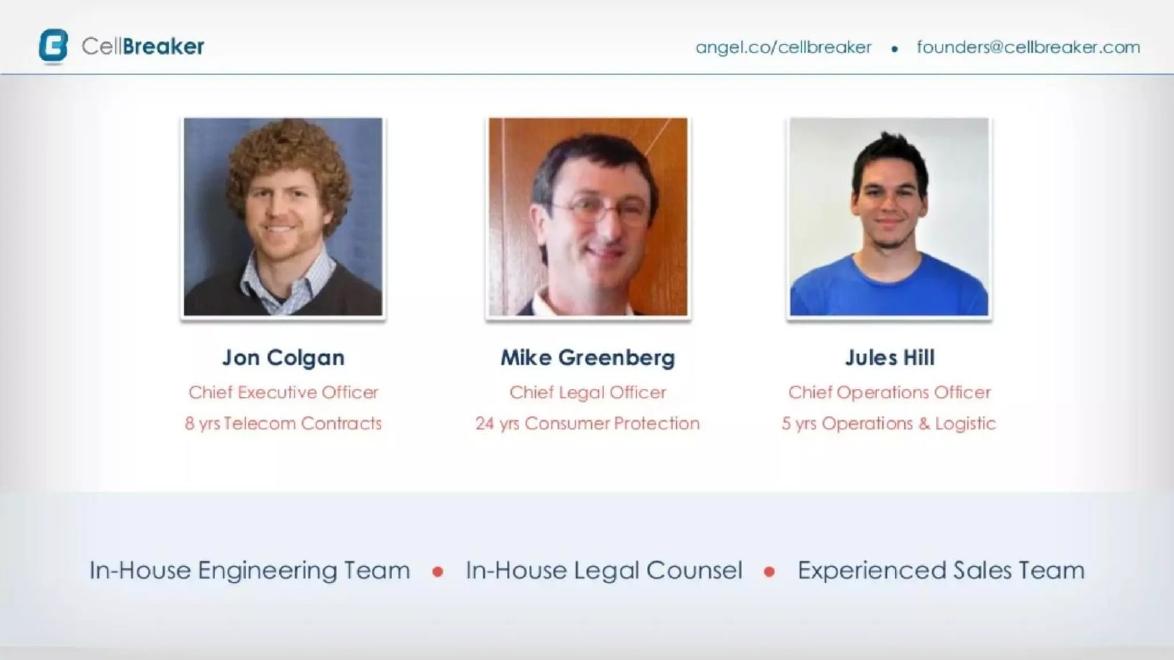
CellBreaker, which helped consumers get out of mobile phone contracts, has a team slide with three photos: 'Jon Colgan, Chief Executive Officer, 8 yrs Telecom Contracts'; 'Mike Greenberg, Chief Legal Officer, 24 yrs Consumer Protection'; and 'Jules Hill, Chief Operations Officer, 5 yrs Operations & Logistic'. A banner across the bottom reads 'In-House Engineering Team • In-House Legal Counsel • Experienced Sales Team'.
This is the opposite situation: the founders want investors to know the product is built in-house. That is a reasonable thing to stress. But none of the three people shown has a technical title or technical experience listed, and the engineering team is not named, counted or described. The in-house legal counsel in the same banner is visible on the slide as the Chief Legal Officer; the engineering team is not.
A reader is left to wonder whether 'in-house' means a full team, one developer, or a part-time contractor working from the office. If you claim in-house engineering, show it: name the lead engineer, give the head count and say what they have built. If the team is small, say so; 'Two full-time engineers led by [name], who built [product]' is stronger than a banner.
Where on the deck to say it
Team slide: one line naming who owns the product and technology, and who builds it. If an outside team builds it, name the firm or describe it ('six-person agency in [city], working with us since [year]'). If you have a technical co-founder or lead, put them first.
Use of funds: a separate line for outside development, with an amount, and a note on what it buys. If part of the round replaces contractors with employees, show both lines, as BoxedUp does with its outside budget and its SDE role.
Financials or appendix: if development is a large cost, split it out of operating expenses so readers can see how it changes.
Data room, not slides: contractor agreements, IP assignments and source code access. The slide only needs a sentence saying the company owns the code; the documents prove it.
You don't need a dedicated slide for this. Two or three precise lines in the right places are enough.
What to write: three facts and a plan
Who: name the person inside the company accountable for the product and technology, and describe the outside team in one phrase.
Ownership: 'All code and IP assigned to [company]' if true. If it isn't yet, fix that before fundraising; it is usually a short contract change, and it is far easier before due diligence than during it.
Cost: the outside development budget for the period the round covers.
Plan: when and why you will bring development in-house, or why you will keep using an outside team. Either can be right. A founder who has decided, with a reason, reads better than one who hasn't thought about it.
Avoid presenting outsourcing as a strength on its own ('variable overhead', 'small team') without these facts. Investors read that as a cost saving that might become a dependency.
What these examples can and cannot show
These four slides show how founders have mentioned who builds their product. They can't show whether any of these arrangements worked, what the contracts said, or whether investors raised the issue. We have not checked any claim against outside sources.
Treat them as patterns of presentation. BoxedUp's paired budget lines are the easiest to copy; the Davakhaana and Reel Cash bullets and the CellBreaker banner show claims that need one more sentence to be useful.
Common mistakes
One-word mention. 'Outsourced technology' with no owner, cost or plan.
No internal owner. Nobody named who decides what gets built.
Ownership unstated. IP claims next to outside development, with no assignment mentioned.
Hidden in opex. Development cost not visible in the forecast.
Unsupported in-house claim. An engineering team the slide doesn't show.
Diagnostic checklist
Internal product and technology owner named.
Outside team described in one phrase.
Code and IP ownership stated.
Outside development budget shown in use of funds.
Plan to keep or replace the outside team stated.
Any in-house team named and counted.
Frequently asked questions
Will investors reject a startup whose product is built by an agency?
Not usually for that reason alone at an early stage. They want to see that someone inside the company owns the product, that the company owns the code, and that there is a plan for development after the round.
Should I name the agency?
It helps if the agency is reputable or has built similar products. If you'd rather not, describe it: size, location and how long you have worked together.
How we chose these examples
Corpus: published pitch deck teardowns on StartupFundraising.com. Founder-uploaded private decks are excluded.
Selection (2026-10-01): we searched extracted slide text for phrases about outsourced and in-house development, excluded outsourced manufacturing, logistics and service businesses, outsourcing providers and listed companies, and kept four startup slides that describe who builds the company's own product, each in a different part of the deck.
Review: the four slides were rendered from the source decks at full size on 2026-10-01 and read in full against company, deck and page number (editorial model review, with AI assistance in drafting; not human-reviewed). BoxedUp's list was enlarged at 300 dpi. The BoxedUp total and percentage are our calculations from the slide. No claim was checked against outside sources.