Food Business Model Slides: 7 Real Pitch Deck Examples
How food and beverage startups show their business model in a pitch deck: per-order commission tiers, franchise fees and royalties, several models at once.
Food Business Model Slide: Show What You Earn on Each Order, Store or Case
Food and beverage companies earn money in very different ways: selling their own product, charging a fee on each order, franchising stores, making private-label goods for others, or sharing profit with a manufacturer. Investors want to know which one you run, who pays you, and how much you keep. This guide compares seven real business model slides from decks tagged food and beverage in our library, from a slide that shows its commission at three order volumes to one that lists two products and two sales channels.
TL;DR
Name who pays you and what you earn on each unit: an order, a store, a case. Cloosiv shows a 12%, 10% and 8% fee on coffee orders by monthly volume. Brewtopia gives investment, franchise fee, payback period and royalty for three store sizes. Bespoken Spirits sets out three separate models without prices. Phospholutions names a profit-sharing deal with fertilizer makers. Parfait lists two channels, and Newinfo Farms and GrowOn list streams without figures.
Food business model slides from real pitch decks
Each example shows the exact stored slide above its analysis and links to the full teardown. The clearest models come first; weaker ones follow for contrast. Claims are as shown on the slides; comments are ours.
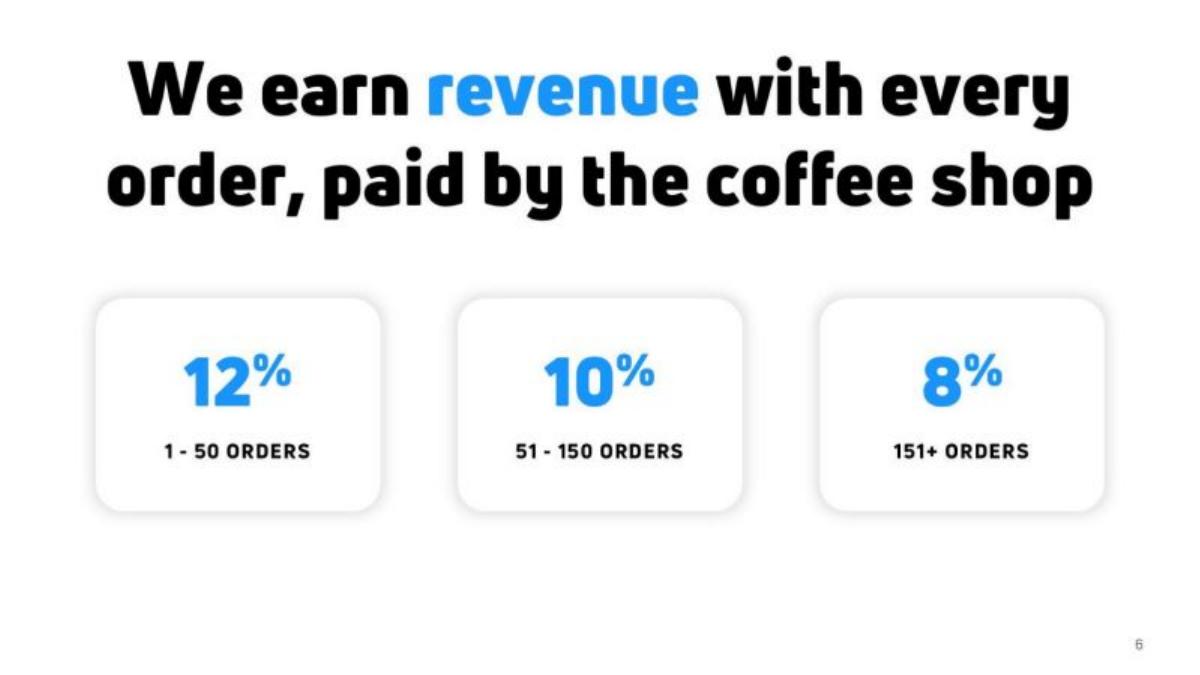
Cloosiv business model slide — slide 6
Mobile ordering app for independent coffee shops. Headline slide with three figures.
Cloosiv deck, slide 6. Exact stored slide matched to this analysis.
Our analysis: One sentence names who pays and when, and the three tiers show the fee falling as a shop sends more orders.
Evidence and limitation: It does not say whether the order bands are per day, week or month, and gives no average order value, so revenue per shop cannot be worked out.
What a founder can adapt: Add the time period for each band and one example: a shop with 100 orders at a typical ticket and what Cloosiv earns.
Supporting analysis
What the deck claims: "We earn revenue with every order, paid by the coffee shop." Three boxes: "12% 1 - 50 orders", "10% 51 - 150 orders", "8% 151+ orders".
Presentation choice: For an ordering platform, the take rate is the model; putting it in the headline answers the first question.
When it does not fit: Order bands without a time period.
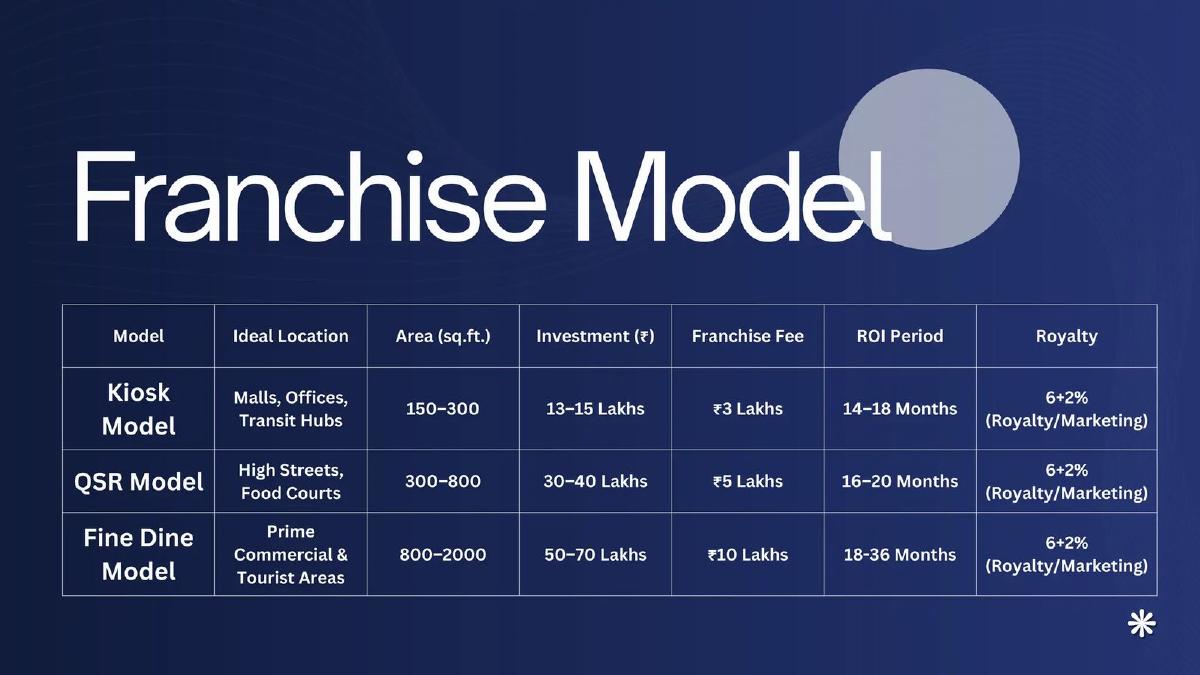
Café brand, India. Slide titled "Franchise Model".
Brewtopia deck, slide 6. Exact stored slide matched to this analysis.
Our analysis: It gives what a franchisee pays up front and on an ongoing basis for each format, which is what an investor needs to see how the brand earns.
Evidence and limitation: The payback periods are the company's estimates; the slide shows no store sales or franchisee results, and does not say what the 6% royalty is charged on.
What a founder can adapt: Say the royalty is on gross sales (if so), and add how many stores of each type are open.
Supporting analysis
What the deck claims: A table with three rows. "Kiosk Model": malls, offices, transit hubs; 150–300 sq.ft.; investment 13–15 Lakhs; franchise fee ₹3 Lakhs; ROI period 14–18 months; royalty "6+2% (Royalty/Marketing)". "QSR Model": 300–800 sq.ft.; 30–40 Lakhs; ₹5 Lakhs; 16–20 months. "Fine Dine Model": 800–2000 sq.ft.; 50–70 Lakhs; ₹10 Lakhs; 18–36 months. The royalty is 6+2% in every row.
Presentation choice: A franchise brand earns from fees and royalties, not coffee sales; this slide shows both for every format.
When it does not fit: Payback periods with no store sales behind them.
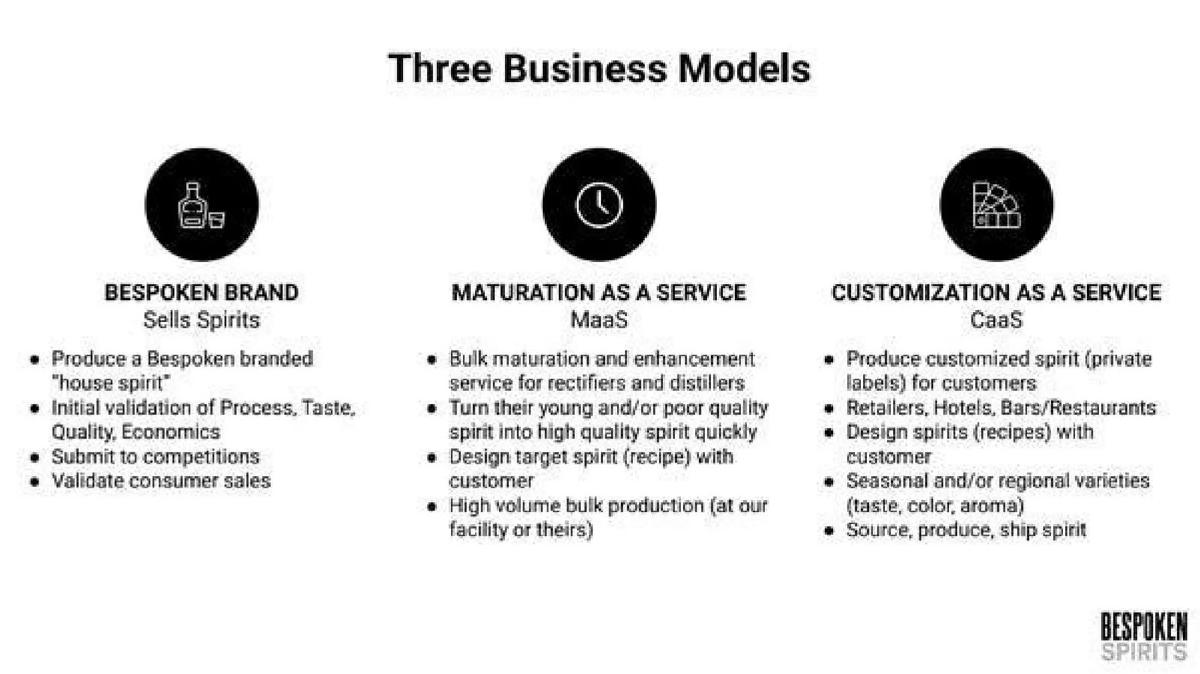
Spirits maturation technology company. Slide titled "Three Business Models".
Bespoken Spirits deck, slide 6. Exact stored slide matched to this analysis.
Our analysis: It separates selling its own brand from selling its process to others, and names the buyer of each, which makes the choices clear.
Evidence and limitation: No prices, margins or volumes, and no sign of which model earns most.
What a founder can adapt: Add a price basis for each (per bottle, per litre matured, per private-label run) and mark which one leads.
Supporting analysis
What the deck claims: Three columns. "Bespoken Brand – Sells Spirits": "Produce a Bespoken branded 'house spirit'", "Validate consumer sales". "Maturation as a Service (MaaS)": "Bulk maturation and enhancement service for rectifiers and distillers", "High volume bulk production (at our facility or theirs)". "Customization as a Service (CaaS)": "Produce customized spirit (private labels) for customers – Retailers, Hotels, Bars/Restaurants".
Presentation choice: A drinks company with a production method can be a brand or a supplier; showing both tells investors the options.
When it does not fit: Three models with equal weight; investors will ask which one you are building first.
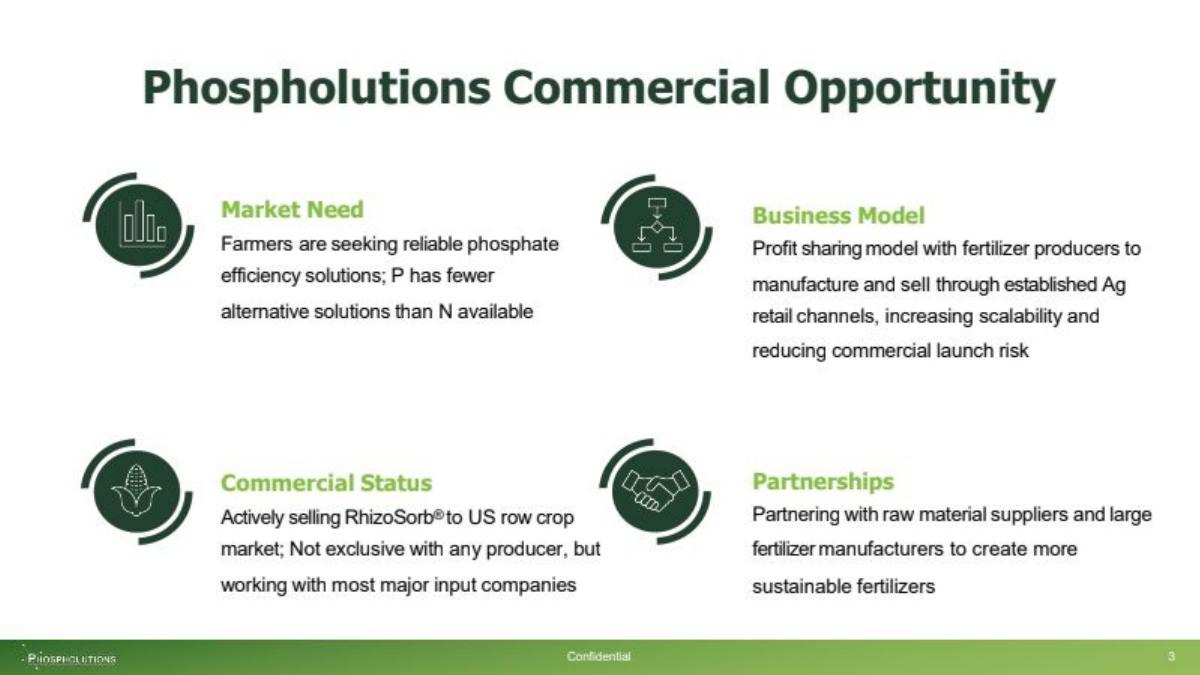
Fertilizer additive for row crops, tagged food in our library. Slide titled "Phospholutions Commercial Opportunity".
Phospholutions deck, slide 4. Exact stored slide matched to this analysis.
Our analysis: It says who makes and sells the product and why the company chose partners over its own sales force.
Evidence and limitation: No profit-share percentage, partner names or sales figures.
What a founder can adapt: Add the share of profit you keep and one live partner, if you can name it.
Supporting analysis
What the deck claims: "Business Model: Profit sharing model with fertilizer producers to manufacture and sell through established Ag retail channels, increasing scalability and reducing commercial launch risk." "Commercial Status: Actively selling RhizoSorb® to US row crop market; Not exclusive with any producer, but working with most major input companies."
Presentation choice: Partner-led models trade margin for reach; explaining the trade answers a question investors will ask.
When it does not fit: "Working with most major input companies" without a number.
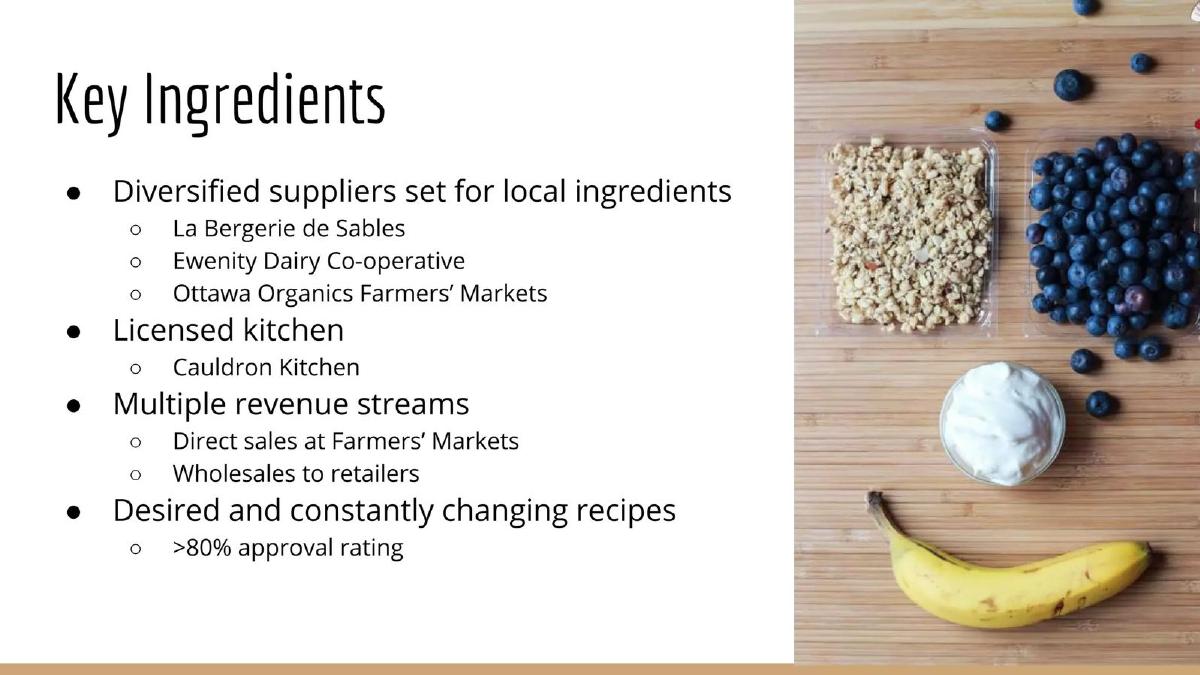
Local yogurt parfait brand. Slide titled "Key Ingredients". (weaker)
Parfait deck, slide 4. Exact stored slide matched to this analysis.
Our analysis: It names two ways the product reaches buyers, but they sit on an ingredients slide, and the reader cannot tell which pays better.
Evidence and limitation: No prices, margins or volumes for either channel, and no source for the approval rating.
What a founder can adapt: Give a price per parfait at markets and to retailers, and the share of sales from each.
Supporting analysis
What the deck claims: Among suppliers and a licensed kitchen: "Multiple revenue streams: Direct sales at Farmers' Markets; Wholesales to retailers." Also "Desired and constantly changing recipes – >80% approval rating".
Presentation choice: Direct and wholesale sales have very different margins; the slide should say which one the plan depends on.
When it does not fit: Hiding the business model inside another slide.
Poultry farming and processing in Nigeria. Slide titled "Business Model: Newinfo Farms". (weaker)
Newinfo Farms deck, slide 6. Exact stored slide matched to this analysis.
Our analysis: It follows a business model canvas but says nothing a reader could use to estimate revenue, and the repeated line suggests the slide was not reviewed.
Evidence and limitation: No prices or buyers, and "value-added services" and "data analytic" are not explained.
What a founder can adapt: Replace the canvas with who buys (retailers, processors, households), the price per bird or kilogram, and your margin.
Supporting analysis
What the deck claims: "Revenue Streams: Product Sales; Value-Added Services; Data Analytic." "Key Partners: Farmers, Suppliers and Logistics Providers." "Key Activities" appears twice with the same text. "Value Proposition: High-quality, sustainable poultry products."
Presentation choice: Canvas headings without content look like a template; investors want the poultry price and who buys it.
When it does not fit: Repeating a line on the slide; proofread before sending.
Say who pays you: shopper, café, franchisee, retailer or manufacturer.
Put a number on each unit: fee per order, price per case, royalty per store.
If you run several models, say which one earns first.
Sales channels (online, stores, markets) are not a business model on their own.
Show what you keep after the partner's share or the cost of goods.
Build your food business model slide
Start from who pays you and for what unit.
Model. Do you sell your own product, take a fee on others' sales, franchise, or make for others?
Payer. Who pays you: shopper, café, franchisee, retailer, manufacturer?
Unit and price. What do you earn per order, case, store or bottle?
What you keep. After cost of goods or the partner's share, what is left?
Proof. Do you have one real figure: a paying café, an open store, a retailer order?
Copyable framework: [Payer] pays us [price] per [unit]; after [cost or partner share] we keep [margin]. Live since [date] with [number] customers. Next: [model] once [condition].
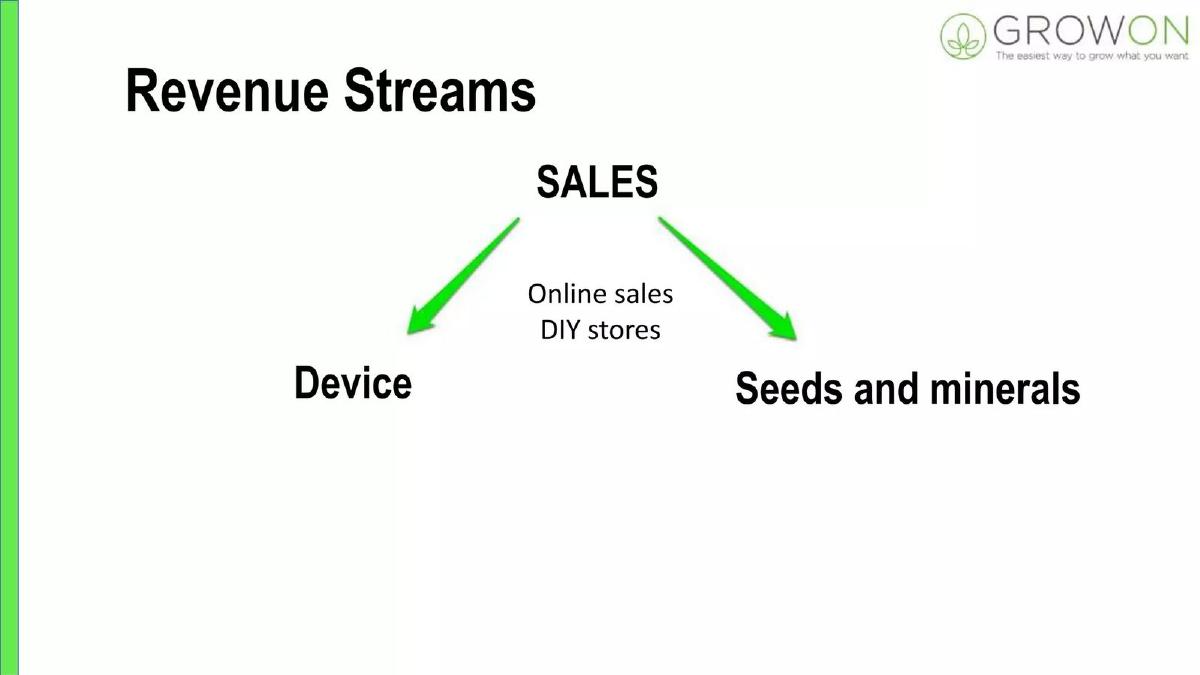
After: Device sold at £120 online and in DIY stores; seed and mineral refills at £15, bought about four times a year, at a 60% margin.
What improved: Our illustrative rewrite; the prices, refill rate and margin are invented for the example. It shows the price of each part and why refills matter.
What this guide adds
The general business model guide covers any company. Food companies face a specific question: do you make and sell the product, take a cut of someone else's sale, or license your brand? The margin and the capital needed differ sharply between the three, so the slide should make the choice clear.
Our library's food tag is broad; it includes cafés, ordering apps, drinks makers, farms and farming inputs. We note each company's business in the examples.
How we read each slide
We quote the text on the stored slide images. We have not checked any fee, price, payback period or commercial claim.
Common mistakes
Channels instead of a model. Online and retail are where you sell, not how you make money.
No price per unit. Give a fee, price or royalty for at least the main stream.
Several models, no order. Say which one earns first.
Missing time periods. Order bands and payback periods need a period and a basis.
Template headings with no content. A canvas with empty categories reads as unfinished.
Diagnostic checklist
Names who pays you.
Gives a fee, price or royalty per unit.
Shows what you keep after cost of goods or partner share.
Marks which model or stream comes first.
States time periods and bases for every figure.
Frequently asked questions
How should a food ordering app show its business model?
State the fee and who pays it. Cloosiv says the coffee shop pays 12%, 10% or 8% per order depending on volume, though it does not give the time period for each band.
What should a franchise business model slide include?
Up-front investment, franchise fee, royalty and a payback estimate for each format. Brewtopia shows all four for kiosk, quick-service and fine-dining stores.
Can a food startup show more than one business model?
Yes, if you say which comes first. Bespoken Spirits shows its own brand, maturation as a service and private label side by side, but does not rank them.
How we chose these examples
Corpus: published pitch deck teardowns on StartupFundraising.com. Founder-uploaded private decks are excluded.
Selection (2026-09-27): we searched extracted slide text in decks tagged food and beverage for business model, revenue model, revenue streams, monetization and how we make money. About 40 slides matched; many were market, highlights, value-proposition or listed-company slides.
Kept seven with stored images. Excluded for no stored image (no uploads requested): Farmpadi p7, Happy Tom p10 and Beveragewala p7. Cafetino p6 is already used in the general business model guide, and the Cloosiv/Odeko deck repeats the Cloosiv slide. Urban Harvest p6 (one sentence) was left out as too thin.
The Phospholutions slide is marked "Confidential" but is part of a teardown already published on this site.
Review: stored slide text and images were checked on 2026-09-27 and matched to company, deck and slide number (editorial model review). No person has yet completed an editorial review of this page. We make no claim that any slide caused a fundraising outcome.