Six Cohorts, One Beta: How Alpe's Pre-Launch Deck Tests
A whole-deck walkthrough of Alpe's 17-page deck for an audio learning app: the beta page promises to find 'the right cohort' and lists six.
Six Cohorts, One Beta: How Alpe's Pre-Launch Deck Tests Its Way to a First Customer
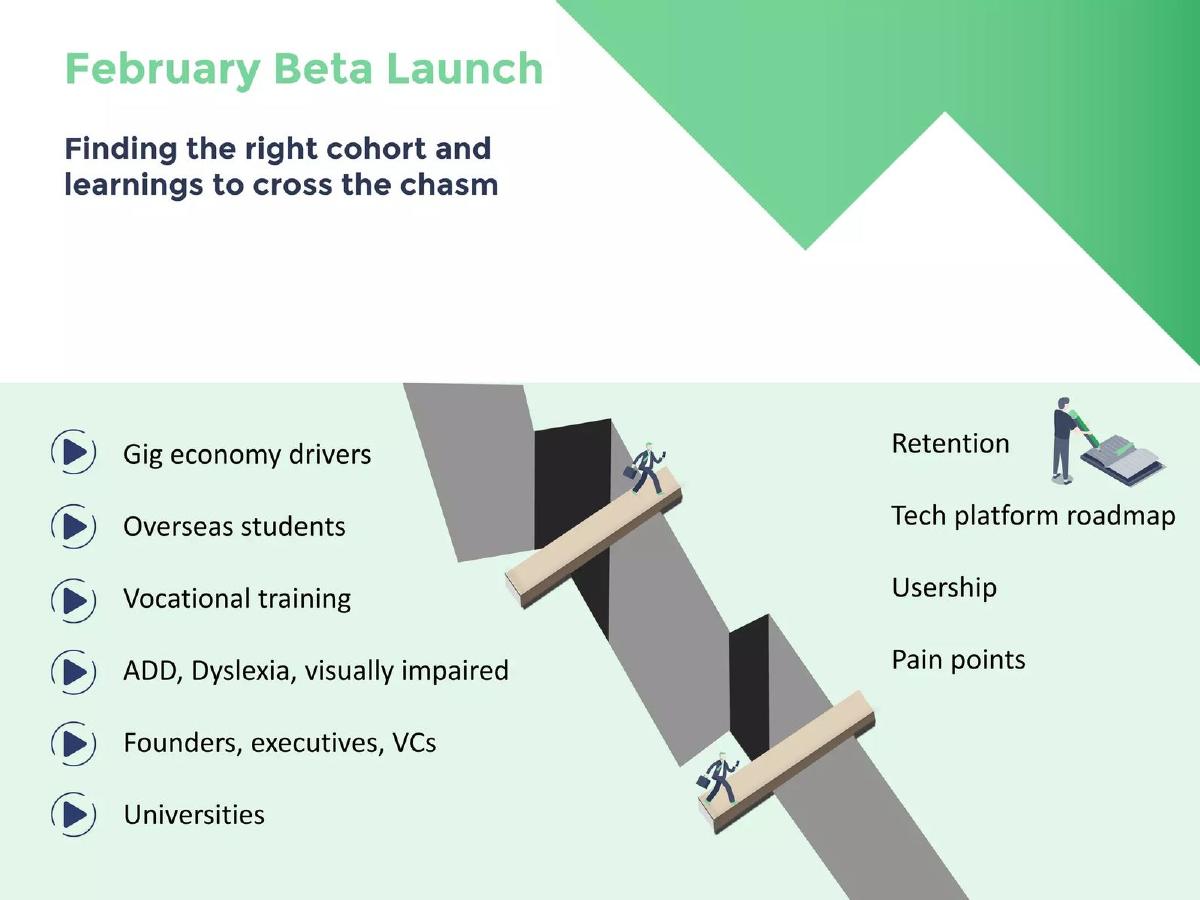
Before launch, many founders don't yet know who their first customer is, and saying so honestly can be a strength. The question is whether the deck shows how the answer will be found. Alpe's 17-page deck, for a mobile app that teaches short courses through interactive audio, is candid about it. Page 9, 'February Beta Launch', is subtitled 'Finding the right cohort and learnings to cross the chasm' and lists six groups: gig economy drivers, overseas students, vocational training, people with ADD, dyslexia or visual impairment, founders, executives and VCs, and universities. We read the deck page by page and ask what an investor needs to see for a six-way test to read as a plan.
TL;DR
A multi-cohort beta reads as a plan when the deck says what will be measured, what result picks the winner, and when. Alpe's page 9 names four things it will learn ('Retention', 'Tech platform roadmap', 'Usership', 'Pain points') but gives no target, no decision date and no way of comparing groups. Page 10 explains why each cohort is interesting, and page 17's roadmap schedules a 'Beta' in Q1 2020 'to 5 cohorts and 2 universities'.
The rest of the deck hasn't chosen either. Page 8 sizes the market as US podcast listeners, not any of the six groups. Page 11 offers three ways to pay: per course ($6.99 to $39.99), premium tutoring, and a monthly subscription. A university, a gig driver and a student with dyslexia would likely buy in different ways and at different prices.
The lesson for founders: if your launch is an experiment to find your first customer, present it as one, with a measure per cohort, a threshold, a decision date and what you'll do with the answer.
The deck page by page, following the cohort question
Seven pages from Alpe's 17-page deck, from the problem to the roadmap.
Alpe executive summary slide — slide 2
Audio learning app. Problem.
Alpe deck, slide 2. Exact stored slide matched to this analysis.
Our analysis: Our reading: a clear problem without a defined learner.
Evidence and limitation: No source for either figure; learner unnamed.
What a founder can adapt: Source the figures and name who has the problem most.
Supporting analysis
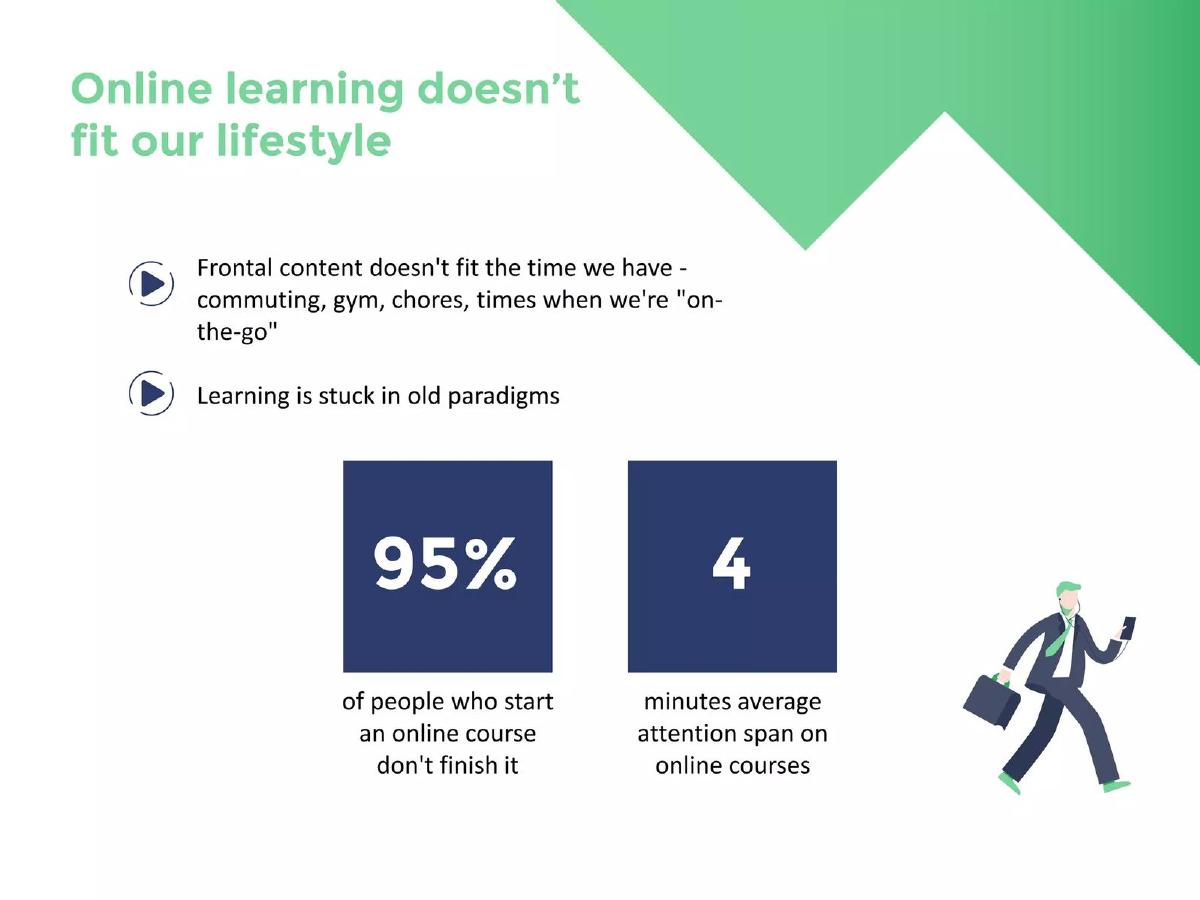
What the deck claims: 'Online learning doesn't fit our lifestyle'; '95%' don't finish, '4 minutes' attention span.
Presentation choice: The problem should belong to the customer you'll serve first.
When it does not fit: Don't leave headline statistics unsourced.
Alpe deck, slide 17. Exact stored slide matched to this analysis.
Our analysis: Our reading: the facts that should shape the cohort choice, hidden in the appendix.
Evidence and limitation: Strongest evidence in the deck; findings not stated.
What a founder can adapt: Bring findings forward and use them to rank the cohorts.
Supporting analysis
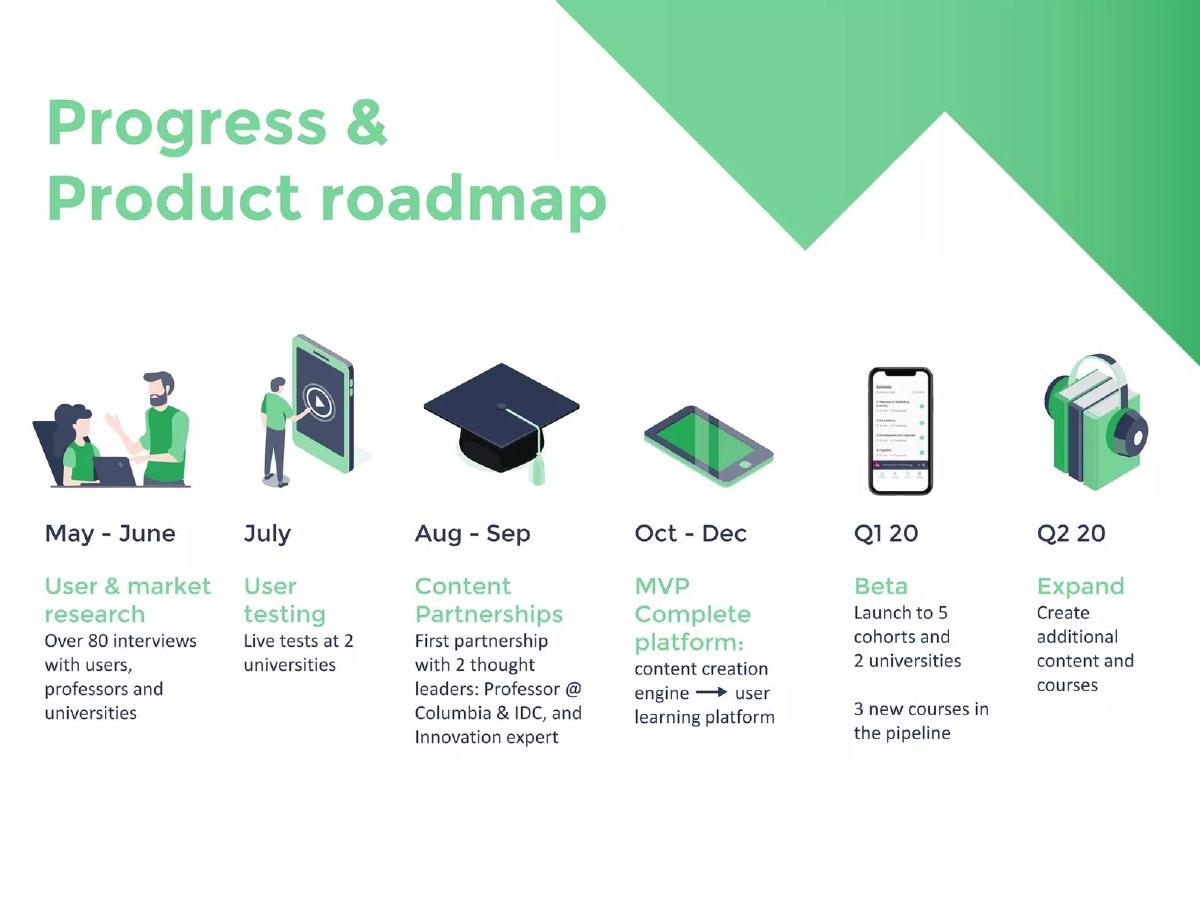
What the deck claims: 80+ interviews (May–June), live tests at 2 universities (July), MVP (Oct–Dec), beta to 5 cohorts and 2 universities (Q1 20), expand (Q2 20).
Presentation choice: Early research is what makes a cohort choice credible.
When it does not fit: Don't bury your best evidence after the closing page.
How the deck's pages relate to the six-cohort beta, and what would connect them.
Page
What it shows
Cohort implied
What would help
2–4 Problem
Unfinished courses, audio habit
Anyone on the move
Name the learner with the sharpest problem
6 Product
Commuter, cyclist, dog walker
Urban professionals
Show a day for the likeliest cohort
8 Market
US podcast listeners
None of the six
Size the likeliest cohorts
9–10 Beta
Six cohorts, four goals
All six
Measure, target, decision date
11 Model
Three pricing models
Unassigned
Model and price per cohort
17 Roadmap
80 interviews, 2 university tests
Universities tested first
Findings, brought forward
Key Takeaways
Say how the beta will pick a winning cohort.
Give each cohort a measure and a target.
Set a decision date.
Size the market for the cohorts you're testing.
Tie each pricing model to the cohort it's for.
Turn your launch into an experiment
Answer these if you plan to test more than one first customer.
Cohorts. Which groups will you test, and are they the same kind of buyer?
Size. How many users or accounts per cohort?
Measure. What single result will you compare across cohorts?
Target. What figure makes a cohort your first customer?
Price. What will each cohort pay, and how?
Date. When will you decide, and what changes after?
Copyable framework: Beta, [months]: [n] cohorts, [m] users each. Measure: [metric] at [weeks]. A cohort wins at [target]; we'll test [price/model] with each. Decision by [date]; we'll then focus [spend] on the winner.
Illustrative example 1 — written by us
Before: 'February Beta Launch: Finding the right cohort' with six cohorts and 'Retention, Usership, Pain points'.
After: Beta, Feb–Apr 2020: 5 learner cohorts, [n] users each, plus 2 university pilots. Measure: [4-week course completion]. Winner at [x]%; [pay-per-course vs subscription] tested in each. Decision by [May 2020].
What improved: Our illustrative rewrite. Bracketed values are placeholders, not Alpe's figures; it shows how the cohort will be chosen and separates university pilots from learner cohorts.
The question this guide answers
Our Alpe teardown summarises the deck as a bet on audio-first education. No guide uses its slides. Most advice on first segments assumes the founders have already picked one; this walkthrough asks a different question: what should a pre-launch deck show when the founders haven't picked a first segment yet, and intend to test several? It follows that choice through the market, business model and roadmap pages.
How we read the deck
We rendered all 17 pages of the original file in our library and read each one, with pages 9 and 10 also read at full size. Page 15 is a closing page with a contact and social icons; page 16 is an appendix divider; page 17, the roadmap, sits in the appendix. The roadmap runs from 'May - June' to 'Q2 20', so the deck was probably prepared in late 2019; that's our inference. The library copy comes from SlideShare. We make no claim about whether this deck raised money.
Figures on the market page are reported as the deck shows them with its stated source; we haven't checked them.
Step one: the problem and the habit
Page 2, 'Online learning doesn't fit our lifestyle', says on-screen content doesn't fit commuting, the gym or chores, with two figures: '95% of people who start an online course don't finish it' and '4 minutes average attention span on online courses'. Page 3, 'Audio is growing exponentially because it fits our lifestyle', shows '70% of US adults are familiar with podcasts', a quotation attributed to Spotify's CEO about podcast growth, and '16 hours a week - average listening time'. Page 4, 'But podcasts aren't good enough', says podcasts are entertainment-driven, not interactive and hard to search.
Our reading: this is a tidy three-step argument: courses go unfinished, people already listen on the move, podcasts don't teach. The two figures on page 2 carry no source, and '95%' and '4 minutes' are the kind of figures readers will want to check. Page 3's '16 hours a week' doesn't say whether it means podcasts or all audio. None of these pages yet names who the learner is.
Step two: the product
Page 5 presents 'Interactive mobile learning', 'Engaging storytelling' and 'Top tier content' from 'leading academics and industry experts'. Page 6 shows the app across a day: 'Discover' at 8am, 'Learn' at 1pm, 'Review' at 7pm, with screens for browsing, an episode and a recall quiz. Page 7, 'The Alpe platform', draws supply from experts, an 'AI based course creation engine' and distribution through the app.
Our reading: page 6 is the best product page in the deck: a reader sees the habit the app is designed around. The people drawn on page 6 (a commuter with a briefcase, a cyclist, a dog walker) look like urban professionals, which is one cohort, not six.
Step three: the market is podcast listeners
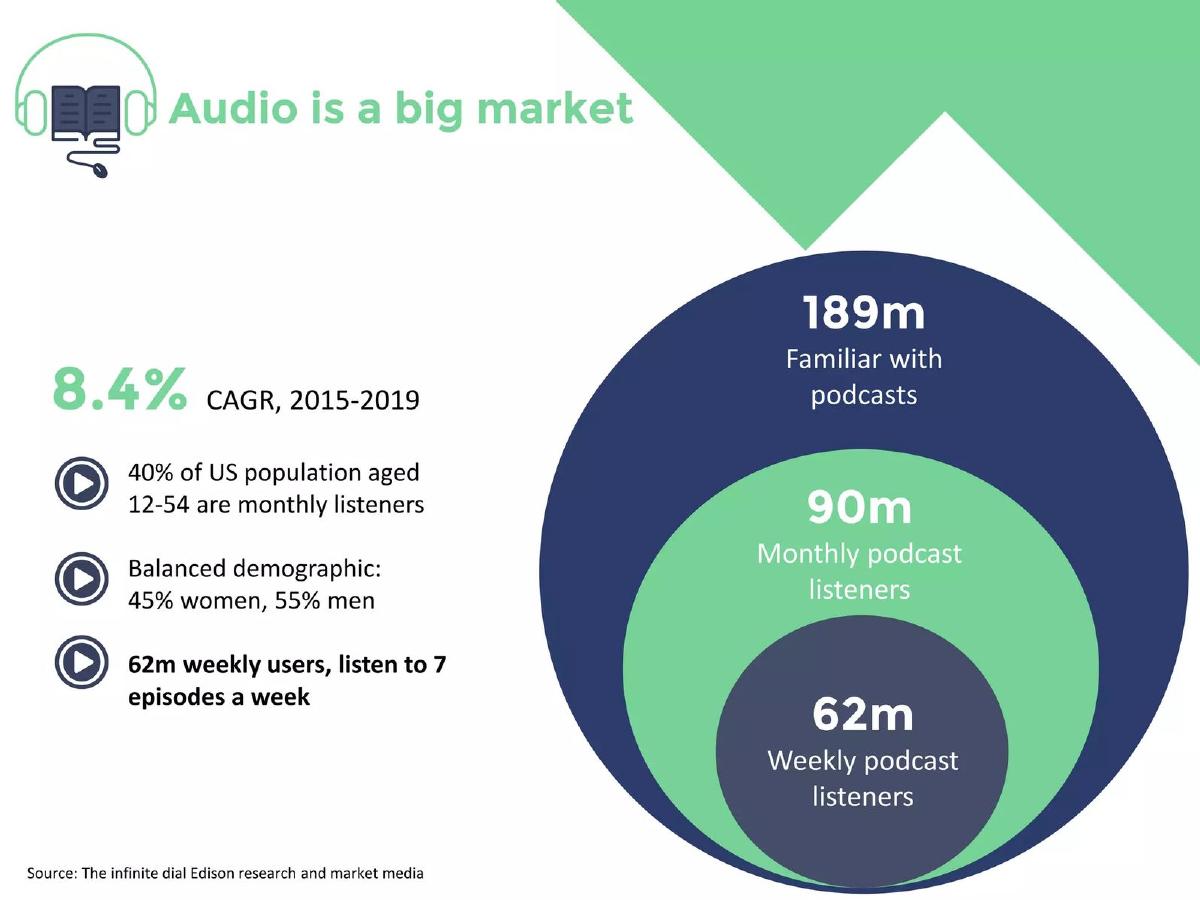
Page 8, 'Audio is a big market', shows '8.4% CAGR, 2015-2019', '40% of US population aged 12-54 are monthly listeners', '45% women, 55% men', '62m weekly users, listen to 7 episodes a week', and nested circles: '189m Familiar with podcasts', '90m Monthly podcast listeners', '62m Weekly podcast listeners'. The source line credits Edison Research's Infinite Dial and Market Media.
Our reading: this page is sourced, which is good, and it sizes podcast listening in the US. It isn't the market for any cohort on page 9: it doesn't count gig drivers, overseas students, vocational learners or universities, and it gives no spending figure. The page also doesn't name the growth measure behind '8.4% CAGR'. A pre-launch deck testing six groups could size each one roughly, or size the one it expects to win.
Step four: the six-cohort beta
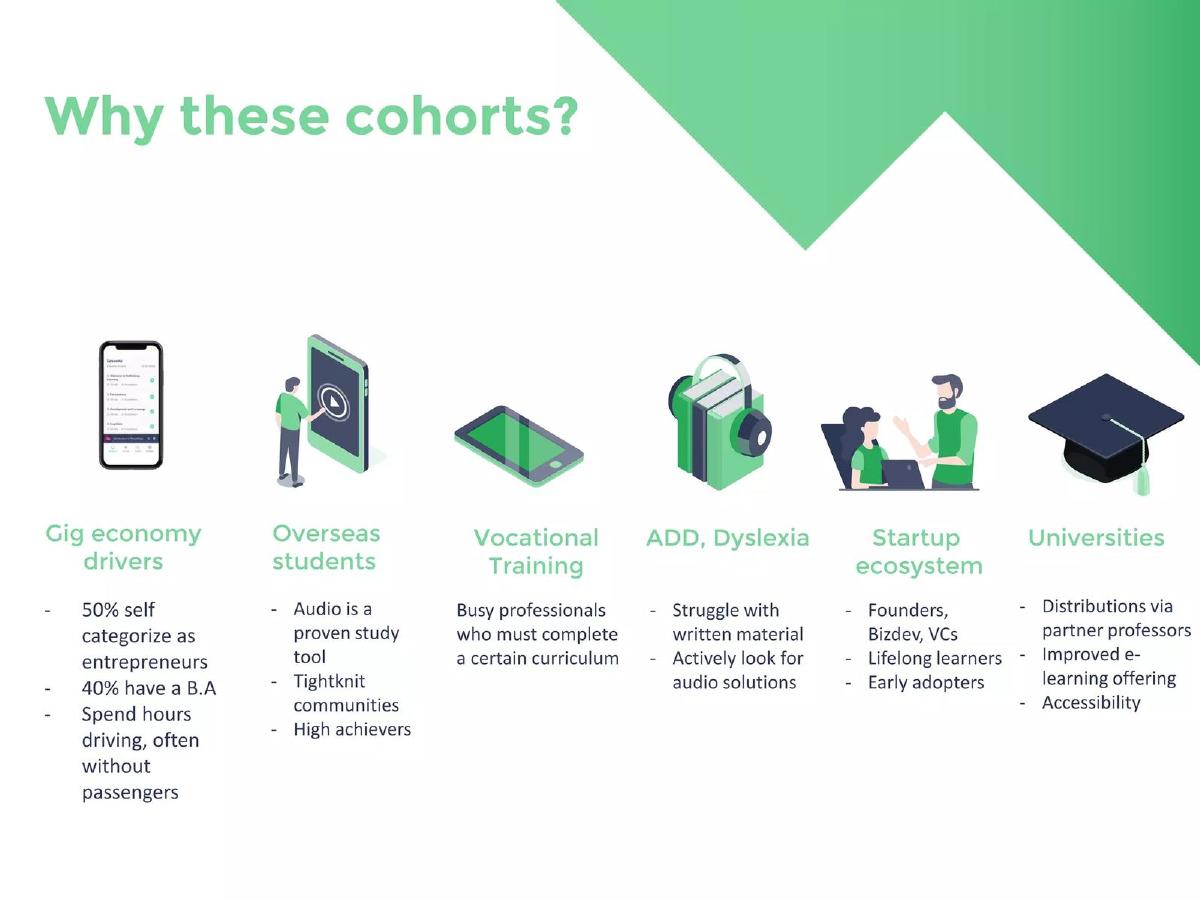
Page 9, 'February Beta Launch: Finding the right cohort and learnings to cross the chasm', lists the six cohorts on the left and four learning goals on the right: 'Retention', 'Tech platform roadmap', 'Usership', 'Pain points'. Page 10, 'Why these cohorts?', gives reasons: gig drivers ('50% self categorize as entrepreneurs', '40% have a B.A', 'Spend hours driving, often without passengers'); overseas students ('Audio is a proven study tool', 'Tightknit communities', 'High achievers'); vocational training ('Busy professionals who must complete a certain curriculum'); ADD and dyslexia ('Struggle with written material', 'Actively look for audio solutions'); the startup ecosystem ('Founders, Bizdev, VCs', 'Lifelong learners', 'Early adopters'); and universities ('Distributions via partner professors', 'Improved e-learning offering', 'Accessibility').
Our reading: it's honest to say the right cohort hasn't been found, and 'cross the chasm' signals the founders know they'll need one group to win first. Page 10's reasons are specific and thoughtful; the gig driver figures have no source. What's missing is the decision rule. Which retention figure would make a cohort the winner? How many users per cohort? When will the team decide? Without that, six cohorts look like a spread bet rather than a test.
The cohorts also differ in kind. Five are groups of individual learners; universities are institutions that would distribute the app through professors. That's a different sale, a different buyer and probably a different price, so testing it alongside individual cohorts compares unlike things.
Step five: three ways to pay
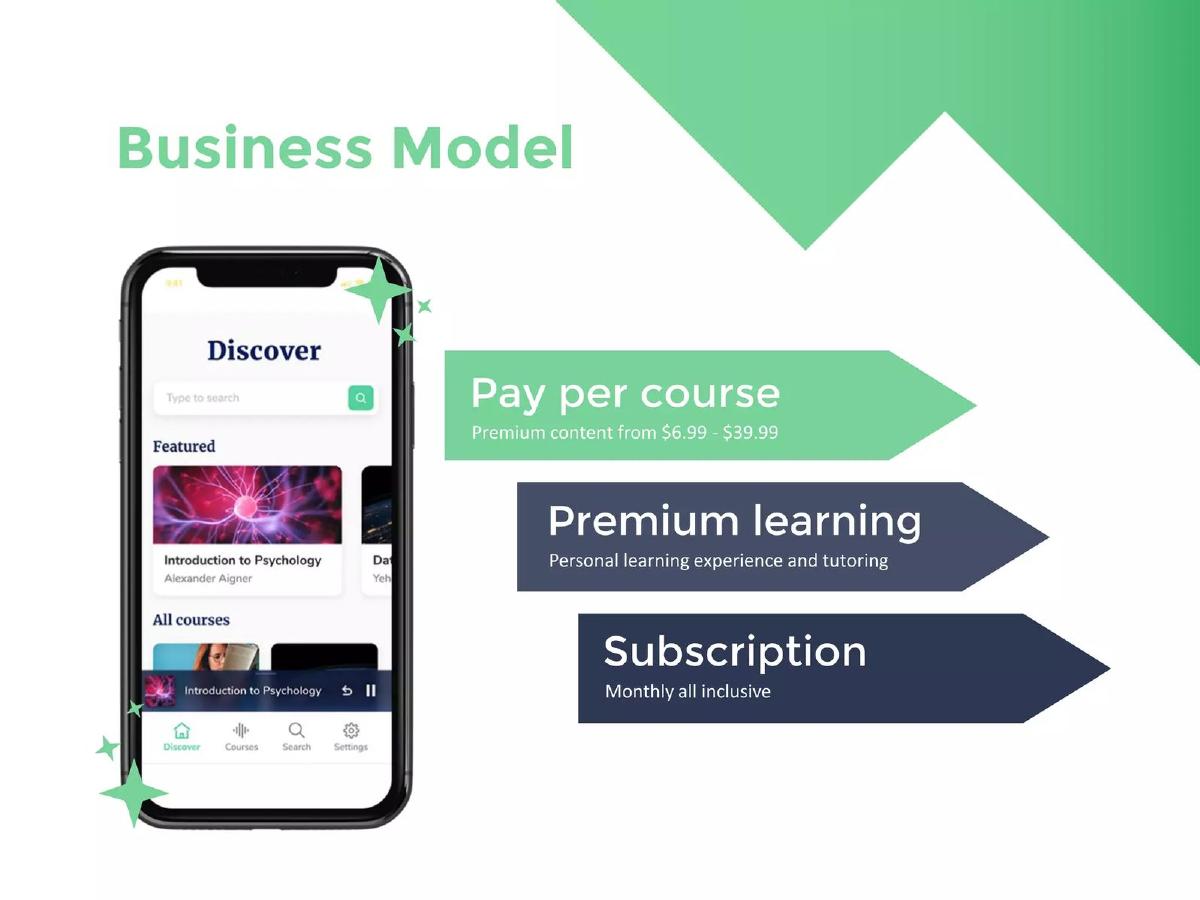
Page 11, 'Business Model', lists 'Pay per course: Premium content from $6.99 - $39.99', 'Premium learning: Personal learning experience and tutoring', and 'Subscription: Monthly all inclusive'. Only the first has a price.
Our reading: three models for six cohorts multiplies the unknowns. An overseas student might buy single courses; a vocational learner's employer might pay a subscription; a university would likely want a licence, which isn't one of the three. The beta is the natural place to test willingness to pay as well as retention, and page 9 doesn't list price among its learning goals.
Step six: landscape, competition, team and roadmap
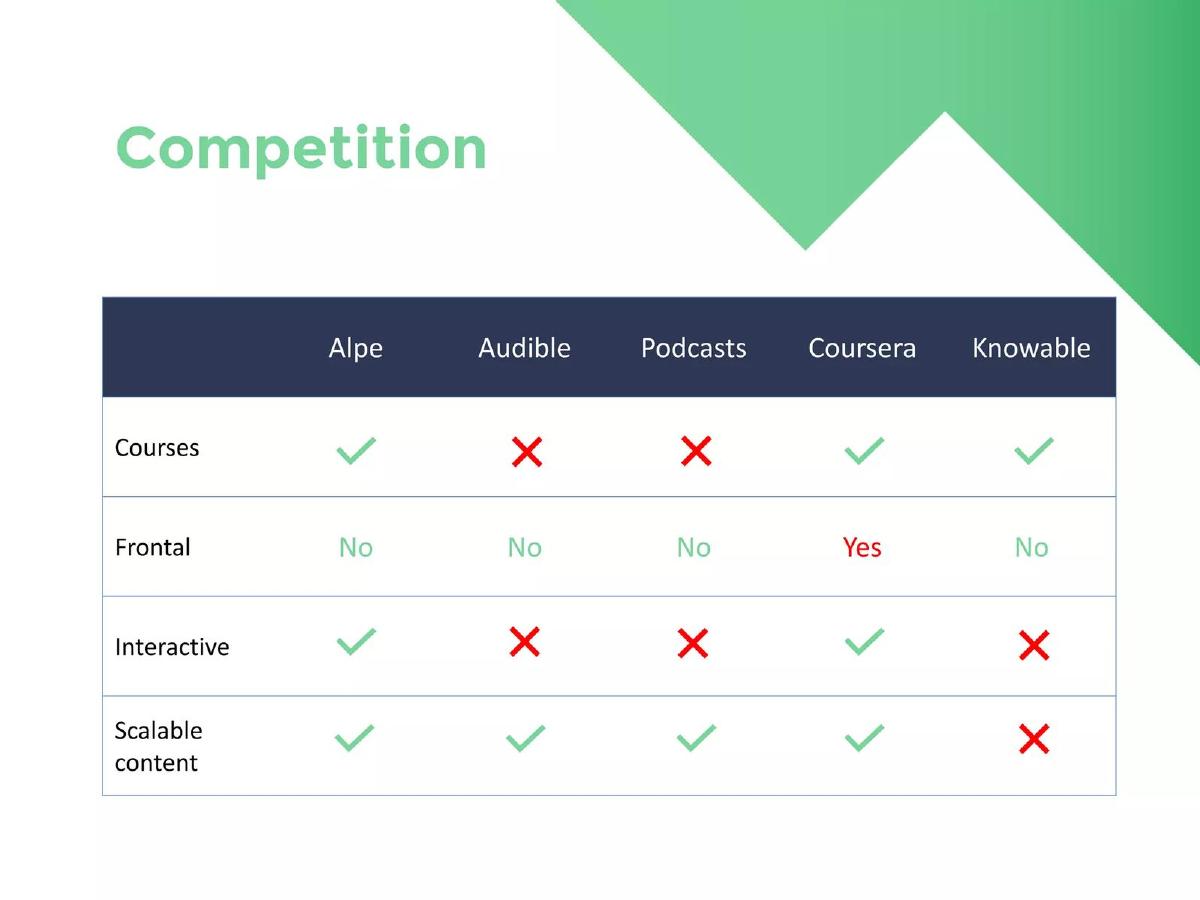
Page 12, 'Landscape: No platform for on-the-go learning', maps players on two axes, 'Passive consumption' to 'In depth, frontal learning', with Alpe alone in the top right. Page 13, 'Competition', compares Alpe, Audible, Podcasts, Coursera and Knowable on 'Courses', 'Frontal', 'Interactive' and 'Scalable content'; only Alpe has every box it wants. Page 14 introduces Yehoshua Zlotogorski (investor and entrepreneur, OurCrowd and Toyota AI Ventures connections listed) and Guy Hadash (former IBM Research staff member in deep learning for language). Page 17's roadmap runs from 'User & market research: Over 80 interviews' (May to June) through 'User testing: Live tests at 2 universities' (July), 'Content Partnerships' (August to September), 'MVP' (October to December), 'Beta: Launch to 5 cohorts and 2 universities, 3 new courses in the pipeline' (Q1 2020) and 'Expand' (Q2 2020).
Our reading: the roadmap adds two facts the beta page didn't: 80 interviews have happened, and two universities have already hosted live tests. Those are the deck's strongest evidence, and they're in the appendix. If the university tests went well, that's a reason to lead with universities; if they didn't, that's useful too. The deck doesn't say what the 80 interviews found. The team pairs investing and partnerships experience with machine learning for language, which fits the 'AI based course creation engine'. There is no ask.
Presenting a launch experiment
A pre-launch deck doesn't need to have picked its first customer, but it should show the method. One page can do it: a table with a row per cohort and columns for how you'll recruit them, the size of the test, the measure (for example, four-week course completion), the target that would make them the first cohort, what they'd pay and under which model, and the decision date. Then size the market for the two or three most likely winners, and say what you learned from the interviews and university tests that shaped the list.
That turns 'we'll find the right cohort' into 'here is how we'll choose, by when', which is the kind of plan investors can back before launch.
What a reader can't tell
Missing from the deck as published: sources for '95%', '4 minutes' and the gig driver figures; what '16 hours a week' measures; the growth measure behind '8.4% CAGR'; the size of any of the six cohorts; how many users each cohort will have in the beta; the target that would pick a winner and the decision date; prices for premium learning and subscription; how universities would pay; what the 80 interviews and two university tests found; the ask; and the deck's exact date. We don't guess at any of these.
When this structure works
Our view, drawing on this deck: being open about not yet knowing the first customer is a credible stance before launch, and Alpe's reasons for each cohort show real thought. The structure works when the beta page reads as an experiment with a rule for choosing, and when the market and pricing pages are built around the cohorts being tested rather than around the medium.
Common mistakes
A test without a decision rule. Give a measure, target and date.
Market sized for the medium. Size the cohorts you're testing.
Mixing institutions and individuals. Test them as separate tracks.
Pricing models with no buyer. Tie each model to a cohort.
Best evidence in the appendix. Bring research findings forward.
Diagnostic checklist
The beta names a measure per cohort.
A target picks the first cohort.
A decision date is stated.
The market sizes the likely cohorts.
Each pricing model has a buyer.
Research findings are in the main deck.
The ask is stated.
Frequently asked questions
Is it OK to say in a pitch deck that I haven't chosen my first customer yet?
Yes, before launch, if you show how you'll choose: the groups you'll test, the measure, the target that picks a winner and the date you'll decide.
Which cohorts was Alpe testing?
Page 9 lists gig economy drivers, overseas students, vocational training, people with ADD, dyslexia or visual impairment, founders, executives and VCs, and universities.
How did Alpe plan to make money?
Page 11 lists pay per course ($6.99 to $39.99), premium learning with tutoring, and a monthly subscription. Only pay per course has a price.
What market does Alpe's deck size?
US podcast listening, sourced to Edison Research: 189 million familiar with podcasts, 90 million monthly and 62 million weekly listeners. It doesn't size any of the six cohorts.
Did Alpe raise money with this deck?
The deck gives no ask, and we haven't confirmed any funding from it, so we make no claim that it raised money.
How we chose these examples
Selection (2026-10-02): the saved lead (Alcidion, an ASX-listed company's investor update) was skipped as ineligible under our listed-company exclusion; Alpe is the next deck in our inventory. Distinctness check: the teardown summarises the deck and no guide uses its slides; existing first-segment material assumes a segment is already chosen, while this walkthrough asks how a pre-launch deck should present a test of several first segments and carry it through market, pricing and roadmap.
All 17 pages of the original deck file (sha256 74bba65b…, matching our inventory) were rendered at 1200 px wide and read on contact sheets at about 600 px per page; pages 9 and 10 were also read at full size (AI editorial model review, not human). Seven images are used: pages 8, 9, 10, 11 and 17 were stored for this draft on 2026-10-02 from the renders, and pages 2 and 13 reuse images already in our library.
The deck's date (late 2019) is our inference from the roadmap. Market figures are reported as shown with the deck's stated source and not independently checked.
Eligibility: private company; the deck comes from SlideShare and is already in our library with an existing teardown; no takedown request is recorded. Team details are reported as shown. No funding or outcome claim is made.