Risks and Mitigation Slide: 12 Real Pitch Deck Examples
How to show risks in a pitch deck: twelve real risk slides compared, from three named risks to tables with likelihood, impact, a plan and an owner.
Risks and Mitigation Slide: How to Show What Could Go Wrong
Some founders add a slide naming what could stop the business, usually next to the ask. The twelve real slides below go from three risks named with icons, through tables with ratings and named owners, to slides that list risks to the people buying the company's notes. Read together, they show the parts a risk slide can include, which of them each company actually filled in, and where a well-built table can still mislead.
TL;DR
A useful risk slide gives each risk five things: what could happen, how likely the team thinks it is, what it would cost the company, what the team will do about it, and who is responsible. It then says what would show the plan is working. None of the twelve slides here does all of that. Doorvest's slide names three risks and stops. Standard Treasury pairs each risk with a one-line plan. BizMallUG adds likelihood and impact ratings and concrete measures such as a 3-month working capital reserve. Dotty AR and Maturious add a named owner for each risk; Maturious also rates nine of its ten risks "Low" likelihood, which shows how ratings can make a table look calmer than the business is. Symfone splits risks to the business from risks to its noteholders, and Savonnerie de St Louis answers one specific investor worry where it arises. Likelihood and impact ratings on these slides are the companies' own estimates; none of the slides shows evidence that a mitigation has worked.
Risk slides from real pitch decks
The first five run from least to most complete and come from the first version of this guide; the next seven, added on 2026-10-01, show a fuller table with owners, candid risks without responses, risks to noteholders, an industry-specific safety risk, a business-plan table, an objection answered in place and a generic slide to avoid. Each example shows the exact stored slide above its analysis and links to the full teardown. Text is quoted as shown on the slides. We describe only what each deck shows; a company may have addressed these risks elsewhere.
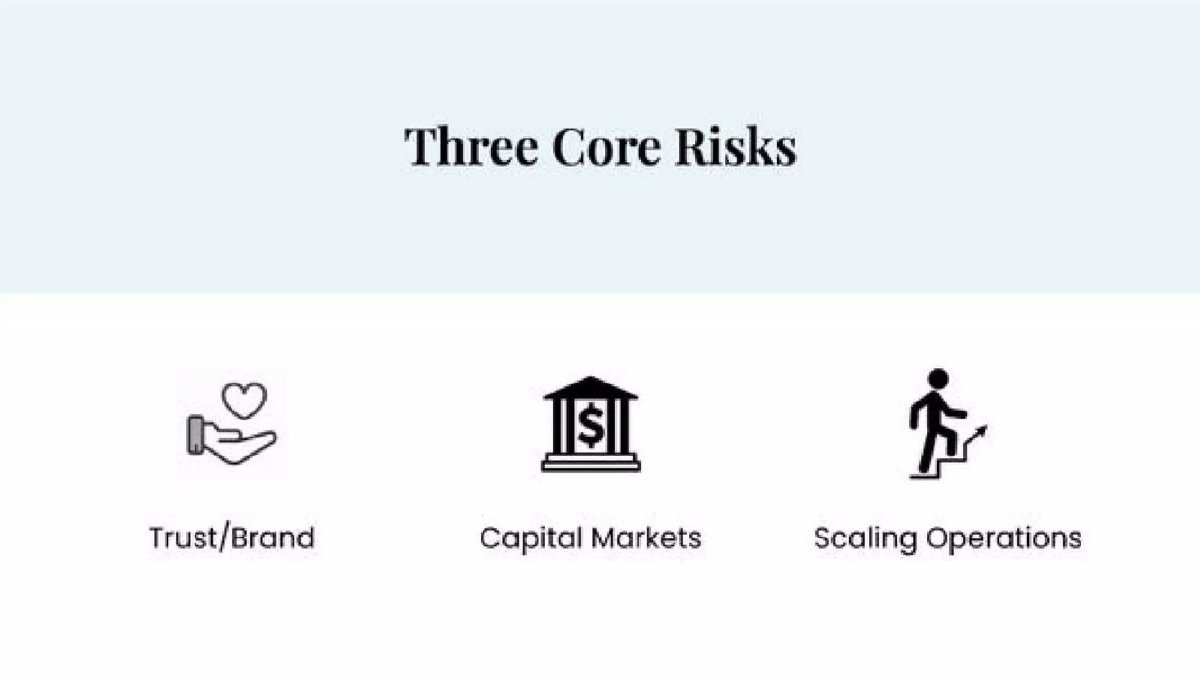
Doorvest ask slide — slide 7
Real estate investment company. The 9-page deck's cover reads "Investor Presentation / Seed Funding Round".
Doorvest deck, slide 7. Exact stored slide matched to this analysis.
Our analysis: It names risks at all, which many seed decks skip, and keeps them to three.
Evidence and limitation: The deck shows no likelihood, impact, response or owner for any of the three. That does not mean Doorvest had no plan, only that this deck does not show one; an investor will ask.
What a founder can adapt: Keep the short list, but turn each label into an event and add one line on what you will do.
Supporting analysis
What the deck claims: "Three Core Risks": "Trust/Brand", "Capital Markets" and "Scaling Operations", each with an icon. The next slides are a testimonial (slide 8) and the use of funds (slide 9).
Presentation choice: It names risks at all, which many seed decks skip, and keeps them to three.
When it does not fit: The deck shows no likelihood, impact, response or owner for any of the three. That does not mean Doorvest had no plan, only that this deck does not show one; an investor will ask.
Banking software company whose plan depended on obtaining a licence. Stage and year are not stated on the slide.
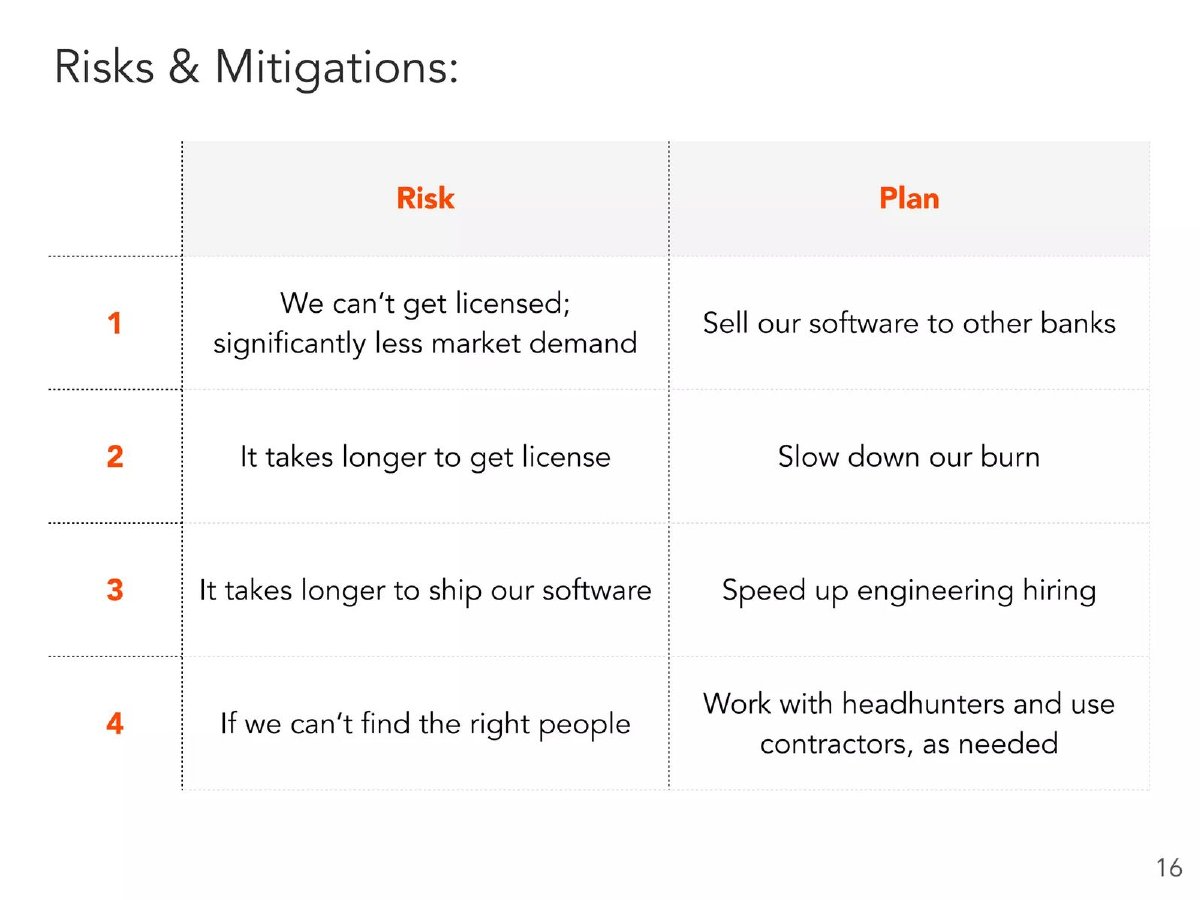
Standard Treasury deck, slide 16. Exact stored slide matched to this analysis.
Our analysis: Each risk is written as something that may or may not happen, and each plan is an action. The first row is a fallback business if the central bet fails.
Evidence and limitation: There are no ratings, owners or triggers. "Slow down our burn" would be stronger with how far and how many months it buys.
What a founder can adapt: Write risks as events and plans as what you will do if they happen. A fallback for your biggest dependency is worth a row.
Supporting analysis
What the deck claims: "Risks & Mitigations" with two columns, Risk and Plan: "We can't get licensed; significantly less market demand" / "Sell our software to other banks"; "It takes longer to get license" / "Slow down our burn"; "It takes longer to ship our software" / "Speed up engineering hiring"; "If we can't find the right people" / "Work with headhunters and use contractors, as needed".
Presentation choice: Each risk is written as something that may or may not happen, and each plan is an action. The first row is a fallback business if the central bet fails.
When it does not fit: There are no ratings, owners or triggers. "Slow down our burn" would be stronger with how far and how many months it buys.
Ugandan business-in-a-box company. The slide follows its funding request (slide 35).
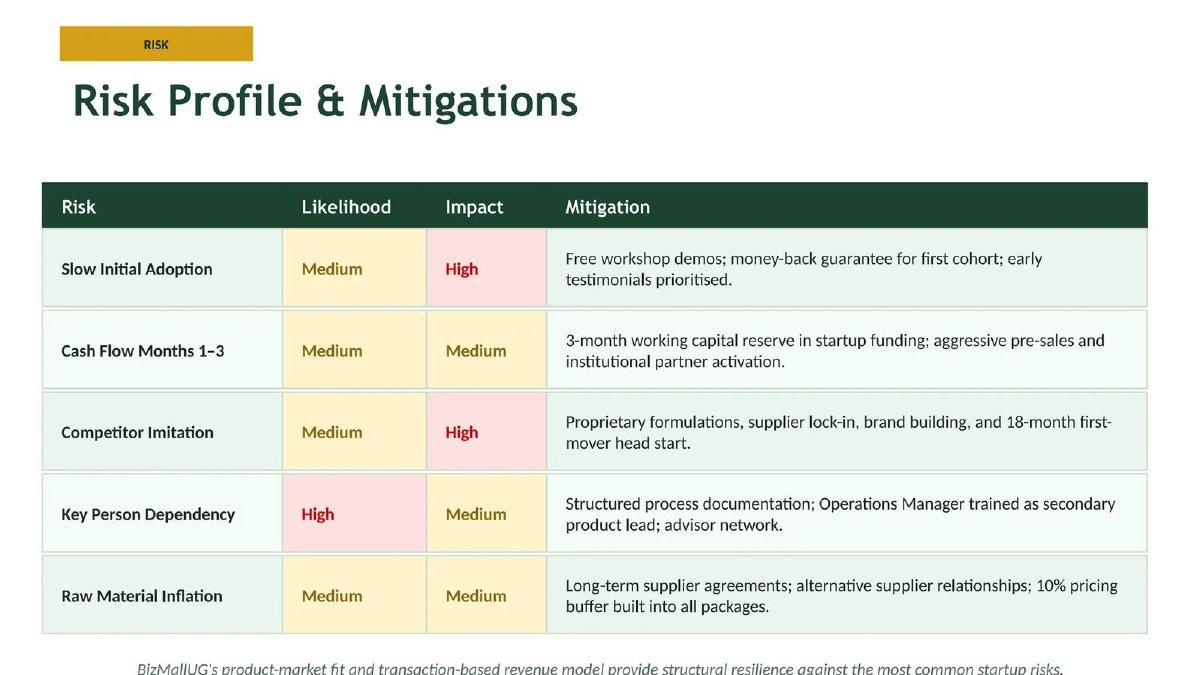
BizMallUG deck, slide 36. Exact stored slide matched to this analysis.
Our analysis: The mitigations are mostly concrete actions, and the cash-flow row ties to money in the round.
Evidence and limitation: No owner is named, the ratings are the company's own estimates, and the footer line ("provide structural resilience against the most common startup risks") is an assertion the table does not demonstrate.
What a founder can adapt: Where a mitigation is funded by the raise, link it to the use of funds so investors can check the amount.
Supporting analysis
What the deck claims: "Risk Profile & Mitigations" with Risk, Likelihood, Impact and Mitigation. Examples: "Slow Initial Adoption" (Medium, High): "Free workshop demos; money-back guarantee for first cohort; early testimonials prioritised." "Cash Flow Months 1–3" (Medium, Medium): "3-month working capital reserve in startup funding; aggressive pre-sales and institutional partner activation." "Key Person Dependency" (High, Medium): "Structured process documentation; Operations Manager trained as secondary product lead; advisor network." "Raw Material Inflation" (Medium, Medium): "Long-term supplier agreements; alternative supplier relationships; 10% pricing buffer built into all packages."
Presentation choice: The mitigations are mostly concrete actions, and the cash-flow row ties to money in the round.
When it does not fit: No owner is named, the ratings are the company's own estimates, and the footer line ("provide structural resilience against the most common startup risks") is an assertion the table does not demonstrate.
Enterprise augmented reality company. The slide is marked "Private & Confidential". Stage and year are not stated on the slide.
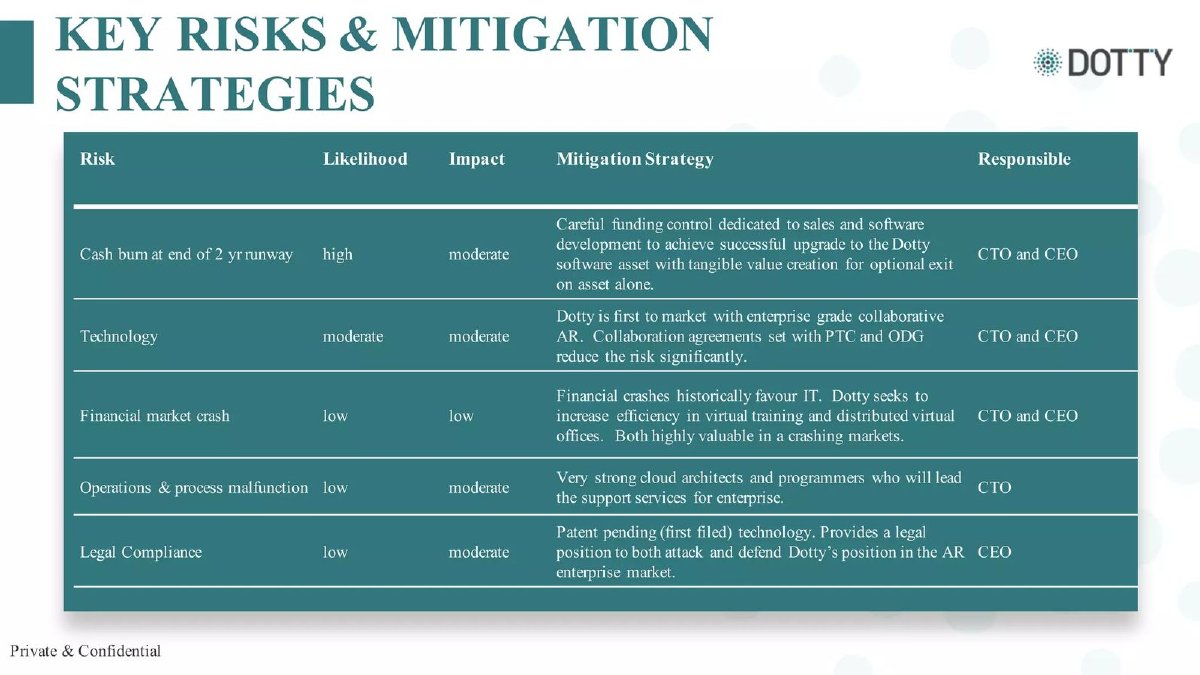
Dotty AR deck, slide 25. Exact stored slide matched to this analysis.
Our analysis: It is the only slide here with all four columns: risk, both ratings, a response and an owner.
Evidence and limitation: Several mitigations are arguments, not actions ("Financial crashes historically favour IT"), and "CTO and CEO" own four of five rows. The ratings are estimates, and the slide gives no terms or evidence for the PTC and ODG agreements.
What a founder can adapt: Copy the structure, then give each row one owner and one action you could report progress on.
Supporting analysis
What the deck claims: "Key Risks & Mitigation Strategies" with Risk, Likelihood, Impact, Mitigation Strategy and Responsible. "Cash burn at end of 2 yr runway" (high, moderate; CTO and CEO). "Technology" (moderate, moderate): "Collaboration agreements set with PTC and ODG reduce the risk significantly" (CTO and CEO). "Financial market crash" (low, low): "Financial crashes historically favour IT" (CTO and CEO). "Operations & process malfunction" (low, moderate; CTO). "Legal Compliance" (low, moderate): "Patent pending (first filed) technology" (CEO).
Presentation choice: It is the only slide here with all four columns: risk, both ratings, a response and an owner.
When it does not fit: Several mitigations are arguments, not actions ("Financial crashes historically favour IT"), and "CTO and CEO" own four of five rows. The ratings are estimates, and the slide gives no terms or evidence for the PTC and ODG agreements.
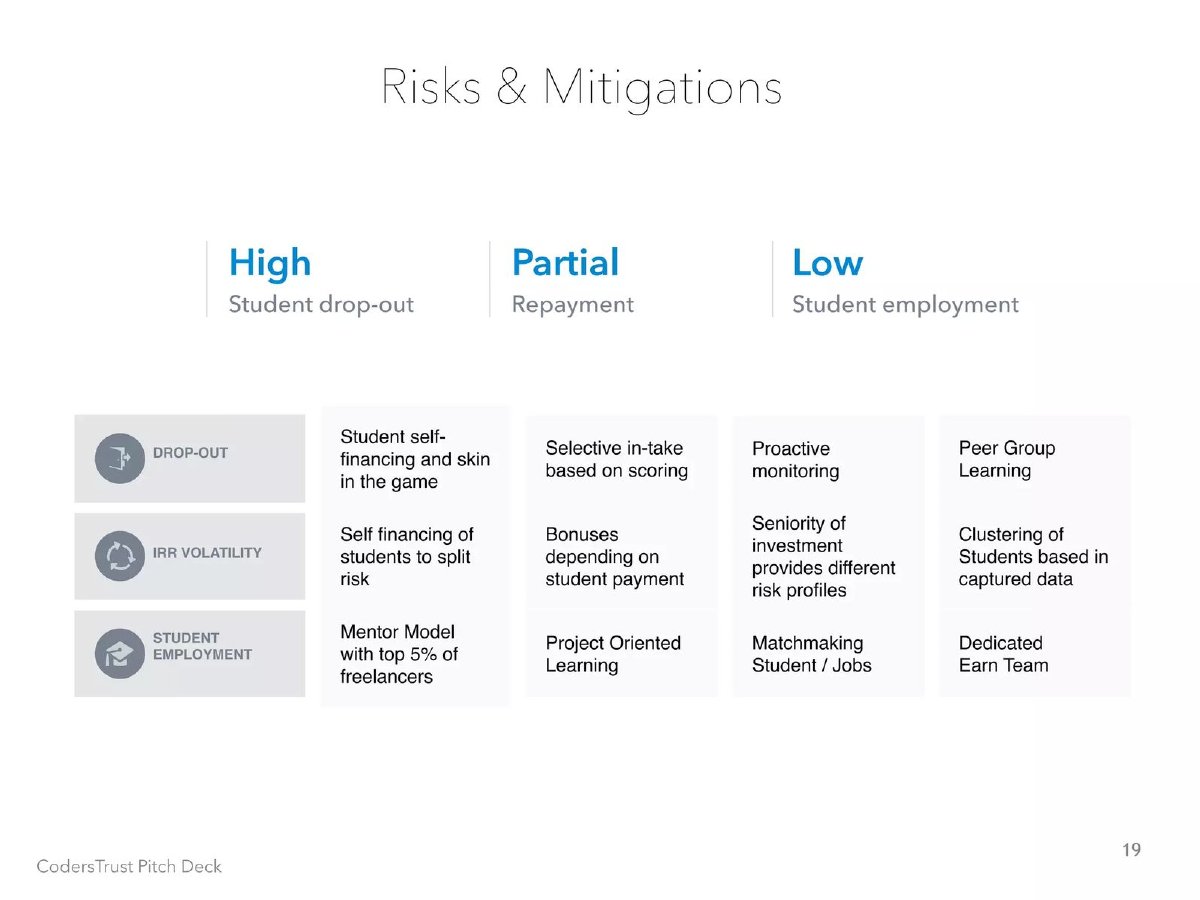
Education financing company that funds students' coding courses and is repaid from their later freelance earnings. Page 22 of the file; the slide itself is numbered 19.
CodersTrust deck, slide 22. Exact stored slide matched to this analysis.
Our analysis: Most of the responses are built into how the product works (who is admitted, who carries part of the cost, how staff are paid), so they operate all the time rather than only after something goes wrong.
Evidence and limitation: The slide does not say what "High", "Partial" and "Low" measure, whether they are likelihoods or labels for each risk, and it shows no drop-out or repayment figures. State what a rating means and show the number it will be judged by.
What a founder can adapt: If your model already absorbs a risk, say which design choice does it. That is often more convincing than a plan you would start later.
Supporting analysis
What the deck claims: "Risks & Mitigations" with three risks: "Drop-out", "IRR Volatility" and "Student Employment". Above them: "High" Student drop-out, "Partial" Repayment, "Low" Student employment. Each risk has four responses, for example for drop-out: "Student self-financing and skin in the game", "Selective in-take based on scoring", "Proactive monitoring", "Peer Group Learning"; for IRR volatility: "Self financing of students to split risk", "Bonuses depending on student payment", "Seniority of investment provides different risk profiles".
Presentation choice: Most of the responses are built into how the product works (who is admitted, who carries part of the cost, how staff are paid), so they operate all the time rather than only after something goes wrong.
When it does not fit: The slide does not say what "High", "Partial" and "Low" measure, whether they are likelihoods or labels for each risk, and it shows no drop-out or repayment figures. State what a rating means and show the number it will be judged by.
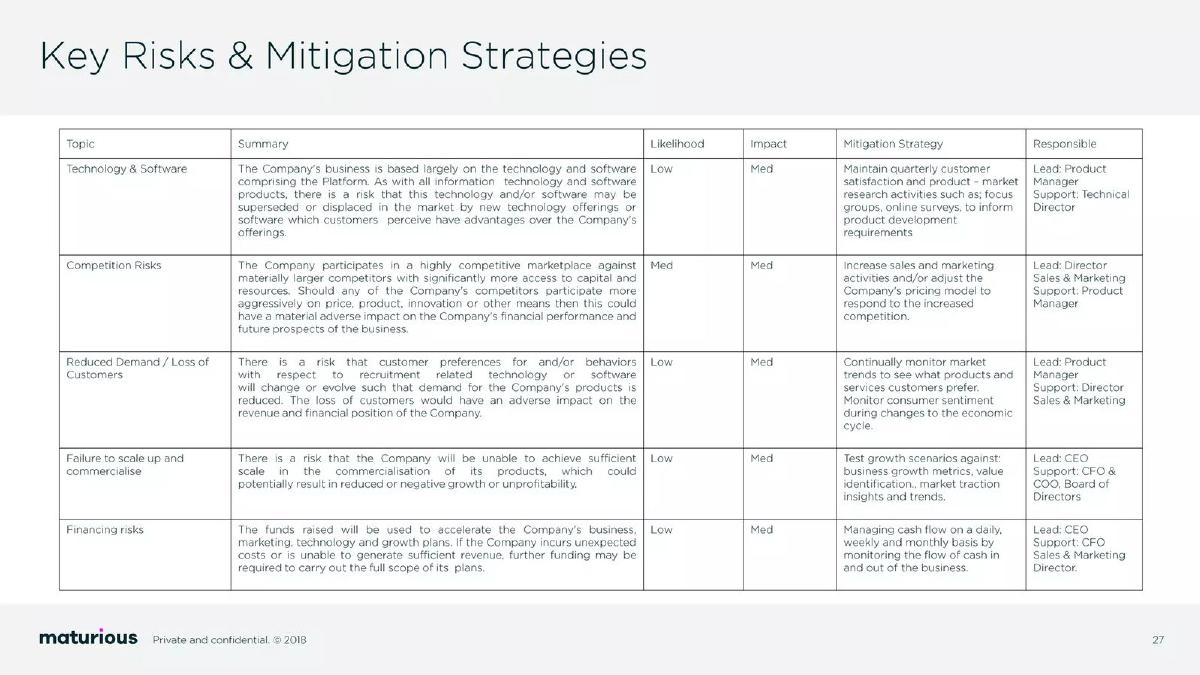
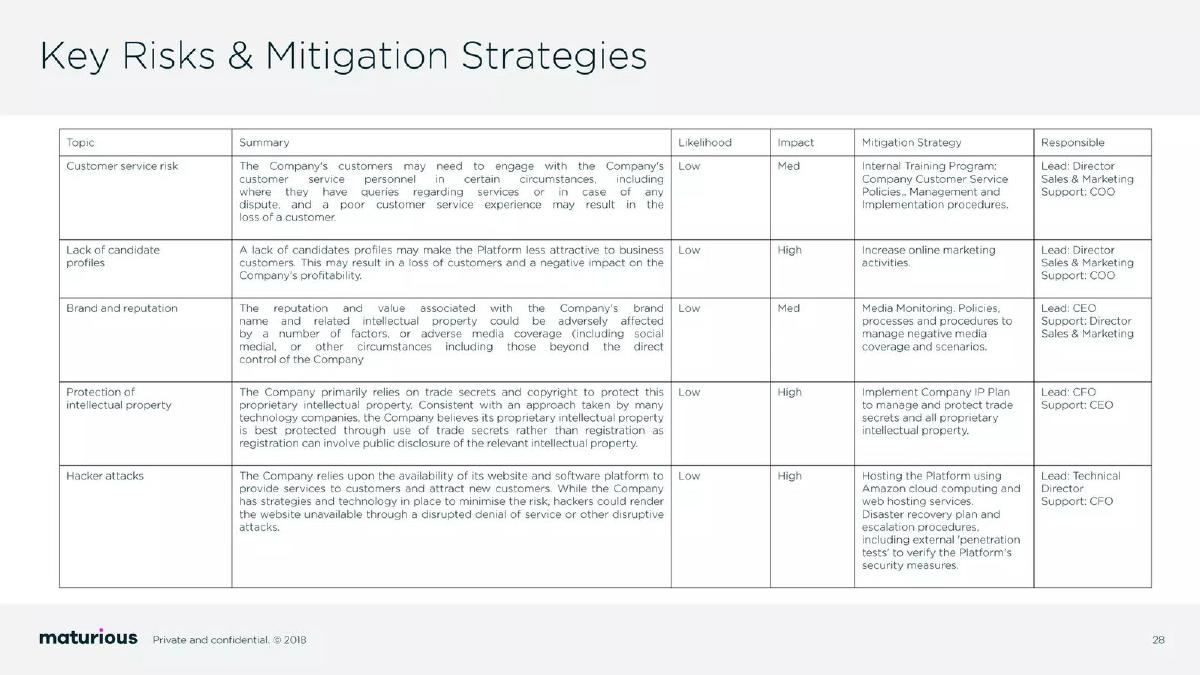
Maturious deck, slide 28. Exact stored slide matched to this analysis.Maturious deck, slide 29. Exact stored slide matched to this analysis.
Our analysis: It is the most complete table in this guide: every row has a summary, both ratings, a mitigation and a named lead and support role. The IP row explains a deliberate choice (trade secrets over patents) instead of leaving investors to wonder why there are no patents.
Evidence and limitation: Nine of ten risks rated "Low" likelihood makes the ratings almost meaningless, and ten rows across two slides is more than most investors will read. Several mitigations are routines ("Continually monitor market trends", "Increase online marketing activities") with no target or date. The ratings are the company's estimates.
What a founder can adapt: Copy the owner column (one lead, one support) and the habit of explaining choices that look like gaps.
Supporting analysis
What the deck claims: Two slides headed "Key Risks & Mitigation Strategies", each a table with Topic, Summary, Likelihood, Impact, Mitigation Strategy and Responsible. Ten risks in total, from "Technology & Software" and "Competition Risks" to "Financing risks", "Protection of intellectual property" and "Hacker attacks". Competition is rated "Med" likelihood; the other nine are "Low". Impacts are "Med" or "High". Each row names a lead and a support role, for example "Lead: CEO / Support: CFO & COO, Board of Directors" for "Failure to scale up and commercialise", and "Lead: Technical Director / Support: CFO" for hacker attacks, mitigated by "Hosting the Platform using Amazon cloud computing and web hosting services" and external "penetration tests". The IP row says the company "believes its proprietary intellectual property is best protected through use of trade secrets rather than registration".
Presentation choice: It is the most complete table in this guide: every row has a summary, both ratings, a mitigation and a named lead and support role. The IP row explains a deliberate choice (trade secrets over patents) instead of leaving investors to wonder why there are no patents.
When it does not fit: Nine of ten risks rated "Low" likelihood makes the ratings almost meaningless, and ten rows across two slides is more than most investors will read. Several mitigations are routines ("Continually monitor market trends", "Increase online marketing activities") with no target or date. The ratings are the company's estimates.
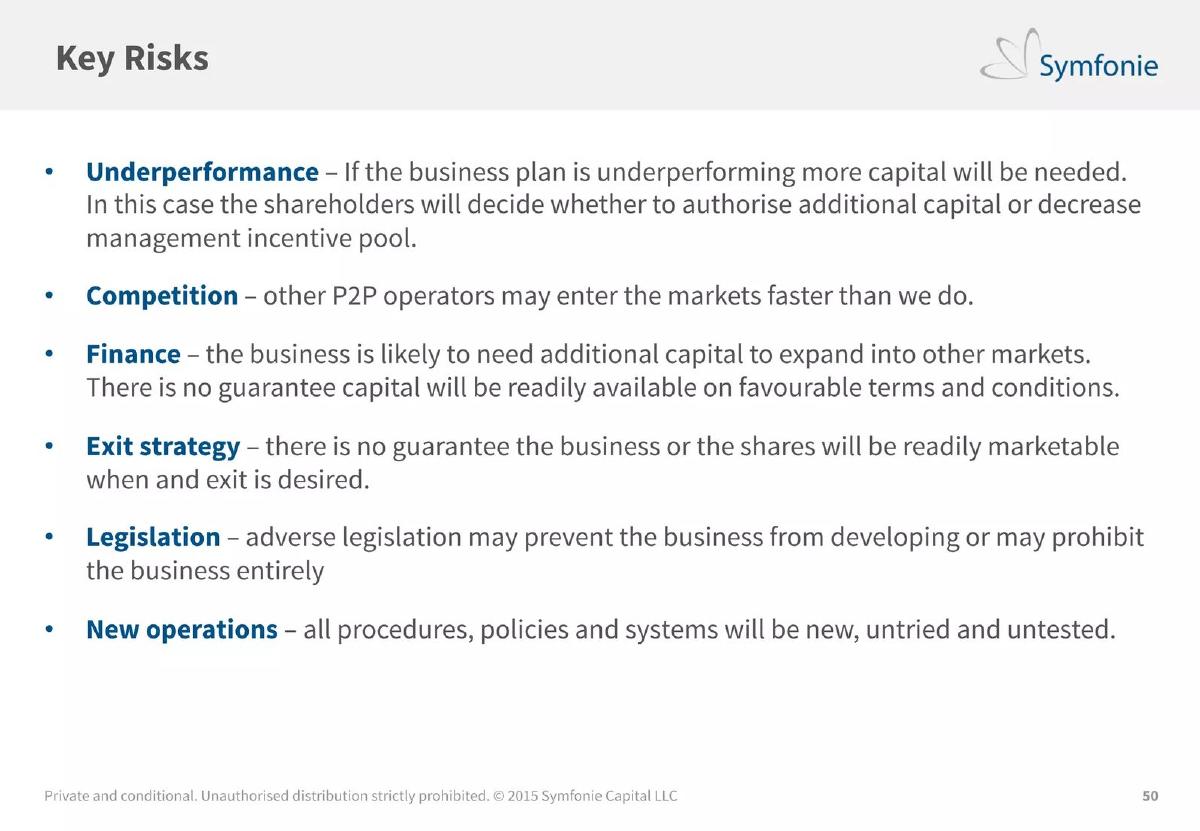
Symfone deck, slide 50. Exact stored slide matched to this analysis.
Our analysis: It is unusually candid: it admits the systems are untested and that legislation could end the business. The underperformance line also says who decides what happens next (the shareholders) and what the options are.
Evidence and limitation: Five of the six risks have no response, ratings or owner. "Finance" and "Exit strategy" read like general investment warnings rather than risks specific to this plan.
What a founder can adapt: Keep the candour, then add one action per risk. The underperformance line is the model: it names the consequence and the decision that follows.
Supporting analysis
What the deck claims: "Key Risks" with six bullets: "Underperformance – If the business plan is underperforming more capital will be needed. In this case the shareholders will decide whether to authorise additional capital or decrease management incentive pool." "Competition – other P2P operators may enter the markets faster than we do." "Finance – the business is likely to need additional capital to expand into other markets." "Exit strategy – there is no guarantee the business or the shares will be readily marketable". "Legislation – adverse legislation may prevent the business from developing or may prohibit the business entirely". "New operations – all procedures, policies and systems will be new, untried and untested."
Presentation choice: It is unusually candid: it admits the systems are untested and that legislation could end the business. The underperformance line also says who decides what happens next (the shareholders) and what the options are.
When it does not fit: Five of the six risks have no response, ratings or owner. "Finance" and "Exit strategy" read like general investment warnings rather than risks specific to this plan.
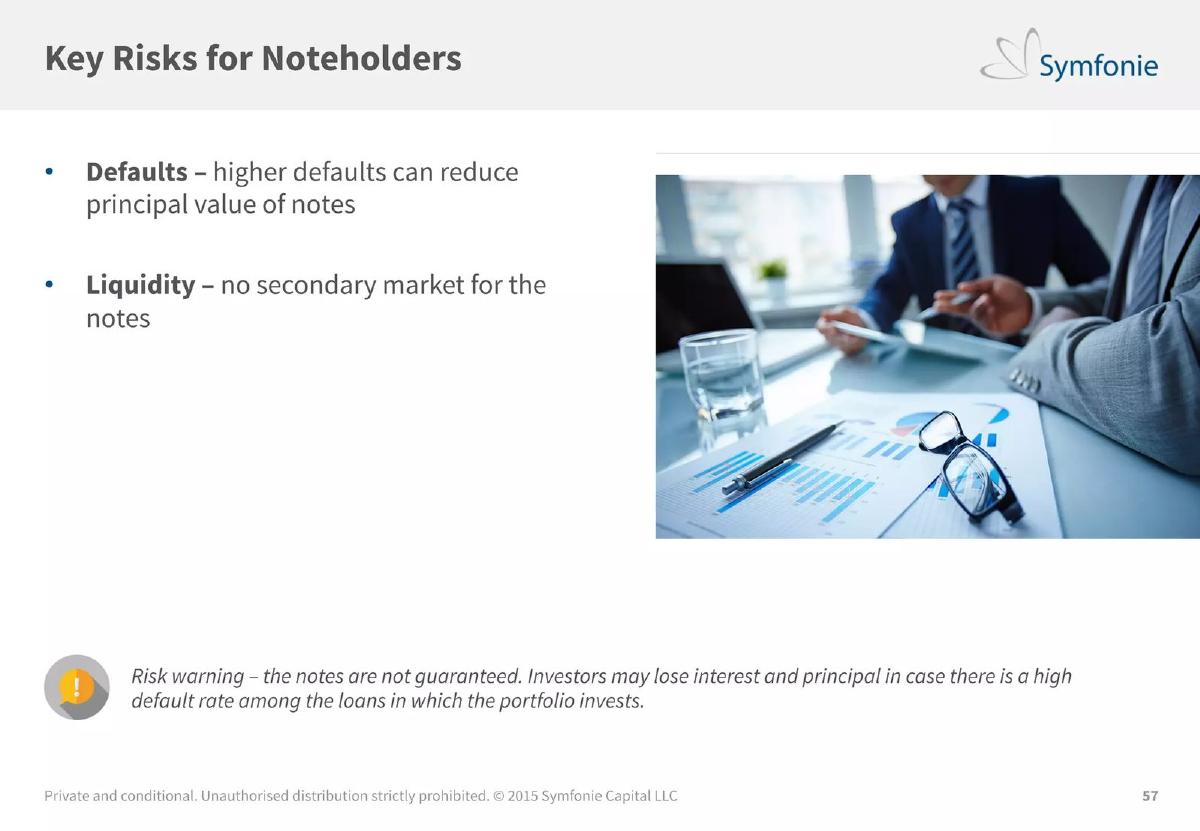
Same deck, page 57: the risks for investors buying the notes of Symfone's lending portfolio rather than shares in the company.
Symfone deck, slide 57. Exact stored slide matched to this analysis.
Our analysis: It separates the risk carried by a different kind of investor from the risks of the business, and states plainly that the notes can lose principal and cannot easily be sold.
Evidence and limitation: It gives no default rate, loss history or reserve, so the holder cannot size the risk. Half the slide is a stock photo.
What a founder can adapt: If your round offers notes or another instrument, list what the holder could lose and how they could exit, separately from business risks.
Supporting analysis
What the deck claims: "Key Risks for Noteholders": "Defaults – higher defaults can reduce principal value of notes" and "Liquidity – no secondary market for the notes". A boxed line reads: "Risk warning – the notes are not guaranteed. Investors may lose interest and principal in case there is a high default rate among the loans in which the portfolio invests."
Presentation choice: It separates the risk carried by a different kind of investor from the risks of the business, and states plainly that the notes can lose principal and cannot easily be sold.
When it does not fit: It gives no default rate, loss history or reserve, so the holder cannot size the risk. Half the slide is a stock photo.
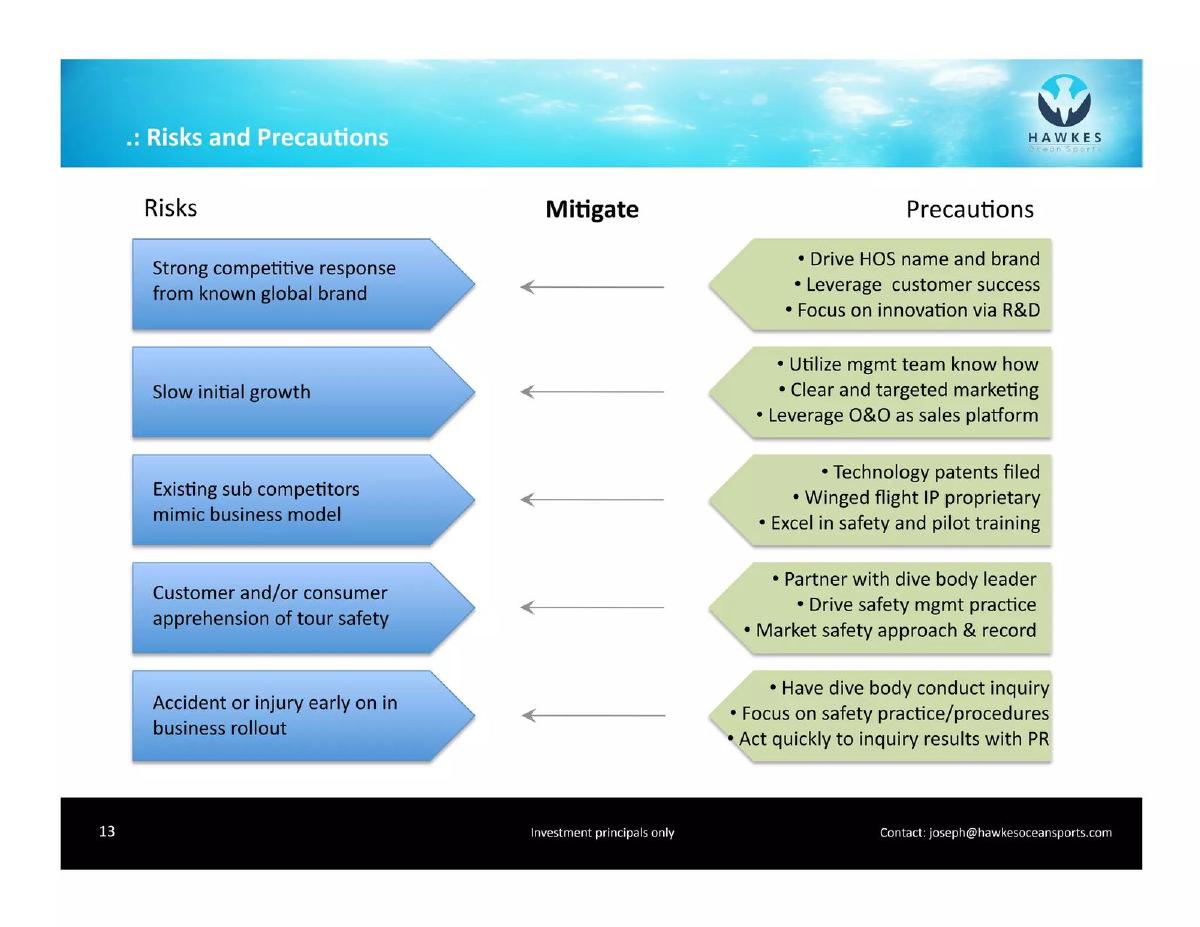
Underwater flight tour company; the slide footer reads "Investment principals only". Stage and year are not stated on the slide.
Hawkes Ocean Sports deck, slide 13. Exact stored slide matched to this analysis.
Our analysis: It names the risk specific to this business that many founders would avoid putting on a slide (a customer being hurt early on) and gives a response plan, including an outside inquiry.
Evidence and limitation: There are no ratings or owners, and several precautions are general ("Drive HOS name and brand", "Clear and targeted marketing"). "Technology patents filed" gives no number, title or status.
What a founder can adapt: Include the risk an investor in your industry will think of first, even if it is uncomfortable, and show the response.
Supporting analysis
What the deck claims: "Risks and Precautions" with Risks on the left, "Mitigate" arrows and Precautions on the right. Five risks: "Strong competitive response from known global brand", "Slow initial growth", "Existing sub competitors mimic business model", "Customer and/or consumer apprehension of tour safety" and "Accident or injury early on in business rollout". For the last: "Have dive body conduct inquiry", "Focus on safety practice/procedures", "Act quickly to inquiry results with PR". For copycats: "Technology patents filed", "Winged flight IP proprietary", "Excel in safety and pilot training".
Presentation choice: It names the risk specific to this business that many founders would avoid putting on a slide (a customer being hurt early on) and gives a response plan, including an outside inquiry.
When it does not fit: There are no ratings or owners, and several precautions are general ("Drive HOS name and brand", "Clear and targeted marketing"). "Technology patents filed" gives no number, title or status.
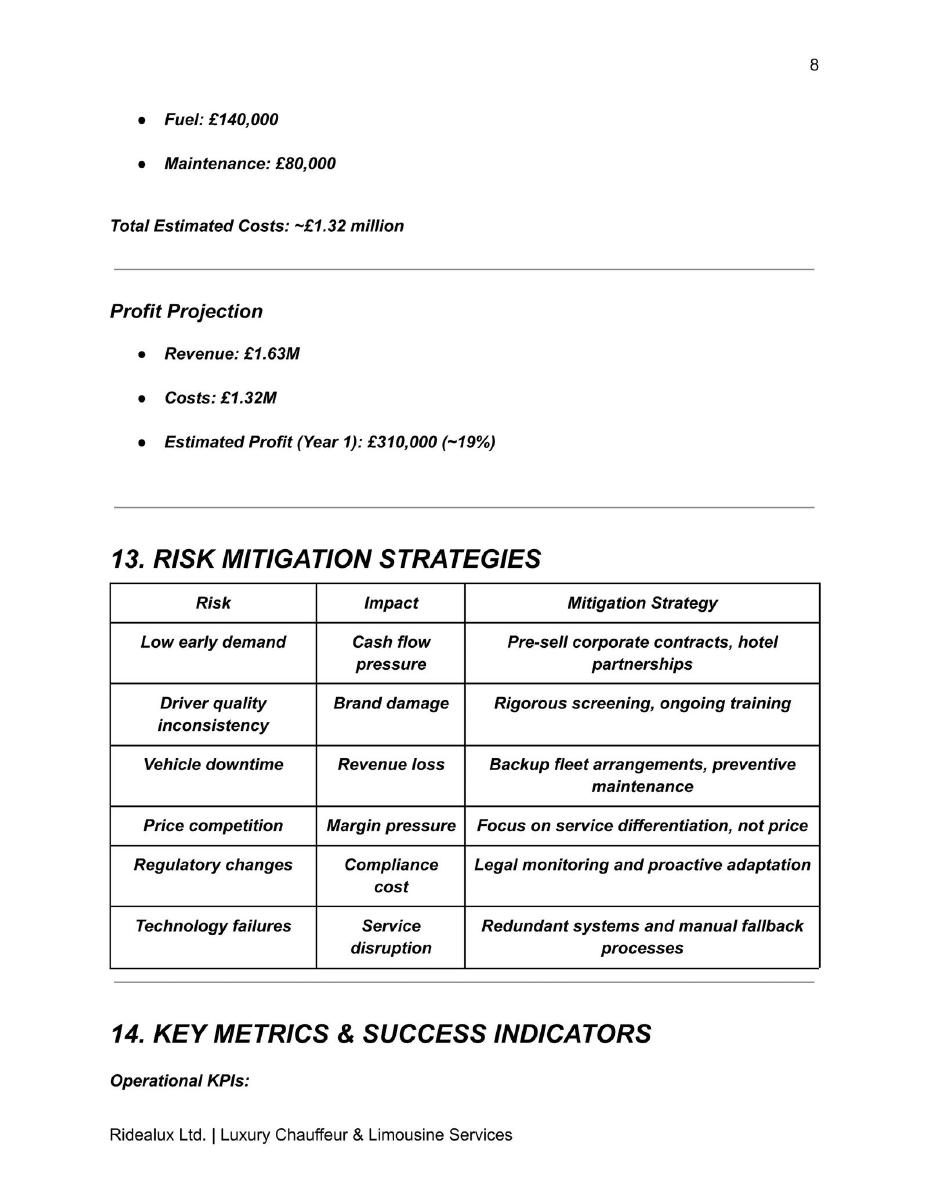
London luxury chauffeur service. This file is a written business plan rather than a slide deck; page 8 holds section "13. Risk Mitigation Strategies" below a first-year profit projection.
Ridealux deck, slide 8. Exact stored slide matched to this analysis.
Our analysis: The Impact column states the consequence of each risk in plain words (cash flow pressure, brand damage, revenue loss), which most risk slides leave the reader to guess.
Evidence and limitation: It is a plan document, not a slide, so it is denser than a deck page should be. There is no likelihood or owner, and "Legal monitoring and proactive adaptation" is a routine rather than a plan.
What a founder can adapt: Add an impact column that names the consequence, and if you can, size it in money or months.
Supporting analysis
What the deck claims: A table with Risk, Impact and Mitigation Strategy: "Low early demand" / "Cash flow pressure" / "Pre-sell corporate contracts, hotel partnerships"; "Driver quality inconsistency" / "Brand damage" / "Rigorous screening, ongoing training"; "Vehicle downtime" / "Revenue loss" / "Backup fleet arrangements, preventive maintenance"; "Price competition" / "Margin pressure" / "Focus on service differentiation, not price"; "Regulatory changes" / "Compliance cost"; "Technology failures" / "Service disruption" / "Redundant systems and manual fallback processes".
Presentation choice: The Impact column states the consequence of each risk in plain words (cash flow pressure, brand damage, revenue loss), which most risk slides leave the reader to guess.
When it does not fit: It is a plan document, not a slide, so it is denser than a deck page should be. There is no likelihood or owner, and "Legal monitoring and proactive adaptation" is a routine rather than a plan.
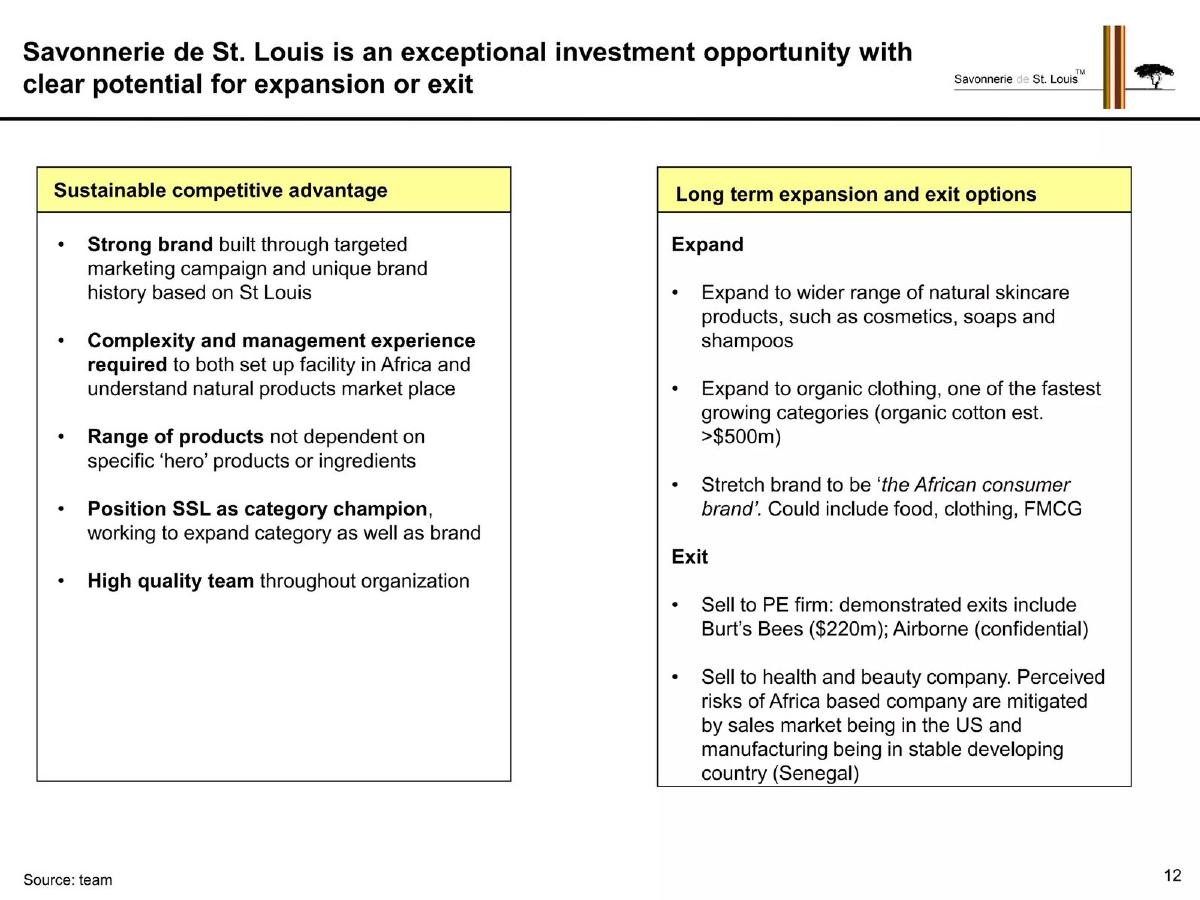
Natural skincare company manufacturing in Senegal and selling in the US. The slide is headed as an investment opportunity with "clear potential for expansion or exit"; it is footed "Source: team".
Savonnerie de St Louis deck, slide 12. Exact stored slide matched to this analysis.
Our analysis: It anticipates a specific doubt an acquirer or investor may have and answers it at the point where it matters, instead of on a generic risk slide.
Evidence and limitation: The mitigation is the company's own argument; the slide shows no buyer feedback, and the Burt's Bees figure is a comparable, not evidence about this company.
What a founder can adapt: For a risk you know investors will raise, answer it next to the claim it threatens.
Supporting analysis
What the deck claims: Under "Long term expansion and exit options", the second exit bullet reads: "Sell to health and beauty company. Perceived risks of Africa based company are mitigated by sales market being in the US and manufacturing being in stable developing country (Senegal)". The first exit bullet cites "Burt's Bees ($220m)" as a demonstrated exit.
Presentation choice: It anticipates a specific doubt an acquirer or investor may have and answers it at the point where it matters, instead of on a generic risk slide.
When it does not fit: The mitigation is the company's own argument; the slide shows no buyer feedback, and the Burt's Bees figure is a comparable, not evidence about this company.
Technology company (ifgtechnology.net). Stage and year are not stated on the slide. Included as a contrast.
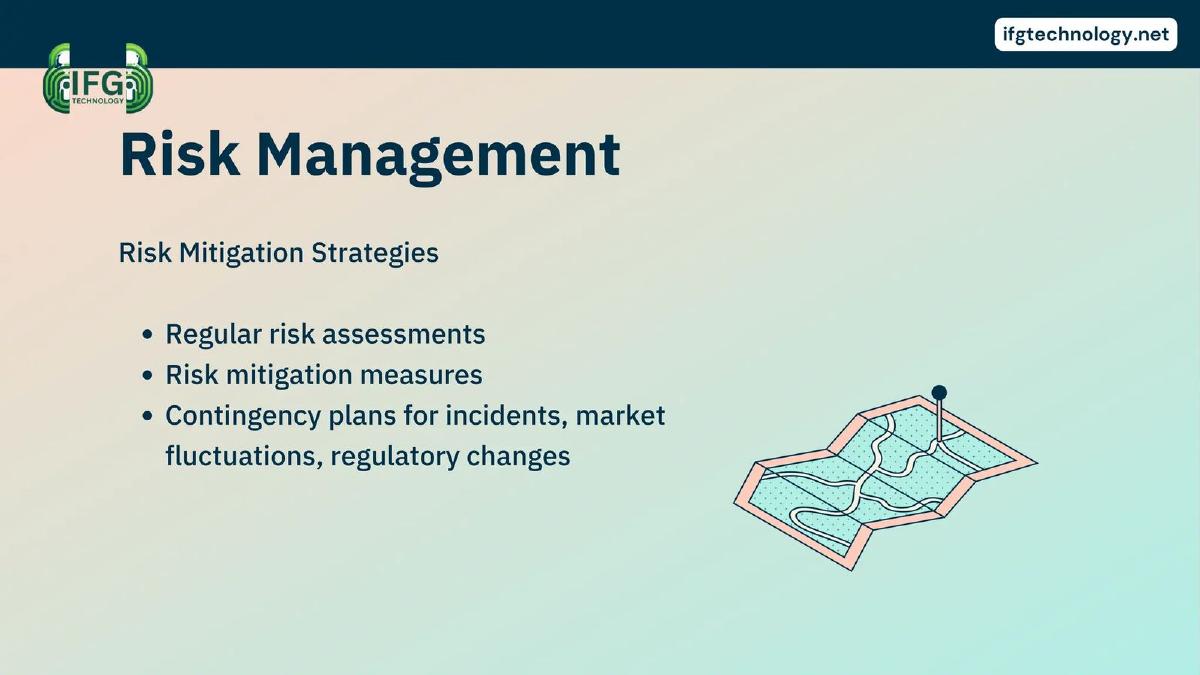
IFG Technology deck, slide 12. Exact stored slide matched to this analysis.
Our analysis: Included as a contrast. It shows the company knows a risk slide is expected.
Evidence and limitation: It names no specific risk, rating, owner or measure; "Risk mitigation measures" as a mitigation strategy says nothing. An investor learns nothing they could ask a follow-up about.
What a founder can adapt: Replace each bullet with a named risk and the action you take for it.
Supporting analysis
What the deck claims: "Risk Management" with the subheading "Risk Mitigation Strategies" and three bullets: "Regular risk assessments", "Risk mitigation measures" and "Contingency plans for incidents, market fluctuations, regulatory changes".
Presentation choice: Included as a contrast. It shows the company knows a risk slide is expected.
When it does not fit: It names no specific risk, rating, owner or measure; "Risk mitigation measures" as a mitigation strategy says nothing. An investor learns nothing they could ask a follow-up about.
"Yes" means the slide states it; nothing here means the risk was or wasn't handled outside the deck.
Example
Risk as event
Likelihood / impact
Response
Owner
Evidence of progress
Doorvest
No (categories)
No
No
No
No
Standard Treasury
Yes
No
Yes, one line each
No
No
BizMallUG
Mostly
Yes (estimates)
Yes, mostly actions
No
No
CodersTrust
Partly (categories)
Unlabelled ratings
Yes, built into the model
No
No
Dotty AR
Partly
Yes (estimates)
Mixed actions and arguments
Yes
No
Maturious
Mostly
Yes (estimates; 9 of 10 Low)
Yes, many routines
Yes, lead and support
No
Symfone (business)
Yes
No
One of six
No
No
Symfone (noteholders)
Yes
No
No (warning only)
No
No
Hawkes Ocean Sports
Yes
No
Yes, mixed
No
No
Ridealux (plan document)
Yes
Impact only (consequence)
Yes
No
No
Savonnerie de St Louis
One perceived risk
No
An argument
No
No
IFG Technology
No
No
No
No
No
Key Takeaways
Name the risk as an event. Standard Treasury's "It takes longer to get license" is testable; Doorvest's "Capital Markets" is a category.
Pair each risk with an action. Standard Treasury's plans ("Slow down our burn") say what the team will do if it happens; Symfone's slide names six risks and no responses.
Rate likelihood and impact separately, and spread the ratings honestly. Maturious rates nine of ten risks "Low" likelihood; an investor will ask what the real top risk is.
Prefer measures to reassurance. BizMallUG's "10% pricing buffer" is an action; Dotty AR's "Financial crashes historically favour IT" is an argument.
Name who owns each risk. Maturious gives a lead and a support role per row; Dotty AR gives "CTO and CEO" for four of five rows.
If investors hold a different instrument, list its risks separately. Symfone's "Key Risks for Noteholders" covers defaults and liquidity for people buying its notes.
Answer a known objection where it comes up. Savonnerie de St Louis addresses the "Africa based company" worry inside its exit options.
Write your risk slide
Pick the three to five risks that could stop this round's plan, then fill one row per risk. If investors buy notes or another instrument, add a separate line on their risks.
Risk. What event could happen, written so you could later say whether it did?
Likelihood and impact. How likely do you think it is, and what would it cost you in months or money? Label these as estimates, and make sure your top risk is not rated low.
Mitigation and owner. What action are you taking, and which one person owns it?
Evidence. What milestone or number would show the mitigation is working, and by when?
Investor's own risk. If investors hold notes or another instrument, what could they lose and how could they sell?
Copyable framework: [Risk event] | Likelihood: [low/medium/high, our estimate] | Impact: [months of runway or revenue at stake] | Mitigation: [action] | Owner: [name/role] | Progress shown by: [milestone, date]
Illustrative example 1 — written by us
Before: Capital Markets
After: Next round takes 6 months longer than planned | Likelihood: medium (estimate) | Impact: runway ends in month 16 | Mitigation: hiring plan can be cut to extend runway to month 22 | Owner: CEO | Progress shown by: monthly burn against plan
What improved: Our illustrative rewrite, not any company's text or plan. It turns a category into an event with a rating, an action, an owner and something to track.
Illustrative example 2 — written by us
Before: Risk mitigation measures
After: Main hosting provider outage | Likelihood: low (estimate) | Impact: platform down, about two days of bookings lost | Mitigation: second region on standby, tested quarterly | Owner: CTO | Progress shown by: date of last failover test
What improved: Our illustrative rewrite of a generic bullet like IFG Technology's. It names the event, the cost, the action and how you would know it works.
What this guide adds
The ask slide guide covers how much you raise and what the money buys; the financials guide covers forecasts and break-even; the roadmap guide covers milestones; the regulatory guide covers approvals and pathways. None of them covers how to present the things that could stop the plan and what you will do about each one. That is the question here.
Risk slides tend to sit next to the ask. Doorvest's comes two slides before its use of funds, and BizMallUG's straight after its funding request, which is why this guide is filed under the ask slide.
Five parts of a risk entry
This is our editorial template, not something any one slide in this guide contains in full. Risk: the event, written so you could later say whether it happened ("licence takes longer than 12 months", not "regulation"). Likelihood and impact: your estimate of each, rated separately. Mitigation: an action you are taking or will take, not a reason the risk is small. Owner: one named person or role. Evidence: the milestone or number that would show the mitigation is working, such as a signed supplier agreement or cash reserve still above a set level.
Mark estimates as estimates. A "high" likelihood on a slide is the founder's judgement, not a measured result.
When the ratings all say low
A table with likelihood and impact columns looks rigorous, but the columns only help if the ratings differ. Maturious' two risk slides rate ten risks; nine have "Low" likelihood and one, competition, is "Med". Every impact is "Med" or "High". Read literally, the company expects almost nothing to go wrong, which is rarely true of an early company raising money to scale.
An investor reading a table like that will usually rank the risks themselves and ask about the one you rated lowest that they think is highest. It is better to do that ranking first. Put the two or three risks you genuinely worry about at the top, rate them honestly, and let the lower rows be lower. A table where one risk is "High" and the plan for it is specific is more credible than a table where everything is "Low".
Ratings are also only useful if the slide says what they mean. CodersTrust's "High", "Partial" and "Low" labels are not explained; BizMallUG, Dotty AR and Maturious at least head their columns Likelihood and Impact.
Risks to the business versus risks to the investor
Most risk slides describe what could go wrong for the company. When investors buy something other than ordinary shares, such as notes, they also carry risks the business slide does not cover. Symfone, a peer-to-peer lending company, shows both: a "Key Risks" slide for the business (underperformance, competition, finance, exit, legislation, new operations) and a separate "Key Risks for Noteholders" slide (defaults reduce principal, no secondary market), with a warning that "the notes are not guaranteed".
Two separate lists make it clear who bears which risk. If your round includes notes, revenue-share agreements or another instrument, consider a short line on what the holder could lose and how easily they could sell. The deal terms guide covers how to describe the instrument itself.
Answering a known objection
Some risks are perceptions you already know investors will raise: the founder's location, a single large customer, a regulated market. Savonnerie de St Louis, a natural skincare company manufacturing in Senegal, puts its answer inside its exit options: "Perceived risks of Africa based company are mitigated by sales market being in the US and manufacturing being in stable developing country (Senegal)."
Placing the answer where the doubt arises (here, whether a buyer would acquire the company) can work better than a separate risk slide. The answer is still a claim; the slide shows no buyer feedback or comparable deal that tested it.
What to leave off
Legal risk-factor pages from offering documents and public-company filings are a different thing: they protect the issuer and list every possible risk. A pitch deck risk slide should cover the few risks that really threaten the plan in this round. See the disclaimer slide guide for legal notices.
Leave off a slide that names no risk at all. IFG Technology's "Risk Management" slide lists "Regular risk assessments", "Risk mitigation measures" and "Contingency plans" without saying what any of them are for. A slide like that uses space without telling an investor anything.
Common mistakes
Categories instead of events. "Trust/Brand" cannot be checked; "first 100 customers take twice as long" can.
Reassurance instead of action. Explaining why a risk is small is not a mitigation.
Everyone owns everything. A founder pair on every row tells an investor nobody specific is watching it.
Estimates shown as facts. Likelihood and impact ratings are judgements; say so.
Everything rated low. Nine low ratings out of ten makes the column meaningless and invites the investor to re-rank your risks for you.
Risks without responses. A candid list with no actions, like Symfone's business slide, leaves the next question unanswered.
A slide that names no risk. "Regular risk assessments" and "contingency plans" tell an investor nothing.
Legal risk factors. A long list copied from an offering document is not a risk slide.
Diagnostic checklist
Three to five risks, each written as an event.
Likelihood and impact rated separately, labelled as estimates, and not all the same.
Each mitigation is an action, not an argument or a routine.
Each risk has one named owner.
Each row names the milestone that would show progress.
Mitigations paid for by the round match the use of funds.
Risks to holders of notes or other instruments are listed separately.
Known investor objections are answered where they arise.
Frequently asked questions
Should a pitch deck include a risk slide?
It is optional. Investors will ask about risks either way. A short slide with three to five specific risks and actions can save time in the meeting and shows you have thought about them; a generic slide like IFG Technology's adds nothing.
How many risks should a risk slide list?
Three to five that could really stop this round's plan. Maturious lists ten across two slides; most investors will not read that many, and the important ones get lost.
Should I rate likelihood and impact?
It helps if the ratings differ and you label them as your estimates. If every risk is rated low, as nine of Maturious' ten are, the column stops telling the reader anything.
What is the difference between a risk slide and risk factors?
Risk factors in offering documents and public filings are legal disclosures that list every possible risk. A pitch deck risk slide picks the few that threaten the plan and says what you will do about each.
Do noteholders need a separate risk list?
If investors buy notes or another instrument, their risks (defaults, no way to sell, no guarantee) differ from the company's. Symfone shows them on a separate slide, which makes clear who bears what.
How we chose these examples
Corpus: published pitch deck teardowns on StartupFundraising.com. Founder-uploaded private decks are excluded.
Selection (2026-09-29): we searched saved slide text and the private research text index for risk, mitigation, mitigants, precautions, contingency, obstacles, dependencies and challenges, then set aside legal risk-factor pages, public-company and offering documents, fund decks and slides where the words meant something else (for example a product that mitigates a customer's risk). Of the founder slides left, we inspected nine original page images and kept five that each show a different level of completeness. Mint (slide 13) and Chartmetric (slide 21) were inspected and not used because they repeat a lesson already shown here.
Update (2026-10-01): a further search of the slide-text index for risk and mitigation slides was screened against the listed-company, fund and offering-document exclusions and against pages already used in other guides. We kept eight pages from six private companies that each add a lesson: Maturious (two pages), Symfone (two pages), Hawkes Ocean Sports, Ridealux, Savonnerie de St Louis and IFG Technology. None of these pages appears in another guide; IFG Technology has a different slide in the cybersecurity competition guide.
Overlap check: we read the sections of the ask, deal terms, financials, roadmap, traction and regulatory guides; none covers presenting risks with responses.
Images: the first five were rendered from the original public deck files (Doorvest 9 pages, Standard Treasury 47, BizMallUG 38, CodersTrust 26, Dotty AR 29) and matched to company and page on 2026-09-29. The eight added pages were rendered at 1200 pixels from the original files and every quote checked against the image on 2026-10-01. This page was checked by an AI editorial model review; no person has yet completed an editorial review of this page.
The five-part template is our editorial framework. Ratings on the slides are the companies' estimates, and every mitigation is the company's own claim. We make no claim that any mitigation worked or that any slide affected a fundraising outcome.