Sports Startup Business Model Slide Examples: 6 Real Pitch
How sports, fitness and esports startups explain how they make money in a pitch deck: subscriptions, per-unit prices, betting fees.
Sports Business Model Slide: Show Who Pays, How Much and How Often
Sports startups sell to very different buyers: professional athletes and trainers, amateur fans, clubs, universities, brands and bettors. Each pays in a different way and at a different price. A good business model slide says which of these buyers pays, how much, and how often. A weak one lists free and paid plans, or advertising, without a single price, which leaves investors to guess whether the company can earn enough from a niche audience.
TL;DR
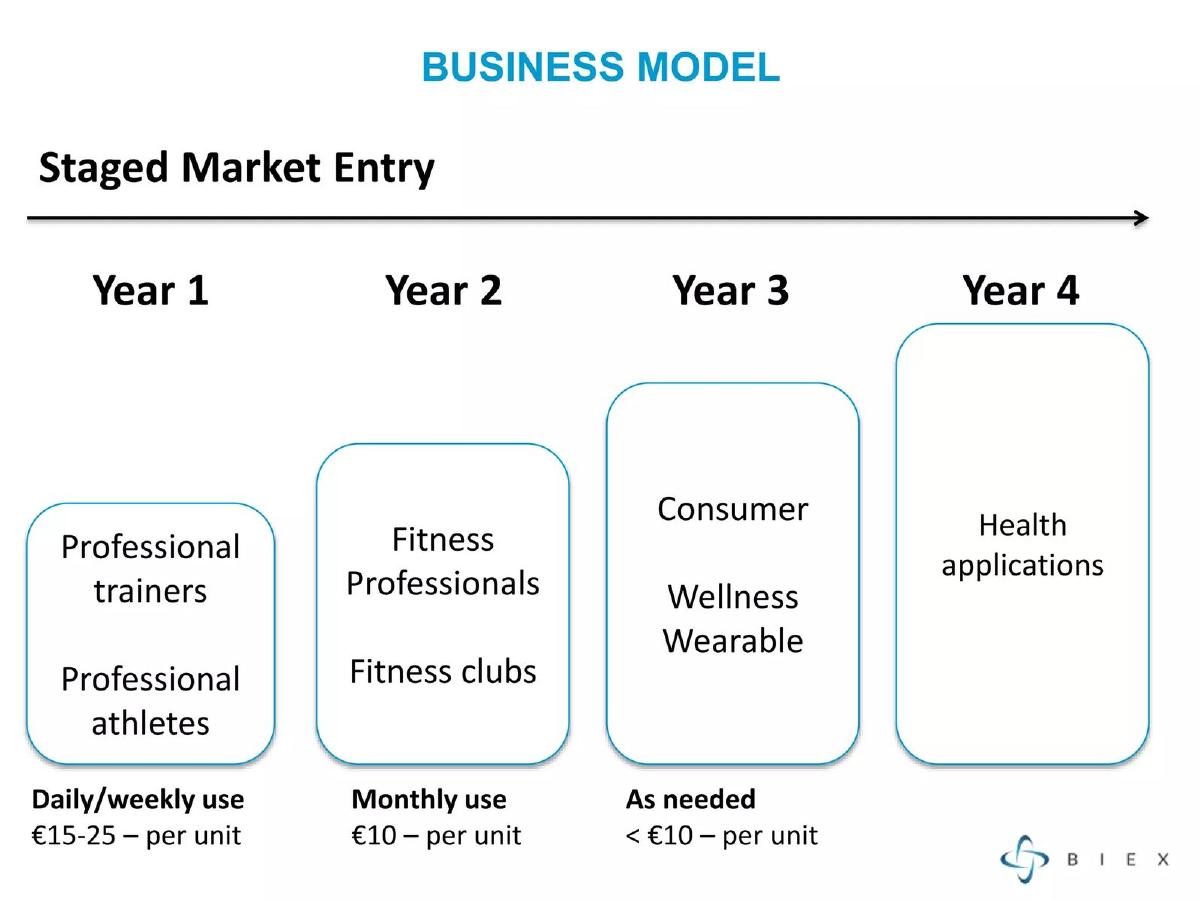
Name the buyer, the price and how often they pay. EnduroPacks charges $69 a month for a subscription box and claims margins above 60%. Brag House charges $2.99 a month and adds a flat platform fee plus a share of ticket sales for universities. Biex sets a price per unit for each year of its staged plan, from €15–25 for professionals down to less than €10 for consumers. GMBL takes a 5–10% cut of bets between players. MiCancha and Team Up Sports list freemium plans and advertising without prices, which is the gap to avoid.
Sports business model slides from real pitch decks
Each example shows the exact stored slide above its analysis and links to the full teardown. Slides with prices come first; slides without figures follow. Text is as shown on the slides; comments are ours.
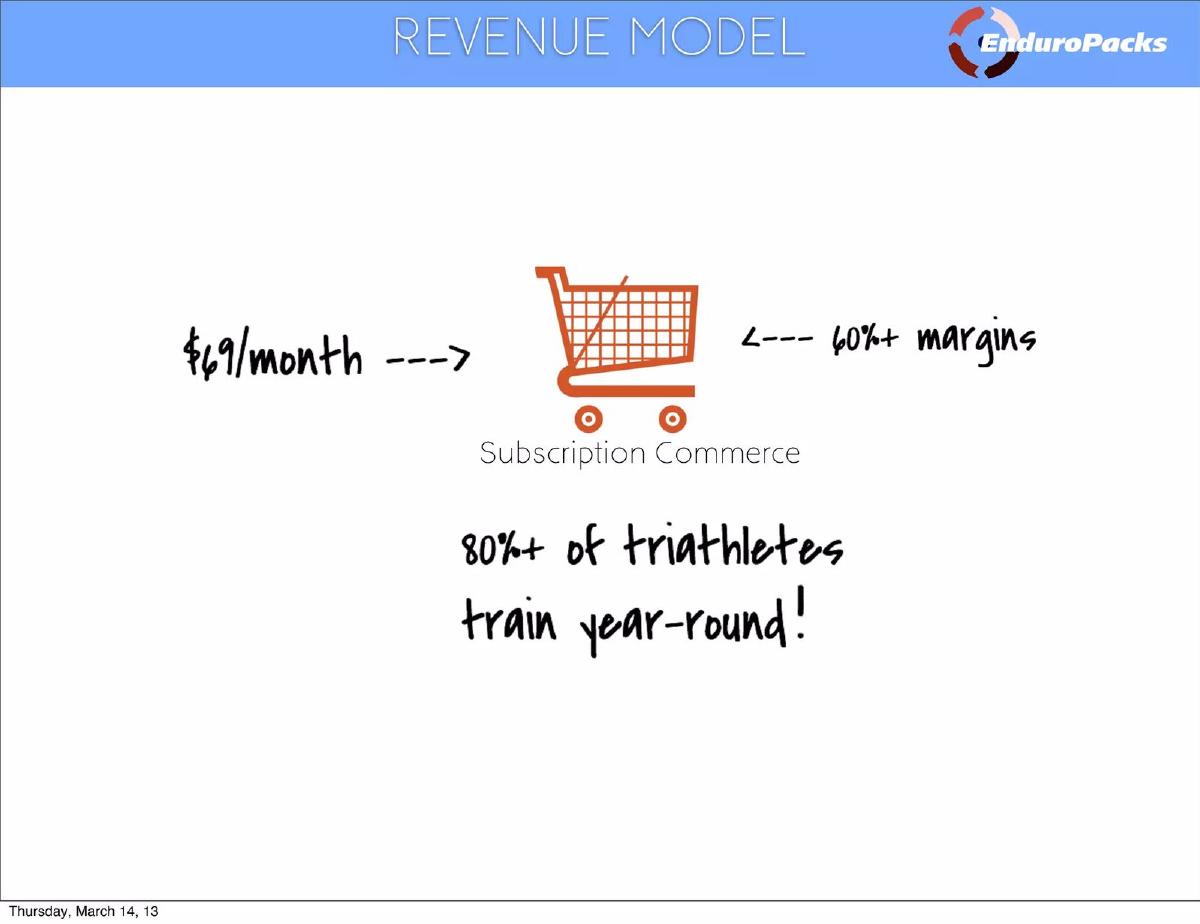
EnduroPacks business model slide — slide 6
Subscription box for endurance athletes; slide dated March 2013. Slide titled "Revenue Model".
EnduroPacks deck, slide 6. Exact stored slide matched to this analysis.
Our analysis: Price, margin and a reason customers keep paying fit on one slide.
Evidence and limitation: Company figures; the source of the 80% claim is not given.
What a founder can adapt: Put your price and margin together and add one line on why customers renew.
Supporting analysis
What the deck claims: "$69/month" pointing to a shopping cart labelled "Subscription Commerce", with "60%+ margins". Below: "80%+ of triathletes train year-round!"
Presentation choice: The year-round line answers the obvious question about seasonal sports before investors ask it.
When it does not fit: Quoting a statistic like the 80% without saying where it comes from.
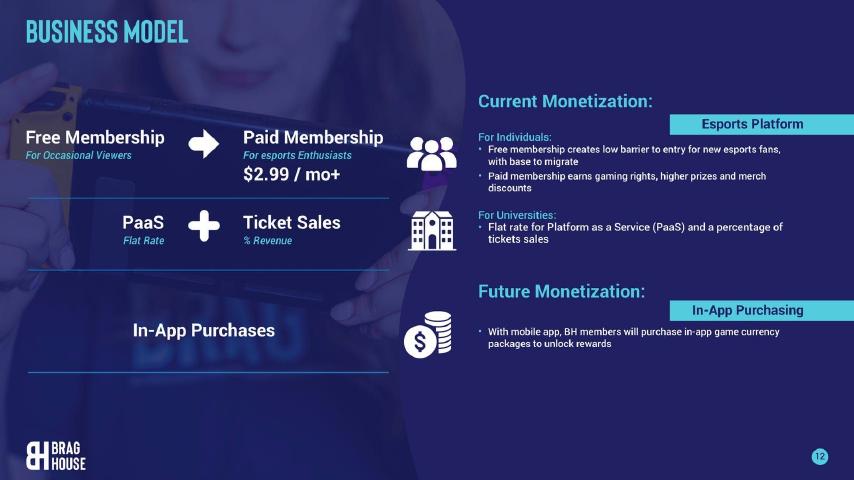
Esports platform for casual gamers and universities. Slide titled "Business Model".
Brag House deck, slide 12. Exact stored slide matched to this analysis.
Our analysis: It names each buyer and separates current revenue from planned revenue.
Evidence and limitation: Company pricing.
What a founder can adapt: Split current and future revenue with clear headings.
Supporting analysis
What the deck claims: "Free Membership" ("For Occasional Viewers") to "Paid Membership" ("For esports Enthusiasts") at "$2.99 / mo+". "PaaS" ("Flat Rate") plus "Ticket Sales" ("% Revenue"). "Current Monetization": for universities, "Flat rate for Platform as a Service (PaaS) and a percentage of tickets sales". "Future Monetization": "In-App Purchasing".
Presentation choice: Investors can see which income exists today and which is a later plan.
When it does not fit: Leaving the university flat rate and ticket percentage unstated.
Esports Entertainment Group (GMBL) business model slide — slide 16
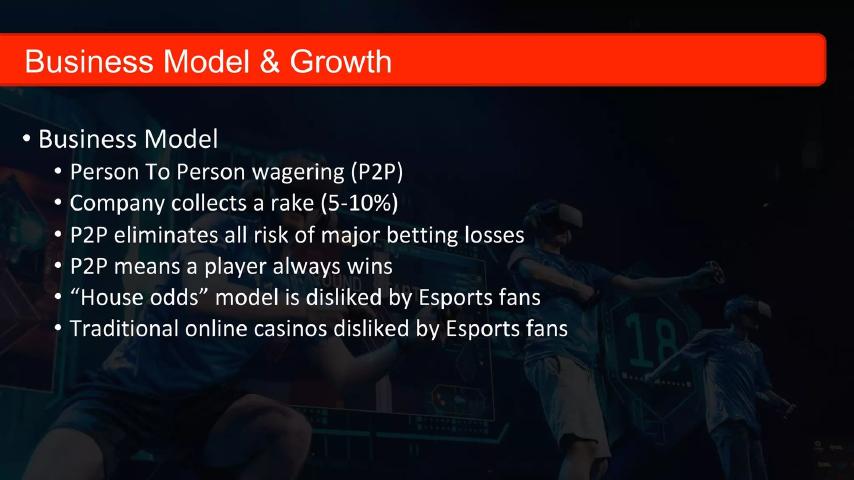
Esports betting company. Slide titled "Business Model & Growth".
Esports Entertainment Group (GMBL) deck, slide 16. Exact stored slide matched to this analysis.
Our analysis: The cut is clear and the slide explains why the company carries no betting risk.
Evidence and limitation: Company description.
What a founder can adapt: Add the value of bets placed so investors can work out revenue.
Supporting analysis
What the deck claims: "Person To Person wagering (P2P)", "Company collects a rake (5-10%)", "P2P eliminates all risk of major betting losses", "P2P means a player always wins", "'House odds' model is disliked by Esports fans".
Presentation choice: A fixed cut of player-to-player bets is simple to model.
When it does not fit: Claims like "a player always wins", which describe every bet rather than the business.
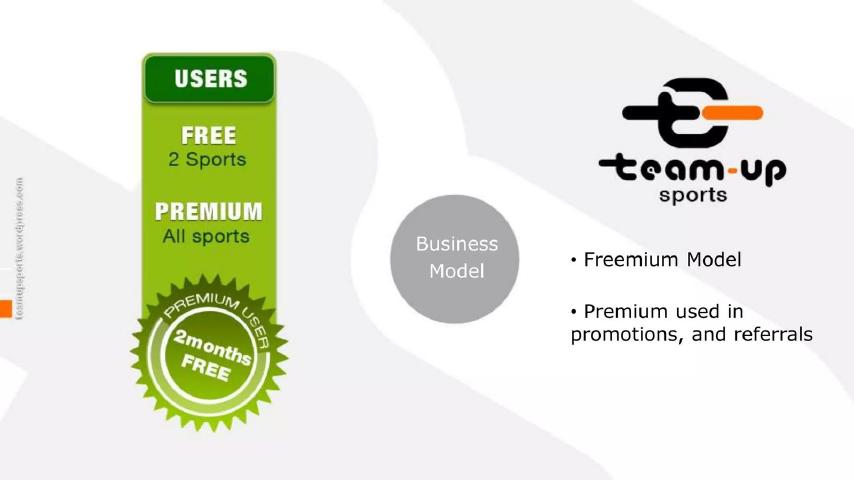
App for finding sports partners and events. First of two business model slides, for users.
Team Up Sports deck, slide 7. Exact stored slide matched to this analysis.
Our analysis: It shows what free users get and what premium adds, but not what premium costs.
Evidence and limitation: Company plan; no prices.
What a founder can adapt: Add the premium price and the share of users expected to pay.
Supporting analysis
What the deck claims: "Users": "Free – 2 Sports", "Premium – All sports", badge "Premium User – 2 months FREE". "Freemium Model"; "Premium used in promotions, and referrals".
Presentation choice: The free limit (two sports) gives users a clear reason to upgrade.
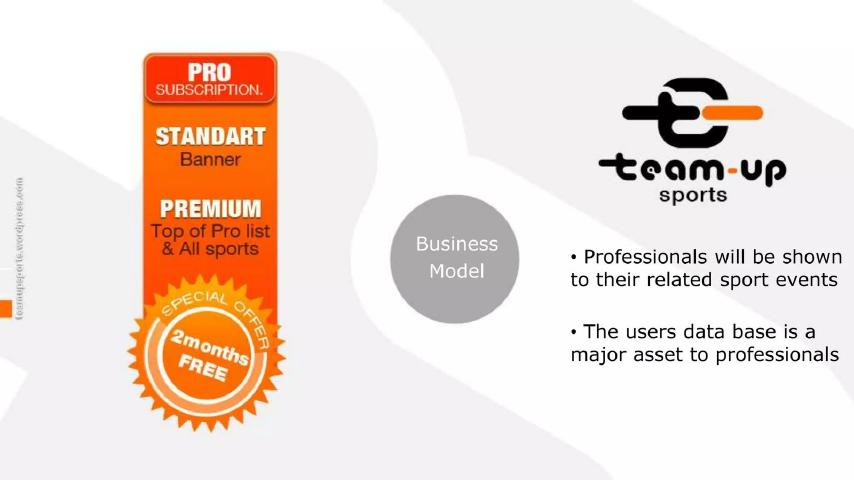
Second business model slide, for sports professionals.
Team Up Sports deck, slide 9. Exact stored slide matched to this analysis.
Our analysis: It names a second paying group, coaches and other professionals, without a price.
Evidence and limitation: Company plan; no prices.
What a founder can adapt: Give the price of each pro tier and how many professionals have signed up.
Supporting analysis
What the deck claims: "Pro Subscription": "Standart – Banner", "Premium – Top of Pro list & All sports", badge "Special Offer – 2 months FREE". "Professionals will be shown to their related sport events"; "The users data base is a major asset to professionals".
Presentation choice: Charging professionals to reach users is a sound idea for a free app.
When it does not fit: Spreading tiers across two slides with no figures on either.
Whether each slide names a buyer, gives a price and says how often they pay.
Example
Buyer
Price
How often
EnduroPacks
Endurance athletes
$69
Monthly
Brag House
Fans and universities
$2.99; flat rate and % not given
Monthly
Biex
Pros, clubs, consumers
€15–25, €10, under €10 per unit
Daily to as needed
GMBL
Bettors
5–10% cut
Per bet
MiCancha
Players and advertisers
Not given
Not given
Team Up Sports (users)
Players
Not given
Not given
Team Up Sports (pros)
Professionals
Not given
Not given
Key Takeaways
Name who pays: athletes, fans, clubs, brands or bettors.
Give a price and how often it is paid.
Show your cut when you take a share of transactions.
Say how free users turn into paying ones.
Give a figure for advertising or leave it off.
Build your sports business model slide
Work out who pays and how much before you design the slide.
Buyer. Who pays: athletes, fans, clubs, brands or bettors?
Price. What do they pay, and per month, per unit or per transaction?
Retention. Why do they keep paying out of season?
Other income. What do tickets, sponsors or extras add, with a figure for each?
Copyable framework: [Buyer] pays [price] per [period]. [Share] of free users upgrade. Sponsors and tickets add [amount] per [period].
Illustrative example 1 — written by us
Before: Freemium model with premium features and advertising.
After: Players use the app free for two sports. Premium is $4 a month; 6% of active players pay. Local sponsors pay $150 a month per city.
What improved: Our illustrative rewrite; all figures are invented for the example. It gives a price, a conversion rate and an advertising figure.
What this guide adds
The general business model guide covers revenue for any startup. This guide covers sports, fitness and esports startups, where audiences are passionate but often small, many users expect free access, and revenue is commonly split between fans, clubs, brands and event organisers.
How we read each slide
We read each stored slide image and quote the text on it. We have not checked any company's prices, margins, user numbers or revenue, and we make no claim that any slide affected a fundraising outcome.
The common sports revenue models
Subscriptions: the customer pays every month, as with EnduroPacks ($69 a month) or Brag House's paid membership ($2.99 a month). The key numbers are the price, how many subscribers stay each month and the cost of serving them.
Selling to professionals first: the startup sells to coaches, athletes or clubs before consumers, as Biex plans. The key numbers are the price for each group and when each group is reached.
Taking a cut: the startup takes a share of each transaction, as GMBL does with a 5–10% cut of bets, or Brag House with a share of ticket sales. The key numbers are the percentage and the value of transactions.
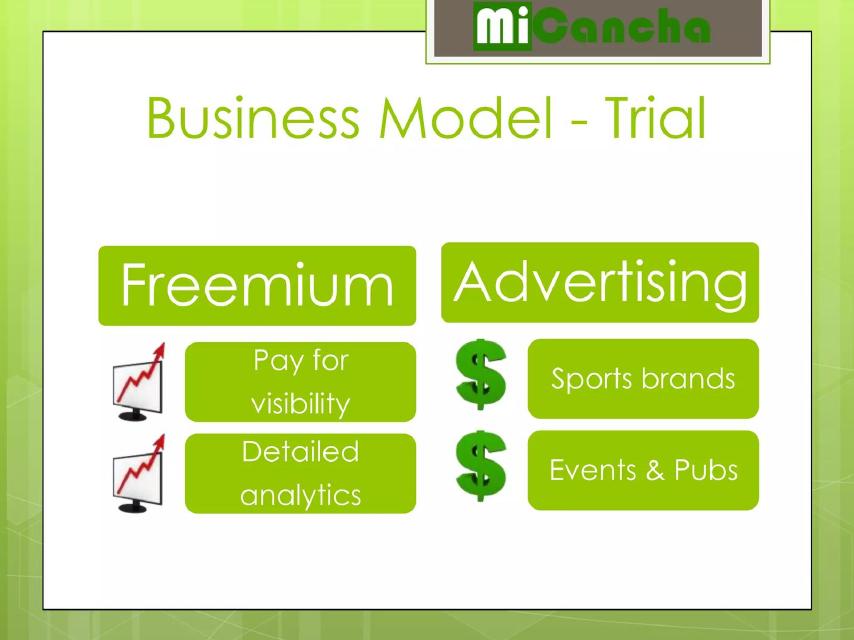
Freemium and advertising: the app is free, with paid extras and sponsors, as MiCancha and Team Up Sports describe. The key numbers are the share of users who pay, the price, and advertising income per user.
What investors check on a sports business model slide
Is the audience big enough at this price? A $2.99 monthly fee needs a large number of paying fans; a $69 monthly box needs far fewer. Put the price next to the number of people who could pay it.
Will people keep paying out of season? EnduroPacks answers this directly on its slide: "80%+ of triathletes train year-round!" Seasonal sports need a similar answer.
What does a cut of transactions add up to? GMBL's 5–10% is clear, but without the value of bets placed, investors cannot tell what it earns.
How do free users start paying? Brag House says free membership "creates low barrier to entry" with a "base to migrate" to paid; Team Up Sports offers two free months of premium. Investors will ask what share of users have paid so far.
Common mistakes on sports business model slides
Listing plans without prices: Team Up Sports names free, premium, standard and pro tiers but gives no price for any of them.
Advertising with no figures: MiCancha lists sports brands and "Events & Pubs" as advertisers but gives no rate or user numbers to support it.
A cut with no volume: a percentage alone does not show how much money the company will make.
A staged plan with an unpriced final stage: Biex's fourth-year health applications have no price, so the largest-looking market is the least defined.
Choosing which numbers to show
Start with your main paying customer. Give their price, how often they pay and how long they stay. Then add other income such as tickets, sponsors or in-app purchases, each with its own figure.
If you have several plans, a small table with prices is clearer than tier names on badges. If you take a cut, add the transaction value you have seen so far or expect next year.
Keep audience size for the market slide, but put one link on this slide: the number of people who might pay at your price.
Mark which revenue is live and which is planned. Brag House separates current and future income with clear headings, which is easy to copy.
Adapting the slide to your type of sports business
Fan and esports platforms should show the paid membership price, the share of members who pay and any event or ticket income.
Fitness products should show the price for professionals and for consumers, and how often each buys or renews.
Betting and fantasy products should show the cut, the value of bets placed and any licences needed in each market.
Club and venue software should show the price per club or venue per month and how many clubs are signed.
Working out what one customer is worth
Investors will turn your price into a figure for what one customer brings in over time. For a subscription, that is the monthly price times the number of months a typical customer stays, minus the cost of the product and delivery. At $69 a month and a margin above 60%, an EnduroPacks subscriber who stays one year would bring in roughly $500 of gross profit, if the margin holds. That arithmetic is ours, not the slide's, and it depends on how long subscribers actually stay.
For a low-priced membership such as Brag House's $2.99 a month, the same sum gives a much smaller figure per member, so the company needs many members, cheap ways to find them, or extra income from tickets and in-app purchases. Showing those other sources with figures makes a low price easier to believe.
For a cut of transactions, multiply the average bet or ticket by the number per user per month and by your percentage. GMBL's 5–10% on a $20 bet would be $1 to $2; the slide gives neither the bet size nor how often users bet, so investors cannot do this sum.
Put the figure on the slide if you can. Most of the slides in this guide leave the sum to investors, and the ones without prices make it impossible.
When the business model belongs on more than one slide
Some sports startups have two very different paying groups, such as players and coaches, or fans and universities. Team Up Sports gives each group its own slide; Brag House puts both on one. Either can work, but each group needs a price.
If you split the model across two slides, keep the same layout on both and add a line that links them, such as how many professionals pay to reach each thousand players. Two slides without figures, as in Team Up Sports' case, take up space without answering how the company earns money.
If you combine them, use one row per paying group, as Brag House does, with the price on the left and a short explanation on the right. Label anything not yet launched as future revenue.
In both cases, add a single total: expected revenue per month or year from each group. That one number tells investors which group matters most and where the company's effort will go.
A staged plan like Biex's is a third option: one slide that shows which group pays first and which comes later. Give every stage a price and a rough date, and say what has to be true before the next stage starts, such as a sensor price low enough for consumers.
Common mistakes
Tiers without prices. Give a price for each plan.
Advertising without figures. Give a rate or leave it off.
A cut without volume. Show the value of transactions.
Seasonality ignored. Say why customers pay year-round.
Unpriced later stages. Price every stage of a staged plan.
Current and future mixed. Label what earns money today.
Diagnostic checklist
Paying buyer named.
Price given.
Payment frequency stated.
Cut and transaction value shown.
Free-to-paid path explained.
Current and planned revenue labelled.
Frequently asked questions
How do sports startups make money?
Through subscriptions (EnduroPacks, $69 a month), memberships and platform fees (Brag House), selling to professionals before consumers (Biex), a cut of transactions (GMBL, 5–10%), and freemium plans with advertising (MiCancha, Team Up Sports).
What should a sports business model slide include?
Who pays, the price, how often they pay, and any cut you take, with current revenue labelled separately from plans.
Is a freemium model enough on its own?
Not on the slide. Investors need the premium price and the share of users who pay, which neither MiCancha nor Team Up Sports gives.
How do I handle seasonal sports?
Say why customers keep paying all year, as EnduroPacks does with its claim that most triathletes train year-round, and give a source for the claim.
How we chose these examples
Corpus: published pitch deck teardowns on StartupFundraising.com. Founder-uploaded private decks are excluded.
Selection (2026-10-01): we searched extracted slide text across the full corpus for business model or revenue model slides that mention sports, fitness, athletes, gyms or esports. We shortlisted 11 companies not used in other guides, viewed 10 and kept 6 (7 slides).
Not used: WannaBet (Insight Market) p10 (a website screenshot), Digital Donations Technologies p13 (charity fundraising, not sports), YoHo p14 (foot care retail rather than sports) and ProSmart Sportgo p10 (deck file unavailable).
Review: stored slide images were read on 2026-10-01 against company, deck and slide number (editorial model review). No person has yet completed an editorial review of this page. We did not verify any company's prices, margins or revenue.