Selling Your Users' Data on the Business Model Slide: What
If selling or licensing data is part of your revenue plan, investors want to know who buys it, what they pay.
Data as a Revenue Stream: How to Put Data Sales on Your Business Model Slide
Six slides from six startups that each took a position on selling the data their product collects: a real estate software company that listed buyers for its data, a farm sensor company that gave data subscriptions a share of its revenue, a stock-ideas community that sized the data market, a research-lab platform that labelled data licensing as a future stream, a diabetes app that wrote only "Monetize Data", and an electric-vehicle charging app that promised never to sell data at all. For each, we record what the slide tells an investor about the buyer, the price, the right to sell and the timing, and what it leaves out.
TL;DR
Data sales belong on a business model slide only when you can say four things: who buys the data and why; what they pay or what a comparable buyer pays, with a source; whether your users' terms and the law let you sell it, and in what form (raw, aggregated or anonymised); and whether it earns money today or is a later option. If you can't answer those yet, label data sales as a future option and keep them out of your revenue split. If your users would object, saying you will not sell data can be the stronger business model statement.
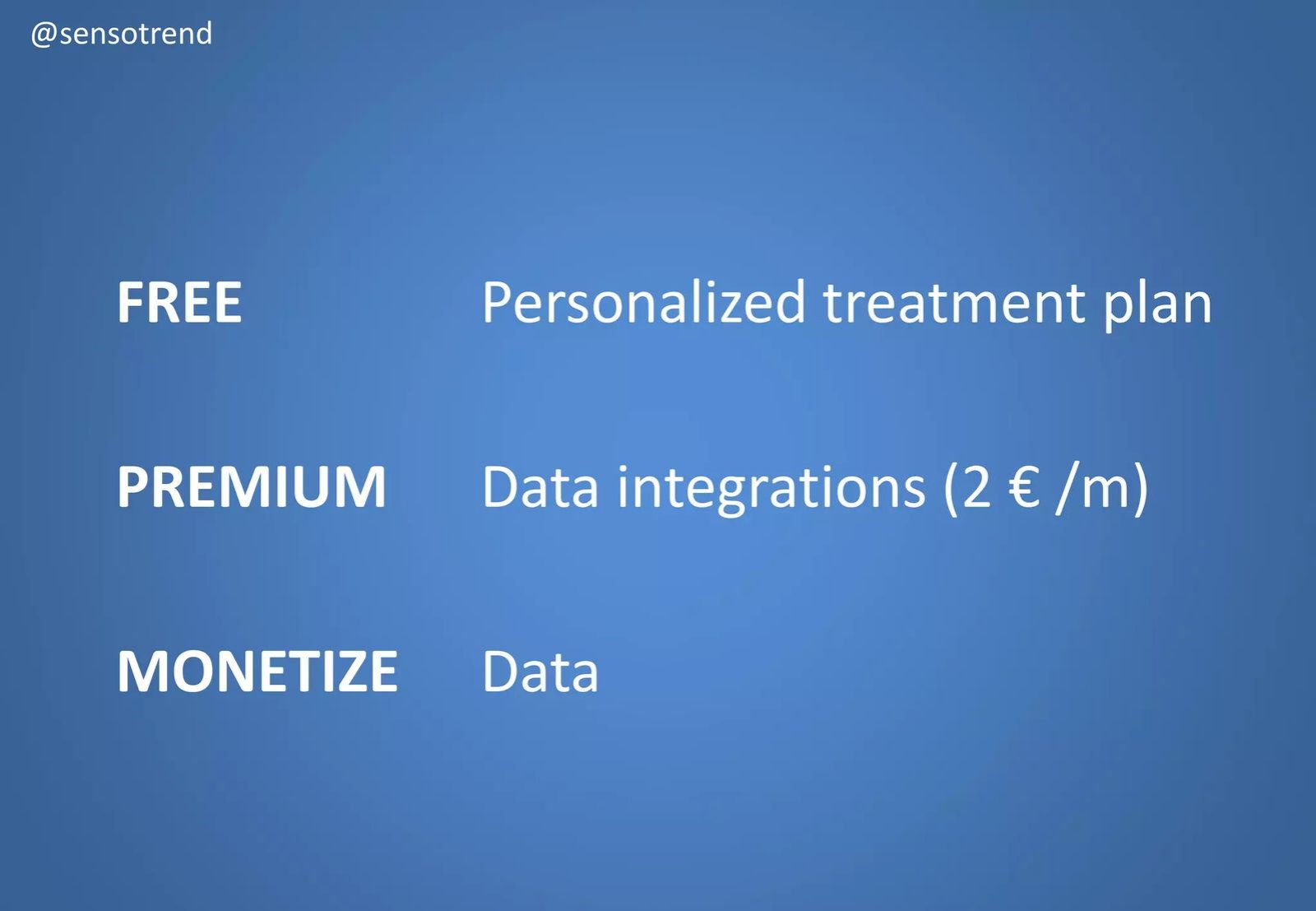
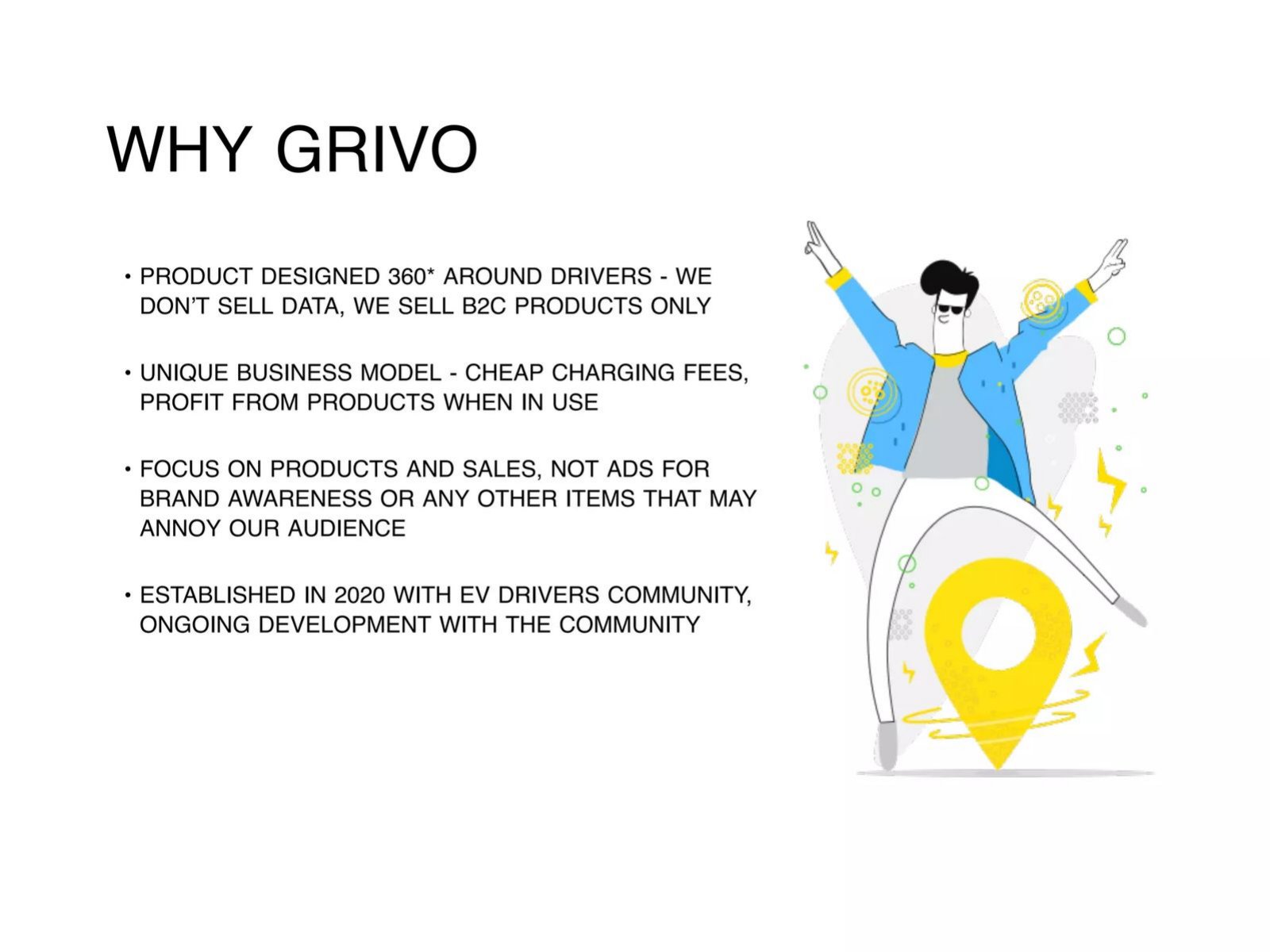
Reesio's page 12 is the most concrete: it names an insurer that "already told us they would buy our data" and a buyer group "paying on average $7,500/month", but its title, "once we own the data", concedes it doesn't yet have the right to sell. Farmpadi's page 7 gives data subscriptions 35% of its revenue without saying who subscribes. Covey's page 11 sizes data buyers at "$300 million" by segment. Academig's page 14 files data licensing under "Future revenue streams". Sensotrend's page 8 writes "Monetize Data" for health data with no buyer, price or consent. Grivo's page 16 says "We don't sell data" as part of its pitch.
Data revenue on real business model slides
Each example records what the slide says about the buyer, the price, the right to sell and the timing. "Our calculation" marks arithmetic we did; the slides don't state it.
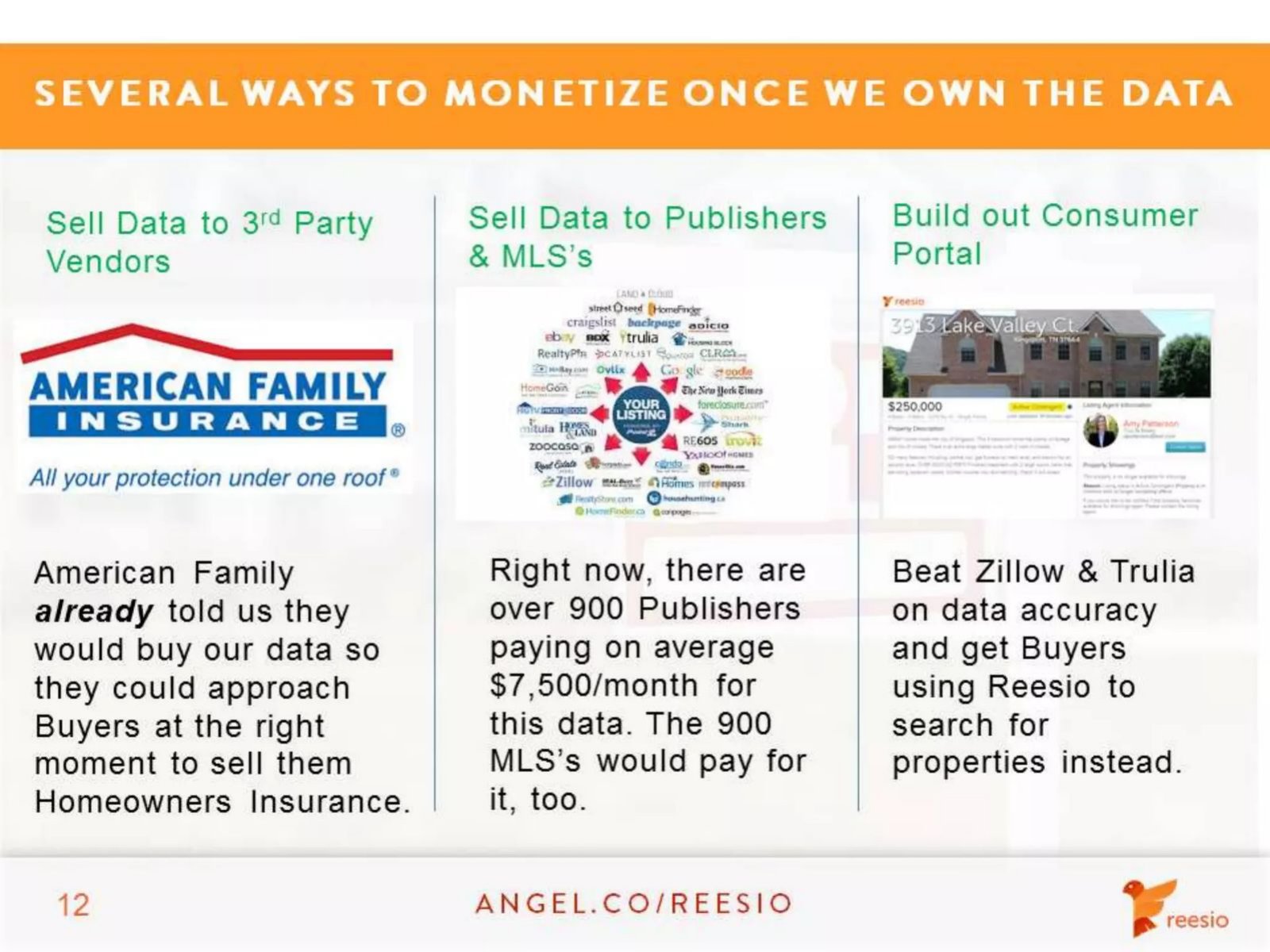
Reesio business model slide — slide 12
Real estate transaction software. 2013 seed deck; monetisation page.
Reesio deck, slide 12. Exact stored slide matched to this analysis.
Our analysis: The strongest buyer evidence in the set, with an honest admission that the right to sell comes later.
Evidence and limitation: Named buyer and use; price benchmark without source; ownership of the data not yet established.
What a founder can adapt: Add the source of the price and the step that gives you the right to sell.
Supporting analysis
What the deck claims: "Several ways to monetize once we own the data." "American Family already told us they would buy our data..." "over 900 Publishers paying on average $7,500/month for this data."
Presentation choice: Shows the buyer-use-price structure investors look for.
When it does not fit: Don't present verbal interest as a customer.
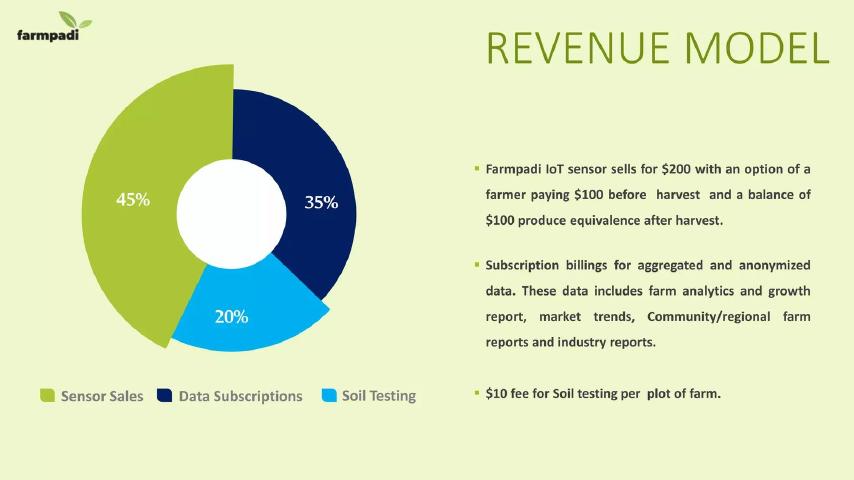
Farm soil sensors, Nigeria. Undated deck; revenue model page.
Farmpadi deck, slide 7. Exact stored slide matched to this analysis.
Our analysis: Good on what is sold, weak on who pays and whether the share is real.
Evidence and limitation: Data form stated (aggregated, anonymised) and product list given; no buyer, price, period or base for the 35%.
What a founder can adapt: Name the subscriber type and price, and say if the split is actual or forecast.
Supporting analysis
What the deck claims: Ring chart: "Sensor Sales" 45%, "Data Subscriptions" 35%, "Soil Testing" 20%. "Subscription billings for aggregated and anonymized data."
Presentation choice: A revenue share for data invites the question of who the customer is.
When it does not fit: Don't give an unpriced stream a third of the chart.
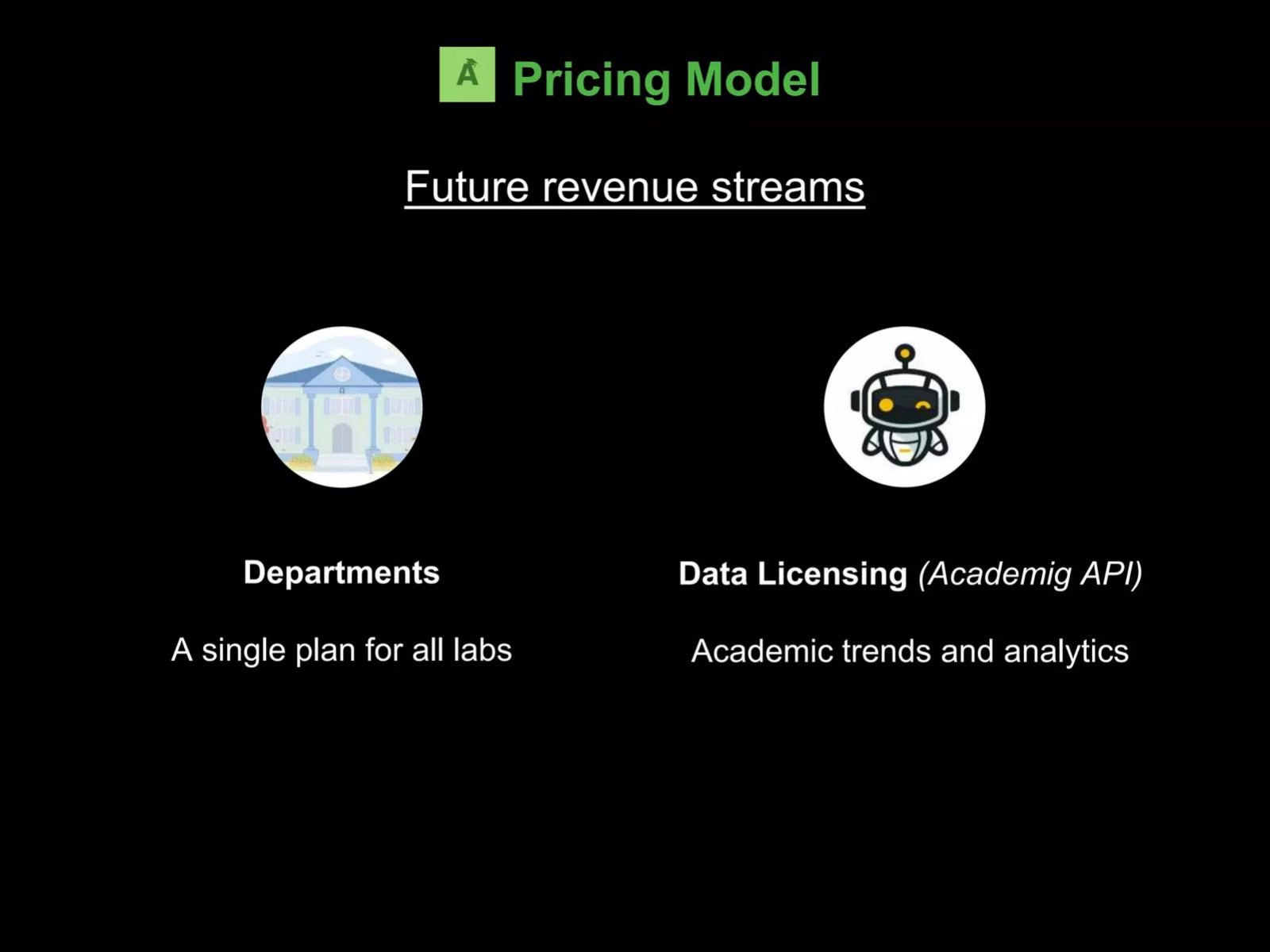
Research-lab profiles platform. Undated deck; pricing model page.
Academig deck, slide 14. Exact stored slide matched to this analysis.
Our analysis: Honest framing that keeps data out of current revenue.
Evidence and limitation: Clearly labelled future; delivery route (API) and product named; no buyer or price.
What a founder can adapt: Add the condition that would start the stream.
Supporting analysis
What the deck claims: "Future revenue streams": "Departments: A single plan for all labs" and "Data Licensing (Academig API): Academic trends and analytics".
Presentation choice: Investors can treat it as upside without discounting the core model.
When it does not fit: Don't move it into revenue until someone pays.
Columns report what each slide states or leaves out; checks are our calculations.
Example
Buyer named
Price or size
Right to sell or form
Status
Reesio p12
Yes (insurer, publishers)
$7,500/month, unsourced
Not yet owned
Plan
Farmpadi p7
No
35% share, no base
Aggregated, anonymised
Unclear
Covey p11
Segments
$300M market, unsourced
No
Opportunity
Academig p14
No
No
API
Future
Sensotrend p8
No
No
No
Unclear
Grivo p16
n/a
n/a
Will not sell
Policy
Key Takeaways
Name the buyer and what they use the data for. Reesio names an insurer that wants to reach home buyers at the right moment.
Give a price with a source, or label it an estimate. Reesio's "$7,500/month" has no source on the slide.
State your right to sell. Reesio's own heading says it doesn't own the data yet.
Don't put a future stream in today's revenue split. Farmpadi's 35% for data has no base, period or customer.
Sensitive data needs consent and a legal basis on the slide. Sensotrend's health data line has neither.
Refusing to sell data is a valid position. Grivo uses it to win drivers' trust and earns from products instead.
Write your data revenue line
Fill in each line; if you can't, list data sales as a future option.
Buyer. Who pays and what they use the data for.
Form. Raw, aggregated, anonymised or via an API.
Price. Price per customer or a comparable price, with its source.
Permission. User consent, contract terms or ownership you rely on.
Status. Revenue to date, or the condition and date for starting.
Trust check. Whether selling would put off the users who create the data.
Copyable framework: We plan to sell [form] data to [buyer type], who use it to [purpose]. Comparable buyers pay [price] ([source]). Our users [consent / terms] allow this. Status: [earned to date / starts when condition, date].
Illustrative example 1 — written by us
Before: Monetize data.
After: From next year we plan to license anonymised regional trend reports to seed suppliers, who use them to plan stock. Two suppliers pay a comparable vendor about $1,000 a month (supplier interviews). Our farmer terms include opt-in consent for aggregated use. Not in our current revenue.
What improved: Our illustrative rewrite; figures are invented for the example. It names the buyer, use, form, price source, permission and status.
The question this guide answers
Many startups collect data as a side effect of their product: listings, sensor readings, research profiles, stock picks, blood-glucose logs, charging sessions. Sooner or later someone in the team suggests selling it, and the idea lands on the business model slide as an extra revenue line. Investors then ask a predictable set of questions. Who would pay, and how much? Do your users' terms let you sell it? Does the law in your markets? Is it earning anything now? Would selling it put off the users who generate it?
Our published guides don't answer this. The data moat guide is about data as a defence against competitors, not as something to sell. The data privacy and security guide is about what protections are audited or still to do. The revenue mix guide covers splitting revenue across streams in general, and the advertising and freemium guides cover other ways to earn from free users. None tells a founder whether, and how, to put data sales on the business model slide. That is the question here, and the practical outcome is a data revenue line an investor can check, or a clear decision to leave it off.
How we chose and read the examples
We searched the extracted text of the deck library for data monetisation, selling data, data licensing, data as a service and anonymised data, then read the matching slides. Many hits used "DaaS" for unrelated software, mentioned data in a market-size headline, or came from companies whose product is a data marketplace, which is a different question. We kept slides where a startup with a different core product took a position on selling the data it collects.
Six slides from six private companies remained: Reesio page 12, Farmpadi page 7, Covey page 11, Academig page 14, Sensotrend page 8 and Grivo page 16. Every slide was rendered from the original deck file and read at full size; quotes are as printed. Our company write-ups record Reesio's deck as a 2013 seed deck, Covey's as a 2022 seed deck, Grivo's as 2022 and Sensotrend's as a 2013 or 2014 demo-day deck; Farmpadi's and Academig's are undated. None of the six companies was listed on a stock exchange when its deck was made. We did not find public records of what any of them earned from data, so every data revenue figure below is the company's own claim or plan.
Who buys the data, and what they pay
The first thing an investor wants is a named buyer with a reason to pay. Reesio's page 12 gives the clearest example in the set. Under "Sell Data to 3rd Party Vendors" it shows an American Family Insurance logo and says the insurer "already told us they would buy our data so they could approach Buyers at the right moment to sell them Homeowners Insurance." That is a buyer, a use and a timing reason in one sentence. What it doesn't give is a price, a volume or any sign the interest became a contract.
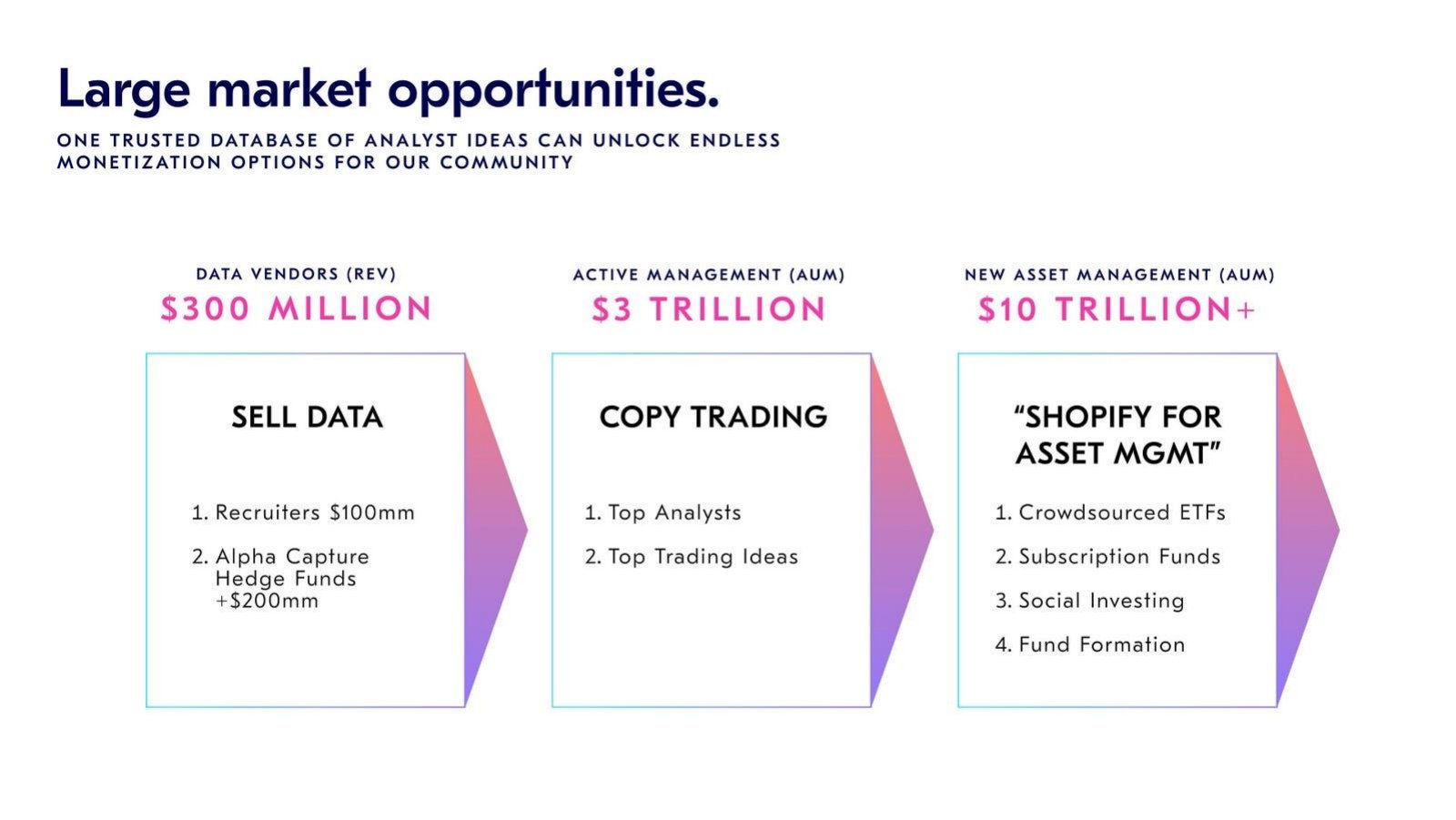
Its second column, "Sell Data to Publishers & MLS's", adds a price: "Right now, there are over 900 Publishers paying on average $7,500/month for this data. The 900 MLS's would pay for it, too." Read literally, that is a market of about $81 million a year (900 x $7,500 x 12, our calculation), but the slide doesn't say who those publishers pay today, where the average comes from, or why they would switch to Reesio. Covey's page 11 takes a market-size approach instead: "DATA VENDORS (REV) $300 MILLION", split into "Recruiters $100mm" and "Alpha Capture Hedge Funds +$200mm". Naming two buyer types with separate sizes is useful, but there is no source and no price per buyer, so an investor can't tell what one customer is worth.
Your right to sell it
Data your users create is not automatically yours to sell. Their terms of use, contracts with business customers and privacy law all limit what you can do. Reesio's heading is unusually candid: "Several ways to monetize once we own the data". The word "once" tells the investor that the plan depends on a step that hasn't happened, and the slide doesn't say what that step is (a change in terms, a deal with listing agents, or building its own listings). A founder should expect the question and answer it on the slide or in the notes.
The risk is highest with personal and sensitive data. Sensotrend's page 8 lists three tiers for a diabetes app: "FREE Personalized treatment plan", "PREMIUM Data integrations (2 € /m)" and "MONETIZE Data". The third line has no buyer, no price and no mention of consent. Health data is a special category under the EU's General Data Protection Regulation, which can only be processed on narrow grounds such as explicit consent, so an investor in a Finnish company will want to know exactly what users agree to before counting this stream. Farmpadi handles the form of the data better: it sells "aggregated and anonymized data" as "farm analytics and growth report, market trends, Community/regional farm reports and industry reports", which tells the investor no individual farmer's records are being sold.
Revenue today or a future option
Investors read a revenue split as what the business earns, or expects to earn, now. Farmpadi's page 7 puts data in that split: a ring chart with "Sensor Sales" 45%, "Data Subscriptions" 35% and "Soil Testing" 20%. The slide gives prices for the other two streams (a $200 sensor, a $10 soil test per plot) but none for data subscriptions, and it doesn't say whether the percentages are actual results or a forecast, for which year, or who subscribes. A 35% share for a stream with no stated customer or price is the weakest kind of number on this slide.
Academig's page 14 does the opposite. Under "Pricing Model" it heads the page "Future revenue streams" and lists "Departments: A single plan for all labs" next to "Data Licensing (Academig API): Academic trends and analytics". It gives no price or buyer either, but it makes no claim that the stream exists yet, so an investor can treat it as upside rather than discount the whole revenue plan. Covey's page sits in between: titled "Large market opportunities", it lines up "Sell Data", "Copy Trading" and a "Shopify for asset mgmt" in a row of arrows, which suggests a sequence but doesn't say when data sales would start.
When not selling data is the better pitch
Some products depend on users trusting them with information they'd rather keep private. For those, a promise not to sell data can be part of the business model. Grivo, a 2022 charging app for electric-vehicle drivers, puts it first on its "Why Grivo" page: "Product designed 360* around drivers - we don't sell data, we sell B2C products only." The next lines explain what it earns from instead: "cheap charging fees, profit from products when in use", and a focus on "products and sales, not ads for brand awareness or any other items that may annoy our audience".
This works on a slide because it closes off an investor question and replaces it with a revenue source. It also costs something: the investor loses a possible future stream, so the products and charging fees have to carry the model alone. Grivo's page doesn't price those products or say what a driver spends, so the promise is clearer than the revenue it points to. If you make the same choice, put the alternative revenue on the same slide with numbers.
Putting it together on your slide
If data sales are part of your plan, give them one line with five parts: the buyer type and what they use the data for; the form you'd sell it in (raw, aggregated, anonymised or through an API); the price or a comparable price with its source; the permission you rely on (user consent, contract terms, or ownership of the data); and the status, either revenue earned to date or the condition and date for starting. Keep the line out of your current revenue split until you have a paying customer, and leave it out of the main forecast unless you can defend each part.
If you can't fill those parts in yet, write it as Academig did, under future options, with one sentence on what would make it real. And if selling data would damage trust with the people who produce it, consider Grivo's approach: say you won't, and show what pays instead. Either choice is easier for an investor to evaluate than a single word such as "Monetize".
Common mistakes
One word, no model. "Monetize data" tells an investor nothing; name buyer and price.
Interest counted as revenue. A buyer who would buy is not a customer.
Unsourced price. Say where an average price comes from.
Right to sell assumed. State the consent or terms that allow the sale.
Future stream in today's split. Keep unpriced data sales out of the revenue chart.
Trust cost ignored. Say how users would react, or promise not to sell.
Diagnostic checklist
The buyer type and their use for the data are named.
A price or comparable price has a source.
The form of the data sold is stated.
The permission to sell (consent, terms or ownership) is stated.
The slide says whether data revenue is earned now or later.
If you won't sell data, the slide shows what pays instead.
Frequently asked questions
Should I put data sales on my business model slide?
Only if you can name the buyer, a sourced price, your right to sell and whether it earns today. Otherwise list it as a future option, as Academig did.
Can I include data revenue in my revenue split?
Not until someone pays. Farmpadi's 35% share for data subscriptions has no customer, price or period, which weakens the whole chart.
Is anonymised data safe to sell?
It lowers the risk, and saying so helps, as Farmpadi's slide does. You still need user terms that allow it and, for sensitive data, a legal basis such as explicit consent.
Does saying I won't sell data hurt my pitch?
Not if you show what pays instead. Grivo pairs its promise with charging fees and product sales, though it doesn't price them.
What if a big company says it would buy our data?
Name it, as Reesio named an insurer, but call it interest, not revenue, and say what is needed before a sale.
How we chose these examples
Selection (2026-10-02): we checked the published guides and queued drafts for any page answering whether and how to show data sales as revenue; the data moat, data privacy and security, revenue mix, advertising and freemium guides cover different questions. We searched the corpus index (docs/seo/artifacts/corpus-search) for data monetisation, selling data, data licensing, data as a service and anonymised data.
Six pages from six original deck files were rendered and read at full size: Reesio 12, Farmpadi 7, Covey 11, Academig 14, Sensotrend 8 and Grivo 16. Excluded: slides using DaaS for unrelated software, data marketplaces whose core product is selling data, and passing mentions in market headlines.
Eligibility was judged at each deck's date; none of the six companies was listed. Deck dates come from our company write-ups. Every example was written with AI assistance and checked by editorial model review against the slide images; no human review is claimed. Figures are as printed; arithmetic is ours and labelled.