Should a pitch deck include a SWOT analysis? Six real SWOT slides compared, with what each tells an investor and what a stronger slide would show instead.
SWOT Analysis Slide Examples in Pitch Decks
Six SWOT analysis slides from real pitch decks, shown in full, compare what a strengths, weaknesses, opportunities and threats grid tells an investor, and where it falls short of a competition or risks slide.
TL;DR
A SWOT slide rarely helps a pitch deck, because the four boxes usually hold generic words an investor can't check. It helps only when each item is specific, the weaknesses are real, and each threat comes with a plan. Meta Innovations comes closest: it names concrete weaknesses (brand recognition, sales channels) and threats such as "Major players completely dominate the markets" and "IoT number projections are inaccurate". Mycroclime names a competitor, Libelium, as a threat. Chartmetric uses one short phrase per box, and its weakness, "Data integrity continuously has to be confirmed", is honest but unexplained. TripLingo lists "weak competition" as an opportunity and "well-funded comps" as a threat on the same slide. Beautyfyn lists "High employee turnover" and "Negative publicity" as weaknesses with no context, which raises questions the deck doesn't answer.
SWOT slides from real pitch decks
Each example shows the exact stored slide above its analysis and links to the full teardown. Stage and year are given only where the deck states them. Every item on these slides is the company's own claim.
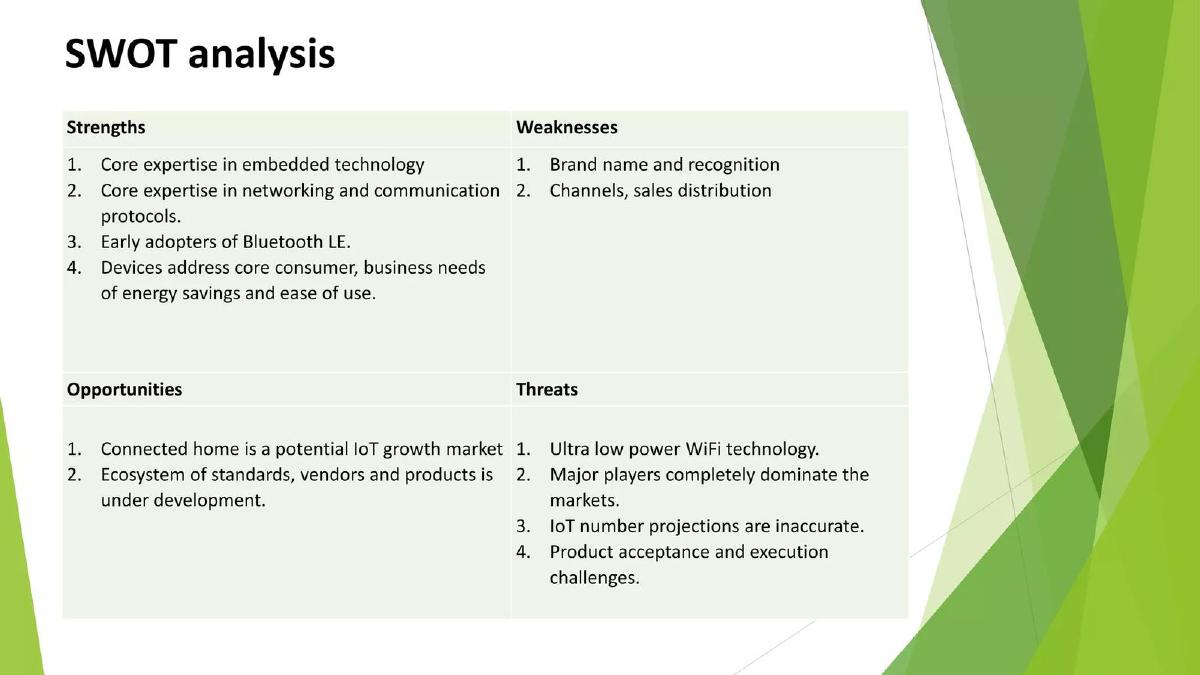
Meta Innovations competition slide — slide 13
Connected-device (IoT) hardware and software using Bluetooth Low Energy ("Adding intelligence, one device at a time").
Meta Innovations deck, slide 13. Exact stored slide matched to this analysis.
Our analysis: Items are specific, the weaknesses are real, and the threats admit that market forecasts may be wrong, which most decks avoid.
Evidence and limitation: No responses to the threats and no named competitors. Add one line per threat on how you will handle it.
What a founder can adapt: Write threats you would actually worry about, including doubts about your own market numbers.
Supporting analysis
What the deck claims: Strengths: core expertise in embedded technology and in networking protocols; early adopters of Bluetooth LE; devices address energy savings and ease of use. Weaknesses: brand name and recognition; channels, sales distribution. Opportunities: connected home as an IoT growth market; ecosystem still under development. Threats: ultra low power WiFi; "Major players completely dominate the markets"; "IoT number projections are inaccurate"; product acceptance and execution.
Presentation choice: Items are specific, the weaknesses are real, and the threats admit that market forecasts may be wrong, which most decks avoid.
When it does not fit: No responses to the threats and no named competitors. Add one line per threat on how you will handle it.
Environmental monitoring and control devices (IoT) for growers; the company designs and manufactures in house.
Mycroclime deck, slide 4. Exact stored slide matched to this analysis.
Our analysis: It names a competitor, Libelium, as a threat, which is more useful than a general phrase.
Evidence and limitation: "Passion" is not a strength an investor can check. The market figures have no sources on the slide. Bullet text in four lines reads like notes, not a slide.
What a founder can adapt: Name the competitors you worry about, then say why you win against them.
Supporting analysis
What the deck claims: Strengths: "passion for what we do, manufacturing in house, price, quality, monitor&control, software partnership." Weaknesses: "small team, marketing." Opportunities: "IOT billion dollars market, 525M Farms, the world needs to increase by 70% food production by 2050." Threats: "Libelium. Big companies around the world want to be part of the market."
Presentation choice: It names a competitor, Libelium, as a threat, which is more useful than a general phrase.
When it does not fit: "Passion" is not a strength an investor can check. The market figures have no sources on the slide. Bullet text in four lines reads like notes, not a slide.
Content management system (CMS) built on Microsoft's .NET Core framework.
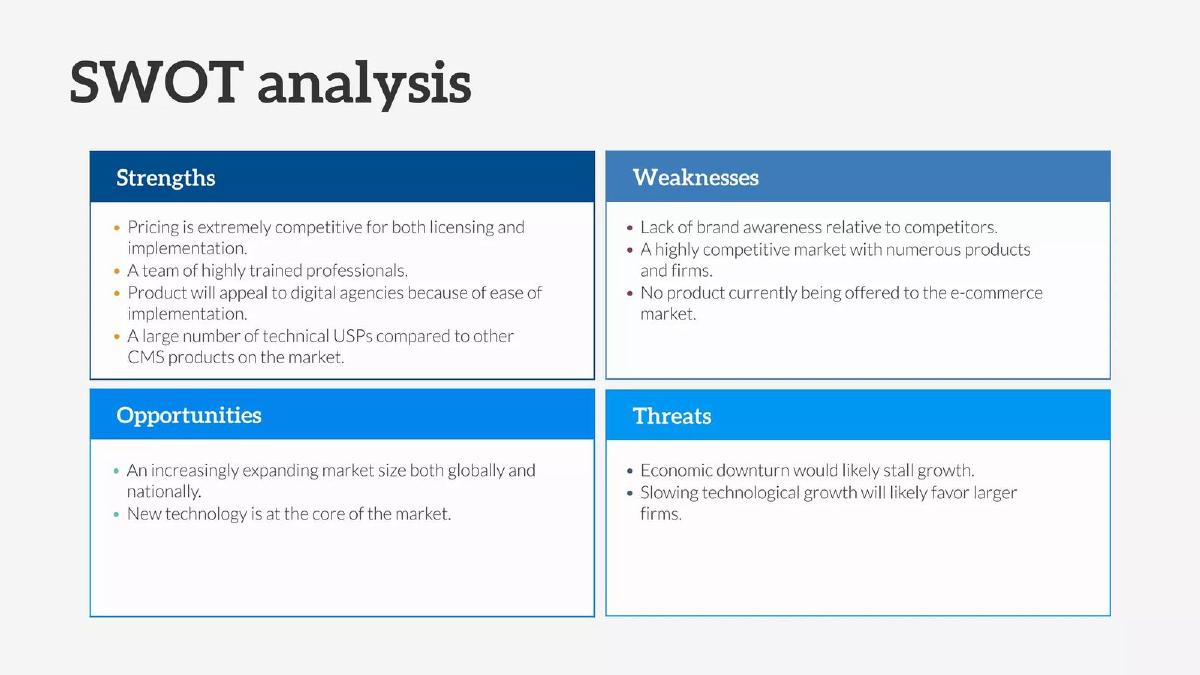
Redakt deck, slide 10. Exact stored slide matched to this analysis.
Our analysis: A clean, readable grid with some specific points, such as the gap in e-commerce.
Evidence and limitation: The USPs and competitors are not named, and the opportunities and threats could apply to any software company.
What a founder can adapt: Turn a weakness like a missing product into a roadmap item with a date.
Supporting analysis
What the deck claims: Strengths: competitive pricing for licensing and implementation; trained team; appeals to digital agencies; "A large number of technical USPs compared to other CMS products". Weaknesses: lack of brand awareness; a highly competitive market; no e-commerce product. Opportunities: expanding market; new technology at the core. Threats: economic downturn; slowing technological growth favouring larger firms.
Presentation choice: A clean, readable grid with some specific points, such as the gap in e-commerce.
When it does not fit: The USPs and competitors are not named, and the opportunities and threats could apply to any software company.
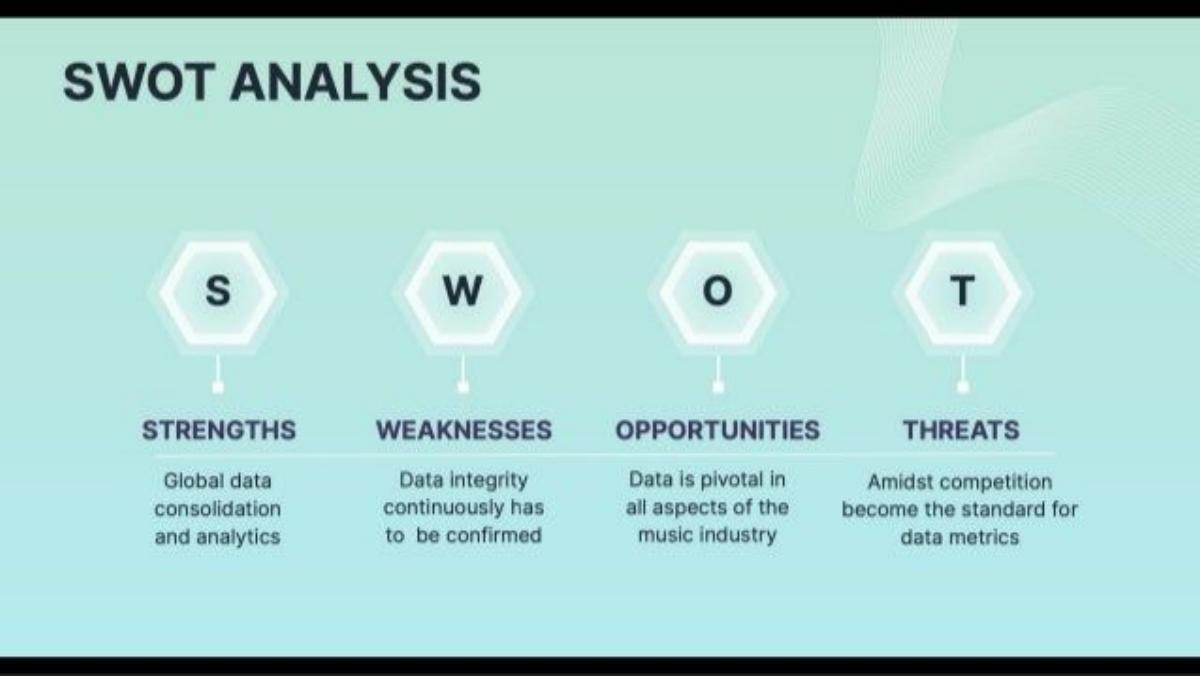
Music data and analytics. Slide 8 of a 45-page deck; the SWOT sits in the market section.
Chartmetric deck, slide 8. Exact stored slide matched to this analysis.
Our analysis: Short and easy to read, and the weakness is an honest one for a data business.
Evidence and limitation: One phrase per box is too little to learn from, and the threat reads as a goal rather than a threat. No competitors are named.
What a founder can adapt: If you name a weakness like data quality, add how you check it.
Supporting analysis
What the deck claims: Strengths: "Global data consolidation and analytics". Weaknesses: "Data integrity continuously has to be confirmed". Opportunities: "Data is pivotal in all aspects of the music industry". Threats: "Amidst competition become the standard for data metrics".
Presentation choice: Short and easy to read, and the weakness is an honest one for a data business.
When it does not fit: One phrase per box is too little to learn from, and the threat reads as a goal rather than a threat. No competitors are named.
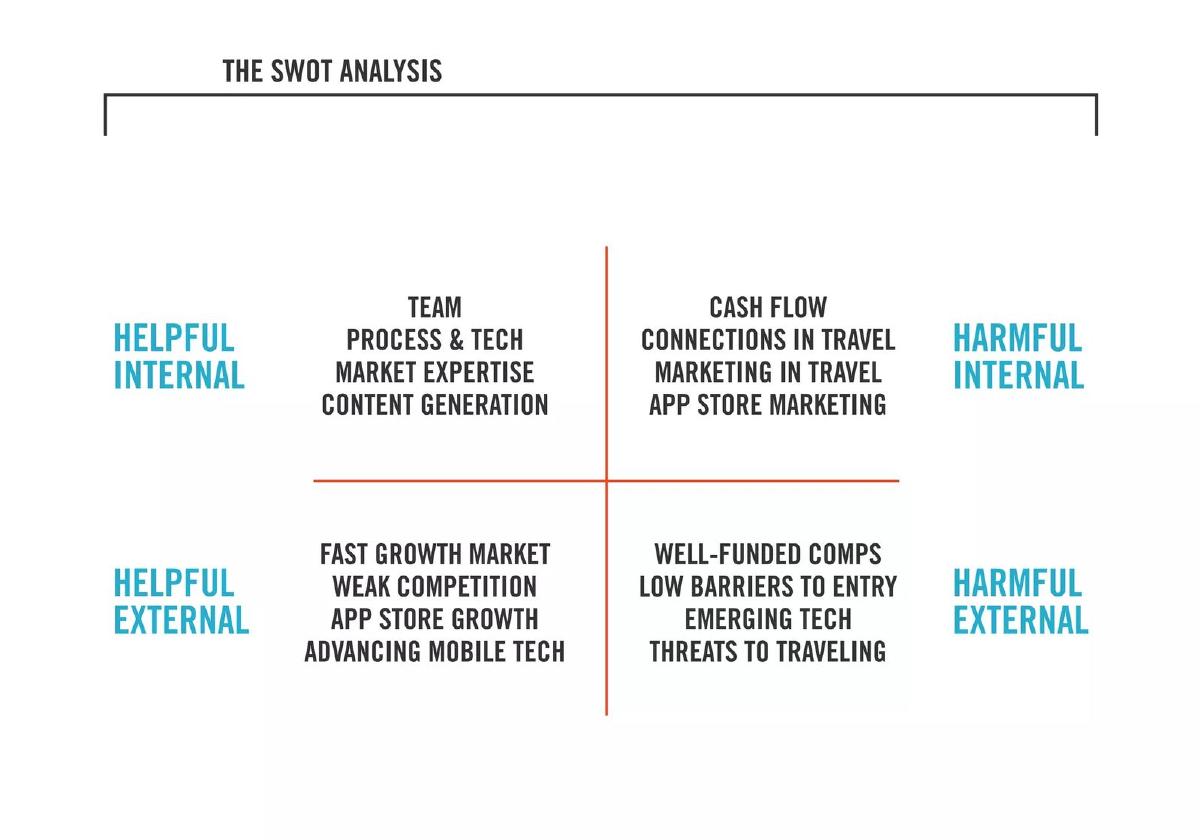
TripLingo deck, slide 10. Exact stored slide matched to this analysis.
Our analysis: The helpful/harmful, internal/external labels make the grid easy to read.
Evidence and limitation: "Weak competition" and "Well-funded comps" sit on the same slide without explanation. Single words like "Team" and "Cash flow" are labels, not claims.
What a founder can adapt: Label the grid clearly, then give each item enough words to make a claim.
Supporting analysis
What the deck claims: Helpful internal: team; process and tech; market expertise; content generation. Harmful internal: cash flow; connections in travel; marketing in travel; app store marketing. Helpful external: fast growth market; weak competition; app store growth; advancing mobile tech. Harmful external: well-funded comps; low barriers to entry; emerging tech; threats to traveling.
Presentation choice: The helpful/harmful, internal/external labels make the grid easy to read.
When it does not fit: "Weak competition" and "Well-funded comps" sit on the same slide without explanation. Single words like "Team" and "Cash flow" are labels, not claims.
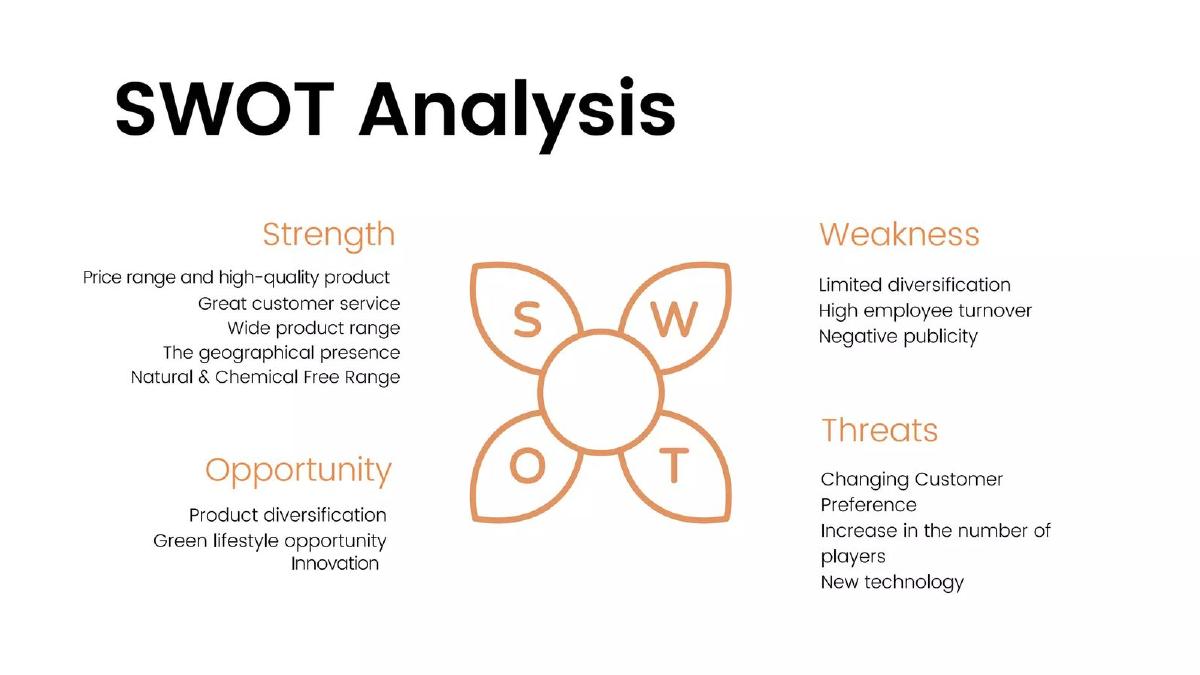
All-natural skincare products sold as chemical-free alternatives.
Beautyfyn deck, slide 8. Exact stored slide matched to this analysis.
Our analysis: A contrast example: it shows how a SWOT slide can raise serious questions without answering them.
Evidence and limitation: "High employee turnover" and "Negative publicity" appear with no detail. "Wide product range" as a strength and "Limited diversification" as a weakness seem to contradict each other.
What a founder can adapt: If you list a serious weakness, explain it and what you have done about it.
Supporting analysis
What the deck claims: Strength: price range and high-quality product; great customer service; wide product range; geographical presence; natural and chemical-free range. Weakness: limited diversification; high employee turnover; negative publicity. Opportunity: product diversification; green lifestyle; innovation. Threats: changing customer preference; increase in the number of players; new technology.
Presentation choice: A contrast example: it shows how a SWOT slide can raise serious questions without answering them.
When it does not fit: "High employee turnover" and "Negative publicity" appear with no detail. "Wide product range" as a strength and "Limited diversification" as a weakness seem to contradict each other.
Specific items, explained weaknesses and named threats matter more than the layout.
Example
Specific items
Weaknesses explained
Competitor named
Contradictions
Meta Innovations
Mostly
No, but concrete
No
None seen
Mycroclime
Partly
No
Yes (Libelium)
None seen
Redakt
Partly
No, but concrete
No
None seen
Chartmetric
No (one phrase per box)
No
No
None seen
TripLingo
No (labels)
No
No
Weak competition vs well-funded comps
Beautyfyn
No
No (turnover, publicity)
No
Wide range vs limited diversification
Key Takeaways
Most investors prefer a competition slide and a risks slide to a SWOT grid.
Generic strengths ("great team", "high quality") tell an investor nothing. Make each one specific and checkable.
Name real weaknesses, and say what you are doing about each one.
Name competitors as threats, not just "increasing number of players".
Check the grid for contradictions, such as weak competition and well-funded competitors on the same slide.
Test your SWOT slide before you send it
Answer these for each box.
Specific. Could a competitor copy this item onto their own slide word for word?
Evidence. What fact or number supports each strength?
Response. What are you doing about each weakness and threat?
Names. Which competitors do you actually lose deals to?
Consistency. Does anything here contradict your market or competition slide?
Copyable framework: [Weakness or threat]: [specific detail] — response: [action, with date or budget]
Illustrative example 1 — written by us
Before: Weaknesses: small team, marketing.
After: Weakness: [number]-person team with no marketing hire — response: [role] hired from this round by [month]
What improved: Our illustrative rewrite, not Mycroclime's text. Bracketed parts are placeholders, not company facts. It turns a weakness into a use of funds.
How this guide relates to the competition and risks guides
The competition slide guides cover how founders compare themselves with named alternatives, using grids, maps and tables. The risks guide covers slides that name what could go wrong and how the company will handle it. A SWOT analysis tries to do both on one slide: strengths and weaknesses inside the company, opportunities and threats outside it. We found SWOT slides in about fifteen decks in our corpus, almost all from early-stage companies, and this guide looks at what they achieve.
Why SWOT slides usually disappoint investors
SWOT is a planning tool taught in business schools and used inside companies. It works well in a strategy session, where a team argues over each item. On a pitch slide it tends to lose its value, for three reasons.
First, the items are usually too general to check. Beautyfyn's strengths include "Great customer service" and "Price range and high-quality product". Mycroclime's include "passion for what we do". Every company would say the same, and nothing on the slide shows it. Second, opportunities often repeat the market slide: Mycroclime's "IOT billion dollars market" and Redakt's "An increasingly expanding market size" add nothing a market slide wouldn't. Third, threats are often listed without any response, so the slide raises a worry and leaves it there.
An investor reading quickly wants to know who you compete with, why you win, and what could stop you. A competition slide answers the first two with named companies. A risks slide answers the third with a plan. A SWOT grid often answers none of them clearly.
Making each item specific
If you keep a SWOT slide, the fix is to make each item specific enough that an investor could ask a follow-up question about it. Meta Innovations does this better than most: its strengths name actual technical capabilities ("Core expertise in embedded technology", "Early adopters of Bluetooth LE"), its weaknesses are concrete ("Brand name and recognition", "Channels, sales distribution"), and its threats include a point many founders avoid: "IoT number projections are inaccurate." That is an admission that the market forecasts the deck may rely on could be wrong, which is honest and useful.
Redakt's strengths are also fairly specific for a software product: competitive pricing "for both licensing and implementation" and "A large number of technical USPs compared to other CMS products". But the slide doesn't name the USPs or the competitors. A stronger version would say which products it is cheaper than, and by how much.
A simple test: for each item, ask whether a competitor could copy it word for word onto their own SWOT slide. If they could, it is not a strength or weakness of your company, just a description of the category.
Weaknesses: honest, but explained
The weaknesses box is the most interesting part of a SWOT slide, because it is the one place where founders volunteer a problem. Done well, it shows self-awareness. Done badly, it raises questions with no answer.
Beautyfyn lists "High employee turnover" and "Negative publicity" as weaknesses. Both are serious for a young consumer brand, and the slide gives no detail: how high the turnover is, what the publicity was about, or what the company has done since. An investor will ask, and if the founder isn't in the room, will assume the worst. Chartmetric's single weakness, "Data integrity continuously has to be confirmed", is honest for a data company but doesn't say how the company checks its data. Mycroclime's "small team, marketing" is typical of an early-stage company and is really a reason to raise money.
The useful pattern is weakness plus response: "Small sales team (two people); this round funds three account executives." That turns a weakness into part of the use of funds. Never list a weakness you can't explain in one more sentence.
Threats: name them and answer them
Threats work best when they are named. Mycroclime is the only example here that names a competitor in its threats: "Libelium. Big companies around the world want to be part of the market." Most others write general phrases: Beautyfyn's "Increase in the number of players", Redakt's "Economic downturn would likely stall growth". These are true of almost every company.
Even a named threat needs a response. Why will Mycroclime win against Libelium? The SWOT slide doesn't say, and that answer belongs either on the same slide or on a competition slide that follows it. Our risks guide covers how to pair each risk with a mitigation; the same approach applies here.
Check the grid for contradictions
Because SWOT items are written quickly, they sometimes contradict each other or the rest of the deck. TripLingo's grid lists "Weak competition" as a helpful external factor and "Well-funded comps" as a harmful one. Both may be partly true (competitors may be well funded but have weak products), but the slide doesn't explain the difference, so a reader sees a contradiction. TripLingo also lists "Team" as an internal strength and "Cash flow" as an internal weakness, which are labels rather than claims.
Before sending, read the four boxes against each other and against your market and competition slides. If your market slide says the market is wide open and your SWOT says big players dominate, an investor will notice. Remove one or explain both.
When a SWOT slide can earn its place
There are cases where a SWOT slide makes sense: a business-plan-style deck for a lender or grant body that expects one, a deck for a local investor group used to that format, or a company in a market so new that there are few direct competitors to compare against. Even then, keep it to two or three specific items per box, name competitors, explain weaknesses and pair threats with responses.
For most venture investors, a better use of the slot is a competition slide that names alternatives and shows why you win, followed (if needed) by a short risks slide. Together they cover everything a SWOT grid tries to, with more evidence and less filler.
Common mistakes
Generic strengths. Make each one specific and checkable.
Unexplained weaknesses. Add what you are doing about it.
Unnamed threats. Name the competitors you worry about.
Opportunities that repeat the market slide. Cut them or add something new.
Contradictions. Read the boxes against each other and the deck.
Diagnostic checklist
A competition or risks slide wouldn't do the job better.
Two or three specific items per box.
Every weakness has a response.
Threats name real competitors or risks.
Nothing contradicts the rest of the deck.
Frequently asked questions
How we chose these examples
Corpus: published pitch deck teardowns on StartupFundraising.com. Founder-uploaded private decks are excluded.
Selection (2026-10-01): we searched extracted slide text for slides whose opening words include "SWOT" and read each candidate from images made from the original deck files.
Not used: IGT Financial Services slide 4 (the original deck file could not be retrieved, so the slide couldn't be checked), Alodmd slide 20 (a hotel project, and Alodmd's competition slide is already used elsewhere), Bespoke Habitat, Desert Haven, MBE Academy and Bijana Healthcare (very similar generic grids; Beautyfyn shows the pattern), Turned International Agriculture (an industry body rather than a startup), and FlexyMovies and OwnAir (SWOT combined with other content or mostly unreadable).
Overlap check: no other guide covers SWOT slides. The competition guides cover comparison grids and maps; the risks guide covers risk and mitigation slides. Chartmetric appears in the agenda guide with a different slide.
Review: all six slide images were inspected on 2026-10-01 and matched to company, deck and slide number (AI editorial model review). No person has yet completed an editorial review of this page.
Every item quoted is the company's own claim; we did not verify them. We make no claim that any slide caused a fundraising outcome.