Future Funding Rounds on a Pitch Deck: When to Show Them
Should your ask slide say what you will raise after this round? Four real decks show how to present the funding path: tie each round to a milestone.
Future Funding Rounds on the Ask Slide: Tie Each Round to a Milestone, Show the Cash Need, Leave Valuations Open
Every investor in a seed or Series A round is also thinking about the next one. Will the company need more money, how much, and what will it have proved by then? Some founders answer this on the ask slide by adding a line about future rounds: 'Series B, raising $10-15M', 'a further £500,000 to £1m in 12 months', 'funding planned in 2 steps'. Done well, it shows the founder understands that this round is one step in a sequence and knows what the step must achieve. Done badly, it reads as a promise of a valuation the company hasn't earned, or as a sign the current round is too small. This guide looks at how four founders presented the rounds after the one they were raising.
TL;DR
Show a later round only to explain what this round must prove: name the milestone that unlocks it, give a rough amount and timing, and show the cash need behind it. Don't put a valuation on a round you haven't started. Orto does this best: it is raising £415,000 to reach '44 cars (176 customers) and £633,000 of revenue', then expects 'a further £500,000 to £1m of investment in 12 months' time' to reach '158 cars (632 customers)' and an 'annualised revenue run rate of £4.1m', and to be cash-flow positive in year three.
Four slides that show rounds after the current one
Each slide is read at full size. Quotes are exact.
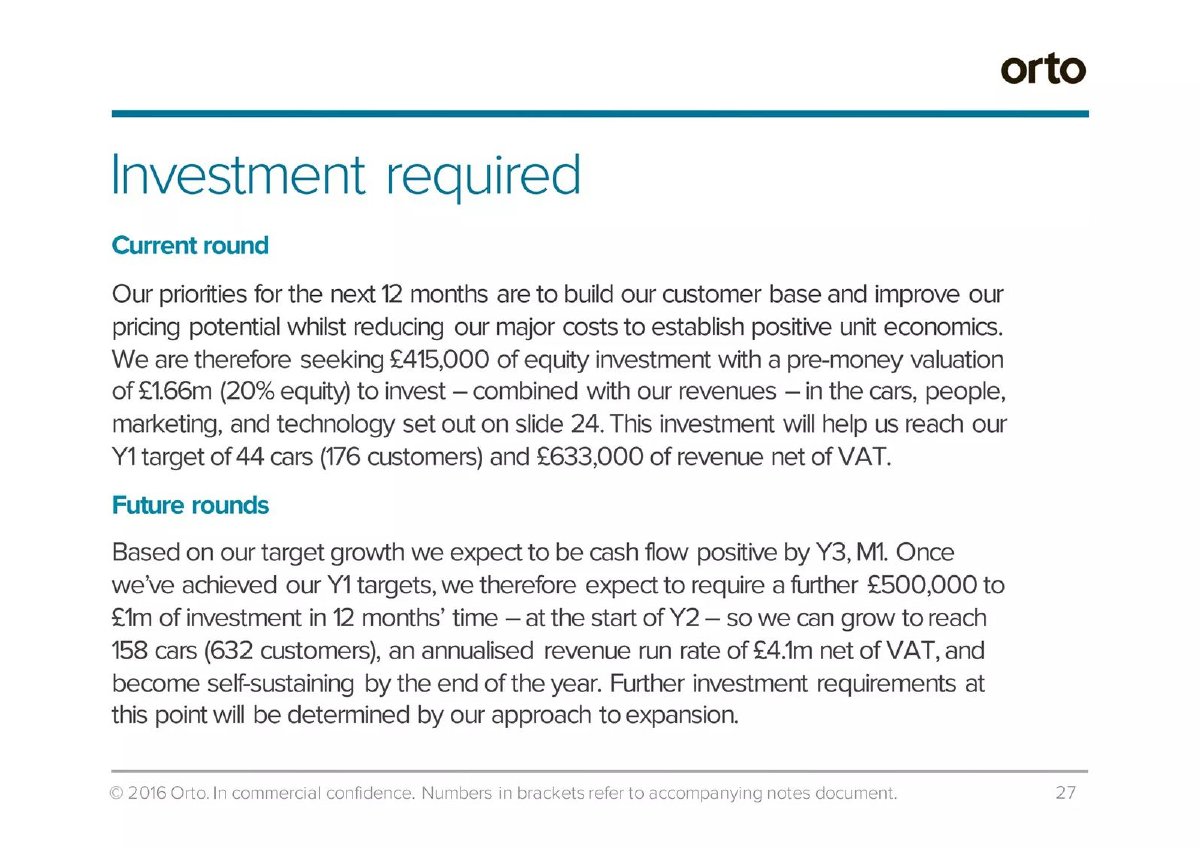
Orto ask slide — slide 27
London car subscription company. 'Investment required' slide.
Orto deck, slide 27. Exact stored slide matched to this analysis.
Our analysis: The most complete funding path in the set.
Evidence and limitation: Each round tied to a target (44 cars / £633,000; 158 cars / £4.1m run rate); 20% at £1.66m pre checks out (our calculation).
What a founder can adapt: Explain what decides the £0.5m vs £1m and the plan if targets slip.
Supporting analysis
What the deck claims: "seeking £415,000 of equity investment with a pre-money valuation of £1.66m (20% equity)"; "a further £500,000 to £1m of investment in 12 months' time"; "cash flow positive by Y3, M1".
Presentation choice: Shows a later round made conditional on this round's milestone.
When it does not fit: A two-to-one range with no reason given.
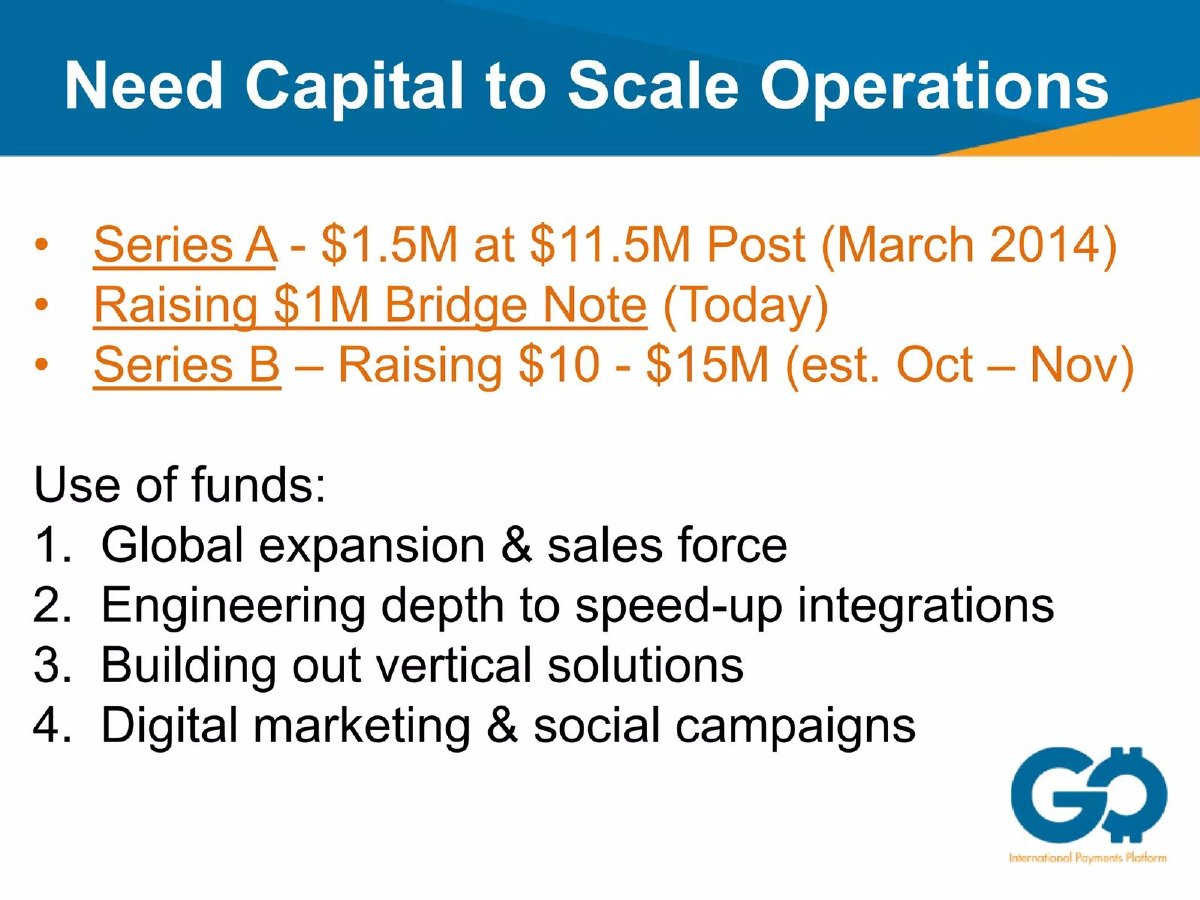
Cryptocurrency payments company. 'Need Capital to Scale Operations' slide.
GoCoin deck, slide 11. Exact stored slide matched to this analysis.
Our analysis: Clear sequence, unexplained jump.
Evidence and limitation: Sequence and timing given; no milestone for the bridge; Series B seven to ten times the Series A (our calculation).
What a founder can adapt: Add what the bridge must achieve before the Series B.
Supporting analysis
What the deck claims: "Series A - $1.5M at $11.5M Post (March 2014)"; "Raising $1M Bridge Note (Today)"; "Series B – Raising $10 - $15M (est. Oct – Nov)".
Presentation choice: Shows past, current and next rounds on one list.
When it does not fit: A large next round with no evidence for the step.
Amount, timing, milestone, cash need and valuation.
Example
Later round
Timing
Milestone linked
Cash need shown
Later valuation
Orto
£500,000 to £1m
Start of Y2
Yes (44 cars, £633,000)
No (cash-flow positive Y3)
Not stated
GoCoin
Series B $10-15M
Est. Oct–Nov
No
No
Not stated
Barcoo
Second step 150 T€
Q1/09, after go-live
Go-live (implied)
Yes, quarterly
Not stated
Longenesis
Phase 2 $5M
Q2 2023
No
No
$30M pre-money
Key Takeaways
Mention the next round only to explain what this round must prove.
Tie each later round to a measurable milestone.
Give rough amount and timing, not a valuation.
Show the cash need that drives the plan.
Say what happens if the next round is late.
Keep the current round clearly separate from later ones.
Prepare your funding path
Answer these before adding a later round to your slide.
This round. What milestone does this round reach, and by when?
Next round. Roughly how much, when, and what does it depend on?
Cash need. What is the monthly or quarterly requirement driving the timing?
End point. When do you expect to stop needing new money?
If late. What happens if the milestone or the next round slips?
Copyable framework: "Raising [amount] to reach [milestone] by [month]. On reaching it, we expect to raise about [amount] to reach [next milestone]; cash-flow positive at [month]."
Illustrative example 1 — written by us
Before: "Raising $1M Bridge Note (Today)" / "Series B – Raising $10 - $15M (est. Oct – Nov)"
After: "Raising $1M bridge to reach [milestone] by [month]; on reaching it, Series B of about $10-15M in Oct–Nov."
What improved: Our illustrative rewrite of GoCoin's lines. Bracketed details are not stated on the slide.
The question this guide answers
This guide answers one founder question: should my ask slide say what I plan to raise after this round, and if so, how do I show it without promising too much?
Our main ask slide guide covers the amount, use of funds, runway and the milestone this round should reach; it suggests in one line marking past and future rounds on a projection. Our runway guide checks months of runway against the burn. Our funding-to-date guide covers money already raised, and our bridge round guide covers a small round that carries the company to a larger one. None of these explains how to present the rounds that come after the current raise: whether to include them, what each should be tied to, and what to leave out. That is this guide's subject.
How we chose and read the examples
We searched extracted text across the library for 'future rounds', 'funding plan', 'funding strategy', 'financing plan' and 'raising' followed by a range. Many matches were legal disclaimers about 'future financing plans', listed companies' capital spending plans, or use-of-funds charts with no later round. We set aside Pendo's slide, which says only '$15M Series B, Q1 FY18' beside a redacted forecast, and ENOUGH's 'Future Funding Plans' slide, which gives no amounts or milestones.
We kept four private-company slides that show later rounds in clearly different ways: a written current-round and future-rounds page (Orto), a list of past, current and next rounds (GoCoin), a quarterly cash-need chart with two funding steps (Barcoo) and a round split into two phases on a timeline (Longenesis). Each was rendered from the source deck and read at full size. Calculations are ours from the slides' figures. We did not check whether any later round happened.
Why investors care about later rounds
Dilution. An investor buying 20% today will own less after each later round. How many rounds the plan needs, and roughly how large, decides what their share is worth at the end.
Financing risk. If the company needs another round in twelve months, the current investors are betting that it will reach the milestone that makes that round possible. The milestone is the real subject of the ask.
Signalling. A later round that looks enormous next to the current one can suggest the current round is too small to get anywhere. A later valuation stated in advance can look naive, because it will be set by the next investors, not the founder.
Planning. A founder who can say 'this round gets us to 44 cars and £633,000 of revenue; that unlocks a £0.5-1m round to reach cash-flow positive' shows they have thought about the whole path, which is the point of including it at all.
A future round tied to milestones: Orto
Orto, a London car subscription company, has a slide headed 'Investment required' with two short sections. Under 'Current round': 'Our priorities for the next 12 months are to build our customer base and improve our pricing potential whilst reducing our major costs to establish positive unit economics. We are therefore seeking £415,000 of equity investment with a pre-money valuation of £1.66m (20% equity)... This investment will help us reach our Y1 target of 44 cars (176 customers) and £633,000 of revenue net of VAT.' Under 'Future rounds': 'Based on our target growth we expect to be cash flow positive by Y3, M1. Once we've achieved our Y1 targets, we therefore expect to require a further £500,000 to £1m of investment in 12 months' time – at the start of Y2 – so we can grow to reach 158 cars (632 customers), an annualised revenue run rate of £4.1m net of VAT, and become self-sustaining by the end of the year. Further investment requirements at this point will be determined by our approach to expansion.'
Linking each round to a milestone is the lesson. The current round has a measurable target (44 cars, 176 customers, £633,000), and the next round is described as conditional on reaching it ('Once we've achieved our Y1 targets'). The next round also has its own target and an end point: cash-flow positive. An investor can see the whole path and judge whether each step is believable. The arithmetic of the current round checks out: £415,000 for 20% after the money implies £2.075m post-money, which is £1.66m plus £415,000 (our calculation).
Two things could be clearer. The next round is a range of two to one, '£500,000 to £1m', with no explanation of what decides the amount. And the slide gives no plan if the Y1 targets are missed or the round is late. Even so, it is the most complete example in the set, and it keeps the later round's valuation open, which is right.
Past, present and next on one list: GoCoin
GoCoin, a cryptocurrency payments company, has a slide headed 'Need Capital to Scale Operations' that opens with three lines: 'Series A - $1.5M at $11.5M Post (March 2014)', 'Raising $1M Bridge Note (Today)', and 'Series B – Raising $10 - $15M (est. Oct – Nov)'. Below is a numbered 'Use of funds' list: 'Global expansion & sales force', 'Engineering depth to speed-up integrations', 'Building out vertical solutions', 'Digital marketing & social campaigns'.
Putting the rounds in sequence is the strength. In three lines a reader sees where the company has been, what it is raising now and what comes next, with timing for each. The bridge is clearly labelled as a bridge, so an investor understands the $1M is meant to carry the company to a larger round, not to fund the whole plan.
The gaps are the milestone and the jump. Nothing says what the bridge must achieve to make a $10-15M Series B possible a few months later. That Series B would be seven to ten times the Series A raised months earlier (our calculation), a large step that needs evidence, and the slide gives none. The use-of-funds list has no amounts and doesn't say which round pays for which item. A stronger version would add one line under the bridge: 'Bridge funds [milestone] by [month], the basis for the Series B.'
Funding steps drawn from the cash need: Barcoo
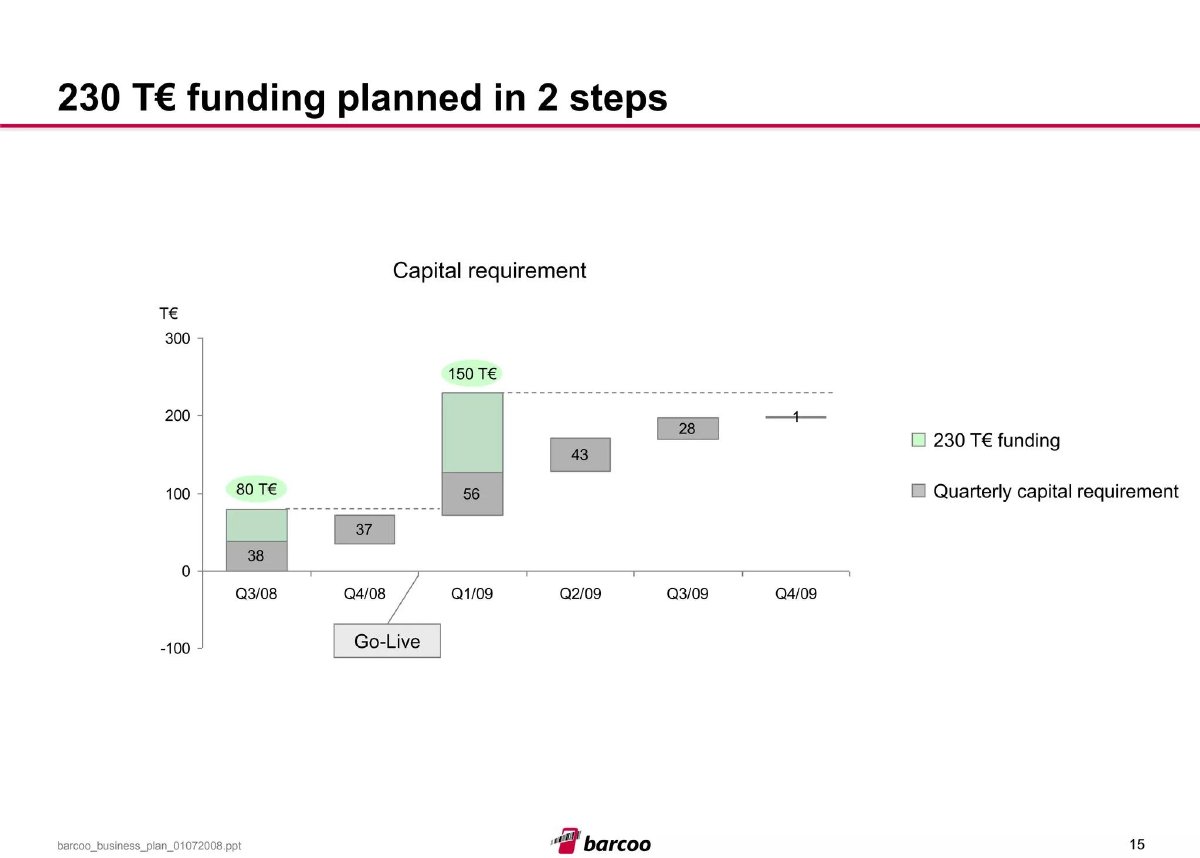
Barcoo, a German mobile barcode-scanning app, has a slide headed '230 T€ funding planned in 2 steps' (T€ means thousands of euros). The chart, titled 'Capital requirement', shows quarterly capital requirement as grey floating bars from Q3/08 to Q4/09: 38, 37, 56, 43, 28 and 1. Two green funding bars sit on top: '80 T€' in Q3/08 and '150 T€' in Q1/09, with dashed lines marking the funded level. A 'Go-Live' label points between Q4/08 and Q1/09.
Deriving the steps from the cash need is the lesson. A reader can see why the money comes in two pieces: the first 80 T€ covers the two quarters before launch (38 + 37 = 75, our calculation), and the second 150 T€ arrives after go-live to cover the rest. The quarterly requirements add up to about 203 T€ against 230 T€ raised (our calculation), so the plan leaves a small buffer. Tying the second step to the launch also tells an investor what must happen first.
What's missing is the terms and the condition. The slide doesn't say whether both steps come from the same investors, whether the second is committed or must be raised separately, or what happens if go-live slips. If the second tranche depends on the launch, saying so ('150 T€ on go-live, committed by the same investors') would turn a chart into a plan.
One round in two phases, with a valuation: Longenesis
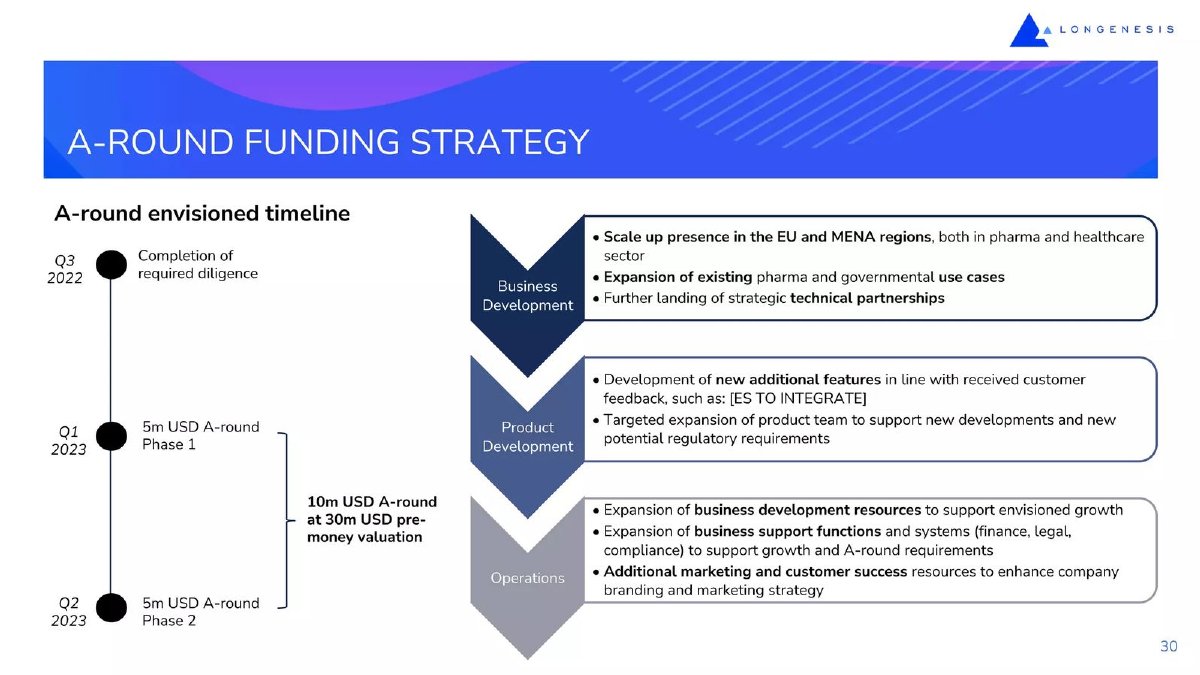
Longenesis, a health-data software company, has a slide headed 'A-ROUND FUNDING STRATEGY'. On the left, an 'A-round envisioned timeline' runs from 'Q3 2022 Completion of required diligence' to 'Q1 2023 5m USD A-round Phase 1' and 'Q2 2023 5m USD A-round Phase 2', bracketed as '10m USD A-round at 30m USD pre-money valuation'. On the right, three arrows list what the money is for: business development (EU and MENA presence, more pharma and government use cases, technical partnerships), product development ('new additional features in line with received customer feedback, such as: [ES TO INTEGRATE]' and a larger product team) and operations (more business development, finance, legal and compliance, marketing and customer success).
Showing the timing and the split is the strength. An investor sees when diligence ends, when each half of the money arrives and how the round is structured. The three areas of spending tell a reader roughly where the money goes.
The weaknesses are typical of plans that run ahead of the evidence. Nothing says what triggers Phase 2: if it depends on a milestone, the slide should name it; if not, it is unclear why the round is split. The $30M pre-money valuation is stated for a round that hasn't started, which invites a negotiation the slide can't win. None of the spending areas has an amount or a target. And '[ES TO INTEGRATE]' is a placeholder left in the deck, which a reader will notice. A stronger version: 'Phase 2 ($5M) on [milestone, e.g. two signed pharma contracts]; Phase 1 funds [targets] by Q2 2023.'
What to put on the slide
The current round first and clearly. Amount, terms if you are sharing them, and the milestone it reaches. Orto puts this in its own section.
The next round, briefly. A rough amount and timing, and the milestone it depends on. Orto and GoCoin give amount and timing; only Orto links the next round to a stated target.
The cash need behind it. A quarterly or monthly requirement, as Barcoo shows, lets a reader see why the money arrives when it does.
The end point. Cash-flow positive, or the round after which the company can grow without new money. Orto names one; the others don't.
No valuation for later rounds. The next investors will set it. Longenesis states one; the others leave it open.
A line on risk. What happens if the milestone is late: a smaller next round, a slower plan or more runway from this round.
When to leave future rounds out
If you have no clear milestone for the next round, a future-round line adds questions without answers. Better to state the runway and milestone for this round alone.
If the next round would be many times larger than this one, explain the jump or leave it to the conversation. An unexplained tenfold step makes the current round look too small.
If your plan reaches cash-flow positive on this round, say so instead. That is a stronger statement than any future round.
Templates
Current round: 'Raising [amount] to reach [milestone] by [month year] ([n] months runway).'
Next round: 'Once [milestone] is reached, we expect to raise about [amount] in [period] to reach [next milestone].'
Tranches: '[Amount] now; [amount] on [trigger], [committed / to be raised].'
End point: 'Cash-flow positive at [month], with [amount] total raised.'
What these examples can and cannot show
These four slides show how founders presented the rounds after the one they were raising. They can't show whether the later rounds happened, at what size or valuation, or whether the milestones were reached. We did not check any of this. Our calculations use the slides' own figures.
Treat them as patterns. Orto links each round to a target and an end point but leaves its next round a wide range. GoCoin shows the sequence clearly but gives no milestone for a large jump. Barcoo derives two funding steps from its cash need but doesn't say whether the second is committed. Longenesis gives timing and structure but states a valuation and leaves a placeholder in place.
Common mistakes
No milestone. A later round with nothing that unlocks it.
Valuation in advance. Stating the price of a round not yet started.
Unexplained jump. A next round many times this one, with no evidence.
Unclear tranches. Two steps with no condition or commitment stated.
Rounds blurred together. The current ask not clearly separated from later ones.
Diagnostic checklist
Current round and milestone first.
Later round: rough amount, timing, trigger.
Cash need behind the timing.
End point named.
No later valuation.
Frequently asked questions
Will mentioning a next round put investors off?
Not if it is tied to a milestone. Investors assume another round is coming; showing what unlocks it reassures them more than silence.
Should I give the valuation I expect for the next round?
No. The next investors will set it. Give the milestone you expect to reach instead, and let them draw the conclusion.
How we chose these examples
Corpus: published pitch deck teardowns on StartupFundraising.com. Founder-uploaded private decks are excluded.
Selection (2026-10-01): we searched extracted text for future-round, funding-plan, funding-strategy and raise-range phrases, set aside disclaimers, listed-company capital plans, a slide giving only a round size beside a redacted forecast (Pendo) and one with no amounts (ENOUGH), and kept four private-company slides that present later rounds differently.
Review: the four slides were rendered from the source decks on 2026-10-01 and read in full at full size against company, deck and slide number (editorial model review, with AI assistance in drafting; not human-reviewed). Calculations use the slides' stated figures. We did not check whether any later round took place.