Buyback as an Exit in a Pitch Deck: Who Buys, When, at What
How to present a share buyback as an investor exit in a pitch deck: name the buyer, the trigger, the price formula and the money that pays for it.
Buyback as an Exit in Your Pitch Deck: Name the Buyer, the Trigger, the Price and the Cash
Some companies will probably never be acquired or listed: a profitable local business, a niche product, a single site. Their founders often offer investors a different way out: the company or the founder buys the investor's shares back later. Four real decks show how differently that promise can be written. CornFinger lists "Buyback" as one word among four exit routes. VRUUM lists an "ESOP buyback + founder-driven secondary exit" with no terms. Archimedes' Offspring names the buyer and sets a price floor of twice the investment. LiquidSpace states who buys, when, how much and at what price, but leaves two key terms undefined. This guide shows what an investor needs before a buyback counts as an exit, and how to put it on one slide.
TL;DR
A buyback is a credible exit on a pitch deck only when the slide answers four questions: who buys (the company, the founder, or other shareholders), what triggers it (a date, a cash milestone, or either side's choice), how the price is set (a fixed multiple, a formula, or an independent valuation, ideally with a floor), and where the money comes from (company profits, a founder's personal funds, or a later round). Say also whether it is the investor's right or the company's right, because the two are opposites: an investor's right to sell is protection, while a company's right to buy can cap the investor's upside. Put the full terms in the term sheet; the slide should carry a one-line summary and a worked example.
Four real buyback exit slides
Each slide below is shown as it appears in the company's original deck, with what it says, what we checked and what an investor still cannot tell. They run from least to most specified.
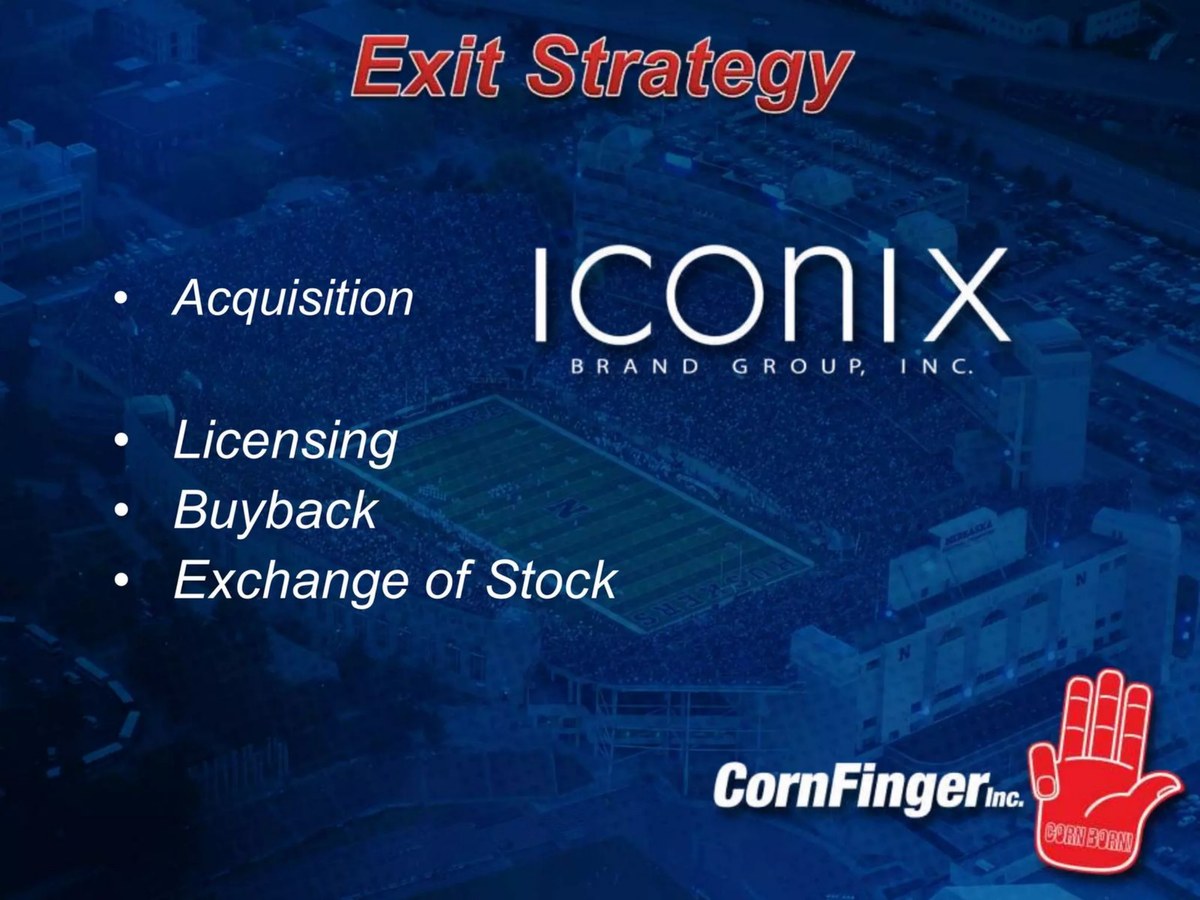
CornFinger deck, slide 11. Exact stored slide matched to this analysis.
Our analysis: A list of possibilities, not a plan. Including "Buyback" shows the founders thought about a route other than acquisition, which suits a regional apparel brand. But a one-word bullet gives an investor nothing to rely on, and placing it under a well-known acquirer's logo makes the whole list look like the acquisition is the real answer.
Evidence and limitation: Directly visible: four one- or three-word routes and one company logo. No buyer, trigger, price, timing or source of money is given for the buyback, and the page does not say whether Iconix has expressed any interest.
What a founder can adapt: If a buyback is a real option, give it its own line with the buyer, the price rule and when it could happen.
Supporting analysis
What the deck claims: "Exit Strategy": "Acquisition" beside the Iconix Brand Group logo, then "Licensing", "Buyback", "Exchange of Stock".
Presentation choice: It shows the starting point most decks stop at: naming the route without any of its terms.
When it does not fit: Don't list an exit route you cannot describe in one sentence; it invites the question and has no answer.
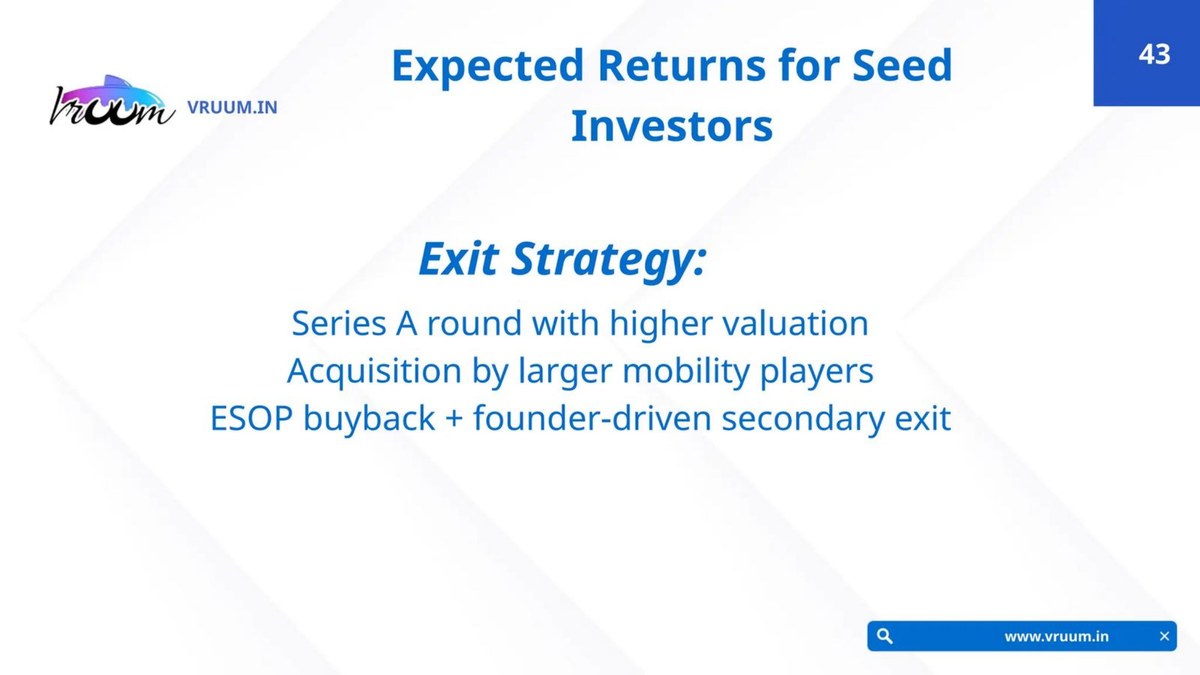
Indian ride-hailing startup; slide 43 of a 45-page seed deck, titled for seed investors.
VRUUM deck, slide 43. Exact stored slide matched to this analysis.
Our analysis: The most useful of the three lines is the last, because it names who might buy the seed investors' shares: the employee share scheme and buyers the founder brings in. That makes it a secondary sale, not a company buyback. The slide would work if it said when (at the Series A?), how much of the seed stake could be sold, and at what price relative to the round.
Evidence and limitation: Directly visible: three routes. The page carries no figures despite its title: no expected multiple, valuation, timing or buyer. "Series A round with higher valuation" is a mark-up, not cash, unless seed shares are sold in that round; the third line suggests they might be.
What a founder can adapt: Say "At Series A, seed investors may sell up to [x]% of their shares to new investors at the round price", and only promise it if you have discussed it with investors who could buy.
Supporting analysis
What the deck claims: "Expected Returns for Seed Investors". "Exit Strategy:" "Series A round with higher valuation", "Acquisition by larger mobility players", "ESOP buyback + founder-driven secondary exit".
Presentation choice: It shows the secondary-sale version of a buyback, and how a title promising returns raises expectations the page does not meet.
When it does not fit: Don't title a slide "Expected Returns" without a number; and don't present a higher valuation as a return the investor has received.
An investment programme in which retail investors buy partial ownership of individual inventions (page 17: 10% to 49%, at most $75,000 per invention). Page 22 is the fourth of four exit options on pages 19–22: licensing royalties, outright sale of the IP, bridge loans, and this buyback.
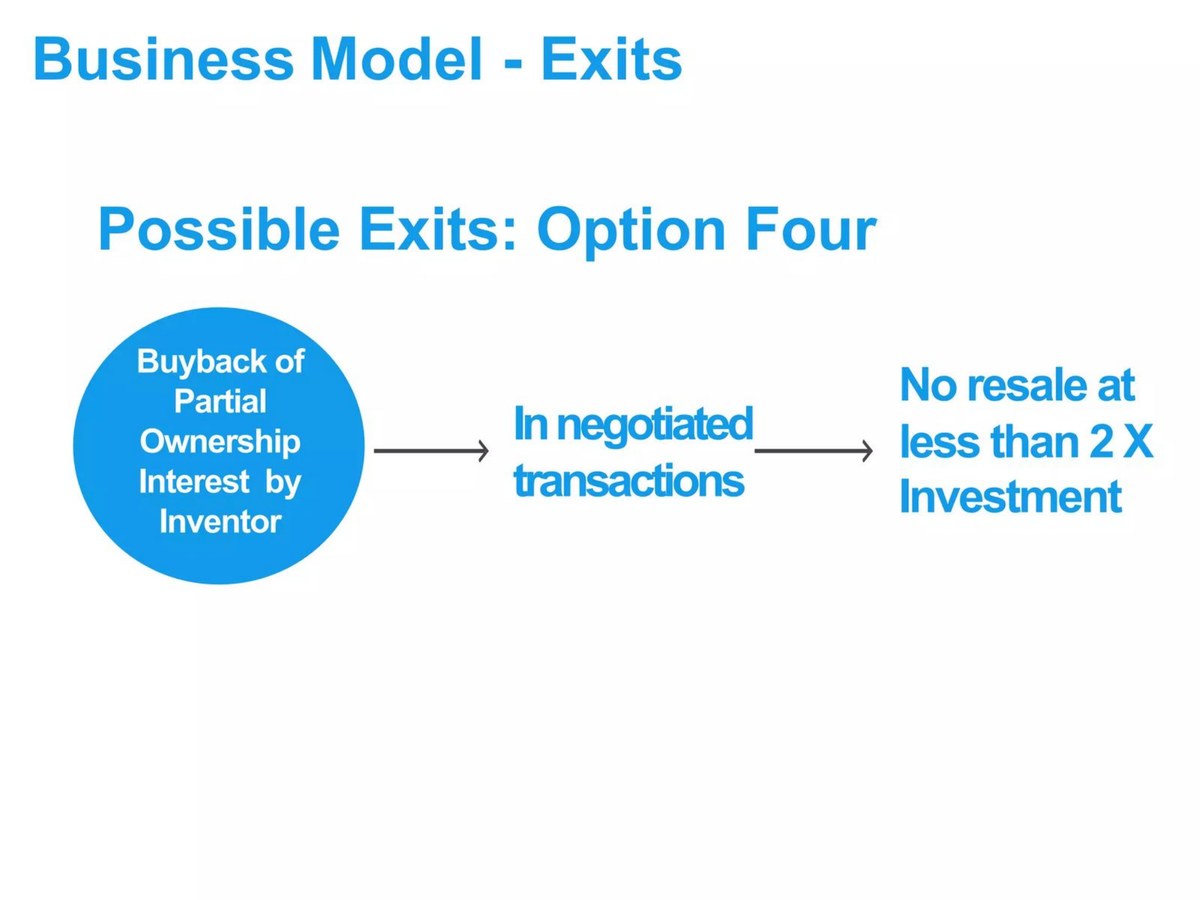
Archimedes' Offspring deck, slide 22. Exact stored slide matched to this analysis.
Our analysis: The clearest price term in this set: a floor the investor can calculate. Showing the buyback as one of four numbered routes, each with its own figure, also tells the investor this is a planned alternative rather than an afterthought. Its weakness is the buyer: an individual inventor's ability to pay twice the investment is the real risk, and "negotiated" means neither side is committed.
Evidence and limitation: Directly visible: buyer (the inventor), method (negotiated) and a price floor (2× investment). At the programme's stated maximum of $75,000 per invention, the floor would be at least $150,000 for a full buyback. Not stated: whether the floor applies to any resale or only to the inventor's buyback, when a buyback could happen, whether either side can require it, and how an inventor would fund it.
What a founder can adapt: Keep the floor, and add who can trigger the sale, the earliest date, and how the buyer will pay.
Supporting analysis
What the deck claims: "Business Model - Exits". "Possible Exits: Option Four": "Buyback of Partial Ownership Interest by Inventor" → "In negotiated transactions" → "No resale at less than 2 X Investment".
Presentation choice: It shows how a single printed floor turns a vague route into something an investor can value.
When it does not fit: Don't rely on a founder's or inventor's personal wealth without saying so; investors treat that as a different, usually weaker, promise.
Cape Town coworking space for professional traders; page 14 of a 16-page deck, "Investment Proposal".
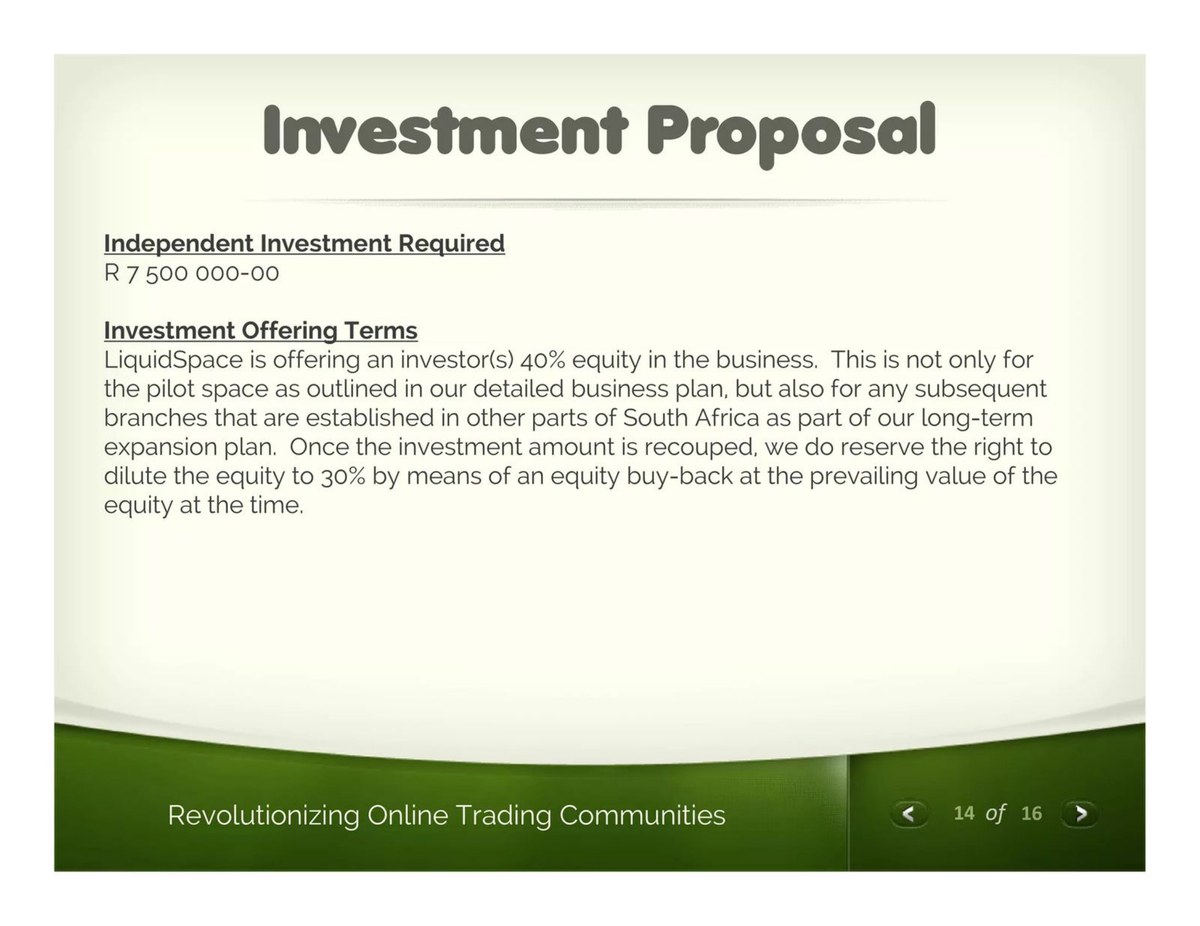
LiquidSpace deck, slide 14. Exact stored slide matched to this analysis.
Our analysis: The most complete buyback term in this set: every element is present in some form. Two words carry too much weight. "Recouped" could mean the investor has received R7.5m back, or the company has earned it, or the pilot site has paid for itself. "Prevailing value" with no valuer leaves the price to be argued later. The wording also says "dilute the equity", but a buyback reduces the investor's stake by purchase, not by dilution; using the precise word avoids confusion in diligence.
Evidence and limitation: Directly visible: amount (R7,500,000), stake (40%), buyer (the company, "we"), option holder (the company, "reserve the right"), size of the buyback (from 40% to 30%, that is 10 percentage points, a quarter of the investor's stake), trigger (investment "recouped") and price rule ("prevailing value"). Our arithmetic: R7,500,000 for 40% implies a post-money valuation of R18,750,000. Not stated: what "recouped" means, who sets the prevailing value, and whether the investor's 40% applies to one company or to each future branch.
What a founder can adapt: Define the trigger ("after investors have received cumulative distributions of R7.5m") and the valuer ("independent valuation agreed by both parties").
Supporting analysis
What the deck claims: "Independent Investment Required R 7 500 000-00". "LiquidSpace is offering an investor(s) 40% equity in the business… Once the investment amount is recouped, we do reserve the right to dilute the equity to 30% by means of an equity buy-back at the prevailing value of the equity at the time."
Presentation choice: It shows a company's right to buy back part of the stake, priced at market value, and the two definitions that make or break it.
When it does not fit: Don't call a buyback dilution, and don't leave the trigger open to three readings.
The five terms a buyback exit needs, and which of them each slide provides.
Slide
Buyer named
Whose option
Trigger or timing
Price rule
Source of cash
CornFinger p11
No
No
No
No
No
VRUUM p43
Yes (ESOP, founder-found buyers)
No
Partly (Series A implied)
No
Partly (new buyers)
Archimedes' Offspring p22
Yes (inventor)
Neither (negotiated)
No
Floor: 2× investment
No
LiquidSpace p14
Yes (company)
Company
Partly ("recouped", undefined)
Prevailing value (valuer unstated)
Implied (company)
Key Takeaways
Name the buyer. A company buyback, a founder buying personally and a sale to new investors are three different promises with different money behind them.
Say whose option it is. If the company can force the sale, the investor's upside is capped; if the investor can demand it, the company carries a future cash obligation.
Give a price rule, not just the word. A multiple of the investment, a valuation formula or an independent appraisal, plus a floor if you offer one.
Define the trigger. "Once the investment is recouped" needs a definition: recouped from what, measured how, by when?
Show where the cash comes from. A buyback paid from profits needs a profit forecast that covers it in the same years.
List a buyback beside acquisition only if you can explain it. A one-word bullet adds nothing an investor can rely on.
Build your buyback line
Answer each prompt before you put a buyback on the exit slide. Any blank is a question an investor will ask.
Buyer. The company, a founder personally, an employee share scheme, or new investors?
Option holder. Can the investor require it, can the company require it, or must both agree?
Trigger. Which date, distribution total or milestone opens the window, and when does it close?
Size. All of the stake or part of it? State it in percentage points and as a share of the investor's holding.
Price. Fixed multiple, formula or independent valuation? Any floor or ceiling? Who calculates it?
Cash. Which year of the forecast pays for it, and from what: profit, a founder's funds or a new round?
Copyable framework: [Buyer] may/must buy [size] of the investor's stake [when/after trigger], at [price rule, floor], funded from [source] (forecast year [x]). Full terms in the term sheet.
Illustrative example 1 — written by us
Before: Exit Strategy: Acquisition, Licensing, Buyback, Exchange of Stock
After: Exit routes: 1) sale to a licensing group (none approached yet); 2) company buyback of up to [x]% of investor shares from year [y] at [price rule], paid from operating profit.
What improved: Built from CornFinger's page 11; bracketed values are placeholders because the slide gives none. Turns a one-word route into terms an investor can weigh.
Illustrative example 2 — written by us
Before: Once the investment amount is recouped, we do reserve the right to dilute the equity to 30% by means of an equity buy-back at the prevailing value of the equity at the time.
After: After investors have received R7.5m in distributions, the company may buy back 10 of their 40 percentage points at an independent valuation agreed by both sides.
What improved: Built from LiquidSpace's page 14. The trigger definition and valuer are our suggested wording, not the company's; they remove the two open readings.
When a buyback belongs on the exit slide
Most early-stage investors expect their return to come from an acquisition or a stock market listing, and most exit slides are written for that: comparable acquisitions, likely buyers, a return multiple. That story does not fit every company. A single coworking site, a regional apparel brand or a portfolio of licensed inventions may produce steady profits for years without ever being an obvious acquisition target. For those companies, telling investors how they will get their money back is more honest than naming a famous acquirer.
A buyback answers that question directly: at some point, someone inside the business pays the investor for some or all of their shares. It is common in small private companies and in revenue-share or royalty arrangements, and much rarer in venture-backed startups, where investors usually want the chance of a large sale. If your deck is going to angel investors, family offices or local investors who are comfortable with a profit-led business, a well-specified buyback can be the main exit. If it is going to venture funds, show it as a secondary route beside the larger outcome you are aiming for, and expect them to ask why the company would spend cash on shares rather than growth.
This guide is about how to present the idea on a slide. It is not legal or tax advice. Rules on when a company may buy back its own shares, and how the investor is taxed, differ by country and by company type; have the terms drafted by a lawyer before you show them to investors. As one example of such limits, UK company law lets a private limited company buy back its own shares only out of distributable reserves, the proceeds of a new share issue made for the purpose, or capital under a stricter procedure. (ICAEW Technical Advisory Service)
Who buys: company, founder or a new investor
The four slides below use three different buyers, and each changes what the investor is relying on. In a company buyback the company pays from its own cash; the investor relies on the business generating that cash and on the company being legally allowed to use it. LiquidSpace's page 14 describes this: "an equity buy-back at the prevailing value of the equity."
In a founder buyback the founder pays personally. Archimedes' Offspring's page 22 is a version of this: the "Inventor" whose invention the investor has part-funded buys back the investor's "Partial Ownership Interest." The investor then relies on that person having the money at the time, which is a very different credit risk from relying on a company.
In a secondary sale a new investor buys the old investor's shares, often at the next funding round. VRUUM's page 43 points at this with "founder-driven secondary exit", alongside an "ESOP buyback" (an employee share scheme buying shares). Here the investor relies on the company raising again at a higher valuation and on new investors wanting those shares. Say which of the three you mean. If more than one could apply, say which comes first.
Whose option it is, and why investors care
A buyback can be written as the investor's right to sell (often called a put or, in term sheets, a redemption right) or as the company's right to buy (a call). From the investor's side these are opposites. A right to sell is protection: if the company stalls, the investor can ask for their money back on agreed terms. A company's right to buy is a cap: if the company does very well, it can buy the investor out at the agreed price before the investor shares in the full upside.
LiquidSpace's slide is a company right: "we do reserve the right to dilute the equity to 30% by means of an equity buy-back." That is a legitimate term, and pricing it at "prevailing value" rather than a fixed price makes it fairer to the investor. But the slide should present it as what it is: a limit on the investor's stake that the company controls, not a return the investor can call on. Archimedes' Offspring's page does not say whose option the buyback is; it says only that it happens "In negotiated transactions", which suggests neither side can force it.
If you offer investors a right to sell, the company is taking on a future cash obligation. Our separate practical guide on redemption rights in term sheets explains what that can cost a company and how founders narrow it; the same arithmetic applies when you volunteer the right yourself.
Setting the price: fixed multiple, formula or valuation
An exit is only as good as its price. There are three common ways to set it, and each slide that names a price uses one of them. A fixed multiple of the amount invested is simple and easy to read: Archimedes' Offspring prints "No resale at less than 2 X Investment", a floor that guarantees at least double the money if a resale happens, though by our reading it does not guarantee that one will. A valuation at the time is fairer when the company's value is uncertain: LiquidSpace's "prevailing value of the equity at the time" is this kind, but the slide does not say who decides the value or how.
A formula, such as a multiple of the previous year's profit or revenue, sits between the two: it moves with the business but is agreed in advance. Whichever you choose, say who calculates it (an independent valuer, the board, an agreed formula) and whether there is a floor or a ceiling. A slide that offers "fair value" with no method invites the question investors fear most: who decides what fair means when the founder is the buyer?
The trigger and the money: make the buyback fit the forecast
A buyback needs a trigger: a date, a milestone or a choice by one side. LiquidSpace's trigger is "Once the investment amount is recouped", which an investor could read in at least three ways: when the company's cumulative profits reach the investment, when the investor has received that much in distributions, or when the pilot site has paid back its fit-out cost. The slide does not say which, and the answer changes the timing by years.
Then show the money. A company buyback is paid from cash the company could otherwise spend on growth, so the forecast should show profits large enough to fund it in the year it is expected, after running costs and any debt payments. If the founder pays personally, say that, and do not show the payment in the company's forecast. If a later round pays, the buyback depends on that round happening; label it as a hope, not a commitment. A buyback that appears on the exit slide but nowhere in the financial plan is the gap investors spot first.
Worked example: a fully specified buyback (hypothetical)
This is our illustration, not a figure from any deck. An investor puts in $500,000 for 20% of a profitable two-site fitness business. The terms: the company may buy back half the investor's stake (10 of the 20 percentage points) at any time between years four and seven, but only after the investor has received cumulative distributions of $500,000. The price is the higher of twice the cost of the shares bought back or their value at an independent valuation.
The cost of the shares bought back is half of $500,000, or $250,000, so the floor is 2 × $250,000 = $500,000. If the independent valuation puts the whole company at $4,000,000, 10% is worth $400,000, and the floor applies: the company pays $500,000. If the valuation is $6,000,000, 10% is worth $600,000, and the company pays $600,000. Either way, the investor has received $500,000 in distributions, a buyback payment of at least $500,000, and still owns 10%.
On the slide, this becomes one line: "Company option, years 4–7, after $500k distributed to investors: buy back half your stake at the greater of 2× cost or independent valuation; funded from operating cash flow (see forecast, year 5)." Everything an investor needs to judge it is there: buyer, option holder, trigger, price rule with floor, and the source of cash.
Common mistakes
One-word route. "Buyback" in a list, with no buyer, price or timing, gives investors nothing to value.
Buyer unclear. A company buyback, a founder buying personally and a secondary sale rely on different money; say which.
Call presented as a return. A company's right to buy caps the investor's upside; don't present it as investor protection.
Undefined trigger. "Once recouped" or "when profitable" can be read several ways; define the measure and the threshold.
No valuer. "Fair" or "prevailing" value needs a method and a person or firm to set it.
Missing from the forecast. A company-funded buyback must appear in the cash plan for the year it is expected.
Diagnostic checklist
The buyer is named: company, founder, employee scheme or new investors.
The slide says whose option the buyback is.
The trigger and the window are defined in measurable terms.
The size is given in percentage points and as a share of the investor's stake.
The price rule names a method, any floor or ceiling, and who calculates it.
The source of cash is shown and matches the financial forecast.
The slide points to the term sheet for full terms, drafted by a lawyer.
Frequently asked questions
Will venture investors accept a buyback as an exit?
Usually only as a secondary route. Venture funds need some investments to return many times their money, so a capped buyback rarely fits as the main outcome. Angels, family offices and local investors backing a profit-led business are more likely to value it.
Is a buyback the same as redemption rights?
Related, but not the same. Redemption rights in a term sheet usually give investors the right to make the company buy their shares. A buyback on an exit slide can be that, or the company's right to buy, or a negotiated sale. Say which you mean.
Should I show a fixed multiple or market value?
A fixed multiple is easier to read and gives certainty; market value is fairer if the company grows much faster or slower than expected. Many terms use the higher of the two, which gives the investor a floor without capping them at it.
Can my company legally buy back shares?
It depends on the country, the company type and its finances at the time; In the UK, for example, a private limited company may repurchase its own shares only out of distributable reserves, the proceeds of a new share issue made for the purpose, or capital under stricter procedures. Rules elsewhere differ. Check with a lawyer before you put the term on a slide. (ICAEW Technical Advisory Service)
How we chose these examples
Discovery (2026-10-04): the owner authorised renewed production and outside research. The 2026-10-03 visual review had set aside LiquidSpace's buyback terms because no second eligible example was known; a targeted search of the durable corpus index for buy-back, buyback, repurchase and redemption terms (42 matching pages) found three more founder-side exit pages. Closest content read in full: the live exit strategy guide, the live investor-returns guide (one mention of interim dividends), the comparable-exits draft, the deal-terms guide and the practical redemption-rights draft (an investor's term-sheet right, not a founder's exit route). None teaches how to present a buyback exit.
Four pages were read from images rendered from the original deck files: CornFinger 11, VRUUM 43, Archimedes' Offspring 22 (with pages 17 and 19–21 for context) and LiquidSpace 14 (four new uploads at 1200px wide through the standing slide-image workflow, re-fetched byte-identical). All four teardowns are published; none is a listed company. Set aside: Archera 13 (product guarantee), Binance 9 (token burn), Astrum (sale-leaseback fund), fund redemption pages and listed-company share repurchase programmes.
Figures were checked by recalculation where printed; the worked example is hypothetical. Company terms are reported as printed and not verified. This guide explains presentation, not legal or tax treatment. Slide readings and analysis are an AI editorial model review, not human-checked.