Robotics and Hardware Competition Slides: 7 Real Pitch Deck
How robotics and hardware startups show competition in a pitch deck: named rival robots, cost and labour tables, price tables.
Robotics and Hardware Competition Slide: Compare Machines on What Buyers Pay For
Hardware buyers compare machines on things they can measure: purchase price, running cost, hours of labour saved, certifications, how long setup takes and whether the machine works with what they already own. That makes a robotics or hardware competition slide easier to get right than most, because the comparison can be concrete. It also makes weak slides easy to spot. A list of features with no rival named, or a grid whose labels don't mean anything, tells an investor the founders have not done the comparison a buyer will do. The six slides below, from an industrial inspection robot, a warehouse robot system, a milk-processing robot, a robot lawnmower, a construction 3D printer and a home robot, show the range from very concrete to empty.
TL;DR
Name the machines or methods a buyer would otherwise use, compare them on the measures the buyer pays for, such as price, running cost, labour, certification or setup, and put your own product in the same table or grid. Direct Dairy's table compares two named milk-processing rivals on capital cost, labour hours per shift and automation, and even marks figures that rest on one unconfirmed source. ANYbotics names five rival robots and the safety ratings that separate them. Destiny Robotics shows a grid whose two ends of each axis carry the same label, so it compares nothing.
Robotics and hardware competition slides from real pitch decks
Each example shows the exact stored slide above its analysis and links to the full teardown. The slides that explain the company's position come first; weaker ones follow for contrast. Claims are as shown on the slides; comments are ours.
Direct Dairy competition slide — slide 24
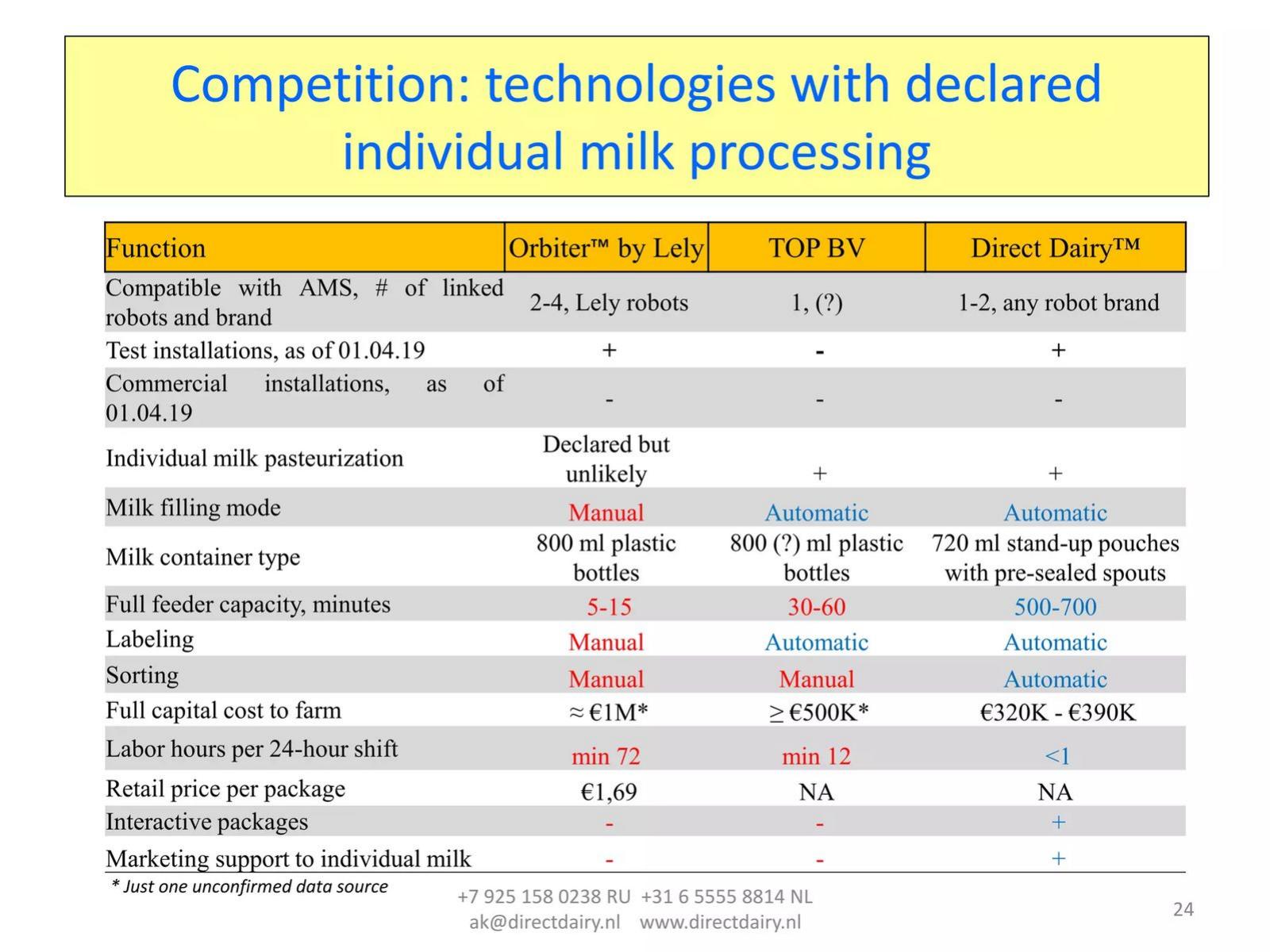
Dutch startup building a robot that processes and packages milk from individual cows on the farm; the table is dated 1 April 2019. Slide titled "Competition: technologies with declared individual milk processing".
Direct Dairy deck, slide 24. Exact stored slide matched to this analysis.
Our analysis: It argues that Direct Dairy costs a farm far less to install and needs almost no labour, while rivals need staff for filling, labelling or sorting.
Evidence and limitation: Rival figures marked by the company as resting on one unconfirmed source. A 2018 note from the company sought a demonstration farm; we found no later public record, so its outcome is unknown.
What a founder can adapt: Add where the labour-hour figures come from and one test-farm result for Direct Dairy itself.
Supporting analysis
What the deck claims: A table comparing Orbiter by Lely, TOP BV and Direct Dairy. Compatible robots: 2-4 Lely robots; 1 (?); 1-2 any robot brand. Commercial installations as of 01.04.19: none for any. Milk filling, labelling and sorting: manual for Lely; automatic, automatic and manual for TOP BV; automatic for Direct Dairy. Full capital cost to farm: about €1M*, at least €500K*, €320K-€390K. Labour hours per 24-hour shift: min 72, min 12, less than 1. Retail price per package: €1,69, NA, NA. Footnote: "* Just one unconfirmed data source".
Presentation choice: It compares named rivals on capital cost and labour, the two numbers a farmer cares about most, and is honest about the quality of its data.
When it does not fit: Presenting rival costs from one unconfirmed source as firm; Direct Dairy marks them, and you should too.
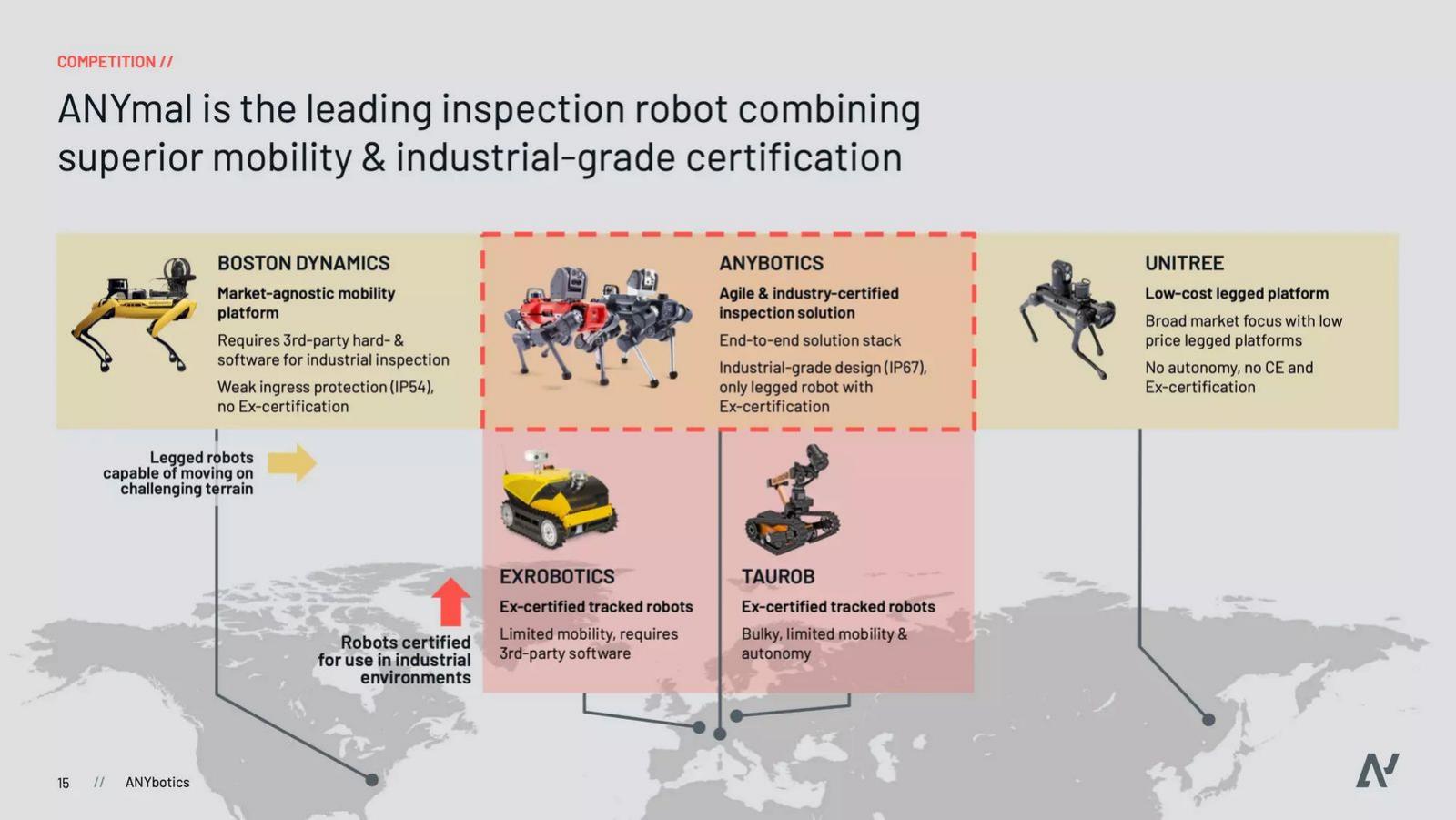
Swiss maker of four-legged inspection robots for industrial plants; Series B deck. Slide titled "ANYmal is the leading inspection robot combining superior mobility & industrial-grade certification".
ANYbotics deck, slide 15. Exact stored slide matched to this analysis.
Our analysis: It argues that ANYmal is the only robot that is both legged, so it can climb stairs and rough ground, and certified for hazardous industrial areas.
Evidence and limitation: Claimed; ratings are published standards a reader can check. ANYbotics raised a $50M Series B in May 2023, according to TechCrunch, which reports the company's own claim of $150M in preorders and reservations.
What a founder can adapt: Add price or cost per inspection round against at least one rival and against a human inspector.
Supporting analysis
What the deck claims: Boston Dynamics: "Market-agnostic mobility platform", "Requires 3rd-party hard- & software for industrial inspection", "Weak ingress protection (IP54), no Ex-certification". Unitree: "Low-cost legged platform", "No autonomy, no CE and Ex-certification". ExRobotics: "Ex-certified tracked robots", "Limited mobility, requires 3rd-party software". Taurob: "Ex-certified tracked robots", "Bulky, limited mobility & autonomy". ANYbotics: "Agile & industry-certified inspection solution", "Industrial-grade design (IP67), only legged robot with Ex-certification". Groups labelled "Legged robots capable of moving on challenging terrain" and "Robots certified for use in industrial environments", over a world map.
Presentation choice: Every rival is named, and the differences are certifications a plant operator must check anyway.
When it does not fit: Leaving out cost; buyers compare it as soon as certification is settled.
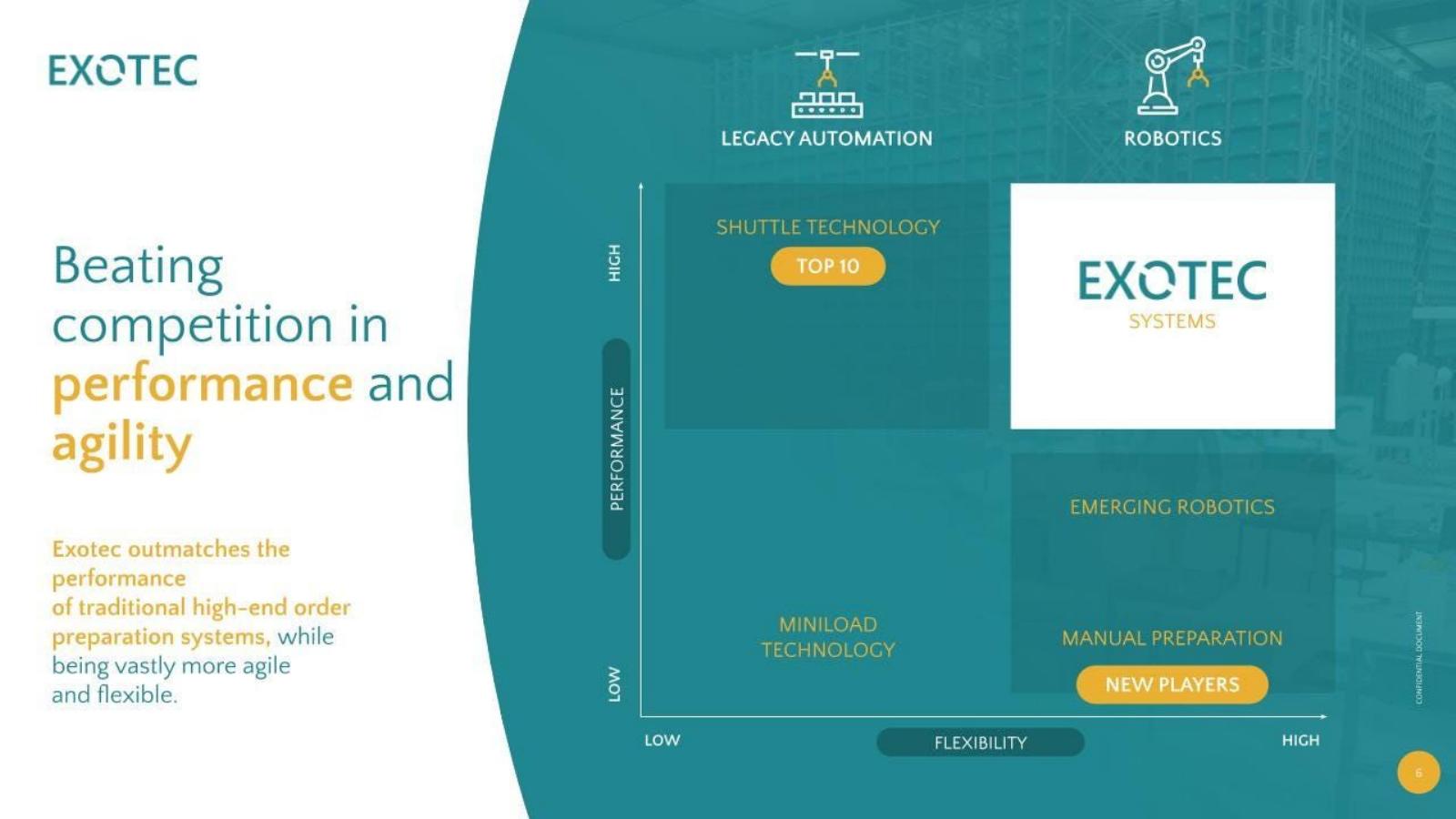
French warehouse robotics company. Slide titled "Beating competition in performance and agility".
Exotec deck, slide 7. Exact stored slide matched to this analysis.
Our analysis: It argues that warehouse buyers no longer have to choose between fast fixed systems and flexible slow ones.
Evidence and limitation: Claimed; no figures. Exotec raised a $335M Series D at a $2B valuation in January 2022, according to TechCrunch.
What a founder can adapt: Name two or three companies in each box and add picks per hour and time to install for Exotec against them.
Supporting analysis
What the deck claims: A two-by-two grid: horizontal axis "Flexibility" (low, high), vertical axis "Performance" (low, high); columns labelled "Legacy automation" and "Robotics". Shuttle technology ("Top 10") high performance, low flexibility; miniload technology low, low; emerging robotics and manual preparation ("New players") high flexibility, low performance; Exotec Systems high, high. "Exotec outmatches the performance of traditional high-end order preparation systems, while being vastly more agile and flexible."
Presentation choice: The axes are the real trade-off warehouse buyers face, and the claim is stated plainly enough to test.
When it does not fit: Categories with no names or figures; a reader has to take the placement on trust.
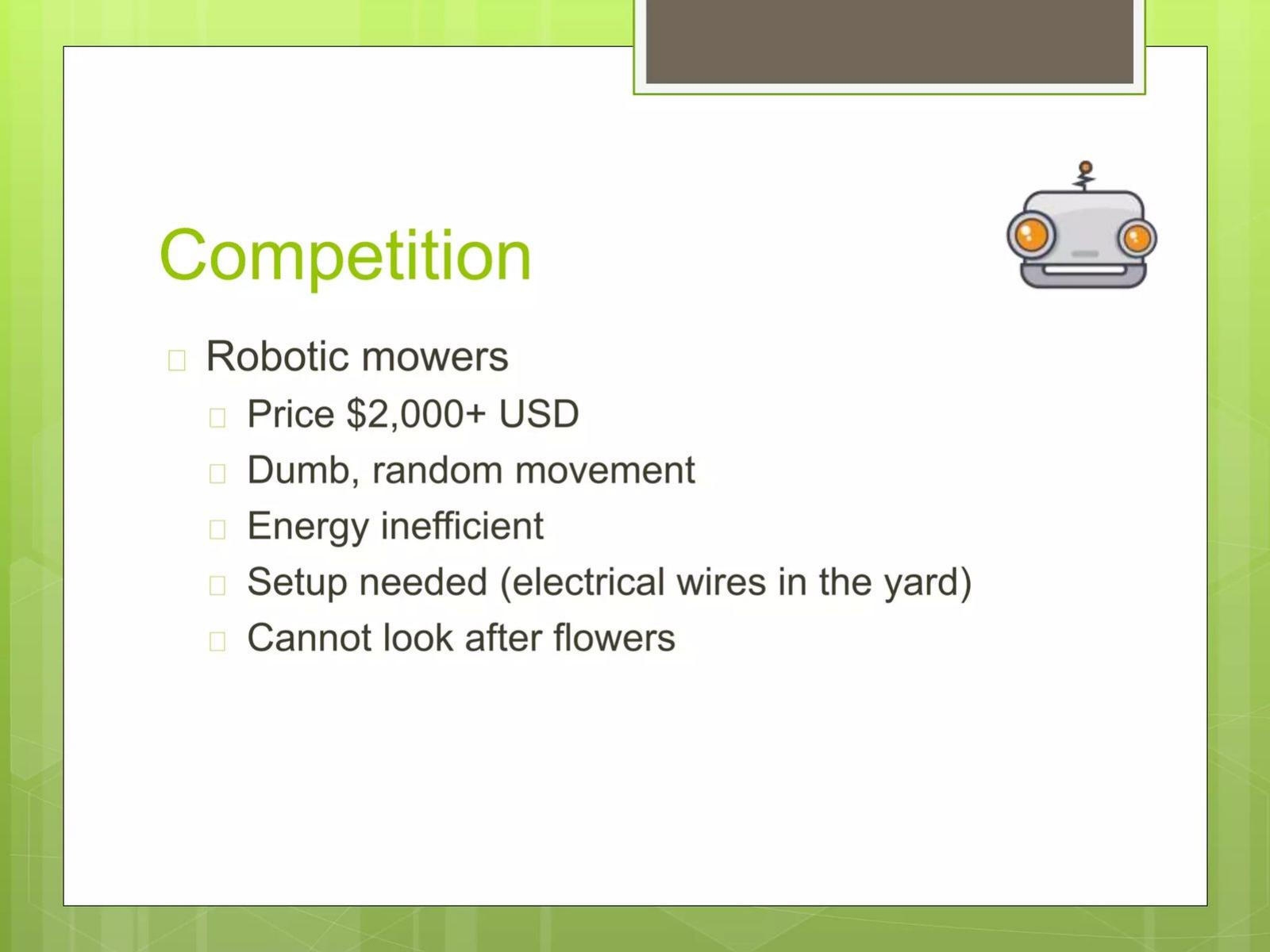
Robot lawnmower prototype with its own local positioning system, 2014 seed deck. Slide titled "Competition".
Alamo deck, slide 10. Exact stored slide matched to this analysis.
Our analysis: It argues that existing robot mowers are expensive, need boundary wires and mow at random, while Alamo navigates precisely.
Evidence and limitation: Claimed; no brands named and no source. Outcome unknown; we found no public record after the deck.
What a founder can adapt: Name two or three leading robot mowers with their prices and setup time, and show Alamo's own planned price beside them.
Supporting analysis
What the deck claims: "Robotic mowers": "Price $2,000+ USD", "Dumb, random movement", "Energy inefficient", "Setup needed (electrical wires in the yard)", "Cannot look after flowers".
Presentation choice: Shown for contrast: the price and boundary wire are real buyer concerns, but with no brand named, a reader can't check them.
When it does not fit: Describing a category of rivals without naming any of them.
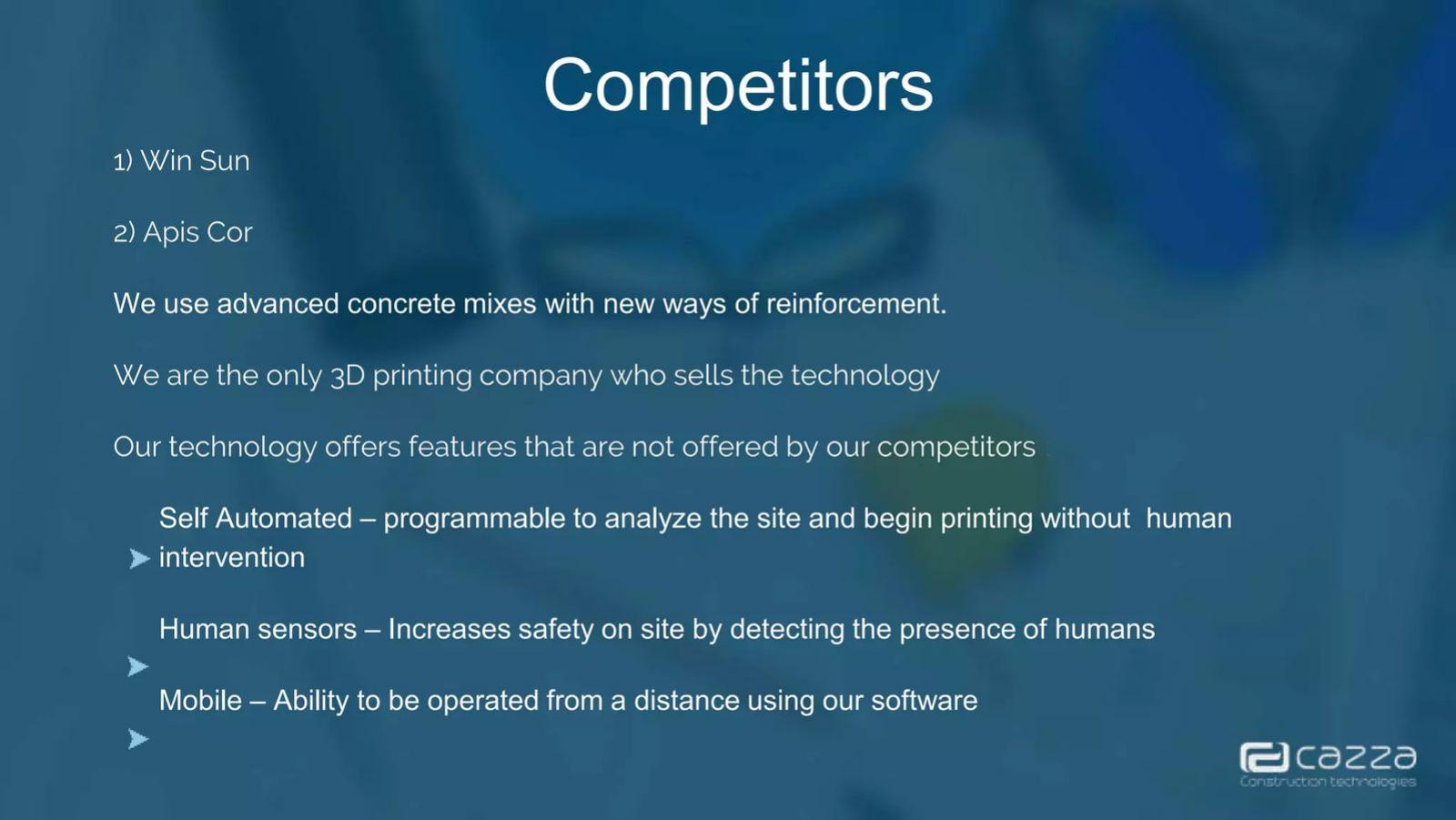
Dubai construction 3D-printing startup founded in 2016, seeking an $80M Series A in its 2017 deck. Slide titled "Competitors".
Cazza deck, slide 22. Exact stored slide matched to this analysis.
Our analysis: It argues that Cazza sells its machines while rivals don't, and that its machines do more on their own.
Evidence and limitation: Claimed; no figures or sources. In September 2018 the trade site Fabbaloo reported that Cazza "may have disappeared".
What a founder can adapt: Compare print speed, wall height and price per square metre against Win Sun and Apis Cor, with sources.
Supporting analysis
What the deck claims: "1) Win Sun", "2) Apis Cor". "We use advanced concrete mixes with new ways of reinforcement." "We are the only 3D printing company who sells the technology". "Our technology offers features that are not offered by our competitors": "Self Automated – programmable to analyze the site and begin printing without human intervention"; "Human sensors – Increases safety on site by detecting the presence of humans"; "Mobile – Ability to be operated from a distance using our software".
Presentation choice: Shown as a warning: two real rivals are named, but every difference is an unsupported claim.
When it does not fit: "Only" and "not offered by our competitors" without evidence; investors will check.
Miami startup pitching a humanoid home assistant robot, crowdfunding deck. Slide titled "Competitors".
Destiny Robotics deck, slide 8. Exact stored slide matched to this analysis.
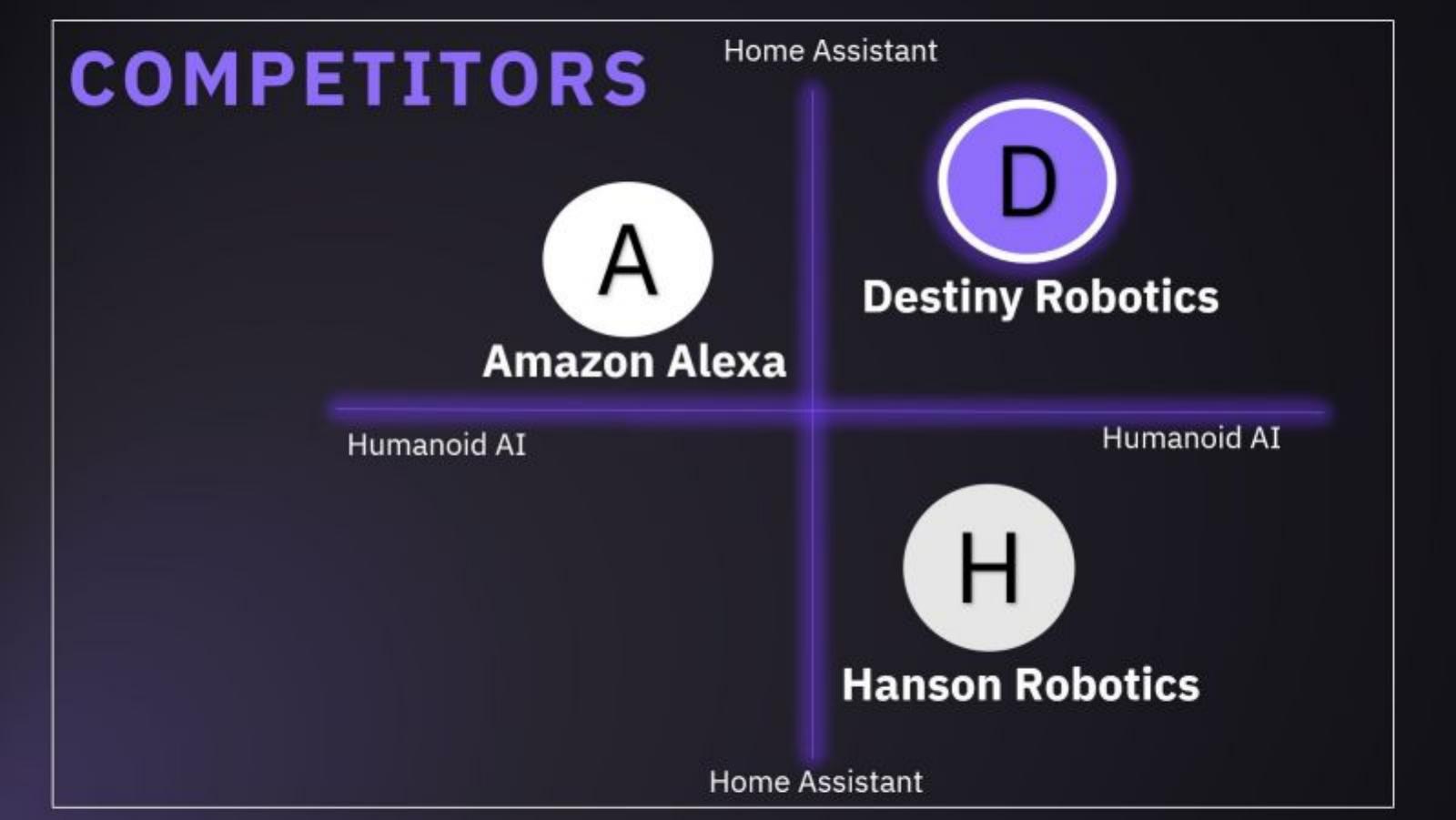
Our analysis: It suggests that Destiny Robotics combines a home assistant like Alexa with a humanoid robot like Hanson's.
Evidence and limitation: No figures. In October 2024 the US Securities and Exchange Commission charged the company and its founder with making false and misleading statements to investors; the SEC says about $141,000 was raised from investors, and both settled without admitting or denying the charges.
What a founder can adapt: Give each axis two different ends, and show what the product can do today against each rival.
Supporting analysis
What the deck claims: A two-by-two grid. Vertical axis labelled "Home Assistant" at both ends; horizontal axis labelled "Humanoid AI" at both ends. Amazon Alexa top left, Hanson Robotics bottom right, Destiny Robotics top right, highlighted.
Presentation choice: Shown as a warning: identical labels at both ends of each axis make the grid impossible to read.
When it does not fit: A grid whose axes don't measure anything.
Whether each slide names rivals, shows the company's own position, and gives something a reader could check.
Example
Rivals named
Own position shown
Checkable basis
Direct Dairy
Yes (two)
Yes (own column)
Yes (costs, labour; one source flagged)
ANYbotics
Yes (four)
Yes (highlighted)
Yes (published ratings)
Exotec
Categories only
Yes (top right)
No (no figures)
Alamo
No (category)
No
Partly (price range)
Cazza
Yes (two)
Partly (claims)
No
Destiny Robotics
Yes (two)
Yes (highlighted)
No (axes unreadable)
Key Takeaways
Compare on what the buyer pays for: price, running cost, labour, setup.
Name rival machines and the manual method you replace.
Use certifications and ratings where buyers require them.
Every grid axis needs two different ends.
Say where a figure about a rival comes from.
Build your robotics or hardware competition slide
Start from what the buyer pays and does today.
Buyer. Who buys the machine, and who uses it?
Today. What do they use now: a rival machine, an older system or people doing the job by hand?
Rivals. Which named machines would they compare you with?
Measures. Which numbers decide the purchase: price, running cost, labour, certification, setup time?
Proof. Which of those numbers can you show from a test or a customer?
Copyable framework: [Buyer] today uses [rival machines or manual method] at [cost]. Our [product] costs [price], needs [setup], and in [test] cut [measure] from [figure] to [figure].
Illustrative example 1 — written by us
Before: Robotic mowers: expensive, random movement, setup needed.
After: Leading robot mowers cost $2,000 or more and need a boundary wire laid around the lawn, which took our test households about half a day. Ours costs $1,500, needs no wire, and mowed a 2,000 m² test lawn in 30% less time.
What improved: Our illustrative rewrite; figures are invented for the example. It names the setup cost and gives one measured comparison a reader could ask about.
What this guide adds
The general competition slide guide covers any kind of business. Hardware adds problems of its own. A machine costs money to build before it is sold, so price and margin matter more than in software. Buyers in factories, farms and building sites often need certifications before a machine can be used at all. Many hardware startups replace a manual process rather than another product, so the strongest rival may be people doing the job by hand. And large incumbents, such as established equipment makers, can lower prices or copy features once a market looks attractive.
Here we look only at how each deck handles rivals: who it names, what it compares, where it places itself and what a reader could check. The companies range from consumer products to industrial machines, so the right measures differ, but the questions an investor asks are the same.
How we read each slide
We quote the text on the stored slide images, read at full size. We have not checked any rival's price, rating, cost or feature as shown on the slides. "Claimed" means the company states something on the slide without a source. Where we checked what happened to a company after its deck, we say what we found and where; where we found nothing, we say the outcome is unknown.
These decks span roughly 2013 to 2022. Rival products named on them have since changed, and prices quoted are those of the time. Readers should judge each slide against its own time and market.
Five formats, and what each one shows
A cost and feature table (Direct Dairy) lists named rivals in columns or rows and compares them on specific measures, which is the format buyers use themselves. A named-rival map (ANYbotics) shows each competitor with a short line on its weak point. A positioning grid (Exotec, Destiny Robotics) places rivals on two measures, which works only if the measures are real. A category description (Alamo) describes a type of rival product and its price without naming a brand. A named list with feature claims (Cazza) names rivals and then lists what the company says they lack.
Whichever format you pick, a reader needs three things: who the rivals are, where you sit among them, and what that position is based on. Four of the six slides name rivals, and three place the company itself in the comparison. Only Direct Dairy puts figures next to named rivals.
Compare on cost and labour, not only features
Direct Dairy's table is the most useful slide here for a buyer. It compares Orbiter by Lely, TOP BV and Direct Dairy on full capital cost to the farm (about €1M, at least €500K, and €320K to €390K), labour hours per 24-hour shift (at least 72, at least 12, and less than 1), and whether filling, labelling and sorting are manual or automatic. A dairy farmer can read it and see what the machine would save. It also footnotes the rivals' cost figures with "Just one unconfirmed data source", which is honest about how good the evidence is.
The table is open about gaps too: none of the three has a commercial installation as of 1 April 2019, and the retail price per package is NA for two of them. Those cells tell investors how early the market is. The slide would be stronger with one line on where the labour figures come from, since they drive most of the saving.
Certifications and ratings as a real difference
ANYbotics names Boston Dynamics, Unitree, ExRobotics and Taurob, and says what separates each from ANYmal. Boston Dynamics' robot has "Weak ingress protection (IP54), no Ex-certification"; Unitree has "No autonomy, no CE and Ex-certification"; ExRobotics and Taurob are "Ex-certified tracked robots" with limited mobility. ANYmal is described as "Industrial-grade design (IP67), only legged robot with Ex-certification".
This works because the measures are ones an oil, gas or chemical plant must check before a robot can enter certain areas. Ingress ratings and explosion-proof certification are published standards, so a reader can check them. The slide groups rivals into legged robots and certified robots and puts ANYbotics where the two overlap. What it doesn't give is price or running cost, which a buyer will compare next.
Grids need real axes
Exotec's grid has two clear measures: flexibility along the bottom and performance up the side. Shuttle technology sits in high performance, low flexibility; miniload technology in low and low; emerging robotics and manual preparation in high flexibility, low performance; and Exotec alone in high and high. The axes are the trade-off warehouse buyers face, and the slide says plainly what it claims: Exotec "outmatches the performance of traditional high-end order preparation systems, while being vastly more agile and flexible." It names categories rather than companies, and gives no figure for picks per hour or cost, so a reader can't check the placement.
Destiny Robotics' grid shows how a grid can fail. Both ends of the vertical axis are labelled "Home Assistant" and both ends of the horizontal axis "Humanoid AI", so the four corners mean nothing. Amazon Alexa sits top left, Hanson Robotics bottom right and Destiny Robotics top right. A reader can't tell what being in the top right means. Each axis needs two different ends, such as "no physical body" to "humanoid body", or "lab or public use" to "home use".
Feature claims with no evidence
Cazza names two rivals, Win Sun and Apis Cor, and then claims "We are the only 3D printing company who sells the technology" and that its technology "offers features that are not offered by our competitors": self-automation, human sensors and remote operation. None of the claims has a figure or a source, and the slide doesn't say what Win Sun and Apis Cor offer.
Alamo describes robotic mowers as a category: "Price $2,000+ USD", "Dumb, random movement", "Energy inefficient", "Setup needed (electrical wires in the yard)" and "Cannot look after flowers". Naming the price and the boundary wire is useful, because both are things buyers notice. But it names no brand, so an investor can't check whether every robotic mower of the time had these weaknesses.
Questions investors ask about a hardware competition slide
What does the buyer pay in total? Purchase price is only part of it. Running cost, installation and labour often matter more, as Direct Dairy's table shows.
What does the buyer use today? Many hardware startups replace manual work. Name it and compare against it.
Which certifications does the buyer require? In industrial settings, a missing rating can rule a rival out entirely, as ANYbotics shows.
What happens when an incumbent copies you? Established equipment makers can add features. Say what would be hard to copy: patents, data, installed base or certification.
Mistakes hardware slides make most often
The first is choosing columns so only the startup wins. Investors trust a table more when it includes a column where a rival is stronger.
The second is claims with no evidence. Cazza says its features are not offered by competitors, and Alamo says robotic mowers move at random, but neither gives a source. One measured comparison, such as time to print a wall or minutes to set up a mower, would carry more weight.
The third is a grid with meaningless axes. Destiny Robotics' grid repeats the same label at both ends of each line. In October 2024 the US Securities and Exchange Commission charged the company and its founder with making false and misleading statements to investors about its home robot; both settled without admitting or denying the charges. A slide alone doesn't show intent, but a comparison that can't be read is a reason to ask more questions.
Common mistakes
Category, not brands. Alamo describes robot mowers without naming one.
Unsupported claims. Cazza says its features aren't offered by rivals, with no source.
Meaningless axes. Destiny Robotics repeats the same label at both ends.
No price. ANYbotics and Exotec leave out cost, which buyers compare next.
Unsourced rival figures. Mark them as Direct Dairy does, or find a better source.
Diagnostic checklist
Names the rival machines a buyer would compare.
Includes the manual method you replace.
Compares on price, running cost or labour.
Uses certifications where buyers require them.
Puts your product in the same table or grid.
Gives each grid axis two different ends.
Cites a source for every figure about a rival.
Frequently asked questions
What should a hardware startup compare on its competition slide?
The numbers a buyer pays for: purchase price, running cost, labour, setup and any required certification. Direct Dairy compares capital cost and labour hours per shift against two named rivals.
Should I include doing the job by hand as a competitor?
Yes, if that is what most buyers do today. Many robots replace people rather than other robots, and investors want to see that saving.
Is a positioning grid a good format for robotics?
Only if the axes are real trade-offs. Exotec's flexibility versus performance works; Destiny Robotics' grid repeats one label at both ends of each axis, so it shows nothing.
How do I handle rival figures I can't fully confirm?
Say so on the slide. Direct Dairy footnotes its rivals' costs as resting on one unconfirmed source, which is better than presenting them as firm.
How we chose these examples
Corpus: published pitch deck teardowns on StartupFundraising.com. Founder-uploaded private decks are excluded.
Selection (2026-10-01): we searched extracted slide text across the full corpus for competition and competitor wording near robot, robotics, hardware and device terms. Candidates were viewed at full size; seven robotics and hardware competition slides that no other guide uses were kept; v2 (2026-10-05) removed Modzify because a page of its deck carries a restriction notice, leaving six.
Not used: Axcess Instruments p9 (surgical camera; covered by the healthcare competition guide); Husarion (deck file unavailable).
Status checks (2026-10-01): TechCrunch for ANYbotics and Exotec; Fabbaloo for Cazza; SEC litigation release for Destiny Robotics. No public outcome was found for Direct Dairy or Alamo.
Review: stored slide text and images were checked on 2026-10-01 against company, deck and slide number (editorial model review). No person has yet completed an editorial review of this page. We make no claim that any slide caused a fundraising outcome.