Company Structure in a Pitch Deck: Show Which Entity
When should a pitch deck show its legal entities, and how? Four real slides show how to name the company investors would own, show who owns each subsidiary.
Company Structure Slide: Name the Entity Investors Buy, and Who Owns What Beneath It
Most founders never think about putting their legal structure in a pitch deck, and for a single company with no subsidiaries that is usually right. But investors always need to know one thing: which legal entity they would be buying shares in. And when a startup has a holding company, subsidiaries, joint ventures or a company that does not exist yet, the structure becomes a real question that the deck should answer before an investor asks. This guide uses four real slides to show when to include the structure, what it needs to say, and the patterns that cause concern.
TL;DR
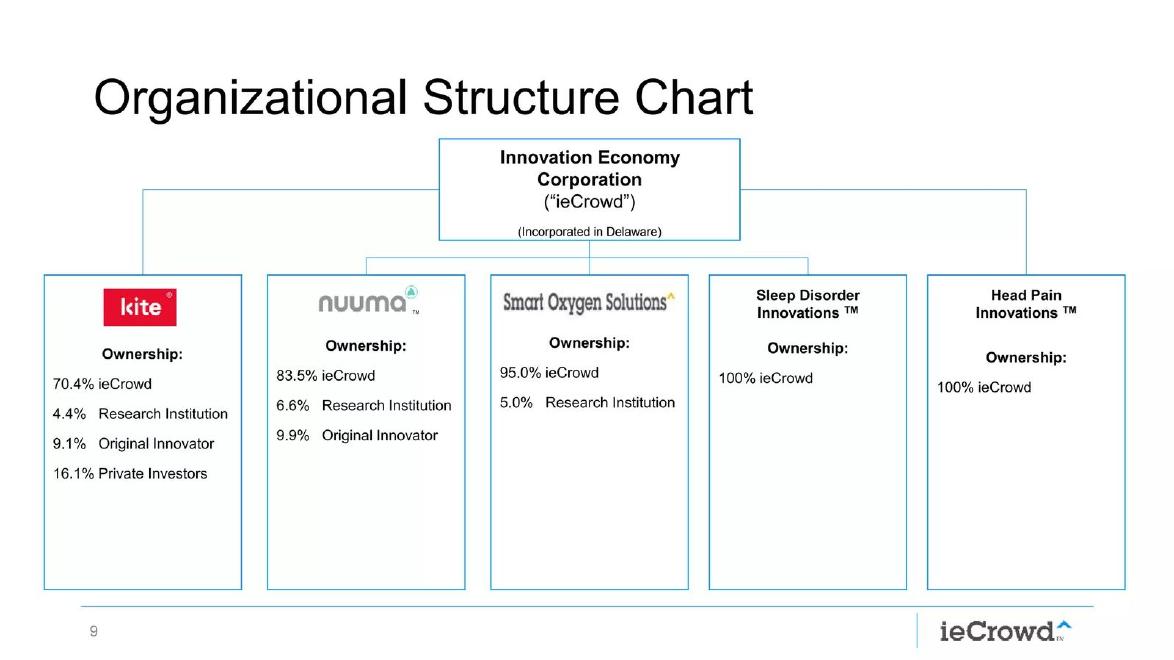
At minimum, name the entity investors would buy shares in and where it is incorporated, in one line near the ask. If there is more than one entity, add a simple chart with the parent at the top and, for each entity below it, what it does and who owns what share. ieCrowd shows this best: its Delaware parent sits above five businesses, each with an ownership breakdown, such as "70.4% ieCrowd, 4.4% Research Institution, 9.1% Original Innovator, 16.1% Private Investors".
Four company structure slides, read in full
Each slide was rendered from the original deck at full size and read in full. Quotes are as the slides state them; we did not check any company's legal records.
ieCrowd ask slide — slide 9
Builds businesses around university inventions. Structure slide.
ieCrowd deck, slide 9. Exact stored slide matched to this analysis.
Our analysis: The clearest structure slide in the set.
Evidence and limitation: Parent named with registration; full ownership for every entity below it.
What a founder can adapt: Add stage, revenue and key patents under each box; retitle it as a company structure.
Supporting analysis
What the deck claims: "Organizational Structure Chart"; "Innovation Economy Corporation ("ieCrowd") (Incorporated in Delaware)"; Kite "70.4% ieCrowd, 4.4% Research Institution, 9.1% Original Innovator, 16.1% Private Investors"; Nuuma "83.5% ieCrowd, 6.6% Research Institution, 9.9% Original Innovator"; Smart Oxygen Solutions "95.0% ieCrowd, 5.0% Research Institution"; two businesses "100% ieCrowd".
Presentation choice: An investor can work out exactly how much of each business they would own.
When it does not fit: Subsidiaries with no ownership shares.
Co-living and home services in Singapore. Group business model slide.
Bespoke Habitat deck, slide 19. Exact stored slide matched to this analysis.
Our analysis: Useful for the revenue link, unclear on who owns what.
Evidence and limitation: Holding company named and revenue linked to each part; no ownership shares for joint ventures and no subsidiary names.
What a founder can adapt: Name each entity, give every joint venture's ownership, and separate supplier partners from shared companies.
Supporting analysis
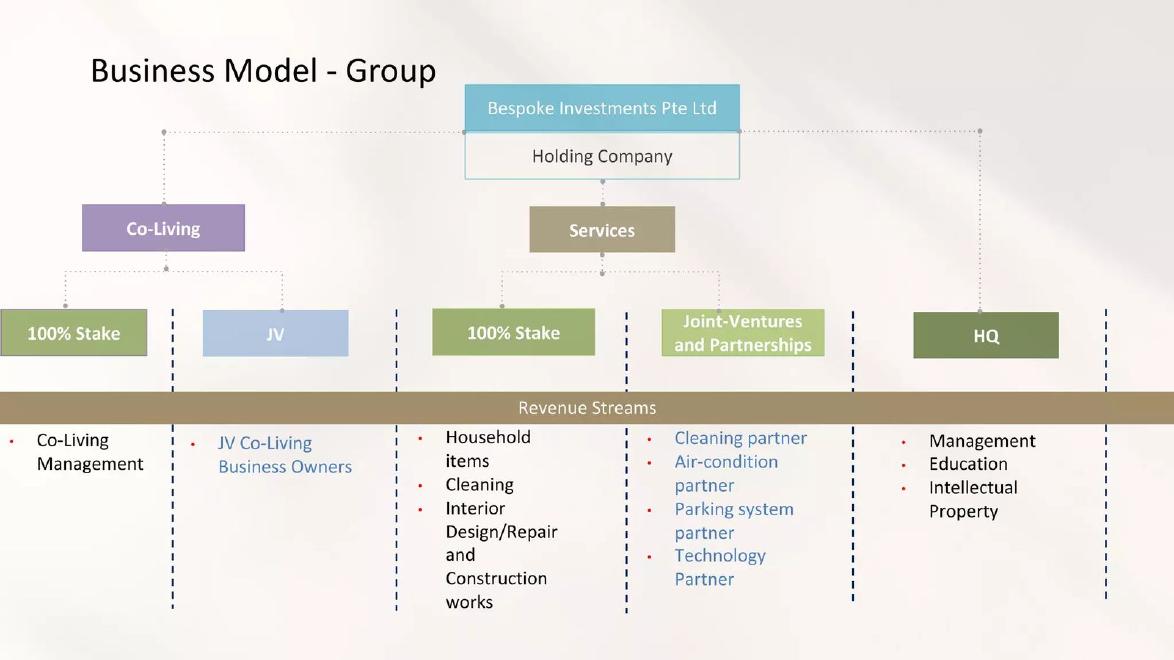
What the deck claims: "Business Model - Group"; "Bespoke Investments Pte Ltd, Holding Company"; branches "Co-Living", "Services", "HQ"; "100% Stake", "JV", "Joint-Ventures and Partnerships"; "Revenue Streams" per column, including "Intellectual Property" under HQ.
Presentation choice: Shows how joint ventures without percentages leave the key question open.
When it does not fit: Mixing legal entities, business lines and supplier partnerships on one chart.
Mycroclime deck, slide 7. Exact stored slide matched to this analysis.
Our analysis: A warning: the investor's real questions are left unanswered.
Evidence and limitation: An honest statement that no company yet exists to invest in.
What a founder can adapt: Say when the company will be formed and what will move into it, or form it before raising.
Supporting analysis
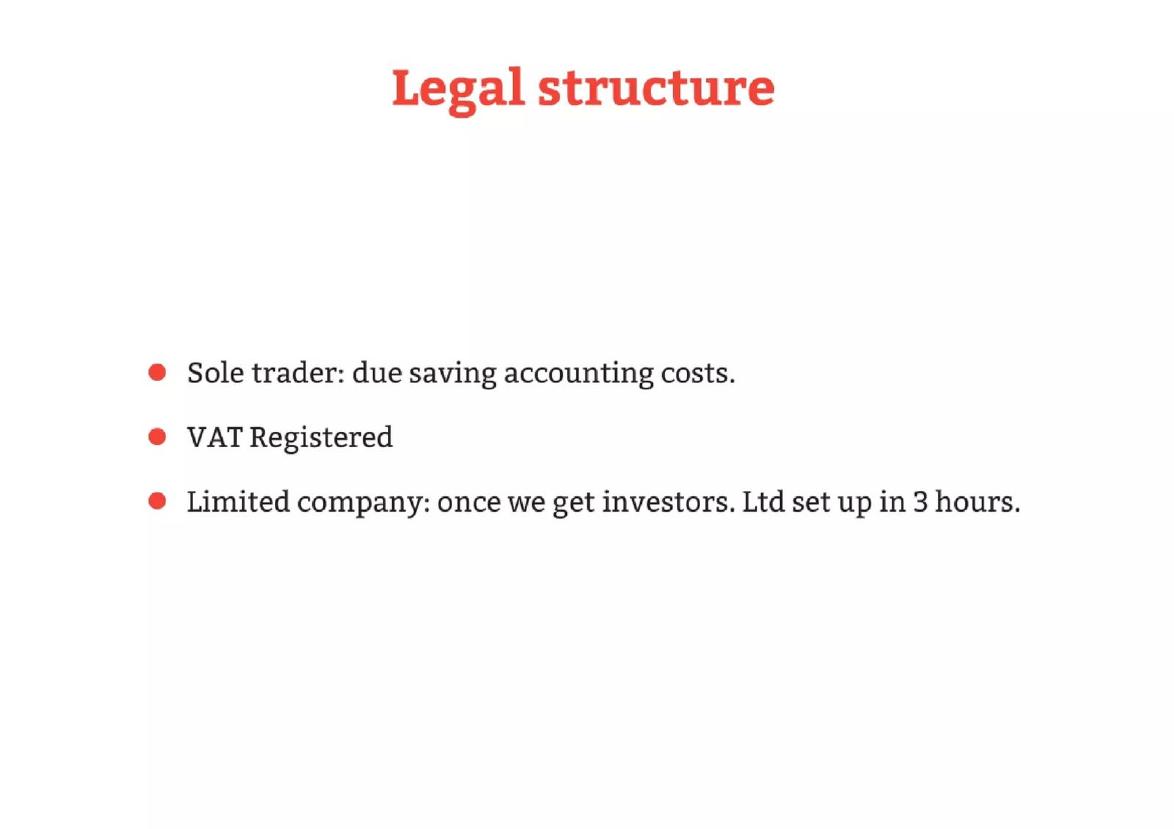
What the deck claims: "Legal structure"; "Sole trader: due saving accounting costs."; "VAT Registered"; "Limited company: once we get investors. Ltd set up in 3 hours."
Presentation choice: Shows what an investor must resolve before a sole trader can raise.
When it does not fit: Treating company formation as a three-hour task when the business must move into it.
Whether each slide names the investable entity and its registration, shows every entity, gives ownership shares, and says where revenue or assets sit.
Example
Investable entity named
Registration stated
Ownership shares
Revenue or assets located
ieCrowd
Yes
Delaware
Yes, all entities
No
Bespoke Habitat
Yes
Pte Ltd only
100% stakes only; JVs blank
Revenue yes
PinMyPet
Yes
Delaware C-Corp
Single company
Not needed
Mycroclime
None yet
Sole trader
Not applicable
No
Key Takeaways
Always name the entity investors would own, and where it is registered.
Show a chart only when there is more than one entity.
Give the ownership share of every entity below the parent.
Say where revenue and key assets, such as IP, sit.
If the investable company does not exist yet, say when it will.
Decide what your structure slide needs
Answer each prompt before deciding between one line and a chart.
Entity. Which entity would investors buy shares in? Full legal name, form and place of registration?
Others. Are there any other entities: parent, subsidiaries, joint ventures, overseas companies?
Ownership. Who owns what share of each entity below the parent?
Location. Where is revenue earned, and where are patents, licences or code held?
Changes. Is anything about to change, such as forming the company or moving the parent?
Copyable framework: [Legal name], a [form] registered in [place], is the company raising. [If more entities:] It owns [x%] of [entity, country, role]; [partner] owns [y%]. Revenue is earned in [entity]; IP is held by [entity].
Illustrative example 1 — written by us
Before: No mention of structure; brand name only.
After: "Raising entity: Fernway Health Inc., a Delaware C-Corp. It owns 100% of Fernway Health Ltd (UK), which employs the team and holds the software IP."
What improved: Our illustrative rewrite; the company names are invented for the example. It names the raising entity, its subsidiary and where the IP sits.
The question this guide answers
Founders ask whether they need to explain their legal structure in a pitch deck, and how. Our cap table guide covers who owns the company: founders, investors and the option pool. Our deal terms guide covers the instrument and valuation. Neither covers the structure of the company itself: which entity is raising, what sits under it, and who else owns parts of the business.
The distinction matters because structure can change what an investor actually gets. If a startup's best product sits in a subsidiary that the parent owns only 70% of, an investor in the parent owns only a share of that product. If intellectual property sits in a different entity from revenue, or a joint venture partner shares the profits of one line, the investor needs to know. And if the company is still a sole trader, there is nothing to invest in yet. A deck that answers these questions plainly saves a round of follow-up and avoids surprises in due diligence.
How we chose and read the examples
We searched saved slide text in the teardown library for "corporate structure", "group structure", "legal structure", "holding company" and "incorporated in Delaware". We left out listed companies, funds, mining, energy and property-trust presentations, and slides where a holding company was mentioned only in a team biography. Four slides from four startup decks remained, and together they cover the range: a full ownership chart, a group chart without ownership shares, a single line naming the entity, and a company not yet formed.
The four are ieCrowd (a company that builds businesses around university inventions), Bespoke Habitat (co-living and home services in Singapore), PinMyPet (a pet app) and Mycroclime (an early-stage UK business). Each slide was rendered from the original deck at full size and read in full. Quotes are the slides' own. We did not check any company's legal records.
The strongest pattern: every entity, with who owns it
ieCrowd titles its slide "Organizational Structure Chart". At the top is "Innovation Economy Corporation ("ieCrowd") (Incorporated in Delaware)". Below it are five boxes, one per business. Kite: "70.4% ieCrowd, 4.4% Research Institution, 9.1% Original Innovator, 16.1% Private Investors". Nuuma: "83.5% ieCrowd, 6.6% Research Institution, 9.9% Original Innovator". Smart Oxygen Solutions: "95.0% ieCrowd, 5.0% Research Institution". Sleep Disorder Innovations and Head Pain Innovations: "100% ieCrowd".
This is exactly what an investor needs. The parent is named with its legal name, its short name and where it is registered, so the reader knows what they would buy. Each business below shows the full ownership, adding to 100%, so the reader can work out how much of each business an investor in the parent really owns. The slide also reveals something important about the model: research institutions and inventors keep a share of each business, and one subsidiary has its own outside investors.
Two additions would make it complete. The slide does not say which businesses make money or hold the key patents, so the reader cannot tell which boxes matter most. A line under each box, such as stage and revenue, would fix that. And the title says "Organizational", which usually means a chart of people; "Company structure and ownership" would be clearer.
A group chart that shows entities but not ownership
Bespoke Habitat titles its slide "Business Model - Group". At the top is "Bespoke Investments Pte Ltd, Holding Company". Below are three branches: "Co-Living", "Services" and "HQ". Co-Living splits into "100% Stake" and "JV"; Services splits into "100% Stake" and "Joint-Ventures and Partnerships". Under a band headed "Revenue Streams", each column lists what it earns: "Co-Living Management"; "JV Co-Living Business Owners"; "Household items, Cleaning, Interior Design/Repair and Construction works"; partners for cleaning, air-conditioning, parking systems and technology; and for HQ, "Management, Education, Intellectual Property".
The slide is useful in two ways. It names the holding company, so an investor knows which entity is raising. And it links each part of the structure to the revenue it earns, which a plain legal chart would not.
But it leaves the most important question open. The joint ventures have no ownership share, so the reader cannot tell whether Bespoke owns 10% or 90% of them, or how their profits are split. The "Joint-Ventures and Partnerships" column lists partners for cleaning or parking, which sound like supplier agreements rather than shared companies; the slide does not say which is which. The subsidiaries marked "100% Stake" are not named. And "Intellectual Property" as an HQ revenue stream is not explained. Naming each entity and giving a percentage for every joint venture would turn this into a strong slide.
The minimum: one line naming the entity
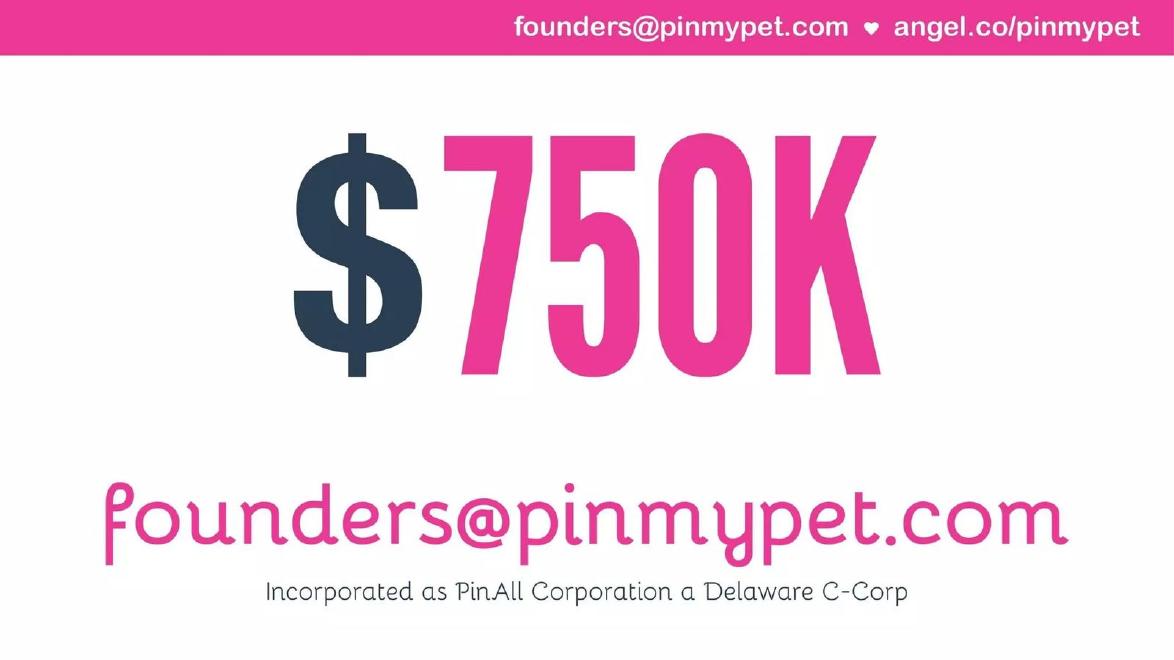
PinMyPet's closing slide is almost entirely its ask: "$750K" in large type, the contact address twice, and at the foot, "Incorporated as PinAll Corporation a Delaware C-Corp".
That one line does a lot. It tells an investor the legal name, which differs from the brand, and the form and place of registration. For a US investor, "Delaware C-Corp" signals that the company can issue standard preferred shares and take a standard seed round, with no restructuring needed first. Placing it next to the amount links the ask to the entity that would receive the money.
For most single-company startups, this is all the structure a deck needs. If the brand and the legal name differ, as here, saying so prevents confusion when an investor checks company records or reads the term sheet. If the company is registered outside the country most of its investors are in, saying where, and whether a parent company is planned, answers a question that otherwise comes up in the first call.
Warning: no company to invest in yet
Mycroclime titles a slide "Legal structure" and lists three points: "Sole trader: due saving accounting costs.", "VAT Registered" and "Limited company: once we get investors. Ltd set up in 3 hours."
The honesty is welcome: the founder says plainly that the business is run as a sole trader and that a limited company will be formed only once investors commit. But this is exactly the situation an investor needs to understand before going further. A sole trader has no shares, so there is nothing to invest in. Contracts, VAT registration and any intellectual property belong to the founder personally and would need to move into the new company. "Set up in 3 hours" addresses forming the company, not moving the business into it, which is the part that takes care.
If you are in this position, the slide is still worth including, but it should answer the investor's real questions: when the company will be formed, what will move into it (contracts, the brand, any designs or code), and that it will happen before money is taken. Better still, form the company before raising, so the slide becomes a single line like PinMyPet's.
When to include a structure slide, and where
Use a single line, as PinMyPet does, if you have one company and it is the one raising. Put it on the ask or closing slide, or in the appendix.
Use a chart, as ieCrowd does, if any of these apply: there is a holding company above the operating company; there are subsidiaries in other countries; any part of the business is owned jointly with a partner, institution or outside investor; the intellectual property sits in a different entity from the one that sells; or the company is restructuring, for example moving its parent to the US before a round. Put the chart in the appendix unless the structure is central to the pitch, as it is for ieCrowd, whose whole model is building businesses that share ownership with inventors.
Explain the plan if the investable company does not yet exist or is about to change, as Mycroclime's slide begins to. Say what will be formed, when, and what will move into it.
What the chart should show
Keep the chart simple. Put the entity investors buy into at the top with its full legal name and where it is registered. Below it, one box per entity, each with its name, country, what it does and the full ownership, adding to 100%. Mark where revenue is earned and where key assets such as patents, licences or code are held. If a joint venture partner shares profits, say on what terms.
Avoid charts that mix legal entities with business lines or partnerships, as Bespoke Habitat's does. A supplier agreement is not a joint venture, and a business line is not a company. If you want to show both, use two slides or two clearly different styles.
Common mistakes
Brand name only. Give the legal name, form and place of registration.
Subsidiaries without ownership. Show who owns each share, adding to 100%.
Entities mixed with partnerships. Keep supplier agreements off the legal chart.
IP location unstated. Say which entity holds patents, licences or code.
No company yet. Say when it will be formed and what moves into it.
Diagnostic checklist
Raising entity named, with form and registration.
Chart only if there is more than one entity.
Ownership for every entity below the parent.
Revenue and key assets located.
Planned changes stated with timing.
Frequently asked questions
Do I need a company structure slide in my pitch deck?
Most single-company startups need only one line naming the legal entity and where it is registered. Add a chart if you have subsidiaries, joint ventures or a holding company.
Where should the structure go?
The one-line version fits on the ask or closing slide. A full chart usually belongs in the appendix unless the structure is central to the business.
Can I raise before forming a company?
Investors need shares to buy, so the company must exist before money is taken. Say when it will be formed and what will move into it.
Why does it matter where IP is held?
If patents or code sit in a different entity from the one investors buy into, investors may not own them. Say where they sit.
How we chose these examples
Corpus: published pitch deck teardowns on StartupFundraising.com. Founder-uploaded private decks are excluded.
Selection (2026-10-01): we searched extracted slide text for corporate, group and legal structure, holding company and Delaware incorporation phrases, excluded listed-company, fund, mining, energy and property-trust presentations and biography mentions, and kept four slides from four startup decks.
Review: all four slides were rendered from the source decks at full size on 2026-10-01 and read in full against company, deck and page number (editorial model review, with AI assistance in drafting). No person has yet completed a human review. No company's legal records were checked.