Hardware Pitch Deck Milestones: Link Prototype Results
Hardware investors fund the step from a working prototype to a product you can build at a profit.
Hardware Milestones: How to Connect Prototype Results, Manufacturing Readiness and Your Raise
Five slides from four hardware startups that each had to explain where their device stood and what the new money would get it to: a diagnostics device that maps prototype versions to funding rounds, a smart planter that claims a production-ready design and prices its next cost cuts, an optics company that splits a $5M raise between production modules and growth, and a robot mower asking for a range of money to finish its prototype. We check what each lets an investor work out about stage, evidence and cost.
TL;DR
A hardware deck should say, in one place, three things: which version of the device exists today and what it has proven (in tests with stated conditions, not just "validated"); what still separates it from a product you can build repeatedly at a target cost (design changes, certification, tooling, a manufacturer, unit cost and assembly time); and which of those steps this raise pays for, with dates and amounts. If an investor can't tell which stage the money buys, they can't tell whether the next round will be raised from a stronger position.
Plantee's two slides come closest: one claims "a mass-production ready product" and a measured 34% small-batch gross margin, the other ties the raise to a 25% cut in parts cost and assembly time from 3.5 to 2 hours per unit, each with a date. Astek Diagnostics maps breadboard, alpha and beta prototypes and FDA clearance to its rounds, but blanks every round amount. ReSight splits its $5M between production-ready modules and growth, without dates or the current stage. Alamo asks for $100,000 to $500,000 to finish its prototype, with no split.
Hardware milestone slides from real pitch decks
Each example records what the slide shows about the device's current stage, its evidence, the steps left before production and what the raise buys. "Our calculation" marks our arithmetic; everything else is quoted from the slide.
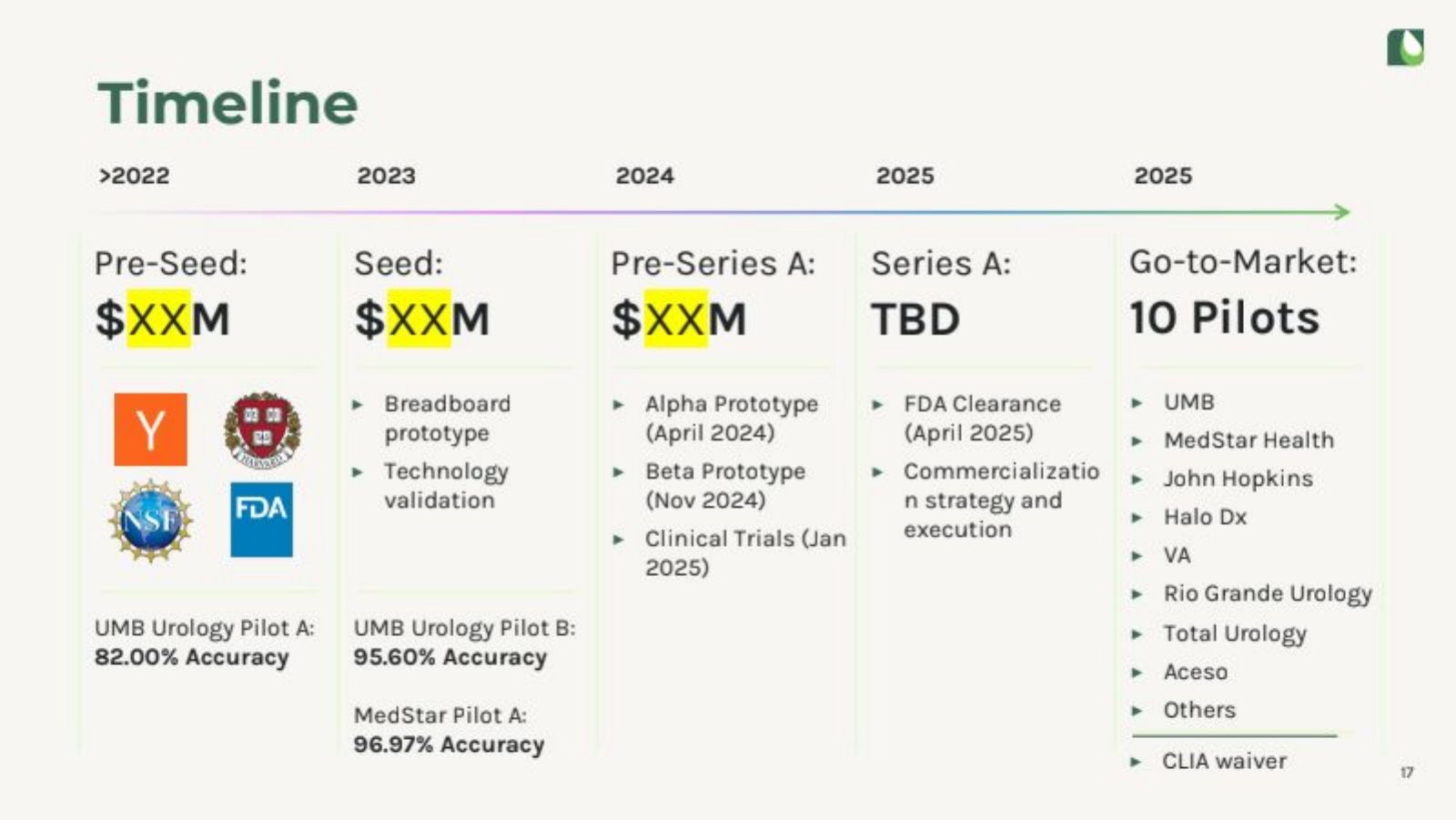
Astek Diagnostics deck, slide 17. Exact stored slide matched to this analysis.
Our analysis: Each round buys a named device version.
Evidence and limitation: Accuracy has no sample size or device version; trials to clearance in three months (our count); eight named sites against "10 Pilots".
What a founder can adapt: Add amounts, test conditions and the regulatory route.
Supporting analysis
What the deck claims: Seed: "Breadboard prototype", "Technology validation", pilots at 95.60% and 96.97% accuracy. Pre-Series A: alpha (April 2024) and beta (Nov 2024) prototypes, clinical trials (Jan 2025). Series A: "FDA Clearance (April 2025)". Round amounts "$XXM".
Presentation choice: The right structure for a hardware raise.
When it does not fit: Don't blank every round amount.
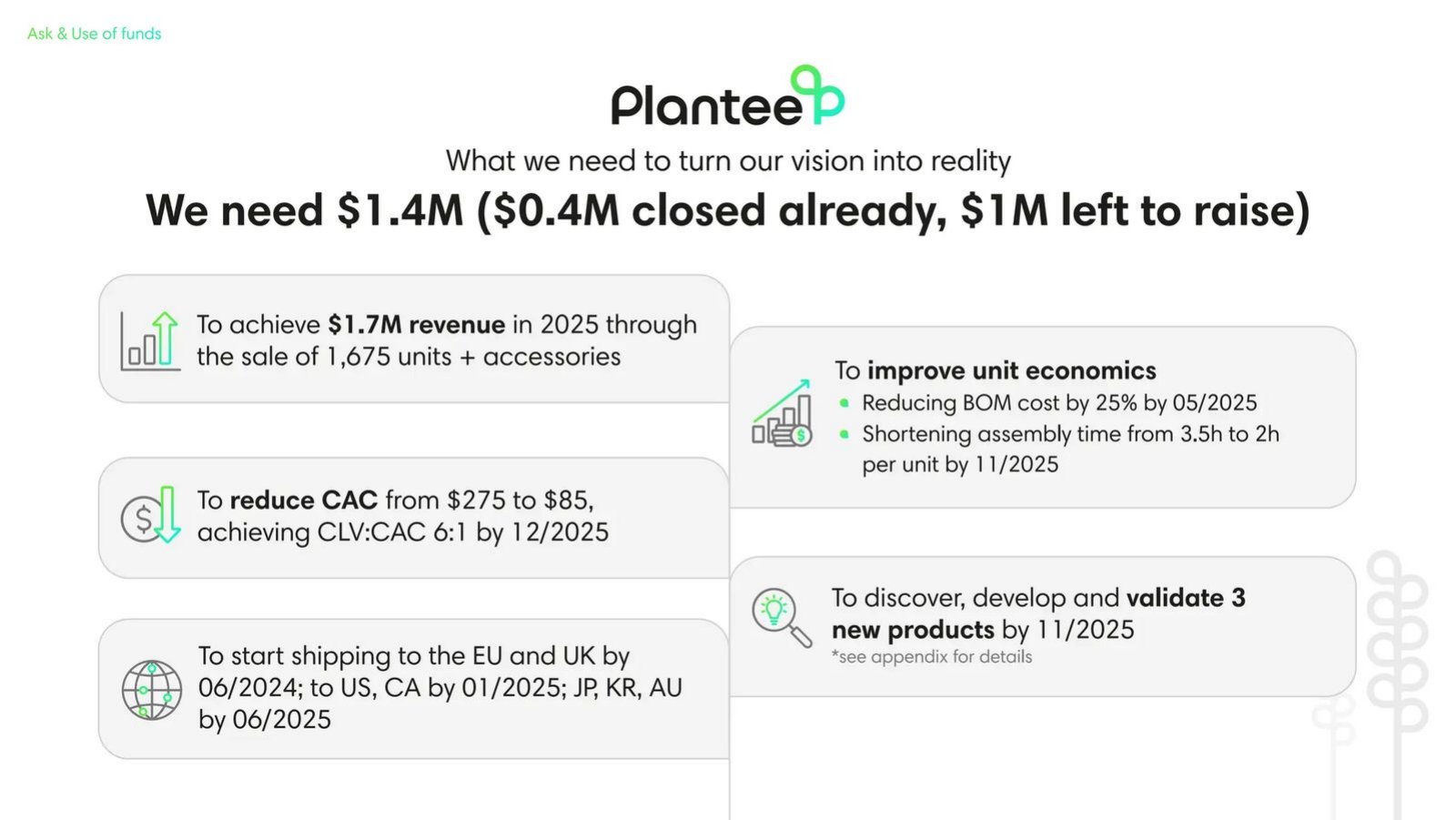
Plantee deck, slide 17. Exact stored slide matched to this analysis.
Our analysis: The raise buys dated cost cuts that explain the margin target.
Evidence and limitation: Our calculation: about $1,015 per unit including accessories; assembly time 43% shorter.
What a founder can adapt: Date each production step and its cost.
Supporting analysis
What the deck claims: "We need $1.4M ($0.4M closed already, $1M left to raise)"; "$1.7M revenue in 2025 through the sale of 1,675 units + accessories"; "Reducing BOM cost by 25% by 05/2025"; "Shortening assembly time from 3.5h to 2h per unit by 11/2025".
Presentation choice: Investors can check each step later.
When it does not fit: Don't leave the margin target unexplained.
Optics and sensing. Year not recorded; funding target page.
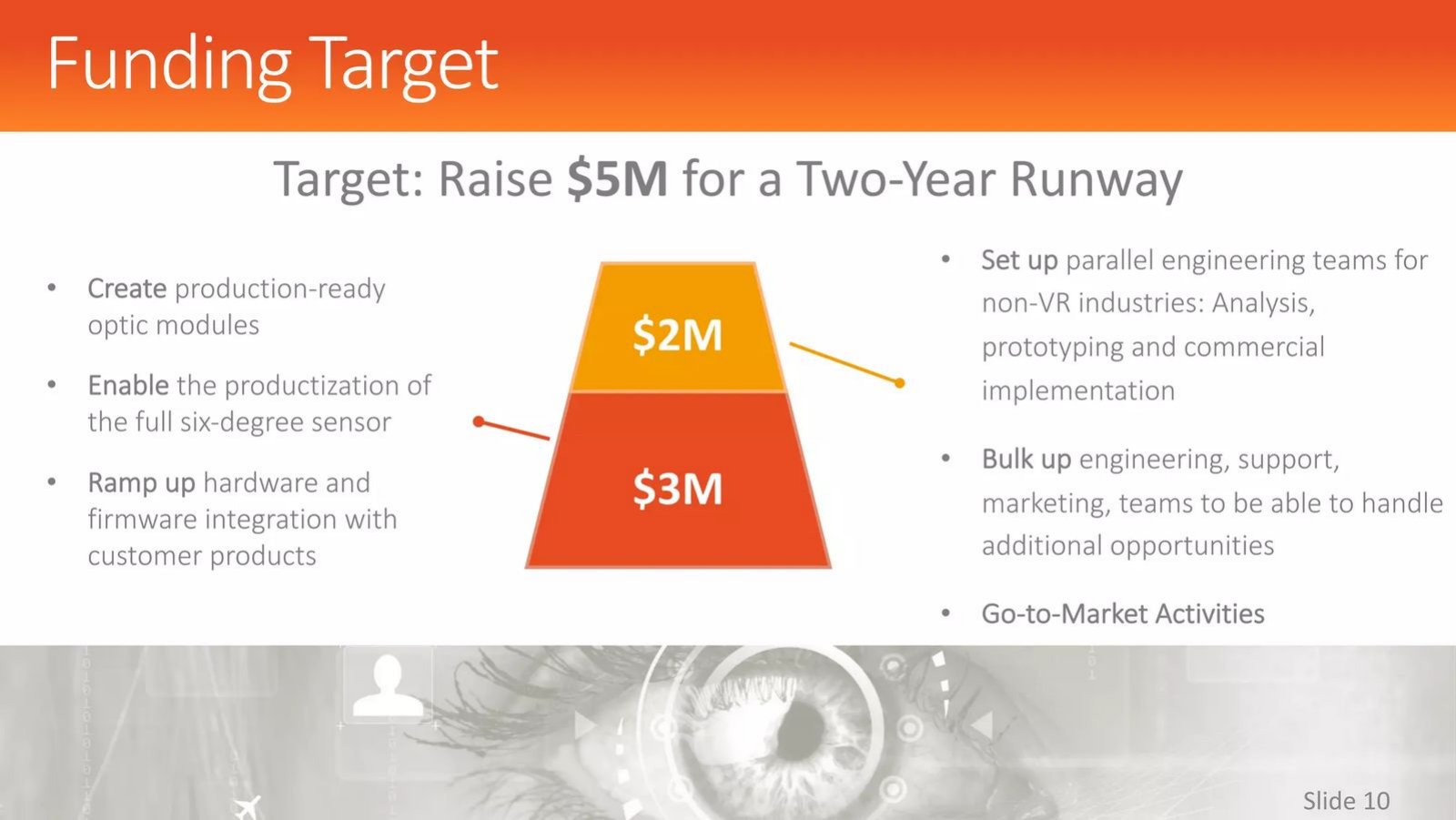
ReSight deck, slide 10. Exact stored slide matched to this analysis.
Our analysis: Split by milestone, but undated.
Evidence and limitation: No current stage, dates or definition of production-ready.
What a founder can adapt: Add today's stage and a date per milestone.
Supporting analysis
What the deck claims: "Raise $5M for a Two-Year Runway": $3M to "Create production-ready optic modules", "productization of the full six-degree sensor", integration; $2M to parallel teams, scaling and "Go-to-Market Activities".
Presentation choice: Investors can't judge if $3M is enough without dates.
When it does not fit: Don't leave "production-ready" undefined.
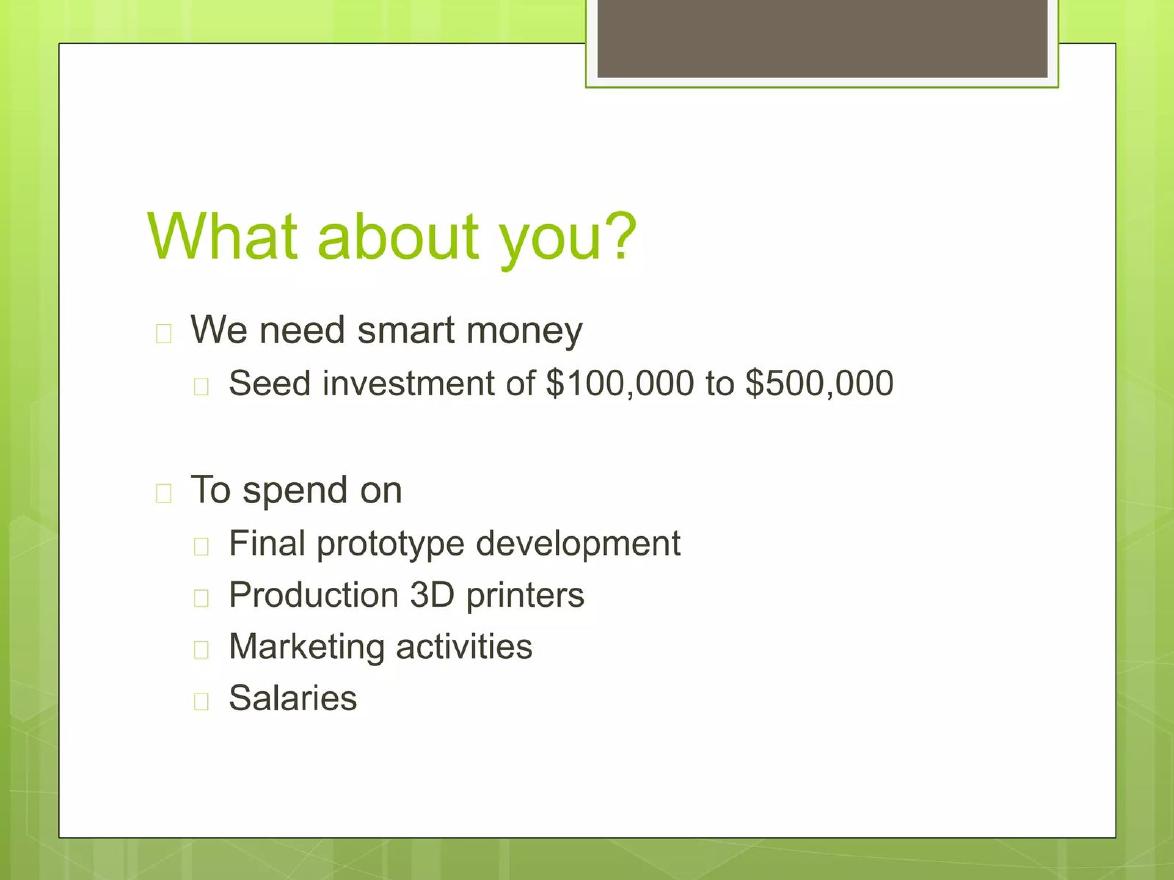
Alamo deck, slide 18. Exact stored slide matched to this analysis.
Our analysis: Names the stage but not what each amount buys.
Evidence and limitation: Top of range five times the bottom (our calculation); no split or unit count.
What a founder can adapt: Say what the low and high amounts each achieve.
Supporting analysis
What the deck claims: "Seed investment of $100,000 to $500,000" to spend on "Final prototype development", "Production 3D printers", "Marketing activities", "Salaries".
Presentation choice: A range needs a milestone at each end.
When it does not fit: Don't ask for a 5x range with no plan.
Name the version that exists today and what it proved, with test conditions. Astek gives pilot accuracies but no sample sizes.
Spell out what stands between prototype and production: design, certification, tooling, a manufacturer, unit cost.
Tie each step to an amount and a date. Plantee dates its parts-cost and assembly-time targets.
"Production-ready" needs evidence: units built, who builds them, cost per unit. Plantee gives margin but not units or maker.
Split the raise by milestone, not just by department. ReSight splits $3M/$2M but gives no dates.
A range like $100K to $500K hides the plan. Say what each amount gets the product to.
Map your hardware milestones
Fill in each line. Keep stages and dates even if an amount is confidential.
Today. The version that exists and how many units.
Proven. Test results with sample size and conditions.
Remaining steps. Design, certification, tooling, manufacturer, pilot run.
This raise buys. Which steps, at what cost, by when.
Unit economics. Unit cost now and target, assembly time, batch margin.
At the end. What the device will have proven when the money runs out.
Copyable framework: Today: [version], [units] built. Proven: [result] on [sample] under [conditions]. This raise: [step] by [date] ([amount]), [step] by [date] ([amount]). Unit cost [now] → [target]; batch margin [x]%.
Illustrative example 1 — written by us
Before: Built and tested a mass-production ready product.
After: Today: 120 units hand-assembled in-house, 3.5 hours each, 34% gross margin on that batch. This raise: contract manufacturer selected and 1,000-unit pilot run by 05/2025 ($350K), parts cost down 25% and assembly to 2 hours by 11/2025.
What improved: Our illustrative rewrite; the unit count, manufacturer step and costs are invented for the example. The margin, assembly times and parts-cost target are Plantee's.
The question this guide answers
Software can usually ship as soon as it works. Hardware passes through stages: a rough working model, a prototype that looks and works like the product, versions tested for reliability and certification, a small production run, and then volume manufacturing at a cost that leaves a margin. Each stage costs money and can fail. Investors in a hardware round are mostly paying to move the device through one or two of those stages, so they need to see where it is now and where the money takes it.
Our hardware product guide asks founders to mark a device as prototype, pilot or shipping. The manufacturing guide covers who builds it and at what capacity, and the cost-at-volume guide covers how unit cost falls with scale. The use-of-funds guide covers splitting a raise. None of them connects the three: what the prototype has proven, what is left before production, and which of those steps the raise pays for. That is this guide's question.
How we chose and read the examples
We searched the extracted text of the deck library for prototype stages (breadboard, alpha, beta, working, final), production readiness, pilot production, tooling and design for manufacturing, and kept slides where a hardware startup connected its device's stage to the money it was raising. Many matches were software "prototypes", accelerator decks or company names containing "Pvt", which we excluded; one software publisher's progress timeline was dropped for that reason.
Five slides from four private startups remained: Astek Diagnostics page 17, Plantee pages 11 and 17, ReSight page 10 and Alamo page 18. Each was rendered from the original deck file and read at full size. Our teardown records date Astek's deck to 2023 and Alamo's to 2014; Plantee's deck dates to 2024 from its own targets; ReSight's year is not recorded. Calculations marked "our calculation" are ours. We did not check any company's test results, costs or regulatory status.
Map each prototype version to a round, and say what it proved
Astek Diagnostics, which develops a urine-testing device, uses page 17, "Timeline", to lay out five columns. "Pre-Seed: $XXM" (before 2022) shows logos and "UMB Urology Pilot A: 82.00% Accuracy". "Seed: $XXM" (2023) lists "Breadboard prototype" and "Technology validation", with "UMB Urology Pilot B: 95.60% Accuracy" and "MedStar Pilot A: 96.97% Accuracy". "Pre-Series A: $XXM" (2024) lists "Alpha Prototype (April 2024)", "Beta Prototype (Nov 2024)" and "Clinical Trials (Jan 2025)". "Series A: TBD" (2025) lists "FDA Clearance (April 2025)" and "Commercialization strategy and execution". The last column, also headed 2025, is "Go-to-Market: 10 Pilots", naming UMB, MedStar Health, John Hopkins, Halo Dx, VA, Rio Grande Urology, Total Urology, Aceso and "Others", with "CLIA waiver" below a line.
The structure is what a hardware investor wants: each round buys a named version of the device, and the evidence grows from round to round. The weaknesses are in the detail. Every amount is blanked as "$XXM" (highlighted in yellow), so the reader can't see what each stage costs. The accuracy figures have no sample sizes or definition of accuracy, and the reader can't tell which version of the device produced them; the Seed results sit beside a breadboard prototype, not the product. The plan has clinical trials starting in January 2025 and FDA clearance in April 2025, three months later (our count), with no explanation of the regulatory route. And the last column lists eight named sites against "10 Pilots", without saying which are signed.
"Production-ready" needs evidence, and the raise should buy the remaining gap
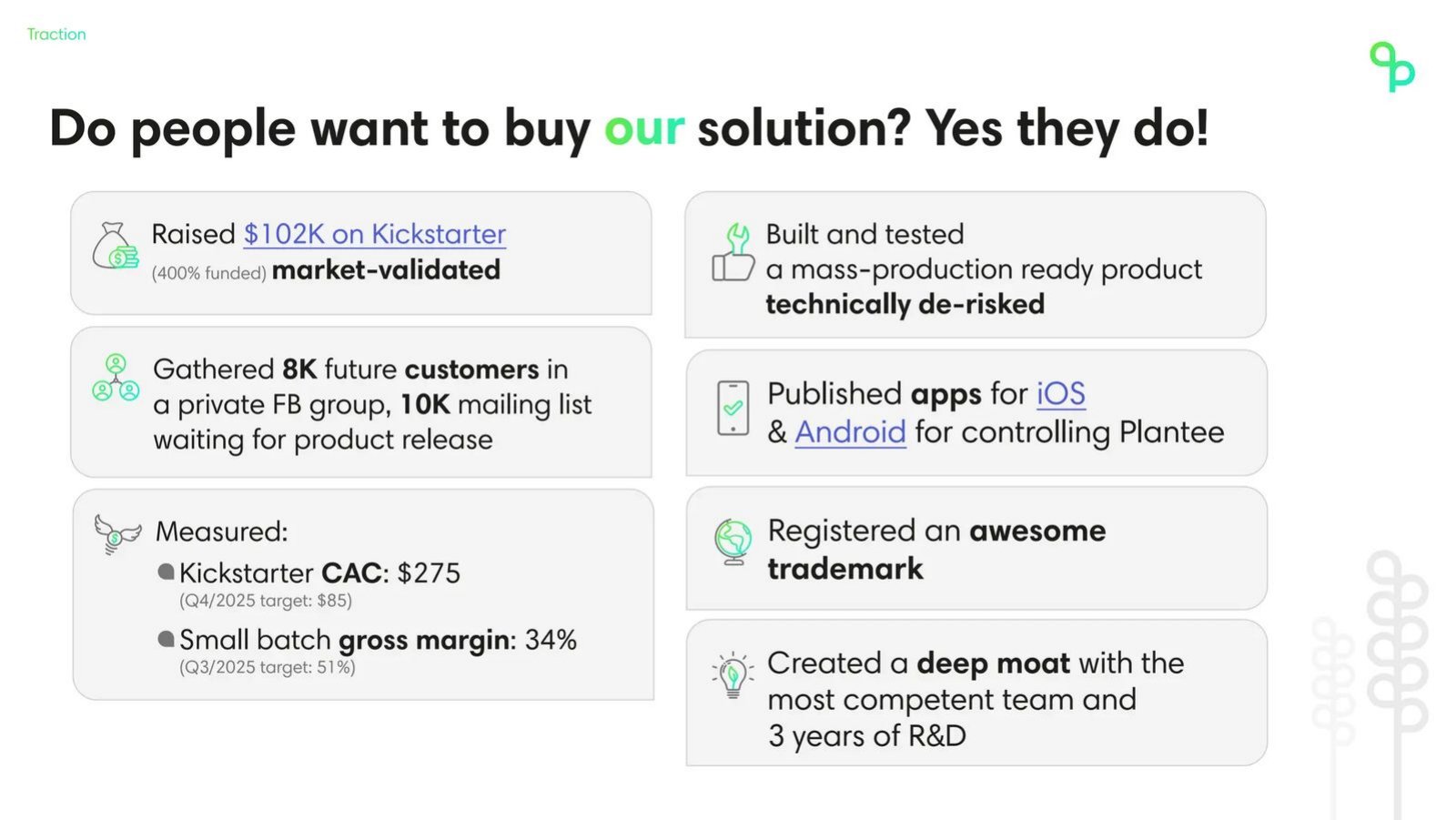
Plantee, which makes a smart indoor greenhouse, makes the strongest readiness claims. Page 11, "Do people want to buy our solution? Yes they do!", says it "Built and tested a mass-production ready product" that is "technically de-risked", raised "$102K on Kickstarter (400% funded)", and measured "Kickstarter CAC: $275 (Q4/2025 target: $85)" and "Small batch gross margin: 34% (Q3/2025 target: 51%)". Page 17, "Ask & Use of funds", asks for "$1.4M ($0.4M closed already, $1M left to raise)" to reach "$1.7M revenue in 2025 through the sale of 1,675 units + accessories", to reduce CAC, to ship to the EU and UK "by 06/2024" and other markets by 2025, to validate three new products, and "To improve unit economics": "Reducing BOM cost by 25% by 05/2025" and "Shortening assembly time from 3.5h to 2h per unit by 11/2025".
This is the clearest link in the set between where the product is and what the money buys. A measured small-batch margin is real evidence that the device can be built and sold at a profit, and the two dated cost targets say exactly how the margin is meant to rise from 34% to 51%: cheaper parts and a 43% shorter assembly time (our calculation from 3.5 to 2 hours). The revenue target works out to about $1,015 per unit including accessories (our calculation, $1.7M over 1,675 units).
What's missing is the evidence behind "mass-production ready". The slides don't say how many units have been built, who assembles them, or whether the 3.5-hour assembly is done in-house. A product that takes 3.5 hours to assemble by hand is ready for small batches; whether it is ready for mass production depends on who builds it at volume and at what cost. Say how many units exist, where they are built and what the small batch was, and "production-ready" becomes a claim the investor can check.
Split the raise by milestone, and give each one a date
ReSight, an optics and sensing company, uses page 10, "Funding Target", to show "Target: Raise $5M for a Two-Year Runway" as a stacked shape split into "$3M" and "$2M". Lines link the $3M to "Create production-ready optic modules", "Enable the productization of the full six-degree sensor" and "Ramp up hardware and firmware integration with customer products", and the $2M to "Set up parallel engineering teams for non-VR industries", "Bulk up engineering, support, marketing, teams" and "Go-to-Market Activities".
Splitting the raise between getting the product made and growing the business is the right instinct, and the larger share goes to production. But the slide doesn't say what stage the optic modules and sensor are at today, when each milestone is due within the two years, or what production-ready means here (a design ready for a manufacturer, a qualified supplier, a first production run). Adding today's stage and a date for each production milestone would let an investor judge whether $3M is enough.
A range without milestones hides the plan
Alamo, which built a robotic lawn mower, closes its 2014 deck with page 18, "What about you?": "We need smart money", "Seed investment of $100,000 to $500,000", "To spend on": "Final prototype development", "Production 3D printers", "Marketing activities", "Salaries".
It names the stage the money is for: finishing the prototype and starting to make units with 3D printers. But the top of the range is five times the bottom (our calculation), and the slide doesn't say what $100,000 achieves compared with $500,000, how many units the printers would make, or what the finished prototype has to prove. A range is acceptable if each end is tied to a milestone: the lower amount completes the final prototype, the higher one also funds a first batch of a stated size.
What to put on your slide
Draw the path from today's device to volume production as a short row of stages, and mark where you are. For the stage you're at, give the evidence with its conditions: how many units, tested how, on how many users or samples, with what result. For each remaining stage, give what it involves (design changes, certification, tooling, choosing a manufacturer, a pilot run), its cost and its date. Then mark which stages this raise pays for, and what the device will have proven when the money runs out.
Add the numbers that show the product can be built at a profit: unit cost now and target, assembly time, the size of any batch already made and the margin on it. If a figure is confidential, keep the stage and the date and describe the direction; a timeline with every amount blanked tells the reader the order of events but not whether the raise is enough.
Common mistakes
Stage not stated. Say which version of the device exists today.
Untested proof. Give sample sizes and conditions for results.
Readiness asserted. Back "production-ready" with units, maker and cost.
Undated milestones. Give each production step a date.
Blanked amounts. Keep at least the share of the raise per stage.
Unexplained range. Tie each end of a range to a milestone.
Diagnostic checklist
Today's device version and unit count are stated.
Results have sample sizes and conditions.
Remaining steps to production are listed.
Each step this raise pays for has a cost and date.
Unit cost, assembly time or batch margin is shown.
The slide says what will be proven when the money runs out.
Frequently asked questions
How should a hardware startup show its stage in a pitch deck?
Name the device version (breadboard, alpha, beta, pilot run) and how many units exist. Astek maps each prototype version to a round on one timeline.
What does "production-ready" need to show?
Units built, who builds them and at what cost. Plantee shows a 34% small-batch margin but not unit count or assembler.
How do I tie my raise to hardware milestones?
Give each step a cost and a date. Plantee dates a 25% parts-cost cut and shorter assembly; ReSight splits $5M but gives no dates.
Can I give a range for my hardware raise?
Only if each end buys a stated milestone. Alamo's $100,000 to $500,000 doesn't say what each amount achieves.
What if my round amounts are confidential?
Keep stages, dates and the share of the raise per stage. Astek's timeline blanks every amount.
How we chose these examples
Selection (2026-10-02): owner-supplied candidate question. The hardware product, manufacturing, cost-at-volume and use-of-funds guides each cover part of the topic; none connects prototype evidence, remaining production steps and the milestones a raise funds.
Five pages from four original deck files were rendered and read at full size: Astek Diagnostics 17, Plantee 11 and 17, ReSight 10, Alamo 18. A software publisher's progress timeline was excluded. This guide was written with an AI editorial model and checked against the slide images by model review.
Eligibility was judged at each deck's date; all four companies were private. Test results, costs and regulatory dates are the companies' own claims and were not independently verified.