Travel Competition Slide Examples: How Travel Startups Show
How travel startup pitch decks compare themselves with booking platforms, agencies and giants like Airbnb and Uber: tables, maps, lists and feature grids.
Travel Competition Slide Examples: How Travel Startups Show Rivals
Nine competition slides from real travel startup pitch decks, shown in full, compare how each deck names its rivals, picks what to compare on, and shows where it fits.
TL;DR
Travel startups usually compete with a large platform and a crowd of local operators at the same time. The clearest slides pick comparison points travellers or suppliers care about. Naugo compares itself with cGO, Marlin Booking and Uber Boat across nine rows, including launch dates and partner counts ("443 individual boat operators"). Holiday Online places Airbnb, HomeAway, Sykes and others on a two-axis map (self service vs full service, cities vs coastal and rural). Comfortway compares its roaming service with carrier roaming, local SIM cards and travel SIM cards. Intui Travel and Relobuddy name rivals, but explain less of what separates them.
Travel competition slides from real pitch decks
Each example shows the exact stored slide above its analysis and links to the full teardown. Stage and year are given only where the deck states them. Claims about rivals are quoted as the slide states them; we have not checked them.
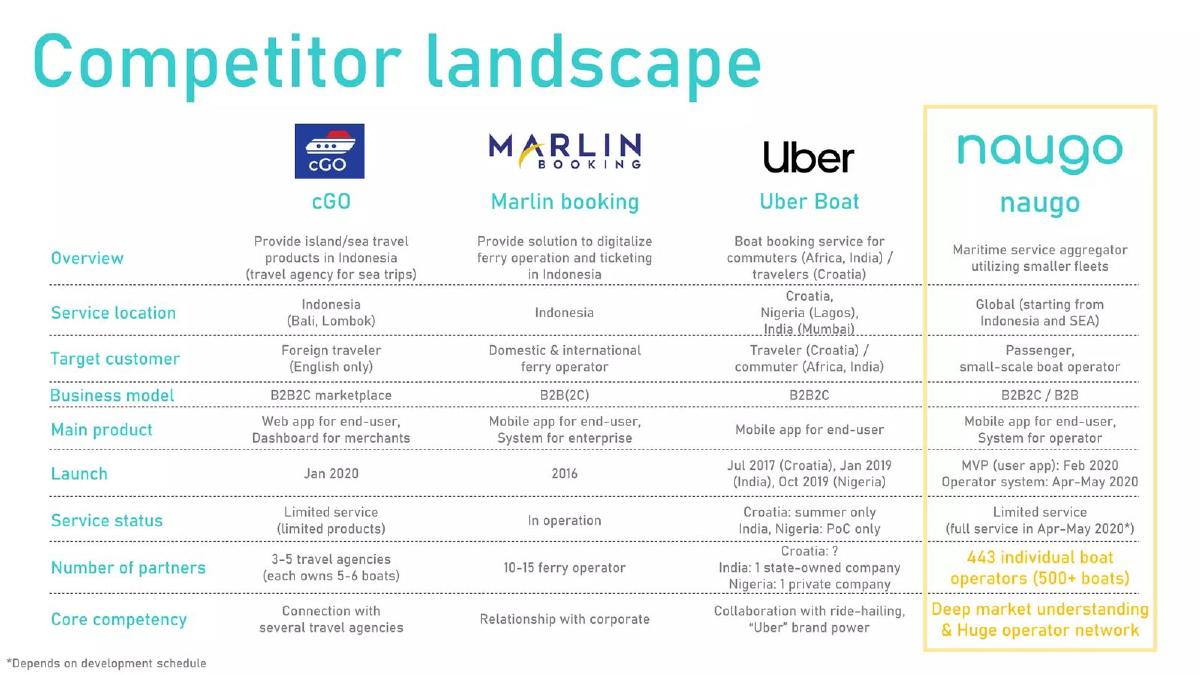
Naugo competition slide — slide 12
Boat and ferry booking aggregator starting in Indonesia. The slide dates Naugo's own MVP to February 2020. The logistics problem and solution guides use other slides from this deck.
Naugo deck, slide 12. Exact stored slide matched to this analysis.
Our analysis: It compares on facts a reader can check (locations, launch dates, service status, partner counts) and admits Naugo's own service is still "Limited".
Evidence and limitation: "Deep market understanding" is not a measurable edge, and the partner count doesn't say how many operators are active.
What a founder can adapt: Use factual rows like launch date and partner count, and state your own limits honestly, as Naugo does.
Supporting analysis
What the deck claims: "Competitor landscape": a table comparing cGO, Marlin Booking, Uber Boat and Naugo on overview, service location, target customer, business model, main product, launch, service status, number of partners and core competency. Naugo: "Maritime service aggregator utilizing smaller fleets", "MVP (user app): Feb 2020", "443 individual boat operators (500+ boats)", "Deep market understanding & Huge operator network". Uber Boat: Croatia "summer only", India and Nigeria "PoC only".
Presentation choice: It compares on facts a reader can check (locations, launch dates, service status, partner counts) and admits Naugo's own service is still "Limited".
When it does not fit: "Deep market understanding" is not a measurable edge, and the partner count doesn't say how many operators are active.
Holiday rental letting for property owners in coastal and rural UK. The travel market guide uses a different slide from this deck.
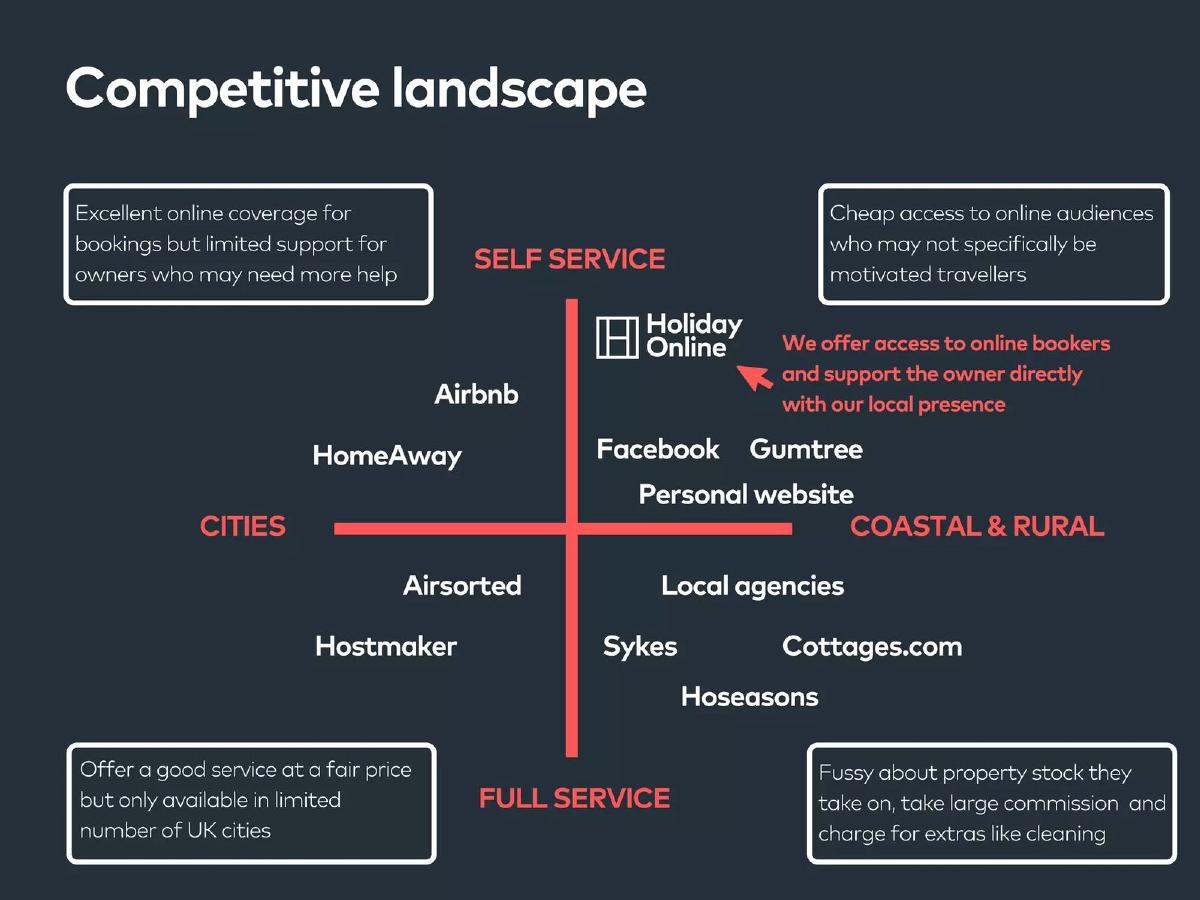
Holiday Online deck, slide 10. Exact stored slide matched to this analysis.
Our analysis: Both axes are real choices a property owner makes, and every quadrant says why its players fall short for that owner.
Evidence and limitation: Holiday Online sits on the boundary between quadrants, so the map doesn't show which rivals it takes business from most directly.
What a founder can adapt: Choose axes your customer actually decides on, and write one line on each quadrant's weakness.
Supporting analysis
What the deck claims: "Competitive landscape": a two-axis map (self service to full service; cities to coastal & rural). Airbnb and HomeAway sit in self service/cities; Facebook, Gumtree and personal websites in self service/coastal; Airsorted and Hostmaker in full service/cities; local agencies, Sykes, Cottages.com and Hoseasons in full service/coastal. Each quadrant has a weakness, for example "Fussy about property stock they take on, take large commission and charge for extras like cleaning". Holiday Online: "We offer access to online bookers and support the owner directly with our local presence."
Presentation choice: Both axes are real choices a property owner makes, and every quadrant says why its players fall short for that owner.
When it does not fit: Holiday Online sits on the boundary between quadrants, so the map doesn't show which rivals it takes business from most directly.
Mobile internet and calls for travellers abroad. The marketplace business model guide uses a different slide from this deck.
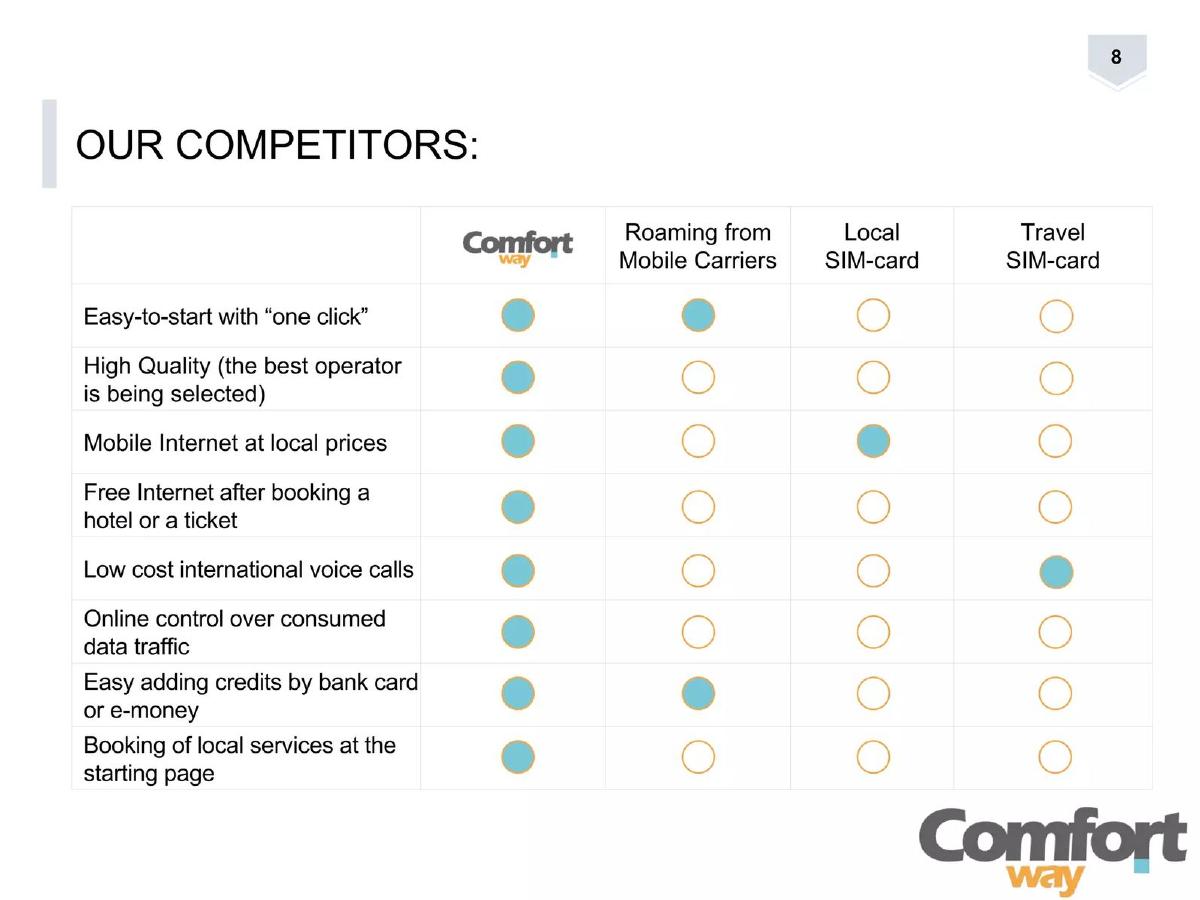
Comfortway deck, slide 8. Exact stored slide matched to this analysis.
Our analysis: It compares against the three things a traveller actually does today, and shows where each already works (carrier roaming is easy to start, a local SIM gives local prices).
Evidence and limitation: Comfortway ticking every row looks one-sided, and dots don't show how much cheaper "local prices" are. A price per GB would be stronger.
What a founder can adapt: Compare against the traveller's current options and give credit where they already do well.
Supporting analysis
What the deck claims: "Our Competitors": a feature table comparing Comfortway with "Roaming from Mobile Carriers", "Local SIM-card" and "Travel SIM-card" on eight rows, including "Easy-to-start with 'one click'", "Mobile Internet at local prices", "Free Internet after booking a hotel or a ticket" and "Low cost international voice calls". Comfortway has every row filled; each alternative has at most two.
Presentation choice: It compares against the three things a traveller actually does today, and shows where each already works (carrier roaming is easy to start, a local SIM gives local prices).
When it does not fit: Comfortway ticking every row looks one-sided, and dots don't show how much cheaper "local prices" are. A price per GB would be stronger.
Airport transfer booking with API integration for travel companies. Stage and year not stated.
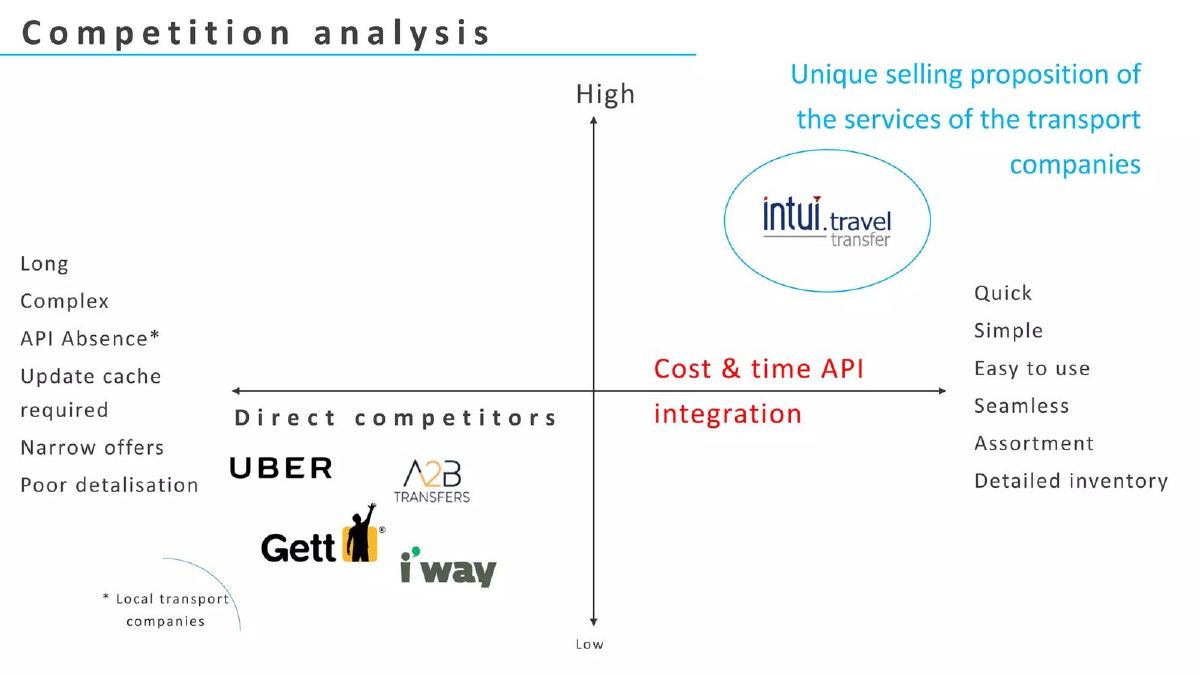
Intui Travel deck, slide 12. Exact stored slide matched to this analysis.
Our analysis: It names four direct rivals and lists the specific weaknesses travel companies hit when integrating them (no API, cache updates).
Evidence and limitation: The vertical axis is only "High" to "Low" with no label, and all rivals are grouped in one corner, which doesn't show how they differ from each other.
What a founder can adapt: List the concrete problems customers have with each rival, as the left side does.
Supporting analysis
What the deck claims: "Competition analysis": a chart with "Long, Complex, API Absence, Update cache required, Narrow offers, Poor detalisation" on the left and "Quick, Simple, Easy to use, Seamless, Assortment, Detailed inventory" on the right. "Direct competitors" Uber, A2B Transfers, Gett and i'way sit on the left; Intui Travel sits top right. "Cost & time API integration" and "Unique selling proposition of the services of the transport companies".
Presentation choice: It names four direct rivals and lists the specific weaknesses travel companies hit when integrating them (no API, cache updates).
When it does not fit: The vertical axis is only "High" to "Low" with no label, and all rivals are grouped in one corner, which doesn't show how they differ from each other.
Relocation help for people moving abroad. The footer reads "ESCP Europe MBA… Class of 2018 | Creative Entrepreneurship | Relobuddy" and is dated 21 June 2018, so this is a business school project deck. The marketplace product and go-to-market guides use other slides from this deck.
Relobuddy deck, slide 6. Exact stored slide matched to this analysis.
Our analysis: It names four real rivals and gives each one a line on what it offers, including a price position for AccompanyMe.
Evidence and limitation: It never says how Relobuddy differs from any of them, so the reader can't see its position.
What a founder can adapt: Keep the one-line description, and add a column for what each rival lacks that you provide.
Supporting analysis
What the deck claims: "Competition": AccompanyMe ("full travel consultation at a high price point"), Citrus Relocation Services ("accommodation services for relocating individuals"), Movehub ("shipping and accommodation services") and Expat Arrivals ("accommodation and general information"), each with its logo.
Presentation choice: It names four real rivals and gives each one a line on what it offers, including a price position for AccompanyMe.
When it does not fit: It never says how Relobuddy differs from any of them, so the reader can't see its position.
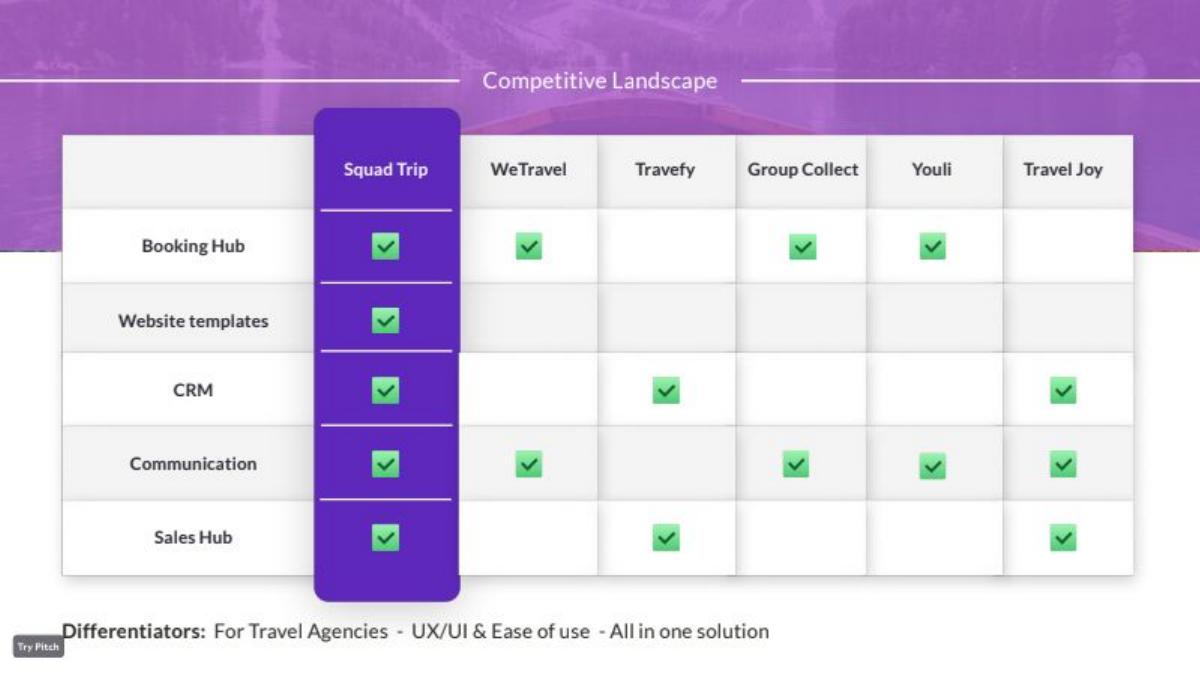
Software for travel agencies and organisers running group trips.
SquadTrip deck, slide 10. Exact stored slide matched to this analysis.
Our analysis: Rivals keep the ticks they have, so the grid reads as honest, and the differentiator line states the position in words: all features in one tool for agencies.
Evidence and limitation: "All in one" is the only edge shown, and there is no price, date or customer number to support it.
What a founder can adapt: Keep the honest ticks and add one measurable row, such as price per agency per month or number of agencies served.
Supporting analysis
What the deck claims: "Competitive Landscape." A grid compares Squad Trip, WeTravel, Travefy, Group Collect, Youli and Travel Joy on "Booking Hub", "Website templates", "CRM", "Communication" and "Sales Hub". Squad Trip ticks all five; WeTravel ticks booking hub and communication; Travefy CRM and sales hub; Group Collect booking hub and communication; Youli booking hub and communication; Travel Joy CRM, communication and sales hub. "Differentiators: For Travel Agencies - UX/UI & Ease of use - All in one solution."
Presentation choice: Rivals keep the ticks they have, so the grid reads as honest, and the differentiator line states the position in words: all features in one tool for agencies.
When it does not fit: "All in one" is the only edge shown, and there is no price, date or customer number to support it.
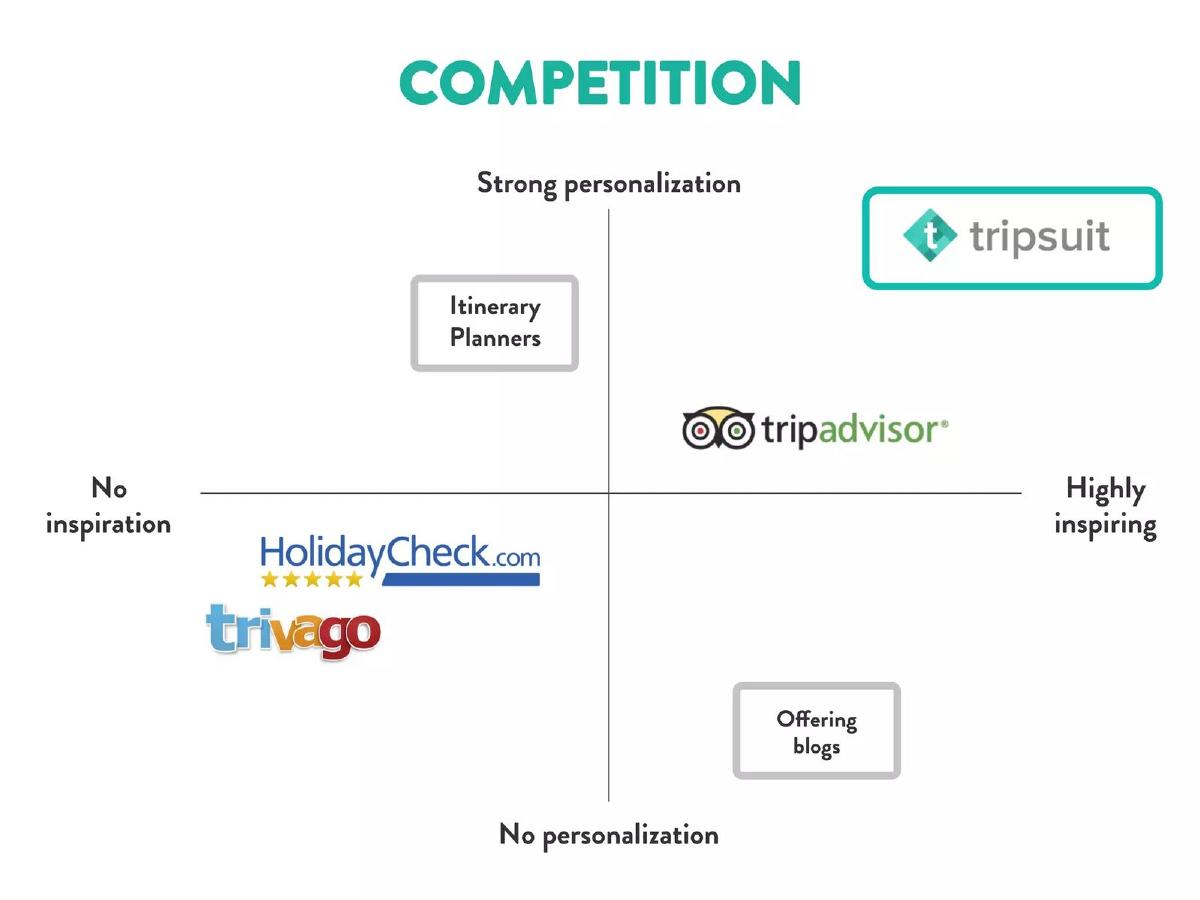
Digital travel agent that suggests personalised trips.
Tripsuit deck, slide 22. Exact stored slide matched to this analysis.
Our analysis: The axes describe how travellers choose between kinds of travel site, so the map quickly explains the gap Tripsuit claims.
Evidence and limitation: Both axes are the company's own judgement, and price-comparison sites are judged on inspiration, which they don't try to offer.
What a founder can adapt: Make one axis measurable and say in a line why the top-right corner is empty.
Supporting analysis
What the deck claims: "Competition." A two-axis map: "Strong personalization" to "No personalization" and "No inspiration" to "Highly inspiring". Tripsuit is alone in the top-right corner. TripAdvisor sits in the inspiring and somewhat personalised quarter. HolidayCheck and trivago are in the no-inspiration, no-personalisation quarter. Grey boxes mark "Itinerary Planners" (personalised, not inspiring) and "Offering blogs" (inspiring, not personalised).
Presentation choice: The axes describe how travellers choose between kinds of travel site, so the map quickly explains the gap Tripsuit claims.
When it does not fit: Both axes are the company's own judgement, and price-comparison sites are judged on inspiration, which they don't try to offer.
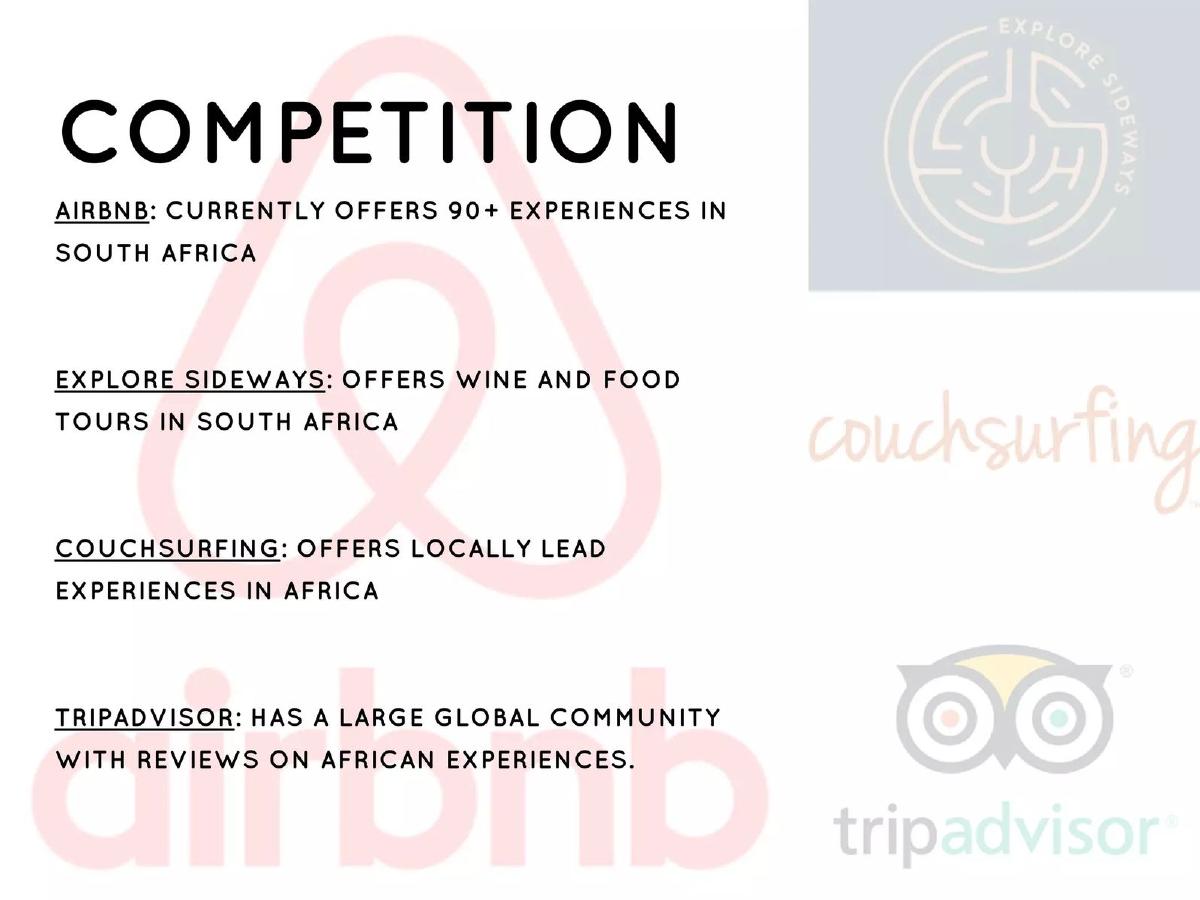
Uthando African Experiences deck, slide 14. Exact stored slide matched to this analysis.
Our analysis: It names the global default (Airbnb) and gives it a number and a place, so the size of the rival is visible.
Evidence and limitation: Listing rivals' strengths without saying why a traveller would choose Uthando.
What a founder can adapt: Add one line per rival on what Uthando does differently, and date the Airbnb count.
Supporting analysis
What the deck claims: "Competition." "Airbnb: currently offers 90+ experiences in South Africa." "Explore Sideways: offers wine and food tours in South Africa." "Couchsurfing: offers locally lead experiences in Africa." "TripAdvisor: has a large global community with reviews on African experiences."
Presentation choice: It names the global default (Airbnb) and gives it a number and a place, so the size of the rival is visible.
When it does not fit: Listing rivals' strengths without saying why a traveller would choose Uthando.
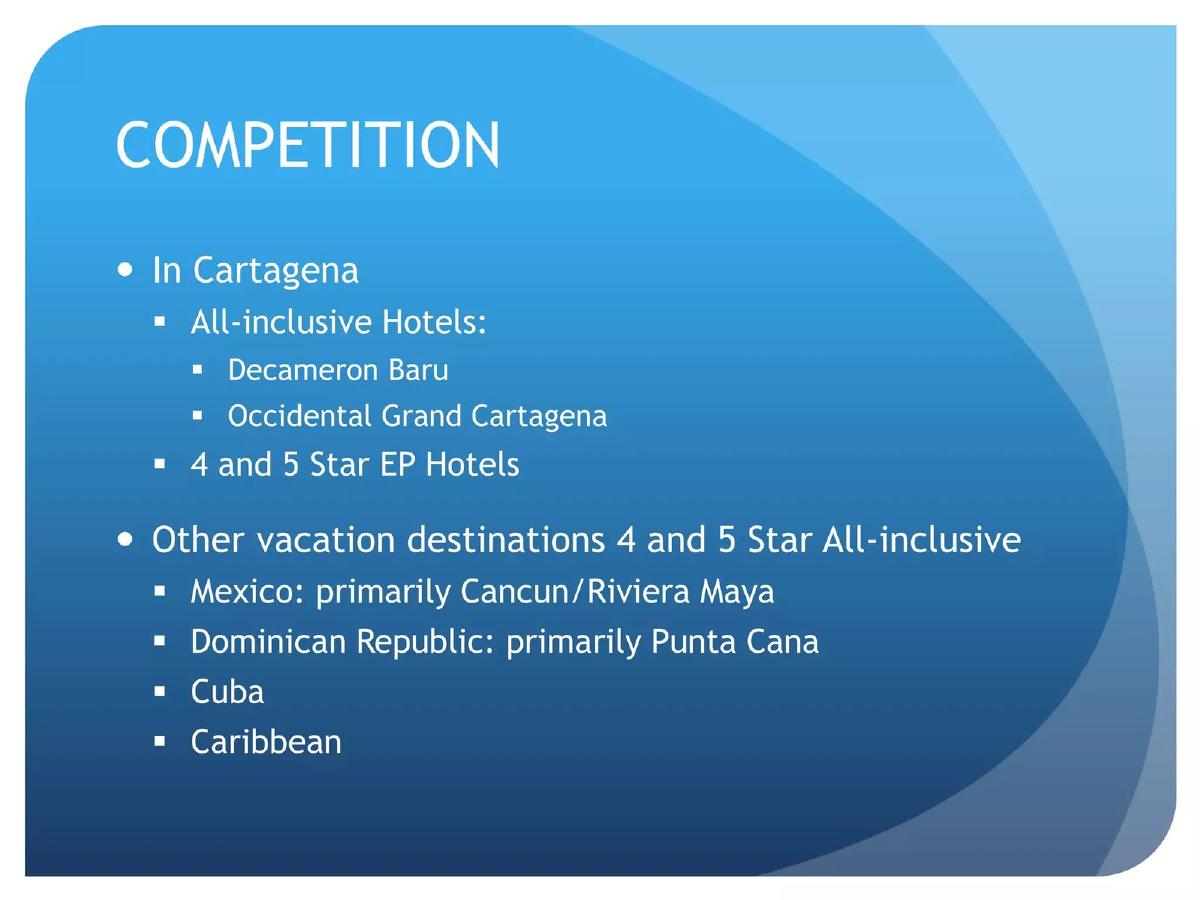
Resort and vacation business in Cartagena, Colombia. The travel problem guide uses slide 5 from this deck.
Alodmd deck, slide 19. Exact stored slide matched to this analysis.
Our analysis: It treats rival destinations as competitors, which matches how holidaymakers choose: first where, then which hotel.
Evidence and limitation: A list of rival places and hotels with no prices, numbers or reason to choose Alodmd.
What a founder can adapt: Add a price per night or package and visitor numbers for each destination, then say why Cartagena and Alodmd win.
Supporting analysis
What the deck claims: "Competition." "In Cartagena": "All-inclusive Hotels: Decameron Baru, Occidental Grand Cartagena"; "4 and 5 Star EP Hotels." "Other vacation destinations 4 and 5 Star All-inclusive": "Mexico: primarily Cancun/Riviera Maya", "Dominican Republic: primarily Punta Cana", "Cuba", "Caribbean."
Presentation choice: It treats rival destinations as competitors, which matches how holidaymakers choose: first where, then which hotel.
When it does not fit: A list of rival places and hotels with no prices, numbers or reason to choose Alodmd.
What each travel competition slide gives the reader
Named rivals plus a clear point of difference make the slide useful.
Example
Format
Rivals named
Compared on
Own difference stated
Naugo
Fact table
cGO, Marlin Booking, Uber Boat
Nine factual rows
Yes, with partner count
Holiday Online
Two-axis map
Airbnb, HomeAway, Sykes and 8 more
Service level, location
Yes, one line
Comfortway
Feature table
Three traveller options
Eight features
Yes, all features ticked
Intui Travel
Chart
Uber, A2B, Gett, i'way
Integration ease
Partly
Relobuddy
List
Four companies
Offer only
No
Key Takeaways
Name both the global platforms and the local alternatives a traveller or supplier actually uses.
Compare on points customers choose by: price, coverage, service level, ease of booking.
A table with facts (launch date, locations, partner count) is more credible than ticks alone.
A two-axis map works when the axes are real choices customers make, and each quadrant explains its weakness.
Say what your position means for the customer, not only where your logo sits.
Build your travel competition slide
Answer these before designing the slide.
Today. What do travellers or suppliers use today: platforms, agencies, doing it themselves?
Criteria. Which two to five factors decide their choice?
Facts. Which facts can you show for each rival: locations, prices, launch dates, supply counts?
Credit. Where is each rival genuinely good?
Difference. What do you offer that none of them does, in one line?
Copyable framework: [Customer] uses [rival A] for [strength] but gets [weakness]. We offer [difference], shown by [fact].
Illustrative example 1 — written by us
Before: AccompanyMe: They provide full travel consultation at a high price point
After: AccompanyMe: full consultation at [price]. We offer [service] at [price], with [difference].
What improved: Our illustrative rewrite, not Relobuddy's text. Bracketed parts are placeholders, not company facts. It adds the missing point of difference.
How this guide relates to the other competition and travel guides
The main competition guide covers comparison tables, positioning maps and feature matrices for any company. The consumer competition guide already uses Tripea's competition slide, so it is not repeated here. The travel problem, solution and market guides use other slides from Holiday Online and other travel decks. This guide covers what is specific to travel competition slides: competing with platforms like Airbnb and Uber alongside local agencies, and choosing comparison points for both travellers and suppliers.
Feature grids: the honest version leaves rivals some ticks
SquadTrip compares itself with WeTravel, Travefy, Group Collect, Youli and Travel Joy on five features: booking hub, website templates, CRM, communication and sales hub. SquadTrip ticks all five. Every rival ticks at least two, and Travel Joy ticks three (CRM, communication, sales hub). The only row no rival has is website templates.
That is more useful than a grid where rivals are blank. An investor can see that the market already covers most of these features and that SquadTrip's claim is bundling: "Differentiators: For Travel Agencies - UX/UI & Ease of use - All in one solution." The weakness is that "all in one" is easy to copy and the grid gives no price, customer count or date, so the reader can't tell whether agencies pay more for one tool than for two. Our count: rivals have 12 ticks between them across 25 cells, so roughly half the features are already available elsewhere.
If your grid only shows you winning, ask what an investor will find in ten minutes on the rivals' websites. Leaving a rival the ticks it has earned makes the remaining blanks believable.
Positioning maps: choose axes a traveller would recognise
Tripsuit plots rivals on two axes: "No personalization" to "Strong personalization" and "No inspiration" to "Highly inspiring". Tripsuit sits alone in the top-right corner; TripAdvisor is in the inspiring, somewhat personal quarter; HolidayCheck and trivago are in the bottom-left; "Itinerary Planners" and "Offering blogs" are shown as categories.
The axes are clear and travellers do choose between inspiration sites and price-comparison sites, so the map tells a story. But both axes are the company's own judgement, with no measure behind them, and putting a booking comparison site such as trivago on an inspiration axis compares it on something it doesn't try to do. A map like this works best when at least one axis is measurable (price, number of destinations, time to plan a trip) and when the categories are named, not left as grey boxes.
Lists of rivals: give one fact each, not just a name
Uthando lists four rivals with one line each: "Airbnb: currently offers 90+ experiences in South Africa", "Explore Sideways: offers wine and food tours in South Africa", "Couchsurfing: offers locally lead experiences in Africa" and "TripAdvisor: has a large global community with reviews on African experiences."
The Airbnb line has a number and a place, which is the strongest kind of entry on a list slide. The figure is undated and unsourced, and a global platform with 90+ local experiences is a serious rival for a small operator, so the slide needs a line on why travellers would book Uthando instead. The slide doesn't give one.
Alodmd's slide goes the other way: no companies outside its city except by destination. In Cartagena it names two all-inclusive hotels (Decameron Baru, Occidental Grand Cartagena) and "4 and 5 Star EP Hotels"; beyond that it lists Mexico (Cancun/Riviera Maya), the Dominican Republic (Punta Cana), Cuba and the Caribbean as "other vacation destinations 4 and 5 Star All-inclusive". Naming rival destinations, not only rival companies, is right for travel: a family choosing a resort compares Cartagena with Punta Cana before it compares hotels. The slide has no prices or visitor numbers, so it shows who the rivals are but not how Alodmd wins.
What investors check on a travel competition slide
Does the slide include the default option a traveller already uses? For trips and experiences that is usually Airbnb, TripAdvisor or a booking site; for resorts it is a rival destination; for agencies it is spreadsheets and email. Leaving the default out makes the market look emptier than it is.
Is there at least one fact per rival: a price, a count, a date or a coverage area? Uthando's "90+ experiences" and the launch dates on Naugo's table are the kind of facts that make a slide checkable.
Is the company's own position stated in words, not only by placement or ticks? SquadTrip's differentiator line and Comfortway's notes do this; Relobuddy and Tripsuit leave it to the reader.
Are figures dated and sourced? None of the four new slides dates its rival figures. Travel platforms change their inventory quickly, so an undated count can be years out of date by the time an investor reads it.
Common mistakes
Only global giants, or only locals. Customers weigh both, so show both.
Ticks with no facts. Add prices, locations or counts where you can.
Every row is yours. Give rivals credit where they're genuinely strong.
Unlabelled axes. Both ends of each axis should name a real customer choice.
No difference stated. Say in one line why a customer would switch.
Diagnostic checklist
Global platforms and local alternatives are both named.
Comparison points match how customers choose.
Factual rows (location, price, supply) are included where possible.
Rivals get credit for real strengths.
Your own difference is stated in one line.
Frequently asked questions
How we chose these examples
Corpus: published pitch deck teardowns on StartupFundraising.com. Founder-uploaded private decks are excluded.
Selection (2026-09-28): we searched extracted slide text for slides whose opening words include "competition", "competitors", "competitive" or "landscape" and whose text mentions travel, hotels, flights, tourism or bookings, then kept travel companies. Update (2026-10-01): a second search added SquadTrip p10, Tripsuit p22, Uthando p14 and Alodmd p19, rendered from the original deck files and viewed. Also not used: AirBed&Breakfast p9 (no deck file available), Outtrippin p10 and iSmartAfrica p8 (pages unclear in our index; the decks are already used by other travel guides), Blackpepper p8 (restaurants), Castle p10 (property management). Excluded: Tripea's competition slide (used by the consumer competition guide), TransferWise and Kruma (finance), and slides outside travel.
Images: four slide images (Comfortway, Holiday Online, Intui Travel, Naugo) were rendered from the published deck PDFs and stored on 2026-09-28; Relobuddy's was already stored. Four more (SquadTrip, Tripsuit, Uthando, Alodmd) were rendered and stored on 2026-10-01.
Overlap check: no competition-slide facet for travel existed. Holiday Online, Comfortway, Naugo and Relobuddy appear in other guides with different slides.
Review: the five original slide images were inspected on 2026-09-28 and the four new ones on 2026-10-01, each matched to company, deck and slide number (editorial model review). Claims about rivals are quoted from the slides and were not checked. No person has yet completed an editorial review of this page.
We make no claim that any slide caused a fundraising outcome.