Carbon Credits in Your Business Model: What the Pitch Deck
If carbon credits are part of how you make money, investors need to know your place in the chain, how each credit is counted and issued.
Carbon Credits in Your Business Model: Show Your Place in the Chain and How Each Credit Is Earned
Nine slides from four climate startups that make money from carbon credits in different ways: Mootral, which planned to create credits from a cattle feed supplement; goodcarbon, which builds credit portfolios for companies; Flowcarbon, which wrapped credits in a crypto token; and Open Forest Protocol, which offers forest projects a cheaper way to verify them. For each, we record what the slide proves about where the credits come from, how many there are, what they sell for and how the startup earns, and what it leaves for an investor to ask.
TL;DR
Carbon credits are not one business model. A startup can create credits, verify them, buy and resell them, or package them into a new product, and each role earns differently and carries different risks. A business model slide that relies on credits should show four things: your role in the chain; what one credit represents and which registry and method will issue it, with its current status; how many credits one unit of your activity produces and how you calculated that; and the price you assume, its source and how much of it you keep.
Mootral's page 7 states its unit plainly ("1 cow fed with Mootral Ruminant for 1 year = 1 CowCredit") but the deck, dated May 2019, predates the registry method later used for feed supplements. goodcarbon's pages 7 and 15 show how a buyer of credits manages supply, with spot, forward and long-term contracts and an inventory split by credit type. Flowcarbon's pages 9 and 10 explain what backs its token but not, on these pages, how Flowcarbon earns. Open Forest Protocol's page 9 compares its verification with the old process, priced at "Free", which leaves its own revenue unexplained.
Carbon credit business model slides from real pitch decks
Each example records what the slide proves about the credit's source, count, price and the startup's earnings. "Our calculation" marks arithmetic we did; the slides don't state it.
Mootral business model slide — slide 4
Feed supplement to cut cattle methane. May 2019 introduction deck; problem page.
Mootral deck, slide 4. Exact stored slide matched to this analysis.
Our analysis: The starting figure for any per-cow credit count.
Evidence and limitation: Per-animal emissions stated and sourced; share that is enteric methane not given; dairy or beef not specified.
What a founder can adapt: Say what share of the total your product affects.
Supporting analysis
What the deck claims: "Each cow emits 3-4 tons of CO2e p.a." "(Using the current IPCC-GWP conversion factor)", footnoted to IPCC 2013; cattle as "3rd largest GHG polluter" if a nation.
Presentation choice: Investors need the baseline before they can check credits per unit.
When it does not fit: Don't apply a reduction to a total it doesn't cover.
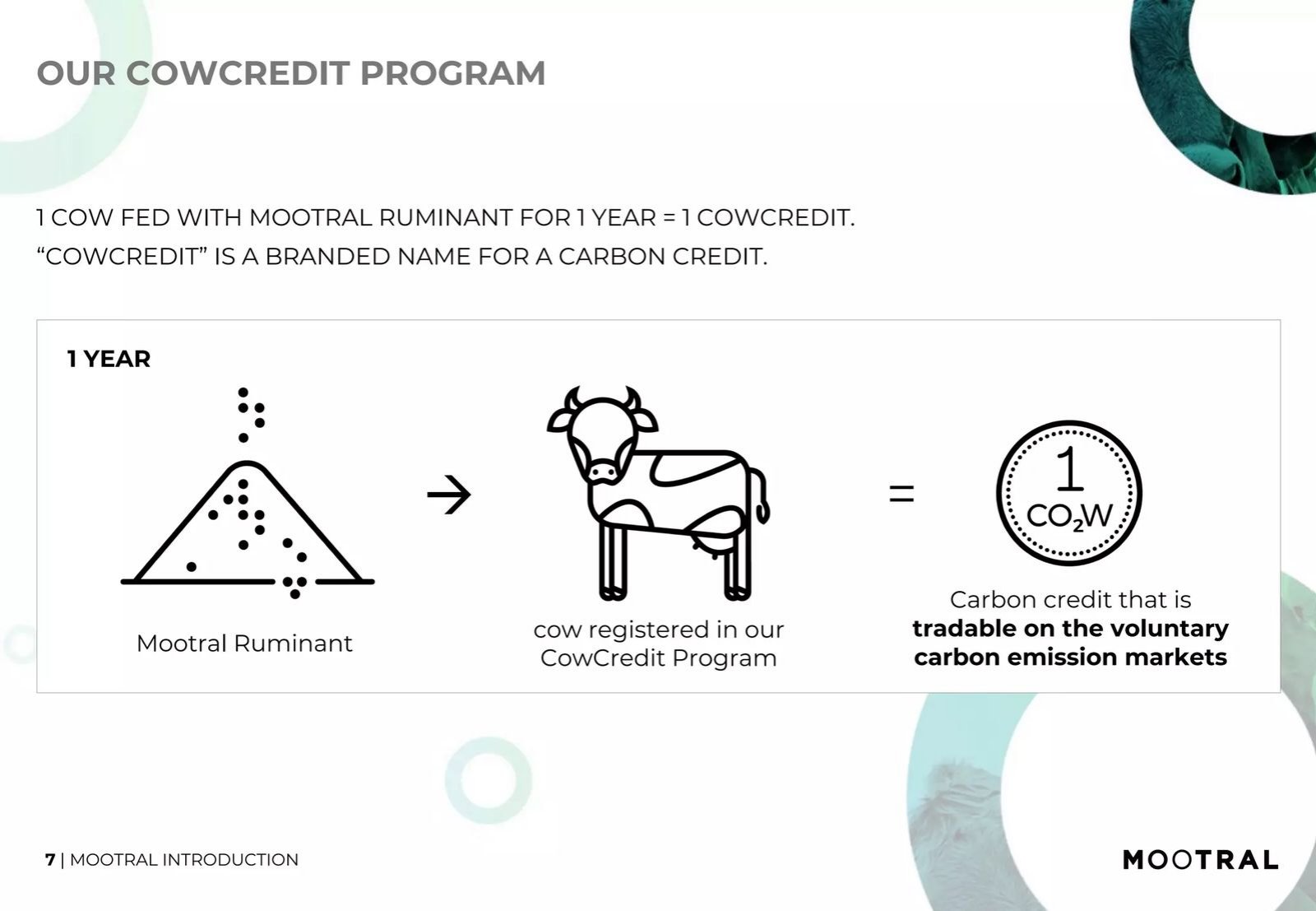
Mootral deck, slide 7. Exact stored slide matched to this analysis.
Our analysis: A clear revenue unit whose arithmetic and issuance route are missing.
Evidence and limitation: Our calculation: a 30-38% cut of 3-4 tonnes is 0.9-1.5 tonnes at most. Verra's feed method came after the deck.
What a founder can adapt: Show the steps to tonnes per cow and the method's status.
Supporting analysis
What the deck claims: "1 cow fed with Mootral Ruminant for 1 year = 1 CowCredit." "'CowCredit' is a branded name for a carbon credit." "Carbon credit that is tradable on the voluntary carbon emission markets."
Presentation choice: One equation turns a product into countable credits.
When it does not fit: Don't call credits tradable before a registry can issue them.
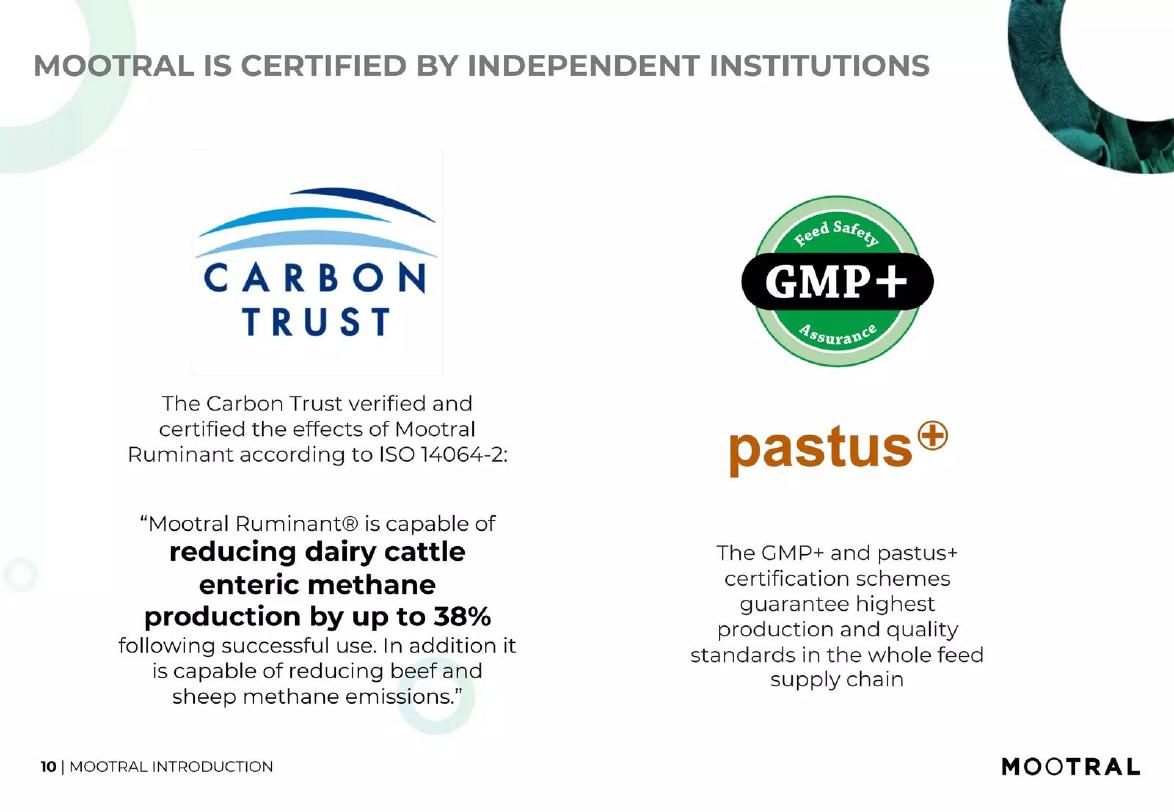
Mootral deck, slide 10. Exact stored slide matched to this analysis.
Our analysis: Real third-party evidence of the reduction, short of credits.
Evidence and limitation: Verification of effect quoted; not a registry issuance. "Up to 38%" differs from the 30% headline on page 11.
What a founder can adapt: Separate effect verification from credit issuance.
Supporting analysis
What the deck claims: Carbon Trust "verified and certified the effects of Mootral Ruminant according to ISO 14064-2": "capable of reducing dairy cattle enteric methane production by up to 38%"; GMP+ and pastus+ feed-quality logos.
Presentation choice: Investors can see who checked the core claim.
When it does not fit: Don't let a maximum stand in for the typical result.
Berlin builder of nature-based credit portfolios for companies. April 2024 deck; price page.
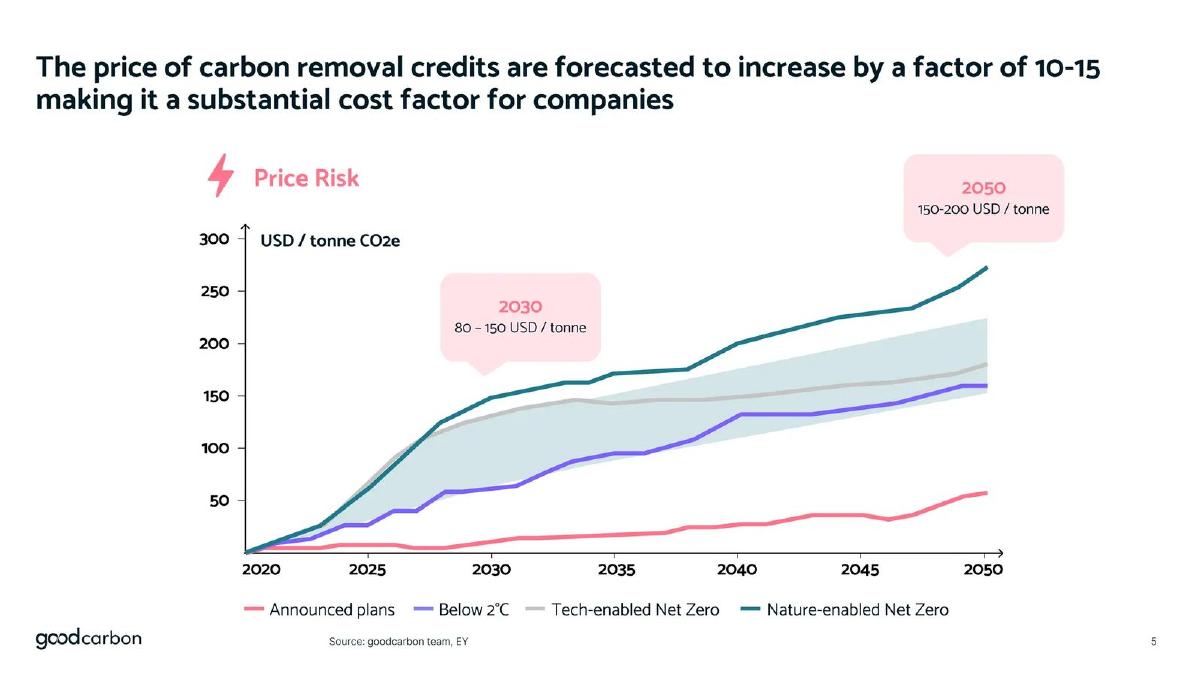
goodcarbon deck, slide 5. Exact stored slide matched to this analysis.
Our analysis: A sourced price case, used to argue for buying early.
Evidence and limitation: Source named. Starting price for the 10-15x not shown; callouts cover the middle scenarios only.
What a founder can adapt: Give today's price and the scenario you model.
Supporting analysis
What the deck claims: "The price of carbon removal credits are forecasted to increase by a factor of 10-15"; callouts "2030: 80 - 150 USD / tonne", "2050: 150-200 USD / tonne"; four scenario lines; source "goodcarbon team, EY".
Presentation choice: The price assumption drives every credit revenue line.
When it does not fit: Don't state a multiple without its base.
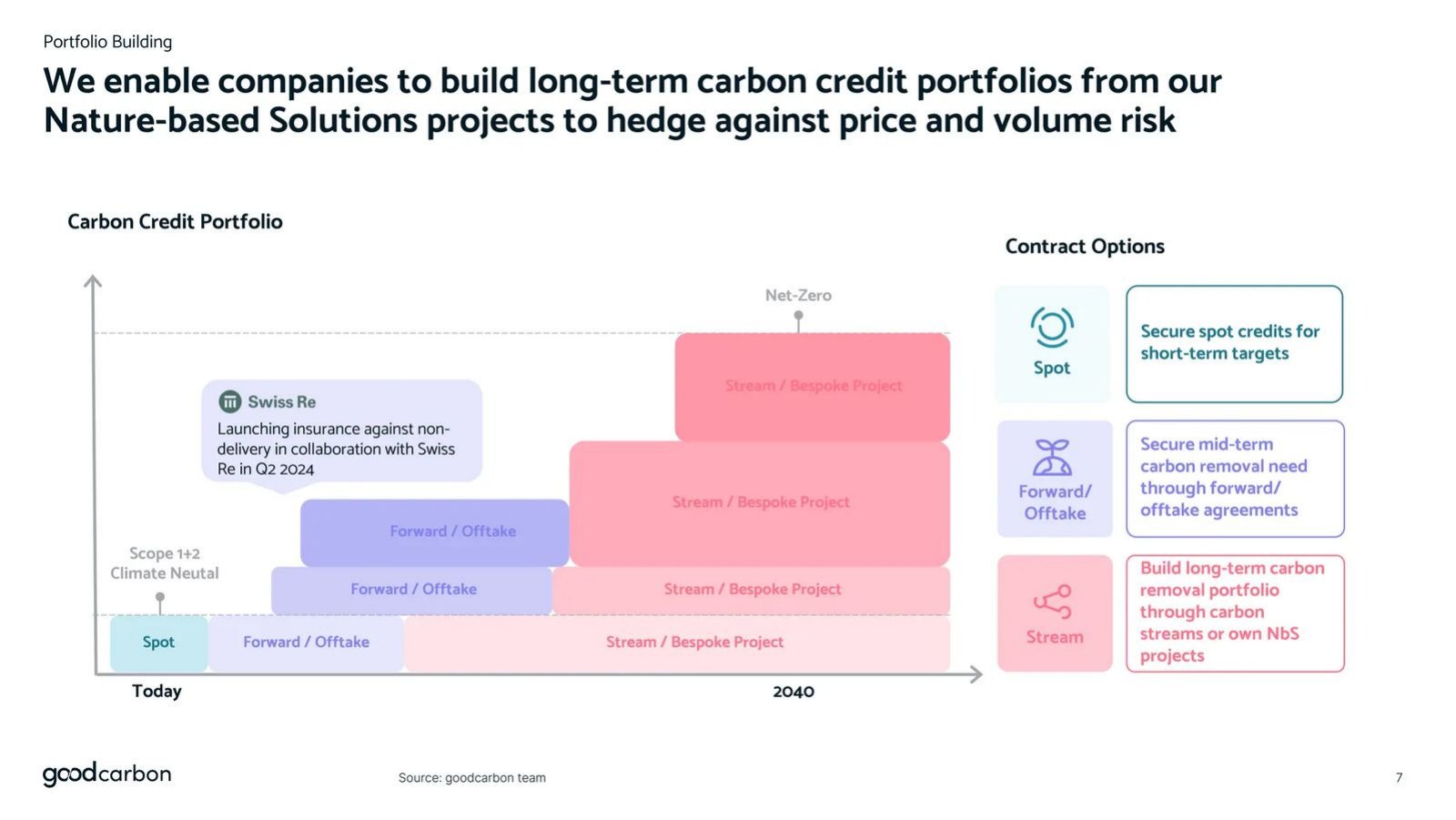
goodcarbon deck, slide 7. Exact stored slide matched to this analysis.
Our analysis: Shows how promised credits are delivered and insured.
Evidence and limitation: Contract types and delivery risk shown; insurance described as launching after the deck date.
What a founder can adapt: Say who bears non-delivery risk today.
Supporting analysis
What the deck claims: Spot, "Forward/Offtake" and "Stream" contracts stacked from "Today" to 2040 and "Net-Zero"; "Launching insurance against non-delivery in collaboration with Swiss Re in Q2 2024".
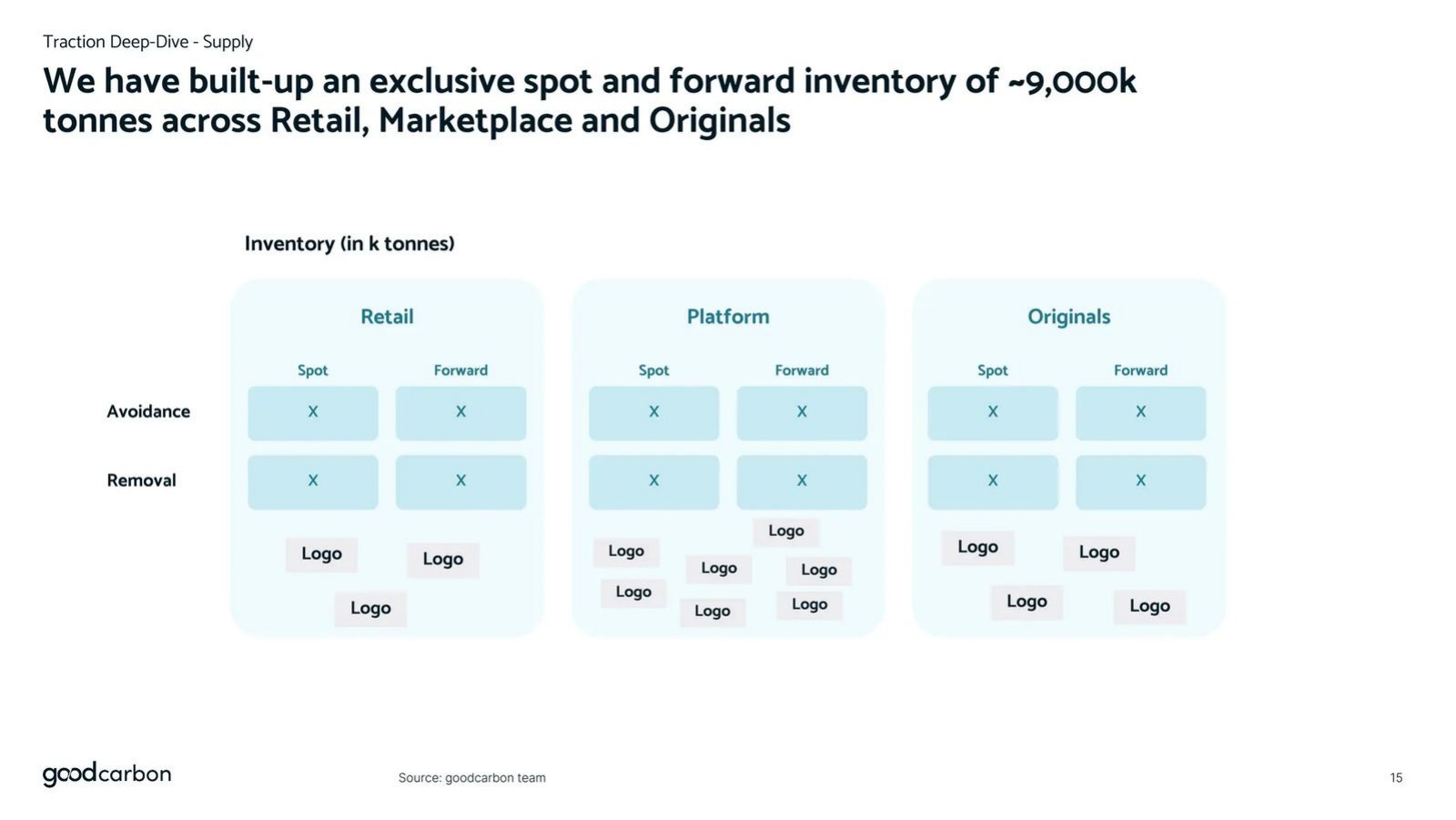
goodcarbon deck, slide 15. Exact stored slide matched to this analysis.
Our analysis: The right structure, with the numbers withheld.
Evidence and limitation: Every cell reads "X" and logos read "Logo" in this copy; only the total is visible. Headline and grid name one source differently.
What a founder can adapt: Show at least the removal and forward shares.
Supporting analysis
What the deck claims: "Exclusive spot and forward inventory of ~9,000k tonnes across Retail, Marketplace and Originals"; grid of avoidance and removal by spot and forward for Retail, Platform and Originals.
Presentation choice: Credit type and delivery timing change what inventory is worth.
When it does not fit: Don't publish a total whose parts can't be seen.
New York company tokenizing voluntary credits. 2022 deck; token page.
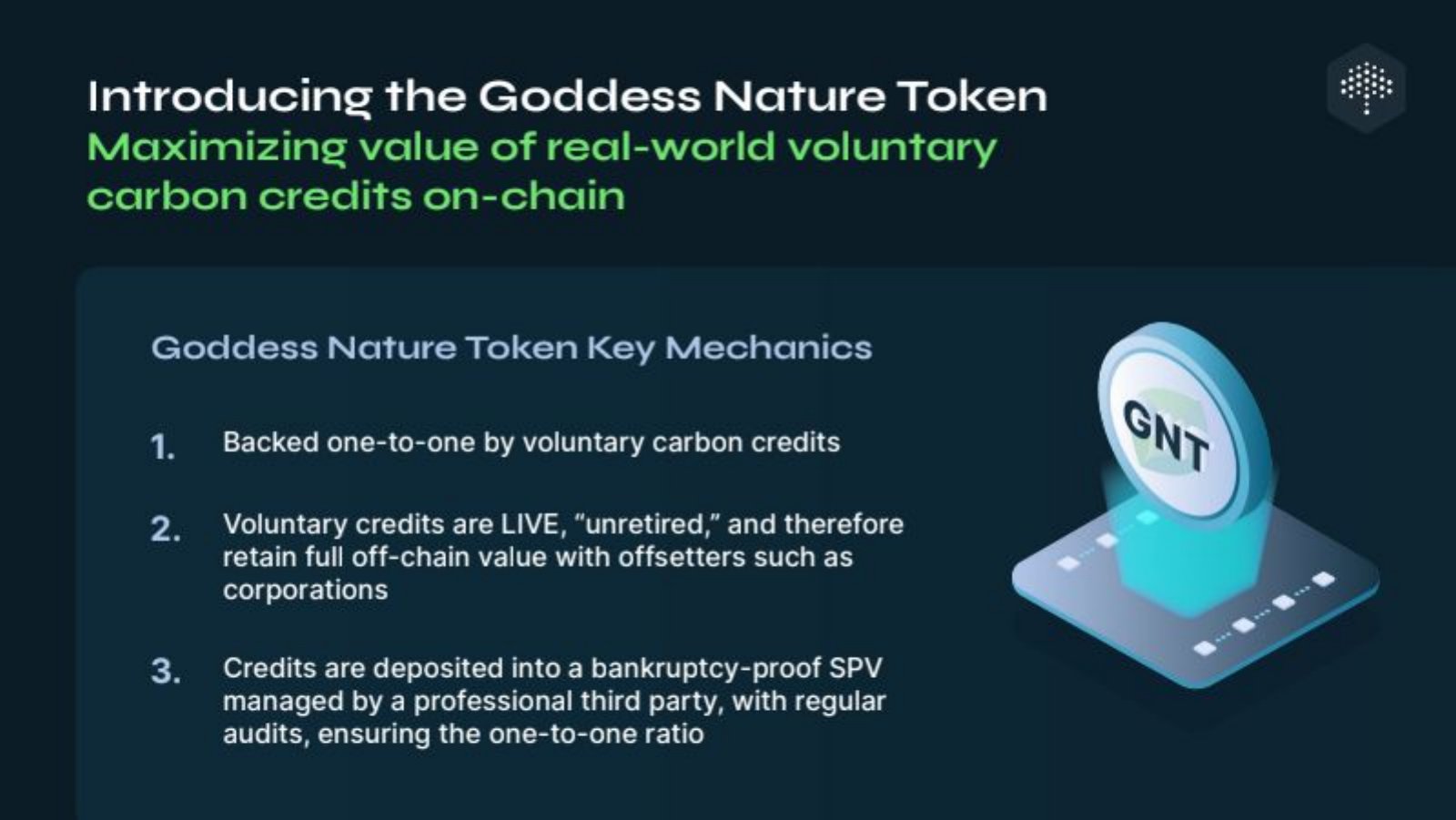
Flowcarbon deck, slide 9. Exact stored slide matched to this analysis.
Our analysis: Answers what backs the product, not how the company earns.
Evidence and limitation: Backing, custody and audit described; third party, auditor and Flowcarbon's own fee not named on this page.
What a founder can adapt: Name the custodian, the auditor and your fee.
Supporting analysis
What the deck claims: Token "Backed one-to-one by voluntary carbon credits"; credits "LIVE, 'unretired'"; "deposited into a bankruptcy-proof SPV managed by a professional third party, with regular audits".
Presentation choice: A packaged product needs its backing explained first.
When it does not fit: Don't leave revenue to press reports.
Same deck. Eligibility rules for the underlying credits.
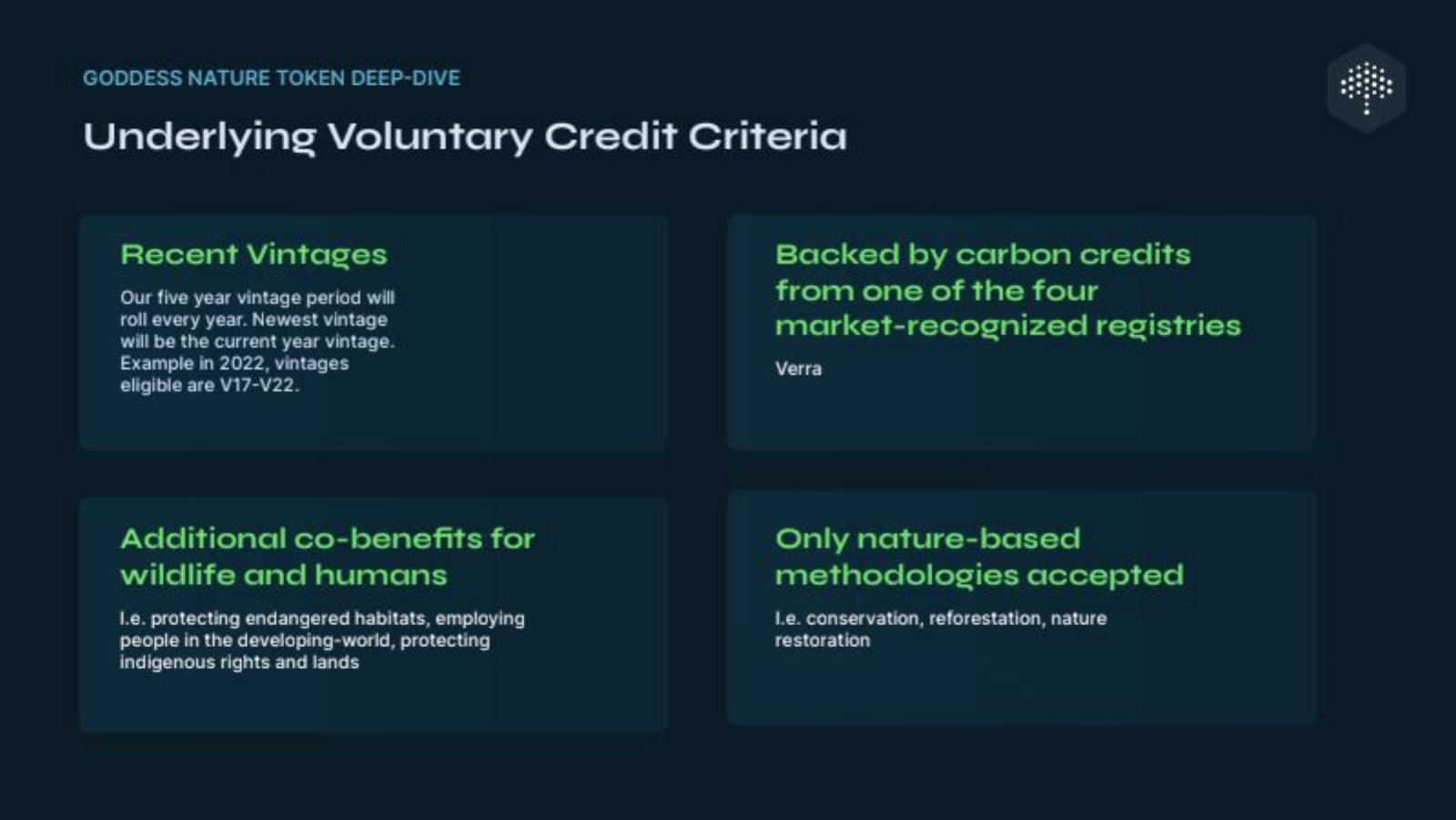
Flowcarbon deck, slide 10. Exact stored slide matched to this analysis.
Our analysis: Clear quality rules with two internal mismatches.
Evidence and limitation: Our count: V17 to V22 is six vintage years. Only one of four registries is named.
What a founder can adapt: List every registry and state the vintage window exactly.
Supporting analysis
What the deck claims: "Backed by carbon credits from one of the four market-recognized registries" with only "Verra" listed; "Only nature-based methodologies accepted"; "five year vintage period ... in 2022, vintages eligible are V17-V22".
Presentation choice: Registry, method and vintage set what a credit is worth.
When it does not fit: Don't let an example contradict its own rule.
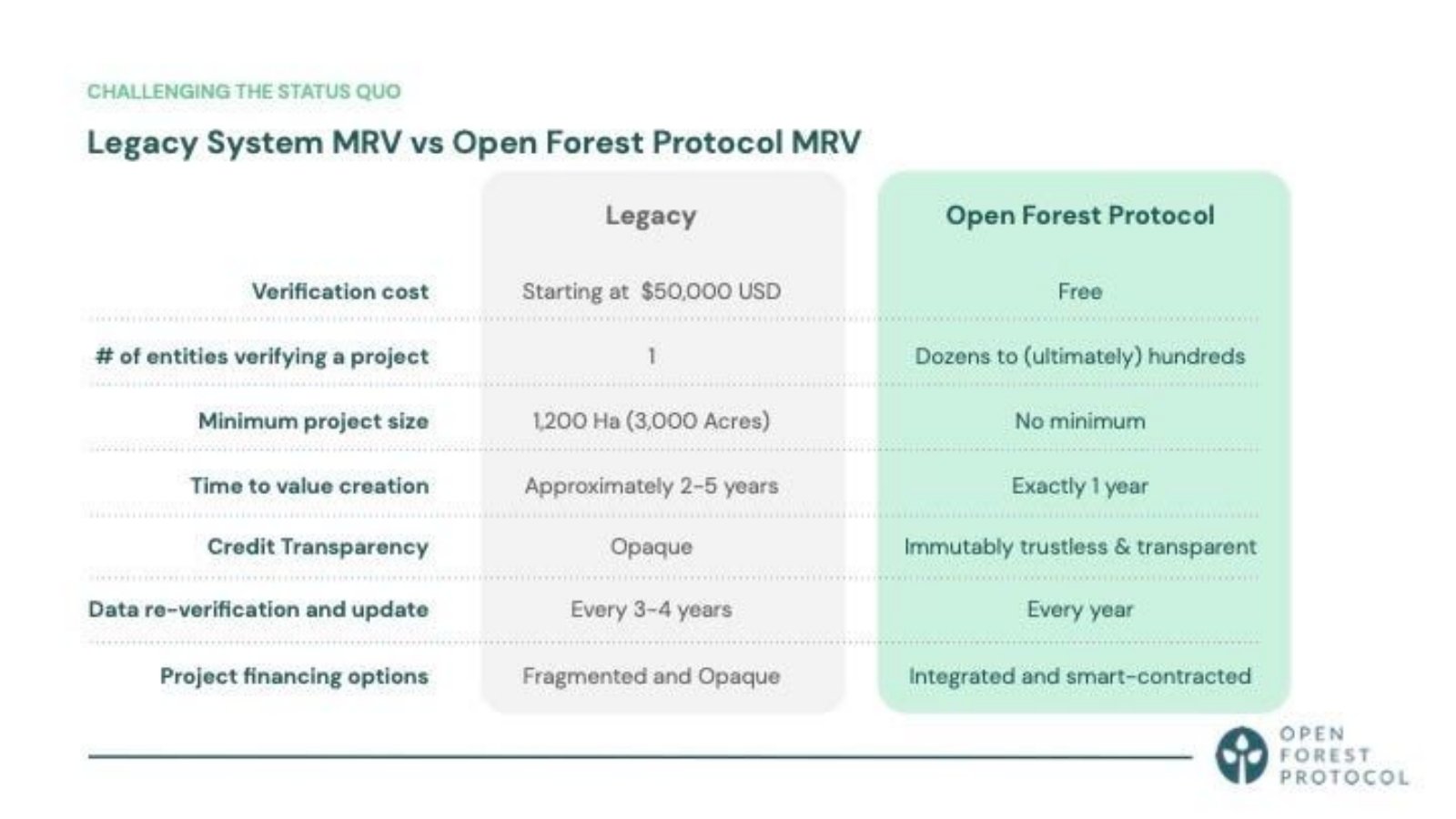
Open Forest Protocol deck, slide 9. Exact stored slide matched to this analysis.
Our analysis: A strong pitch to projects that leaves the revenue model open.
Evidence and limitation: No sources for the legacy figures; no statement of who pays OFP. Our calculation: 1,200 ha is about 2,965 acres.
What a founder can adapt: Say what you charge, to whom and when.
Supporting analysis
What the deck claims: Legacy MRV "Starting at $50,000 USD" vs OFP "Free"; minimum project "1,200 Ha (3,000 Acres)" vs "No minimum"; time to value "Approximately 2-5 years" vs "Exactly 1 year"; re-verification every 3-4 years vs every year.
Presentation choice: Shows why a free service still needs a stated payer.
When it does not fit: Don't price your service at free without explaining income.
Columns report what each slide states or leaves out; checks are our calculations.
Example
Role in the chain
Credits per unit or volume
Registry and method status
Price or what the startup earns
Mootral p4
Creator
3-4 t CO2e per cow (baseline)
No
No
Mootral p7
Creator
1 credit per cow-year (unsupported by own figures)
No; method came later
No
Mootral p10
Creator
Up to 38% reduction
Effect verified, not issued
No
goodcarbon p5
Reseller
No
No
80-150 USD/t in 2030 (EY)
goodcarbon p7
Reseller
No
No
Contract types; no margin
goodcarbon p15
Reseller
~9M tonnes; split withheld
No
No
Flowcarbon p9
Packager
1 token per credit
No
No (fee in press only)
Flowcarbon p10
Packager
No
Verra named; vintage rule
No
OFP p9
Verifier
No
Own process
"Free"; payer not stated
Key Takeaways
Name your role: credit creator, verifier, reseller or packager. Each earns from a different part of the price.
Say which registry and method issue your credits and whether that method is approved yet. Mootral's 2019 deck came before the Verra method for feed supplements.
Show the arithmetic from your activity to credits. Mootral's own figures only support one credit per cow-year if most of a cow's emissions are the methane it reduces (our calculation).
Source the price and show what you keep. goodcarbon cites EY for a price forecast; no slide in the set says what margin the startup takes.
Split supply by credit type and contract. goodcarbon's inventory grid separates avoidance from removal and spot from forward.
If your service is free to projects, say who pays you. Open Forest Protocol's comparison prices its verification at "Free" and doesn't say how it earns.
Map your credit business
Fill in each line with your own figures, and keep the labels if the numbers are confidential.
Role. Creator, verifier, reseller or packager, and who your customer is.
Credits per unit. Baseline, share affected, measured reduction and tonnes per unit, with sources.
Issuance. Registry, method, its status and the expected date of first issuance.
Price. Price per credit assumed, its source and scenario, and a lower case.
What you keep. Your margin or fee after partners, verifiers and registries.
Delivery. Delivered versus forward credits, and who carries non-delivery risk.
Copyable framework: We [create / verify / resell / package] carbon credits for [customer]. Each [unit of activity] produces [x] tonnes a year ([baseline] x [share affected] x [reduction], source [s]). Credits are issued by [registry] under [method], status [approved / submitted / in development], first issuance expected [date]. We assume [price] per credit ([source], [scenario]; low case [price]) and keep [margin or fee]. [n]% of our supply is delivered; the rest is forward, with non-delivery risk held by [party].
Illustrative example 1 — written by us
Before: Every tonne we save becomes a tradable carbon credit.
After: We create credits from farm methane cuts. Each enrolled cow cuts 0.8 tonnes a year (2.7 t enteric baseline x 30% measured cut). Credits will be issued by [registry] under a method submitted in March; first issuance expected next year. We assume $25 per credit (low case $12) and keep 60% after farmer and verifier payments.
What improved: Our illustrative rewrite; figures are invented for the example. It names the role, shows the arithmetic to tonnes per unit, gives the method's status and timing, and states the price assumption and the share the startup keeps.
The question this guide answers
A carbon credit is a certificate, issued by a registry such as Verra or Gold Standard, representing one tonne of carbon dioxide (or the equivalent in other greenhouse gases) kept out of the atmosphere or removed from it. Companies buy credits to compensate for emissions they can't yet cut. A growing number of startups make some or all of their money from these certificates, and investors reviewing their decks ask a narrow set of questions: who issues the credits, how many you will have, what they sell for, how long it takes to get paid and how much of the price you keep.
Our published guides don't answer this. The climate product guide uses a consumer offset app as a weak example and asks for the price, the projects and how impact is measured. The climate traction guide, the revenue-mix guide and the web3 business model guide touch other questions. No guide explains what a business model slide must show when carbon credits are the product or part of it, or how that differs depending on where a startup sits in the chain. That is the question here, and the practical outcome is a slide that lets an investor check each step from your activity to your revenue.
How we chose and read the examples
We searched the extracted text of the deck library for carbon credit, offset, Verra, Gold Standard, prices per tonne and related phrases, then read the matching decks. Several were excluded. A Chinese wind power company's 2010 deck splits revenue between electricity and carbon credits, but the company was listed on a stock exchange when it was made. A cookstove company's deck has strong credit economics but carries a confidentiality notice on its cover, so we left it out under the same rule we apply to other decks marked confidential. Another deck was from a listed agricultural company, one was from a nonprofit foundation, and a crop-monitoring deck mentioned credits only beside redacted content.
Nine slides from four private companies remained: Mootral pages 4, 7 and 10; goodcarbon pages 5, 7 and 15; Flowcarbon pages 9 and 10; and Open Forest Protocol page 9. Every slide was rendered from the original deck file and read at full size, and quotes are as printed. Company facts outside the slides come from public sources listed below: goodcarbon's April 2024 funding announcement, TechCrunch's May 2022 report on Flowcarbon's raise, Open Forest Protocol's January 2023 pre-seed release and Verra's page on its enteric methane method. Mootral's deck is dated May 2019 and goodcarbon's April 2024; Flowcarbon's and Open Forest Protocol's are undated but refer to 2022 figures. All four companies were private when their decks were made.
Four roles, four ways to earn
The four companies sit at different points in the same chain. Mootral is a creator: it sells a feed supplement to farmers and planned for each fed cow to generate a credit. goodcarbon is a buyer and portfolio manager: it sources credits from projects and sells long-term portfolios to companies. Flowcarbon is a packager: it puts existing credits into a pool and issues a tradable token against them. Open Forest Protocol is a verifier: it offers forest projects a way to measure and verify their carbon so that credits can be issued.
Each role earns from a different part of the price and carries a different main risk. A creator earns when credits are issued and sold, so its risk is whether the registry accepts the method and how long issuance takes. A reseller earns a spread between buying and selling prices, so its risk is holding inventory and delivering what it promised. A packager typically earns a fee on what it wraps; TechCrunch reported that Flowcarbon charged credit providers a 2% tokenization fee, citing Reuters, though the pages we read don't say so. A verifier earns from projects or from credits issued, and its risk is whether buyers trust credits it verifies. The first line of your slide should say which of these you are.
From your activity to a credit: show the arithmetic
Mootral's page 4, "A source of GHG emissions so far overlooked", says "Each cow emits 3-4 tons of CO2e p.a." (using, in its words, "the current IPCC-GWP conversion factor", footnoted to the 2013 IPCC report). Page 7, "Our CowCredit program", then states: "1 cow fed with Mootral Ruminant for 1 year = 1 CowCredit" and "'CowCredit' is a branded name for a carbon credit". A diagram runs from a pile of supplement, to a "cow registered in our CowCredit Program", to a coin marked "1 CO2W", labelled "Carbon credit that is tradable on the voluntary carbon emission markets".
This is the right instinct: one sentence that turns the product into a countable revenue unit. An investor can multiply cows by credits by price. The problem is that the deck's own numbers don't show how the equation was reached. Page 10 quotes the Carbon Trust: Mootral Ruminant "is capable of reducing dairy cattle enteric methane production by up to 38%", and page 11 gives a headline of 30%. Enteric methane is the methane from digestion, which is only part of a cow's total emissions. Even if all of a cow's 3 to 4 tonnes were enteric methane, a 30% cut would be 0.9 to 1.2 tonnes a year, and a 38% cut 1.1 to 1.5 tonnes (our calculation). One credit per cow-year therefore holds only if most of the 3 to 4 tonnes is the methane the supplement reduces, a share the deck doesn't give.
The fix is to show the chain on the slide: emissions per animal from the named source, the share the product affects, the measured reduction and the resulting tonnes per animal per year. Then say which reduction figure you use. A deck that quotes 30% on one page and "up to 38%" on another should state which figure drives the credit count and why.
Who issues the credit, and is the method approved?
Page 7 describes CowCredits as tradable on voluntary markets, and page 10 cites a Carbon Trust verification "according to ISO 14064-2", a standard for quantifying emission reductions in a project. A verification of the supplement's effect is not the same thing as credits issued by a registry. Registries issue credits only under an approved method, which sets how the starting emissions, the reduction and its monitoring must be measured.
Verra announced version 2.0 of its VM0041 method for reducing enteric methane through feed ingredients in January 2022, and lists it as active since 21 December 2021; a copy of version 1.0, dated November 2020, that we read on a document-sharing site credits Mootral SA as its developer. Either date is after Mootral's May 2019 deck. So when the deck was made, the registry method that would issue CowCredits did not yet exist in approved form, and the slide's present tense ("tradable") ran ahead of the evidence. That is not unusual for an early climate company, but it should be stated: name the registry, the method and its status (approved, submitted, in development), and when the first credits are expected.
Flowcarbon's page 10 does better on this point. Under "Underlying Voluntary Credit Criteria" it says the token is "Backed by carbon credits from one of the four market-recognized registries" and lists Verra, accepts "Only nature-based methodologies" (conservation, reforestation, nature restoration) and sets a vintage rule: "Our five year vintage period will roll every year. Newest vintage will be the current year vintage. Example in 2022, vintages eligible are V17-V22." The vintage is the year the reduction happened. Two details don't reconcile: the page names only one registry while promising four (TechCrunch's report names Verra, Gold Standard, Climate Action Reserve and the American Carbon Registry), and 2017 to 2022 inclusive is six vintage years, not five (our count). An investor will ask which is the real rule.
What the credits sell for, and what you keep
goodcarbon's page 5 is headed "The price of carbon removal credits are forecasted to increase by a factor of 10-15 making it a substantial cost factor for companies". A chart in USD per tonne CO2e runs from 2020 to 2050 with four lines ("Announced plans", "Below 2°C", "Tech-enabled Net Zero", "Nature-enabled Net Zero") and two callouts: "2030: 80 - 150 USD / tonne" and "2050: 150-200 USD / tonne". The source line reads "goodcarbon team, EY".
Citing a named source for a price forecast is the minimum, and this page does it. What the page doesn't show is the starting price that "a factor of 10-15" multiplies, and the callouts don't match every line: the "Nature-enabled Net Zero" line ends near 270 dollars in 2050 and "Announced plans" below 60, so the 150 to 200 range describes the middle scenarios only. For a buyer-facing company, rising prices are a reason for customers to lock in supply early, which is how goodcarbon uses the page. For a credit creator, the price assumption drives revenue directly, and the slide should give the price per credit used in the model, the scenario it comes from and a lower case.
None of the nine slides says what share of the credit price the startup itself keeps. That is the number investors most often have to ask for. A reseller should show its typical buying and selling price or margin; a creator should show what it pays project partners, verifiers and registries per credit; a packager or verifier should show its fee and what it is charged on.
Supply and delivery: contracts and inventory
goodcarbon's page 7, "We enable companies to build long-term carbon credit portfolios from our Nature-based Solutions projects to hedge against price and volume risk", shows a stacked chart of a client's portfolio from "Today" to 2040, rising to "Net-Zero", built from three contract types: "Spot: Secure spot credits for short-term targets", "Forward/Offtake: Secure mid-term carbon removal need through forward/offtake agreements" and "Stream: Build long-term carbon removal portfolio through carbon streams or own NbS projects". A callout reads "Swiss Re: Launching insurance against non-delivery in collaboration with Swiss Re in Q2 2024".
This is the clearest page in the set on how a credit business actually delivers. Forward and stream contracts promise credits that projects have not yet produced, so the risk that a forest burns or a project under-delivers sits with someone, and the page says goodcarbon was arranging insurance for it. Because the deck is dated April 2024, the insurance was a plan for the following quarter, not an existing product, and the slide words it that way.
Page 15, "We have built-up an exclusive spot and forward inventory of ~9,000k tonnes across Retail, Marketplace and Originals", shows a grid: avoidance and removal credits down the side, spot and forward across the top, for three sources. In the copy we have, every cell reads "X" and the customer logos read "Logo", so only the headline total of about 9 million tonnes is visible; the split is withheld. The structure is still the one to copy, because avoidance and removal credits sell at different prices and forward tonnes are not yet delivered. One naming detail: the headline says "Marketplace" while the grid column says "Platform". If you publish a total, show the split, or at least the share that is removal and the share that is forward.
Packagers and verifiers: say what backs the product and who pays
Flowcarbon's page 9, "Introducing the Goddess Nature Token: Maximizing value of real-world voluntary carbon credits on-chain", gives three mechanics: the token is "Backed one-to-one by voluntary carbon credits"; the credits are "LIVE, 'unretired,' and therefore retain full off-chain value with offsetters such as corporations"; and "Credits are deposited into a bankruptcy-proof SPV managed by a professional third party, with regular audits, ensuring the one-to-one ratio". (An SPV is a separate legal company that holds the credits.) For a packaged product, this is what an investor needs first: what backs each unit, who holds it and who checks. The page doesn't name the third party or the auditor, and it doesn't show how Flowcarbon earns; the 2% fee appears only in press reports. TechCrunch reported that $38 million of Flowcarbon's $70 million May 2022 raise came from selling the token itself, so the revenue line and the token deserve separate explanation.
Open Forest Protocol's page 9, "Legacy System MRV vs Open Forest Protocol MRV", compares the two in seven rows. MRV means measurement, reporting and verification. Legacy verification is "Starting at $50,000 USD" against OFP's "Free"; one verifying entity against "Dozens to (ultimately) hundreds"; a minimum project size of "1,200 Ha (3,000 Acres)" against "No minimum"; time to value of "Approximately 2-5 years" against "Exactly 1 year"; and re-verification "Every 3-4 years" against "Every year". 1,200 hectares is about 2,965 acres, so the rounding is fair (our calculation).
As a comparison it is sharp: a small landowner can see why the old route excluded them. As a business model it leaves the key question open. If verification is free to projects, the company must earn somewhere else, perhaps from credits issued, a share of sales or a token, and the page doesn't say. The company's January 2023 release describes access "at no up-front cost", which suggests payment later, but the slide should state it. The "$50,000" and "2-5 years" figures also need sources, since they carry the whole comparison.
What to put on your slides
Start with one line naming your role: we create credits, we verify them, we buy and resell them, or we package them. Then show one credit's path: the activity, the tonnes per unit and how they were calculated, the registry and method that will issue them, the method's status and when the first issuance is expected. Use the same reduction figure throughout, or say why figures differ.
Next, the money: the price per credit you assume, its source and scenario, a lower case, and what you keep after paying project partners, verifiers and registries. If you sell forward, show the split between delivered and promised credits, and who carries the risk of non-delivery. If your service is free to one side, say who pays and when. Finally, keep claims in the right tense. "Tradable", "verified" and "certified" mean specific things in carbon markets; use them only for what has happened, and describe the rest as planned, with a date.
Common mistakes
Role not stated. Say whether you create, verify, resell or package credits.
Credits per unit asserted. Show the baseline, share affected and reduction behind the number.
Verification called issuance. A verified effect is not a registry-issued credit.
Wrong tense. Don't call credits tradable before an approved method can issue them.
Price without base or source. Give today's price, the scenario and who forecast it.
Free with no payer. If one side pays nothing, say who pays you and when.
Diagnostic checklist
The slide names the startup's role in the credit chain.
Tonnes per unit of activity are calculated from stated, sourced inputs.
The registry, method and its current status are given.
The assumed price has a source, a scenario and a lower case.
The startup's own margin or fee is shown.
Delivered and forward credits are separated, with non-delivery risk assigned.
Frequently asked questions
What is the most important thing a carbon credit business model slide should show?
Your role in the chain and what you earn from it. Mootral, goodcarbon, Flowcarbon and Open Forest Protocol each earn from a different step, and none of the nine slides states its own margin or fee.
Can I count credits before a registry method is approved?
You can forecast them, but label them as expected and give the method's status. Mootral's 2019 deck called CowCredits tradable before Verra's feed-supplement method was approved.
Is a third-party verification enough to claim credits?
No. Mootral's Carbon Trust verification under ISO 14064-2 checked the supplement's effect; credits still need a registry to issue them under an approved method.
How should I show carbon credit prices?
Give the price you model, its source and scenario, and a lower case. goodcarbon's page 5 cites EY, but its "factor of 10-15" has no stated starting price.
My service is free to projects. Is that a problem on the slide?
Only if you don't say who pays. Open Forest Protocol's comparison lists its verification as "Free" without explaining how the company earns.
How we chose these examples
Selection (2026-10-02): we checked the published guides and queued drafts for any page answering how to present carbon credits as revenue; the climate product guide mentions offsets only as a weak example, and the climate traction, revenue-mix and web3 business model guides cover different questions. We searched the corpus index (docs/seo/artifacts/corpus-search) for carbon credit, offset, Verra, Gold Standard, price per tonne and credit revenue.
Nine pages from four original deck files were rendered and read at full size: Mootral 4, 7 and 10; goodcarbon 5, 7 and 15; Flowcarbon 9 and 10; Open Forest Protocol 9. Excluded: a wind power deck from a listed company, a cookstove deck carrying a confidentiality notice, a listed agricultural company, a nonprofit foundation and a crop-monitoring deck with only a passing mention beside redacted content.
Eligibility was judged at each deck's date; all four companies were private when their decks were made. Funding facts come from goodcarbon's announcement, TechCrunch and PR Newswire; method dates from Verra's announcement. Every example was written with AI assistance and checked by editorial model review against the slide images; no human review is claimed. Figures are as printed; arithmetic is ours and labelled.