Travel Startup Go-to-Market Slide Examples: 9 Real Pitch
How travel startups explain how they will win customers: paid ads, booking-site distribution, travel agency partners, referrals and seasonal sales cycles.
Travel Go-to-Market Slide: Name the Channel, Its Cost and Who Sells for You
Winning travellers is expensive. Booking sites and search engines already spend heavily on the same customers, and most people book a trip only a few times a year. So investors read a travel go-to-market slide for three things: which channel works today and what it costs, which partners already sell for you, and when in the year customers actually buy. This guide uses nine go-to-market slides from nine travel startups, from a tour marketplace paying $25 per customer through online ads to a travel software company listing customer values from $3,300 to $45,000.
TL;DR
Say which channel works now, what each customer costs and who already sells for you. Kangarooo marks paid ads as "now", at $25 per customer through Facebook and Google, and marks social media, partnerships and SEO as "later". Tourmega names eight current distribution partners, including EaseMyTrip and Mews. Squadtrip names its ideal customer, travel agents with under $10 million in yearly sales, and the referral reward that brings them in. Project Travel gives a one-to-three-month sales cycle and the months customers buy. Slides that list channels with no cost, partner or result, such as JourneyPalette's, tell investors only what the company hopes to try.
Nine travel go-to-market slides
Strongest first. Each example quotes the slide and notes what an investor can and cannot learn from it.
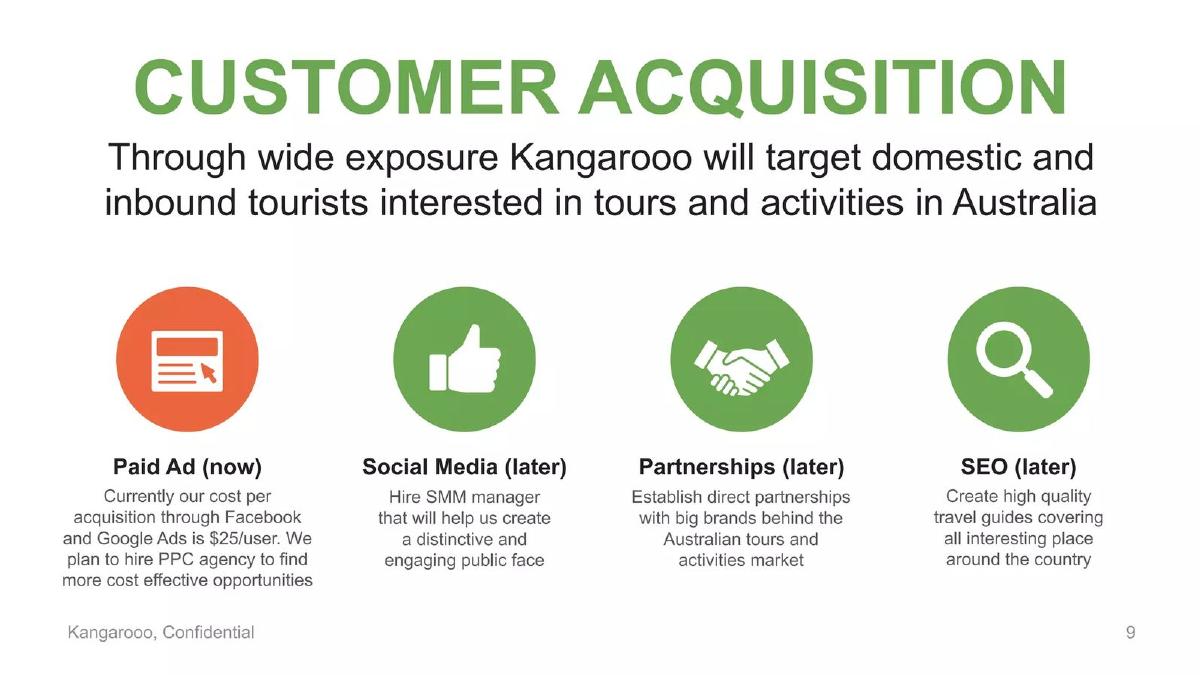
Kangarooo go to market slide — slide 9
Tours and attractions marketplace for travellers in Australia. Slide titled "Customer Acquisition".
Kangarooo deck, slide 9. Exact stored slide matched to this analysis.
Our analysis: One working channel with a stated cost, and three marked clearly as future plans.
Evidence and limitation: Company figures and plans.
What a founder can adapt: Mark each channel's status and give the cost of the one that works.
Supporting analysis
What the deck claims: "Through wide exposure Kangarooo will target domestic and inbound tourists interested in tours and activities in Australia". "Paid Ad (now)": "Currently our cost per acquisition through Facebook and Google Ads is $25/user. We plan to hire PPC agency to find more cost effective opportunities". "Social Media (later)", "Partnerships (later)", "SEO (later)", each with one line of plan.
Presentation choice: Labelling each channel now or later answers the first question investors ask.
When it does not fit: Saying "user" when you mean a paying customer; say which.
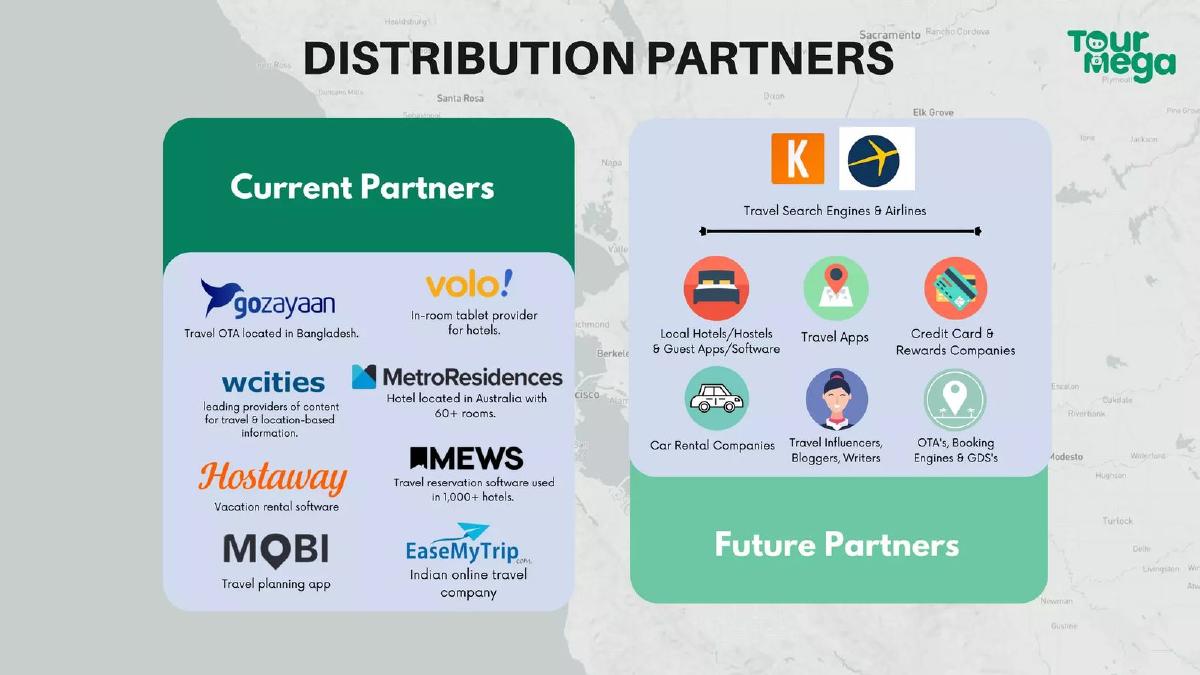
Tours and activities booking platform. Slide titled "Distribution Partners".
Tourmega deck, slide 8. Exact stored slide matched to this analysis.
Our analysis: Signed partners are named and described; future partners are shown only as types.
Evidence and limitation: Company descriptions.
What a founder can adapt: Add how many bookings each current partner has sent.
Supporting analysis
What the deck claims: "Current Partners": GoZayaan ("Travel OTA located in Bangladesh"), Volo ("In-room tablet provider for hotels"), Wcities, MetroResidences ("Hotel located in Australia with 60+ rooms"), Hostaway ("Vacation rental software"), Mews ("Travel reservation software used in 1,000+ hotels"), Mobi ("Travel planning app"), EaseMyTrip ("Indian online travel company"). "Future Partners": travel search engines and airlines, local hotels and hostels, travel apps, credit card and rewards companies, car rental companies, travel influencers, and OTAs, booking engines and GDSs.
Presentation choice: The split between current and future is clear and honest.
When it does not fit: Partner logos with no results attached.
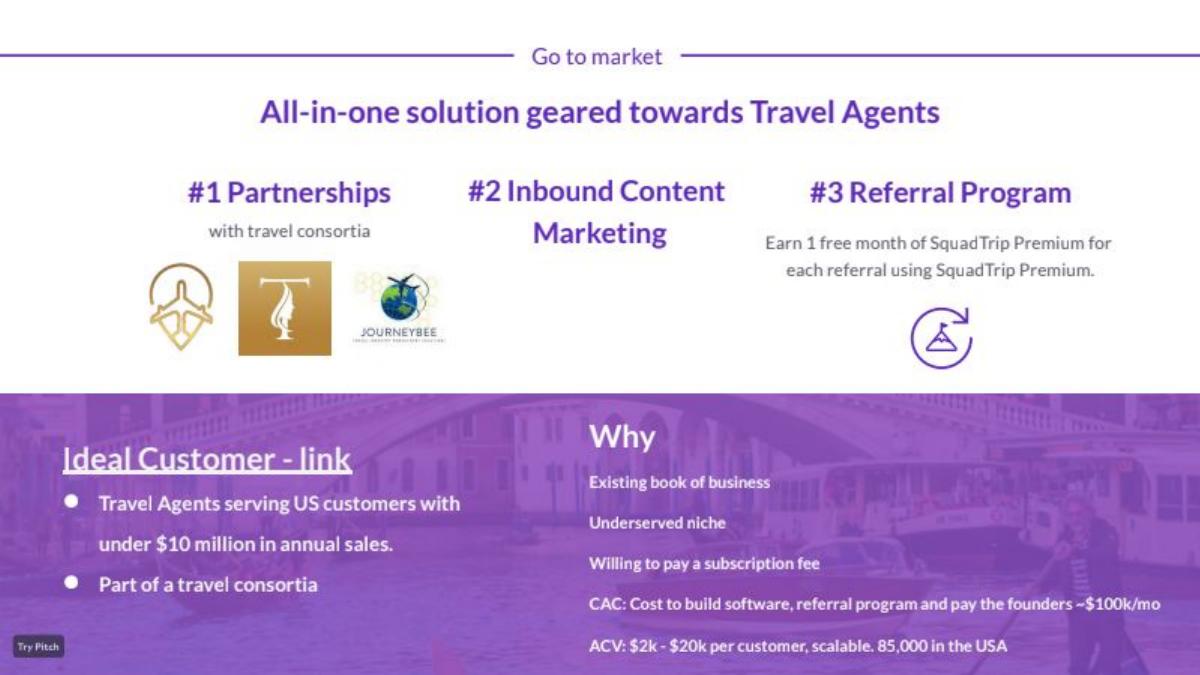
Group trip booking and payment software for travel agents. Slide titled "Go to market".
Squadtrip deck, slide 7. Exact stored slide matched to this analysis.
Our analysis: A precise customer, ranked channels and a concrete referral reward; the cost line is total spending.
Evidence and limitation: Company figures and plans.
What a founder can adapt: Give cost per new customer rather than total monthly spending.
Supporting analysis
What the deck claims: "All-in-one solution geared towards Travel Agents". "#1 Partnerships with travel consortia", "#2 Inbound Content Marketing", "#3 Referral Program: Earn 1 free month of SquadTrip Premium for each referral". "Ideal Customer": "Travel Agents serving US customers with under $10 million in annual sales", "Part of a travel consortia". "CAC: Cost to build software, referral program and pay the founders ~$100k/mo". "ACV: $2k - $20k per customer, scalable. 85,000 in the USA".
Presentation choice: Ranking channels and naming the reward shows a worked-out plan.
When it does not fit: Using the label CAC for something other than cost per customer.
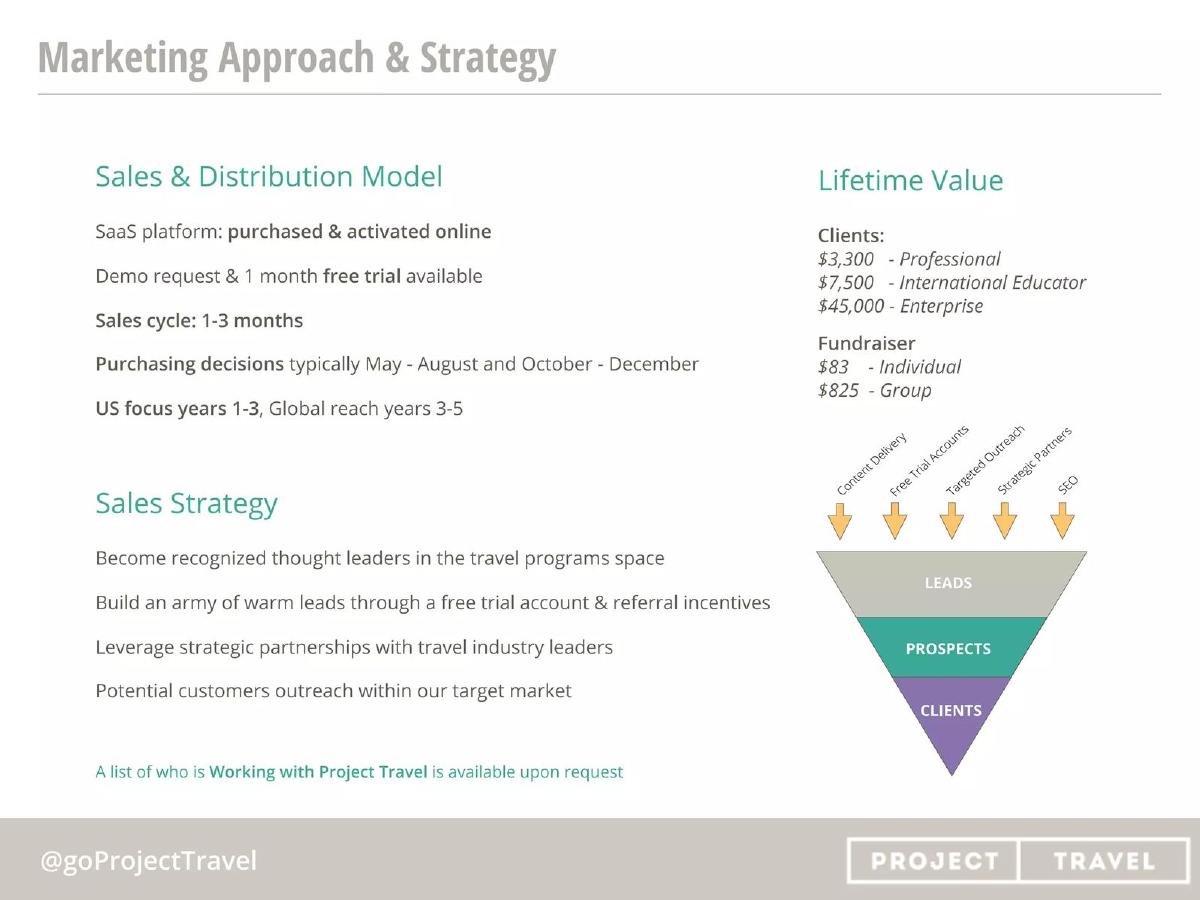
Project Travel deck, slide 10. Exact stored slide matched to this analysis.
Our analysis: Sales cycle, buying season and value per customer type on one slide.
Evidence and limitation: Company figures and plans.
What a founder can adapt: Add the cost to win each customer type next to its value.
Supporting analysis
What the deck claims: "SaaS platform: purchased & activated online"; "Demo request & 1 month free trial available"; "Sales cycle: 1-3 months"; "Purchasing decisions typically May - August and October - December"; "US focus years 1-3, Global reach years 3-5". "Lifetime Value": clients "$3,300 - Professional", "$7,500 - International Educator", "$45,000 - Enterprise"; fundraiser "$83 - Individual", "$825 - Group". A funnel fed by content delivery, free trial accounts, targeted outreach, strategic partners and SEO.
Presentation choice: Investors can see when revenue arrives and how much each customer type is worth.
When it does not fit: A funnel graphic with no numbers at each stage.
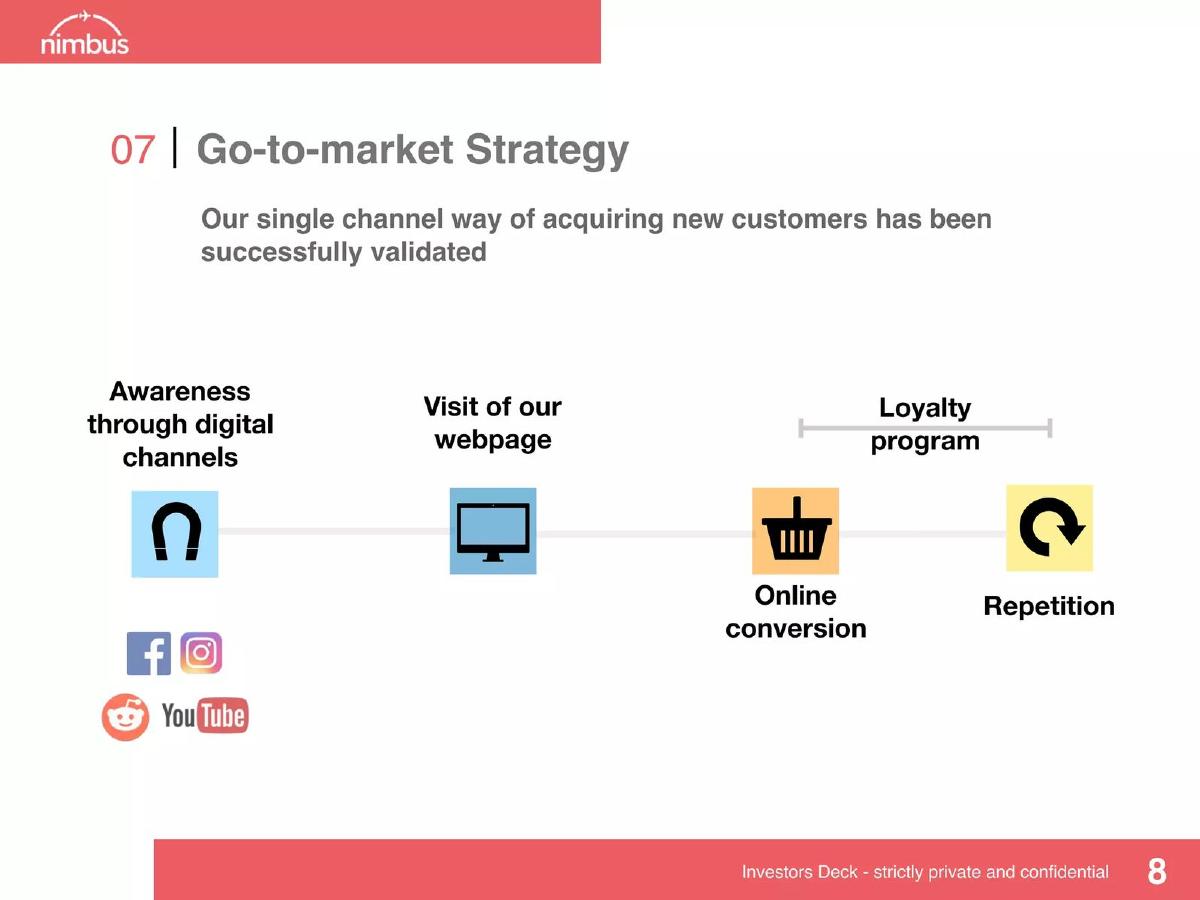
Nimbus deck, slide 9. Exact stored slide matched to this analysis.
Our analysis: One channel, one path from first contact to repeat booking.
Evidence and limitation: Company description.
What a founder can adapt: Put a number on each step, such as visits, conversion rate and repeat rate.
Supporting analysis
What the deck claims: "Our single channel way of acquiring new customers has been successfully validated". A four-step path: "Awareness through digital channels" (Facebook, Instagram, Reddit and YouTube icons), "Visit of our webpage", "Online conversion", and "Loyalty program" leading to "Repetition".
Presentation choice: Focusing on one validated channel is credible at an early stage.
When it does not fit: Claiming validation without showing the figures that prove it.
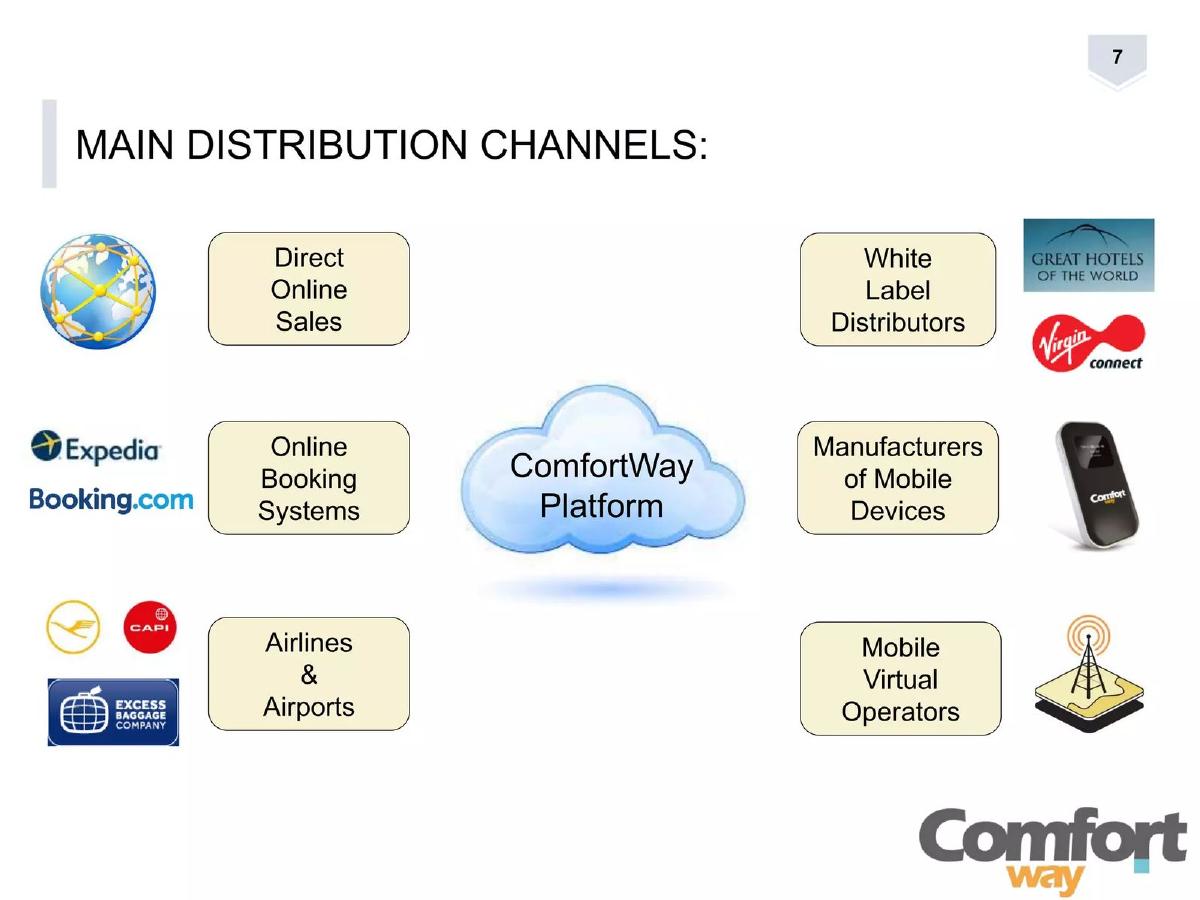
Mobile data for travellers. Slide titled "Main Distribution Channels".
Comfortway deck, slide 7. Exact stored slide matched to this analysis.
Our analysis: A broad channel map with recognisable logos, but no sign of which deals exist.
Evidence and limitation: Company graphic; partner status not stated.
What a founder can adapt: Mark each logo as signed, in talks or target, and lead with the best channel.
Supporting analysis
What the deck claims: Six channels around a "ComfortWay Platform" graphic: "Direct Online Sales", "Online Booking Systems" (Expedia and Booking.com logos), "Airlines & Airports", "White Label Distributors" (Great Hotels of the World and Virgin Connect logos), "Manufacturers of Mobile Devices" and "Mobile Virtual Operators".
Presentation choice: It shows the many places a travel data product can be sold.
When it does not fit: Six equal channels with no figures or status.
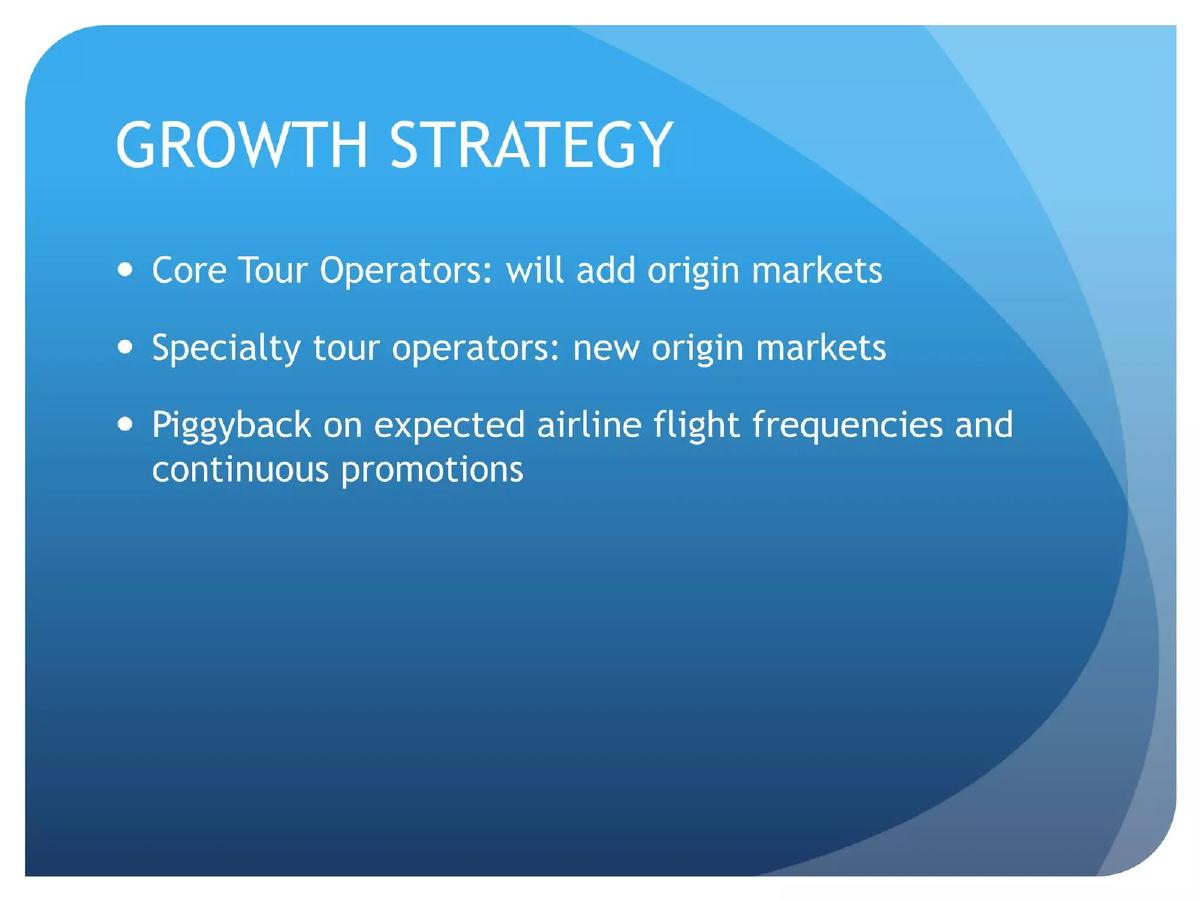
Alodmd deck, slide 18. Exact stored slide matched to this analysis.
Our analysis: The right levers for an inbound travel business, with no names, markets or numbers.
Evidence and limitation: Company plans.
What a founder can adapt: Name the tour operators, the new markets and the routes you expect.
Supporting analysis
What the deck claims: "Core Tour Operators: will add origin markets"; "Specialty tour operators: new origin markets"; "Piggyback on expected airline flight frequencies and continuous promotions".
Presentation choice: Linking growth to airline routes is a sound idea for destination businesses.
When it does not fit: Three bullets that could describe any destination company.
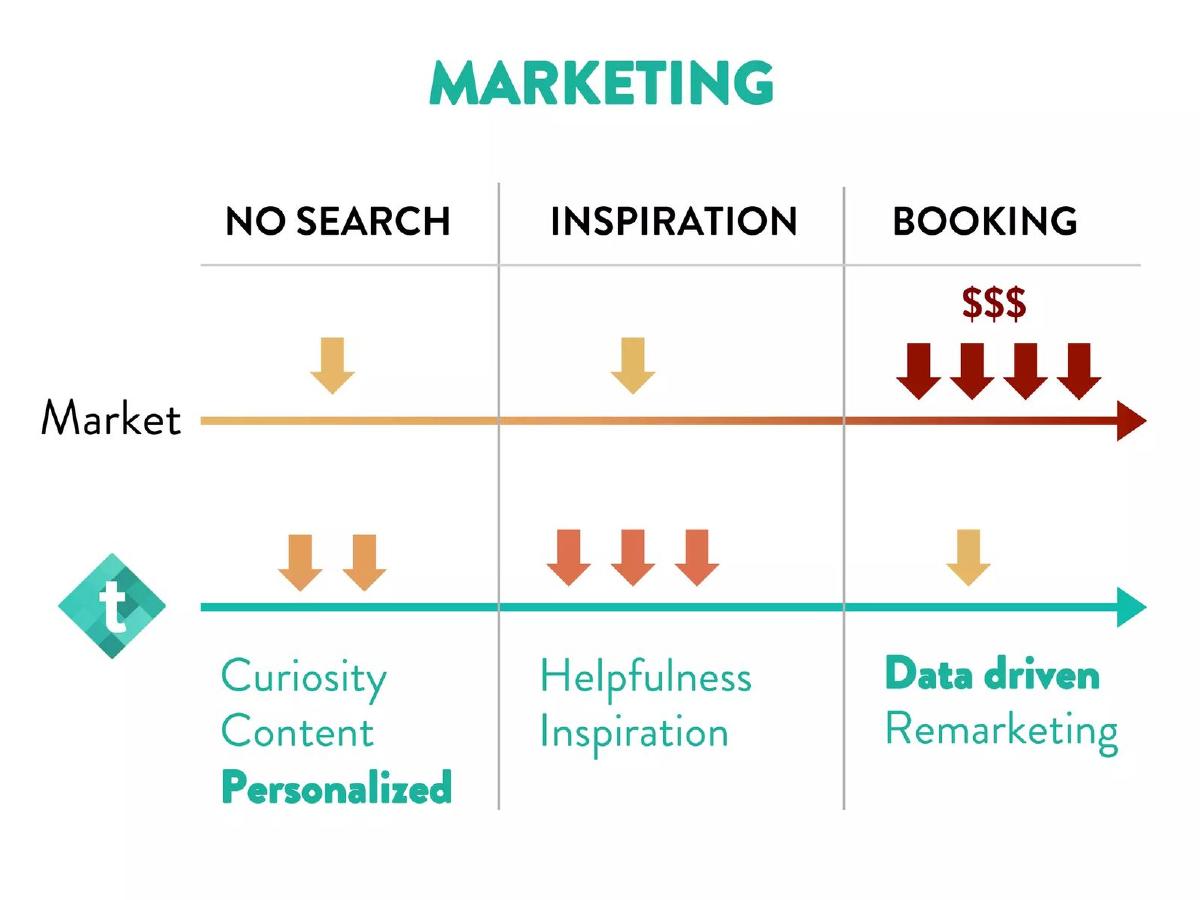
Tripsuit deck, slide 20. Exact stored slide matched to this analysis.
Our analysis: A clear idea, reaching travellers before they search, with no channel, cost or result.
Evidence and limitation: Company graphic.
What a founder can adapt: Add the channel that reaches travellers early and what it costs.
Supporting analysis
What the deck claims: Three stages: "No search", "Inspiration" and "Booking", with the market's spending concentrated at booking ("$$$"). Tripsuit's focus: "Curiosity Content Personalized", "Helpfulness Inspiration" and "Data driven Remarketing".
Presentation choice: It explains why competing at the booking stage is expensive.
When it does not fit: A strategy diagram with no numbers.
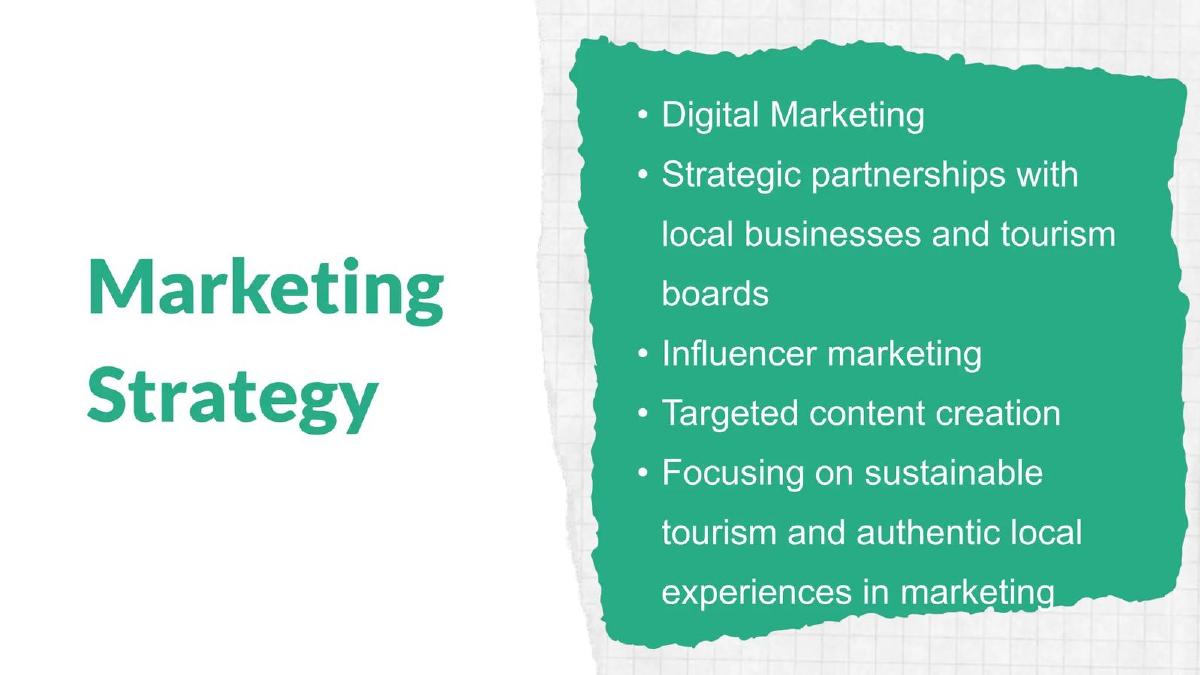
JourneyPalette deck, slide 10. Exact stored slide matched to this analysis.
Our analysis: Five channels with equal weight and no cost, partner or result.
Evidence and limitation: Company plans.
What a founder can adapt: Pick one channel, name a partner and give a target.
Supporting analysis
What the deck claims: "Digital Marketing"; "Strategic partnerships with local businesses and tourism boards"; "Influencer marketing"; "Targeted content creation"; "Focusing on sustainable tourism and authentic local experiences in marketing".
Presentation choice: Tourism boards are a realistic travel partner worth naming.
When it does not fit: A list that could appear in any consumer deck.
Whether each slide marks a working channel, gives a cost or value, and names partners.
Example
Working channel marked
Cost or value
Named partners
Kangarooo
Yes, paid ads
$25 per customer
No
Tourmega
Partners
No
Eight current
Squadtrip
Ranked 1 to 3
$2k–$20k per customer
Consortia logos
Project Travel
No
$3,300–$45,000 lifetime
No
Nimbus
Yes, single channel
No
No
Comfortway
No
No
Logos, status unclear
Alodmd
No
No
No
Tripsuit
No
No
No
JourneyPalette
No
No
No
Key Takeaways
Mark which channel works today and which are plans.
Give the cost of winning a customer per customer, not in total.
Name partners that already sell for you.
Describe your ideal customer precisely.
Say when in the year customers buy.
Build your travel go-to-market slide
Answer these before you design the slide.
Working channel. Which channel brings customers today, and how many last month?
Cost. What does it cost to win one customer through that channel?
Partners. Which partners have signed, and what have they sent you so far?
Season. In which months do your customers decide to buy?
Copyable framework: Now: [channel], [cost] per customer, [volume] customers last month. Signed partners: [names]. Next: [channel] from [date].
Illustrative example 1 — written by us
Before: Digital marketing, partnerships and influencers.
After: Now: Instagram ads at $18 per booking, 400 bookings in May. Signed: two hostel chains. Next: tourism board partnership from September.
What improved: Our illustrative rewrite; all figures are invented for the example. It marks what works, its cost and what comes next.
What this guide adds
The general go-to-market guide covers any startup. This guide covers travel, where large booking sites and search engines dominate paid search, much of the business flows through partners such as travel agencies, airlines and hotel software, and demand follows the seasons. Those features change which channels are realistic and which numbers investors want to see.
How we read each slide
We read each stored slide image and quote the text on it. We have not checked any company's costs, partners or sales figures, and we make no claim that any slide affected a fundraising outcome.
The channels travel startups use
Paid ads: search and social ads reach travellers directly but compete with large booking sites. Kangarooo gives its cost: $25 per customer.
Distribution partners: booking sites, hotel software, airlines and travel apps that show your product to their users. Tourmega and Comfortway build their plans on these.
Travel agency networks: groups of agencies, often called consortia, that recommend tools to members. Squadtrip uses partnerships with consortia and a referral reward.
Content and search: travel guides and articles that rank in search results. Kangarooo plans this for later; Project Travel lists SEO in its funnel.
Direct sales with a trial: for software sold to travel businesses or schools, a demo and free trial lead to a sale. Project Travel gives the cycle length.
Now versus later
Investors want to know which channel is proven and which are ideas. Kangarooo's slide does this in four words: "Paid Ad (now)", then "Social Media (later)", "Partnerships (later)" and "SEO (later)". Nimbus goes further and says its "single channel way of acquiring new customers has been successfully validated".
A slide that lists six channels with equal weight suggests none is working yet. Lead with the one that works and give its numbers; list the rest as next steps.
Cost per customer, stated correctly
Kangarooo states a cost per customer: $25. Squadtrip's slide uses the same label differently: "CAC: Cost to build software, referral program and pay the founders ~$100k/mo". That is total monthly spending, not the cost of winning one customer. Investors will divide spending by new customers themselves, so give the per-customer figure and show how you worked it out.
Put the cost beside what a customer is worth. Squadtrip gives "ACV: $2k - $20k per customer"; Project Travel gives lifetime values by customer type. Either lets investors compare cost with value.
Partners who already sell for you
Distribution partners can bring customers at low cost, but only if the deals exist. Tourmega separates "Current Partners", eight named companies with a line on what each does, from "Future Partners", shown only as types such as car rental companies and credit card rewards programmes. That split is exactly what investors need.
Comfortway's slide shows six channels with logos beside each, including Expedia, Booking.com and Virgin. It does not say which are signed deals and which are targets. If a logo is a hope rather than a contract, label it.
Seasons and buying cycles
Travel buying follows the calendar. Project Travel states that "Purchasing decisions typically May - August and October - December" and that the sales cycle is one to three months. That tells investors when revenue will arrive and why a quiet quarter is not a failure.
Alodmd, a destination marketing deck, lists winter and summer origin markets on a separate slide; its growth slide adds "Piggyback on expected airline flight frequencies". Tying marketing to when and where travellers come from is the right instinct; the slide needs dates or volumes to make it useful.
Common mistakes on travel go-to-market slides
Lists with no figures: JourneyPalette lists digital marketing, partnerships, influencers, content and sustainable tourism with no cost, target or result.
Concepts in place of channels: Tripsuit's funnel shows when travellers search, seek inspiration and book, but not which channel the company will use or what it costs.
Total spending labelled as cost per customer, as on Squadtrip's slide.
Logos with no status: Comfortway's slide does not say which partners are signed.
Vague bullets: Alodmd's growth slide says tour operators "will add origin markets" without naming any.
Adapting the slide to your type of travel business
Consumer booking marketplaces should give the paid channel that works, its cost per customer and the share of repeat bookings, as Kangarooo does.
Experience and tour inventory sellers should name the booking sites, hotel software and apps that distribute their inventory, as Tourmega does.
Software for travel agents should name the agency networks and the referral reward, as Squadtrip does.
Software sold to institutions should give the sales cycle, buying months and customer value by type, as Project Travel does.
Travel services sold through other businesses should show which partners are signed, as Comfortway should.
Describing the ideal customer
Squadtrip's slide names a precise customer: "Travel Agents serving US customers with under $10 million in annual sales" who are "Part of a travel consortia", and adds "85,000 in the USA". Investors can check that number and see how a consortium partnership reaches many of them at once.
Kangarooo is broader: "domestic and inbound tourists interested in tours and activities in Australia". That is fine for a consumer product, but pairing it with the paid channel and its cost is what makes it believable.
Common mistakes
Equal-weight channel lists. Lead with the one that works.
Total spending called CAC. Give cost per customer.
Logos with no status. Label signed, in talks or target.
No buying season. Say when customers decide.
Concepts, not channels. Name the channel and its cost.
Vague partner plans. Name the partners and markets.
Diagnostic checklist
Working channel marked as now.
Cost per customer stated.
Value per customer stated.
Signed partners named.
Buying season or cycle given.
Future channels labelled as plans.
Frequently asked questions
What should a travel startup's go-to-market slide show?
The channel that works today and its cost per customer, partners already selling for you, and when customers buy. Kangarooo marks paid ads as "now" at $25 per customer and its other channels as "later".
Should I compete with booking sites on paid search?
Only if your cost per customer works against what each customer is worth. Many travel startups instead reach customers through partners, as Tourmega does with eight named distribution partners.
How do I show partners on the slide?
Separate signed partners from targets. Tourmega lists current partners by name with a line on each, and shows future partners only as types.
Does seasonality belong on a go-to-market slide?
Yes, if it affects when you sell. Project Travel states that purchasing decisions typically fall in May to August and October to December, with a one-to-three-month sales cycle.
How we chose these examples
Corpus: published pitch deck teardowns on StartupFundraising.com. Founder-uploaded private decks are excluded.
Selection (2026-10-01): we searched extracted slide text for go-to-market, marketing, distribution and customer acquisition slides in decks from travel companies already identified in other travel guides. We shortlisted 10 slides, dropped one already used in another guide (Holdbar), viewed the remaining 9 and kept all 9.
Review: stored slide images were read on 2026-10-01 against company, deck and slide number; slides with small text were read at full size (editorial model review). No person has yet completed an editorial review of this page. We did not verify any company's costs, partners or sales.