Media Business Model Slides: 7 Real Pitch Deck Examples
How media, music and entertainment startups show their business model in a pitch deck: stated take rates, production and performance fees.
Media Business Model Slide: Show Who Pays, How Much, and Your Cut
Media and entertainment startups often list several ways to make money: ads, subscriptions, licensing, affiliate fees, merchandise. Investors want to know which one pays first, who pays it, and what share the company keeps. This guide compares seven real business model slides from decks tagged media in our library, from a slide that states each commission rate to one with five percentages and no explanation of what they measure.
TL;DR
Say who pays, what they pay for, and what share you keep, and make clear which stream comes first. Vinyl.st states its affiliate commission (about 7–10%) and a £20-a-month record club. Trio Entertainment shows a 25% production fee and a 50% performance fee after investor minimums. Slip.stream splits revenue by customer group. Circulate starts with AdSense and adds paid features and a subscription cut. Pluntz and AdVolve Media name their streams without prices, and RewardBux shows five percentages without saying what they are.
Media business model slides from real pitch decks
Each example shows the exact stored slide above its analysis and links to the full teardown. The clearest models come first; weaker ones follow for contrast. Claims are as shown on the slides; comments are ours.
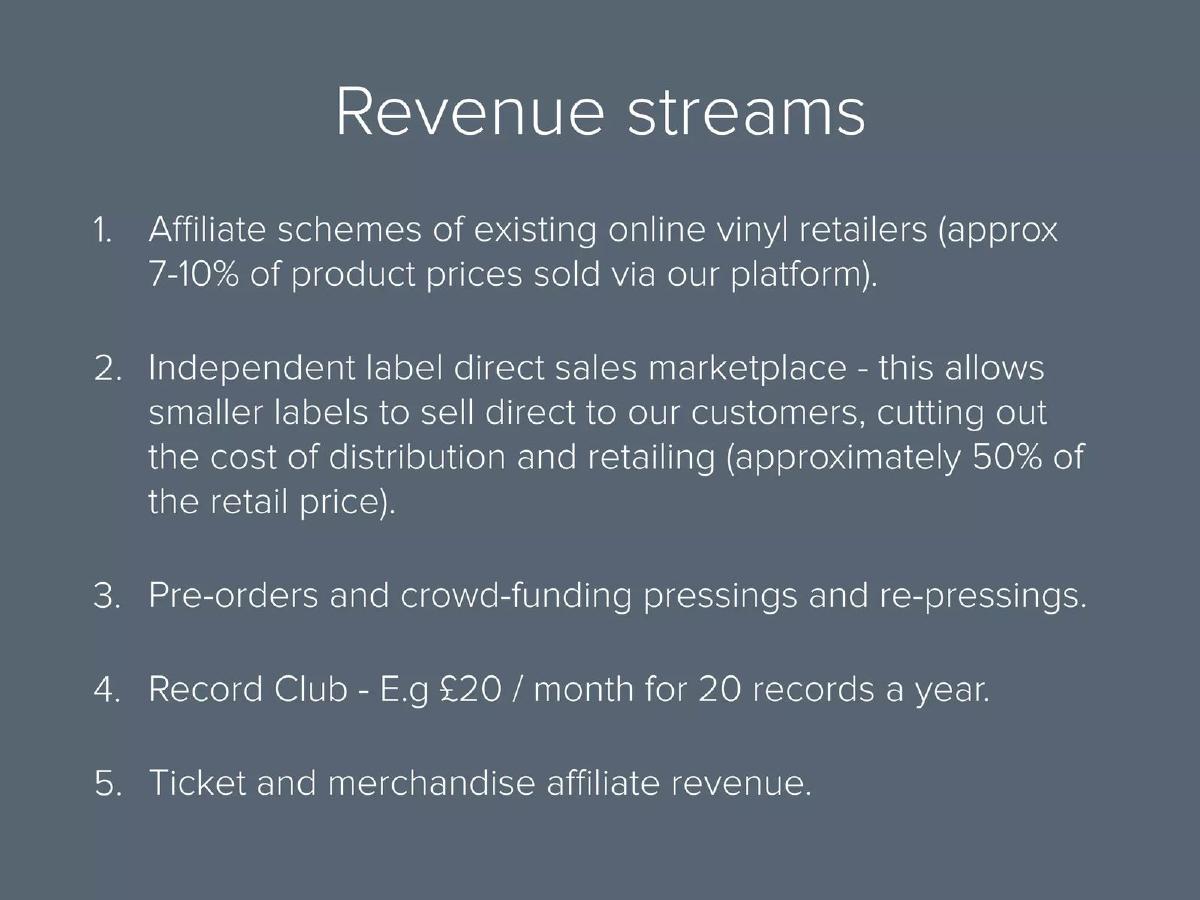
Vinyl.st business model slide — slide 6
Vinyl record discovery and buying platform, UK. Slide titled "Revenue streams".
Vinyl.st deck, slide 6. Exact stored slide matched to this analysis.
Our analysis: It gives a rate or price for the two main streams, so an investor can estimate revenue per sale.
Evidence and limitation: No sales volumes or order values, so the rates cannot be turned into revenue. The 50% figure describes the cost labels save, not Vinyl.st's own cut.
What a founder can adapt: Keep the rates, say which stream you will launch first, and add Vinyl.st's own share on the label marketplace.
Supporting analysis
What the deck claims: "1. Affiliate schemes of existing online vinyl retailers (approx 7-10% of product prices sold via our platform)." "2. Independent label direct sales marketplace - this allows smaller labels to sell direct to our customers, cutting out the cost of distribution and retailing (approximately 50% of the retail price)." "3. Pre-orders and crowd-funding pressings and re-pressings." "4. Record Club - E.g £20 / month for 20 records a year." "5. Ticket and merchandise affiliate revenue."
Presentation choice: Commission-based media models live or die on take rate; stating it up front answers the first question.
When it does not fit: Mixing your commission with the customer's saving in the same kind of figure.
Film and TV content production and financing company. Slide titled "Business Model".
Trio Entertainment deck, slide 6. Exact stored slide matched to this analysis.
Our analysis: It shows the cycle and both fees in one picture, so the reader sees how the company is paid at each step.
Evidence and limitation: It does not say what the 25% is a percentage of (budget or capital raised), or what the investor minimums are.
What a founder can adapt: Say what each percentage applies to and give one worked example: a project budget and what Trio would earn.
Supporting analysis
What the deck claims: A triangle: "Raise Capital", "Produce Content", "License / Sell". "Identify Opportunities" between license and raise; "Production Fee 25%" between raise and produce; "Performance Fee 50% (After investor minimums)" between produce and license.
Presentation choice: In production, investors want to know whether the company earns on making content or only on hits; this slide shows both.
Pre-cleared music catalog for content creators. Slide titled "How we monetize."
Slip.stream deck, slide 5. Exact stored slide matched to this analysis.
Our analysis: It sets out who pays for what and what they get in return, which is clear for a model with three sides.
Evidence and limitation: No prices, subscriber counts or split between the three groups.
What a founder can adapt: Add a price per row and which row earns most today.
Supporting analysis
What the deck claims: A table with three rows. Music Assets: "Streaming revenue, sync fees, and traditional royalties with uncapped upside for breakout hits." Creators: "Subscriptions + fees from both personal and commercial users for licensed access to the catalog." Musicians: "Subscriptions + fees for distribution, promotional, and production services." A second column describes the value each group gets.
Presentation choice: Multi-sided music models confuse readers; one row per payer makes the model easy to follow.
When it does not fit: Three revenue sources with no sign of which one matters most.
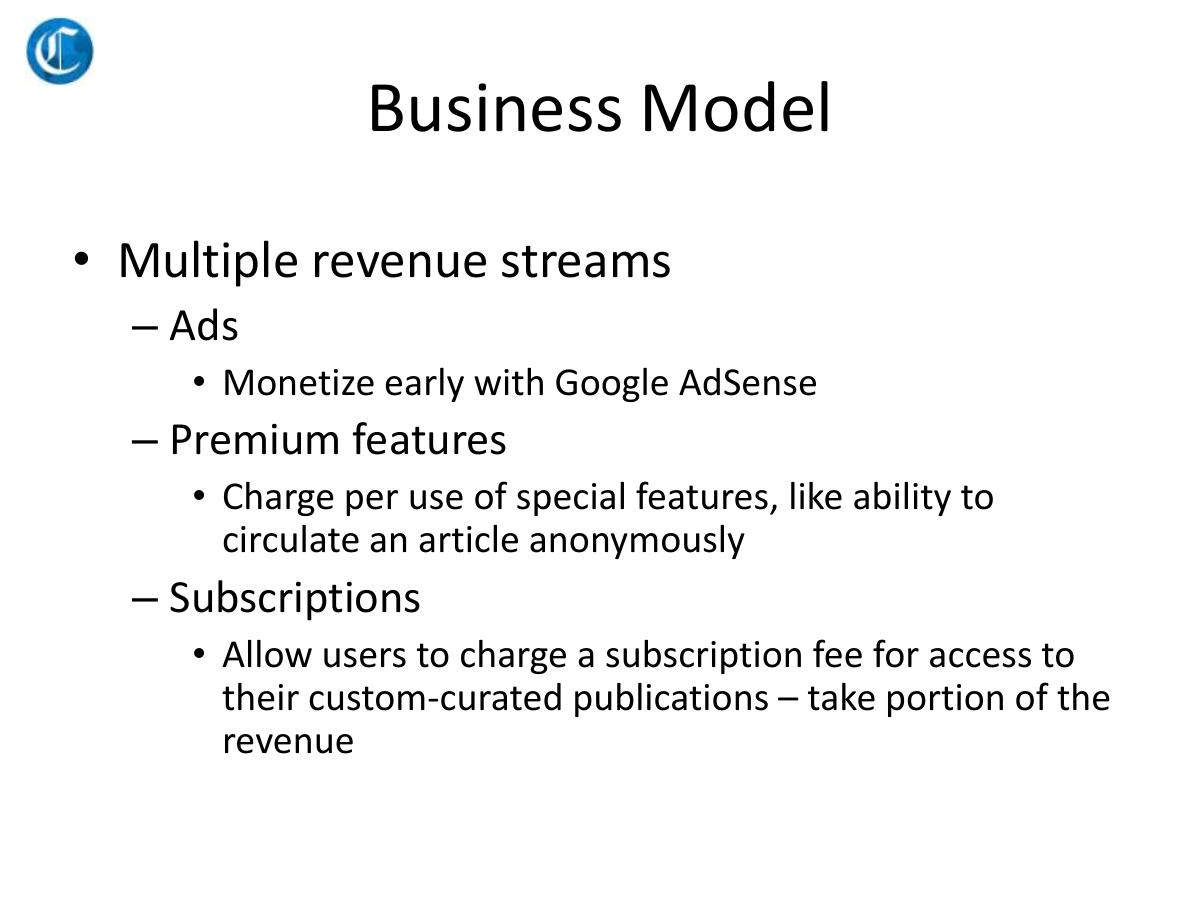
Tool for curating and sharing article collections. Slide titled "Business Model".
Circulate deck, slide 5. Exact stored slide matched to this analysis.
Our analysis: It says which stream comes first (AdSense) and how the others follow, which gives the model an order.
Evidence and limitation: No prices, and the share of subscription revenue it would keep is not stated.
What a founder can adapt: Add the expected revenue per thousand views for ads, a price for premium use, and your cut of subscriptions.
Supporting analysis
What the deck claims: "Multiple revenue streams": "Ads – Monetize early with Google AdSense"; "Premium features – Charge per use of special features, like ability to circulate an article anonymously"; "Subscriptions – Allow users to charge a subscription fee for access to their custom-curated publications – take portion of the revenue".
Presentation choice: Naming the first stream shows the team has thought about earning before scale.
When it does not fit: "Take portion of the revenue" without saying what portion.
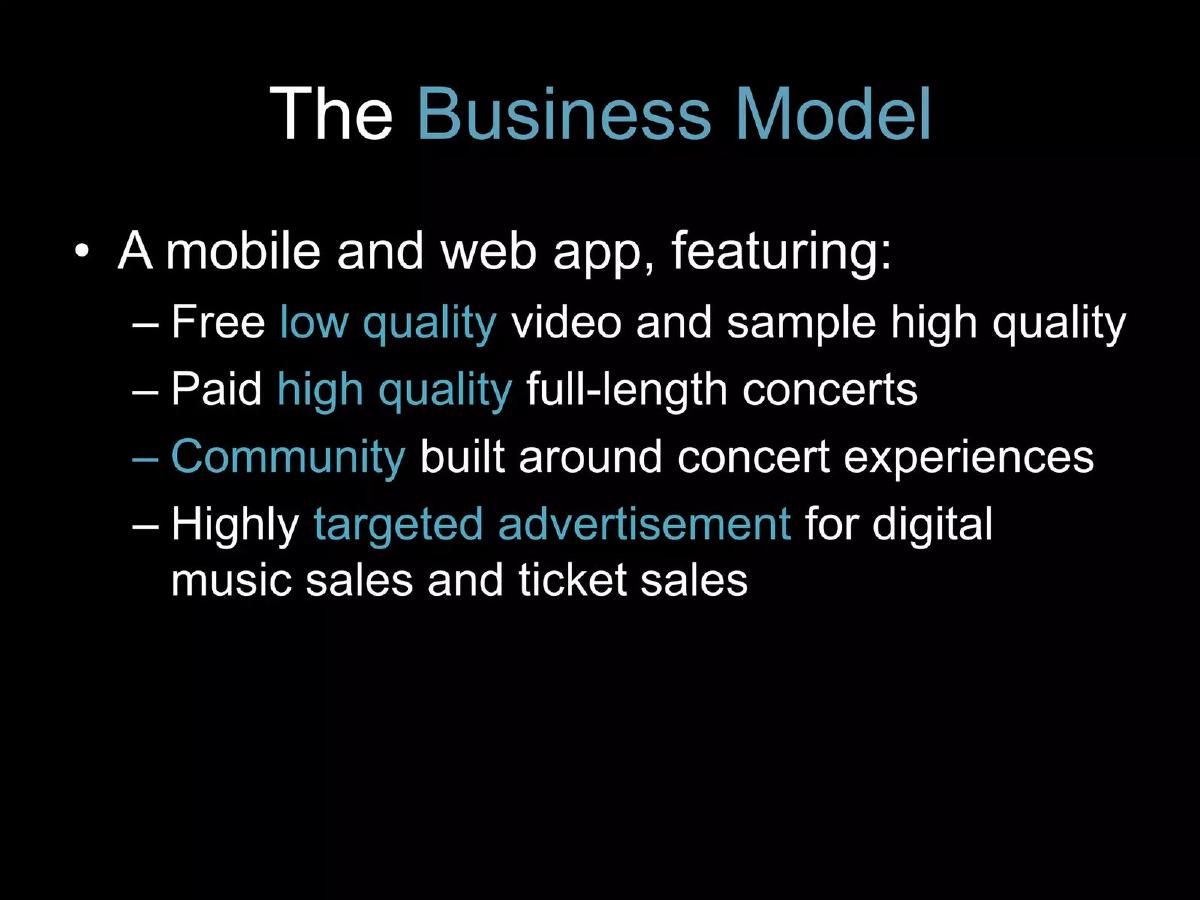
Mobile and web app for concert videos. Slide titled "The Business Model". (weaker)
Pluntz deck, slide 5. Exact stored slide matched to this analysis.
Our analysis: The free-to-paid step is clear, but the slide reads as a feature list, and it leaves out who owns the concert rights.
Evidence and limitation: No price for paid concerts and no split with artists or rights holders.
What a founder can adapt: Give the price per concert, the share paid to artists or labels, and what you keep.
Supporting analysis
What the deck claims: "A mobile and web app, featuring: Free low quality video and sample high quality; Paid high quality full-length concerts; Community built around concert experiences; Highly targeted advertisement for digital music sales and ticket sales."
Presentation choice: For recorded performances, rights costs decide the margin; leaving them out raises the obvious question.
When it does not fit: Listing "community" as a revenue line; it is a feature.
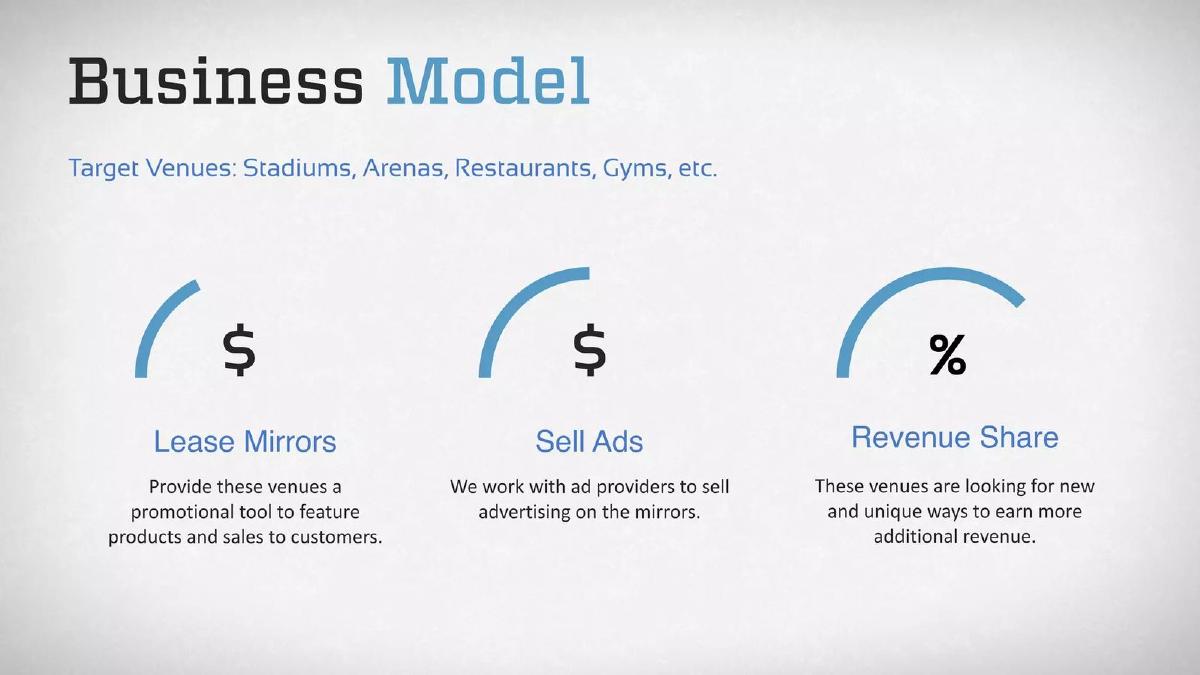
Interactive advertising mirrors for venues. Slide titled "Business Model". (weaker)
AdVolve Media deck, slide 6. Exact stored slide matched to this analysis.
Our analysis: It names three streams and who pays each, but the revenue share appears to be money paid out to venues, which the slide does not make clear.
Evidence and limitation: No lease price, ad rate or revenue share percentage.
What a founder can adapt: Show one venue: lease per month, ad income per mirror, and the share paid to the venue.
Supporting analysis
What the deck claims: "Target Venues: Stadiums, Arenas, Restaurants, Gyms, etc." "Lease Mirrors – Provide these venues a promotional tool to feature products and sales to customers." "Sell Ads – We work with ad providers to sell advertising on the mirrors." "Revenue Share – These venues are looking for new and unique ways to earn more additional revenue."
Presentation choice: Investors need to know whether a revenue share is income or a cost; the "%" icon suggests either.
When it does not fit: Listing a payout to partners as if it were a revenue stream.
Digital rewards widget for websites. Slide titled "Revenue Model". (weakest)
RewardBux deck, slide 6. Exact stored slide matched to this analysis.
Our analysis: It looks precise but the reader cannot tell what any ring measures, and the margin claim is unconditional.
Evidence and limitation: The five percentages are not labelled; they add up to 260%, so they are not shares of revenue. Only the +35% redemption markup is explained.
What a founder can adapt: Label each figure (margin, share of revenue or expected mix) and support the 50% margin with a cost line.
Supporting analysis
What the deck claims: "Our revenue model is intelligent, diverse & built on a super stable economic strategy that will allow us to achieve a consistent 50%+ margin no matter what is happening to our overall business model, operation or in the marketplace." Five streams with rings: "#1 Sponsorship & performance marketing revenue" 70%; "#2 Direct Ads" 80%; "#3 Redemption Fees – We build +35% into every redemption" 50%; "#4 Premium Features" 40%; "#5 Ad Revenue" 20%.
Presentation choice: Unlabelled figures invite doubt about every other number in the deck.
When it does not fit: "No matter what is happening" claims about margin.
Name who pays for each stream: reader, advertiser, label, venue, creator.
State your take rate or price next to each stream.
Mark which stream earns first; the rest are later options.
A list of five streams with no figures reads as undecided.
Label every percentage: share of revenue, margin or commission.
Build your media business model slide
Start from who pays you first.
First payer. Who pays you first: reader, subscriber, advertiser, label, venue, creator?
Price or take rate. What do they pay, or what share of each sale do you keep?
Rights and payouts. What do you pay artists, labels or partners, and what is left?
Later streams. Which streams come later, and what has to be true first?
Proof. Do you have one real figure: a paying customer, an order, an ad rate?
Copyable framework: [Payer] pays [price] for [what]; we keep [share] after [payout]. First stream: [stream], live since [date]. Later: [stream] once [condition].
Illustrative example 1 — written by us
Before: Premium Features — We have a suite of upgrades that matter. 40%
After: Premium: £4 a month for ad-free listening; 40% of revenue in our 2016 plan, after a 30% app-store fee.
What improved: Our illustrative rewrite; the price, share and fee are invented for the example. It says what the percentage measures, the price, and the cost that comes off first.
What this guide adds
The general business model guide covers any company, and the advertising business model guide covers ad-funded models. Media startups tend to mix ads with subscriptions, licensing and commissions, so the questions here are which stream leads and what the company keeps from each.
Our library's media tag is broad; it includes music services, entertainment production, publishing tools and ad networks. We note each company's business in the examples.
How we read each slide
We quote the text on the stored slide images. We have not checked any rate, price or margin claim.
Common mistakes
Streams with no prices. Give a price or take rate for at least the first stream.
Unlabelled percentages. Say whether each figure is a margin, commission or share of revenue.
Leaving out rights costs. Artist, label and venue payouts decide media margins.
No first stream. Mark which stream earns now and which are later.
Payouts shown as revenue. A revenue share paid to partners is a cost.
Diagnostic checklist
Names who pays for each stream.
Gives a price or take rate for the main stream.
Shows what is paid out to rights holders or partners.
Marks which stream comes first.
Labels every percentage.
Frequently asked questions
How many revenue streams should a media startup show?
As many as are real, but mark the first. Circulate starts with AdSense and lists paid features and subscriptions as later additions.
Should a media business model slide show take rates?
Yes, when you earn a commission. Vinyl.st states about 7–10% of each sale through retailer affiliate schemes.
How should a production company show its fees?
State each fee and what it applies to. Trio Entertainment shows a 25% production fee and a 50% performance fee after investor minimums, but does not say what the 25% is based on.
How we chose these examples
Corpus: published pitch deck teardowns on StartupFundraising.com. Founder-uploaded private decks are excluded.
Selection (2026-09-27): we searched extracted slide text in decks tagged media for business model, revenue model, revenue streams and how we make money. About 48 slides matched; many were tables of contents, market or executive-summary slides, or listed-company decks.
Kept seven with stored images. Excluded for no stored image (no uploads requested): Alliance MMA p10, Foursquare p11, Local Space p7, Metahand p8, NeoSound p7, ZewindTV p10, MusicHub p7, Music Coco p10 and Legion M p9. Iveda p5 is already used in the general business model guide.
The Vinyl.st deck's cover is marked "Proprietary and Confidential" but is part of a teardown already published on this site.
Review: stored slide text and images were checked on 2026-09-27 and matched to company, deck and slide number (editorial model review). No person has yet completed an editorial review of this page. We make no claim that any slide caused a fundraising outcome.