The Q1 2015 LogMeIn investor presentation serves as a post-IPO growth roadmap rather than a traditional seed-stage pitch. With a reported revenue of $222.0 million in 2014 and a projected $260-$264 million for 2015, the company demonstrates a mature 23% CAGR. The deck is structured around three core pillars: the modern workforce, instant collaboration, and the emerging Internet of Things. By mapping specific products like join.me, Xively, and Rescue to distinct industry drivers, LogMeIn illustrates a sophisticated multi-product strategy. The presentation focuses on expansion and market share…
Key takeaways
- LogMeIn achieved a 23% Revenue CAGR from 2009 to 2014, growing from $74.4 million to $222.0 million (Slide 7).
- The company projected 2015 revenue between $260 million and $264 million, with EBITDA estimated at $54-$58 million (Slide 7).
- Product segmentation is clear: 'Pro' and 'Central' target the modern workforce, while 'join.me' focuses on collaboration (Slides 10, 13).
- Market validation for join.me is strong, claiming one million new users try the service every month (Slide 13).
- The 'Rescue' tool is positioned as the #1 premium support tool in the world, used by the top three computer manufacturers (Slide 16).
- Strategic growth is concentrated on three initiatives: expanding join.me's addressable market, enhancing IT tools, and IoT business growth (Slide 19).
- The deck uses a consistent 'Industry Drivers vs. Solution' framework to justify product existence across different verticals (Slides 10, 13, 16).
- Security is a highlighted driver, noting that 49% of ex-employees have accessed a former employer's account (Slide 10).
Introduction: The Mature SaaS Growth Playbook
The LogMeIn Investor Presentation from Q1 2015 is a quintessential example of how a public or late-stage company communicates complex multi-product strategies to the market. Unlike early-stage decks that focus on survival and product-market fit, this deck focuses on dominance, diversification, and consistent financial performance. The company uses a clean, professional aesthetic to present a narrative of 'connectivity' that spans from simple remote desktop access to the complex world of the Internet of Things (IoT).
Slide 1: Title Slide
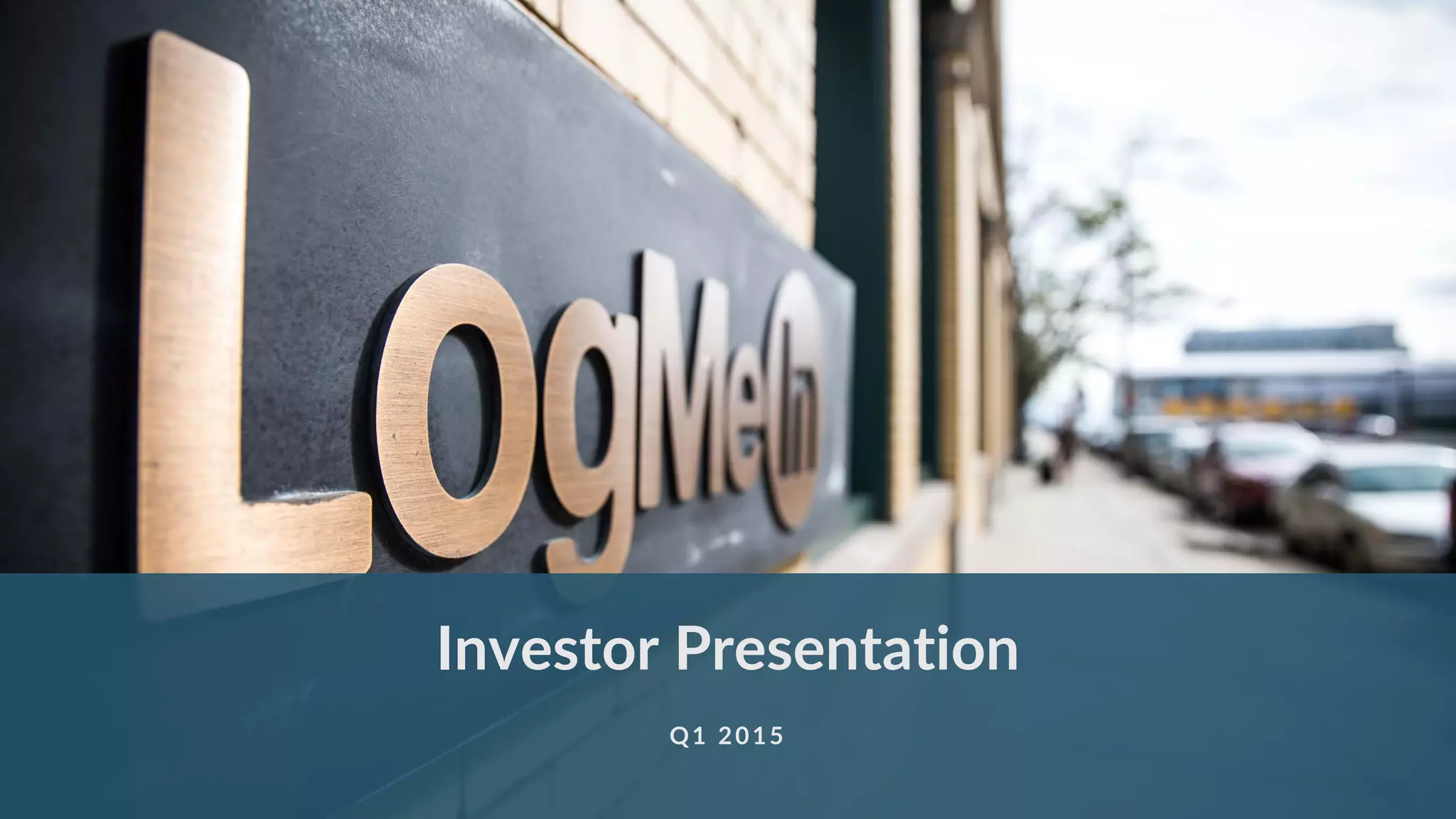
The cover slide is minimalist, featuring the LogMeIn logo on a physical building sign. This choice of imagery suggests stability and a physical presence, contrasting with the 'cloud' nature of their software. The text is simple: 'Investor Presentation Q1 2015'. There are no taglines or fluff, which is standard for a company of this maturity level.
Slide 2: The Vision Statement
Slide 2 presents the core thesis: 'We believe – possibilities increase with connectivity.' This acts as the 'North Star' for the company. By framing their business around 'connectivity' rather than specific software features, LogMeIn gives itself the flexibility to acquire or build products in disparate categories—like password management and IoT—without appearing unfocused to investors.
Slide 7: Financial Performance and Growth
This is the most critical slide for any investor. It displays a bar chart showing Revenue and EBITDA from 2009 through an estimated 2015. The figures are impressive: revenue grew from $74.4 million in 2009 to $222.0 million in 2014. The projected revenue for 2015 is stated as $260-$264 million. The slide explicitly highlights a 23% CAGR (Compound Annual Growth Rate). Crucially, the gray bars representing EBITDA show that the company is not just growing top-line revenue but is also consistently profitable, with 2015 EBITDA estimated at $54-$58 million. This slide proves the business model is both scalable and sustainable.
Slide 10: Empowering the Modern Workforce
LogMeIn breaks down its product segments using a 'Industry Drivers' vs. 'Solution' format. On Slide 10, they address the remote work trend. They cite that 70% of employees work from alternate locations regularly and highlight a security risk: 49% of ex-employees have accessed a former employer's account. The 'Solution' side lists Pro (remote access), Central (IT management), and Meldium/AppGuru (password and app management). This slide effectively ties specific products to quantified market problems, showing that their product development is reactive to real-world data.
Slide 13: Instant Collaboration
This slide focuses on join.me, which was LogMeIn's high-growth collaboration tool at the time. The industry drivers cited include the spontaneity of online meetings and the 'legacy problems' of older software. The metrics provided for join.me are strong: one million new users try the service every month. They also claim that the average enterprise customer saves 50% while doubling their number of licenses compared to legacy solutions. This is a classic 'better, faster, cheaper' value proposition backed by significant user acquisition numbers.
Slide 16: The Internet of Things (IoT)
Slide 16 represents the company's forward-looking growth engine. By 2015, LogMeIn was positioning itself as a leader in IoT through its Xively platform. They identify the driver as companies 'scrambling to build connected products.' They also highlight 'Rescue' as the #1 premium support tool in the world, citing Gartner research that the top three computer manufacturers use it. This slide is designed to convince investors that LogMeIn has a foothold in a massive, emerging market, providing a 'long tail' of growth beyond their core remote access products.
Slide 19: Three Growth Initiatives
The presentation concludes its strategic section by narrowing the focus to three pillars: 1) Expand join.me’s addressable market, 2) Enhance IT and access tools, and 3) Help companies grow their businesses with IoT. This slide serves to simplify the preceding 18 slides into a clear, actionable roadmap. It tells investors exactly where the company's resources and management attention will be directed in the coming quarters.
What LogMeIn Does Well
The deck excels at thematic grouping . Managing a portfolio that includes remote desktop, password management, video conferencing, and IoT platforms can easily look like a 'conglomerate discount' waiting to happen. However, LogMeIn successfully ties these together under the banner of 'connectivity.' By using the same 'Drivers vs. Solution' layout for each segment, they create a sense of strategic coherence.
Furthermore, the use of third-party validation is excellent. Citing Intelligent Office, Tech Target, Osterman Research, Ovum, and Gartner lends an air of objective authority to their claims. For a public company, this is vital for maintaining credibility with sophisticated institutional investors.
What is Missing from the Deck
Because this is an investor presentation for a public company, it lacks several elements found in a venture capital pitch deck. There is no Team Slide , as the executive leadership is already a known quantity to the market. There is also no Ask Slide ; the company isn't looking for a specific check, but rather trying to maintain or increase its stock price by demonstrating growth potential.
From a competitive standpoint, the deck is silent on rivals . There is no mention of Zoom, GoToMeeting (which they would later merge with), or TeamViewer. While they mention 'legacy software,' they avoid direct comparisons, which is a common tactic for market leaders who do not want to give 'airtime' to smaller competitors.
Founder Takeaways: What to Copy
Quantify the Problem: Don't just say 'people work remotely.' Say '70% of employees work from alternate locations.' Specificity builds trust. · The 'Drivers vs. Solution' Framework: This is a brilliant way to justify a multi-product roadmap. If you can show that each product you build solves a specific, documented industry trend, your expansion strategy looks calculated rather than desperate. · Highlight the Growth Rate: If you have a strong CAGR, put it in a circle with a bright color. LogMeIn's 23% CAGR is the most memorable part of their financial slide because it is explicitly labeled and highlighted. · Use a Unified Vision: If your startup does three different things, find the one word (like 'connectivity') that binds them. This prevents investors from thinking you are unfocused.
Frequently asked questions
- What is the primary financial narrative of the LogMeIn deck?
- The narrative is one of consistent, profitable scaling. By showing a steady climb in both revenue and EBITDA from 2009 to 2015, LogMeIn proves it is not just a high-growth SaaS company, but a fiscally responsible one. The 23% CAGR is the anchor metric, suggesting that the company has found a repeatable formula for expansion across its various product lines.
- How does LogMeIn categorize its diverse product portfolio?
- LogMeIn uses three thematic buckets: Empowering the Modern Workforce (Pro, Central, Meldium), Instant Collaboration (join.me), and The Internet of Things (Xively, Bold, Rescue). This allows them to manage a complex portfolio of tools under a unified 'connectivity' mission, making the broad offering easier for investors to digest.
- What specific market problems does the deck address?
- The deck identifies several pain points: the rise of remote work (70% of employees), the security risks of ex-employees retaining account access (49%), and the inefficiency of legacy collaboration software. By citing third-party research from firms like Gartner and Ovum, they validate that these aren't just internal assumptions but broad industry trends.
- What is the significance of the IoT slide in a 2015 presentation?
- In 2015, IoT was a major buzzword. By including Xively and Rescue under an IoT banner, LogMeIn was positioning itself as a picks-and-shovels provider for the next industrial revolution. This was a strategic move to increase their valuation multiple by moving beyond simple remote desktop software into high-growth enterprise infrastructure.
- What is missing from this investor presentation?
- As a public company presentation, it lacks the 'Team' and 'Ask' slides typical of a startup deck. There is no mention of specific competitors by name, nor is there a detailed breakdown of unit economics like CAC or LTV. It assumes the audience is already familiar with the company's basic operational structure and is looking for high-level growth strategy.