iPoS Print (iPoS Print Private Limited) operates in the competitive point-of-sale (POS) hardware and software integration space, specifically targeting the Indian market. The deck outlines a transition from utilizing third-party software and Chinese assembly to developing proprietary software and Indian-based manufacturing. While the deck provides clear specifications for their 2-inch and 3-inch thermal printer POS units, it lacks critical financial data, traction metrics, and a specific funding ask. The strategy relies heavily on a B2B ecosystem involving systems integrators, software vendor…
Key takeaways
- The product line features two primary hardware variants: a 2-inch thermal printer model and a 3-inch Seiko printer model with an auto-cutter (Slide 3).
- iPoS Print identifies 'monolithic design' and 'expensive maintenance' as core cons of existing micro and mini POS systems (Slide 2).
- The company targets three specific verticals: Quick Service Restaurants, Leisure & Entertainment, and Healthcare & Professional Services (Slide 4).
- A complex B2B strategy is employed, positioning iPoS as a hub for Systems Integrators, Software Vendors, and Distributors (Slide 5).
- The company has four active partnerships in the 'Product Testing' phase with firms like ePaisa and Mosambee (Slide 6).
- A primary strategic goal is to move the current assembly setup from China to India (Slide 7).
- The deck omits all financial projections, current revenue, unit economics, and the specific amount of capital being raised.
- The vision includes developing 'Own Software' to move away from limited third-party software capabilities mentioned as a current drawback (Slide 7).
Executive Summary: The Hardware-First POS Play
iPoS Print Private Limited presents a deck that is heavily focused on product specifications and ecosystem positioning. Operating under the Unitak POS Systems Inc. umbrella, the company seeks to capture the Indian retail market by providing integrated hardware that bridges the gap between bulky traditional registers and modern tablet-based solutions. The deck outlines a clear path from hardware distribution to full-stack integration, though it leaves significant questions regarding financial viability and leadership.
Slide 1: Title and Table of Contents
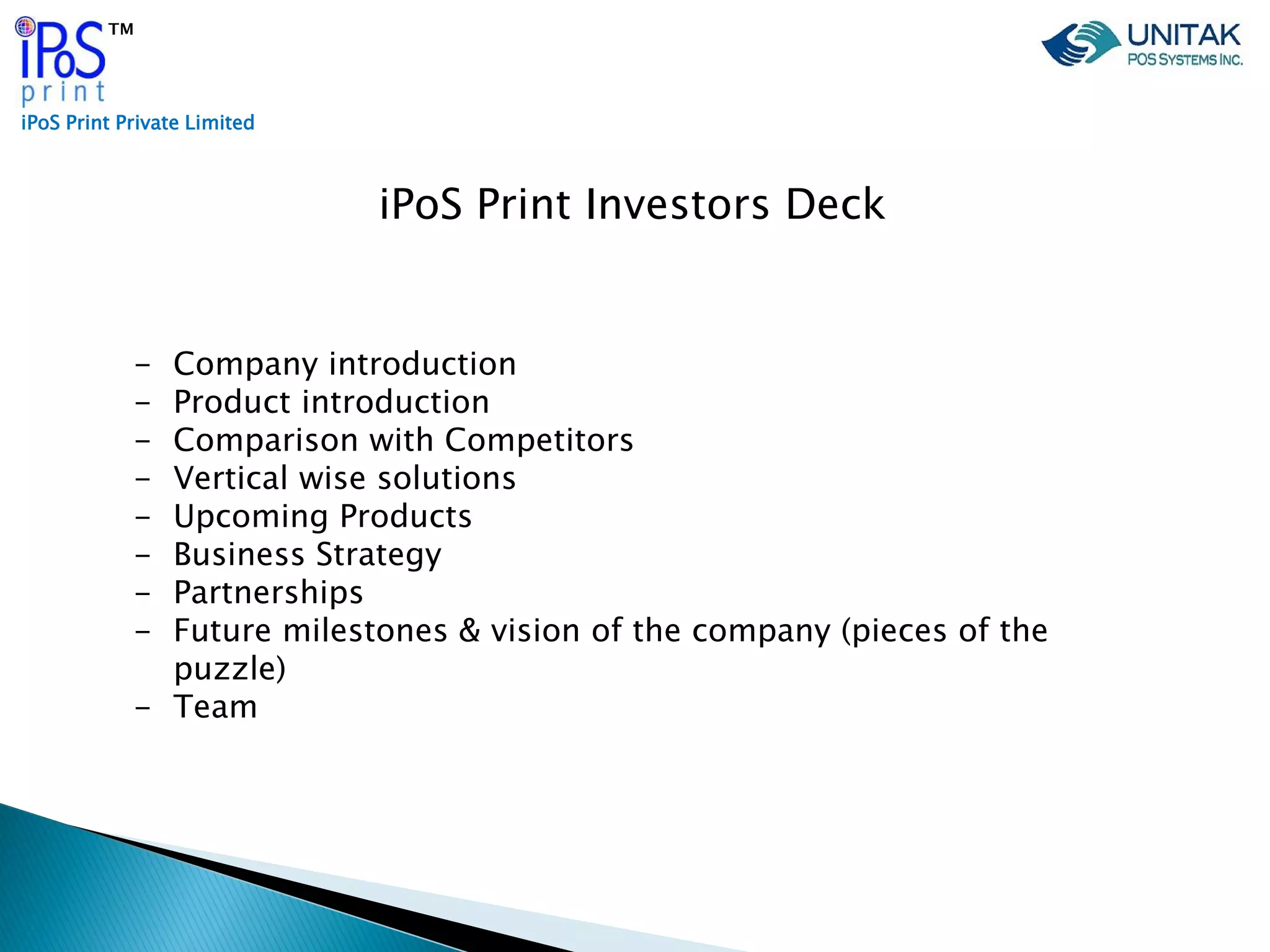
The deck opens with a standard title slide identifying the company as iPoS Print Private Limited and Unitak POS Systems Inc. The table of contents lists nine sections, ranging from company introduction to team. Notably, the attached slides cover most of these, but the 'Team' slide and a formal 'Company Introduction' (beyond the logo) are missing from the provided sequence. The visual style is functional but dated, using a standard corporate template.
Slide 2: Product Introduction - The Market Context
This slide attempts to position iPoS Print within the evolution of POS technology. It identifies 'Micro and Mini POS systems' as the next iteration from desktop systems. The slide lists 'Easy to use' and 'All in one systems' as pros. Crucially, it lists 'Monolithic design,' 'Software capabilities limited,' and 'Maintenance expensive' as cons. This is a strategic move to highlight the flaws in current market offerings that iPoS intends to solve, though it doesn't explicitly state how their specific hardware avoids these pitfalls yet.
Slide 3: Technical Specifications of the iPoS Lineup
Slide 3 provides the most concrete value proposition in the deck. It details two hardware variants:
2" Printer Model: Supports 7"-10" tablets, available in Bluetooth-only or Bluetooth with battery variants, featuring multiple ports. · 3" Seiko Printer Model: Features a Seiko printer with an auto-cutter and a customer-facing LCD display.
By specifying the use of 'Seiko' printers, the company is signaling a commitment to component quality in a market often flooded with low-tier generic thermal printers.
Slide 4: Vertical-Specific Solutions
The company identifies three target verticals: Quick Service Restaurants (QSR), Leisure & Entertainment, and Healthcare & Professional Services. The slide uses a grid to show that their solution includes a wireless barcode scanner, a wireless card reader, and the tablet-integrated printer base. The key takeaways here are 'mobility' and 'offline and online options,' which are critical for the Indian infrastructure environment where internet stability can be inconsistent.
Slide 5: The B2B Ecosystem Strategy
This slide illustrates the 'Business Strategy' through a hub-and-spoke model. iPoS Print sits at the center, interacting with three external groups:
Systems Integrators: iPoS provides hardware, integration support, and branding. · Software Vendors: iPoS provides interoperability and marketing support. · Distributors: iPoS provides reseller prices and marketing/sales support.
This suggests that iPoS Print is not trying to build a direct-to-consumer sales force but is instead relying on a channel partner model to scale.
Slide 6: Partnership Status (Work In Progress)
Transparency is high on this slide, as it lists four specific partners: RnR Datalex (Nagpur), SaralPOS (Bangalore), ePaisa (Mumbai), and Mosambee (Mumbai). For all four, the status is listed as 'Product Testing' with the comment 'Product integration testing going on.' While this shows active development, it also reveals that the company is in a pre-revenue or early-pilot stage regarding these specific integrations.
Slide 7: Future Milestones and Vision
The final slide in this set uses a chevron graphic to map out the company's trajectory: Marketing & Promotion, After Sales Service, Own Tablet, Own Software, New Products, and finally, an 'Assembly unit in India.' The text highlights three key goals: developing proprietary software to 'fully utilize the hardware capabilities,' introducing new products to the Indian market, and moving the assembly setup from China to India. This indicates a desire for vertical integration to improve margins and control the user experience.
What iPoS Print Does Well
The deck is exceptionally clear about what the hardware is and what it does. By providing specific printer sizes (2" vs 3") and naming component brands like Seiko, they provide a level of technical detail that hardware-focused investors appreciate. The vertical-wise solution slide (Slide 4) clearly communicates the 'kit' a merchant would actually receive, which grounds the abstract concept of a 'POS system' in reality. Furthermore, the partnership slide (Slide 6) is honest about the 'Work In Progress' status, which builds more trust than vague claims of 'global partnerships.'
What is Missing from the Deck
The omissions in this deck are significant and would likely prevent a successful seed or Series A raise without a follow-up document. There is no Problem Slide ; while they hint at 'expensive maintenance' in Slide 2, they don't quantify the pain for the merchant. There is no Market Size data; investors need to know how many QSRs or clinics in India are currently unserved or underserved. Most importantly, there are no Financials . There is no mention of the unit cost, the retail price, the margin, or the projected revenue. Finally, the Ask is missing—there is no indication of how much capital is being sought or what the specific valuation expectations are.
Founder Takeaways: Lessons to Copy and Avoid
Copy the Ecosystem Map: Slide 5 is a strong example of how to explain a complex B2B2C go-to-market strategy. It clearly defines what the startup provides to each partner and what it expects in return. This helps investors understand the 'moat' (in this case, being the hardware standard for multiple software vendors).
Avoid the 'Vision' Without Data: Slide 7 mentions moving assembly from China to India. While a noble goal, it lacks a 'why' backed by data. A founder should include the cost savings or tax benefits associated with such a move to make it a financial milestone rather than just a patriotic one. Also, never omit the Team slide in a final version; investors invest in people first, especially in hardware where execution risks are high.
Conclusion
iPoS Print has a clear product identity and a logical channel-partner strategy. However, the deck functions more like a product brochure than a professional investment vehicle. To attract institutional capital, the founders would need to wrap this hardware clarity in a much stronger narrative of market opportunity, financial scalability, and team expertise.
Frequently asked questions
- What is the primary hardware offering from iPoS Print?
- iPoS Print offers integrated POS systems that support tablets ranging from 7 to 10 inches. Their flagship units include built-in thermal printers—either a standard 2-inch model or a premium 3-inch Seiko printer with an auto-cutter and a customer-facing LCD display. These units are designed to be 'all-in-one' solutions that reduce the clutter of traditional desktop POS setups.
- How does iPoS Print plan to differentiate itself from competitors?
- According to Slide 2, the company aims to solve the issues of 'monolithic design' and 'expensive maintenance' found in other micro/mini POS systems. Their solution emphasizes mobility, wireless connectivity for barcode scanners and card readers, and the ability to operate in both offline and online modes to ensure business continuity for retailers.
- What is the company's go-to-market strategy?
- iPoS Print utilizes a B2B ecosystem strategy. They provide hardware, integration support, and branding to Systems Integrators; offer software interoperability to Software Vendors; and provide reseller pricing and marketing support to Distributors. This multi-channel approach allows them to embed their hardware into various existing retail software environments.
- What are the major gaps in this investor deck?
- The deck is missing several fundamental components required for a professional fundraise. There is no 'Problem' slide defining the market pain point, no 'Market Size' (TAM/SAM/SOM) analysis, no 'Team' slide (despite being listed in the table of contents), and no 'Ask' slide detailing how much money is needed or how it will be spent.
- What are the company's long-term manufacturing goals?
- As stated on Slide 7, iPoS Print currently assembles its products in China. A key milestone in their 'Future Vision' is to establish an assembly unit in India. This move is likely intended to reduce supply chain costs, take advantage of local manufacturing incentives, and improve their 'Made in India' brand positioning.