Automation Workz Institute is an EdTech and vocational training startup targeting urban populations at risk of job displacement due to automation. Their pitch deck outlines a 6-12 month IT certification program designed to transition workers into high-paying tech roles. The company identifies a specific market opportunity among single women in ten major U.S. metro areas, including New York, Chicago, and Detroit. With a leadership team boasting backgrounds in finance, academia, and game design, the institute seeks $592,000 in pre-seed funding to formalize their operations, hire executive staff…
Key takeaways
- The company is seeking $592,000 in pre-seed funding to cover a 12-month runway (Slide 13).
- The core product is a 6-12 month IT certification training program featuring game-based and simulation-based labs (Slide 9).
- The initial target market focuses on Black female populations in 10 major U.S. cities, with New York Metro representing nearly 2 million potential candidates (Slide 7).
- Automation risk is cited as a primary driver for the business, with food preparation and construction identified as high-risk sectors (Slide 5).
- The institute achieved an early milestone on 5/18/2019 by graduating four CCENT candidates (Slide 9).
- The funding ask includes a plan to transition the CEO and VPs from equity-only compensation to paid roles (Slide 13).
- The team includes a VP of Innovation with experience as a Director of Game Design for the Lightning McQueen App (Slide 11).
- The deck identifies a decline in women's representation in computer jobs since 1990 as a core problem to be solved (Slide 3).
Automation Workz Institute Pitch Deck Teardown
Automation Workz Institute presents a mission-driven pitch focused on the intersection of vocational training and social equity. The deck positions the company as a solution to the displacement caused by automation, specifically targeting underserved demographics in major American urban centers. By focusing on high-tech certifications, the institute aims to move individuals from low-wage, high-risk jobs into stable careers in the technology sector.
Slide 1: Title Slide
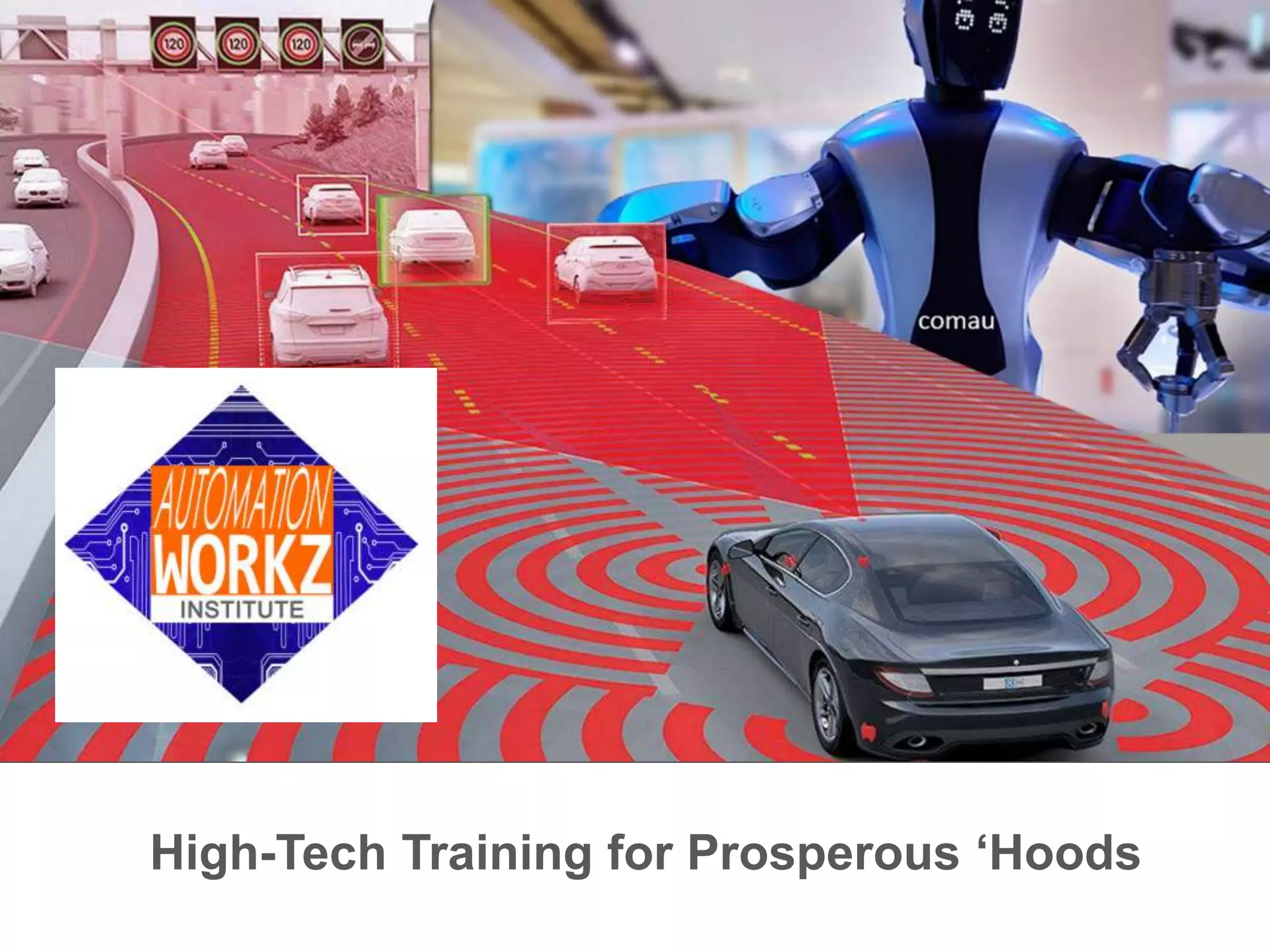
The title slide features the company logo and the tagline "High-Tech Training for Prosperous 'Hoods." The background imagery is a collage showing autonomous vehicle sensors and a robotic arm, signaling a focus on the Fourth Industrial Revolution and automation technologies. The branding is functional, though the use of the term "'Hoods" in the tagline explicitly defines the company's target demographic and social mission.
Slide 3: Problem
Slide 3, titled "PROBLEM: Single Women Doomed to Poverty," uses data to establish the need for their service. It includes two charts. The first, sourced from Statista, shows the average annual earnings of women versus men across three time periods, highlighting a persistent gap (e.g., $28,683 for women vs. $50,442 for men in 2001-2015). The second chart, from Pew Research Center, shows that women's representation in computer jobs declined from 32% in 1990 to 25% in 2016. The slide effectively uses external data to validate that the current labor market is failing this specific demographic.
Slide 5: Why Now?
This slide addresses the urgency of the mission by highlighting the risk of automation. A bar chart sourced from The Economist and OECD shows "Automation risk by job type, %." Food preparation leads the list at over 60%, followed by construction, cleaning, and driving. The slide argues that because these entry-level or manual labor roles are most at risk, there is an immediate need for retraining programs that move workers into lower-risk fields like Information Technology and Science & Engineering, which appear at the bottom of the risk chart.
Slide 7: Market
The market slide breaks down the opportunity into "Initial" and "Follow-on" segments. The focus is geographically specific, targeting "U.S. Cities with Largest Black Female Populations." The slide lists 10 metro areas with their respective populations: New York (1,994,836), Atlanta (1,074,373), Chicago (916,127), D.C. (882,638), Philadelphia (736,042), Miami (706,937), Houston (648,966), Detroit (548,990), Dallas (522,431), and L.A. (521,490). By quantifying the population in these specific hubs, the company demonstrates a clear understanding of its TAM (Total Addressable Market) within its chosen niche.
Slide 9: Product
Slide 9 details the "6-12 months IT Certification Training" program. Key features include:
After-work hours training (M-W 5:30-7:30 pm, Sat 1-3 pm). · Virtual office hours on Sunday nights. · Game-based and simulation-based labs. · Mentorship from Black instructors and Cisco EEs. · Higher-level options in IoT, Cybersecurity, Linux, Python, and Data Analytics.
The slide also lists early successes, including the graduation of four CCENT candidates on 5/18/2019 (3 Black women, 1 Black man) and securing a Michigan license on 5/30/2019. It mentions being the "1st American Academy hosted in a public library system," which suggests a low-overhead, community-integrated distribution model.
Slide 11: Team
Ida Byrd-Hill (CEO): Managed the pilot, previously grew a financial firm to $353M in assets, and created a financial fitness course for UAW/Chrysler. · Patricia Sanford (VP, Academics): Adjunct Professor at University of Detroit-Mercy and former Program Manager at Northwest Airlines. · Mark Kreitler (VP, Innovation): Former Director of Game Design for the Lightning McQueen App and tech lead for various simulations. · Bethany Collins (VP, Marketing): Neighborhood marketing consultant and community engagement manager.
The team appears well-balanced between academic rigor, financial management, and technical game design, which aligns with the product's emphasis on simulation-based learning.
Slide 13: The Financial Ask
The final slide presents a "$592,000 Pre-Seed for the next 12 months" ask. A detailed timeline (Months 1-12) outlines the planned milestones:
Months 1-3: Hire the CEO and VPs (who are currently working for equity), negotiate training contracts, and secure student financial aid options. · Months 3-6: Hire VP of Finance and Marketing, develop crowdfunding, and virtualize simulations. · Months 6-12: Hire VP of Innovation and development team, build a video game-based AI instructor, and apply for Title IV funding.
The slide also mentions entering pitch competitions in Detroit, San Francisco, and New York as part of the company's progress strategy.
What Automation Workz Institute Does Well
The deck excels at defining a specific, underserved niche. Rather than claiming to be a general coding bootcamp, the founders have identified a clear demographic (single women in specific urban metros) and a clear threat (automation of service jobs). This specificity makes the mission feel attainable and the market research feel grounded in reality. The inclusion of early graduation dates and licensing milestones provides necessary proof of concept for a pre-seed round.
What Is Missing from the Deck
The most significant omission is a slide on unit economics. While the ask is clear, the deck does not explain the cost per student, the tuition price point, or the projected revenue per graduate. There is also no mention of the competitive landscape; other vocational schools and online platforms like Coursera or Udacity are not addressed. Furthermore, while the "Initial Market" slide shows population figures, it does not translate those figures into a realistic SAM (Serviceable Addressable Market) or SOM (Serviceable Obtainable Market) based on their current capacity.
Instructions for Founders
Founders should take note of how Automation Workz Institute uses external data (Statista, Pew, OECD) to build a narrative of urgency. This "Why Now?" framing is essential for attracting impact investors. However, founders should ensure they include a clear business model slide. Investors need to know if the revenue comes from student tuition, corporate hiring fees, or government grants. Additionally, if your team is currently working for equity, being transparent about using the seed round to formalize those roles—as seen on Slide 13—is a standard and honest practice in early-stage fundraising.
Frequently asked questions
- What is the primary problem Automation Workz Institute aims to solve?
- According to Slide 3, the company addresses the issue of single women being 'doomed to poverty' due to a gender pay gap and declining representation in tech. They cite that women's representation in computer jobs has dropped from 32% in 1990 to 25% in 2016, and they aim to reverse this trend through high-tech training.
- How does the company plan to use the $592,000 investment?
- Slide 13 details a 12-month roadmap. The funds will be used to hire the executive team (who currently work for equity), negotiate training contracts, secure job partners, virtualize simulations, and build a video game-based AI instructor. They also plan to apply for Title IV funding and enter startup pitch competitions in Detroit, San Francisco, and New York.
- What specific training does the institute provide?
- Slide 9 outlines a 6-12 month IT certification program. Features include after-work hours training, virtual office hours, and simulation-based labs. The curriculum covers Cisco networking (CCENT), IoT, Cybersecurity, Linux, Python, and Data Analytics. They are noted as the first American Academy hosted in a public library system.
- Who are the key members of the management team?
- Slide 11 introduces CEO Ida Byrd-Hill, who previously grew a financial firm to $353 million in assets. She is joined by Patricia Sanford (VP, Academics), Mark Kreitler (VP, Innovation), and Bethany Collins (VP, Marketing). The team combines experience in academia, game design, and neighborhood marketing.
- What is the geographic focus of the company?
- Slide 7 identifies 10 urban 'initial market' cities with large Black female populations. These include New York Metro (1,994,836), Atlanta Metro (1,074,373), Chicago Metro (916,127), and others like Detroit, Philadelphia, and D.C. The company intends to use these same 10 cities for their follow-on market.