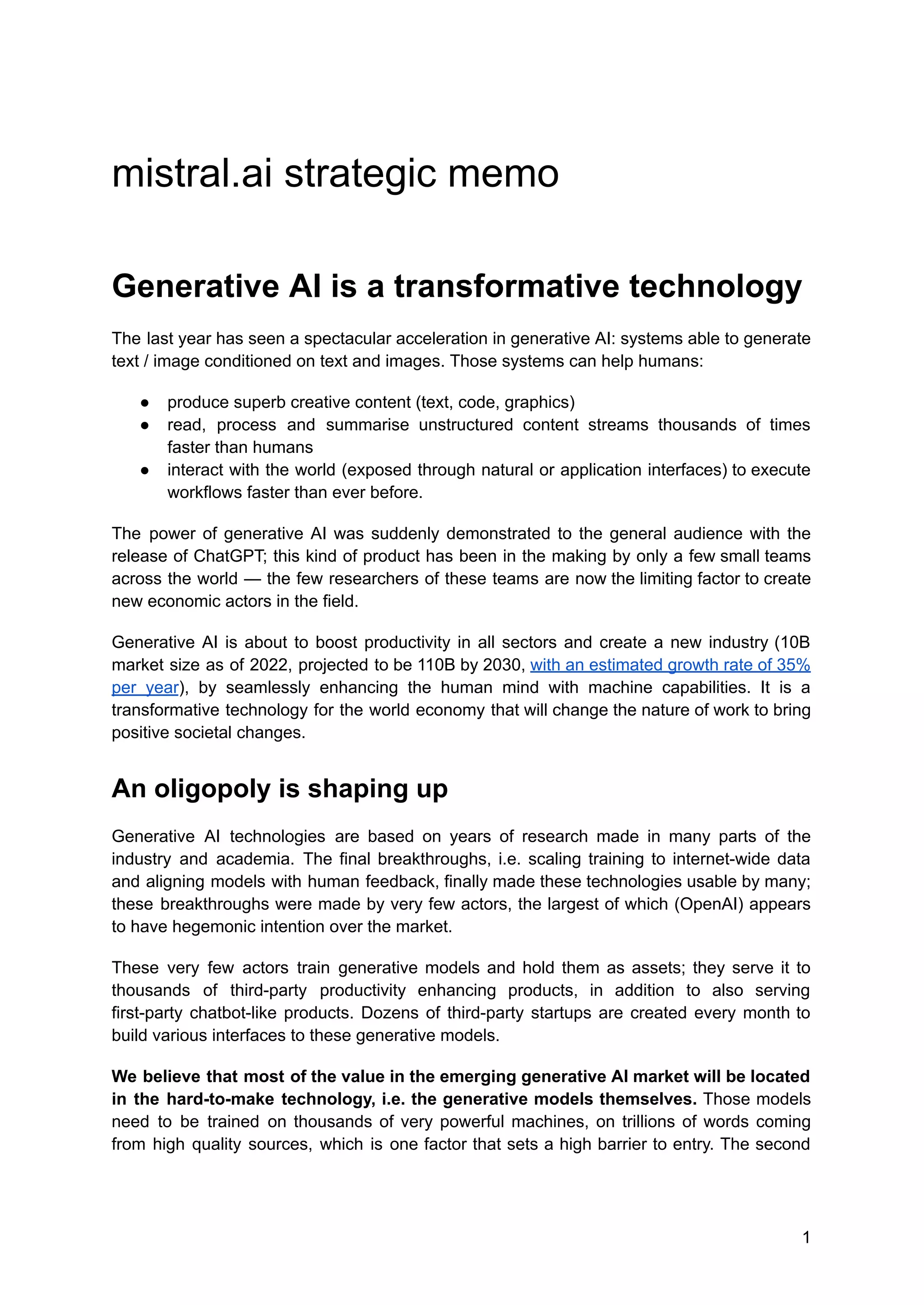
Mistral AI's seed deck is not a deck at all, but a seven-page strategic memo. Eschewing graphics and charts, the document focuses entirely on the technical and geopolitical necessity of a European alternative to US-based AI giants like OpenAI. The founders leveraged their elite backgrounds at DeepMind and Meta to argue that the 'limiting factor' in AI is talent, not just capital. By positioning themselves as an open-source, privacy-focused counterweight to 'closed-model' incumbents, they successfully raised €105 million before writing a single line of public code. The memo outlines a clear ro…
Key takeaways
- The memo identifies a $10B market in 2022 projected to grow to $110B by 2030 at a 35% annual rate (Slide 1).
- Mistral positions itself as a 'European leader' to counter the US-based oligopoly of generative AI (Slide 2).
- The strategy relies on an open-source approach to model development to attract top talent and create a developer community (Slide 3).
- The core team includes lead researchers from DeepMind and Meta who worked on landmark models like Chinchilla and Llama (Slide 4).
- The company planned to reserve 1536 H100 GPUs starting in September 2023 to train their models (Slide 5).
- A specific technical goal is to train models small enough to run on a 16GB laptop while maintaining high performance (Slide 6).
- The memo explicitly forecasts a €200M Series A requirement by Q3 2024 to train models exceeding GPT-4 capacities (Slide 7).
- Mistral commits to dedicating 1% of funding to a non-profit foundation for open-source community development (Slide 3).
The Strategic Memo: A Departure from Pitch Deck Norms
Mistral AI’s fundraising document is a rare artifact in the venture capital world. It is not a deck of slides designed for a visual presentation, but a seven-page 'strategic memo.' This format signals a high level of intellectual rigor and assumes a sophisticated reader. By choosing text over templates, the founders forced investors to engage with their logic, technical roadmap, and geopolitical positioning. The document is dated around April 2023, just months after the public release of ChatGPT, and it captures the urgency of the 'AI arms race' from a uniquely European perspective.
Slide 1: The Transformative Power of Generative AI
The memo opens by defining Generative AI as a 'transformative technology' capable of producing creative content, processing unstructured data, and executing workflows faster than humans. It cites a market size of $10B in 2022 , with a projection to reach $110B by 2030 , growing at 35% per year . Crucially, it identifies that the 'limiting factor' for new economic actors in this field is the small number of researchers worldwide capable of building these systems. This sets the stage for the team's value proposition: they are those researchers.
Slide 2: The European Counter-Narrative
Mistral identifies a burgeoning 'oligopoly' dominated by US-based actors like OpenAI. The memo argues that this creates a 'major geopolitical issue' for Europe. They critique the 'closed technology approach' of incumbents, noting that businesses are currently forced to feed sensitive data into 'black-box' models in the public cloud. Mistral positions itself as the solution to these 'market constraints,' promising to become a European leader that offers an alternative to the closed-model status quo. This slide is less about technology and more about sovereignty and market gap.
Slide 3: Technological Counter-Positioning
This section details Mistral's 'dead angles' in competitor strategies. The core pillars are: 1) An open approach to model development, releasing models with permissive licenses to build a developer community; 2) Tighter integration , allowing customers to feed data into different parts of the deep model rather than just a text API; 3) Data control , focusing on high-quality licensed data; and 4) Security/Privacy , proposing models small enough to run on-device or in private clouds. They also commit to dedicating 1% of funding to a non-profit foundation for open-source development.
Slide 4: The Rarest Team
This is arguably the most important page of the memo. It lists the founding team's credentials, which are peerless in the AI space. Arthur Mensch (CEO) is a former staff research scientist at DeepMind and lead author of the Chinchilla and Flamingo models. Guillaume Lample (Chief Scientist) and Timothée Lacroix (CTO) were senior researchers at Meta, credited with leading the Llama model. The team also includes seasoned French entrepreneurs like Jean-Charles Samuelian and Charles Gorintin (founders of Alan), and Cédric O , the former French Secretary of State for Digital Affairs. The message is clear: this is the 'dream team' for European AI.
Slide 5: Infrastructure and Data Sources
Mistral addresses the massive capital requirements of AI. They state the need for an 'exa-scale cluster' and reveal they have already negotiated deals to reserve 1536 H100 GPUs starting in September 2023. They claim their founders' expertise allows for a 10-100x increase in training efficiency compared to public methods. This section aims to de-risk the 'compute' problem by showing they have the technical know-how to stretch every dollar and the industry connections to secure the necessary hardware.
Slide 6: The Roadmap and Technical Milestones
The roadmap is divided into clear phases. By the end of 2023, they aimed to train models that could 'beat ChatGPT 3.5 and Bard March 2023 by a large margin.' By Q1-Q2 2024, the focus shifts to two specific technical goals: training models small enough to run on a 16GB laptop and developing models with 'hot-pluggable extra-context' in the millions of words . The end goal for Q2 2024 was to be the leading distributor of open-source text-generative models with high 'value/cost' ratios.
Slide 7: Next Stages and Capital Requirements
The final page is a blunt assessment of the capital needed to compete with OpenAI. It notes that GPT-4 cost 'a few hundred million dollars' to train. Mistral sets a 'North Star' of safety and staged releases. Most importantly, it outlines the future: by Q3 2024 , they expect to need to raise €200M for their Series A to train models that exceed GPT-4 capacities. This slide serves as both a warning of the costs ahead and an invitation to participate in a massive, capital-intensive journey.
What Works in This Memo
The Founder-Market Fit: In the field of LLMs, there are perhaps only a few hundred people globally who have successfully trained a frontier model. Mistral had three of them. The memo leans heavily into this, making the technical execution seem like a certainty rather than a risk.
Strategic Positioning: By choosing the 'open-source' and 'European' angles, Mistral created a narrative that was distinct from the US giants. This appealed to European investors looking for a regional champion and to businesses wary of sending data to US-controlled black boxes.
Technical Specificity: Despite the lack of charts, the memo is dense with technical targets (16GB laptop deployment, millions of words of context, H100 GPU counts). This demonstrates that the founders aren't just visionaries; they have a granular plan for the hardware and software architecture.
What is Missing
Revenue Model: The memo is vague on how exactly they will make money, mentioning 'AI-as-a-service' and 'commercial contracts for fully integrated solutions' only briefly. There are no pricing tiers or revenue projections.
Competitive Analysis: While it mentions OpenAI and Google (Bard), it does not address other emerging open-source competitors or how they will maintain a moat if their primary models are open-source.
Unit Economics: There is no mention of the cost per inference or the projected margins of their future service. The focus is entirely on the cost of training, not the cost of operation.
What You Should Copy
The 'Strategic Memo' Format for Deep Tech: If you are building something highly technical where the 'how' is as important as the 'what,' consider a memo. It allows you to build a logical argument that a slide deck often fragments.
Geopolitical Alignment: Mistral successfully tapped into the desire for 'technological sovereignty.' If your startup solves a problem that is a priority for a specific region or government, make that a central pillar of your pitch.
Roadmap Transparency: Mistral didn't just say they would 'build AI.' They gave specific dates and technical benchmarks. This gives investors a way to measure your progress and builds trust in your ability to execute.
Frequently asked questions
- How did Mistral AI raise so much money without a product?
- Mistral AI raised €105M based on the exceptional pedigree of its founders and a compelling strategic narrative. The memo (Slide 4) highlights that the team includes lead authors of major LLMs like Chinchilla and Llama. In the high-stakes world of foundation models, investors often bet on the few individuals globally capable of training state-of-the-art AI, treating the team itself as the 'product' in the seed stage.
- What is Mistral's primary competitive advantage according to the memo?
- Their primary advantage is 'technological counter-positioning' (Slide 3). Unlike OpenAI's closed-box approach, Mistral proposed an open-source strategy. They argued this would allow for tighter integration with customer workflows, better security/privacy for businesses, and a stronger pull for top-tier research talent who prefer working in open environments.
- What are the specific market problems Mistral aims to solve?
- Slide 2 outlines three main concerns with current AI: businesses are forced to feed sensitive data to 'black-box' public clouds, closed models are harder to interconnect with other components, and the training data remains secret. Mistral aims to solve these by offering models that can be deployed on private clouds or directly on devices.
- What infrastructure requirements did they disclose?
- Mistral was highly specific about their compute needs. Slide 5 states they negotiated deals for Tier 1 cloud providers to reserve 1,536 H100 GPUs. They also noted that their founders' experience allows them to be 10-100x more efficient in training compared to public methods, which is a critical claim for managing the high costs of AI development.
- What was the projected timeline for their first models?
- According to the roadmap on Slide 6, Mistral intended to train its first family of models by the end of 2023, aiming to beat ChatGPT 3.5 and Bard. They projected having proof-of-concept integrations by Q1 2024 and distributing the 'best open-source text-generative model' by Q2 2024.