Consolidated Water (CWCO) operates at the intersection of utility infrastructure and environmental necessity, focusing on seawater desalination and distribution. Their 2018 investor presentation outlines a business model built on long-term government contracts and organic expansion, most notably the 100 million gallon per day (MGD) Rosarito project in Mexico. With a footprint spanning the Cayman Islands, The Bahamas, Belize, and the British Virgin Islands, the company leverages a strong balance sheet—reporting $150 million in stockholders' equity on slide 13—to fund capital-intensive projects…
Key takeaways
- The company positions itself as a full-lifecycle provider that designs, builds, finances, and operates desalination plants (Slide 3).
- Global water market tailwinds are central to the thesis, with the desalination sector expected to grow at 8.1% annually through 2021 (Slide 5).
- Operations are concentrated in the Caribbean, with the Cayman Islands hosting the most facilities at 6 plants (Slide 7).
- The Rosarito Project represents a massive scale-up, targeting 100 MGD capacity and potential water export to the U.S. (Slide 9).
- Growth is driven by a two-pronged strategy: organic expansion like Rosarito and M&A activity targeting government-contracted plants (Slide 11).
- Financial stability is a core selling point, citing $34.1 million in cash against only $0.29 million in total debt as of June 2018 (Slide 13).
- The company uses a dividend-paying model, reporting a TTM dividend of $0.34 to attract income-focused investors (Slide 13).
- Management acknowledges that the Rosarito investment may temporarily mask the strong performance of the core business (Slide 15).
Consolidated Water: An Infrastructure-First Approach to Scarcity
The Consolidated Water (CWCO) investor presentation from October 2018 is a classic example of an infrastructure and utility-grade pitch. Unlike high-growth software decks that focus on user acquisition and viral loops, this deck focuses on capital expenditure, long-term government contracts, and geographic footprints. The company operates in a sector where the barrier to entry is high due to the technical complexity of desalination and the massive capital required to build plants.
Slide 1: Title and Identity
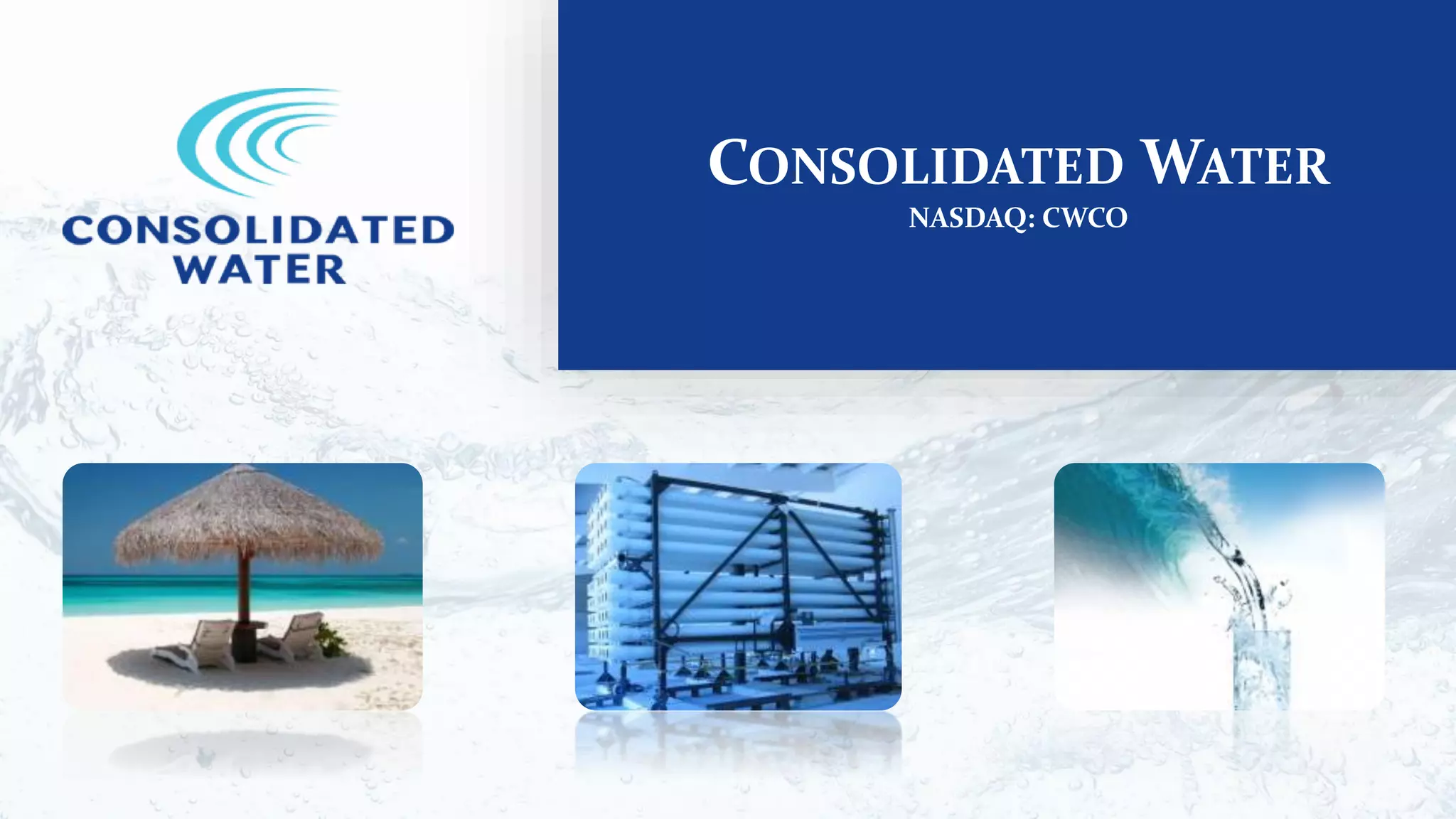
The cover slide establishes the company's identity immediately. The use of the NASDAQ ticker (CWCO) signals that this is a public company presentation, likely intended for institutional investors or retail analysts. The imagery—a tropical beach, desalination equipment, and a glass of water—clearly communicates the three pillars of their business: the location (Caribbean/coastal), the technology (desalination), and the end product (potable water).
Slide 3: Defining the Business
Slide 3 provides a concise mission statement. It defines Consolidated Water as a provider of "innovative solutions to the world's water related issues." The slide explicitly lists their capabilities: design, build, finance, and operate. This is a critical distinction for investors; the company isn't just a contractor or a technology provider; they are a full-service utility partner. The focus is on "potable water in locations where naturally-occurring freshwater supplies are limited or non-existent," which sets the stage for their geographic focus in the Caribbean and arid coastal regions.
Slide 5: The Macro Thesis
To justify the investment, the company points to massive global trends. Citing Global Water Intelligence (GWI), slide 5 notes a $589 billion market in 2014 growing to $700 billion by 2018. The most compelling statistic is the "40% demand gap by 2030." By framing water as a finite resource with a growing deficit, CWCO positions its desalination technology not as an alternative, but as a necessity. The slide also notes that the desalination market is growing at 8.1% annually, double the rate of the general water market.
Slide 7: Geographic Footprint
This slide provides a visual breakdown of their operational scale. It shows a concentrated presence in the Caribbean: 6 plants in the Cayman Islands (9.0M gallons/day), 3 plants in The Bahamas (15.2M gallons/day), 2 plants in the British Virgin Islands (0.8M gallons/day), and 1 plant in Belize (0.6M gallons/day). It also highlights the CWCO office and Aerex Industries in the U.S., and a massive development in Mexico. This slide proves the company's ability to operate across multiple international jurisdictions, a key requirement for infrastructure investors.
Slide 9: The Rosarito Project
Organic growth is headlined by the Rosarito Project in Mexico. Slide 9 details a 100 MGD (million gallons per day) plant. This is a step-change in scale compared to their existing Caribbean plants. The slide notes that financing will be through "third party non-recourse debt and equity," which protects the parent company's balance sheet. The mention of a 40-year O&M (Operations and Maintenance) contract with a Suez joint venture emphasizes the long-term, predictable nature of the cash flows they are targeting.
Slide 11: Acquisition Strategy
Growth isn't just organic; it is also inorganic. Slide 11 outlines a two-tiered acquisition strategy. The primary focus is on existing water treatment plants with government contracts. This is a "buy and hold" utility strategy. The secondary focus is on manufacturing and technology companies like Aerex Industries. This vertical integration allows them to capture more margin during the "build" phase of their projects and provides a technological moat against competitors.
Slide 13: Financial Strength
For a capital-intensive business, the balance sheet is the most important slide. Slide 13 shows a very healthy financial position as of June 30, 2018. With $150 million in stockholders' equity and virtually no debt ($0.29 million), the company is "under-leveraged" by typical utility standards. This gives them significant "dry powder" to fund new projects. The inclusion of the TTM Dividend of $0.34 is a clear signal to income-seeking investors that the company generates enough free cash flow to reward shareholders while still investing in growth.
Slide 15: Investment Highlights
The final slide summarizes the bull case. It reiterates the long-term trends, operating expertise, and recurring revenue from contracts. Interestingly, it includes a note that the "Rosarito investment masks strong core business performance." This is a common tactic in public company decks to explain why current earnings might look depressed due to heavy investment in future growth projects. It asks investors to look past the temporary costs of expansion to the underlying profitability of the existing Caribbean plants.
What Works in This Deck
The CWCO deck succeeds in establishing credibility through scale . By listing the exact number of plants and their daily capacities (Slide 7), they move beyond theoretical technology to proven execution. The financial slide (Slide 13) is also exceptionally strong; in a world of high-burn startups, a company with $34 million in cash and almost no debt is a rarity that appeals to conservative, long-term capital.
The clarity of the business model is another highlight. Slide 3 leaves no doubt about what they do. They aren't trying to be a "water platform" or a "smart city AI"; they are a utility that builds and runs pipes and pumps. This lack of jargon is refreshing and appropriate for the sector.
What Is Missing
Despite the strengths, there are notable omissions. First, there is no mention of unit economics . While we see total capacity, we don't see the cost to produce a gallon of water versus the price sold to the government. For a desalination company, the cost of energy is the primary variable, and the deck does not address how they mitigate energy price volatility.
Second, there is a lack of competitive landscape . Desalination is a competitive field with large players like Veolia and IDE Technologies. The deck does not explain CWCO’s specific technological advantage or why they win contracts over these global giants. Finally, there is no team slide in the provided selection. In infrastructure, the relationships between management and local governments are paramount, and the absence of leadership bios is a missed opportunity to build trust.
What Founders Should Copy
Founders building in the hardware or infrastructure space should emulate CWCO’s geographic visualization (Slide 7). Showing a map with specific metrics for each location is far more persuasive than a list of cities. It demonstrates a footprint and a localized understanding of different markets.
Additionally, the segmentation of growth (Slides 9 and 11) is a smart way to present a multi-year roadmap. By separating "Organic Expansion" (building new things) from "Acquisition Strategy" (buying existing things), they show investors that they have multiple levers to pull to increase shareholder value. This balanced approach to growth is often more sustainable than relying on a single strategy.
Final Thoughts
The Consolidated Water deck is a professional, albeit conservative, presentation of a mature business. It leans heavily on the "scarcity" narrative, which is a powerful motivator for investment. While it lacks the flash of a Silicon Valley pitch, its focus on tangible assets, long-term contracts, and a fortress balance sheet makes a compelling case for the company as a stable player in the essential services sector.
Frequently asked questions
- What is the primary business model of Consolidated Water?
- Consolidated Water operates as a vertically integrated water utility. According to slide 3, they design, build, finance, and operate seawater desalination plants and distribution systems. Their revenue is primarily derived from providing potable water to regions where natural freshwater is scarce, typically secured through long-term contracts with governments or governmental agencies, which provides high revenue visibility.
- How does the company justify the market opportunity for desalination?
- The company relies on data from Global Water Intelligence (GWI) to frame the opportunity. Slide 5 notes that the total water market was approximately $589 billion in 2014. More importantly, they highlight a projected 40% global water demand gap by 2030, suggesting that traditional freshwater sources will be insufficient, thereby increasing the necessity for desalination technology.
- What is the significance of the Rosarito Project mentioned in the deck?
- The Rosarito Project is a major organic growth initiative located in Mexico. Slide 9 details a two-phase 100 MGD seawater desalination plant. This project is significant because it includes an opportunity to export water to U.S. markets and involves a 40-year operation and maintenance contract through a joint venture with Suez, representing long-term infrastructure play.
- What does the company's debt profile look like?
- As of June 30, 2018, the company maintained an exceptionally low debt-to-equity ratio. Slide 13 shows total debt at just $0.29 million, compared to $34.1 million in cash and cash equivalents and $150 million in stockholders' equity. This conservative capital structure is intended to signal the company's ability to self-fund or attractively finance large-scale future projects.
- What are the secondary focuses of their acquisition strategy?
- While the primary focus is acquiring plants with government contracts, slide 11 outlines a secondary focus on manufacturing and technology companies. They cite Aerex Industries as an example, noting that such acquisitions provide a competitive edge in obtaining new contracts or accessing new geographic markets by controlling more of the supply chain.