TraceAir’s demo day deck is a masterclass in brevity, leveraging high-impact visuals and strong financial traction to command attention. The company identifies a massive $400 billion annual waste problem within the $8 trillion global construction market, positioning its drone-based data platform as the solution for detecting errors like incorrect elevation levels or misplaced pillars. The deck highlights significant early success, reporting $700k in revenue for 2016 and a 28% month-over-month growth rate. While the presentation excels at establishing the 'why' and the 'how much,' it remains l…
Key takeaways
- The company reports $700k in revenue for 2016 on slide 2.
- TraceAir claims a 28% month-over-month growth rate as of July 2016 (slide 2).
- The deck identifies a $400 billion annual waste problem in the construction industry, representing 5% of the $8 trillion total market (slide 5).
- The platform uses drone data to identify specific errors such as incorrect elevation levels and misplaced pillars (slide 6).
- The traction slide lists six enterprise logos, including Morton, Devcon, and Dokken Engineering (slide 2).
- The team includes experience from major firms like Bechtel, EY, and Microsoft (slide 9).
- A significant revenue dip occurred around March 2016 following a price increase, before recovering to new highs by July 2016 (slide 2).
- The deck lacks a specific 'Ask' slide detailing the amount of capital being raised or the valuation (slides 1-10).
Executive Summary: The Power of Traction in Demo Day Decks
TraceAir’s pitch deck for 500 Startups Batch 17 is a lean, 10-slide presentation that follows the classic demo day format: high-impact visuals, minimal text, and a heavy emphasis on growth metrics. The company tackles a visceral problem—expensive construction mistakes—and provides proof of a working business model through impressive revenue figures. By leading with traction and ending with a vision of a robotic future, TraceAir positions itself not just as a drone company, but as an essential data layer for the $8 trillion construction industry.
Slide 1: Title and Value Proposition
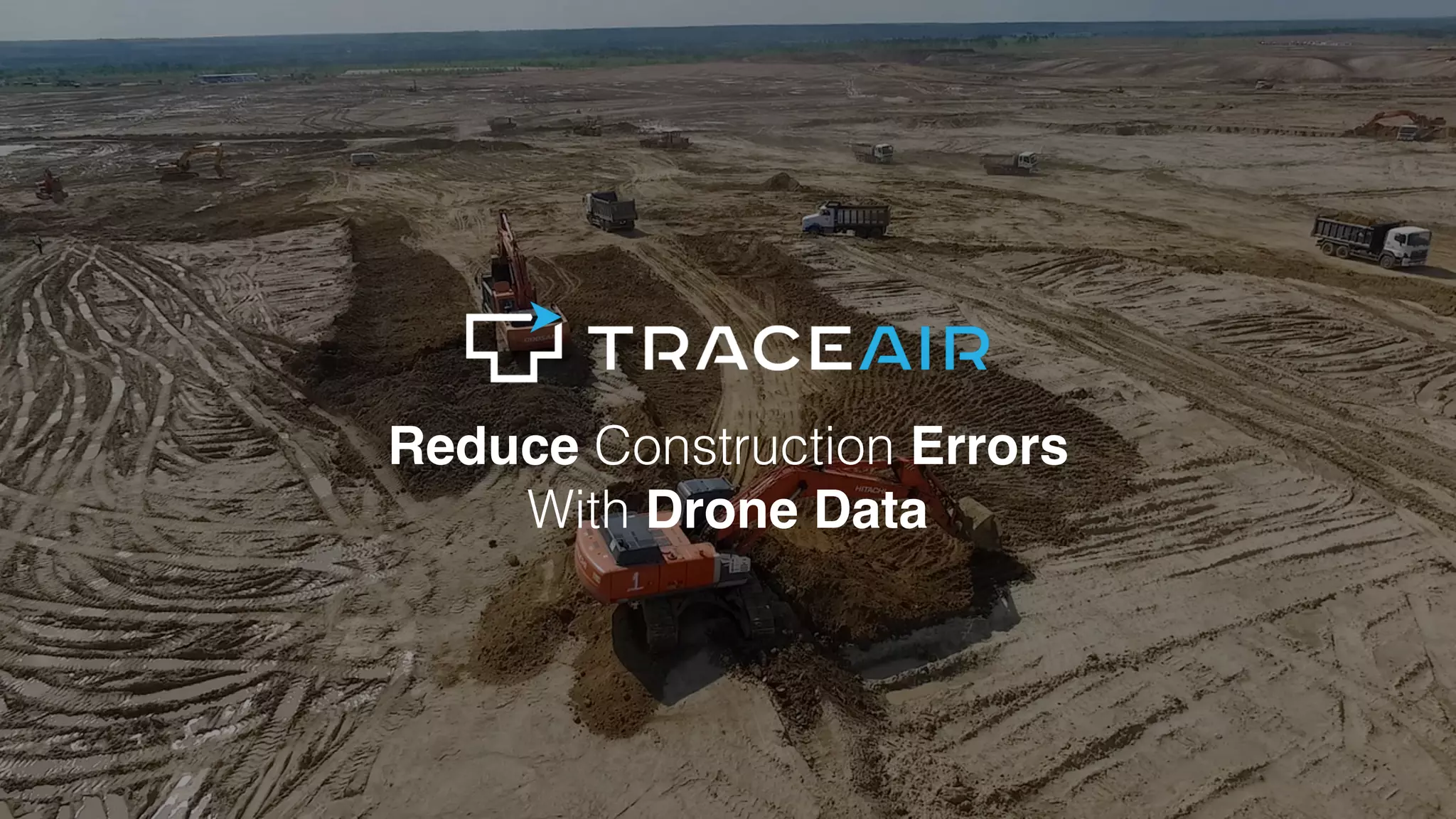
The cover slide is clean and direct. It features a background image of a large-scale earthmoving site, immediately grounding the company in the heavy construction sector. The text is a simple, two-part value proposition: "Reduce Construction Errors With Drone Data." This tells the investor exactly what the product does and what the primary benefit is within seconds. The branding is professional, using a blue and white color palette that suggests reliability.
Slide 2: Traction and Revenue Growth
TraceAir makes a bold move by placing traction as the second slide. This is a common tactic for companies with strong numbers to immediately validate the business. The slide shows a revenue chart from July 2015 to July 2016. A key detail is the callout "Increased prices" in early 2016, which explains a temporary dip in revenue followed by a sharp recovery to all-time highs. The slide lists two major KPIs: "+28% MoM" growth and "$700k in 2016." At the bottom, a row of customer logos—Morton, Devcon, Dokken Engineering, and Saipem—proves that large enterprise players are paying for the solution.
Slide 3 & 4: The Problem Context
Slide 3, titled "Typical Construction Site," shows a dense urban construction project. It sets the stage for Slide 4, titled "Shit Happens." Slide 4 is a collage of construction failures, most notably a railway track with a concrete pillar built directly in the middle of the path. This use of humor and shocking imagery effectively communicates the absurdity and cost of human error in large-scale projects without needing a single bullet point of text.
Slide 5: Market Opportunity
The deck quantifies the problem on slide 5. It identifies an "$8T Construction Market" and notes that "5%" or "$400B" is "Wasted Annually." This slide is crucial because it transforms the company from a niche drone tool into a solution for a massive global economic inefficiency. By framing the opportunity as capturing a portion of that $400 billion waste, the founders make the potential upside clear to venture investors.
Slide 6: The TraceAir Platform in Action
This slide provides a product demonstration via a single annotated image. It shows an aerial view of a construction site with digital overlays. The callouts identify three specific issues: "Incorrect elevation level," "Pillars positioned incorrectly," and "Level #2 construction runs late." This slide bridges the gap between the "drone data" mentioned on the cover and the "AI" mentioned later, showing exactly how the software translates raw imagery into actionable management insights.
Slide 7 & 8: The AI Vision and Future Roadmap
Slide 7 introduces the headline "Artificial Intelligence for Construction" over a photo of manual labor. Slide 8, titled "Construction Site 2025," features a futuristic illustration of robots sitting on a steel beam, mimicking the famous "Lunch atop a Skyscraper" photograph. This transition suggests that TraceAir’s current data platform is the first step toward a fully automated, robotic construction environment. It moves the narrative from a current-day utility to a long-term platform play.
Slide 9: The Team
The team slide features four founders: Dmitry Korolev (CEO), Nick Ushakov (CMO), Alex Solovyev (CTO), and Maria Khokhlova (CXO). The strength of this slide lies in the logos at the bottom: Bechtel, EY, Microsoft, Columbia University, and Mail.ru. The inclusion of Bechtel is particularly important, as it is one of the largest construction companies in the world, providing the team with necessary industry credibility.
Slide 10: Conclusion and Contact
The final slide repeats the core metrics: "$700k Rev in 2016," "28% MoM," and "AI for Construction." It provides an email address and an AngelList URL. Repeating the traction numbers ensures that the last thing an investor sees is the company's financial success.
What Works in This Deck
Immediate Validation: Leading with $700k in revenue and 28% MoM growth (Slide 2) immediately separates TraceAir from pre-revenue startups. · Visual Storytelling: The "Shit Happens" slide (Slide 4) is memorable and perfectly illustrates the pain point without over-explaining. · Industry Credibility: Having a team member with a background at Bechtel (Slide 9) is a massive signal for a construction tech startup. · Clear Value Prop: The product slide (Slide 6) shows exactly what the user gets: a way to spot errors before they become $400B problems.
What is Missing from This Deck
The Ask: There is no mention of how much money the company is raising or what the milestones for the next round will be. · Competition: The deck does not address other drone mapping companies (like DroneDeploy or Propeller) or how TraceAir’s AI is superior. · Unit Economics: While total revenue is shown, there is no information on the cost of customer acquisition (CAC) or the lifetime value (LTV) of these enterprise contracts. · Business Model: It is unclear if this is a SaaS subscription per site, a per-flight fee, or an enterprise license.
Founder Takeaways: Copy the Traction-First Strategy
Founders should take note of how TraceAir handles a price increase. By being transparent about the revenue dip in March 2016 on Slide 2, they demonstrate that their product has price inelasticity—they raised prices, and after a brief churn or adjustment period, growth accelerated. This is a very strong signal of product-market fit. Additionally, the use of a "Vision" slide (Slide 8) is a great way to show investors that you aren't just building a tool, but are aiming to own a future category (in this case, autonomous construction).
Frequently asked questions
- What is the primary problem TraceAir is solving?
- TraceAir targets the massive inefficiency in the construction industry. According to slide 5, the global construction market is worth $8 trillion, but 5% of that—roughly $400 billion—is wasted annually due to errors. The deck illustrates these errors on slide 4 and slide 6, showing real-world examples like railway tracks blocked by pillars and incorrect elevation levels that lead to costly rework and delays.
- How much revenue has TraceAir generated?
- As of the date this deck was presented (likely mid-to-late 2016), the company reported $700,000 in revenue for the year 2016. Slide 2 shows a revenue chart starting in July 2015 and ending in July 2016, indicating a strong upward trajectory despite a temporary dip in early 2016 attributed to a price increase.
- Who are the key members of the TraceAir team?
- The leadership team consists of Dmitry Korolev (CEO), Nick Ushakov (CMO), Alex Solovyev (CTO), and Maria Khokhlova (CXO). Their collective background includes experience at high-profile organizations such as Bechtel (a major construction firm), EY, Microsoft, Columbia University, and Mail.ru, as shown on slide 9.
- What specific technology does TraceAir use?
- The company uses a combination of drone data and artificial intelligence. Slide 1 introduces the concept of reducing errors with drone data, while slide 6 shows the platform in action, highlighting site anomalies. Slide 7 and slide 8 further emphasize 'Artificial Intelligence for Construction,' suggesting the software automates the detection of deviations from site plans.
- Is there a specific investment ask in the deck?
- No. The deck concludes on slide 10 with contact information and a summary of traction ($700k revenue, 28% MoM growth) but does not state a specific dollar amount being raised, the intended use of funds, or the terms of the round. This is common for demo day decks intended to spark initial interest rather than close a deal on the spot.